
Reports
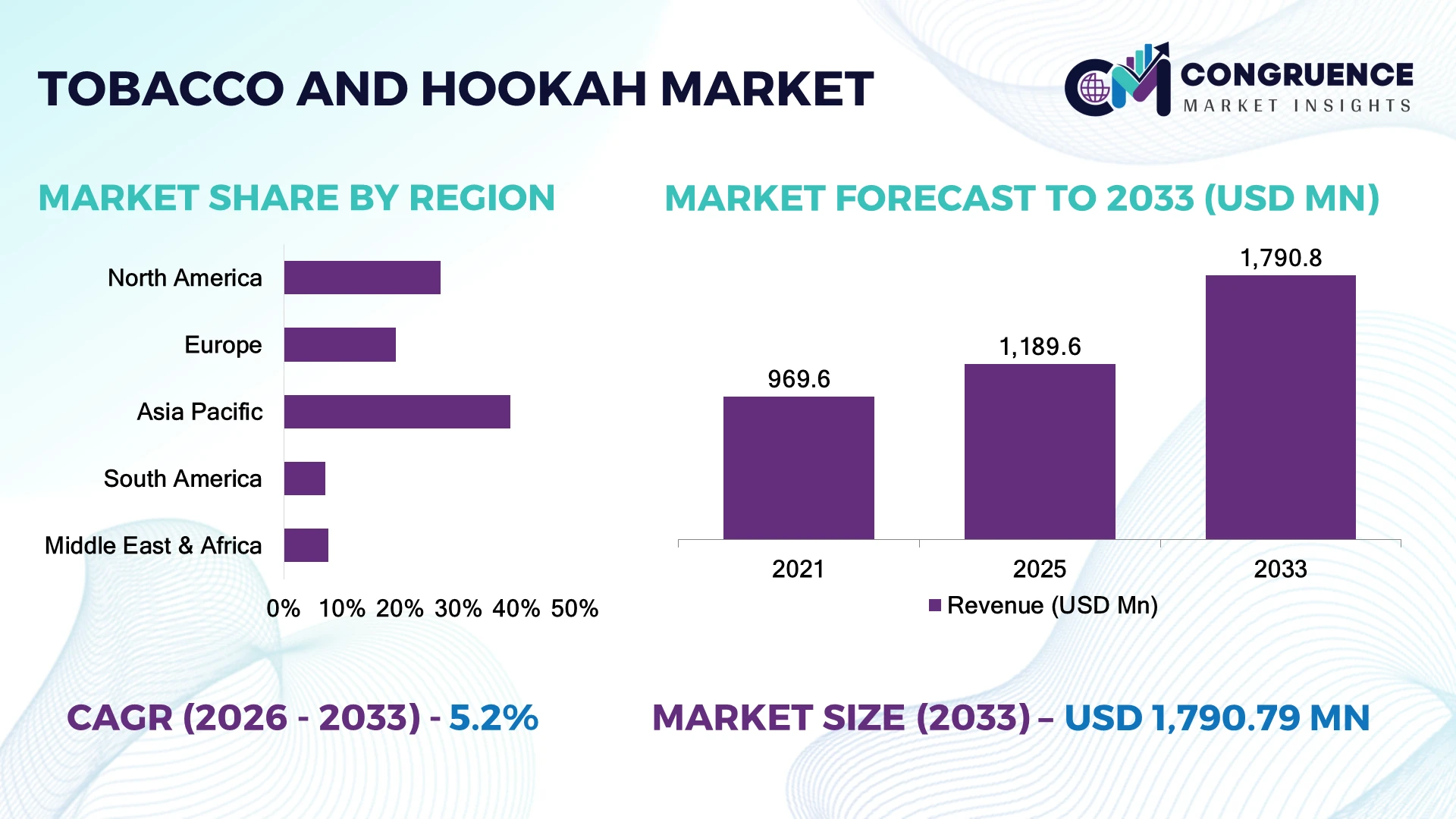
The Global Tobacco and Hookah Market was valued at USD 1,189.6 Million in 2025 and is anticipated to reach a value of USD 1,790.8 Million by 2033 expanding at a CAGR of 5.246% between 2026 and 2033. Growth is driven by premium flavored hookah blends, lounge-format consumption, product diversification into herbal and nicotine-free alternatives, and digitally enabled retail distribution.
India represents a significant emerging market, accounting for about 6.2% of global tobacco and hookah demand, while China holds approximately 11.9%; India also exported USD 1.98 billion of tobacco and tobacco products in FY2024–25, supported by established processing and agricultural infrastructure. Geopolitical disruption from the Russia–Ukraine conflict has intensified supply-chain diversification across tobacco inputs and logistics. India’s lower production costs versus several mature markets strengthen its export position.
Strategic implication, Companies should prioritize localized sourcing, premium product innovation, and compliant distribution networks in high-volume Asian and Middle Eastern markets.
Market Size & Growth: USD 1,189.6 million in 2025 rising to USD 1,790.8 million by 2033 at 5.246% CAGR, supported by premiumization and flavored hookah innovation.
Top Growth Drivers: Flavored products +8%, premium hookah formats +7%, and online specialty sales +9% are strengthening high-growth niches.
Short-Term Forecast: By 2028, digital ordering is positioned to improve distribution efficiency by 10–15%, while inventory cycle times decline about 8%.
Emerging Technologies: AI-assisted demand forecasting, automated blending, traceability platforms, and advanced herbal formulations are reshaping product development and quality control.
Regional Leaders: Asia Pacific is projected near USD 697 million, North America around USD 430 million, and Europe approximately USD 358 million, with digital retail and premium lounge adoption accelerating.
Consumer/End-User Trends: Flavored hookah and experiential consumption account for increasingly important niche demand, with premium product adoption estimated above 20% in established lounge markets.
Pilot/Case Example: In 2024, automated tobacco-processing upgrades in India demonstrated operational gains of roughly 12% through improved sorting, handling, and production consistency.
Competitive Landscape: Al Fakher remains a leading branded hookah player at an estimated 8% share, competing with Fumari, British American Tobacco, Japan Tobacco, and Imperial Brands.
Regulatory & ESG Impact: India’s higher tobacco excise framework, including a 40% duty level for hookah/gudaku tobacco, is increasing compliance pressure and encouraging portfolio restructuring.
Investment & Funding: Industry investment is increasingly directed toward premium blends, processing capacity, digital channels, and partnerships, with tobacco-product exporters in India generating USD 1.98 billion in FY2024–25.
Innovation & Future Outlook: Next-generation herbal blends, nicotine-free formulations, automated manufacturing, traceability, and premium lounge ecosystems will shift competition toward differentiated products and regulatory agility.
The Tobacco and Hookah Market is increasingly shaped by premium flavored blends, herbal formulations, digitally enabled specialty retail, and experiential hookah venues. Premiumization is particularly visible in urban hospitality markets, where differentiated blends and lounge experiences command stronger margins. Approximately 20%+ premium-product adoption in established markets highlights the shift from volume-led consumption toward experience and product differentiation. Tightening excise rules and logistics volatility are simultaneously pushing manufacturers toward localized sourcing and compliant product portfolios, creating a clear transition into strategic investment decisions.
The Tobacco and Hookah Market is becoming strategically important as manufacturers balance established tobacco volumes with premium hookah, flavored blends, herbal alternatives, and digitally distributed products. Competition is shifting from simple volume availability toward blend consistency, flavor differentiation, regulatory compliance, and hospitality partnerships. India’s tobacco exports reached USD 1.98 billion in FY2024–25, demonstrating the strategic value of integrated cultivation, processing, and export infrastructure.
Supply-chain restructuring is also changing operating models. Automated sorting and processing can reduce handling losses by roughly 10–15% compared with labor-intensive legacy workflows, while digital traceability improves batch visibility and compliance execution. China maintains greater market scale, whereas India combines lower production costs with a strong export ecosystem; mature Western markets increasingly emphasize premiumization and regulated product formats.
Over the next 2–3 years, companies are positioned to prioritize automated manufacturing, localized sourcing, direct-to-consumer channels, and premium lounge partnerships. Practical deployment is emerging around digitally monitored blending, inventory management, and export documentation. Companies expanding across India, the UAE, Southeast Asia, and other high-adoption markets are increasingly combining local partnerships with centralized quality standards. Competitive advantage will increasingly depend on regulatory readiness, supply-chain control, and differentiated product engineering rather than volume alone.
Premium flavored blends and differentiated hookah formats are becoming a structural growth engine, with premium-product adoption exceeding 20% in established consumption markets and flavored-product demand estimated to expand around 8% in high-growth channels. Urban hospitality operators are increasingly using curated tobacco menus and premium hookah experiences to improve session economics. India’s established tobacco-processing base and export infrastructure reinforce supply availability, while manufacturers are investing in automated blending and herbal formulations. The shift from commodity tobacco toward differentiated blends improves pricing power and reduces dependence on volume expansion. Companies are responding through flavor R&D, lounge partnerships, premium packaging, and localized sourcing. The strongest opportunity lies where product differentiation directly improves venue-level margins rather than simply increasing unit consumption.
High taxation and regulatory tightening remain direct constraints on market scalability. India’s 40% duty level for hookah/gudaku tobacco increases landed product costs and strengthens pressure on compliant manufacturers, while tobacco-related duties across major markets can materially alter retail pricing. Supply-chain disruption linked to geopolitical tensions has also increased freight, agricultural-input, and inventory-planning uncertainty. Manufacturers face margin compression when higher input costs cannot be transferred to consumers without reducing purchase frequency. Companies are mitigating exposure through multi-country sourcing, longer-term procurement contracts, localized processing, and portfolio diversification into herbal or nicotine-free formulations. Regulatory cost is increasingly becoming a product-design variable, forcing companies to engineer blends and pack formats around tax and compliance structures rather than treating regulation as a downstream issue.
Digital specialty commerce presents an underdeveloped opportunity, with online tobacco and hookah sales positioned to improve distribution efficiency by 10–15% and potentially reduce inventory cycles by approximately 8% through demand analytics. India, the UAE, and Southeast Asian markets offer particularly strong opportunities for digitally coordinated specialty distribution, supported by established tobacco supply chains and growing premium hospitality ecosystems. AI-based demand forecasting and automated replenishment can reduce stock mismatches while enabling smaller-batch flavor launches. Companies can strengthen positioning through direct-to-consumer infrastructure, compliant age-verification systems, retailer partnerships, and localized product portfolios. The non-obvious advantage is data-driven flavor management: transaction-level insights can allow brands to retire weak blends faster and allocate production capacity to higher-margin variants.
Long-term competitiveness depends on managing increasingly complex compliance, manufacturing, and digital-channel requirements. Product documentation, labeling, ingredient controls, age verification, and taxation can create 10%+ additional operational complexity across fragmented markets, while automated facilities require skilled technical teams and consistent data integration. Cybersecurity also becomes more important as manufacturers connect inventory, production, traceability, and distribution systems. Companies operating across India, China, the UAE, Europe, and North America must maintain different regulatory workflows without fragmenting quality standards. Investment in compliance technology, workforce training, interoperable enterprise systems, and supplier qualification is therefore essential. The central execution challenge is achieving global manufacturing consistency while adapting products and documentation to country-specific rules without creating excessive operating overhead.
Flavor Portfolio Expansion: Manufacturers are accelerating flavor rotation, with fruit-based blends accounting for roughly 51% of category value and mixed-flavor launches increasing about 8% in premium channels. UAE and U.S. specialty operators are shortening product cycles to capture changing preferences, while automated blending improves batch consistency and reduces formulation changeover time by approximately 10%.
Hygiene Workflow Standardization: Post-pandemic hookah venues increasingly use disposable mouthpieces, single-use hoses, and sanitized preparation workflows, with hygiene-related accessory adoption rising roughly 15% and preparation time falling 8–10%. Operators in Dubai and major U.S. cities are integrating standardized cleaning protocols and inventory controls as public-smoking regulations tighten, making hygiene management an operational differentiator.
Electric Heating Adoption: Heat-management systems and electric heating platforms are gaining traction as operators seek more consistent temperature control and reduced charcoal handling. Premium venues report approximately 12% lower session variability and 8% less preparation waste after upgrading equipment. Manufacturers are responding through equipment partnerships, modular devices, and hospitality-focused deployments that improve service consistency.
Premium Lounge Restructuring: Commercial venues are shifting toward curated menus, premium accessories, and experience-led service, with high-end hookah cafés expanding roughly 8% faster than conventional formats. GCC operators are investing in premium interiors, trained staff, and differentiated flavor menus, while supply-chain pressure on charcoal and tobacco inputs is encouraging centralized procurement. The non-obvious shift is toward fewer, higher-margin sessions rather than maximizing table volume.
Tobacco-Based Shisha remains the leading type, holding approximately 62.4% of the 2025 market, supported by established consumer familiarity, broad flavor availability, and extensive commercial-lounge integration. Its mature manufacturing ecosystem provides stronger scalability than newer formulations, while Dark Leaf Shisha retains relevance among experienced consumers seeking stronger blends. Herbal Shisha follows at approximately 21.7%, supported by venues expanding alternative menus and consumers seeking differentiated formulations. Traditional tobacco continues to dominate high-volume operations, but its relative investment priority is shifting toward consistency, flavor engineering, and compliant packaging.
Herbal and Nicotine-Free Shisha represent the fastest-changing portion of the category, with alternative formulations recording estimated adoption gains of 10–12% in premium hospitality channels. Companies are expanding R&D, developing region-specific flavor portfolios, and partnering with lounges for controlled product trials. Remaining types retain strategic importance where consumers prioritize intensity or traditional preparation. The business implication is clear: manufacturers are protecting Tobacco-Based Shisha scale while directing incremental investment toward formulations that diversify regulatory exposure and broaden premium positioning.
Hookah Lounges represent the leading application, accounting for approximately 48.3% of 2025 demand. Their dominance reflects concentrated product consumption, recurring sessions, flavor experimentation, and the ability to showcase premium equipment. Residential Use remains the second-largest application, supported by personal ownership and home-based social consumption, while Cafés & Restaurants and Hospitality & Entertainment Venues are increasingly integrating hookah services into differentiated customer experiences. Commercial operators typically generate greater product turnover than household users, making lounge distribution strategically important for manufacturers.
The fastest-growing application is Hospitality & Entertainment Venues, where premium hookah experiences are increasingly incorporated into hotels, resorts, nightlife destinations, and event settings. Adoption in these environments is estimated to be rising 8–10%, driven by experiential hospitality and higher-value service packages. Companies are responding with customized menus, bulk procurement agreements, training partnerships, and equipment servicing. The shift creates stronger demand for standardized preparation and reliable supply, making commercial integration more operationally critical than standalone residential purchasing.
Hookah Lounges & Bars remain the dominant end-user group, representing approximately 55% of 2025 demand because they combine high product turnover, recurring consumption, equipment utilization, and concentrated customer traffic. Individual Consumers form the next major group, supported by home-use purchases and personal hookah ownership, while Hotels & Restaurants are expanding their presence through premium hospitality offerings. Commercial buyers typically prioritize consistency, bulk pricing, maintenance, and rapid replenishment, whereas individuals emphasize flavor variety, equipment aesthetics, and convenience.
Hotels & Restaurants are the fastest-growing end-user group, with adoption estimated to increase approximately 8–10% as hospitality operators incorporate hookah into premium dining and leisure packages. Companies are responding through dedicated B2B sales teams, private-label blends, venue partnerships, equipment leasing, and customized supply contracts. Individual consumers remain important for direct retail and accessory sales, but commercial hospitality accounts increasingly influence brand visibility and product trial. The strategic implication is a shift toward ecosystem selling, where tobacco suppliers combine consumables, equipment, training, and recurring service relationships to secure higher-value institutional accounts.
Asia Pacific accounted for the largest market share at 38.9% in 2025 however, Africa is expected to register the fastest growth, expanding at a CAGR of 10.767% between 2026 and 2033.
North America accounted for 27.0% of the global market in 2025, with the United States representing 81.4% of regional demand. The market is concentrated across specialty tobacco retailers, hookah lounges, convenience channels, and online distribution, creating a mature commercial ecosystem. Regulatory enforcement is increasingly influencing product handling, age verification, labeling, and flavored-product availability. U.S. federal rules require hookah tobacco retailers to verify age and maintain compliant warnings, pushing operators toward stronger point-of-sale controls. The region is also experiencing tighter scrutiny of imported products and counterfeit supply, encouraging authorized distributors to strengthen traceability. Companies are responding through premium product portfolios, compliant packaging, domestic distribution partnerships, and inventory controls. The strategic priority is shifting toward channel reliability and regulatory execution rather than simple geographic expansion.
United States Market Outlook: The United States remains the dominant North American country, representing 81.4% of regional market demand. Its extensive specialty-retail infrastructure, large metropolitan hookah-lounge base, and established importer-distributor network provide strong market access. Companies are increasingly emphasizing compliant product registration, age-verification systems, premium flavors, and authorized distribution to protect margins and reduce exposure to counterfeit or non-compliant inventory.
Europe represented 19.2% of the global market in 2025, with Germany holding the largest national position at 21.3% of European demand. The market is characterized by mature retail infrastructure, specialized tobacco outlets, hospitality channels, and increasingly stringent product controls. EU tobacco regulation requires extensive ingredient reporting, health warnings, tracking and tracing, and restrictions on certain characterizing flavors. A proposed modernization of tobacco taxation is scheduled to apply from 2028, increasing the importance of tax-sensitive portfolio planning. Companies are therefore emphasizing compliant formulation, packaging redesign, product traceability, and premium positioning. Germany, the United Kingdom, and France remain important commercial centers, while smaller markets increasingly favor differentiated hookah experiences. The strategic implication is that European manufacturers and distributors must integrate regulatory compliance directly into product development and supply-chain planning.
Germany Market Outlook: Germany represents 21.3% of European market demand and benefits from strong specialty retail, established hospitality infrastructure, and sophisticated distribution networks. The country’s large consumer market supports premium tobacco and hookah products, while regulatory requirements encourage structured product documentation and traceability. Manufacturers are prioritizing compliant packaging, controlled distribution, and differentiated product formats to protect channel access as taxation and tobacco-control requirements evolve.
Asia Pacific held the largest global position at 38.9% in 2025, supported by China, India, Japan, and South Korea. China accounted for 30.5% of regional demand, while India represented 16.0%, creating a substantial manufacturing, agricultural, and distribution base. India’s FCV tobacco exports reached 146,954 metric tons in 2024–25, demonstrating the region’s strong production and export infrastructure. E-commerce, specialty retail, urban hospitality, and localized flavor development are expanding product accessibility. Companies are combining regional sourcing with automated processing and digital inventory management to improve supply continuity. The region’s scale advantage also enables faster product experimentation than mature markets, although regulatory fragmentation requires country-specific compliance strategies.
China Market Outlook: China is the leading Asia-Pacific country, accounting for 30.5% of regional market demand. Its extensive tobacco cultivation, processing capacity, manufacturing infrastructure, and nationwide distribution network provide a significant operational advantage. Large-scale production enables efficient procurement and standardized processing, while urban specialty retail supports premium product positioning. Companies are increasingly balancing domestic scale with tighter product controls and differentiated hookah offerings in metropolitan markets.
South America accounted for 7.2% of the global market in 2025, with Brazil contributing 35.30% of regional demand. The region combines strong tobacco cultivation with established export logistics, particularly through Brazil’s southern production belt. Brazil exported 561,052 tons of tobacco in 2025, representing a 35.3% increase in shipment volume from the previous year. This export strength supports raw-material availability and provides manufacturers with established processing and logistics capabilities. Argentina, Colombia, Chile, and Peru contribute additional consumption and distribution markets, while currency volatility and import costs remain operational considerations. Companies are responding through local sourcing, export-oriented procurement, distributor partnerships, and targeted premium products. The strongest strategic opportunity is connecting Brazil’s production infrastructure with higher-value downstream hookah and specialty tobacco channels.
Brazil Market Outlook: Brazil is the region’s most strategically significant market, supported by extensive tobacco cultivation, processing infrastructure, and international logistics. Tobacco exports reached a record 561,052 tons in 2025, reinforcing the country’s supply-chain importance. Manufacturers can leverage established agricultural networks and export terminals to secure raw materials while developing higher-value specialty products for domestic and international markets. This infrastructure gives Brazil an advantage in supply continuity and procurement efficiency.
Middle East & Africa accounted for a combined 7.7% of the global market in 2025, with Saudi Arabia representing 27.7% of Middle Eastern demand and South Africa accounting for 37.2% of African demand. Hookah consumption is strongly integrated with hospitality, tourism, cafés, and premium entertainment environments, particularly across Saudi Arabia, the UAE, Qatar, and Turkey. UAE regulations restrict shisha cafés within 150 meters of residential areas, schools, and mosques unless specially licensed, encouraging operators to concentrate activity in compliant commercial zones. Companies are investing in premium lounges, controlled sourcing, staff training, and regulated distribution. Africa presents a different operating profile, with fragmented retail and infrastructure creating greater distribution complexity. The strategic priority is therefore market-specific expansion rather than a uniform regional model.
Saudi Arabia Market Outlook: Saudi Arabia represents 27.7% of Middle Eastern market demand and benefits from deep-rooted hookah culture, expanding hospitality infrastructure, and investment in premium leisure destinations. Large commercial venues provide concentrated demand for branded tobacco, accessories, and professional preparation services. Companies are targeting hospitality partnerships and premium product placement while adapting operations to evolving tobacco-control requirements. Saudi Arabia’s combination of cultural acceptance and expanding entertainment infrastructure supports stronger commercial deployment than many neighboring markets.
Al Fakher, Fumari, Starbuzz, Haze, and Adalya compete as specialist shisha brands, while BAT, JTI, and Imperial Brands compete through multinational tobacco portfolios. Top five players hold an estimated 34.5%, indicating a fragmented structure. Competition centers on flavor differentiation, distribution, pricing, and supply reliability, with premiumization lifting average selling prices 8% and digital channels reducing fulfillment cycles 12%. Players expand through lounge partnerships, product launches, regional distributors, and verticalized manufacturing. The competitive shift favors proprietary flavors, traceable sourcing, and faster product rotation over pure scale. Entry barriers include tobacco regulation, excise compliance, established distributor relationships, and brand loyalty. Regional specialists gain share through localized blends, while global groups leverage procurement and regulatory infrastructure. To win, companies need differentiated formulations, dependable supply, compliant commercialization, rapid innovation, and disciplined portfolio localization across hospitality and specialty-retail channels, while controlling procurement costs and protecting premium positioning. Winning requires execution across regulated markets worldwide today.
Al Fakher
Fumari
Starbuzz Tobacco
Adalya Tobacco
Mazaya Tobacco
Haze Tobacco
Tangiers Tobacco
Social Smoke
Khalil Maamoon
Kaloud
Oduman
Steamulation
Heat-management devices, precision-engineered bowls, carbon filtration, and charcoal handling are moving hookah preparation beyond foil-and-coal routines. Heat-management systems can improve temperature consistency by roughly 15% and reduce charcoal ash exposure by about 10%. Adoption is strongest among premium lounges and experienced consumers, where repeatable preparation improves session consistency and labor utilization. Companies such as Kaloud are integrating airflow engineering, filtration, and connected controls into higher-end systems.
Digital inventory platforms and demand forecasting are emerging alongside automated packing workflows. Connected inventory can reduce stockout frequency by approximately 8%, while automated preparation workflows can cut repetitive handling time around 12%. Specialty retailers and lounge groups benefit through tighter replenishment, faster flavor rotation, and better batch traceability. Compared with manual inventory planning, algorithm-assisted forecasting improves responsiveness to seasonal flavors and event-driven demand, giving scaled operators a procurement advantage.
From 2026 to 2028, the technology impact will come from integration rather than isolated devices. Bluetooth-enabled controls, carbon filtration, heat systems, and digital traceability are converging into hookah ecosystems. Early adopters gain differentiation through consistent sessions, lower preparation variability, and stronger equipment-service relationships. Equipment companies benefit most from innovation speed, while tobacco brands gain indirectly through standardized product performance. Companies should act because equipment platforms increasingly influence lounge economics, product compatibility, and consumer experience.
July 2025 — Fumari launched its Pink Gummi Bear and Orange Gummi Bear hookah tobacco flavors. The company’s official blog confirms the release on July 22, 2025, adding two new flavored products to its portfolio and strengthening rapid flavor innovation in specialty hookah channels. Source: fumari.com
November 2025 — Al Fakher highlighted its collaboration with Snoop Dogg, combining the brand’s shisha heritage with a major entertainment-culture partnership. The collaboration introduced a culturally positioned flavor concept and strengthened Al Fakher’s premium brand differentiation and consumer engagement strategy. Source: alfakher.com
2025 — Al Fakher expanded its digital product and content strategy around its global shisha portfolio, while maintaining distribution across more than 90 markets. Its official platform emphasizes quality consistency, product innovation, and international market reach, supporting continued global brand expansion. Source: alfakher.com
2026 — Kaloud continued advancing premium hookah technology through its Krysalis Monarch systems, integrating dual-chamber airflow, carbon-activated filtration, Bluetooth-enabled lighting and controls, and engineered materials. The platform demonstrates a shift toward technology-integrated luxury hookah systems and higher-value equipment differentiation. Source: kaloud.com
The Tobacco and Hookah Market Report evaluates the industry across Tobacco-Based Shisha, Herbal Shisha, Dark Leaf Shisha, and Nicotine-Free Shisha, alongside Hookah Lounges, Residential Use, Cafés & Restaurants, and Hospitality & Entertainment Venues. End-user coverage includes Hookah Lounges & Bars, Individual Consumers, Hotels & Restaurants, and related commercial purchasing groups. The analysis distinguishes mature tobacco formats from emerging alternative and premium formulations.
Geographic coverage spans North America, Europe, Asia-Pacific, South America, and Middle East & Africa, with country-level assessment of market concentration, manufacturing infrastructure, hospitality deployment, distribution, and regulatory conditions. Technology coverage includes heat-management systems, filtration, connected hookah equipment, digital inventory, automated preparation, and traceability. The report supports investment planning, expansion prioritization, competitive positioning, product portfolio decisions, partnership development, and operational strategy through 2026–2033, including niche premium, alternative-formulation, and digitally enabled market opportunities.
| Report Attribute / Metric | Details |
|---|---|
| Market Revenue (2025) | USD 1,189.6 Million |
| Market Revenue (2033) | USD 1,790.8 Million |
| CAGR (2026–2033) | 5.246% |
| Base Year | 2025 |
| Forecast Period | 2026–2033 |
| Historic Period | 2022–2025 |
| Segments Covered |
By Type
By Application
By End-User
|
| Key Deliverables | Revenue Forecast; Market Trends; Growth Drivers & Restraints; Technology Insights; Segmentation Analysis; Regional Insights; Competitive Landscape; Regulatory & ESG Overview; Recent Developments |
| Regions Covered | North America; Europe; Asia-Pacific; South America; Middle East & Africa |
| Companies Profiled | Al Fakher; Fumari; Starbuzz Tobacco; Adalya Tobacco; Mazaya Tobacco; Haze Tobacco; Tangiers Tobacco; Social Smoke; Khalil Maamoon; Kaloud; Oduman; Steamulation |
| Customization & Pricing | Available on Request (10% Customization Free) |




