
Reports
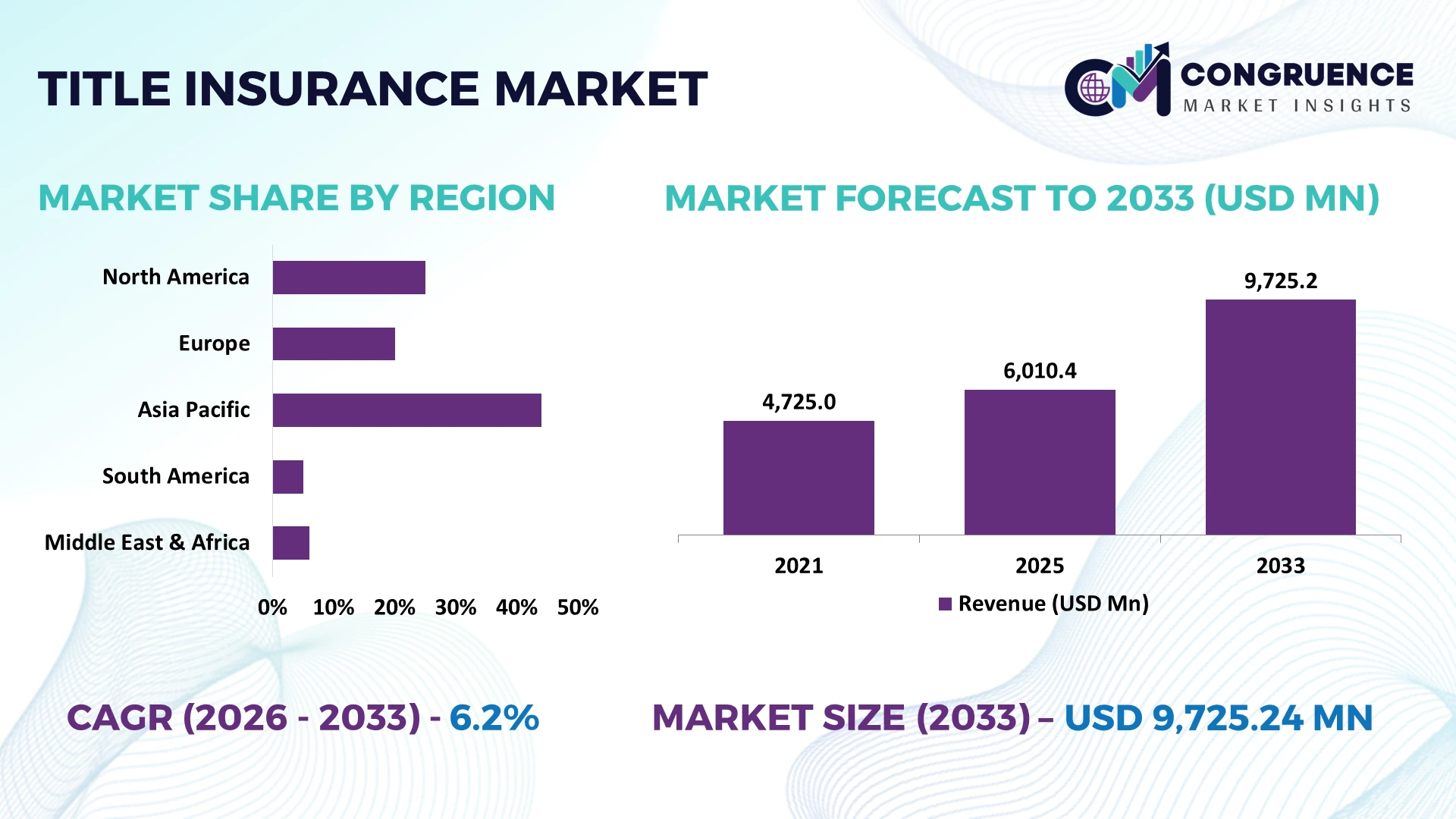
The Global Title Insurance Market was valued at USD 6010.41 Million in 2025 and is anticipated to reach a value of USD 9725.24 Million by 2033 expanding at a CAGR of 6.2% between 2026 and 2033. Growth is driven by increasing mortgage originations, residential property refinancing, electronic real estate closings, AI powered title examination, and modernization of digital land records.
The United States dominates the global title insurance industry, accounting for approximately 85% to 90% of global activity under an indicative market concentration estimate. Its established mortgage lending infrastructure supports residential purchases, commercial property transactions, and refinancing operations. The American Land Title Association reported approximately USD 18.5 billion in US title insurance premiums during 2025, reflecting 13.8% annual growth. Texas generated approximately USD 2.7 billion, while Canada represents a smaller market emphasizing digital conveyancing, lender protection, and electronic property registration.
Strategically, insurers targeting 15% to 25% faster title examination and 10% to 20% lower administrative costs through automation can strengthen underwriting capacity and improve transaction profitability.
Market Size & Growth: USD 6,010.41 million in 2025, projected to reach USD 9,725.24 million by 2033 at 6.2% CAGR, driven by mortgage refinancing and digital underwriting.
Top Growth Drivers: US title premiums increased 13.8%, commercial and refinancing activity strengthened, and direct underwriting operations expanded 25.6% in 2025.
Short Term Forecast: By 2028, automated title examination targets an estimated 20% reduction in document processing time and 15% improvement in underwriting productivity.
Emerging Technologies: AI document extraction, blockchain ownership verification, and robotic process automation target 15% to 25% faster title searches in digitally integrated operations.
Regional Leaders: Illustrative 2033 market allocations place North America at USD 8,752.72 million, Europe at USD 583.51 million, and Asia Pacific at USD 291.76 million, emphasizing digital closings, electronic conveyancing, and registry modernization.
Consumer and End User Trends: Nonaffiliated agencies generated 62.7% of US direct premiums in 2025, highlighting the importance of independent distribution networks and digital lender integration.
Pilot and Case Example: A proposed 2027 automated title examination pilot targets 25% faster document verification and 15% fewer manual processing interventions.
Competitive Landscape: First American Title Insurance led individual US underwriters with 23.1% share in 2025, followed by Fidelity National Title, Old Republic Title, Chicago Title, and Stewart Title.
Regulatory & ESG Impact: Texas introduced revised title insurance rates in March 2026, including a USD 780 basic premium for USD 100,000 coverage, reinforcing regulated pricing transparency.
Investment & Funding: US title insurers generated USD 1.50 billion in operating cash flow during 2025, increasing 28.4% and strengthening financial capacity for technology investment.
Innovation & Future Outlook: By 2033, integrated digital closing platforms target an estimated 30% faster settlement workflows, combining predictive risk analytics, automated underwriting, and electronic property records.
The Title Insurance Market supports residential mortgage lending, commercial property acquisitions, refinancing, and ownership risk protection. AI powered title examination, automated lien detection, and digital closing platforms are transforming underwriting operations by reducing manual verification requirements. In 2025, US title insurers recorded 13.5% growth in direct premiums, while independent agency operations represented 62.7% of distribution activity. Increasing property fraud exposure, state regulated insurance pricing, and electronic recording requirements are accelerating investment in secure transaction infrastructure. These developments establish digital underwriting efficiency, regulatory compliance, and distribution partnerships as central priorities for competitive positioning and long term market expansion.
Title insurance is becoming strategically important as mortgage lenders, real estate investors, and property technology companies prioritize transaction security, underwriting efficiency, and digital settlement infrastructure. The United States remains the industry's operational center, with four major title insurance groups controlling approximately 80% of direct premiums. Increasing mortgage digitization and electronic property recording are restructuring competitive advantages around data accessibility, risk assessment, and closing speed. Insurers are expanding automated title examination capabilities to strengthen lender relationships and reduce administrative complexity.
AI assisted document examination offers an estimated 20% to 30% faster processing than traditional manual title searches, while automated lien identification targets 15% lower verification costs. The United States benefits from established title plants and electronic recording infrastructure, whereas Canada emphasizes digital conveyancing and lender protection. India is advancing computerized land records through its Digital India Land Records Modernization Programme, although title insurance adoption remains limited. During 2026 to 2028, digitally integrated underwriting platforms are positioned to achieve 20% faster processing and improved transaction transparency.
Operationally, insurers integrating electronic recording, automated document classification, and mortgage origination platforms can reduce manual handoffs across closing workflows. Strategic investment increasingly targets AI underwriting, cybersecurity, and lender partnerships. Companies combining proprietary property databases with automated risk evaluation will secure stronger distribution relationships and sustainable operational differentiation.
Mortgage transaction digitization is accelerating title insurance adoption by strengthening demand for faster ownership verification, lien identification, and settlement protection. US title insurance premiums increased approximately 13.8% in 2025, reflecting stronger transaction activity. Independent title agencies accounted for approximately 62.7% of direct premiums, highlighting their importance in mortgage distribution. AI assisted title examination offers an estimated 20% to 30% reduction in document processing time compared with manual workflows. Electronic recording adoption across US counties enables faster document retrieval and reduces physical filing dependencies. Fidelity National Financial and First American Financial are expanding digital closing capabilities, automated underwriting, and lender integrations to improve processing capacity. Competitive advantage increasingly depends on reducing title clearance time without compromising underwriting accuracy.
Title insurance profitability remains sensitive to mortgage transaction volumes, property market liquidity, and fragmented public recording infrastructure. The US mortgage rate environment has constrained refinancing activity, increasing exposure to transaction fluctuations. Under an illustrative operating scenario, a 10% decline in insured transactions combined with 15% higher examination expenses reduces underwriting operating leverage. Fragmented county recording systems can increase manual verification workloads by an estimated 20% where digital property histories remain incomplete. State regulated premium structures further restrict insurers' flexibility to recover rising administrative expenses through pricing. Companies are responding through centralized title production, shared document processing infrastructure, and diversified commercial underwriting portfolios. Maintaining flexible staffing and examination capacity is essential for protecting profitability during mortgage market fluctuations.
Advanced title risk analytics creates opportunities to improve underwriting productivity while expanding digital insurance distribution. AI powered document extraction and automated lien detection offer estimated processing efficiency improvements of 25% to 35% compared with conventional examination workflows. Integrated electronic closing systems target 20% lower administrative costs by reducing document duplication and manual settlement coordination. In the United States, growing adoption of digital mortgage origination platforms supports direct integration between lenders, settlement agents, and title insurers. Emerging applications include predictive ownership dispute identification, automated fraud screening, and property data intelligence services. Companies investing in proprietary title databases, application programming interfaces, and mortgage technology partnerships can expand transaction capacity without proportionate staffing increases. Data driven underwriting also creates differentiated services for institutional property investors.
Scaling digital title insurance infrastructure introduces cybersecurity, data interoperability, and operational governance challenges. Property transaction systems process sensitive ownership records, mortgage documentation, and settlement instructions, creating exposure to wire fraud and identity manipulation. The FBI reported that real estate related cybercrime generated substantial financial losses in the United States, reinforcing the need for secure closing infrastructure. In an illustrative deployment scenario, fragmented system integration increases implementation workloads by 20%, while inadequate automated verification controls create an estimated 15% additional exception handling burden. Integrating legacy title plants with modern mortgage platforms also requires consistent data standards and audit trails. Insurers are strengthening multifactor authentication, encrypted document exchange, automated fraud detection, and third party technology oversight. Long term competitiveness depends on maintaining secure, scalable underwriting operations across diverse recording jurisdictions.
- Rising Focus on Wire Fraud Prevention: US settlement providers are strengthening payment authentication as business email compromise continues targeting property closings. Enhanced verification protocols target 20% to 30% fewer payment instruction exceptions, while dual authorization procedures aim to reduce unauthorized transfer exposure by 15%. Title insurers are partnering with secure payment platforms and banks to validate beneficiary details before fund disbursement. The operational shift prioritizes transaction integrity over closing speed alone, protecting lender relationships and reducing fraud related claims.
- Growing Adoption of Remote Notarization: State authorization of remote online notarization is reshaping document execution across US property transactions. More than 40 states have enacted permanent remote notarization legislation, while digitally coordinated signings target 15% to 25% shorter scheduling cycles. Settlement companies are expanding notary networks and integrating identity authentication tools. This transition improves transaction accessibility for geographically dispersed buyers while reducing dependence on physical signing appointments.
- Increasing Consolidation of Settlement Operations: Large title insurance groups are centralizing examination, escrow administration, and agency support functions to improve operational consistency. The four largest US title insurance groups control approximately 80% of direct premiums, creating substantial processing scale. Shared service restructuring targets 10% to 15% lower administrative overhead. Companies are consolidating regional processing centers and standardizing workflows, strengthening margins while maintaining localized customer distribution.
- Expansion of Specialized Commercial Coverage: Complex property transactions are increasing demand for tailored endorsements covering access rights, zoning, easements, and ownership structures. Commercial underwriting teams are targeting 15% faster endorsement preparation and 20% fewer documentation revisions through standardized review protocols. Insurers are expanding specialist legal teams and collaborating with commercial real estate advisers. This shift supports differentiated underwriting services for institutional acquisitions and complex development projects.
Lender's Title Insurance represents the leading segment, with an estimated 60% to 65% share of global title insurance activity, supported by established mortgage lending requirements and institutional risk protection. US mortgage lenders generally require coverage protecting their security interest against undisclosed liens, recording defects, and ownership disputes. Standardized underwriting procedures and integration with loan origination systems support transaction scalability. Owner's Title Insurance accounts for an indicative 35% to 40% share, protecting property purchasers against covered ownership defects after acquisition. Its purchase is generally optional, creating greater dependence on consumer awareness and settlement agent recommendations.
Owner's Title Insurance is positioned as the faster expanding segment in an analytical adoption scenario, supported by rising property fraud concerns and increased buyer attention to ownership protection. Insurers are strengthening bundled policy distribution, digital educational tools, and settlement partnerships to improve voluntary coverage selection. Lender coverage remains concentrated around mortgage financed purchases and refinancing, while owner protection supports lasting customer relationships beyond loan repayment. Investment priorities increasingly favor integrated policy issuance, simplified coverage explanations, and automated endorsement administration.
Residential Property Transactions represent the largest application, with an indicative 55% to 60% market share, supported by mortgage financed home purchases and established lender insurance requirements. The United States remains the primary transaction center, where residential settlements require ownership verification, lien searches, and recording accuracy. Mortgage Refinancing represents a significant cyclical application, with demand closely linked to borrowing costs and loan replacement activity. Property Ownership Transfers support coverage needs involving inheritance, private sales, and changes in ownership structure. Insurers are expanding standardized residential underwriting workflows and integrating settlement documentation with mortgage platforms to improve processing consistency.
Commercial Property Transactions are positioned as the fastest expanding application in an illustrative segment outlook, supported by institutional acquisitions, complex ownership structures, and specialized endorsement requirements. Real Estate Development creates additional demand involving construction financing, land assemblage, and phased ownership transfers. Commercial title examination can involve multiple parcels, easements, and historical encumbrances, increasing underwriting complexity compared with conventional residential purchases. Companies are investing in specialized commercial underwriting teams, property intelligence databases, and transaction coordination partnerships. These capabilities support differentiated coverage and stronger relationships with institutional property buyers.
Mortgage Lenders represent the leading end user segment, accounting for an estimated 40% to 45% of market demand under an indicative buyer allocation. Their dominance reflects recurring title coverage requirements across mortgage originations, refinancing, and secured property lending. Individual Homebuyers represent another major customer group, purchasing ownership protection against covered title defects and undisclosed property claims. Financial Institutions require specialized coverage for secured lending portfolios, while Real Estate Investors prioritize ownership certainty during acquisitions and portfolio restructuring. Insurers are strengthening lender integrations, standardized policy administration, and settlement agent relationships to protect institutional distribution channels.
Real Estate Investors are positioned as the fastest expanding end user segment in an analytical adoption scenario, supported by institutional property acquisitions and demand for complex title endorsements. Commercial Property Owners require protection involving easements, access rights, and ownership disputes, while Real Estate Developers depend on coverage supporting land acquisition and construction financing. Digital underwriting initiatives target 20% faster institutional transaction reviews and 15% fewer documentation exceptions. Companies are developing customized commercial policies, dedicated underwriting teams, and partnerships with property investment advisers. Competitive differentiation increasingly depends on managing complex ownership risks rather than relying exclusively on standardized mortgage coverage.
North America accounted for the largest market share at an estimated 90% in 2025 however, Asia Pacific is expected to register the fastest growth, expanding at a CAGR of an estimated 9.2% between 2026 and 2033.
Dominance of Mortgage Underwriting and Digital Settlement Infrastructure
North America maintains an estimated 90% share of the global title insurance market, supported by established mortgage underwriting, property ownership verification, and lender protection requirements. The United States accounts for most regional activity, while Canada contributes through residential conveyancing and institutional mortgage insurance services. Digital settlement platforms, electronic property recording, and automated title examination are transforming operational efficiency. More than 40 US states have enacted permanent remote online notarization legislation, supporting broader electronic closing adoption. Major insurers are integrating mortgage origination systems with title production platforms to streamline policy issuance and reduce documentation errors. Automated title examination targets 20% to 30% faster processing, while centralized settlement operations offer estimated administrative cost reductions of 10% to 15%. Competitive positioning increasingly depends on proprietary property databases, agency distribution strength, and secure transaction infrastructure.
United States Market Outlook: The United States remains the principal title insurance market, supported by established lender requirements and extensive property recording infrastructure. Texas, Florida, and California represent important underwriting centers because of residential transaction volumes and commercial property activity. State regulated premium structures influence pricing strategies, while digital title plants improve ownership verification. The four largest US title insurance groups collectively control approximately 80% of direct premiums, reinforcing the importance of scale, underwriting expertise, and agency partnerships.
Digital Conveyancing and Cross Border Property Risk Protection
Europe represents an estimated 5% of global title insurance activity, with demand concentrated in the United Kingdom and selected commercial property markets. Established land registration systems reduce the need for conventional title insurance in many jurisdictions, shifting demand toward defective title protection, missing documentation, restrictive covenants, and transaction specific legal risks. The European Union's digital public administration initiatives are strengthening electronic document accessibility and property information interoperability. In the United Kingdom, HM Land Registry continues modernizing digital registration services and electronic property transaction processes. Specialized insurers are developing policies covering planning restrictions, access rights, and historical ownership defects. Digital conveyancing initiatives target an estimated 15% to 20% reduction in administrative processing time. Market differentiation increasingly depends on legal risk assessment, localized underwriting expertise, and integration with conveyancing professionals rather than standardized mortgage insurance distribution.
United Kingdom Market Outlook: The United Kingdom leads European title insurance activity through established conveyancing networks, specialist legal indemnity products, and institutional commercial property transactions. HM Land Registry supports property ownership verification across England and Wales, while digital registration services improve document accessibility. Specialist underwriting increasingly addresses restrictive covenants, missing easements, and defective leasehold titles. Automated document review offers an estimated 15% improvement in examination productivity, supporting faster conveyancing decisions and more efficient insurer relationships with solicitors.
Land Registry Modernization and Institutional Property Protection
Asia Pacific accounts for an estimated 3% of global title insurance activity, reflecting limited conventional title insurance penetration despite extensive property development and digital land administration investment. Australia represents an established market for title insurance products, while India and selected Southeast Asian countries offer emerging opportunities linked to ownership verification and property documentation modernization. India's Digital India Land Records Modernization Programme is advancing computerized land records, cadastral mapping, and registration integration across states. Australia benefits from established electronic conveyancing infrastructure, including PEXA, which supports digital property settlement workflows. Automated ownership verification targets 20% to 25% faster document processing in digitally integrated environments. Insurers and property technology providers are exploring partnerships with lenders, conveyancers, and registry service operators. Competitive advantage depends on reliable property records, enforceable ownership rights, and localized risk assessment capabilities.
Australia Market Outlook: Australia maintains one of the region's most developed title insurance environments, supported by electronic conveyancing infrastructure and established property transaction procedures. PEXA facilitates digital settlements across participating jurisdictions, reducing dependence on physical documentation. Specialist title insurance providers address ownership defects, survey issues, and property transaction risks. Electronic settlement integration targets an estimated 20% reduction in administrative handling requirements, creating opportunities for insurers to strengthen partnerships with mortgage lenders and conveyancing professionals.
Property Formalization and Digital Registry Infrastructure Development
South America represents an estimated 1% of global title insurance activity, with opportunities concentrated in Brazil, Chile, and Colombia. Property registration modernization, institutional real estate investment, and ownership documentation improvements are creating demand for specialized transaction protection. Brazil's electronic property registration initiatives are strengthening digital access to real estate records and supporting more consistent ownership verification. However, fragmented municipal documentation, historical title disputes, and differing registration procedures continue to limit standardized insurance deployment. Digital registry integration targets an estimated 15% to 20% reduction in document retrieval workloads where electronic records are sufficiently complete. Insurers and legal service providers are developing transaction specific coverage arrangements for commercial acquisitions and complex ownership transfers. Market entry requires partnerships with local registries, conveyancing specialists, and financial institutions to address jurisdictional differences and underwriting uncertainty.
Brazil Market Outlook: Brazil represents the region's most strategically significant opportunity because of its extensive property market and ongoing registration modernization. The Electronic System of Public Registries supports efforts to improve digital access and interoperability across registry services. São Paulo remains a major commercial property transaction center, while agricultural land acquisitions create additional ownership verification requirements. Specialized insurance providers can differentiate through legal due diligence, registry integration, and institutional transaction protection.
Property Registration Digitization and Institutional Investment Expansion
The Middle East and Africa account for an estimated 1% of global title insurance activity, with opportunities concentrated in the United Arab Emirates, Saudi Arabia, and South Africa. Government investment in digital property registration and real estate transaction transparency is improving the infrastructure required for ownership risk protection. Dubai's land administration ecosystem supports electronic property services, while Saudi Arabia's real estate registration reforms are strengthening formal ownership documentation. Institutional property investment and complex commercial acquisitions create demand for specialized title risk assessment. Digital verification initiatives target an estimated 15% to 25% faster ownership documentation processing in integrated registry environments. However, jurisdictional differences and limited standardized title insurance distribution constrain deployment. Insurers are evaluating partnerships with property developers, financial institutions, and legal advisers to develop localized protection products and strengthen transaction assurance.
United Arab Emirates Market Outlook: The United Arab Emirates offers a strategic entry point through Dubai's established property registration infrastructure and international real estate investment activity. Dubai Land Department digital services support ownership documentation and transaction registration. Commercial acquisitions, foreign investor participation, and large property developments create opportunities for specialized title risk protection. Insurers can strengthen market positioning through partnerships with property advisers, developers, and financial institutions, particularly where complex ownership structures require additional legal verification.
The title insurance market is dominated by Fidelity National Financial, First American Financial, Old Republic International, and Stewart Information Services, competing through underwriting scale, agency networks, and proprietary property databases. These groups collectively control approximately 80% of US direct premiums, while specialist providers compete through commercial coverage customization and localized expertise. An illustrative top five concentration estimate exceeds 80%, reflecting substantial distribution barriers. Automated examination platforms target 20% faster processing, while centralized title production offers estimated administrative savings of 15%. Fidelity National Financial emphasizes integrated settlement services, First American invests in property data intelligence, and Stewart strengthens agency relationships and digital transaction capabilities. Competitive pressure increasingly centers on electronic closing integration, fraud prevention, and automated underwriting rather than premium pricing alone. Regulatory licensing, historical title records, and established lender relationships restrict entry. Sustainable competitive advantage requires proprietary data access, dependable underwriting accuracy, secure technology integration, and efficient nationwide distribution capabilities.
Fidelity National Financial, Inc.
First American Financial Corporation
Old Republic International Corporation
Stewart Information Services Corporation
Westcor Land Title Insurance Company
WFG National Title Insurance Company
Investors Title Company
CATIC Financial, Inc.
Title Resources Group
AmTrust Financial Services, Inc.
First National Financial Corporation
Secure Legal Title Limited
Current title insurance technology centers on electronic title plants, automated document classification, and digital settlement platforms. Optical character recognition reduces manual data entry, with targeted processing improvements of 15% to 25% in standardized workflows. Electronic recording eliminates physical document delivery across participating jurisdictions, improving filing speed and auditability. Insurers integrating these systems with mortgage origination software strengthen lender retention through consistent policy issuance and faster exception resolution.
Emerging technologies include AI powered lien detection, machine learning risk scoring, and secure digital identity verification. Compared with legacy manual examination, automated title review targets 20% to 30% faster processing and approximately 15% lower administrative costs. Remote online notarization, authorized permanently in more than 40 US states, demonstrates growing digital transaction readiness. API integration connects underwriters, settlement agents, and lenders, reducing duplicate data handling and improving transaction visibility.
Disruptive developments involve predictive ownership fraud analytics, tamper resistant property records, and intelligent underwriting orchestration. Blockchain registries remain experimental, while AI assisted exception management offers more immediate operational value. During 2026 to 2028, insurers targeting 25% faster clearance and 20% fewer documentation exceptions will prioritize verified property datasets, cybersecurity, and automated quality controls. Large underwriters benefit from proprietary title databases, while specialist providers gain competitiveness through interoperable platforms and customized commercial risk assessment capabilities.
May 2025 First American Financial expanded its proprietary title plant infrastructure by 100 facilities, surpassing 1,800 nationwide. AI and automation supported broader property data coverage, strengthening underwriting decisions, accelerating title production, and improving competitive positioning in mortgage settlement services. Source: businesswire.com.
September 2026 Stewart Information Services expanded commercial underwriting capabilities through its acquisition of Tower Title, serving 5 specialized property sectors: telecommunications, solar, wind, data centers, and billboards. The transaction strengthened access to complex commercial transactions and diversified specialist coverage capabilities. Source: alta.org.
September 2026 First American Title expanded complimentary property title monitoring through independent agents across 49 states, subject to county restrictions. The service alerts homeowners to suspicious filings, strengthening fraud prevention, customer retention, and protection beyond the original property closing transaction. Source: firstam.com.
October 2024 FinCEN renewed geographic targeting orders requiring title insurers to identify beneficial owners in specified property purchases. Reporting thresholds remained USD 300,000, except Baltimore at USD 50,000, strengthening transaction transparency and compliance screening. The orders subsequently expired in 2026. Source: fincen.gov.
The Title Insurance Market Report evaluates industry structure, underwriting operations, technology adoption, and competitive positioning across 2026 to 2033. Segmentation covers Owner's Title Insurance and Lender's Title Insurance, alongside residential transactions, commercial property transactions, mortgage refinancing, ownership transfers, and real estate development. End user analysis examines individual homebuyers, mortgage lenders, financial institutions, real estate investors, developers, and commercial property owners. Geographic coverage includes North America, Europe, Asia Pacific, South America, and the Middle East and Africa, emphasizing country specific regulatory and deployment differences.
The report assesses AI underwriting, electronic recording, digital closings, fraud detection, and automated property verification. Competitive benchmarking incorporates the approximately 80% combined US market concentration of major underwriting groups, alongside emerging specialist providers. Strategic analysis supports investment allocation, distribution partnerships, operational modernization, and expansion into underserved property risk protection segments.
| Report Attribute/Metric | Report Details |
|---|---|
Market Revenue in 2025 | USD 6010.41 Million |
Market Revenue in 2033 | USD 9725.24 Million |
CAGR (2026 - 2033) | 6.2% |
Base Year | 2025 |
Forecast Period | 2026 - 2033 |
Historic Period | 2021 - 2025 |
Segments Covered | By Type
By Application
By End-User
|
Key Report Deliverable | Revenue Forecast, Growth Trends, Market Dynamics, Segmental Overview, Regional and Country-wise Analysis, Competition Landscape |
Region Covered | North America, Europe, Asia-Pacific, South America, Middle East, Africa |
Key Players Analyzed | Fidelity National Financial, Inc., First American Financial Corporation, Old Republic International Corporation, Stewart Information Services Corporation, Westcor Land Title Insurance Company, WFG National Title Insurance Company, Investors Title Company, CATIC Financial, Inc., Title Resources Group, AmTrust Financial Services, Inc., First National Financial Corporation, Secure Legal Title Limited |
Customization & Pricing | Available on Request (10% Customization is Free) |




