
Reports
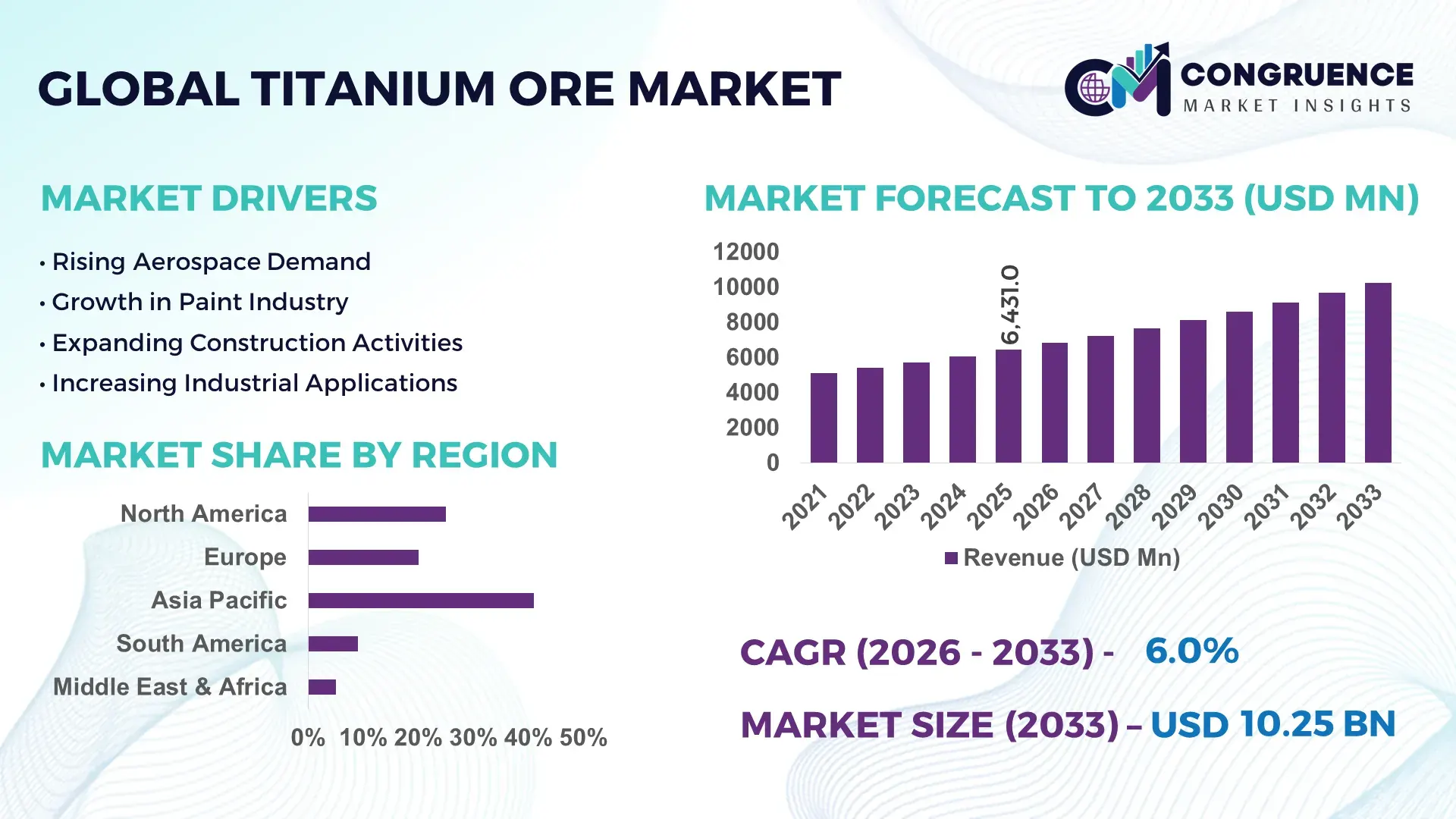
The Global Titanium Ore Market was valued at USD 6431 Million in 2025 and is anticipated to reach a value of USD 10250.03 Million by 2033 expanding at a CAGR of 6% between 2026 and 2033.
Growth is being driven by rising demand for titanium dioxide pigments and aerospace-grade alloys, with processing efficiency improving by nearly 12% due to advanced beneficiation technologies. Between 2024 and 2026, global supply chains have been reshaped by export restrictions and resource nationalism, particularly following tightening mining policies in key producing regions.
China remains the dominant player, accounting for approximately 38% of global titanium ore processing capacity, supported by over USD 1.2 billion in recent investments across refining and downstream pigment production. The country’s titanium dioxide output exceeds 4 million tons annually, supplying coatings, plastics, and construction sectors. In comparison, Australia contributes nearly 22% of global ilmenite production with higher-grade reserves, while Africa’s emerging producers are increasing output by 8–10% through foreign direct investments. This geographic concentration creates a supply risk differential of over 15% between integrated and import-dependent markets.
Compared to 2020, ore processing yields have improved by nearly 10%, reducing waste and lowering operational costs across major mining operations. Strategic implication: companies must prioritize vertical integration and secure long-term supply agreements to mitigate geopolitical volatility and pricing fluctuations.
Market Size & Growth: USD 6431M (2025) to USD 10250.03M (2033) at 6% CAGR, driven by 14% rise in titanium dioxide demand from coatings and plastics industries.
Top Growth Drivers: Aerospace demand +18%, construction coatings +12%, and EV battery components +9% driving ore consumption.
Short-Term Forecast: By 2027, processing costs expected to decline by 8% due to automation and energy-efficient extraction technologies.
Emerging Technologies: AI-driven ore grading, automated mining systems, and advanced smelting improve recovery rates by 10–15%.
Regional Leaders: Asia Pacific at USD 4.5B with 40% processing dominance; Australia at USD 2.1B with high-grade reserves; Africa at USD 1.6B with 9% annual output growth.
Consumer/End-User Trends: 65% of titanium ore is consumed by pigment manufacturing, with industrial coatings adoption rising by 11%.
Pilot/Case Example: 2025 automated mining project improved extraction efficiency by 13% and reduced labor costs by 9%.
Competitive Landscape: Top players hold ~55% share, with leading firms expanding refining capacity and securing long-term supply contracts.
Regulatory & ESG Impact: Environmental regulations reduced emissions by 7% in processing plants, increasing compliance costs by 5%.
Investment & Funding: Over USD 2.3B invested globally in mining expansion and downstream integration between 2024–2026.
Innovation & Future Outlook: Shift toward high-purity titanium feedstock and circular processing technologies improving resource utilization by 12%.
Aerospace and defense sectors account for approximately 28% of titanium ore consumption, while construction and coatings contribute nearly 45%, driven by infrastructure expansion and urbanization. Recent innovations in chloride-route processing and high-purity titanium extraction have improved output efficiency by 10–12%. Asia Pacific leads demand with over 50% share, while supply chain realignments following export controls have accelerated regional diversification. Increasing focus on sustainable mining and recycling technologies signals a shift toward resilient, low-impact supply models, shaping long-term strategic positioning.
Titanium ore has shifted from a conventional raw material to a strategically critical resource, accelerating its importance across aerospace, defense, and high-performance industrial ecosystems. The market is transforming as supply security, cost optimization, and technological capability become decisive competitive factors. A significant structural shift is underway as export controls and resource nationalism tighten global supply chains, reducing availability in import-dependent markets by nearly 10% and forcing companies to redesign sourcing strategies.
Advanced beneficiation and chloride-route processing technologies are redefining efficiency benchmarks. AI-enabled ore sorting improves recovery efficiency by 15% while reducing processing costs by 10% compared to legacy gravity-based systems. Regionally, Asia Pacific leads in volume with over 50% of global output, while North America leads in innovation adoption with more than 35% deployment of automated mining and digital processing technologies. This divergence is reshaping value capture, with innovation-driven regions achieving higher margins despite lower production volumes.
Over the next 2–3 years, processing efficiency is set to improve by 10%, while operational downtime is projected to decline by 8% through predictive maintenance and automation integration. ESG compliance is emerging as a measurable competitive advantage, with low-emission processing reducing energy costs by 6% and enabling access to regulated premium markets. A 2025 digital mining pilot improved yield consistency by 12%, demonstrating tangible operational gains. Capital allocation is shifting toward downstream integration and long-term supply agreements, signaling a strategic pivot toward control over processing and supply continuity. The market is now defined by the ability to optimize resources while securing resilient, geopolitically stable supply chains.
The titanium ore market is being driven by a structural surge in demand from aerospace, coatings, and advanced manufacturing sectors, with aerospace-grade titanium consumption rising by over 18% and pigment-related demand increasing by 12%. This accelerating demand is forcing a transition from traditional extraction models to efficiency-focused processing and resource optimization. A key global trigger is the ongoing supply chain restructuring driven by export restrictions and regional resource control policies, which has tightened supply availability by nearly 10% in key importing economies. This supply-demand imbalance is directly elevating pricing pressure and pushing companies to invest in beneficiation technologies that enhance recovery rates by up to 15%. The business response is highly strategic, with firms accelerating capacity expansion, securing upstream mining assets, and forming long-term supply agreements to stabilize procurement. Companies are also increasing investments in localized processing hubs to reduce import dependency and strengthen supply resilience, reinforcing their ability to maintain pricing power in a constrained global environment.
Titanium ore production remains constrained by heavy dependence on geographically concentrated reserves, with more than 60% of high-grade deposits located in a limited number of regions, creating significant exposure to supply disruptions. This concentration has contributed to raw material price volatility of up to 14%, directly impacting cost predictability for downstream industries. Additionally, increasingly stringent environmental regulations have raised compliance costs by approximately 7%, adding further pressure on operational margins. A major real-world constraint is the infrastructure gap in emerging mining regions, where inadequate processing facilities delay project execution by 10–12% and limit scalability. These structural challenges are constraining expansion timelines and reducing operational efficiency across the value chain. In response, companies are actively diversifying supply sources, investing in synthetic rutile production, and entering long-term procurement contracts to reduce risk exposure. These mitigation strategies are essential for stabilizing supply, controlling costs, and maintaining production continuity in a volatile operating environment.
High-value growth opportunities in the titanium ore market are being unlocked through next-generation processing technologies and geographic expansion into underdeveloped resource regions. Advanced chloride-route processing is improving output efficiency by 12–15%, enabling the production of high-purity titanium feedstock that commands premium pricing across aerospace and specialty applications. At the same time, emerging regions such as Africa and Southeast Asia are increasing production capacity by over 9%, supported by foreign direct investment and infrastructure development initiatives. A critical innovation shift lies in the adoption of AI-driven resource modeling and digital mining systems, which improve ore recovery rates by around 10% while minimizing waste. This creates a strategic advantage where companies can extract greater value from existing reserves without proportional increases in operational costs. Industry leaders are positioning for long-term dominance by expanding into these emerging markets, investing heavily in R&D, and building integrated supply ecosystems that combine extraction, processing, and downstream manufacturing capabilities, thereby reshaping competitive advantage around efficiency and technological leadership.
The titanium ore market faces significant execution challenges that constrain long-term scalability and operational sustainability, particularly due to high capital intensity and energy dependence. Establishing processing facilities requires substantial investment, with capital costs increasing by nearly 20% due to energy-intensive operations and stricter compliance requirements. Additionally, processing inefficiencies remain a concern, with energy consumption gaps of up to 15% compared to optimized systems, placing sustained pressure on operating costs. A key real-world pressure point is the tightening of environmental standards alongside limited access to reliable, low-cost energy in several mining regions, which directly impacts production consistency and expansion feasibility. These constraints are forcing companies to reassess growth strategies and prioritize investments in energy-efficient technologies and circular processing systems. To remain competitive, firms are forming strategic partnerships to share infrastructure costs, accelerating innovation in low-energy extraction methods, and integrating sustainability into core operations. Addressing these execution barriers is critical to ensuring stable growth, regulatory alignment, and long-term profitability in an increasingly complex and resource-sensitive market.
15% increase in AI-driven ore sorting adoption is reshaping processing efficiency. Mining operators are deploying automated ore grading systems across 30% of new facilities, improving recovery rates by 12–15% and reducing manual inspection dependency by 20%. This shift is optimizing throughput speed and lowering processing errors. Companies are scaling digital mining platforms and forming technology partnerships to standardize data-driven extraction workflows.
10–12% reduction in processing costs through energy-efficient smelting is redefining operations. Chloride-route processing adoption has crossed 40% in advanced facilities, cutting energy consumption by 8–10% compared to legacy methods. This transition is being forced by rising energy prices and stricter environmental norms. Producers are restructuring plants and investing in low-energy furnaces to maintain cost competitiveness and regulatory compliance.
Over 50% demand concentration in Asia Pacific is shifting regional supply strategies. While the region dominates volume, Africa is increasing output by 9%, driven by new mining projects and foreign investment inflows. This redistribution is reshaping supply dependencies and reducing overreliance on single-region sourcing. Companies are expanding geographically and securing multi-region supply chains to balance risk exposure.
20% increase in long-term supply contracts is redefining business models. Buyers are locking in multi-year agreements to stabilize raw material costs amid 14% price volatility. This shift is reducing spot market exposure and improving procurement predictability. Producers are prioritizing contract-based sales and vertically integrating operations to secure stable demand and protect margins.
The titanium ore market is segmented by type, application, and end-user, with demand heavily concentrated in pigment production and industrial applications. Ilmenite and rutile dominate supply due to their scalability and processing efficiency, collectively accounting for over 70% of total consumption. Applications are led by titanium dioxide production, which represents approximately 65% of usage, driven by coatings, plastics, and paper industries. Demand is shifting toward high-purity feedstock as advanced manufacturing and aerospace sectors require superior material performance. End-user demand is concentrated in paints and coatings, contributing nearly 40%, followed by aerospace and automotive industries, which are expanding due to lightweight material adoption. This segmentation highlights a clear transition toward high-performance applications and integrated supply models, requiring companies to align production capabilities with evolving industrial demand patterns.
Ilmenite dominates the titanium ore market with approximately 55% share, driven by its widespread availability, cost efficiency, and compatibility with large-scale titanium dioxide production. Its structural advantage lies in its scalability and lower extraction cost, making it the preferred choice for bulk industrial applications. Rutile, accounting for nearly 20%, represents the fastest-growing segment with an estimated 8–10% increase in demand, fueled by its high titanium content and suitability for premium-grade applications such as aerospace alloys and high-purity pigments. Compared to ilmenite, rutile offers superior processing efficiency but at higher cost, creating a clear trade-off between volume and performance.
Leucoxene, anatase, and titanomagnetite collectively contribute around 25% of the market, serving niche and strategic roles in specialized applications. Leucoxene is gaining traction in upgraded feedstock production, while titanomagnetite is being explored for integrated iron-titanium extraction processes. Demand is gradually shifting toward higher-grade ores, prompting companies to invest in upgrading lower-grade ilmenite and expanding rutile extraction capacity. This shift is redefining investment priorities, with a growing focus on quality-driven production and advanced processing capabilities.
Titanium dioxide production leads the application segment with approximately 65% share, as it remains the primary use of titanium ore in pigments, coatings, plastics, and paper. This dominance is driven by high-volume demand and consistent industrial consumption. Metal production is the fastest-growing application, expanding by 9%, supported by increasing use of titanium alloys in aerospace and defense sectors. Compared to titanium dioxide production, which is mature and volume-driven, metal production is value-driven, focusing on performance and material strength.
Pigments and coatings represent a significant share within the broader titanium dioxide segment, reflecting strong demand from construction and automotive industries. Welding electrodes and plastics and paper applications collectively account for nearly 20%, serving stable but slower-growing markets. Usage patterns are evolving as companies shift toward high-purity titanium feedstock to meet stricter quality and performance standards. Producers are adapting by scaling chloride-route processing and repositioning product portfolios toward premium applications. This transition highlights a strategic shift from volume-based consumption to performance-driven demand, influencing investment and production strategies.
The paints and coatings industry leads the titanium ore market with approximately 40% share, driven by its reliance on titanium dioxide for opacity, durability, and color retention. This concentration is supported by large-scale infrastructure and construction activities. The aerospace industry is the fastest-growing end-user, expanding by over 10%, fueled by increasing demand for lightweight, high-strength titanium alloys in aircraft manufacturing. Compared to paints and coatings, which is volume-driven, aerospace demand is precision-driven, focusing on material performance and quality.
The automotive and construction sectors collectively account for around 35%, benefiting from the adoption of lightweight materials and urban development projects. The chemical industry holds a smaller but stable share, utilizing titanium compounds in specialized processes. Buying behavior is shifting toward long-term supply agreements and high-purity material sourcing, with companies targeting aerospace and automotive sectors through customized product offerings and strategic partnerships. This shift indicates a move toward high-margin segments, where performance and reliability outweigh cost considerations.
Asia Pacific accounted for the largest market share at 52% in 2025 however, Middle East & Africa is expected to register the fastest growth, expanding at a CAGR of 7% between 2026 and 2033.
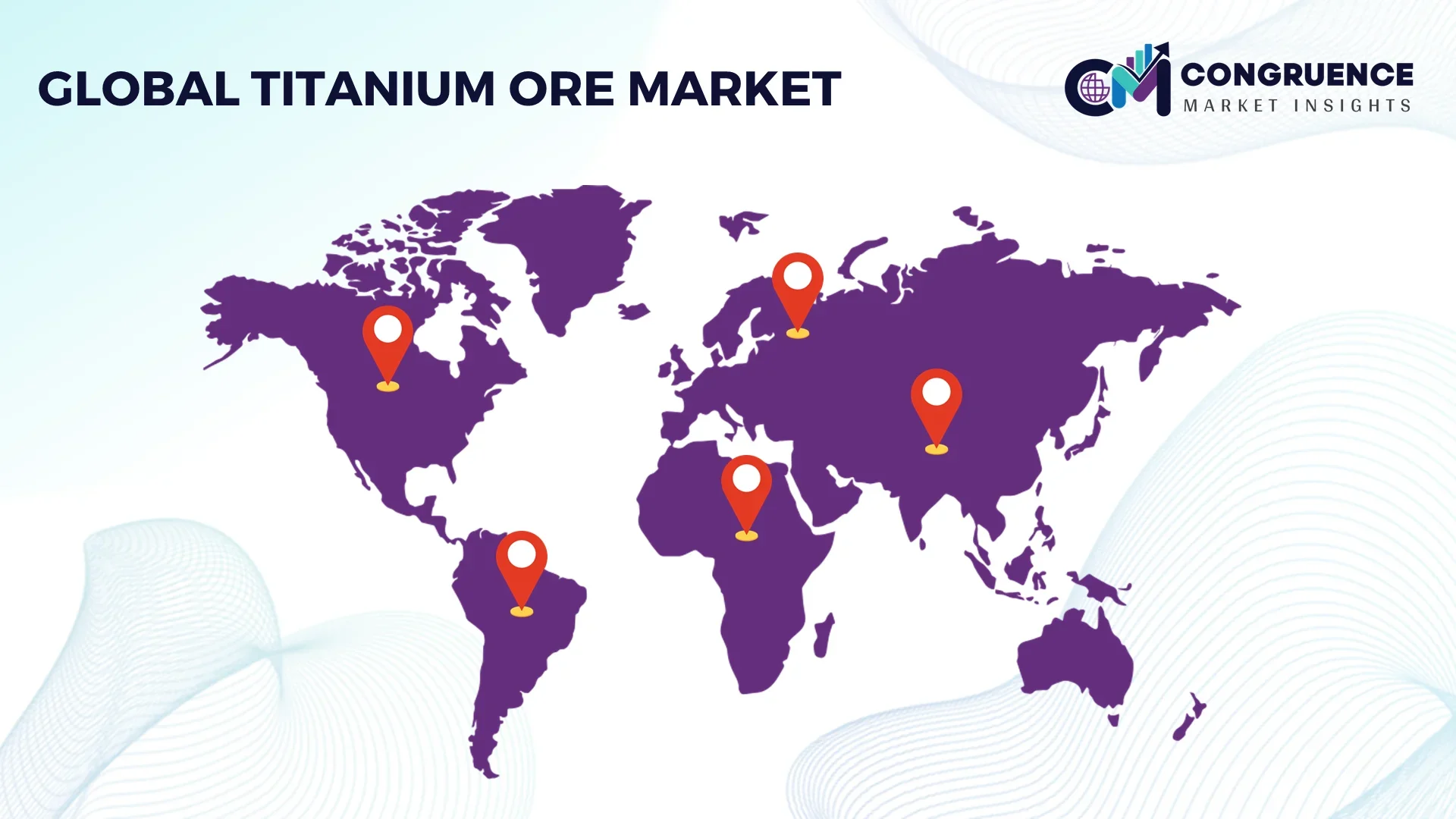
Asia Pacific dominates due to large-scale processing capacity and strong downstream demand, while North America holds nearly 18% driven by advanced technology adoption. Europe contributes around 16%, with demand shaped by regulatory compliance and sustainability mandates. Meanwhile, Africa is accelerating production growth by over 9%, supported by new mining investments and infrastructure expansion. A key structural shift is the diversification of supply chains away from single-region dependence following export controls and resource security concerns. Companies are increasingly focusing on multi-region sourcing and localized processing hubs to balance cost, risk, and long-term supply stability.
North America holds approximately 18% of titanium ore demand, driven by aerospace and defense sectors accounting for over 35% of regional consumption. A key structural force is the push for domestic supply chain resilience, reducing import dependency by nearly 12%. Companies are rapidly adopting automated mining and AI-driven processing, with over 30% of facilities integrating digital optimization systems to improve efficiency by 10%. A notable strategic move includes expansion of refining capacity to support high-purity titanium production. Enterprise buyers prioritize reliability and quality over cost, favoring long-term contracts and certified supply chains. This region is being prioritized for its innovation-driven margins and supply security advantage.
Europe accounts for nearly 16% of the titanium ore market, with demand concentrated in Germany, France, and the UK due to strong coatings and industrial manufacturing sectors. Strict environmental regulations have increased compliance requirements, pushing companies to adopt low-emission processing technologies, reducing carbon output by 8%. This regulatory pressure is accelerating the shift toward energy-efficient chloride-route processing, now adopted by over 35% of facilities. A key strategic move includes investments in recycling and circular material systems to reduce raw ore dependency by 6%. Enterprises exhibit compliance-driven behavior, prioritizing sustainable sourcing and certified materials. This region forces innovation through regulation, making it a benchmark for ESG-led transformation.
Asia Pacific leads the titanium ore market with over 52% share, supported by dominant production hubs in China, India, and Australia. The region benefits from integrated supply chains and cost-efficient processing, enabling large-scale output at 10–12% lower operational costs compared to global averages. Execution-level shifts include mass adoption of automated beneficiation systems, improving recovery rates by 15%. A key strategic move is the expansion of refining capacity, with several projects increasing output by over 8% annually. Enterprises prioritize scale and speed, focusing on high-volume production to meet domestic and export demand. This region remains critical for global supply stability and large-scale expansion strategies.
South America contributes approximately 7% to the titanium ore market, with Brazil as the primary producer due to its mineral-rich reserves. Demand is driven by construction and industrial applications, growing by nearly 6%. However, infrastructure limitations and logistical inefficiencies increase operational costs by up to 10%, constraining scalability. Companies are gradually adopting localized processing and improving extraction techniques, boosting efficiency by 8%. A strategic move includes targeted investments in mining infrastructure to enhance export capacity. Enterprises exhibit price-sensitive behavior, focusing on cost-effective sourcing and regional partnerships. This region presents a balanced mix of opportunity and operational risk, requiring careful investment planning.
Middle East & Africa account for nearly 7% of global titanium ore demand but are experiencing rapid expansion, with production increasing by over 9% annually. Key countries such as South Africa and Mozambique are leveraging mineral reserves to support growing industrial and export demand. A major transformation driver is increased foreign investment and public-private partnerships, boosting mining project development by 12%. Execution-level shifts include the adoption of modern extraction technologies, improving output efficiency by 10%. Enterprises are focusing on export-oriented strategies and resource monetization. This region is emerging as a strategic growth frontier, offering high resource potential combined with increasing infrastructure development.
China – 38% share in the Titanium Ore Market, driven by extensive processing capacity and strong downstream industrial demand.
Australia – 22% share in the Titanium Ore Market, supported by high-grade reserves and efficient large-scale mining operations.
The titanium ore market is defined by competition between global mining leaders, integrated processing companies, and emerging regional producers. Major players such as Rio Tinto, Iluka Resources, Kenmare Resources, Tronox Holdings, and Base Resources collectively control approximately 55% of the market, competing directly on supply control and processing capability. Global leaders focus on scale and vertical integration, while regional players compete through cost advantages and localized supply contracts. Competition is primarily driven by pricing efficiency, processing technology, and supply chain reliability, with advanced processing improving recovery rates by up to 15% and reducing costs by 10%. Companies are actively expanding mining capacity, forming strategic partnerships, and investing in downstream processing to capture higher margins. A key competitive shift is the increasing focus on securing long-term supply agreements, with contract-based sales rising by 20%, reducing exposure to volatile spot markets. Entry barriers remain high due to capital-intensive infrastructure requirements and regulatory compliance pressures, which increase initial investment costs by nearly 20%. Winning in this market requires control over high-grade resources, investment in advanced processing technologies, and the ability to secure stable, diversified supply chains.
Rio Tinto
Iluka Resources Limited
Kenmare Resources plc
Tronox Holdings plc
Base Resources Limited
V.V. Mineral
Trimex Sands Pvt Ltd
Richards Bay Minerals
Sierra Rutile Limited
Indian Rare Earths Limited
Yucheng Jinhe Industrial Co., Ltd.
Pangang Group Vanadium Titanium & Resources Co., Ltd.
Advanced beneficiation and automated ore sorting technologies are reshaping current operations, with AI-driven grading systems improving recovery efficiency by 12–15% and reducing manual inspection costs by 10%. Adoption has crossed 30% across large-scale mining operations, particularly in integrated facilities. This shift is optimizing throughput and minimizing waste, giving early adopters a clear cost and productivity advantage. Emerging technologies such as chloride-route processing and energy-efficient smelting are accelerating performance gains, with energy consumption reduced by 8–10% and output purity improved by 12%. Deployment levels have reached nearly 40% in technologically advanced plants. Compared to legacy sulfate processes, chloride-based systems improve efficiency by 15% while lowering operational costs by 9%, marking a decisive transition toward high-purity, low-cost production models.
Disruptive integration of digital mining platforms and predictive maintenance is redefining operational reliability, reducing downtime by 8% and improving asset utilization by 10%. Around 25% of mining companies are deploying integrated digital ecosystems to enhance real-time decision-making. This integration is enabling faster response to ore variability and operational disruptions, strengthening supply chain resilience. From 2026 to 2028, technology adoption is expected to accelerate further, with automation penetration exceeding 45% and advanced processing becoming the industry standard. Competitive advantage is shifting toward companies that control both technology and processing capabilities, allowing them to optimize resource utilization, reduce costs, and secure long-term supply contracts in an increasingly constrained market.
March 2026 – Rio Tinto reported improved operational performance with production efficiency rising by 9%, driven by optimized mining processes and stronger supply chain coordination. This enhances output consistency and strengthens global supply positioning. [Operational Resilience] Source: https://www.wsj.com
December 2025 – Rio Tinto advanced its portfolio restructuring strategy, targeting $650 million in productivity gains through asset optimization and operational efficiency improvements. This move sharpens capital allocation and improves long-term competitiveness. [Portfolio Optimization] Source: https://www.reuters.com
July 2025 – Rio Tinto initiated a strategic review of its titanium operations following a 24% decline in segment performance, aiming to streamline assets and improve cost efficiency. This reflects shifting market dynamics and margin pressures. [Strategic Review] Source: https://www.reuters.com
October 2025 – Tronox secured approximately $600 million in funding to expand processing capabilities, supporting supply diversification and reducing regional dependency risks. This strengthens vertical integration and supply chain resilience. [Supply Diversification] Source: https://www.theaustralian.com.au
This report provides comprehensive coverage of the titanium ore market across key dimensions, including segmentation by type (ilmenite, rutile, leucoxene, anatase, titanomagnetite), application (titanium dioxide production, metal production, pigments and coatings, welding electrodes, plastics and paper), and end-user industries such as paints and coatings, aerospace, automotive, chemical, and construction. It evaluates demand distribution across five major regions and analyzes over 12 key companies shaping the competitive landscape. The report integrates technology insights, highlighting adoption levels of advanced processing systems, with automation penetration exceeding 30% and chloride-route processing adoption nearing 40% in leading facilities.
Analytical depth is driven by quantitative insights, including segment share distribution, regional production concentration exceeding 50% in Asia Pacific, and efficiency improvements of 10–15% from next-generation technologies. The scope extends to emerging areas such as AI-driven mining, digital resource modeling, and sustainable processing innovations, capturing evolving industry dynamics. Strategically, the report supports investment and expansion decisions by identifying high-growth segments, supply chain shifts, and competitive positioning strategies. With forward-looking coverage through 2033, it enables stakeholders to align capital allocation, optimize operations, and capture value in a market increasingly defined by efficiency, technology integration, and resource security.
| Report Attribute/Metric | Report Details |
|---|---|
|
Market Revenue in 2025 |
USD 6431 Million |
|
Market Revenue in 2033 |
USD 10250.03 Million |
|
CAGR (2026 - 2033) |
6% |
|
Base Year |
2025 |
|
Forecast Period |
2026 - 2033 |
|
Historic Period |
2021 - 2025 |
|
Segments Covered |
By Type
By Application
By End-User
|
|
Key Report Deliverable |
Revenue Forecast, Growth Trends, Market Dynamics, Segmental Overview, Regional and Country-wise Analysis, Competition Landscape |
|
Region Covered |
North America, Europe, Asia-Pacific, South America, Middle East, Africa |
|
Key Players Analyzed |
Rio Tinto, Iluka Resources Limited, Kenmare Resources plc, Tronox Holdings plc, Base Resources Limited, V.V. Mineral, Trimex Sands Pvt Ltd, Richards Bay Minerals, Sierra Rutile Limited, Indian Rare Earths Limited, Yucheng Jinhe Industrial Co., Ltd., Pangang Group Vanadium Titanium & Resources Co., Ltd. |
|
Customization & Pricing |
Available on Request (10% Customization is Free) |




