
Reports
The Global Tire Sealant Market was valued at USD 1150 Million in 2025 and is anticipated to reach a value of USD 1816.39 Million by 2033 expanding at a CAGR of 5.88% between 2026 and 2033. Growth is driven by expanding tubeless-tire penetration, OEM replacement of spare wheels with mobility kits, rising bicycle and off-road applications, and sealant formulations compatible with tire-pressure monitoring systems.
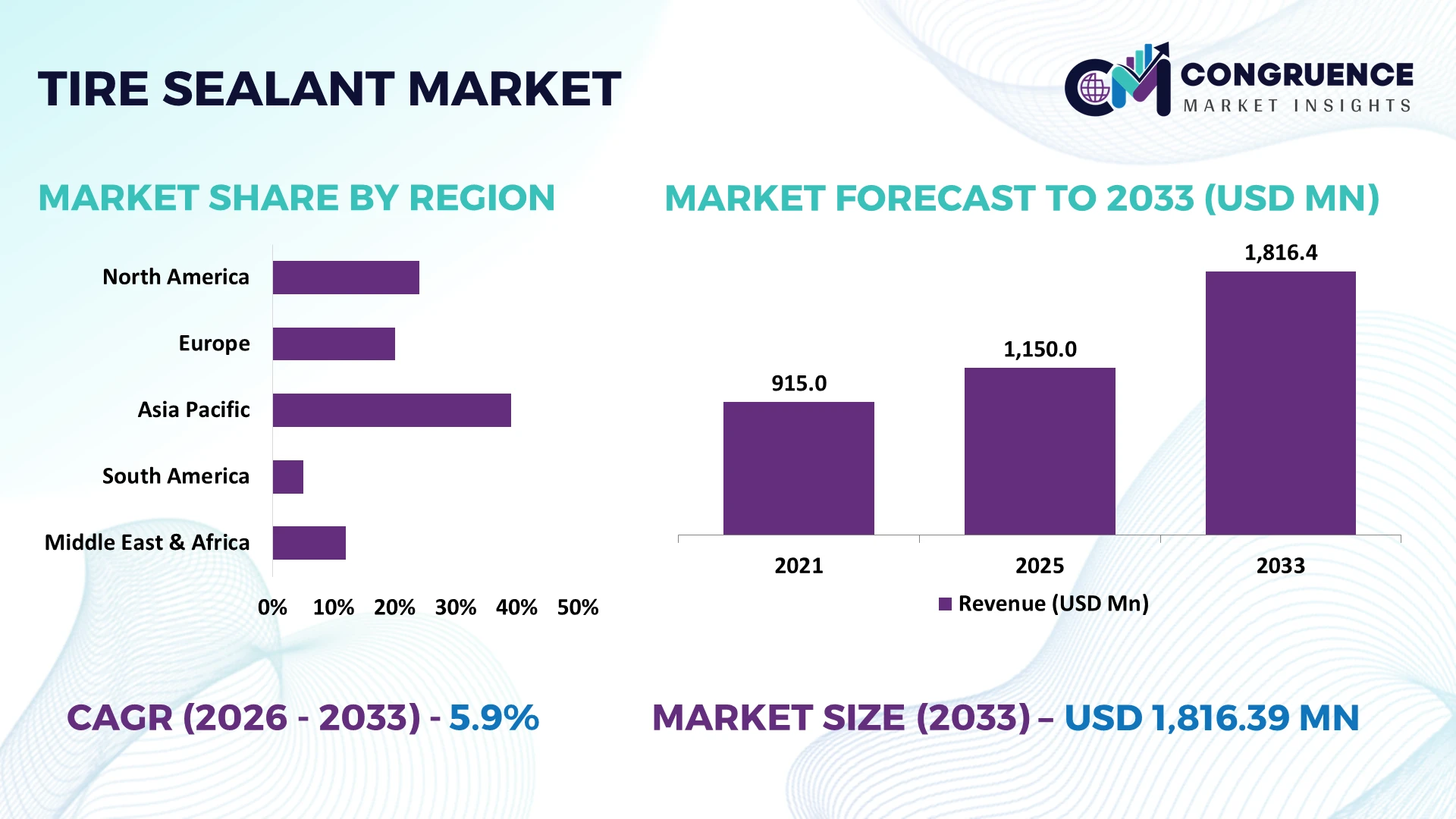
The United States leads the Tire Sealant Market with an estimated 30% global share, supported by approximately 16.3 million annual light-vehicle sales and a replacement-tire market exceeding 200 million units. China, despite producing more than 30 million vehicles annually, remains more fragmented in aftermarket sealants. U.S. demand benefits from established automotive aftermarket, cycling, powersports, fleet, and roadside-mobility channels. Compared with China, the United States has stronger premium aftermarket penetration, while U.S.–China tariff and natural-rubber supply-chain pressures are encouraging manufacturers to diversify chemical inputs, packaging, and tire-service sourcing; North America represents roughly 35% of global sealant consumption.
Strategically, suppliers combining OEM-compatible formulations, TPMS-safe chemistry, puncture reliability, and localized raw-material sourcing are best positioned to capture higher-value automotive and mobility-kit contracts.
Market Size & Growth: USD 1.15 billion in 2025 advances toward USD 1.82 billion by 2033 at 5.88%, driven by spare-wheel deletion and tubeless mobility systems.
Top Growth Drivers: Tubeless tires support approximately 45% of demand, automotive applications exceed 55%, and aftermarket channels represent roughly 60% of sealant consumption.
Short-Term Forecast: By 2027, automated sealant dispensing and optimized dosing are positioned to reduce material waste by approximately 10–15% in high-volume tire-service workflows.
Emerging Technologies: TPMS-safe latex formulations, fiber-reinforced sealants and automated dosing systems increasingly target punctures approaching 6 mm while minimizing wheel-sensor contamination.
Regional Leaders: By 2033, North America approaches USD 636 million, Europe USD 491 million and Asia-Pacific USD 509 million, supported respectively by aftermarket, mobility-kit and vehicle-production adoption.
Consumer/End-User Trends: Automotive users generate above 55% of global demand as motorists increasingly prioritize temporary puncture repair without roadside wheel replacement.
Pilot/Case Example: In 2025, Continental's ContiSeal technology continued supporting automatic sealing of tread punctures up to 5 mm, reducing immediate roadside intervention requirements.
Competitive Landscape: Continental-associated sealing solutions hold approximately 10% of organized demand, alongside Slime, Stan's, Fix-a-Flat, and Orange Seal across automotive and cycling channels.
Regulatory & ESG Impact: Spare-wheel deletion can remove roughly 15–20 kg from a vehicle, supporting lower material consumption and improving vehicle mass efficiency by approximately 1%.
Investment & Funding: More than USD 100 million in combined tire-material and mobility-product expansion activity is supporting automated production, advanced compounds, and localized supply chains.
Innovation & Future Outlook: Next-generation sealants target 6–8 mm punctures, extended liquid life and TPMS compatibility, shifting competition toward preventive sealing rather than emergency-only repair.
The Tire Sealant Market is shifting toward preventive puncture protection across passenger vehicles, commercial fleets, bicycles, motorcycles and off-road mobility. Advanced latex, microfiber and TPMS-compatible formulations increasingly address punctures of approximately 6 mm while reducing roadside servicing. OEM spare-wheel deletion and volatile natural-rubber supply chains are strengthening demand for lightweight mobility kits, establishing the strategic context for technology and competitive analysis.
Tire sealants are becoming strategically important as automakers replace conventional spare-wheel systems with lighter mobility kits, creating recurring demand across OEM, aftermarket, fleet, cycling, and off-highway channels. In the United States, 28–36% of surveyed model-year vehicles were sold without spare tires, while roadside operations continue recording millions of flat-tire assistance events. This structural shift makes puncture-management capability an increasingly important vehicle-support component.
Technology is moving from emergency aerosol repair toward pre-applied, sensor-compatible sealing systems. Continental’s ContiSeal automatically seals about 80% of qualifying tread punctures up to 5 mm, eliminating the wheel-changing step for suitable damage; conventional mobility kits still require sealant injection, inflation, driving, and pressure rechecking. U.S. adoption also benefits from mandatory TPMS on model-year 2008-and-newer passenger vehicles, forcing suppliers to prioritize sensor-compatible chemistry.
Through 2026–2028, competition will intensify around 5–6 mm puncture capability, multi-year preventive formulations, TPMS compatibility, and automated dosing. Preventive sealants already address punctures approaching 6 mm and remain active for up to two years in specified applications. Suppliers are expanding application-specific chemistry and OEM integration rather than competing solely on emergency-repair price. Winning positions will combine dependable sealing, simplified roadside operation, electronics compatibility, and scalable distribution.
Automotive lightweighting is directly expanding tire-sealant deployment because mobility kits increasingly replace conventional spare-wheel assemblies. In the United States, 36% of surveyed 2015-model vehicles lacked a spare, versus only 5% in 2006; another assessment placed the share at 28% for 2017 models. Removing a spare, jack, and associated tools can eliminate more than 50 pounds of vehicle mass, strengthening manufacturers’ efficiency and packaging incentives. Integrated sealant technology reinforces this transition, with ContiSeal designed to automatically address approximately 80% of qualifying tread punctures up to 5 mm. Suppliers are therefore extending OEM-ready inflator kits, pre-applied sealing layers, and TPMS-compatible formulations. The strategic implication is significant: automotive lightweighting converts puncture management from an optional aftermarket purchase into an increasingly integrated component of vehicle mobility architecture.
Sealants remain structurally restricted by puncture location, damage severity, wheel condition, and sensor-service requirements. U.S. inflator-kit penetration reached 36% of surveyed 2015-model vehicles without conventional spares, yet these systems cannot address sidewall damage, blowouts, damaged rims, or many larger punctures. Approximately 20% of U.S. drivers have also been reported as unable to change a flat tire, increasing reliance on roadside solutions despite these technical limitations. TPMS compatibility adds another constraint because virtually all U.S. passenger cars, light trucks, and vans manufactured from model year 2008 onward require tire-pressure monitoring. Suppliers are reducing exposure through sensor-safe chemistry, clearer application specifications, and separate highway and off-highway formulations. Operationally, inconsistent damage coverage increases roadside-service requirements, warranty exposure, technician intervention, and potential tire replacement costs.
The strongest opportunity is the shift from one-time roadside repair toward continuously active puncture prevention across fleets, agriculture, ATVs, bicycles, and industrial mobility. Advanced preventive formulations can seal tread punctures approaching 6 mm and remain active for as long as two years in specified applications, transforming sealant into scheduled tire-maintenance material rather than an emergency-only purchase. Integrated tire technologies raise functionality further, with pre-applied sealant layers capable of automatically addressing approximately 80% of qualifying punctures up to 5 mm. Suppliers are developing bulk dispensing, fiber-reinforced chemistry, fleet-sized packaging, and factory-integrated sealing systems. The non-obvious opportunity lies in recurring maintenance economics: preventive dosing converts episodic consumer purchases into predictable fleet and equipment-service consumption, strengthening distributor retention while creating opportunities for volume-based maintenance contracts and automated replenishment programs.
Long-term scale depends on achieving consistent sealing across tire sizes, temperatures, speeds, valve architectures, TPMS hardware, and vehicle categories. Current products illustrate this fragmentation: some preventive formulations remain active for up to two years and address 6 mm punctures but are restricted to non-highway applications below 45 mph, while certain highway emergency formulations require removal within three days or 100 miles. Integrated sealing technologies covering approximately 80% of qualifying punctures still leave damage categories requiring conventional repair or replacement. Meanwhile, TPMS is standard across virtually all U.S. model-year 2008-and-newer passenger vehicles, making sensor compatibility operationally critical. Companies must invest in formulation validation, temperature stability, valve-safe delivery, standardized dosing, and technician training. Competitive durability depends on reducing application-specific restrictions while maintaining predictable sealing performance across increasingly diverse mobility platforms.
TPMS-Compatible Formulations Gain Priority: Tire sealant suppliers are reformulating products around sensor-safe chemistry as TPMS remains standard across virtually 100% of newer U.S. passenger vehicles. Current OE-compatible products seal punctures up to 6 mm, restore mobility within about 10 minutes, and permit onward travel approaching 200 km. Manufacturers are reducing valve-core removal, residue formation, and sensor contamination through lower-viscosity particle-gel formulations, improving service speed and reducing workshop cleanup.
OE Mobility Kits Become Smarter: Automotive repair kits are shifting from basic compressor-and-bottle assemblies toward electronically controlled dispensing systems. New sensor-integrated kits combine pressure monitoring, automated sealant delivery, and inflation control, reducing manual repair steps while eliminating spare-wheel storage requirements. Ford’s 2025 Explorer adopted inflator-and-sealant kits across its lineup, reinforcing OEM integration. Tier-1 suppliers are responding with compact compressors, snap-fit cartridges, and digitally controlled valves.
Performance Chemistry Moves Beyond Foam: Particle-gel, aramid-fiber, and pre-vulcanized natural-rubber technologies are replacing conventional foam-based sealing in higher-performance applications. Modern formulations handle approximately 6 mm punctures, operate across temperature windows approaching -40°C to 65°C, and can be up to 10 times thinner than some competing products. Suppliers are investing in dispersion stability and reinforced sealing particles to improve flow, cleanup, and storage consistency.
Replacement Cycles Create Recurring Demand: Sealant replacement is becoming a defined maintenance workflow rather than an emergency-only purchase. OE mobility-kit sealants commonly require replacement around every five years, while temporary applications can remain roadworthy for approximately 200 km after use. Service centers and retailers are expanding replacement-bottle programs, compatibility databases, and inspection services, converting installed mobility kits into recurring aftermarket demand.
Latex-Based tire sealants lead the market with an estimated 38% share because rapid coagulation, flexible film formation, and established manufacturing economics support automotive, bicycle, and off-road applications. Water-Based formulations account for approximately 24%, gaining preference where easier cleanup, lower odor, and reduced rim contamination matter operationally. Solvent-Based products retain about 15% share in applications requiring stronger adhesion and faster curing, although handling and environmental requirements limit wider adoption. Synthetic Rubber-Based formulations hold approximately 14%, supported by temperature stability and reinforced puncture sealing.
Bio-Based sealants are the fastest-growing type as suppliers increase renewable natural-rubber content and reduce dependence on petroleum-intensive chemistry. Recent pre-vulcanization research has demonstrated improved natural-rubber latex rheology, mechanical film strength, and puncture-sealing performance, strengthening its viability beyond niche eco-positioning. Manufacturers are consequently developing low-toxicity carriers, renewable polymers, particle reinforcement, and TPMS-compatible chemistry. Investment is shifting toward formulations combining 5–6 mm puncture capability with easier cleanup and longer storage stability, because buyers increasingly evaluate total serviceability rather than sealing strength alone.
Passenger Cars represent the largest tire sealant application with approximately 46% share, driven by OEM mobility kits, TPMS integration, compact vehicle packaging, and replacement-bottle demand. Commercial Vehicles account for roughly 21%, where fleet downtime and roadside interruption make puncture management operationally important. Motorcycles represent about 12%, while Bicycles hold approximately 13%, supported by tubeless mountain, gravel, and performance cycling. Off-Road Vehicles account for the remaining share, with sealants used extensively where puncture exposure exceeds normal highway conditions.
Bicycles are the fastest-growing application as tubeless-ready rims, wider tires, gravel riding, and preventive sealant dosing become mainstream among performance users. Passenger-car demand remains structurally stronger in absolute deployment because multiple OEMs now supply compressor-and-sealant kits instead of conventional spares. Suppliers are adapting through bicycle-specific low-viscosity products, larger commercial-vehicle containers, high-fiber off-road formulations, and OE-compatible passenger-car cartridges. The operational distinction is widening: automotive buyers prioritize temporary mobility and TPMS compatibility, whereas bicycle and off-road users increasingly demand continuous preventive sealing during normal operation.
Individual Vehicle Owners account for approximately 43% of tire sealant demand because passenger cars, motorcycles, bicycles, and personal off-road vehicles collectively create the largest installed user base. Automotive Service Centers represent around 19%, supported by replacement cartridges, post-sealant inspection, TPMS cleaning, and permanent tire repair. Tire Repair Shops contribute approximately 16%, while Fleet Operators account for roughly 14% through commercial vans, delivery vehicles, and service fleets. Agricultural Operators hold the remaining share but consume comparatively larger quantities per application across tractors, trailers, and utility equipment.
Fleet Operators are the fastest-growing end-user group because puncture prevention directly affects vehicle availability, technician labor, route continuity, and roadside-service costs. Suppliers are targeting fleets with bulk packaging, preventive formulations, automated dosing, and service contracts instead of consumer-sized emergency bottles. Agricultural buyers are also moving toward long-life, fiber-reinforced sealants for low-speed equipment. Individual owners remain highly price-sensitive, whereas service centers increasingly prioritize OE compatibility and cleanup efficiency. Competitive positioning is therefore shifting toward channel-specific pack sizes, maintenance programs, and technical support rather than one universal formulation.
North America accounted for the largest market share at 35% in 2025 however, Asia-Pacific is expected to register the fastest growth, expanding at a CAGR of 7.2% between 2026 and 2033.
Spare-Tire Deletion Reshapes Roadside Mobility
North America holds approximately 35% of global tire sealant demand, supported by high passenger-vehicle ownership, established automotive aftermarket distribution, commercial fleets, recreational vehicles, and performance cycling. U.S. automakers increasingly use tire mobility kits to reduce vehicle weight and free packaging space, embedding sealant cartridges within vehicle service architecture. Virtually 100% of U.S. passenger vehicles produced from model year 2008 onward incorporate TPMS, making sensor-safe chemistry essential for replacement products. Integrated technologies such as ContiSeal can automatically address approximately 80% of qualifying tread punctures up to 5 mm. Suppliers including ITW Global Brands and Continental compete through OEM-compatible formulations, retail availability, extended shelf life, and faster inflation workflows. Replacement cartridges also create recurring aftermarket activity as factory mobility-kit sealants reach defined expiration intervals.
United States Market Outlook: The United States anchors regional consumption through more than 16 million annual light-vehicle sales, extensive highway travel, large delivery fleets, and mature automotive service networks. Growing spare-wheel deletion strengthens demand for compact inflator-and-sealant systems, while federal TPMS requirements make valve and sensor compatibility a decisive product qualification. Retailers and service providers increasingly maintain vehicle-specific replacement cartridges rather than universal emergency products.
Lightweighting Strengthens Factory-Fitted Sealant Systems
Europe accounts for approximately 27% of global Tire Sealant Market demand, supported by stringent vehicle-efficiency requirements, compact vehicle architectures, mature tire manufacturing, and strong cycling penetration. Germany, France, Italy, and the United Kingdom represent important automotive replacement markets, while Continental's manufacturing and tire-technology ecosystem strengthens integrated sealing deployment. European OEMs increasingly substitute spare-wheel assemblies with mobility kits, eliminating approximately 15–25 kg of associated tire, wheel, jack, and tooling weight depending on configuration. ContiSeal technology addresses tread penetrations up to approximately 5 mm without immediate roadside intervention, demonstrating the region's movement beyond bottled emergency products. Suppliers are prioritizing low-residue formulations, recyclable packaging, extended cartridge life, and compatibility with increasingly sophisticated wheel electronics. EU vehicle-efficiency requirements reinforce lightweighting, while mature workshop networks create structured replacement and inspection channels for expired or previously deployed sealants.
Germany Market Outlook: Germany combines major vehicle manufacturers, Continental's tire technology capabilities, sophisticated aftermarket distribution, and stringent technical standards. More than 2.8 million passenger cars were newly registered during 2024, maintaining a substantial addressable base for OE mobility systems and replacement cartridges. German suppliers benefit from proximity to vehicle engineering teams, accelerating validation of sealant chemistry, compressors, TPMS interfaces, and factory-fitted tire technologies.
Vehicle Scale Accelerates Localized Sealant Production
Asia-Pacific represents approximately 25% of global tire sealant demand, with China, India, Japan, and South Korea providing exceptional automotive and two-wheeler scale. China manufactured more than 31 million vehicles in 2024, while India produced approximately 6 million motor vehicles, creating substantial OE and replacement opportunities for puncture-management products. India's two-wheeler ecosystem adds another application layer, particularly for preventive sealants used with tubeless tires. Local manufacturers increasingly compete on smaller pack sizes and application-specific formulations, while international suppliers target premium passenger vehicles and advanced mobility kits. China's extensive tire-production infrastructure supports localized compound development, packaging, and distribution, reducing dependence on imported finished sealants. Suppliers are investing in water-based formulations, automated filling, motorcycle-specific products, and e-commerce distribution. Scale increasingly favors companies capable of adapting chemistry and pricing to sharply different passenger-car, motorcycle, bicycle, and off-road requirements.
China Market Outlook: China offers the strongest regional manufacturing advantage, producing more than 31 million vehicles in 2024 and maintaining the world's largest automotive production ecosystem. Its dense tire, rubber, chemical, packaging, and automotive-component supply chains enable localized sealant manufacturing at scale. Increasing electric-vehicle penetration also reinforces vehicle-weight optimization, creating additional relevance for compact mobility kits where spare-wheel deletion improves packaging flexibility.
Fleet and Agricultural Applications Support Demand
South America contributes approximately 7% of global tire sealant demand, with Brazil providing the strongest automotive, agricultural, motorcycle, and off-highway application base. Brazil produced approximately 2.5 million vehicles in 2024 and operates one of the world's largest commercial agricultural machinery environments, supporting demand beyond passenger-car emergency kits. Preventive sealants provide particular operational value for tractors, utility vehicles, motorcycles, and equipment working on unpaved surfaces where punctures create expensive downtime. Argentina contributes agricultural and commercial-fleet demand but faces greater imported-component and currency constraints. Suppliers are therefore emphasizing bulk containers, fiber-reinforced products, locally sourced packaging, and distributor partnerships rather than relying exclusively on consumer aerosol products. The principal limitation remains fragmented service infrastructure outside major urban centers; however, that same constraint increases the practical value of self-sealing products for remotely operated equipment.
Brazil Market Outlook: Brazil combines approximately 2.5 million vehicles of annual production with more than 30 million motorcycles in circulation and extensive mechanized agriculture. These operating conditions create distinct demand for highway-compatible emergency products and preventive off-road formulations. Local distributors increasingly differentiate products by tire size, vehicle duty cycle, operating temperature, and puncture exposure, supporting more specialized rather than universal sealant portfolios.
Harsh-Duty Mobility Drives Specialized Formulations
Middle East & Africa represents approximately 6% of global tire sealant demand, with the UAE, Saudi Arabia, South Africa, and major African mining and agricultural economies generating differentiated requirements. High ambient temperatures, long-distance road networks, construction fleets, off-road tourism, mining equipment, and agricultural vehicles create demanding puncture-management conditions. Saudi Arabia's expanding logistics and construction ecosystem is increasing commercial-fleet utilization, while the UAE provides a concentrated premium passenger and off-road vehicle base. Sealant suppliers must engineer formulations for temperature stability, extended storage, larger tire volumes, and severe tread exposure rather than simply transferring temperate-market products. South Africa adds mature automotive aftermarket and mining channels. Companies are strengthening distributor inventories, bulk-format availability, and fleet-service relationships, because remote operations place greater economic value on puncture prevention and reduced roadside intervention than urban consumer applications.
Saudi Arabia Market Outlook: Saudi Arabia's logistics modernization, infrastructure construction, mining development, and expanding domestic automotive ambitions create a strategically important tire-service environment. Commercial vehicles routinely operate across high-temperature, long-distance routes where downtime carries significant operating costs. Suppliers targeting the Kingdom increasingly require heat-stable chemistry, larger commercial packs, reliable distributor inventories, and products suited to highway fleets, construction equipment, and off-road applications.
ITW Global Brands, Continental, Stan’s NoTubes, Orange Seal and Berryman compete across distinct tire-sealant channels, with automotive suppliers challenging cycling specialists and chemical formulators targeting price-sensitive aftermarket users. The top five players collectively account for approximately 32% of organized demand, leaving substantial space for regional brands and private labels. ITW competes through Slime and Fix-a-Flat distribution strength, while Continental differentiates through factory-integrated sealing technology. Premium formulations capable of addressing 5–6 mm punctures command stronger positioning than basic emergency products, while preventive products lasting up to two years improve replacement economics. Companies are expanding TPMS-safe chemistry, fiber reinforcement, OEM partnerships, bulk fleet packaging and e-commerce availability. Competition is shifting from aerosol convenience toward preventive sealing, integrated mobility kits and application-specific formulations. Formulation stability, vehicle compatibility and trusted distribution create entry pressure. Winning requires verified sealing performance, sensor compatibility, competitive unit economics and channel-specific products backed by reliable supply and replacement support globally.
ITW Global Brands
Continental AG
Stan’s NoTubes
Orange Seal
Berryman Products
Ride-On
MULTI SEAL
LiquiTube
OKO Global
AirMan
TECH Tire Repairs
Muc-Off
Finish Line
Vittoria Industries
Current tire sealant technology centers on latex and particle-fiber formulations that coagulate around punctures without wheel removal. Continental’s integrated ContiSeal layer automatically addresses about 80% of punctures and closes tread damage up to 5 mm. Preventive liquid systems extend capability to approximately 6 mm, while TPMS-safe chemistry reduces sensor-service complications. These technologies improve roadside mobility and reduce dependence on spare-wheel assemblies.
Emerging formulations combine synthetic fibers, optimized particle distributions, water-soluble carriers, and extended-life chemistry. Orange Seal Endurance can remain effective two to three times longer than standard formulations while sealing punctures approaching 6.35 mm. Compared with legacy inner-tube repair requiring wheel removal, self-sealing technology eliminates 100% of immediate wheel-changing steps for successfully sealed punctures. Automated injection systems further improve dosing consistency for workshops, fleets, and cycling users.
Disruptive development is moving toward factory-integrated self-sealing tires, recyclable silicone materials, and condition-specific formulations. Silicone-based sealing technology improves end-of-life separation compared with conventional difficult-to-remove compounds, strengthening tire recyclability. Between 2026 and 2028, suppliers will prioritize 5–6 mm sealing capability, multi-year stability, TPMS compatibility, and automated dispensing. OEM-linked manufacturers benefit most because integration during tire production creates stronger qualification barriers, recurring replacement demand, and defensible technology positioning.
March 2024 — Stan’s NoTubes refreshed its tubeless sealant packaging using bottles containing 30% post-consumer recycled material and added 54 ml to its one-liter format without increasing price, improving packaging circularity while delivering higher customer volume. Source: BRAIN
January 2024 — Orange Seal entered a multi-year partnership with Epic Rides as official tire sealant sponsor across three Arizona endurance mountain-bike events attracting more than 5,500 participants annually, expanding direct product exposure within performance tubeless cycling. Source: SGB
May 2025 — Continental continued deployment of ContiSeal technology, whose viscous internal sealing layer automatically fixes 80% of punctures and addresses tread penetrations up to 5 mm, strengthening factory-integrated puncture protection and reducing immediate roadside intervention requirements. Source: Continental
June 2026 — 9:24 Group partnered with Permaseal Global to introduce preventive tire-sealant technology across automotive dealerships and fleet operations; Permaseal targets punctures up to ½ inch, creating a service-based flat-prevention offering for commercial mobility customers. Source: 9:24 Group
The Tire Sealant Market Report evaluates Latex-Based, Water-Based, Solvent-Based, Synthetic Rubber-Based, and Bio-Based formulations across Passenger Cars, Commercial Vehicles, Motorcycles, Bicycles, and Off-Road Vehicles. Latex-Based products represent approximately 38% of demand, while Passenger Cars account for about 46% of application deployment. Technology coverage includes fiber-reinforced chemistry, TPMS-safe formulations, automated dispensing, preventive sealants, and factory-integrated self-sealing tire systems.
End-user analysis covers Individual Vehicle Owners, Fleet Operators, Automotive Service Centers, Tire Repair Shops, and Agricultural Operators across North America, Europe, Asia-Pacific, South America, and Middle East & Africa. Individual owners represent approximately 43% of current demand, while fleet adoption strengthens preventive applications. The 2026–2033 assessment evaluates competitive positioning, localization, OEM integration, puncture-performance requirements, sustainability shifts, and channel opportunities, supporting investment prioritization, geographic expansion, product development, partnership strategy, and long-term portfolio planning.
| Report Attribute/Metric | Report Details |
|---|---|
Market Revenue in 2025 | USD 1150 Million |
Market Revenue in 2033 | USD 1816.39 Million |
CAGR (2026 - 2033) | 5.88% |
Base Year | 2025 |
Forecast Period | 2026 - 2033 |
Historic Period | 2021 - 2025 |
Segments Covered | By Type
By Application
By End-User
|
Key Report Deliverable | Revenue Forecast, Growth Trends, Market Dynamics, Segmental Overview, Regional and Country-wise Analysis, Competition Landscape |
Region Covered | North America, Europe, Asia-Pacific, South America, Middle East, Africa |
Key Players Analyzed | ITW Global Brands, Continental AG, Stan’s NoTubes, Orange Seal, Berryman Products, Ride-On, MULTI SEAL, LiquiTube, OKO Global, AirMan, TECH Tire Repairs, Muc-Off, Finish Line, Vittoria Industries |
Customization & Pricing | Available on Request (10% Customization is Free) |




