
Reports
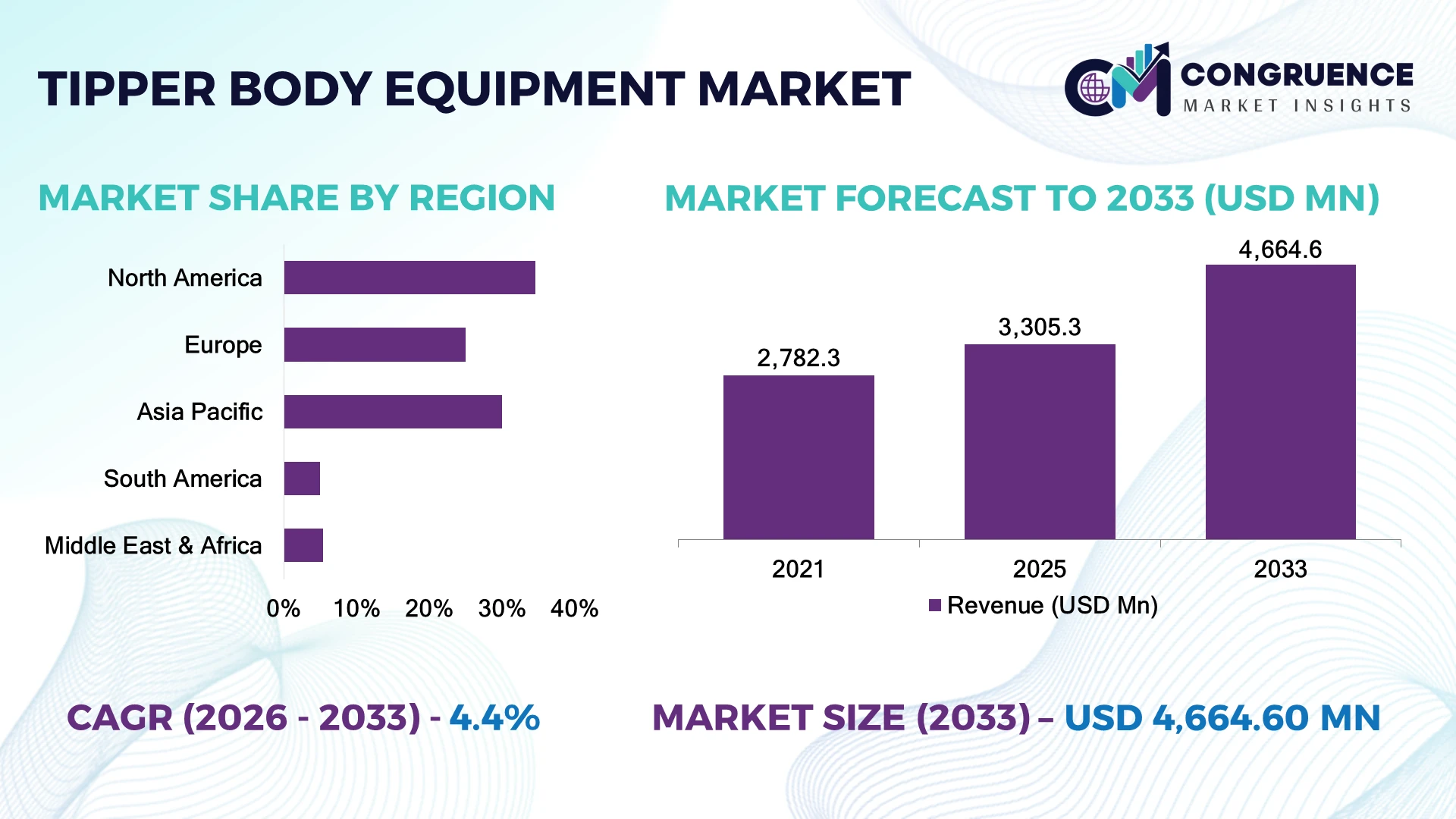
The Global Tipper Body Equipment Market was valued at USD 3,305.3 Million in 2025 and is anticipated to reach a value of USD 4,664.6 Million by 2033 expanding at a CAGR of 4.4% between 2026 and 2033. Growth is being driven by higher payload requirements, infrastructure-led material movement, mining fleet modernization, and adoption of lightweight hydraulic tipping systems.
India is emerging as a high-growth manufacturing and deployment hub, supported by ₹6.38 lakh crore allocated across 115 National Highway and road projects evaluated under PM Gati Shakti by March 2025. India’s 25–40-ton tipper segment represented about 85% of domestic demand in FY2026, compared with 33% in FY2019, while geopolitical supply-chain tensions are accelerating localization of construction equipment.
Strategic implication: suppliers with localized manufacturing, lightweight bodies, automated hydraulics, and fleet-linked technology are best positioned to capture replacement and expansion demand.
Market Size & Growth: USD 3,305.3 million in 2025 to USD 4,664.6 million by 2033 at 4.4% CAGR, supported by infrastructure construction and mining fleet modernization.
Top Growth Drivers: Infrastructure investment 34%, mining activity 27%, fleet replacement 21%.
Short-Term Forecast: By 2028, lightweight body adoption is positioned to reduce vehicle weight 8–12% and improve payload efficiency 5–9%.
Emerging Technologies: Telematics, AI-based maintenance, automated hydraulics, and high-strength steel are raising operational visibility and tipping precision.
Regional Leaders: Asia-Pacific leads at about 36% share, North America near 30%, and Europe around 20%, with Asia-Pacific showing the strongest fleet modernization.
Consumer/End-User Trends: Construction and mining operators increasingly prioritize high-capacity bodies, with 25–40-ton tippers representing about 85% of India’s market.
Pilot/Case Example: 2025 advanced tipper deployments introduced automated transmission, electric powertrains, and factory-fitted CNG configurations, targeting measurable reductions in operating energy costs.
Competitive Landscape: Tata Motors holds a strong position in India, competing with Ashok Leyland, Daimler Truck, Volvo, Komatsu, and specialized body manufacturers on payload, uptime, durability, and lifecycle cost.
Regulatory & ESG Impact: Alternative-fuel and electric tipper adoption is accelerating, with electric operating costs reported at roughly 60–70% below comparable diesel use in Indian demonstrations.
Investment & Funding: A $100 million Indian truck-body expansion program is adding four manufacturing units, emphasizing automation and proximity to OEM production hubs.
Innovation & Future Outlook: Lightweight aluminum, high-strength steel, connected hydraulics, predictive maintenance, and electric tipping platforms are shifting investment toward payload optimization and total cost of ownership.
The Tipper Body Equipment Market is shifting toward high-capacity mining and construction bodies, lightweight structures, automated hydraulic systems, and connected fleet monitoring. Electric and CNG configurations are expanding the technology mix, while India’s 85% concentration in the 25–40-ton segment demonstrates the commercial importance of payload optimization. Supply-chain localization and tighter axle-load economics are pushing manufacturers toward modular production and regionally sourced components, setting up the strategic discussion around cost, uptime, and fleet productivity.
Tipper body equipment is becoming strategically important because payload utilization, unloading speed, durability, and vehicle uptime increasingly determine fleet economics in construction, mining, quarrying, and infrastructure logistics. In India, the shift toward 25–40-ton configurations has materially changed equipment specifications, while PM Gati Shakti is integrating road, rail, and logistics planning across major infrastructure corridors.
Technology is also changing the cost equation. Lightweight high-strength bodies can reduce structural weight by roughly 8–12% compared with conventional designs, creating additional payload capacity without proportionally increasing vehicle size. Automated hydraulic controls and telematics further improve cycle consistency and maintenance visibility. North America emphasizes advanced fleet monitoring and high-capacity dump applications, while India and China prioritize scalable manufacturing and ruggedized bodies for infrastructure and mining.
Over the next 2–3 years, manufacturers are prioritizing modular body platforms, predictive maintenance, alternative-fuel compatibility, and localized component sourcing. Tata Motors’ 2025 launch of deep-mining, electric, and CNG tippers illustrates this transition from conventional body supply toward integrated productivity solutions. Competitive advantage will increasingly depend on combining payload efficiency, manufacturing scale, digital monitoring, and low operating cost rather than body fabrication alone.
India’s shift toward higher-capacity construction and mining tippers is strengthening demand for engineered bodies that maximize payload without breaching axle-load limits. The 25–40-ton category accounts for approximately 85% of Indian tipper demand, while lightweight body structures can reduce tare weight by 8–12%. Connected hydraulic systems are also improving tipping-cycle consistency by roughly 5–8%. The transition toward Bharat Stage VI-compliant fleets is accelerating replacement of older equipment and increasing demand for compatible body systems. Manufacturers are responding through high-strength steel, modular fabrication, and OEM partnerships. The strategic advantage is clear: reducing structural weight while preserving durability directly increases payload productivity and lowers cost per transported tonne.
Volatility in steel, hydraulic components, and imported cylinders continues to pressure tipper body margins, particularly for manufacturers dependent on concentrated supplier networks. Steel typically represents 35–45% of body manufacturing cost, while imported hydraulic and control components can account for 15–20% of system value. In India, currency fluctuations and disruptions affecting global metal and component flows increase procurement uncertainty and extend production planning cycles. Longer lead times of 10–20% can delay vehicle body integration and customer deliveries. Manufacturers are responding by qualifying multiple steel mills, localizing hydraulic assemblies, and negotiating indexed supply contracts. The operational priority is protecting delivery reliability without sacrificing material strength or increasing body weight.
The strongest opportunity lies in combining lightweight structures with telematics-enabled hydraulic systems and predictive maintenance. High-strength steel can deliver approximately 8–12% weight savings, while sensor-based hydraulic monitoring can reduce unplanned equipment downtime by 10–15%. India, Indonesia, and Saudi Arabia offer attractive deployment opportunities as construction, mining, and logistics operators modernize heavy-duty fleets. Electric and alternative-fuel tippers create an additional requirement for optimized body weight because every kilogram saved improves usable payload and operating efficiency. Manufacturers are investing in modular platforms, digital diagnostics, and OEM integration rather than selling fabricated bodies independently. The non-obvious opportunity is recurring aftermarket revenue from connected maintenance, component replacement, and fleet-performance services.
Integrating smart tipping bodies across mixed fleets remains a major execution challenge because hydraulic architectures, chassis interfaces, telematics protocols, and payload-control systems differ substantially between OEM platforms. Integration engineering can add 5–10% to development effort, while inconsistent sensor calibration can reduce data reliability by 10–15%. In mining environments, vibration, dust, and extreme loading further increase component stress and maintenance requirements. India’s expanding connected-fleet ecosystem is therefore forcing body manufacturers to standardize interfaces without limiting OEM-specific configurations. Companies are investing in modular electrical architectures, ruggedized sensors, technician training, and joint validation programs with truck manufacturers. Long-term competitiveness will depend on delivering interoperable systems that maintain accurate payload and hydraulic data under severe operating conditions.
Lightweight Structures Gain Priority: High-strength steel and optimized cross-sections are reducing tipper body weight by 8–12% while maintaining structural durability. Indian manufacturers are increasingly engineering bodies around payload-to-weight ratios rather than maximum structural thickness, improving payload efficiency by approximately 5–9%. This shift is strengthening demand for automated fabrication and material-optimization software.
Smart Hydraulics Enter Fleets: Sensor-equipped hydraulic systems are moving from premium deployments toward mainstream heavy-duty applications, with predictive monitoring capable of reducing unplanned downtime by 10–15%. Fleet operators are integrating pressure, temperature, and cycle-time data into telematics platforms. Manufacturers are responding with electronically controlled tipping systems and service partnerships that improve maintenance scheduling.
Alternative-Fuel Tippers Reshape Bodies: Electric and CNG truck platforms are changing body specifications because battery or fuel-system weight affects usable payload. Optimized body designs can recover approximately 4–7% of payload capacity, while electric tipping systems reduce hydraulic energy losses by roughly 5–10%. OEMs are increasingly co-developing body configurations rather than treating the body as an independent attachment.
Localized Supply Chains Accelerate: Geopolitical trade disruptions and component shortages are encouraging Indian and Southeast Asian manufacturers to localize steel processing, hydraulic assemblies, and fabricated subcomponents. Localization can shorten selected procurement cycles by 15–25% and reduce exposure to currency volatility. Companies are expanding regional supplier networks and dual-sourcing critical components to protect production continuity and delivery schedules.
Rigid tipper bodies represent the leading type at approximately 62% market share, supported by structural durability, high payload tolerance, and straightforward integration with heavy-duty truck chassis. Their established fabrication ecosystem gives operators lower replacement complexity than specialized configurations. Lightweight high-strength steel variants are expanding fastest, with adoption increasing by roughly 10–12% as fleet owners prioritize payload efficiency and fuel economics. Conventional steel bodies remain important for quarrying and construction, while aluminum and hybrid structures are gaining selective traction where tare-weight reduction has higher commercial value.
The segment shift is pushing manufacturers toward modular body platforms, reinforced stress zones, and optimized thickness profiles. High-strength designs can reduce body weight by 8–12% while retaining required load performance. Companies are increasing investment in automated welding, finite-element design, and OEM integration to shorten customization cycles. The business implication is a gradual shift from volume fabrication toward engineered payload optimization, making material efficiency and lifecycle durability key purchasing criteria.
The International Council on Mining and Metals reported in 2025 that mining companies continue prioritizing equipment productivity and operational efficiency, reinforcing the commercial case for higher-payload heavy-duty transport equipment.
Construction applications account for approximately 54% of tipper body equipment demand, reflecting sustained use across road building, excavation, aggregates, and material hauling. Mining is the fastest-growing application, expanding its equipment specification toward higher payload, reinforced bodies, and automated tipping systems. Mining deployments increasingly require bodies capable of handling severe abrasion and repeated high-cycle loading, while construction buyers prioritize versatility and lower acquisition cost.
Mining-related demand is strengthening at roughly 9–11% adoption growth as operators modernize haulage fleets and deploy connected payload monitoring. Construction remains more mature, with standardized body configurations representing nearly 65% of purchases, whereas mining increasingly favors customized engineering. Manufacturers are responding with abrasion-resistant liners, modular reinforcement, telematics integration, and OEM-specific mounting systems. The operational implication is clear: construction rewards standardized scale, while mining rewards engineering depth, durability, and uptime performance, shifting supplier investment toward application-specific platforms.
The International Mining organization highlighted in 2026 that mine operators are accelerating digitalization and equipment productivity programs, increasing emphasis on connected mobile equipment and measurable fleet performance.
Construction contractors represent approximately 48% of end-user demand because of their large installed base of rigid tippers and recurring requirements for road, building, and infrastructure projects. Mining companies form the fastest-growing buyer group, supported by heavier payload requirements and fleet modernization. Their purchasing criteria emphasize body durability, cycle time, payload monitoring, and maintenance availability more heavily than contractor fleets.
Mining operators are increasing deployment of reinforced and digitally monitored bodies, with connected-equipment adoption approaching 25–30% across larger organized fleets. Contractors remain more price-sensitive, with standardized configurations accounting for about 60% of purchases, while mining buyers accept higher customization premiums for productivity gains. Quarry operators and municipal fleets occupy smaller but strategically relevant niches, particularly where localized material hauling requires specialized dimensions. Manufacturers are therefore developing tiered product portfolios, service contracts, and OEM partnerships. Competitive positioning increasingly depends on matching body architecture and lifecycle support to the intensity of each operating environment.
The U.S. National Stone, Sand & Gravel Association reported in 2025 that aggregates producers continued investing in equipment modernization and productivity improvements, supporting demand for durable heavy-haul transport solutions.
North America accounted for the largest market share at 34.6% in 2025 however, Asia-Pacific is expected to register the fastest growth, expanding at a CAGR of 5.3% between 2026 and 2033.
Fleet modernization is shifting demand toward lightweight, high-cycle bodies
North America retains a leading position through heavy-duty construction, mining, aggregates, and municipal fleet replacement. The region represents approximately 34.6% of global demand, supported by established truck manufacturing and sophisticated aftermarket networks. U.S. operators increasingly prioritize aluminum and high-strength steel bodies that reduce tare weight while maintaining payload durability. Telematics-linked fleet management is also strengthening equipment utilization, with connected commercial-vehicle deployment exceeding 70% across larger fleets. Canada contributes through mining and infrastructure applications, while U.S. demand remains concentrated in construction and quarrying. Manufacturers are responding with modular body platforms, hydraulic optimization, and dealer-led customization. The competitive advantage is shifting from basic fabrication toward payload efficiency, lifecycle durability, and rapid replacement support.
United States Market Outlook: The United States remains the regional production and purchasing center, supported by large construction fleets, aggregate operations, and extensive highway investment. More than 20% of commercial construction fleets now incorporate connected asset-monitoring functions, strengthening demand for electronically integrated tipping equipment and predictive maintenance capabilities.
Lightweight engineering and emissions compliance are reshaping body specifications
Europe emphasizes payload optimization, durability, and regulatory compliance as fleet operators modernize construction and municipal vehicles. Germany, France, Italy, and the United Kingdom anchor demand through established commercial-vehicle manufacturing and specialized bodybuilding ecosystems. Lightweight steel, aluminum structures, corrosion-resistant coatings, and automated hydraulic controls are gaining traction, particularly where urban restrictions constrain operating efficiency. Electric and alternative-power trucks are also creating requirements for lighter bodies because every kilogram recovered from body weight improves usable payload. Manufacturers are increasingly integrating body design with chassis electronics and fleet-management systems. Approximately 25% of newly specified premium tipper bodies increasingly incorporate enhanced corrosion protection or lightweighting measures, supporting longer service intervals and lower lifecycle costs.
Germany Market Outlook: Germany holds strategic importance through advanced truck manufacturing, precision fabrication, and engineering-intensive construction fleets. Its industrial base supports rapid adoption of automated welding, digitally controlled hydraulic systems, and high-strength materials. More than 30% of new specialized commercial-body configurations increasingly emphasize weight reduction or modular engineering, reinforcing Germany’s role as a technology-led manufacturing hub.
Manufacturing scale is accelerating localized body production
Asia-Pacific combines high-volume truck production with expanding construction, mining, logistics, and infrastructure activity. China, India, Japan, South Korea, and Australia represent the principal demand centers, while China and India provide substantial manufacturing capacity. The region accounts for roughly 30% of global demand, with India recording particularly strong uptake of locally engineered tipper bodies for quarrying, roadbuilding, and urban infrastructure projects. Chinese manufacturers increasingly combine standardized platforms with application-specific fabrication, reducing lead times by approximately 15% in high-volume configurations. Producers are expanding regional component sourcing and hydraulic-system partnerships to control costs and improve availability. The strategic shift favors suppliers capable of combining low-cost manufacturing with durable, fleet-specific engineering.
China Market Outlook: China remains the region’s largest industrial base, supported by extensive truck manufacturing, steel availability, mining operations, and infrastructure construction. Domestic production enables shorter component cycles and localized customization. Automated fabrication and high-strength steel adoption are increasingly used to reduce structural weight by roughly 8–12%, improving payload utilization across high-cycle construction fleets.
Mining and infrastructure fleets are driving heavy-duty specifications
South America is shaped by mining, aggregates, agriculture, and road infrastructure, with Brazil accounting for the largest equipment concentration. Demand favors high-capacity steel bodies engineered for abrasive materials, uneven haul routes, and intensive operating cycles. Brazil and Chile remain particularly important because mining fleets require reinforced bodies, hydraulic reliability, and rapid aftermarket servicing. Approximately 20% of specialized tipper-body demand is linked to mining and quarrying applications, creating stronger requirements for wear-resistant liners and reinforced floors. Currency volatility and imported hydraulic components remain operational pressure points, encouraging manufacturers to localize fabrication and establish regional supplier contracts. Companies with local repair networks and configurable body platforms gain an advantage over purely imported solutions.
Brazil Market Outlook: Brazil combines large construction, mining, agricultural, and roadbuilding fleets with an established commercial-vehicle manufacturing ecosystem. Domestic fabrication reduces dependence on imported structures and supports faster customization. More than 25% of heavy-duty body specifications increasingly emphasize reinforced floors, abrasion resistance, or localized component sourcing, strengthening Brazil’s position as South America’s principal production and demand center.
Infrastructure spending is favoring high-capacity, ruggedized equipment
The Middle East & Africa market is increasingly concentrated around construction megaprojects, quarrying, mining, and oilfield-support logistics. Saudi Arabia, the United Arab Emirates, South Africa, and Nigeria are key operating centers, with procurement increasingly favoring high-capacity bodies, reinforced chassis interfaces, and corrosion-resistant structures. Saudi infrastructure programs are accelerating fleet deployment, while African mining operations prioritize durability under severe operating conditions. Approximately 18% of regional demand is associated with mining and quarrying applications, where abrasion-resistant body configurations command greater specification intensity. Manufacturers are responding through distributor partnerships, localized assembly, and spare-parts stocking. The strongest competitive position comes from combining rugged engineering with dependable regional service rather than competing solely on purchase price.
Saudi Arabia Market Outlook: Saudi Arabia is the region’s strongest investment-led market, supported by large-scale infrastructure, urban development, mining, and logistics projects. Fleet procurement increasingly favors high-payload configurations and electronically monitored hydraulic systems. Construction and infrastructure programs are driving sustained replacement activity, while local distribution partnerships shorten service response times and improve equipment availability for high-utilization fleets.
The Tipper Body Equipment market pits integrated body-and-hydraulic specialists such as Hyva and MEILLER against regional fabricators, truck-body manufacturers, and steel-led engineering suppliers such as SSAB-backed builders. The top five participants collectively hold an estimated 28% share, leaving substantial volume for regional specialists competing through customization and cost. Price remains decisive in approximately 40% of procurement decisions, while payload optimization and durability influence nearly 35%; delivery speed affects about 20%. Leaders are expanding modular platforms, partnering with steel and hydraulic suppliers, and integrating fabrication with chassis-specific engineering. Regional manufacturers counter with localized production, shorter lead times, and application-specific bodies for mining, construction, and municipal fleets. The competitive shift is toward lightweight high-strength steel, hydraulic integration, and lifecycle efficiency rather than basic fabrication. Entry barriers center on engineering validation, fabrication capacity, OEM compatibility, and service networks. Winning requires combining payload efficiency, rapid customization, reliable components, and localized after-sales support.
Hyva
MEILLER
JOST Werke
Palfinger
Schmitz Cargobull
Kögel Trailer
TIRSAN
Wielton
SSAB
Prabha Automotive Engineers
TIVAPL
Chaphekar Engineering
BlueRock Tippers
Himalaya Enterprises
High-strength wear-resistant steel, lightweight aluminum, and optimized structural design are reshaping current tipper body engineering. Advanced steel configurations can reduce body weight by about 30–35% while extending service life by roughly 20–40% in abrasive applications. Adoption is strongest in mining, quarrying, and construction fleets where payload utilization directly affects operating economics. Compared with conventional mild-steel bodies, optimized high-strength structures deliver approximately 15–25% better payload efficiency, giving premium fabricators an advantage in high-cycle operations.
Hydraulic optimization is moving from standalone tipping hardware toward integrated electro-hydraulic control, load sensing, and electronically monitored cylinders. These systems can improve tipping-cycle efficiency by 5–10% and reduce hydraulic energy losses by around 3–7%. Connected diagnostics are gaining traction among larger fleet operators, with deployment approaching 25% in technology-oriented heavy-duty fleets. Manufacturers benefit through predictive maintenance, reduced downtime, and more precise body-chassis integration, while fleet owners gain improved utilization and service planning.
Between 2026 and 2028, digital body configuration, automated welding, robotic fabrication, and sensor-enabled load monitoring will become more commercially important. Automated fabrication can improve production consistency by 10–15%, while digital engineering shortens configuration cycles by approximately 10%. The strongest beneficiaries will be vertically integrated manufacturers and regional specialists combining advanced materials, hydraulic electronics, and localized customization.
February 2025 SSAB reported that International Trailer Company reduced tipper-body weight by 35% using Hardox 500 Tuf, while service life increased about 40%. The upgrade improved payload capacity and reduced fuel and tire costs for Saudi construction-waste operators. Source: ssab.com
January 2026 Hyva expanded application-focused tipping solutions with standardized body and hydraulic configurations, strengthening compatibility across truck chassis. Its modular approach supports faster specification and installation, helping fleet operators reduce configuration complexity and improve equipment availability across construction and municipal applications. Source: hyva.com
October 2025 BlueRock Tippers highlighted delivery of more than 5,000 commercial-vehicle bodies since establishment, supported by a modernized Gujarat facility using automated design, press-brake fabrication, MIG welding, and shot blasting. The capacity strengthens localized customization and shortens service response for Indian fleets. Source: bluerocktippers.com
June 2024 Himalaya Enterprises expanded heavy-duty fabrication capabilities across mining and construction applications, reporting more than 10,000 vehicles supported through its body-building operations. Its 95,000-square-foot facility strengthens production scalability, quality control, and application-specific engineering for Indian commercial fleets. Source: himalayaentp.com
The Tipper Body Equipment Market Report covers product configurations, body materials, lifting mechanisms, capacities, and application-specific designs serving construction, mining, quarrying, waste management, agriculture, and municipal operations. The analysis evaluates demand across light-, medium-, and heavy-duty platforms, with particular attention to high-capacity mining bodies, lightweight structures, reinforced bodies, and specialized hydraulic configurations. Regional coverage spans North America, Europe, Asia-Pacific, South America, and the Middle East & Africa, with country-level assessment of manufacturing concentration, fleet deployment, infrastructure activity, and localization.
The report also examines advanced high-strength steel, aluminum structures, electro-hydraulic systems, automated fabrication, telematics, load monitoring, and predictive maintenance. Competitive analysis covers established global manufacturers and regional body builders, with emphasis on customization, supply-chain resilience, payload optimization, and aftermarket capability. The 2026–2033 assessment supports investment planning, manufacturing expansion, partnership decisions, competitive positioning, and technology-led product strategy.
| Report Attribute/Metric | Report Details |
|---|---|
|
Market Revenue in 2025 |
USD 3,305.3 Million |
|
Market Revenue in 2033 |
USD 4,664.6 Million |
|
CAGR (2026 - 2033) |
4.4% |
|
Base Year |
2025 |
|
Forecast Period |
2026 - 2033 |
|
Historic Period |
2021 - 2025 |
|
Segments Covered |
By Type
By Application
By End-User
|
|
Key Report Deliverable |
Revenue Forecast, Growth Trends, Market Dynamics, Segmental Overview, Regional and Country-wise Analysis, Competition Landscape |
|
Region Covered |
North America, Europe, Asia-Pacific, South America, Middle East, Africa |
|
Key Players Analyzed |
Hyva, MEILLER, JOST Werke, Palfinger, Schmitz Cargobull, Kögel Trailer, TIRSAN, Wielton, SSAB, Prabha Automotive Engineers, TIVAPL, Chaphekar Engineering, BlueRock Tippers, Himalaya Enterprises |
|
Customization & Pricing |
Available on Request (10% Customization is Free) |




