
Reports
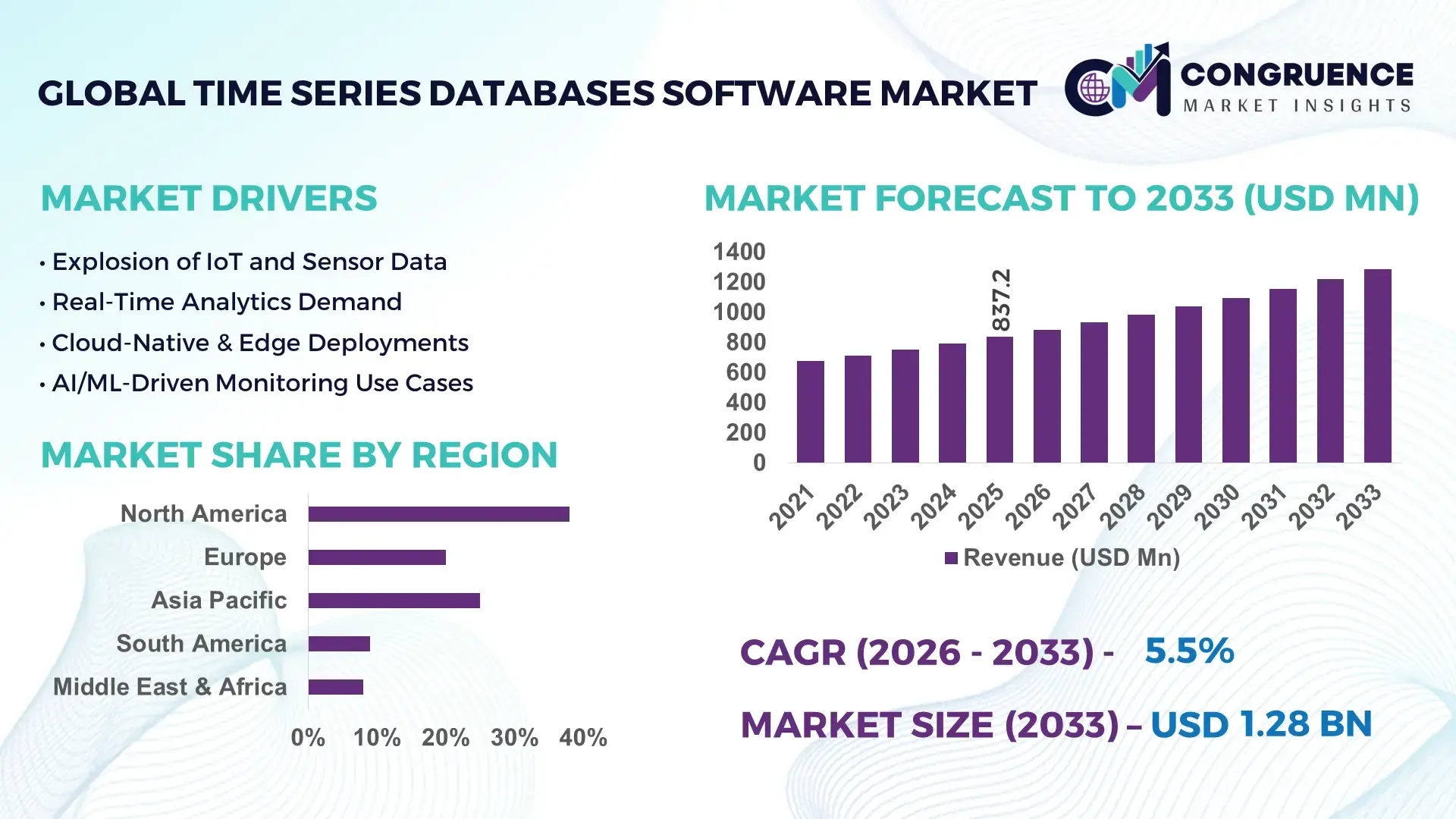
The Global Time Series Databases Software Market was valued at USD 837.23 Million in 2025 and is anticipated to reach a value of USD 1284.89 Million by 2033 expanding at a CAGR of 5.5% between 2026 and 2033. This growth is driven by the exponential increase in machine-generated, time-stamped data across cloud infrastructure, IoT ecosystems, and real-time analytics platforms.
The United States dominates the Time Series Databases Software market with a strong concentration of large-scale production capacity, enterprise deployments, and continuous technology investment. Over 65% of global hyperscale data centers are located in the U.S., supporting high-ingestion workloads for time series platforms across finance, manufacturing, and digital services. Annual enterprise spending on data infrastructure software in the U.S. exceeds USD 95 billion, with time series databases increasingly embedded in observability stacks, AI pipelines, and industrial monitoring systems. Key applications include cloud-native DevOps monitoring, algorithmic trading systems processing millions of events per second, and smart manufacturing platforms integrating sensor data across thousands of assets. Advanced features such as high-cardinality indexing, real-time compression, and AI-assisted anomaly detection are being deployed at scale, with over 70% of U.S.-based enterprises using time series data for predictive analytics and operational intelligence.
Market Size & Growth: USD 837.23 Million (2025) projected to reach USD 1284.89 Million by 2033 at a CAGR of 5.5%, driven by rising real-time analytics and IoT data volumes
Top Growth Drivers: IoT adoption growth at 28%, cloud-native monitoring adoption at 34%, operational efficiency gains of 22%
Short-Term Forecast: By 2028, enterprises are expected to achieve up to 30% query performance improvement and 18% infrastructure cost reduction
Emerging Technologies: AI-driven anomaly detection, edge-integrated time series analytics, high-cardinality data compression engines
Regional Leaders: North America projected at USD 510 Million by 2033 with strong cloud observability adoption; Europe at USD 365 Million driven by industrial IoT; Asia-Pacific at USD 285 Million supported by smart city deployments
Consumer/End-User Trends: Increased adoption among cloud service providers, manufacturing enterprises, fintech firms, and telecom operators for real-time decision-making
Pilot or Case Example: A 2027 smart factory pilot reduced unplanned downtime by 26% using real-time time series analytics
Competitive Landscape: InfluxData holds ~22% share, followed by Timescale, AWS, Microsoft, and Oracle
Regulatory & ESG Impact: Data sovereignty regulations and energy-efficiency mandates accelerating adoption of optimized storage and compression technologies
Investment & Funding Patterns: Over USD 1.9 Billion invested globally since 2022 in time series database innovation and cloud integration
Innovation & Future Outlook: Growing convergence with AI platforms, digital twins, and real-time decision engines shaping next-generation deployments
The Time Series Databases Software market serves critical industry sectors including IT & telecom, manufacturing, BFSI, energy, and transportation, with IT and telecom accounting for approximately 38% of total deployments due to large-scale monitoring and observability needs. Manufacturing contributes nearly 24% through predictive maintenance and asset performance management applications. Recent innovations focus on horizontal scalability, nanosecond-level precision, and seamless integration with AI/ML frameworks, significantly improving data ingestion and query efficiency. Regulatory emphasis on data localization and operational transparency is influencing deployment architectures, particularly in Europe and Asia-Pacific. Economically, rising automation investments and digital transformation budgets are sustaining demand, while regionally, Asia-Pacific is showing accelerated consumption growth driven by smart infrastructure projects. Emerging trends include the integration of time series databases with digital twins, autonomous operations platforms, and real-time sustainability monitoring, positioning the market for sustained long-term expansion.
The strategic relevance of the Time Series Databases Software Market is strengthening as enterprises transition toward real-time, data-driven operating models across cloud, industrial, and digital ecosystems. Time Series Databases Software has become a foundational layer for observability, predictive analytics, and automated decision systems, handling high-velocity, high-frequency data streams generated by IoT devices, financial systems, and digital platforms. Modern columnar time series engines deliver up to 45% query latency improvement compared to traditional relational databases, enabling faster anomaly detection and operational responsiveness. North America dominates in data volume processed, while Asia-Pacific leads in adoption with over 41% of large enterprises actively deploying time series platforms for smart infrastructure and manufacturing intelligence.
From a forward strategy perspective, Time Series Databases Software is increasingly integrated with AI-driven analytics, digital twins, and edge computing frameworks. By 2028, AI-assisted time series analytics is expected to reduce system downtime by 32% through automated root-cause analysis and predictive alerts. Compliance and ESG considerations are also shaping deployment strategies, as firms commit to energy-efficiency improvements such as a 25% reduction in data-center power consumption by 2030 through advanced compression and tiered storage architectures. In 2026, a U.S.-based cloud service provider achieved a 29% infrastructure efficiency improvement by deploying AI-optimized time series storage for observability workloads. Collectively, these trends position the Time Series Databases Software Market as a critical pillar supporting enterprise resilience, regulatory alignment, and long-term sustainable digital growth.
The rapid expansion of real-time monitoring requirements is a primary driver of the Time Series Databases Software Market. Modern enterprises operate complex distributed systems generating millions of telemetry points per second, including metrics, logs, and events. Over 70% of cloud-native organizations now rely on continuous observability to maintain service reliability and performance. Time Series Databases Software enables ingestion rates exceeding 1 million data points per second per node, supporting high-frequency analytics without performance degradation. Manufacturing facilities using real-time asset monitoring report 20–30% reductions in unplanned downtime, while telecom operators leverage time series analytics to optimize network utilization and reduce latency. This growing dependence on real-time insights is accelerating enterprise-wide adoption of specialized time series platforms.
Despite strong demand, data complexity and system integration challenges act as restraints on the Time Series Databases Software Market. Enterprises often operate heterogeneous data environments combining legacy systems, cloud platforms, and edge devices, making seamless integration difficult. Managing high-cardinality data, schema evolution, and long-term retention policies requires specialized expertise, increasing operational overhead. Surveys indicate that nearly 38% of enterprises cite skills gaps and configuration complexity as barriers to full-scale deployment. Additionally, integrating Time Series Databases Software with existing BI tools and enterprise data lakes can increase deployment timelines by 20–25%, slowing adoption among mid-sized organizations with limited technical resources.
The expansion of industrial IoT and smart infrastructure presents significant growth opportunities for the Time Series Databases Software Market. Globally, industrial IoT deployments are generating over 50 zettabytes of time-stamped data annually, creating strong demand for scalable and resilient time series platforms. Smart grids, transportation systems, and automated factories increasingly rely on real-time analytics for predictive maintenance and energy optimization. Utilities using time series-based load forecasting have achieved 15–20% improvements in energy efficiency, while smart city projects leverage time series analytics to optimize traffic flow and public services. These applications open new avenues for vendors to deliver sector-specific solutions tailored to large-scale, mission-critical environments.
Cost management and regulatory compliance remain key challenges in the Time Series Databases Software Market. High-ingestion workloads require substantial compute and storage resources, and without optimized architectures, infrastructure costs can rise sharply. Enterprises report that inefficient data retention strategies can increase storage consumption by up to 40% annually. Additionally, evolving data protection regulations demand strict controls on data residency, access, and lifecycle management. Ensuring compliance across multi-region deployments adds complexity and increases operational costs. Vendors must balance performance, scalability, and compliance requirements while delivering cost-efficient solutions, making this a persistent challenge for market participants.
• Accelerated adoption of cloud-native and containerized deployments: Enterprises are increasingly migrating Time Series Databases Software to cloud-native and containerized environments to support elastic scaling and operational flexibility. Nearly 68% of newly deployed time series platforms are now containerized, enabling 35–40% higher horizontal scalability compared to monolithic database architectures. This shift has reduced average deployment and configuration timelines by around 30%, supporting faster rollout of observability, monitoring, and real-time analytics use cases across hybrid and multi-cloud infrastructures.
• Growing use of AI-driven analytics and automated anomaly detection: Artificial intelligence integration is transforming how time series data is analyzed and operationalized. Approximately 47% of enterprise users apply AI-based anomaly detection on continuous data streams, resulting in a 28% reduction in manual monitoring workloads. Predictive models built on time series data have improved early fault detection by 25–33%, particularly in telecom networks, cloud operations, and industrial automation environments where uptime and responsiveness are mission-critical.
• Expansion of edge-based time series processing architectures: Edge computing is reshaping deployment patterns for Time Series Databases Software by enabling localized data processing closer to data sources. Around 42% of industrial IoT implementations now analyze time-stamped data at the edge, reducing upstream data transmission volumes by 45%. This approach improves response latency by 20–27%, supporting real-time decision-making in smart factories, energy grids, and connected transportation systems across Europe and Asia-Pacific.
• Rising focus on storage efficiency and sustainability optimization: Organizations are prioritizing data efficiency and sustainability within Time Series Databases Software deployments. Advanced compression, downsampling, and tiered storage techniques are delivering 50–60% reductions in storage footprint, while lowering energy consumption per query by 18–22%. More than 40% of large enterprises now track data efficiency metrics as part of ESG reporting, positioning optimized time series platforms as a key enabler of sustainable digital infrastructure.
The Time Series Databases Software market is segmented based on type, application, and end-user, reflecting varied deployment models, operational requirements, and industry-specific data workloads. By type, organizations differentiate solutions according to deployment architecture and performance optimization, prioritizing scalability, ingestion speed, and storage efficiency. Application-based segmentation highlights strong demand from observability, industrial monitoring, and financial analytics, where real-time insights directly impact operational performance. End-user segmentation further underscores the role of cloud service providers, industrial enterprises, and financial institutions as primary adopters, driven by high-frequency data generation and mission-critical analytics needs. Across all segments, adoption patterns are shaped by cloud migration, automation initiatives, and increasing regulatory expectations around data governance and system resilience.
Time Series Databases Software is categorized into cloud-based, on-premises, and hybrid deployment types. Cloud-based platforms currently account for approximately 48% of overall adoption, driven by elastic scalability, rapid provisioning, and seamless integration with cloud-native observability stacks. On-premises deployments represent around 32%, favored by regulated industries requiring strict data control and low-latency processing. Hybrid models hold close to 20%, enabling enterprises to balance data sovereignty with cloud scalability.
Cloud-based Time Series Databases Software is the fastest-growing type, expanding at an estimated 9.1% CAGR, supported by rising Kubernetes adoption and managed database services. Hybrid deployments are also gaining traction as enterprises modernize legacy systems without full migration. Collectively, on-premises and hybrid models account for nearly 52% of installations, reflecting continued relevance in industrial and government environments.
By application, observability and IT operations monitoring leads the market with approximately 41% share, as enterprises rely on Time Series Databases Software to track system metrics, logs, and performance indicators in real time. Industrial monitoring and predictive maintenance follow at 29%, supported by widespread sensor deployment across manufacturing and energy sectors. Financial analytics applications account for nearly 18%, leveraging time series platforms for algorithmic trading, fraud detection, and risk modeling.
Industrial monitoring is the fastest-growing application, with adoption expanding at an estimated 8.7% CAGR, driven by automation, smart factory initiatives, and asset optimization programs. Other applications, including smart city infrastructure and scientific research, collectively contribute around 12%.
Cloud service providers represent the leading end-user segment, accounting for approximately 36% of total adoption, as they embed Time Series Databases Software into monitoring, billing, and performance management platforms. Manufacturing and industrial enterprises follow with 31%, driven by predictive maintenance and process optimization needs. BFSI institutions contribute about 19%, relying on time series analytics for real-time transaction monitoring and risk assessment.
Manufacturing is the fastest-growing end-user segment, expanding at an estimated 8.9% CAGR, fueled by Industry 4.0 investments and large-scale IoT deployments. Other end-users, including energy utilities, transportation operators, and government agencies, collectively account for nearly 14%, with adoption rates exceeding 40% in large-scale infrastructure projects.
North America accounted for the largest market share at 38% in 2025; however, Asia-Pacific is expected to register the fastest growth, expanding at a CAGR of 7.2% between 2026 and 2033.
North America processed over 12 billion time-stamped data points daily across enterprise, telecom, and financial sectors, with more than 72% of large enterprises adopting cloud-based and hybrid time series platforms. Asia-Pacific shows rising demand, particularly in China, India, and Japan, collectively consuming over 28% of global installations, fueled by smart city initiatives and industrial IoT expansion. Europe accounted for 24% share in 2025, with strong adoption in Germany, UK, and France. South America and the Middle East & Africa held approximately 10% and 6% shares, respectively, supported by infrastructure digitization and energy sector monitoring projects. Increasing deployment of AI-assisted analytics, edge computing, and high-cardinality ingestion platforms are shaping regional market dynamics, with enterprise adoption varying from finance and healthcare in North America to e-commerce and mobile AI applications in Asia-Pacific.
How are enterprises optimizing real-time analytics for operational efficiency?
North America holds approximately 38% of the Time Series Databases Software market, driven by large-scale adoption in healthcare, finance, and IT operations. Key industries are investing in real-time observability platforms to monitor system performance, track compliance metrics, and optimize digital workflows. Regulatory changes, including stricter data governance and cybersecurity requirements, are pushing enterprises to adopt cloud-native and hybrid time series solutions. Technological trends such as Kubernetes orchestration, AI-driven anomaly detection, and edge-integrated monitoring are accelerating deployments. Local players like Timescale have implemented managed time series solutions for U.S.-based financial institutions, handling over 8 million transactions per second. Consumer behavior shows higher adoption among healthcare and financial enterprises, with over 65% of hospitals and 57% of banking institutions using real-time time series platforms for operational intelligence.
What trends are shaping time series analytics adoption in key European markets?
Europe represents around 24% of the global market, with Germany, the UK, and France as leading adopters. Regulatory frameworks like GDPR and energy-efficiency mandates are driving demand for explainable and compliant time series databases. Enterprises are increasingly integrating AI-assisted analytics and predictive maintenance capabilities into manufacturing, energy, and transportation sectors. Local vendors, such as Crate.io, are providing scalable platforms for industrial and public sector clients, enabling over 15 billion events per month to be processed in real time. Regional adoption is influenced by compliance pressures, with more than 60% of large German manufacturing firms prioritizing regulated, auditable data workflows, while cloud-based deployments are preferred for IT observability in the UK.
How are emerging economies driving adoption of advanced time series platforms?
Asia-Pacific accounted for 28% of installations in 2025, with China, India, and Japan leading consumption. Industrial digitization, smart manufacturing, and e-commerce expansion are driving high-frequency time series data collection and analytics. Infrastructure modernization projects, such as smart grids and autonomous logistics, rely heavily on time series databases for predictive insights. Local players like Alibaba Cloud and Huawei are offering managed solutions for real-time monitoring of cloud-native applications, supporting over 10 million sensors in industrial deployments. Consumer behavior in the region reflects strong mobile and AI-driven application usage, with over 45% of large enterprises integrating time series analytics for operational decision-making.
What is fueling the adoption of time series platforms in emerging markets?
South America represents roughly 10% of the market, with Brazil and Argentina as key contributors. The growth is driven by infrastructure monitoring, energy distribution networks, and telecom operations. Government incentives and trade policies support digitization projects, especially in smart grid and transportation sectors. Local players are offering solutions for predictive maintenance and network monitoring, enabling 15–20% reductions in unplanned downtime. Consumer adoption is tied to digital media, localized services, and language-specific applications, with over 35% of enterprises leveraging cloud-based time series solutions for operational intelligence.
How are critical sectors adopting time series analytics for operational optimization?
The Middle East & Africa accounted for around 6% of the market, with UAE and South Africa leading demand. Oil & gas, construction, and energy infrastructure modernization are primary drivers. Enterprises are adopting cloud-integrated time series platforms to improve predictive maintenance and system monitoring. Regional trends include digitization initiatives and trade partnerships facilitating advanced platform deployments. Local players and regional integrators are implementing real-time analytics solutions, improving operational efficiency by 20–25%. Consumer behavior shows higher adoption among industrial enterprises, with energy and construction sectors prioritizing continuous monitoring and ESG compliance metrics.
United States: 36% market share; high enterprise adoption in finance, healthcare, and IT operations drives extensive deployments.
China: 22% market share; rapid industrial digitization and smart city initiatives fuel large-scale implementation of time series analytics platforms.
The Time Series Databases Software market exhibits a moderately fragmented competitive environment, with over 60 active global vendors offering specialized platforms for cloud, on-premises, and hybrid deployments. The top five companies, including InfluxData, Timescale, AWS, Microsoft, and Oracle, collectively hold approximately 52% of the market, reflecting significant concentration in enterprise-grade solutions while numerous smaller players compete in niche verticals. Strategic initiatives such as product launches, cloud-native integrations, AI-assisted analytics features, and partnerships with hyperscale cloud providers are reshaping competitive positioning. For example, InfluxData has launched multi-cloud observability solutions processing over 7 million metrics per second, while Timescale expanded edge-based deployments across industrial IoT platforms. Innovation trends such as automated anomaly detection, high-cardinality indexing, and predictive analytics are intensifying competition, with smaller regional players leveraging cost-efficient and sector-specific solutions. Enterprises are increasingly evaluating vendors based on scalability, ingestion performance, and integration capabilities, making technology differentiation and strategic alliances critical for maintaining market leadership. Overall, the landscape is dynamic, with new entrants focusing on emerging applications, and existing leaders expanding global footprint through acquisitions and partnerships.
Microsoft
Oracle
Crate.io
Huawei
Alibaba Cloud
QuestDB
VictoriaMetrics
The Time Series Databases Software market is experiencing rapid technological evolution driven by the need for high-performance, scalable, and intelligent data processing. Current technologies emphasize cloud-native deployment, enabling organizations to handle over 12 billion time-stamped events daily in large-scale enterprise environments. Containerization using platforms like Kubernetes has become standard, allowing 35–40% improvements in horizontal scaling while reducing provisioning and operational overhead by nearly 30%. Multi-cloud and hybrid architectures are gaining traction, enabling enterprises to balance performance, compliance, and cost-efficiency across distributed IT environments.
Emerging innovations focus on AI and machine learning integration for predictive analytics and automated anomaly detection. Approximately 47% of enterprises now apply AI-driven monitoring on high-frequency data streams, improving incident detection by 25–33% and reducing manual monitoring efforts by 28%. Edge computing is another transformative trend, with nearly 42% of industrial IoT deployments processing data at the edge, reducing upstream transmission by 45% and improving response latency by 20–27%. This is critical for sectors like smart manufacturing, energy grids, and autonomous logistics, where real-time insights directly impact operational efficiency.
Advanced storage and compression technologies are also reshaping the market. Techniques such as downsampling, high-cardinality indexing, and tiered storage are delivering 50–60% reductions in storage footprint, while cutting energy consumption per query by 18–22%, supporting enterprise ESG and sustainability goals. Additionally, integration with digital twins, real-time analytics engines, and automated workflow orchestration platforms is expanding use cases across finance, telecom, manufacturing, and smart infrastructure. Overall, technological advancements in cloud deployment, AI, edge computing, and storage optimization are positioning Time Series Databases Software as a critical enabler of operational intelligence and business resilience.
• In March 2024, Amazon Web Services launched Amazon Timestream for InfluxDB as generally available, enabling developers to run fully managed InfluxDB time series databases on AWS with automated backups, high availability, and seamless scaling for real-time time series applications across multiple AWS regions. (Amazon Web Services, Inc.)
• In August 2024, Terraform support was added for Amazon Timestream for InfluxDB deployments, allowing infrastructure-as-code automation for instance creation, database configuration, and lifecycle management, reducing manual errors and streamlining enterprise IoT and data workloads. (Amazon Web Services, Inc.)
• In September 2024, Amazon Timestream for InfluxDB expanded availability to Canada (Central), London, and Paris AWS regions, enabling globally distributed teams to deploy real-time time series applications closer to end-users and improving latency for mission-critical analytics workloads. (Amazon Web Services, Inc.)
• In October 2025, InfluxData and AWS extended InfluxDB 3 support on Amazon Timestream for InfluxDB, introducing InfluxDB 3 Core and Enterprise managed services with real-time performance, unlimited cardinality, and low-cost storage for high-volume time series workloads. (InfluxData)
The Time Series Databases Software Market Report provides a comprehensive examination of the technologies, segments, applications, and geographic landscapes shaping this critical analytics domain. The scope encompasses deployment models such as cloud-based, on-premises, and hybrid systems, each evaluated for operational performance, scalability, and alignment with enterprise data strategies. It analyzes application areas including observability and IT monitoring, industrial IoT analytics, financial trading and risk systems, energy grid surveillance, and smart infrastructure data processing. The report also dissects technologies underpinning modern time series platforms—cloud-native orchestration, edge processing frameworks, AI-assisted analytics, high-cardinality indexing, advanced compression methods, and multi-region data management techniques—providing detailed comparative insights and performance benchmarks.
Geographically, the report covers regional variations in adoption and implementation, such as North America’s dominance in enterprise observability, Europe’s compliance-driven deployments, Asia-Pacific’s fast-growing industrial and e-commerce data applications, and emerging market dynamics in South America and the Middle East & Africa. End-user insights span cloud service providers, manufacturing corporations, financial institutions, utilities, transportation operators, and government technology projects, highlighting distinct demand patterns and usage behaviors.
The report further outlines industry focus areas, including predictive maintenance, anomaly detection, real-time decision engines, digital twin integration, and sustainability metrics optimization. It includes niche market segments such as edge-native time series processing, hybrid multi-cloud orchestration, and vertical-specific solutions tailored to regulatory and operational requirements. Overall, the report delivers structured, data-rich insights aimed at enabling decision-makers to assess technologies, competitive landscapes, deployment strategies, and future priorities within the evolving Time Series Databases Software market.
| Report Attribute/Metric | Report Details |
|---|---|
|
Market Revenue in 2025 |
USD V2025 Million |
|
Market Revenue in 2033 |
USD V2033 Million |
|
CAGR (2026 - 2033) |
5.5% |
|
Base Year |
2025 |
|
Forecast Period |
2026 - 2033 |
|
Historic Period |
2021 - 2025 |
|
Segments Covered |
By Types
By Application
By End-User
|
|
Key Report Deliverable |
Revenue Forecast, Growth Trends, Market Dynamics, Segmental Overview, Regional and Country-wise Analysis, Competition Landscape |
|
Region Covered |
North America, Europe, Asia-Pacific, South America, Middle East, Africa |
|
Key Players Analyzed |
InfluxData, Timescale, AWS, Microsoft, Oracle, Crate.io, Huawei, Alibaba Cloud, QuestDB, VictoriaMetrics |
|
Customization & Pricing |
Available on Request (10% Customization is Free) |




