
Reports
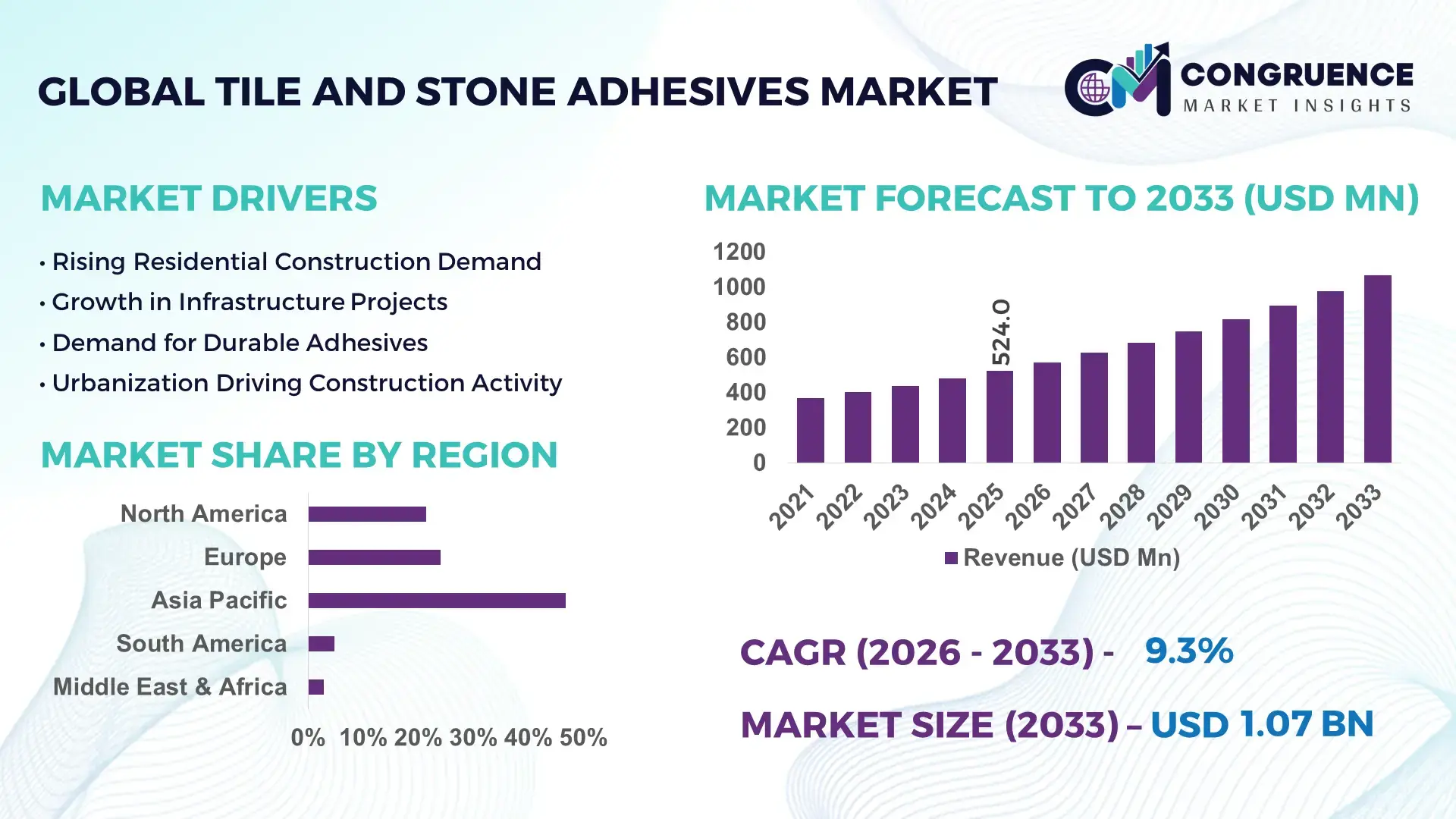
The Global Tile and Stone Adhesives Market was valued at USD 524.0 Million in 2025 and is anticipated to reach a value of USD 1,067.3 Million by 2033 expanding at a CAGR of 9.3% between 2026 and 2033. Growth is being accelerated by large-scale urban infrastructure programs, rising porcelain tile installations, and increasing adoption of polymer-modified adhesives that improve bond strength by over 30% compared to conventional cement-based formulations.
China remains the dominant country in the market, accounting for approximately 32% of global ceramic tile production capacity and supplying over 40% of worldwide tile exports, supported by continued investment in smart manufacturing and large-scale construction activity. India follows as one of the fastest-expanding markets, contributing nearly 9% of global tile output while adding new manufacturing capacity across Gujarat. Compared with Germany’s mature renovation-driven demand, China’s volume-led construction ecosystem delivers significantly higher adhesive consumption intensity across residential and infrastructure projects.
For manufacturers and investors, securing raw material access and expanding high-performance adhesive portfolios will be critical to capturing demand from large-format tile and advanced construction applications.
Market Size & Growth: USD 524.0 Million in 2025, reaching USD 1,067.3 Million by 2033, supported by rapid adoption of polymer-modified and high-bond-strength adhesive systems.
Top Growth Drivers: Infrastructure spending (+18%), large-format tile installations (+22%), and renovation activity growth (+15%) are accelerating product deployment.
Short-Term Forecast: By 2028, installation productivity is projected to improve by 20% while material wastage declines by nearly 12% through advanced formulations.
Emerging Technologies: AI-enabled manufacturing, low-VOC chemistry, and nano-polymer additives are improving adhesion performance by more than 25%.
Regional Leaders: Asia Pacific exceeds USD 430 Million, Europe approaches USD 250 Million, and North America surpasses USD 170 Million, driven by modernization and premium flooring adoption.
Consumer/End-User Trends: Nearly 58% of commercial projects now prefer ready-mix or enhanced polymer adhesive solutions for durability and installation efficiency.
Pilot/Case Example: In 2024, large-format tile installation programs using advanced adhesives reduced rework rates by approximately 18% across selected commercial developments.
Competitive Landscape: Top manufacturers collectively control around 38% market share, with leaders including Mapei, Sika, Saint-Gobain, ARDEX, and LATICRETE.
Regulatory & ESG Impact: Low-emission product adoption increased by 27% as green-building standards influence procurement decisions across major construction markets.
Investment & Funding: More than USD 500 Million has been directed toward capacity expansion, localization, and supply-chain optimization initiatives.
Innovation & Future Outlook: High-performance lightweight adhesives, robotic application systems, and digital quality monitoring are reshaping competitive differentiation.
The Tile and Stone Adhesives Market is increasingly influenced by demand from residential renovation, commercial flooring upgrades, and transportation infrastructure projects. Manufacturers are introducing low-VOC, rapid-setting, and high-flexibility formulations capable of improving installation efficiency by nearly 20%. Growing adoption of large-format porcelain tiles and localized sourcing strategies following recent global supply-chain disruptions are reshaping procurement priorities, creating a stronger focus on performance, consistency, and application versatility across construction ecosystems.
Tile and stone adhesives have become strategically important as construction stakeholders prioritize installation efficiency, durability, and lifecycle performance. The market is increasingly linked to infrastructure modernization, urban redevelopment, and premium flooring adoption. Supply-chain restructuring following geopolitical trade disruptions has encouraged manufacturers to localize production and secure alternative raw-material sourcing channels, improving procurement resilience and reducing operational dependency on single-country suppliers.
Technology differentiation is becoming a key competitive lever. Advanced polymer-modified adhesives deliver up to 35% greater bond strength and reduce installation failures by nearly 20% compared with traditional cementitious alternatives. China continues to lead through large-scale construction deployment and manufacturing capacity, while Germany and Italy focus on innovation-driven specialty formulations designed for premium renovation and commercial applications. This contrast highlights the growing separation between volume-driven and value-driven market strategies.
Over the next two to three years, adoption of low-emission adhesive systems is expected to accelerate as green-building specifications become more prominent. Several manufacturers are expanding partnerships with tile producers and construction contractors to strengthen project integration. For example, integrated adhesive-tile solution programs have reduced installation timelines by approximately 15% on large commercial projects. Organizations that combine product innovation, supply security, and contractor engagement will strengthen competitive positioning and long-term market relevance.
Large-format ceramic and porcelain tile installations have increased by more than 22% across commercial construction projects, creating demand for high-performance adhesives capable of supporting heavier materials and minimizing installation defects. Infrastructure modernization programs in China and India continue to stimulate adhesive consumption, while premium residential renovation activity has expanded by approximately 15% in several developed markets. The shift toward polymer-modified formulations improves bond strength by over 30%, enabling broader use in demanding environments. In response, leading manufacturers are investing in production upgrades, localized distribution networks, and advanced formulation technologies. A key strategic insight is that adhesive suppliers are increasingly competing on installation productivity rather than product pricing alone, creating stronger value differentiation and contractor loyalty.
Volatility in polymer resins, specialty additives, and chemical intermediates continues to pressure profitability across the industry. Certain adhesive input costs have experienced fluctuations exceeding 20% during recent supply-chain disruptions, while freight and logistics expenses remain elevated in several import-dependent markets. European manufacturers remain exposed to energy-cost variability, creating additional pricing pressure throughout production networks. These conditions directly affect margin stability, procurement planning, and project budgeting for contractors. To reduce exposure, companies are expanding supplier diversification programs, increasing regional sourcing, and entering long-term procurement agreements. An important operational insight is that firms with localized raw-material ecosystems are demonstrating greater pricing stability and improved delivery consistency during periods of market disruption.
Low-VOC and environmentally compliant adhesive solutions are emerging as a major opportunity as green-building certification requirements influence material selection. Adoption of sustainable construction materials has increased by nearly 25% across major commercial projects, while automated production systems have improved manufacturing efficiency by approximately 15%. India and Southeast Asia present significant untapped potential due to expanding urban construction pipelines and rising demand for premium flooring systems. Manufacturers are investing in R&D partnerships focused on bio-based additives, enhanced durability technologies, and automated quality-control platforms. A less obvious opportunity lies in adhesive systems optimized for prefabricated construction, where faster installation cycles and reduced material waste create measurable cost advantages for contractors and developers.
Maintaining installation quality across diverse construction environments remains a significant challenge. Industry studies indicate that improper application practices can contribute to project defect rates exceeding 12%, particularly in large-format tile installations. Rapid product innovation has increased technical complexity, requiring specialized installer training and stricter quality-control procedures. In markets such as India and parts of Southeast Asia, workforce development has not always kept pace with advanced adhesive adoption. The resulting inconsistency can affect project durability, customer satisfaction, and long-term brand credibility. To address this issue, manufacturers are expanding contractor certification programs, digital training platforms, and technical support partnerships. A critical strategic insight is that installation expertise is becoming as important as product performance in sustaining competitive advantage and ensuring project success.
Rise of Low-VOC Formulations Regulatory tightening around indoor air quality and green-building certifications is accelerating adoption of low-emission adhesive systems. Low-VOC product penetration has increased by nearly 27% across commercial construction specifications, while certification-driven projects account for over 35% of premium flooring installations in Germany and the United States. This shift is reducing compliance risks and improving project qualification rates. Manufacturers are expanding sustainable product portfolios, reformulating chemistries, and aligning development programs with evolving construction standards.
Large-Format Tile Installation Shift Large-format porcelain tile usage has expanded by approximately 22% in commercial developments, creating demand for higher-flexibility and enhanced-bond-strength adhesives. Installation failure rates have declined by nearly 18% where advanced polymer-modified systems are deployed. Labor shortages in several construction markets are also pushing contractors toward solutions that simplify application workflows. Producers are responding by scaling rapid-setting formulations and strengthening partnerships with tile manufacturers to improve installation compatibility and field performance.
Localized Supply Chain Expansion Recent logistics disruptions and geopolitical trade pressures have encouraged greater regional manufacturing localization. Procurement lead times have improved by roughly 15%, while transportation-related costs have declined by nearly 10% for companies operating localized production facilities. India and Türkiye are attracting new capacity investments due to competitive manufacturing economics. Adhesive suppliers are restructuring sourcing networks, diversifying raw-material procurement, and increasing warehouse footprints to improve delivery reliability and operational resilience.
Automation in Adhesive Production Digital process control, AI-assisted quality monitoring, and automated batching technologies are transforming manufacturing operations. Plants deploying advanced automation have reported production efficiency improvements exceeding 20% alongside waste reductions of approximately 12%. The trend is particularly visible among large producers seeking consistent formulation quality across multiple facilities. Companies are accelerating factory modernization programs and investing in smart manufacturing platforms to improve scalability, strengthen quality assurance, and support increasingly specialized construction adhesive requirements.
Cementitious adhesives remain the leading segment, accounting for approximately 58% of global demand due to their cost efficiency, broad compatibility with ceramic and porcelain tiles, and suitability for large-scale residential and commercial projects. Their strong market position is supported by extensive deployment across China, India, and Southeast Asia, where high-volume construction activity continues to drive consumption. Manufacturers are improving cementitious formulations through polymer modification, enabling up to 25% greater flexibility and improved moisture resistance. These performance enhancements are helping the segment remain competitive despite increasing demand for premium solutions. Reaction resin adhesives represent the fastest-growing category, supported by rising adoption in high-performance commercial, industrial, and specialty applications. Demand for epoxy- and polyurethane-based products has increased by nearly 18% as developers seek superior chemical resistance and durability. Dispersion adhesives continue to gain traction in renovation projects due to ease of application and reduced installation time. Meanwhile, specialty polymer-modified products are attracting investment as tile sizes increase and installation requirements become more demanding. Companies are prioritizing innovation, capacity expansion, and contractor education programs to strengthen their positioning in higher-margin adhesive categories.
Residential construction remains the dominant application segment, representing approximately 48% of total adhesive consumption. Strong housing development activity, apartment construction, and home renovation spending continue to support demand for ceramic and porcelain tile installations. Urban expansion in India and large-scale housing programs in China have reinforced residential demand concentration. Adhesive suppliers are expanding regional distribution networks and introducing contractor-focused product lines to improve accessibility and installation efficiency. Enhanced formulations that reduce curing time by nearly 15% are also supporting faster project completion across residential developments. Infrastructure projects are emerging as the fastest-growing application segment, driven by transportation hubs, metro systems, public facilities, and smart-city investments. Demand from infrastructure-related tile installations has expanded by approximately 17% as governments modernize public assets and transit networks. Commercial construction remains a major contributor, particularly in hospitality, healthcare, and retail developments where durability requirements are increasing. Renovation and remodeling activity continues to generate stable demand due to aging building stock across developed economies. Industrial applications maintain strategic relevance in manufacturing facilities and specialized environments requiring high-performance bonding systems. Companies are responding through application-specific product development and integrated project support services.
The commercial segment remains the largest end-user group, accounting for approximately 38% of total market demand due to the scale of deployment across offices, retail centers, hospitality facilities, healthcare institutions, and mixed-use developments. Commercial projects increasingly require high-performance adhesives capable of supporting large-format tiles, rapid installation schedules, and stringent durability standards. Procurement teams are prioritizing products that reduce maintenance requirements and improve lifecycle performance. Manufacturers are responding with specialized product portfolios, technical consulting services, and strategic partnerships with contractors and flooring solution providers.Industrial & infrastructure end-users represent the fastest-growing segment, supported by expanding investments in transportation facilities, logistics centers, manufacturing plants, and public infrastructure modernization programs. Demand from this group has increased by nearly 16% as project specifications become more performance-oriented. Residential buyers continue to represent a substantial share through new housing construction and renovation activity, while institutional users such as schools, hospitals, and government facilities increasingly prioritize low-emission and durability-focused solutions. Companies are tailoring pricing structures, technical certifications, and project-specific support programs to capture demand across these evolving customer groups.
Asia-Pacific accounted for the largest market share at 46.8% in 2025 however, Middle East & Africa is expected to register the fastest growth, expanding at a CAGR of 10.8% between 2026 and 2033.
North America represented approximately 21.4% of global market demand in 2025, supported by sustained residential remodeling activity, commercial refurbishment projects, and growing adoption of premium flooring systems. The region demonstrates high penetration of polymer-modified and low-VOC adhesive formulations, particularly across healthcare, hospitality, and mixed-use developments. Large-format tile installations have increased by nearly 20% over the past three years, driving demand for advanced bonding solutions. Manufacturers continue expanding local distribution networks and contractor training programs to strengthen project execution. A notable operational trend is the increasing integration of installation productivity metrics into procurement decisions, encouraging wider deployment of rapid-setting and high-flexibility adhesive technologies.
United States Market Outlook: The United States remains the dominant market due to its extensive renovation ecosystem, commercial construction activity, and strong adoption of performance-oriented building materials. More than 55% of tile-related adhesive demand originates from remodeling and replacement projects rather than new construction. Growing investment in healthcare facilities, data centers, and mixed-use developments is accelerating specification of premium adhesive solutions. Manufacturers are increasing warehouse capacity, strengthening contractor certification programs, and expanding low-emission product portfolios to align with evolving building-performance requirements.
Europe accounted for nearly 24.1% of global demand, supported by mature renovation markets, stringent environmental regulations, and widespread adoption of advanced construction materials. Sustainability-focused procurement practices continue to influence adhesive selection, particularly in Germany, France, and Italy. More than 30% of commercial flooring projects now prioritize low-emission installation systems. Manufacturers are investing in product reformulation initiatives and environmentally compliant manufacturing processes to strengthen competitive positioning. Rising demand for energy-efficient building modernization programs is also supporting deployment of specialized adhesive technologies designed for complex refurbishment applications.
Germany Market Outlook: Germany serves as the region’s most strategically important market due to its advanced construction standards, industrial manufacturing capabilities, and leadership in sustainable building practices. Renovation and modernization projects account for a significant share of construction spending, creating consistent demand for premium tile installation products. The country has seen low-emission construction material adoption exceed 35% across major commercial developments. Companies continue investing in research partnerships and advanced formulation technologies to support evolving performance and environmental requirements.
Asia-Pacific led the global market with approximately 46.8% share in 2025, driven by large-scale construction activity, rapid urbanization, and dominant ceramic tile manufacturing capacity. The region benefits from extensive production ecosystems concentrated in China and India, supporting efficient supply chains and competitive pricing structures. Infrastructure development, residential housing programs, and commercial construction continue to sustain strong adhesive consumption. Regional tile production contributes more than 60% of global output, reinforcing demand for installation materials. Manufacturers are expanding production facilities, enhancing automation, and increasing distribution reach to serve both domestic and export-driven construction markets.
China Market Outlook: China remains the most influential country market, supported by its position as the world's largest ceramic tile producer and exporter. The country contributes more than 40% of global tile exports and maintains extensive construction activity across residential, infrastructure, and commercial sectors. Smart manufacturing adoption is accelerating across building-material production facilities, improving efficiency and product consistency. Domestic adhesive manufacturers are expanding premium product offerings while strengthening integration with tile producers to improve installation performance and supply-chain responsiveness.
South America accounted for approximately 4.8% of global market demand, supported by recovering residential construction activity and growing investment in commercial infrastructure. Demand is increasingly concentrated in urban development corridors where modernization projects and housing expansion programs are improving construction material consumption. Installation productivity has become a greater focus for contractors facing labor constraints and project scheduling pressures. Manufacturers are strengthening regional partnerships and improving local distribution coverage to enhance market accessibility. While infrastructure limitations and economic volatility continue to influence investment cycles, the region presents attractive opportunities for performance-focused adhesive suppliers.
Brazil Market Outlook: Brazil represents the largest market in South America due to its extensive construction sector, domestic tile manufacturing presence, and large urban population. Residential development remains a major consumption driver, while commercial projects continue to support demand for advanced installation materials. The country accounts for more than half of regional tile production capacity, creating strong downstream demand for adhesives. Suppliers are expanding localized product portfolios and contractor engagement initiatives to improve market penetration and strengthen long-term customer relationships.
Middle East & Africa represented approximately 2.9% of global demand in 2025 but remains the fastest-expanding regional market due to large-scale infrastructure development and urban transformation initiatives. Major construction programs, transportation projects, hospitality developments, and smart-city investments are creating significant demand for advanced tile installation materials. Premium flooring specifications are becoming increasingly common in commercial and mixed-use developments. Manufacturers are establishing strategic distribution partnerships and expanding regional supply capabilities to support growing project pipelines. The shift toward higher-performance construction materials is strengthening demand for specialized adhesive formulations capable of supporting complex installations.
Saudi Arabia Market Outlook: Saudi Arabia is the most strategically significant market in the region due to extensive infrastructure investment, large-scale urban development programs, and ambitious construction modernization initiatives. Mega-project activity continues to generate substantial demand for premium flooring and installation systems. More than 40% of regional high-value construction developments are concentrated within the Kingdom, supporting strong consumption of advanced adhesive technologies. Companies are expanding local partnerships, technical support capabilities, and supply-chain infrastructure to align with accelerating project execution requirements and long-term development objectives.
The Tile and Stone Adhesives Market is characterized by competition between global formulation leaders such as Sika AG, Mapei S.p.A., Saint-Gobain Weber, ARDEX Group, and LATICRETE International versus regional cost-focused manufacturers across Asia and the Middle East. The top five players collectively control approximately 38–42% of global market demand, creating a moderately consolidated structure. Competition is increasingly driven by technology, installation speed, and supply-chain responsiveness rather than price alone. Premium polymer-modified systems deliver up to 30% higher bond performance, while rapid-setting formulations reduce installation time by nearly 20%. Leading companies are expanding manufacturing footprints, pursuing contractor partnerships, and integrating complete tile-installation systems to strengthen customer retention. The competitive shift is moving toward sustainable low-VOC solutions and localized production control. Raw-material security and certification compliance remain major entry barriers. Winning requires technical differentiation, reliable distribution, contractor engagement, and scalable manufacturing execution.
Mapei S.p.A.
ARDEX Group
Saint-Gobain Weber
LATICRETE International
Bostik
Fosroc International
Parex Group
BAL Adhesives
RAK Ceramics Construction Chemicals
MYK LATICRETE
Pidilite Industries
Terraco Group
Dunlop Adhesives
The technology landscape is shifting from conventional cement-based bonding systems toward advanced polymer-modified and hybrid adhesive platforms. Modern polymer-enhanced formulations provide up to 30% higher adhesion strength and nearly 25% greater flexibility under thermal and moisture stress conditions. Adoption of these solutions has surpassed 55% in large-format tile installations, where durability and substrate compatibility are critical. The business impact is significant, reducing installation failures, minimizing rework costs, and improving contractor productivity.
Emerging technologies are centered on low-VOC chemistries, nano-modified additives, and automated manufacturing systems. Digital quality-control platforms have improved production consistency by approximately 15%, while automated batching systems reduce material waste by nearly 12%. Compared with traditional cementitious products, advanced rapid-setting adhesives shorten installation cycles by nearly 20%, enabling faster project completion. Premium manufacturers and large construction contractors benefit most from these technologies because installation efficiency increasingly influences project profitability and procurement decisions.
Between 2026 and 2028, smart manufacturing integration and sustainable adhesive development will become major competitive differentiators. AI-assisted formulation optimization, predictive quality analytics, and bio-based performance additives are expected to accelerate commercialization. Companies investing early in advanced production technologies and environmentally compliant formulations will strengthen market positioning, improve operational resilience, and capture demand from increasingly specification-driven construction projects.
January 2025 – Sika AG opened new manufacturing facilities in Singapore and Xi’an, China, expanding local production of mortars and tile adhesives. The investment strengthened regional supply capabilities while reducing logistics distances and improving service responsiveness for high-density construction markets. Source: www.sika.com
March 2025 – Sika AG and BASF launched Baxxodur EC 151 epoxy hardener technology for construction flooring applications. The solution delivers up to 90% lower VOC emissions than conventional hardeners, supporting sustainability goals while improving application efficiency and performance consistency.
June 2025 – Mapei S.p.A. supplied a complete tile installation system for Europe’s largest beverage can manufacturing facility in the UK. The project supports a site designed for annual production exceeding 3 billion units, reinforcing Mapei’s position in large-scale industrial construction projects.
February 2026 – ARDEX Americas launched ARDEX D 16 premixed tile adhesive featuring immediate tile set capability and coverage of up to 175 sq. ft. per 3.5-gallon pail. The innovation improves jobsite productivity, simplifies installation workflows, and strengthens ARDEX’s premium product portfolio.
The report provides comprehensive coverage of the global Tile and Stone Adhesives Market across product categories, applications, end-user industries, and regional markets. Analysis includes cementitious adhesives, dispersion adhesives, reaction resin adhesives, and specialty formulations, with detailed assessment of residential construction, commercial construction, infrastructure projects, renovation activities, and industrial applications. More than 55% of market demand is evaluated through performance-driven installation requirements, procurement trends, and evolving material specifications. The study further examines commercial, residential, institutional, and industrial end-user purchasing patterns alongside key deployment and adoption indicators.
The report delivers strategic insights across North America, Europe, Asia-Pacific, South America, and Middle East & Africa while evaluating technology adoption, supply-chain transformation, sustainability initiatives, and manufacturing investments. Competitive benchmarking covers leading multinational producers and regional suppliers, highlighting market-share positioning, innovation priorities, and expansion strategies. The analysis supports investment planning, market-entry assessment, portfolio optimization, partnership development, and competitive positioning by identifying operational trends, emerging opportunities, technology shifts, and business priorities expected to shape market direction between 2026 and 2033.
| Report Attribute / Metric | Details |
|---|---|
| Market Revenue (2025) | USD 524.0 Million |
| Market Revenue (2033) | USD 1,067.3 Million |
| CAGR (2026–2033) | 9.3% |
| Base Year | 2025 |
| Forecast Period | 2026–2033 |
| Historic Period | 2021–2025 |
| Segments Covered |
By Type
By Application
By End-User
|
| Key Report Deliverables | Revenue Forecast; Market Trends; Growth Drivers & Restraints; Technology Insights; Segmentation Analysis; Regional Insights; Competitive Landscape; Regulatory & ESG Overview; Recent Developments |
| Regions Covered | North America; Europe; Asia-Pacific; South America; Middle East & Africa |
| Key Players Analyzed | Sika AG; Mapei S.p.A.; ARDEX Group; Saint-Gobain Weber; LATICRETE International; Bostik; Fosroc International; Parex Group; BAL Adhesives; RAK Ceramics Construction Chemicals; MYK LATICRETE; Pidilite Industries; Terraco Group; Dunlop Adhesives |
| Customization & Pricing | Available on Request (10% Customization Free) |




