
Reports
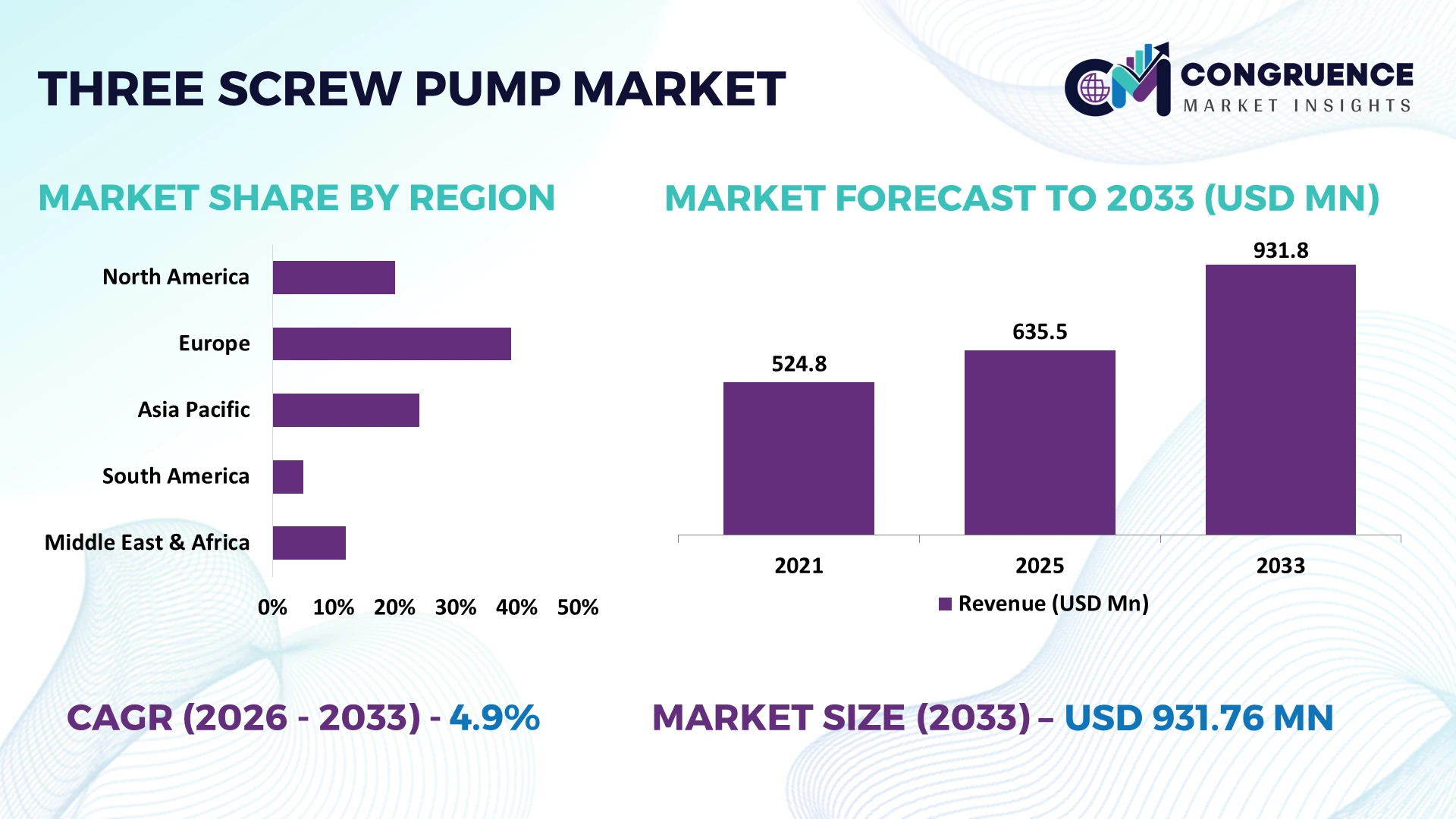
The Global Three-Screw Pump Market was valued at USD 635.48 Million in 2025 and is anticipated to reach a value of USD 931.76 Million by 2033 expanding at a CAGR of 4.9% between 2026 and 2033. Growth is driven by refinery lubrication upgrades, marine fuel-oil handling, turbine and compressor lubrication systems, higher-viscosity process fluids, and replacement of pulsating pump technologies with low-noise, continuous-flow three-screw designs.
China represents approximately 17% of global three-screw pump demand, supported by refining, petrochemicals, power generation, heavy manufacturing, and shipbuilding. Chinese yards delivered 56.1% of global shipbuilding tonnage in 2025 and secured 69% of new orders, strengthening demand for marine lubrication and fuel-transfer pumps. Germany maintains a smaller but technology-intensive position through precision engineering, chemicals, machinery, and high-specification process applications. U.S.-China maritime trade tensions further reinforce supply-chain localization priorities.
Pump manufacturers combining application engineering, energy-efficient hydraulics, localized servicing, digital condition monitoring, and reliable marine-grade production will secure the strongest positioning across replacement and new-build industrial projects.
Market Size & Growth: USD 635.48 million in 2025 advances to USD 931.76 million by 2033 at 4.9%, driven by marine, lubrication, and refinery modernization.
Top Growth Drivers: Lubrication systems contribute approximately 34%, marine applications 24%, and replacement-driven installations around 40% across established industrial markets.
Short-Term Forecast: By 2028, digitally monitored pump installations will reduce unplanned maintenance intervention by approximately 15–20% through vibration, temperature, and pressure diagnostics.
Emerging Technologies: IoT condition monitoring, variable-frequency drives, magnetic-drive configurations, and precision-machined screw profiles are improving efficiency, leakage control, and predictive maintenance.
Regional Leaders: Asia-Pacific approaches USD 360 million, Europe USD 270 million, and North America USD 210 million by 2033, with digitalization strengthening replacement activity.
Consumer/End-User Trends: Pumps below 50 m³/h hold approximately 38% share as industrial users favor compact, standardized lubrication and auxiliary fluid-transfer packages.
Pilot/Case Example: In 2025, China delivered 53.69 million DWT of ships, up 11.4%, strengthening OEM demand for onboard lubrication and fuel-handling equipment.
Competitive Landscape: CIRCOR/IMO holds an estimated 14% position, competing with Leistritz, KRAL, SPX FLOW, DESMI, and Flowserve across engineered applications.
Regulatory & ESG Impact: Maritime efficiency requirements are pushing operators toward lower-loss auxiliary equipment, with optimized pump-drive configurations capable of cutting electricity consumption approximately 10–15%.
Investment & Funding: Multi-billion-dollar refinery, shipbuilding, petrochemical, and energy infrastructure programs are directing equipment investment toward automated pumping skids, reliability upgrades, and localized servicing capacity.
Innovation & Future Outlook: Next-generation three-screw pumps target 5–10% efficiency improvement through optimized rotor geometry, smart drives, advanced coatings, and continuous condition monitoring.
Three-screw pumps are increasingly critical in lubrication, marine fuel handling, refineries, power plants, compressors, and high-viscosity industrial transfer systems. Lubrication applications account for roughly 34% of demand, reflecting their low-pulsation and stable-pressure advantages. Digital condition monitoring, variable-speed drives, and advanced screw geometries are improving lifecycle performance, while maritime efficiency requirements and localized equipment sourcing are reshaping procurement priorities ahead of strategic market positioning.
Three-screw pumps are becoming strategically important as refineries, ships, power plants, and rotating-equipment operators prioritize predictable fluid delivery, lower pulsation, and reduced lifecycle maintenance. Procurement is shifting from mechanically isolated pumps toward digitally monitored packages integrating variable-frequency drives, vibration sensors, and condition diagnostics. China’s 56.1% share of global ship deliveries in 2025 reinforces demand for reliable lubrication and fuel-transfer equipment, while maritime efficiency regulations are accelerating auxiliary-system optimization.
Compared with conventional external gear pumps, optimized three-screw designs can deliver 5–10% higher operating efficiency in suitable high-viscosity duties while generating lower noise and pressure pulsation. China leads deployment scale through shipbuilding and petrochemical infrastructure, whereas Germany concentrates on high-specification engineering, precision manufacturing, and customized process applications. Through 2028, digitally monitored installations should reduce unplanned maintenance interventions by approximately 15–20%, strengthening lifecycle economics.
A practical example is continuous lubrication of turbine bearings, compressors, and marine propulsion systems, where stable flow directly protects high-value rotating equipment. Manufacturers are investing in smart monitoring, modular skids, localized service networks, and application partnerships. Competitive advantage will increasingly depend on combining hydraulic efficiency with predictive maintenance, application engineering, and dependable aftermarket support.
Lubrication-intensive machinery is the strongest structural demand driver because three-screw pumps provide continuous, low-pulsation flow for turbines, compressors, gearboxes, engines, and hydraulic systems. Lubrication applications represent approximately 34% of demand, while marine installations contribute about 24%; replacement projects account for roughly 40% across mature industrial fleets. China’s shipyards delivered 56.1% of global shipbuilding tonnage in 2025, expanding the installed base requiring fuel-transfer and lubrication pumps. Simultaneously, IMO efficiency requirements are pushing ship operators to optimize auxiliary energy consumption and machinery reliability. This combination raises demand for efficient, compact pumping packages. Manufacturers are expanding marine-qualified portfolios, integrating variable-speed drives, strengthening shipyard partnerships, and developing application-specific screw geometries. The strategic advantage lies increasingly in lifecycle reliability rather than maximum pumping capacity alone.
Three-screw pumps require tightly controlled rotor profiles, clearances, bearings, seals, and casing tolerances, creating higher manufacturing and servicing requirements than simpler centrifugal or gear alternatives. Precision-machined screw sets can represent 25–35% of pump manufacturing value, while specialized alloys and mechanical sealing components can raise configured equipment costs by approximately 15–25% for corrosive or high-temperature duties. Germany and other precision-engineering centers also face elevated industrial labor and energy costs, intensifying pressure on machining economics. Volatile nickel, stainless-steel, and specialty-alloy inputs further complicate quotation stability for engineered projects. These constraints reduce competitiveness in standardized, price-sensitive fluid-transfer applications. Manufacturers are responding by dual-sourcing castings, localizing machining, standardizing modular components, and securing longer-term material contracts. Operationally, suppliers that cannot maintain micron-level manufacturing consistency struggle to compete on both price and service life.
Digitalization creates a higher-value opportunity beyond equipment sales by turning three-screw pumps into continuously monitored rotating assets. Vibration, temperature, pressure, and motor-current analytics can reduce unplanned maintenance interventions by approximately 15–20%, while variable-frequency drives can lower energy consumption by 10–15% in duty cycles with changing flow requirements. Predictive diagnostics are particularly attractive for refineries, marine propulsion systems, and power plants where unexpected lubrication failure creates disproportionately high downtime costs. China’s industrial automation expansion and India’s refinery and manufacturing modernization provide scalable deployment environments through 2028. Manufacturers are embedding sensors, remote diagnostics, and performance analytics into pump skids while partnering with automation and drive suppliers. The non-obvious opportunity is recurring aftermarket value: condition-based maintenance converts installed pumps into service platforms, strengthening customer retention while extending equipment life and reducing unnecessary component replacement.
The principal long-term challenge is integrating precision pumps with increasingly automated industrial systems without compromising hydraulic stability, cybersecurity, or maintenance accessibility. Digital monitoring can reduce maintenance interventions by 15–20%, yet extracting that benefit requires reliable sensors, calibrated algorithms, variable-speed control, and trained personnel. Industrial users can lose 5–10% of achievable pump efficiency when viscosity changes, incorrect speed selection, or system resistance moves equipment away from its optimized operating envelope. Retrofitting older refineries, vessels, and power plants adds further complexity because existing control architectures frequently lack standardized digital interfaces. Skilled rotating-equipment technicians are also increasingly important as mechanical and electronic diagnostics converge. Manufacturers must invest in interoperable controllers, remote-service capabilities, commissioning expertise, cybersecurity controls, and operator training. Winning suppliers will treat integration engineering as a core product capability rather than leaving system optimization entirely to end users.
Shipbuilding Orders Lift Marine Demand: China delivered 53.69 million DWT of ships in 2025, up 11.4%, while holding orders increased 31.5%. This backlog is expanding demand for fuel-transfer and lubrication pumps. Manufacturers are aligning production with shipyard schedules, standardizing marine packages, and strengthening Asian service networks to shorten commissioning and replacement cycles.
Refinery Upgrades Favor Integrated Packages: India operated roughly 258 million tonnes of refining capacity in 2025, while Panipat, Gujarat, and Barauni expansions increased demand for dependable lubrication and process-transfer equipment. Pump suppliers are responding with skid-mounted systems, variable-speed drives, and standardized controls that reduce engineering time and simplify brownfield integration.
Lifecycle Cost Replaces Purchase Price: Industrial buyers increasingly evaluate pumps around energy use, seal maintenance, and service intervals rather than acquisition price alone. Optimized screw profiles and variable-speed operation can lower power consumption approximately 10–15%, while condition monitoring cuts unplanned interventions around 15–20%. Companies are restructuring aftermarket offerings around diagnostics, remote support, and planned maintenance contracts.
Compact Designs Reduce Maintenance Burden: Marine and industrial users are shifting toward pumps with fewer components, external bearings, hardened screws, and simplified seal chambers. New configurations can reduce routine service requirements by roughly 20% and spare-parts inventories by 10–15%. Suppliers are modularizing pump families, automating precision machining, and consolidating components to improve repeatability and lifecycle margins.
Triple-Screw pumps lead the market with approximately 46–48% share because their three-rotor geometry delivers smooth, low-pulsation flow across lubrication, fuel oil, and high-viscosity transfer duties. Their mature manufacturing base, compact footprint, and ability to operate at high rotational speeds support standardized deployment across marine, refinery, and power-generation systems. Positive Displacement configurations remain strategically important where stable volumetric delivery is essential, while Twin-Helical designs serve applications requiring balanced flow and broader viscosity handling.
Heated Screw pumps represent the fastest-growing type, supported by applications involving heavy fuel oil, bitumen-like fluids, and temperature-sensitive process media requiring controlled viscosity. Multi-Screw systems are gaining selective adoption where higher throughput and redundancy justify greater engineering complexity. Heated and Multi-Screw architectures together account for roughly 20–22% of demand, while Twin-Helical systems represent approximately 15%. Manufacturers are expanding jacketed housings, hardened screw materials, modular heating arrangements, and customized drive packages, shifting investment toward difficult-fluid applications rather than purely standardized pumping duties.
Lubrication Systems account for approximately 32–34% of application demand because three-screw pumps provide continuous flow, low pulsation, and stable pressure for turbines, compressors, gearboxes, engines, and large rotating equipment. Oil Transfer follows with roughly 24–26%, supported by refineries, terminals, and industrial storage facilities. Fuel Handling remains closely linked to marine engines and burner systems, where viscosity variation and continuous operation favor screw-pump architectures over less stable alternatives.
Chemical Processing is the fastest-growing application as operators require controlled transfer of viscous, shear-sensitive, and temperature-dependent fluids. Hydraulic Systems maintain a smaller but technically important position where low noise and consistent volumetric output are priorities. Variable-speed drives can reduce power consumption around 10–15% under variable-load conditions, strengthening the case for automated pump packages. Suppliers are adapting through heated casings, corrosion-resistant materials, digital pressure monitoring, and application-specific sealing systems, directing engineering resources toward chemical and specialty-fluid applications with higher customization requirements.
Oil & Gas leads end-user demand with approximately 33–35% share because refineries, terminals, pipelines, storage facilities, and processing plants require dependable transfer and lubrication equipment operating across wide viscosity ranges. Marine follows at roughly 23–25%, supported by propulsion lubrication, fuel conditioning, transfer, and auxiliary systems. Chemical Processing maintains a significant installed base where controlled flow and material compatibility are essential for continuous production.
Marine is the fastest-growing end-user segment as China, South Korea, and other shipbuilding centers work through large vessel orderbooks while shipowners modernize auxiliary systems for efficiency and reliability. Power Generation remains a stable buyer for turbine and bearing lubrication systems, while Food Processing uses sanitary screw-pump configurations selectively for viscous edible oils and process fluids. Manufacturers are differentiating portfolios through marine approvals, sanitary materials, application engineering, and lifecycle service packages. Competitive positioning increasingly depends on sector-specific customization rather than offering a universal pump configuration across all industries.
Asia-Pacific accounted for the largest market share at 36.8% in 2025 however, Asia-Pacific is expected to register the fastest growth, expanding at a CAGR of 6.1% between 2026 and 2033.

Refinery Reliability Drives Replacement Programs
North America accounts for approximately 25.4% of the global Three-Screw Pump Market, anchored by extensive refinery, petrochemical, pipeline, marine, and power-generation infrastructure. The United States operates more than 18 million barrels per day of refinery capacity, creating a substantial installed base for lubrication, fuel-transfer, hydraulic, and process pumps. Operators increasingly prioritize equipment reliability over initial acquisition cost because unscheduled rotating-equipment downtime can disrupt continuous-processing assets. Variable-speed drives, vibration monitoring, and standardized pump skids are consequently entering brownfield replacement programs. Gulf Coast refining and petrochemical facilities represent the largest concentration of demanding installations, while marine activity along Houston, Louisiana, and major coastal ports supports fuel-handling requirements. Manufacturers are expanding aftermarket service, engineered replacements, remote monitoring, and API-compatible configurations, creating recurring opportunities around installed equipment rather than relying solely on greenfield projects.
United States Market Outlook: The United States combines the world’s largest concentration of sophisticated refining assets with substantial chemical, power-generation, and marine infrastructure. Refinery utilization frequently exceeds 90% during high-demand periods, increasing the operational value of reliable lubrication systems. Suppliers offering rapid replacement, domestic servicing, condition monitoring, and application-engineered screw packages gain an advantage across Gulf Coast industrial clusters.
Efficiency Standards Reshape Pump Engineering
Europe represents approximately 27.1% of global demand, supported by Germany, Italy, Norway, the Netherlands, and the United Kingdom across chemicals, marine engineering, machinery, refining, and power applications. Germany provides significant precision-manufacturing capability for screw profiles, casings, seals, and drive systems, while Norway and northern European maritime clusters sustain specialized marine requirements. Energy-efficiency pressure is shifting procurement toward correctly sized pumps, variable-speed operation, and lower-friction hydraulic designs capable of reducing auxiliary electricity consumption by approximately 10–15% under variable-duty conditions. European operators also emphasize lifecycle maintenance, leakage control, and repairability as industrial energy and labor costs remain elevated. Manufacturers are responding through high-efficiency motors, digital condition monitoring, modular service components, and optimized rotor geometries. The competitive shift favors engineering-intensive suppliers capable of documenting lifecycle performance rather than competing primarily through equipment price.
Germany Market Outlook: Germany remains strategically important because its chemicals, machinery, power systems, and industrial equipment sectors require precision fluid handling. Manufacturing accounts for roughly one-fifth of national economic output, supporting substantial rotating-equipment infrastructure. German pump producers benefit from advanced machining capability and engineering expertise, particularly in customized high-pressure and high-viscosity applications where tight screw tolerances determine efficiency and equipment longevity.
Shipbuilding Scale Anchors Pump Deployment
Asia-Pacific controls approximately 36.8% of the Three-Screw Pump Market, reflecting concentrated shipbuilding, refining, chemicals, power generation, and heavy manufacturing across China, India, South Korea, and Japan. China alone delivered 53.69 million DWT of ships in 2025, increasing output by 11.4%, while its shipbuilding orderbook expanded substantially. This production concentration creates recurring demand for engine lubrication, fuel-transfer, booster, and auxiliary pumping systems. India adds momentum through refinery expansion and industrial infrastructure modernization, while South Korean shipyards sustain demand for technically advanced marine packages. Local suppliers increasingly compete with established European manufacturers through shorter lead times and lower manufacturing costs. International companies are therefore expanding Asian servicing, local sourcing, joint engineering, and application support. Scale is shifting competitive advantage toward manufacturers capable of combining standardized production economics with marine and process-industry qualification.
China Market Outlook: China provides unmatched deployment scale through shipbuilding, petrochemicals, refining, power generation, and industrial manufacturing. Domestic shipyards accounted for 56.1% of global completions in 2025 and 69% of new orders, creating a substantial future equipment pipeline. Localized casting, machining, motor, and control-system supply chains enable pump manufacturers to shorten production cycles while competing aggressively on integrated package costs.
Heavy-Oil Infrastructure Sustains Specialized Demand
South America represents approximately 4.6% of global Three-Screw Pump Market demand, with Brazil, Argentina, Colombia, and Guyana providing the strongest industrial opportunities. Brazil dominates through offshore petroleum production, refining, marine infrastructure, biofuels, and industrial processing. Three-screw pumps are particularly relevant for lubrication, fuel handling, and viscous hydrocarbon transfer where smooth, non-pulsating operation protects downstream equipment. Brazil produced more than 3 million barrels per day of crude oil during 2025, reinforcing requirements across production support, terminals, refineries, and marine assets. Guyana’s rapidly expanding offshore infrastructure creates additional equipment opportunities, although limited local manufacturing and service capabilities increase import dependence. Suppliers are addressing these constraints through Brazilian service centers, distributor partnerships, stocked replacement components, and modular pump packages designed to simplify installation and maintenance at remote industrial sites.
Brazil Market Outlook: Brazil offers the region’s strongest combination of petroleum production, refining, shipyards, chemicals, and industrial processing. Offshore pre-salt fields account for more than 75% of national oil output, increasing demand for reliable auxiliary and lubrication equipment operating under demanding conditions. Manufacturers with local technical support and offshore-qualified equipment gain a meaningful advantage because downtime and imported-spare lead times carry significant operational costs.
Downstream Expansion Intensifies Pump Requirements
Middle East & Africa accounts for approximately 6.1% of global demand, driven principally by Saudi Arabia, the United Arab Emirates, Qatar, Kuwait, and South Africa. Large refining, petrochemical, storage, desalination, and power-generation complexes require continuous lubrication and hydrocarbon-transfer equipment, supporting technically demanding three-screw pump installations. Saudi Arabia is shifting investment downstream through refinery integration, chemicals, and industrial localization, while the UAE is expanding petrochemical and logistics infrastructure. Regional procurement increasingly emphasizes local service capability and reduced dependence on imported replacement components. Variable-speed drives and condition-monitoring systems are entering high-value installations where avoiding process interruptions outweighs equipment acquisition costs. Manufacturers are establishing service partnerships, local assembly arrangements, and maintenance capabilities around Gulf industrial hubs. African demand remains more project-specific because industrial infrastructure and aftermarket coverage vary considerably between countries.
Saudi Arabia Market Outlook: Saudi Arabia combines large-scale refining and petrochemical infrastructure with localization policies designed to expand domestic industrial capability. Saudi Aramco’s IKTVA framework targets 70% local content, encouraging pump manufacturers to develop local servicing, assembly, and supplier relationships. Jubail and Yanbu provide concentrated opportunities for engineered three-screw pumps used across lubrication, fuel transfer, and continuous-process applications.
The Three-Screw Pump Market pits established engineering leaders CIRCOR/IMO, Leistritz, KRAL, Alfa Laval, and SPX FLOW against specialized Asian manufacturers competing on price, localization, and delivery speed. The top five suppliers collectively command approximately 42% of global demand, reflecting strong marine approvals, installed bases, and precision-manufacturing expertise. Premium suppliers achieve 10–15% energy advantages through optimized screw geometry and variable-speed integration, while localized Asian competitors can offer equipment around 15–25% below imported configurations. Aftermarket servicing can reduce customer downtime by approximately 20% where stocked components and local technicians are available. Companies are expanding service centers, integrating condition monitoring, standardizing modular packages, and vertically controlling screw machining and testing. Competition is shifting from standalone pump supply toward lifecycle performance and digitally supported maintenance. Tight rotor tolerances, application engineering, certification, and installed-reference requirements remain entry barriers. Winning requires precision manufacturing, rapid servicing, application customization, competitive lifecycle cost, and dependable localized supply across marine and process industries.
CIRCOR International
Leistritz Pumpen GmbH
KRAL GmbH
Alfa Laval
SPX FLOW
Flowserve Corporation
DESMI A/S
NETZSCH Group
Roto Pumps Limited
Settima Meccanica
HMS Group
Tianjin Hanno Industrial Pump
Hebei Hengsheng Pumps
Delta Corporation
Current three-screw pump technology centers on precision-ground rotors, hardened screw surfaces, variable-frequency drives, and magnetic couplings for leakage-sensitive duties. Modern optimized screw profiles can improve hydraulic efficiency by 8–12% versus older fixed-speed units, while seal-less magnetic designs reduce leakage-related maintenance by around 15%. Adoption is strongest in marine, refinery, lubrication, and power applications, where reliability protects continuous processes and expensive rotating equipment.
Emerging systems integrate vibration, temperature, pressure, and motor-current sensors with edge diagnostics and predictive maintenance platforms. Digitally monitored pumps can cut unplanned maintenance interventions by 15–20%, while variable-speed control lowers energy use by roughly 10–15% under fluctuating loads. Smart skids are increasingly specified in brownfield modernization projects, benefiting manufacturers that combine pumps, drives, instrumentation, controls, and aftermarket analytics instead of supplying stand-alone mechanical equipment.
Disruptive development is moving toward software-assisted optimization, additive-manufactured components, advanced coatings, and modular cartridges engineered for direct replacement. Compared with legacy gear pumps, advanced three-screw configurations can deliver roughly 10% higher efficiency with markedly lower pulsation in suitable viscous-fluid duties. Between 2026 and 2028, adoption of connected condition monitoring will accelerate across critical assets. Suppliers investing now gain stronger lifecycle-service margins, faster retrofit deployment, and defensible differentiation through integrated reliability rather than hardware pricing.
October 2024 Leistritz introduced its patented HYPER³ hygienic three-screw pump for food, beverage, and pharmaceutical processing, delivering up to 96% efficiency and precise low-pulsation dosing. The launch expanded triple-screw technology beyond traditional oil applications into sanitary processing markets. Source: Leistritz
January 2025 Leistritz’s HYPER³ sanitary platform was highlighted for 96% volumetric efficiency and flow rates reaching 23 m³/h during cleaning cycles. The design eliminates a dedicated centrifugal CIP pump, reducing equipment complexity while strengthening adoption in hygienic processing lines. Source: AlimentiBevande
July 2026 CIRCOR introduced the IMO LB6D three-screw pump series for lease automatic custody transfer boost applications, targeting crude-oil handling under demanding field conditions. The platform emphasizes reduced maintenance and higher reliability, expanding IMO’s addressable upstream and pipeline-transfer applications. Source: PumpIndustry
June 2026 SEIM presented its PZ, PHS, and PB three-screw pump series at Posidonia 2026, covering 3 dedicated marine product families. The showcase strengthened engagement with shipyards and vessel operators seeking reliable fuel, lubrication, and auxiliary pumping solutions. Source: SEIM
The Three-Screw Pump Market Report evaluates Positive Displacement, Twin-Helical, Triple-Screw, Multi-Screw, and Heated Screw configurations across Oil Transfer, Fuel Handling, Lubrication Systems, Hydraulic Systems, and Chemical Processing. End-user coverage includes Oil & Gas, Chemical Processing, Marine, Power Generation, and Food Processing, with Triple-Screw designs holding approximately 46–48% of type demand and lubrication systems representing about one-third of application deployment.
Regional analysis spans North America, Europe, Asia-Pacific, South America, and Middle East & Africa, examining manufacturing scale, shipbuilding exposure, refinery modernization, localization, and service infrastructure. Technology coverage includes variable-speed drives, magnetic couplings, digital condition monitoring, precision rotor machining, advanced coatings, and modular pump cartridges. Competitive benchmarking, installed-base dynamics, replacement cycles, and niche hygienic and high-viscosity applications support investment planning, partnership selection, geographic expansion, product positioning, and long-term strategic decisions between 2026 and 2033.
| Report Attribute/Metric | Report Details |
|---|---|
Market Revenue in 2025 | USD 635.48 Million |
Market Revenue in 2033 | USD 931.76 Million |
CAGR (2026 - 2033) | 4.9% |
Base Year | 2025 |
Forecast Period | 2026 - 2033 |
Historic Period | 2021 - 2025 |
Segments Covered | By Type
By Application
By End-User
|
Key Report Deliverable | Revenue Forecast, Growth Trends, Market Dynamics, Segmental Overview, Regional and Country-wise Analysis, Competition Landscape |
Region Covered | North America, Europe, Asia-Pacific, South America, Middle East, Africa |
Key Players Analyzed | CIRCOR International, Leistritz Pumpen GmbH, KRAL GmbH, Alfa Laval, SPX FLOW, Flowserve Corporation, DESMI A/S, NETZSCH Group, Roto Pumps Limited, Settima Meccanica, HMS Group, Tianjin Hanno Industrial Pump, Hebei Hengsheng Pumps, Delta Corporation |
Customization & Pricing | Available on Request (10% Customization is Free) |




