
Reports
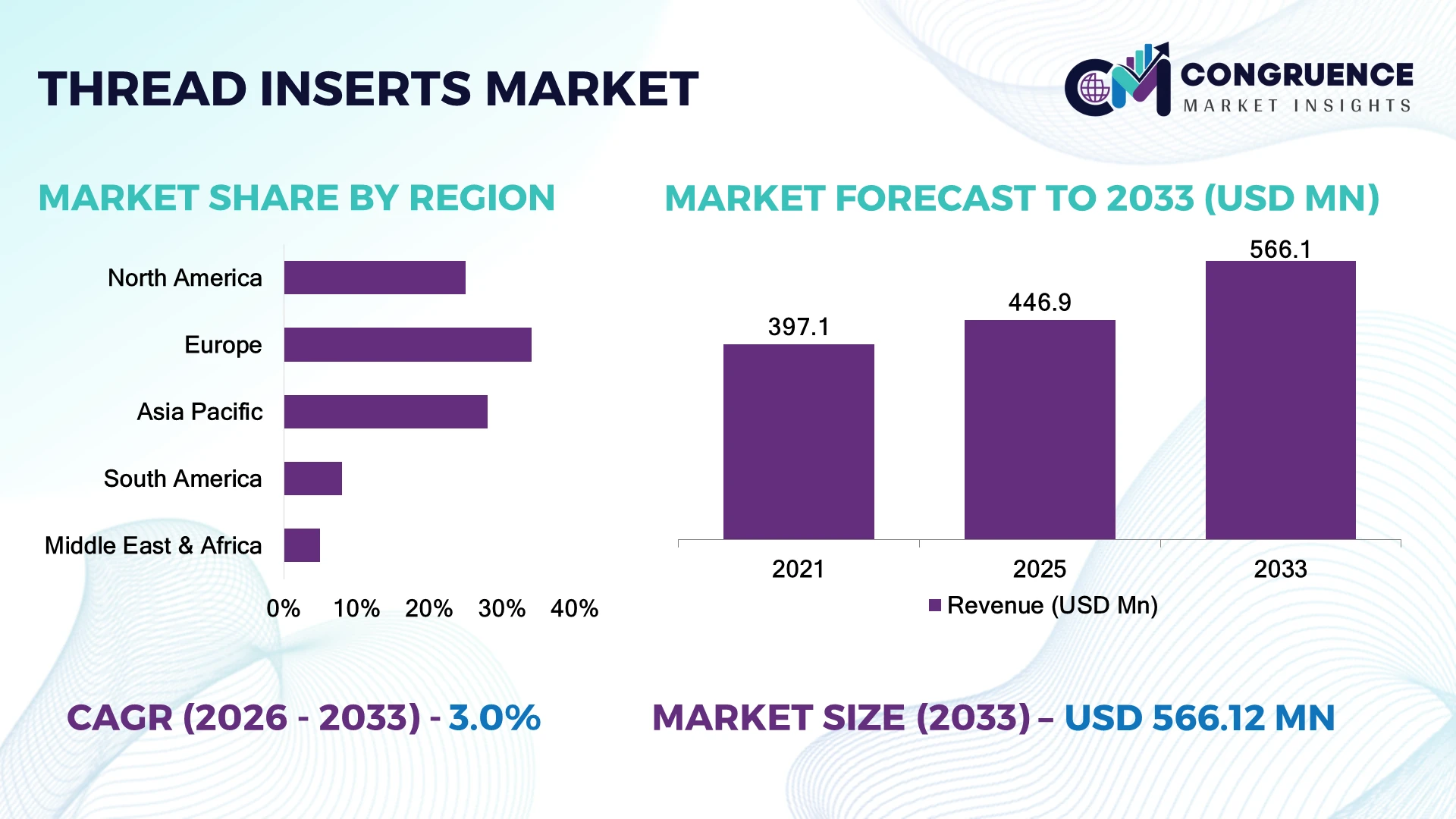
The Global Thread Inserts Market was valued at USD 446.9 Million in 2025 and is anticipated to reach a value of USD 566.1 Million by 2033 expanding at a CAGR of 3.0% between 2026 and 2033. Growth is driven by rising adoption of lightweight metal components, precision fastening solutions, and durable threaded reinforcement systems across automotive, aerospace, and industrial equipment manufacturing.
Germany holds a dominant position with nearly 22% share due to advanced engineering capabilities, automotive production strength, and investments in high-precision manufacturing technologies. The country’s automotive sector uses millions of reinforced fastening components annually, while China accounts for over 30% of global manufacturing capacity through expanding industrial production hubs. Compared with Germany’s engineering-led adoption, China’s large-scale manufacturing ecosystem accelerates volume demand. Companies prioritizing regional sourcing and automation integration gain stronger supply-chain resilience.
Strategic implication is manufacturers focusing on advanced materials and localized production networks are positioned to capture long-term industrial fastening opportunities.
Market Size & Growth: USD 446.9 Million in 2025 to USD 566.1 Million by 2033 at 3.0% CAGR, supported by demand for high-strength fastening solutions in industrial manufacturing.
Top Growth Drivers: Automotive lightweighting 35%, aerospace component upgrades 28%, industrial automation expansion 22%.
Short-Term Forecast: By 2028, automated insert installation improves production efficiency by 18% and reduces assembly errors by 12%.
Emerging Technologies: Advanced thread insert materials, automated fastening systems, and AI-based quality inspection improve manufacturing precision.
Regional Leaders: Asia Pacific reaches USD 245 Million with industrial expansion, North America reaches USD 150 Million with aerospace adoption, Europe reaches USD 130 Million with engineering innovation.
Consumer/End-User Trends: Over 60% of manufacturers prioritize durable fastening components for extended equipment lifecycle performance.
Pilot/Case Example: 2024 automotive assembly projects using automated insert systems achieved 20% faster installation cycles.
Competitive Landscape: Leading suppliers include Helicoil, Stanley Engineered Fastening, Bollhoff, KATO Fastening Systems, and Recoil, with major players controlling approximately 40% of organized supply.
Regulatory & ESG Impact: Lightweight component adoption reduces material usage by nearly 15% in selected industrial applications, supporting sustainability targets.
Investment & Funding: Over USD 500 Million directed toward industrial automation and advanced manufacturing partnerships, strengthening regional production capabilities.
Innovation & Future Outlook: Next-generation inserts with corrosion resistance, smart monitoring compatibility, and automated installation capabilities are shaping future fastening strategies.
The Thread Inserts Market is witnessing stronger demand across automotive repair, aerospace assemblies, electronics equipment, and heavy machinery applications as manufacturers seek improved durability and reduced maintenance requirements. Recent innovations include corrosion-resistant alloys and precision-engineered inserts, with advanced fastening solutions improving component reliability by approximately 25%. Supply-chain diversification initiatives across Asia and Europe are encouraging localized production strategies and strengthening industrial resilience, creating new opportunities for specialized insert manufacturers.
The Thread Inserts Market is becoming strategically important as manufacturers prioritize component reliability, repair efficiency, and extended product lifecycles across automotive, aerospace, and industrial sectors. Increasing supply-chain restructuring and regional manufacturing expansion are encouraging companies to secure dependable fastening component sources while improving production flexibility.
Advanced automated insert installation systems provide measurable advantages over traditional manual processes, delivering up to 20% faster assembly cycles and improved placement accuracy compared with legacy methods. Europe emphasizes precision engineering and aerospace applications, while Asia Pacific leads in large-scale industrial deployment supported by expanding manufacturing infrastructure and supplier networks.
A practical example includes automotive production facilities integrating automated thread insert systems to reduce assembly downtime and improve quality consistency. Companies are increasing investments in smart manufacturing equipment, regional partnerships, and specialized material development to strengthen competitive positioning.
Over the next few years, adoption of advanced fastening technologies, digital quality monitoring, and sustainable material solutions will define market leadership. Businesses that combine engineering innovation with resilient supply strategies will achieve stronger operational advantages and maintain long-term relevance in global manufacturing ecosystems.
The increasing use of lightweight materials in automotive, aerospace, and industrial equipment is accelerating demand for high-performance thread inserts. Automotive manufacturers are reducing component weight by 15–20% through advanced material integration, increasing the need for reinforced fastening solutions. Aerospace applications require fastening reliability across more than 90% of structural assemblies where vibration resistance is critical. Germany and Japan are expanding precision manufacturing investments as industries shift toward durable engineered components. Companies are responding through automated production lines, alloy-based insert innovations, and strategic partnerships with equipment manufacturers to improve installation accuracy and reduce assembly downtime.
Thread insert manufacturers face pressure from fluctuating steel, aluminum, and specialty alloy prices, with raw material costs representing nearly 40–50% of production expenses for precision fastening components. Dependence on specialized suppliers in China and Europe creates supply-chain exposure during trade disruptions and logistics constraints. Small and mid-sized manufacturers experience profitability pressure due to limited purchasing power and inventory flexibility. Companies are reducing risks through multi-country sourcing agreements, localized production facilities, and long-term material contracts. The key operational challenge remains maintaining cost stability while meeting increasing quality requirements from aerospace and automotive customers.
Opportunities are expanding through automation, digital manufacturing, and next-generation materials that enhance insert performance in demanding applications. Automated fastening technologies can improve installation efficiency by approximately 20% while reducing production inconsistencies. India, Vietnam, and Mexico are emerging as attractive manufacturing locations due to industrial expansion and supply-chain diversification strategies. New corrosion-resistant alloys and coated inserts are gaining adoption in marine, electric vehicle, and renewable equipment applications. Companies are investing in R&D centers, technology partnerships, and localized manufacturing ecosystems to capture specialized demand segments. The strongest opportunity lies in combining precision inserts with automated quality monitoring systems.
Long-term market expansion faces challenges from complex installation requirements, inconsistent component standards, and shortages of skilled precision manufacturing workers. Approximately 30% of industrial manufacturers report difficulties integrating advanced fastening technologies into existing production systems. Aerospace and defense applications require strict validation processes that can extend qualification cycles by 12–18 months. Countries such as the United States and Germany are addressing these issues through workforce training and smart factory investments. Companies must improve process standardization, digital inspection capabilities, and supplier collaboration to maintain consistent performance. Operational scalability will depend on balancing automation adoption with technical expertise across manufacturing networks.
Automation-Driven Installation Shift Manufacturers are increasing automated thread insert installation across automotive and industrial plants, with automation adoption improving assembly productivity by 15–20% and reducing fastening defects by nearly 10%. Germany and Japan are integrating robotic fastening cells to address skilled labor shortages and improve production consistency. Companies are responding through smart equipment partnerships, digital inspection systems, and workflow restructuring to achieve faster cycle times and lower operational variability.
Lightweight Material Compatibility Growth The transition toward aluminum, magnesium, and composite components is increasing demand for specialized thread inserts, with lightweight structures accounting for over 30% of new automotive component designs. Electric vehicle platforms are accelerating the shift as manufacturers require stronger fastening solutions without increasing component weight. Companies are expanding coated insert portfolios and investing in corrosion-resistant materials to support next-generation vehicle and industrial equipment production.
Supply Chain Localization Expansion Global manufacturers are restructuring sourcing strategies as supply-chain disruptions encourage localized thread insert production. More than 40% of industrial suppliers are increasing regional supplier networks to reduce dependency on concentrated manufacturing hubs. The United States, India, and Mexico are attracting investment in precision component facilities, enabling shorter lead times and improved inventory control. Companies are developing regional partnerships and dual-sourcing models to strengthen manufacturing resilience.
Advanced Material Performance Innovation Demand is rising for high-strength inserts designed for extreme temperature, vibration, and corrosion environments, particularly in aerospace and energy equipment. Advanced alloy and surface-treatment technologies improve service life by approximately 20–25% compared with conventional fastening components. Companies are prioritizing material research and application-specific designs to meet stricter performance requirements, creating opportunities in specialized industrial segments.
Metal thread inserts represent the leading segment, accounting for approximately 65% of the market, supported by superior durability, load-bearing capability, and extensive use in automotive, aerospace, and machinery applications. Stainless steel and alloy-based inserts dominate high-performance environments where vibration resistance and long service life are critical. Plastic thread inserts maintain demand in lightweight consumer products and electronics, while self-tapping and helical inserts are gaining adoption due to easier installation and repair capabilities. The fastest-growing segment is advanced self-locking and corrosion-resistant inserts, expanding as manufacturers prioritize maintenance reduction and component reliability. Adoption is increasing by nearly 8–10% annually in electric vehicles and industrial automation systems. Companies are expanding specialized product lines, improving coating technologies, and forming partnerships with equipment manufacturers to address application-specific requirements. The market shift indicates growing investment toward engineered fastening solutions rather than standard replacement components.
Automotive applications represent the largest segment with nearly 40% market share due to extensive use of thread inserts in engines, transmissions, battery systems, and lightweight vehicle structures. Electric vehicle manufacturing is accelerating adoption as battery enclosures and aluminum components require reinforced fastening points. Aerospace applications represent a high-value growth area, supported by demand for vibration-resistant and lightweight fastening solutions, while industrial machinery and electronics continue providing stable demand. The fastest-growing application is electric vehicle and advanced mobility systems, with adoption increasing as manufacturers integrate more aluminum and composite materials. Nearly 25% of new vehicle platforms incorporate advanced lightweight fastening approaches to improve efficiency and durability. Companies are adapting through customized insert designs, automated installation systems, and collaboration with automotive component suppliers. Growing repair and refurbishment activities in industrial equipment are also strengthening demand for reliable insert-based fastening solutions.
Automotive manufacturers are the leading end-user group, contributing approximately 45% of demand due to large-scale vehicle production, lightweighting initiatives, and increasing electric vehicle manufacturing requirements. Aerospace companies represent another critical user group, requiring highly reliable inserts for structural components and specialized equipment. Industrial machinery producers and electronics manufacturers continue adopting thread inserts to improve product durability and simplify maintenance operations. The fastest-growing end-user segment is electric vehicle manufacturers, where demand is increasing by approximately 12% as battery systems and lightweight structures require advanced fastening solutions. Aerospace and renewable equipment producers are also expanding adoption due to stricter reliability requirements and longer operating lifecycles. Companies are targeting these segments through customized engineering support, application-specific solutions, and strategic supplier agreements. Future demand is shifting toward customers seeking integrated fastening systems rather than standalone components.
Europe accounted for the largest market share at 34% in 2025 however, Asia-Pacific is expected to register the fastest growth, expanding at a CAGR of 3.6% between 2026 and 2033.

North America accounted for approximately 25% of the global thread inserts market in 2025, supported by aerospace manufacturing, automotive production, defense systems, and industrial machinery applications. The United States contributes nearly 80% of regional demand due to its extensive aerospace supply chain and advanced manufacturing infrastructure. Around 30% of regional thread insert consumption is associated with transportation and aerospace applications requiring high-strength fastening solutions. Increasing automation in manufacturing plants is improving installation consistency and reducing production downtime. Companies are expanding domestic production capacity, investing in automated fastening technologies, and developing specialized insert solutions for electric vehicles, defense equipment, and industrial machinery.
United States Market Outlook: The United States dominates the North American market due to its aerospace, automotive, and industrial manufacturing ecosystem. The country accounts for more than 20% of global aerospace component production, creating sustained demand for vibration-resistant and corrosion-resistant thread inserts. Manufacturers are increasing investments in automated assembly systems and localized supplier networks to improve production reliability and reduce supply-chain dependency.
Europe accounted for approximately 34% of the global thread inserts market in 2025, making it the leading regional market due to strong automotive, aerospace, machinery, and industrial equipment manufacturing. Germany represents the largest country-level contributor, accounting for nearly 22% of global demand through its advanced engineering sector and automotive production base. More than 50% of major European industrial suppliers are adopting advanced fastening and lightweight component technologies to improve efficiency and durability. Companies are focusing on precision manufacturing, material innovation, and automation integration to support high-performance applications across automotive and industrial sectors.
Germany Market Outlook: Germany remains the most strategically significant European market due to its automotive manufacturing strength, industrial automation capabilities, and engineering expertise. The country supports thousands of automotive and machinery suppliers requiring reliable fastening solutions. German manufacturers are increasingly adopting automated production systems and advanced alloy-based inserts to improve assembly efficiency and component performance.
Asia-Pacific accounted for approximately 28% of the global thread inserts market in 2025 and is expected to achieve the fastest expansion due to large-scale manufacturing, automotive production, electronics assembly, and industrial infrastructure development. China contributes the highest share within the region, supported by more than 30% of global manufacturing capacity across multiple industrial component categories. India, Japan, and South Korea are strengthening regional demand through automotive, electronics, and machinery production. Companies are expanding localized manufacturing facilities, improving supplier networks, and adopting automated production technologies to support rising industrial requirements.
China Market Outlook: China leads the Asia-Pacific market through its extensive manufacturing ecosystem, automotive production scale, and industrial equipment exports. The country contributes a significant portion of global precision component production and continues to expand automated manufacturing adoption. Companies are investing in domestic production capabilities and advanced fastening technologies to support high-volume industrial applications.
South America accounted for approximately 8% of the global thread inserts market in 2025, with Brazil representing the largest contributor due to automotive manufacturing, agricultural machinery production, mining equipment, and industrial applications. Nearly 35% of regional demand comes from heavy machinery and transportation-related industries. Infrastructure modernization and manufacturing improvements are supporting gradual adoption of advanced fastening solutions. However, dependence on imported specialty materials affects supply flexibility. Companies are strengthening local distribution networks, improving inventory planning, and developing regional partnerships to enhance market accessibility.
Brazil Market Outlook: Brazil dominates the South American market due to its established automotive and agricultural machinery industries. The country’s industrial equipment sector generates consistent demand for durable fastening components. Manufacturers are improving local supply capabilities and expanding technical support services to address increasing requirements from industrial customers.
Middle East & Africa accounted for approximately 5% of the global thread inserts market in 2025, supported by infrastructure development, energy projects, construction equipment demand, and industrial diversification initiatives. Gulf countries are increasing adoption of high-performance fastening components for large-scale infrastructure and industrial applications. More than 25% of major industrial investments in leading Gulf economies are directed toward manufacturing and infrastructure transformation programs. Companies are improving regional partnerships, strengthening distribution channels, and introducing corrosion-resistant insert solutions for challenging operating environments.
United Arab Emirates Market Outlook: The United Arab Emirates represents a key market within the region due to aerospace activities, infrastructure development, and advanced manufacturing investments. The country’s growing industrial ecosystem is increasing demand for precision fastening solutions across energy, construction, and maintenance applications. Companies are focusing on customized solutions and regional service capabilities to support specialized industrial requirements.
The Thread Inserts Market features competition between global fastening specialists, precision component manufacturers, and regional suppliers. Leading players such as Bollhoff, STANLEY Engineered Fastening, and KATO compete with regional manufacturers through technology, customization, and supply reliability. The top five companies collectively account for approximately 35–40% of organized market participation. Competition is driven by product durability, automated installation compatibility, material innovation, and delivery speed, with advanced solutions improving assembly efficiency by 15–20%. Global suppliers focus on aerospace and automotive partnerships, while regional players compete through cost advantages and faster customization. Companies are expanding manufacturing networks, developing corrosion-resistant inserts, and integrating automated quality systems. The market is shifting toward specialized engineering solutions as OEMs demand higher performance and lifecycle value. Entry barriers include certification requirements, manufacturing expertise, and customer qualification processes. Winning players must combine material innovation, responsive supply chains, and application-specific engineering support to outperform established fastening providers.
STANLEY Engineered Fastening
KATO Fastening Systems
Recoil (Alcoa Fastening Systems)
Helicoil
Bossard Group
PennEngineering
Acument Global Technologies
Sideco Thread Inserts
E-Z LOK
Spirol International
Wurth Group
KVT Bielefeld
VÖLKEL Threading Solutions
Thread inserts are advancing through automated installation systems, advanced coatings, and precision manufacturing technologies. Robotic insertion equipment is replacing manual processes, improving installation consistency by 15–20% and reducing assembly errors by nearly 10%. Automotive and aerospace manufacturers are increasingly deploying automated fastening cells to support higher production accuracy and workforce efficiency.
Material innovation is shaping next-generation inserts through stainless steel alloys, lightweight metals, and corrosion-resistant coatings. Advanced coated inserts deliver approximately 20% longer service performance compared with conventional designs in demanding environments. More than 50% of high-performance fastening applications are shifting toward engineered insert solutions that support vibration resistance and extended component life.
From 2026 to 2028, smart manufacturing integration, digital quality monitoring, and application-specific insert designs will become competitive differentiators. Large automotive and aerospace suppliers benefit from automation scalability, while specialized manufacturers gain advantages through customization. Companies adopting digital inspection and flexible production systems will improve speed, reduce waste, and strengthen positioning against cost-focused competitors.
January 2025 Böllhoff expanded its global joining technology network through the acquisition of K.E.L. in Bulgaria, strengthening local manufacturing and customer support capabilities. The expansion increased Böllhoff’s presence to 26 countries and improved regional supply flexibility for fastening solutions. Source: www.boellhoff.com
July 2025 Bossard Group launched the Bossard Exploration Lab with ETH Zurich to accelerate industrial innovation in smart factory technologies. The initiative developed more than 30 project ideas, with battery retrofit technology reducing SmartBin battery costs by over 50% and lowering CO₂ emissions by 16%. Source: www.bossard.com
July 2026 PennEngineering expanded its Sherex by PEM® blind rivet nut portfolio across Europe, supported by expanded Galway manufacturing capabilities and certified European stock availability. The move strengthens localized fastening supply chains and supports automotive and industrial customers requiring traceable production. Source: www.pemnet.com
July 2025 STANLEY Engineered Fastening highlighted automation-focused fastening strategies through its “Man vs. Machine” industry update, addressing the shift toward automated assembly processes. The company supports OEMs with global facilities exceeding 2.5 million square feet and advanced fastening systems for automotive and aerospace applications.
The Thread Inserts Market Report covers detailed analysis across product types, including helical, self-locking, and specialty inserts, along with applications spanning automotive, aerospace, electronics, machinery, and industrial equipment. The report evaluates end-user adoption patterns, manufacturing trends, technology integration, and competitive strategies across North America, Europe, Asia-Pacific, South America, and Middle East & Africa.
The study examines advanced materials, automated installation technologies, supply-chain developments, and emerging opportunities in electric vehicles and lightweight manufacturing. With analysis of leading companies, regional demand patterns, and innovation trends, the report supports investment planning, market expansion decisions, competitive positioning, and strategic planning from 2026 onward. It highlights deployment shifts, customization trends, and niche application opportunities shaping future fastening solutions.
| Report Attribute / Metric | Details |
|---|---|
| Market Revenue (2025) | USD 446.9 Million |
| Market Revenue (2033) | USD 566.1 Million |
| CAGR (2026–2033) | 3.0% |
| Base Year | 2025 |
| Forecast Period | 2026–2033 |
| Historic Period | 2021–2025 |
| Segments Covered |
By Type
By Application
By End-User
|
| Key Deliverables | Revenue Forecast; Market Trends; Growth Drivers & Restraints; Technology Insights; Segmentation Analysis; Regional Insights; Competitive Landscape; Regulatory & ESG Overview; Recent Developments |
| Regions Covered | North America; Europe; Asia-Pacific; South America; Middle East & Africa |
| Companies Profiled | Bollhoff; STANLEY Engineered Fastening; KATO Fastening Systems; Recoil (Alcoa Fastening Systems); Helicoil; Bossard Group; PennEngineering; Acument Global Technologies; Sideco Thread Inserts; E-Z LOK; Spirol International; Wurth Group; KVT Bielefeld; VÖLKEL Threading Solutions |
| Customization & Pricing | Available on Request (10% Customization Free) |




