
Reports
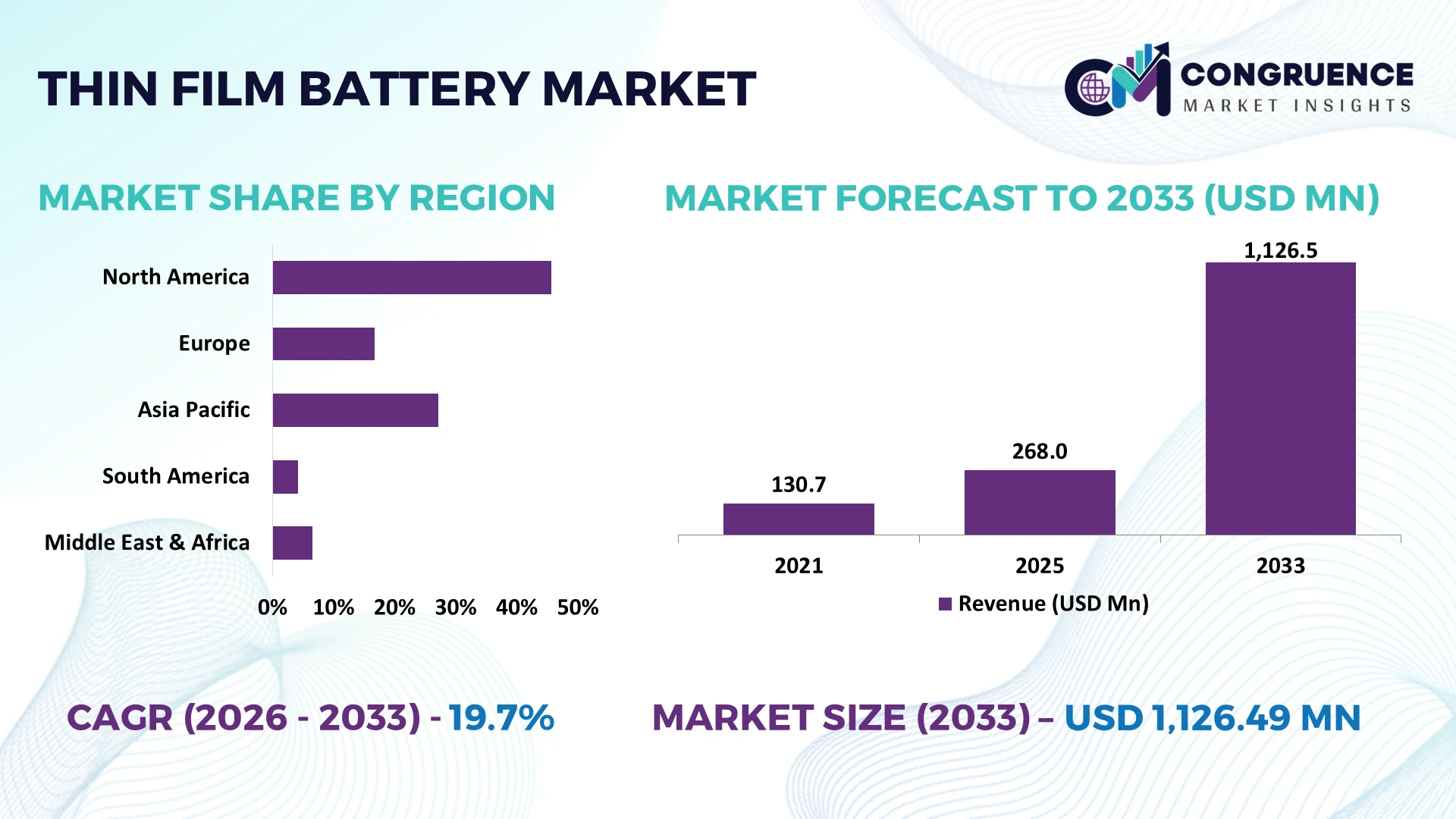
The Global Thin Film Battery Market was valued at USD 268.0 Million in 2025 and is anticipated to reach a value of USD 1,126.5 Million by 2033 expanding at a CAGR of 19.66% between 2026 and 2033. Growth is driven by rising integration of solid-state microbatteries into smart cards, medical wearables, wireless sensors, and IoT devices, supported by advances in thin-film deposition, solid electrolytes, and miniaturized energy-storage architectures.
The United States holds a strategic position in thin film battery innovation, supported by advanced semiconductor manufacturing, medical-device development, and investments in domestic battery supply chains under the Inflation Reduction Act. U.S. manufacturers benefit from established microelectronics research infrastructure, while Japan and South Korea strengthen competition through precision manufacturing and solid-state material innovation. These developments position North America as an important commercialization hub, with Asia-Pacific retaining a strong manufacturing advantage.
Companies should prioritize solid-state thin-film architectures, semiconductor partnerships, and scalable deposition technologies to strengthen commercialization and secure high-value applications.
Market Size & Growth: The global market advances from USD 268.0 million in 2025 to USD 1,126.5 million by 2033, at 19.66% CAGR, driven by solid-state microbattery integration and semiconductor-compatible manufacturing.
Top Growth Drivers: Medical devices (54.97% application share), rechargeable batteries (73.57% share), and printed battery technology (81.64% share) define the principal market growth drivers.
Short-Term Forecast: By 2028, manufacturers are prioritizing automated deposition and inline inspection, targeting production defect rates below 50 parts per million to improve manufacturing consistency and commercial yields.
Emerging Technologies: Lithium phosphorus oxynitride (LiPON) electrolytes, flexible solid-state architectures, and roll-to-roll vacuum deposition are advancing battery miniaturization, charging performance, and manufacturing scalability.
Regional Leaders: North America, Europe, and Asia-Pacific remain strategic markets. Illustrative 2033 allocations are USD 440.0 million, USD 316.6 million, and USD 291.9 million, respectively, based on a thin-film solid-state regional distribution scenario rather than independently published regional forecasts.
Consumer/End-User Trends: Medical devices represent approximately 54.97% of application demand, reflecting increasing integration into implantable electronics, diagnostic equipment, wearable monitoring systems, and compact medical sensors.
Pilot/Case Example: In 2025, Switzerland-based BTRY won a CHF 50,000 industrial innovation award to accelerate commercialization of its solid-state thin-film battery, featuring charging in under one minute and solvent-free manufacturing.
Competitive Landscape: Ion Storage Systems holds an estimated 10.5% share in one 2025 industry assessment, competing with STMicroelectronics, Cymbet, BrightVolt, and Ilika across solid-state chemistry, flexible designs, and microbattery manufacturing.
Regulatory & ESG Impact: The EU Battery Passport becomes mandatory for covered battery categories from February 18, 2027, increasing traceability and lifecycle-data requirements and encouraging transparent material sourcing.
Investment & Funding: The European SOLiD research initiative received approximately EUR 6.98 million in EU funding for scalable solid-state lithium-metal battery manufacturing, digital quality control, and improved production processes.
Innovation & Future Outlook: Next-generation development centers on multilayer solid-state cells, flexible substrates, advanced electrolyte engineering, and semiconductor-compatible production, shifting competition toward manufacturing precision, energy density, and application-specific customization.
The thin film battery market is increasingly concentrated around medical electronics, smart identification systems, flexible wearables, and wireless IoT sensors. Solid-state microbattery architectures and multilayer deposition are improving integration into space-constrained products, while printed battery technology already represents 81.64% of the market in one industry assessment. The European Battery Passport framework is also encouraging manufacturers to strengthen material traceability and production transparency, making process innovation and supply-chain readiness important competitive differentiators.
Thin film batteries are becoming strategically important because they enable electronic manufacturers to integrate reliable power sources directly into increasingly compact products. Their commercial relevance extends beyond conventional energy storage into implantable medical devices, smart labels, industrial sensors, and connected electronics. Control over solid-state electrolyte formulations, deposition processes, and manufacturing intellectual property is emerging as a competitive differentiator.
The technology transition from conventional liquid-electrolyte microcells to solid-state thin-film architectures improves packaging flexibility and eliminates liquid-electrolyte leakage risks. BTRY's vacuum-coating approach produces batteries thinner than 25 micrometers and operates across temperatures from -40°C to 150°C, demonstrating the potential of semiconductor-derived manufacturing techniques.
Regional strategies differ considerably. North American companies emphasize medical-device integration and specialist battery development, European manufacturers prioritize precision engineering and sustainability compliance, while Japanese and South Korean suppliers leverage established electronics and materials ecosystems. Over the next 2–3 years, companies will prioritize pilot-line expansion, customer qualification, deposition automation, and reliable multilayer production. For example, BTRY is progressing from laboratory development toward small-series manufacturing for IoT and medical applications. Strategic partnerships between battery developers, semiconductor manufacturers, and device OEMs will determine commercialization speed. Ultimately, competitive advantage will depend on combining manufacturing consistency, application-specific performance, and dependable supply-chain access.
Increasing integration of compact power sources into medical electronics and connected devices is accelerating thin-film battery adoption. Medical devices account for approximately 54.97% of application demand, while rechargeable configurations represent 73.57% of the market, highlighting the importance of reliable, long-life power solutions. Implantable sensors, smart medical patches, and wireless diagnostic systems increasingly require thin, lightweight batteries with stable discharge characteristics. Advances in LiPON electrolytes and multilayer deposition are improving design flexibility and integration. The expansion of connected healthcare and industrial IoT applications is encouraging manufacturers to invest in automated deposition equipment, solid-state chemistry, and OEM development partnerships. A key strategic advantage lies in integrating batteries directly into device structures rather than treating them as replaceable components.
Thin-film battery manufacturing faces considerable cost and scalability constraints arising from precision deposition, specialized substrates, electrolyte processing, and multilayer interface control. Printed technologies account for approximately 81.64% of market revenue, while rechargeable configurations represent 73.57%, increasing the importance of consistent manufacturing quality and electrochemical reliability. Vacuum deposition and solid-electrolyte processing require controlled production environments, specialized equipment, and stringent quality inspection. Manufacturers also face material sourcing exposure and limited supplier availability for specialized electrolyte formulations. These factors increase initial capital requirements and complicate high-volume commercialization. Companies are responding through automated coating systems, alternative material development, strategic procurement agreements, and partnerships with semiconductor fabrication specialists. Manufacturing yield, rather than cell performance alone, remains a critical determinant of commercial profitability.
Flexible solid-state batteries create opportunities across wearable electronics, smart packaging, implantable sensors, and autonomous monitoring systems. Wearable technology is projected to expand at a 25.36% CAGR through 2031 in one industry assessment, highlighting an attractive application opportunity for ultra-thin energy-storage solutions.Developments in multilayer cell stacking, solvent-free vacuum coating, and flexible substrates are enabling manufacturers to combine high energy density with rapid charging and compact integration. Switzerland's BTRY demonstrates this opportunity through its sub-25-micrometer battery architecture and scalable vacuum-coating approach.Companies can strengthen their positions through R&D partnerships with medical-device OEMs, semiconductor manufacturers, and IoT developers. An important untapped opportunity lies in powering distributed sensors where conventional battery replacement is operationally expensive.
Scaling thin-film batteries from laboratory prototypes to dependable commercial products requires consistent electrochemical performance, precise layer alignment, interface stability, and compatibility with different electronic architectures. Medical devices account for 54.97% of application demand, while rechargeable batteries represent 73.57% of the market, placing substantial emphasis on reliability, safety validation, and repeatable charge-discharge performance. Integration into implantable medical equipment and industrial sensors also requires stringent qualification procedures and long-term performance monitoring. Meanwhile, manufacturers entering European markets must prepare for evolving battery traceability requirements, including the February 2027 Battery Passport implementation for covered categories. Companies must strengthen pilot-to-production capabilities, invest in automated inspection, establish application-specific testing partnerships, and improve manufacturing data integration. Long-term competitiveness will depend on achieving consistent cell quality across different production volumes and end-use environments.
Rechargeable Battery Production Intensifies: Rechargeable batteries accounted for 73.57% of the global market in 2025, prompting manufacturers to prioritize multilayer solid-state cells, improved cycling stability, and precision electrode deposition. Companies are expanding rechargeable product portfolios for medical electronics and connected devices, while automated quality inspection is becoming increasingly important for reducing production variability.
Wearable Integration Accelerates: Wearable devices represented 38.5% of non-rechargeable thin-film battery applications in 2024, reflecting demand for lightweight power sources in smartwatches, fitness trackers, and health-monitoring bands. Manufacturers are adapting flexible battery formats to curved device housings and thinner product designs. The shift toward continuous health monitoring is also increasing the importance of compact batteries with predictable discharge characteristics.
Solid-State Manufacturing Advances: Vacuum deposition, ceramic electrolytes, and multilayer architectures are reshaping production strategies. BTRY's sub-25-micrometer battery demonstrates how semiconductor-derived coating processes support ultra-thin energy storage and operation across temperatures from -40°C to 150°C. Manufacturers are investing in pilot production and process control to improve layer uniformity, reliability, and commercial repeatability.
Battery Traceability Becomes Strategic: The European Union's Battery Regulation introduces digital battery passport requirements from February 18, 2027, for covered battery categories. This is accelerating supplier documentation, material traceability, and lifecycle-data integration. Manufacturers are strengthening procurement controls and digital production records, with an important operational shift: traceability is increasingly becoming a qualification requirement rather than simply a sustainability reporting exercise.
Rechargeable thin-film batteries dominated the market with approximately 73.57% share in 2025, supported by repeated-use requirements across medical electronics, connected wearables, and wireless sensor networks. Their ability to reduce replacement frequency, support recurring charging cycles, and maintain reliable power delivery strengthens their commercial advantage. Non-rechargeable batteries account for the remaining approximately 26.43%, retaining relevance in smart packaging, disposable medical patches, and single-use identification products.
Rechargeable configurations are also attracting stronger development investment as manufacturers improve solid-state electrolyte stability, charging efficiency, and cycle life. Non-rechargeable solutions remain commercially relevant where low initial cost and extended shelf life outweigh rechargeability. Companies are increasingly differentiating portfolios according to operating lifetime, device architecture, and integration requirements. The strategic shift favors rechargeable platforms for long-duration connected applications, while disposable configurations retain opportunities in high-volume, cost-sensitive electronics.
Medical devices represented approximately 54.97% of the thin film battery application market in 2025, establishing the segment as a major demand center. Implantable stimulators, diagnostic sensors, hearing devices, and compact patient-monitoring equipment require dependable power sources with strict dimensional and reliability requirements. Wearable devices represent an important expansion category, supported by increasing adoption of fitness trackers, smartwatches, and continuous health-monitoring products. Smart cards and RFID maintain established demand through secure identification and contactless applications, while consumer electronics and other applications provide additional commercialization opportunities.
Medical applications benefit from longer product qualification cycles and performance-sensitive procurement, whereas wearables emphasize flexibility, compact dimensions, and integration speed. Smart cards prioritize manufacturing throughput and low unit costs. Battery developers are responding through application-specific cell designs, flexible substrates, improved discharge characteristics, and OEM engineering partnerships. Investment is increasingly shifting toward products that combine dependable operation with reduced device thickness, particularly where battery replacement requires specialized servicing.
Healthcare represented approximately 34.8% of the thin-film and printed battery end-user market in 2025, making it the leading purchasing category in this market classification. Demand is concentrated around implantable medical equipment, neurostimulators, ophthalmic devices, diagnostic instruments, and wearable patient-monitoring systems. Consumer electronics represents another important buyer group, with procurement driven by compact product designs, battery longevity, and high-volume manufacturing requirements. Industrial and automotive customers increasingly evaluate thin-film batteries for wireless sensors, equipment monitoring, and specialized electronic systems. Other end-users include smart infrastructure and connected identification applications.
Healthcare procurement emphasizes biocompatibility, operational reliability, and product qualification, whereas consumer electronics manufacturers prioritize manufacturing economics and integration flexibility. Industrial buyers place greater emphasis on operating consistency and maintenance reduction. Battery suppliers are responding through customized cell architectures, technical partnerships, application-specific testing, and direct collaboration with equipment manufacturers. Healthcare remains the premium application-focused buyer group, while industrial and consumer electronics procurement provides opportunities to expand production volumes and diversify customer portfolios.
North America accounted for the largest market share at 45.62% in 2025 however, Asia-Pacific is expected to register the fastest growth, expanding at a CAGR of 22.35% between 2026 and 2033.
North America accounted for 45.6% of the global thin film battery market in 2025, supported by established medical-device manufacturers, advanced electronics research, and specialist battery developers. The United States anchors regional demand through implantable medical devices, defense electronics, wearable healthcare systems, and connected industrial equipment. Approximately 90% of North America's market activity is attributed to the United States, highlighting the concentration of manufacturing and technology development. Federal research programs supported by the Department of Energy, DARPA, and ARPA-E strengthen advanced electrolyte development and solid-state battery commercialization. Companies are prioritizing domestic manufacturing partnerships, pilot production, and semiconductor-compatible deposition technologies. The region's strategic advantage lies in combining specialized medical-device demand with strong research commercialization capabilities.
United States Market Outlook: The United States leads North American commercialization through its concentration of medical-device manufacturers, semiconductor research facilities, and specialist battery developers. Boston, Massachusetts, and Minneapolis, Minnesota, provide important medical technology ecosystems, while California supports advanced electronics development. The country accounts for approximately 90% of North America's thin film battery market activity. Federal battery manufacturing support exceeding USD 3 billion across more than 25 projects in 14 states strengthens the wider domestic battery manufacturing ecosystem, supporting materials innovation and advanced fabrication capabilities.
Europe represented 16.7% of the global thin film battery market in 2025, supported by advanced industrial electronics, medical-device manufacturing, and specialized coating technologies. Germany, France, the United Kingdom, Switzerland, and the Netherlands contribute through precision engineering, industrial IoT, and solid-state battery research. Germany accounts for approximately 25% of the European market, reflecting its established industrial and medical technology base. The EU Batteries Regulation (EU 2023/1542) is strengthening requirements around battery sustainability, durability, and lifecycle transparency, influencing supplier qualification and product development. Switzerland's BTRY is advancing solvent-free vacuum-coated solid-state batteries using semiconductor-derived manufacturing processes, demonstrating Europe's innovation capabilities. Manufacturers are increasingly investing in traceable materials, specialized production equipment, and collaborative commercialization programs.
Germany Market Outlook: Germany represents Europe's most strategically significant market through its automotive electronics ecosystem, industrial automation capabilities, and established medical-device manufacturing base. Approximately 25% of European thin film battery market activity is concentrated in the country. Industrial sensor networks, predictive maintenance systems, connected medical equipment, and precision electronics create opportunities for specialized battery integration. German manufacturers benefit from established engineering infrastructure and access to European research collaborations. Companies are prioritizing solid-state battery qualification, advanced materials development, and partnerships with industrial equipment manufacturers to strengthen domestic commercialization.
Asia-Pacific held 27.1% of the global thin film battery market in 2025 and represents the fastest-expanding regional opportunity. China, Japan, South Korea, and India contribute through consumer electronics manufacturing, advanced materials research, semiconductor production, and connected-device deployment. South Korea represents approximately 35% of the region's thin film battery market activity, supported by its established battery and electronics manufacturers. China's manufacturing ecosystem strengthens production scalability, while Japan contributes precision materials engineering and industrial electronics integration. South Korea's K-Battery initiatives are encouraging university-industry research into LiPON electrolytes and high-throughput sputtering technologies. Manufacturers are expanding regional partnerships, improving deposition processes, and strengthening domestic materials capabilities. The key competitive advantage is the ability to connect battery innovation directly with high-volume electronics manufacturing and downstream OEM supply chains.
South Korea Market Outlook: South Korea maintains a strategically important position through its advanced battery manufacturing ecosystem and the presence of major electronics companies, including Samsung SDI and LG Chem. The country represents approximately 35% of Asia-Pacific thin film battery market activity. Government-backed K-Battery initiatives support next-generation solid-state battery research, particularly electrolyte optimization and advanced deposition methods. Collaboration between universities, materials developers, and electronics manufacturers strengthens technology transfer and commercialization. South Korean companies are positioning themselves to supply compact batteries for wearable electronics, medical devices, and industrial sensor platforms while leveraging existing semiconductor and battery engineering expertise.
South America represented 4.1% of the global thin film battery market in 2025, with Brazil serving as its principal commercial center. Demand is developing around imported medical equipment, wearable healthcare products, smart identification systems, and industrial monitoring applications. Limited domestic production of specialized thin-film cells means that regional procurement remains dependent on international manufacturers and distribution partnerships. Brazil accounts for approximately 48% of South America's thin film battery market activity, highlighting its importance as a regional demand and commercialization hub. Growing investment in healthcare modernization and agricultural digitization is creating opportunities for compact batteries in portable diagnostics, wireless monitoring, and smart agricultural sensors. Companies are increasingly prioritizing distributor partnerships, local technical support, and application-specific product adaptation rather than establishing capital-intensive manufacturing operations immediately.
Brazil Market Outlook: Brazil leads South American commercialization through its comparatively developed healthcare infrastructure, industrial base, and expanding agricultural technology ecosystem. The country accounts for approximately 48% of the regional thin film battery market activity. Demand opportunities include portable diagnostic equipment, connected medical devices, agricultural monitoring sensors, and smart identification technologies. Brazil's electronics manufacturing incentives and established medical equipment distribution networks provide entry opportunities for international battery suppliers. Companies can strengthen market access through local OEM relationships, distributor agreements, and customized battery solutions designed for industrial and healthcare operating conditions.
Middle East & Africa accounted for 6.5% of the global thin film battery market in 2025, with demand concentrated in specialized electronics, healthcare modernization, defense systems, and industrial monitoring. Israel contributes through advanced defense electronics, sensor technologies, and specialized battery development, while Saudi Arabia and the UAE are expanding connected infrastructure and smart-city initiatives. Israel represents approximately 30% of regional market activity, demonstrating the importance of its established technology ecosystem. Saudi Arabia's Vision 2030 initiatives and NEOM-related infrastructure development create opportunities for compact power systems in environmental monitoring, wireless sensors, and connected industrial equipment. However, limited localized battery manufacturing and dependence on imported components constrain production scalability. Companies are targeting regional distributors, industrial technology integrators, and infrastructure developers to establish commercial access without extensive upfront manufacturing commitments.
Israel Market Outlook:Israel holds a strategically important position in the Middle East and Africa through its defense electronics industry, semiconductor expertise, and advanced sensor development ecosystem. The country accounts for approximately 30% of regional thin film battery market activity. Demand is associated with compact power systems for unmanned platforms, wearable defense equipment, surveillance electronics, and industrial monitoring applications. Its established technology commercialization environment supports collaboration between specialist battery developers, defense contractors, and electronics manufacturers. Companies targeting Israel benefit from a technically sophisticated customer base that prioritizes reliability, compact architecture, and performance under demanding operating conditions
The market pits diversified electronics manufacturers against specialist microbattery developers. STMicroelectronics, Panasonic, Murata, Samsung SDI and Maxell compete through scale, OEM access and materials control; Ilika, Cymbet, BrightVolt, Blue Spark and BTRY differentiate through solid-state chemistry, printable formats, fast charging and customized designs. Global Market Insights estimates the top five—Ion Storage Systems, STMicroelectronics, BrightVolt, Renata and Maxell—held 33% collectively in 2025, indicating concentration alongside specialist competition. Competition centers on reliability, deposition yield, charging speed, customization and qualified supply. Rechargeable configurations held 73.57% in one market segmentation, reinforcing lifecycle performance; Fraunhofer reports electrolyte deposition rates up to 10 times sputtering benchmarks, intensifying process-cost competition. Larger suppliers pursue OEM partnerships and production integration, while innovators secure funding and pilot-line access. The shift is from prototype differentiation toward repeatable manufacturing. Capital intensity, proprietary processes and medical-device qualification restrict entry. Winners will pair validated performance with scalable yields, dependable materials and customer-specific engineering globally.
STMicroelectronics
Panasonic Holdings Corporation
Murata Manufacturing Co., Ltd.
Samsung SDI Co., Ltd.
Ilika plc
Blue Spark Technologies
Enfucell Oy
BrightVolt, Inc.
Cymbet Corporation
Imprint Energy, Inc.
Excellatron Solid State, LLC
Jenax Inc.
BTRY AG
LionVolt B.V.
Thin-film battery performance depends on deposition precision, electrolyte chemistry, and electrode architecture. Lithium phosphorus oxynitride (LiPON) remains the established commercial thin-film solid electrolyte, with reported cycle life exceeding 10,000 cycles. Sputtering produces uniform nanoscale layers, while thermal evaporation and advanced coating target faster throughput and lower costs. Fraunhofer reports deposition rates of 100–200 nm per minute, up to 10 times sputtering rates.
The shift is toward multilayer and three-dimensional solid-state architectures that increase active material per footprint and integrate into sensors, medical implants, smart cards, and wearables. TDK’s 2024 CeraCharge material reached 1,000 Wh/L, approximately 100 times its conventional solid-state battery’s energy density, demonstrating advanced oxide-electrolyte and lithium-alloy anode potential. This company-reported result is not a market-wide efficiency gain. Adoption remains specialized: LiPON is the principal commercially established thin-film solid electrolyte; sulfide and halide alternatives remain under development.
During 2026–2028, manufacturers with vacuum coating, inline metrology, and reliable multilayer interfaces stand to benefit. Liquid-electrolyte microcells retain cost familiarity, but solid-state thin films offer leakage safety, flexible form factors, and integration. Investment should prioritize process yield, qualified materials, and OEM co-design over laboratory energy-density records. Roll-to-roll compatibility links fabrication with semiconductor equipment supply chains, reducing adoption friction for specialist producers globally.
November 2025 — BTRY raised USD 5.7 million in an oversubscribed seed round led by Redstone VC to industrialize ultra-thin solid-state cells and advance roll-to-roll manufacturing. Funding supports product integration for connected labels, wireless sensors, wearables, and pilot-line scale-up plans. btry.ch
January 2026 — Ilika completed Stereax manufacturing-process qualification at Cirtec Medical’s Lowell facility and commenced production for product testing and initial deliveries. The milestone moves its medical microbattery programme from qualification toward customer evaluation and early commercial supply for customers. ilika.com
June 2024 — TDKdeveloped a CeraCharge solid-state battery material reaching 1,000 Wh/L, approximately 100 times the energy density of its conventional solid-state battery. The advance targets wireless earbuds, hearing aids, and smartwatches, strengthening miniature power solutions for next-generation wearables. tdk.com
January 2024 — LionVolt acquired a battery-cell production line in Thurso, Scotland, complementing pilot-line development at Eindhoven’s Brainport Industries Campus. The expansion supports its 3D-electrode architecture programme, adding infrastructure for prototype development, manufacturing validation, commercialization, and future commercial
The report evaluates the global thin film battery market across rechargeable and non-rechargeable types; medical devices, wearable devices, smart cards and RFID, consumer electronics, and other applications; and healthcare, consumer electronics, industrial and automotive, and other end-users. It examines demand concentration, purchasing priorities, product qualification, and differences between high-reliability medical deployments and volume-driven connected electronics.
Geographic coverage spans North America, Europe, Asia-Pacific, South America, and the Middle East & Africa, with country-level analysis of manufacturing ecosystems, technology investment, supply-chain exposure, and commercialization readiness. Technology coverage includes LiPON solid electrolytes, thin-film deposition, vacuum coating, printed cells, multilayer architectures, and flexible solid-state designs. Competitive profiling assesses established suppliers and specialist innovators, supporting investment screening, market-entry decisions, partnership selection, capacity planning, and positioning through 2026–2033.
| Report Attribute / Metric | Details |
|---|---|
| Market Revenue (2025) | USD 268.0 Million |
| Market Revenue (2033) | USD 1,126.5 Million |
| CAGR (2026–2033) | 19.66% |
| Base Year | 2025 |
| Forecast Period | 2026–2033 |
| Historic Period | 2021–2025 |
| Segments Covered |
By Type
By Application
By End-User
|
| Key Report Deliverables | Revenue Forecast; Market Trends; Growth Drivers & Restraints; Technology Insights; Segmentation Analysis; Regional Insights; Competitive Landscape; Regulatory & ESG Overview; Recent Developments |
| Regions Covered | North America; Europe; Asia-Pacific; South America; Middle East & Africa |
| Key Players Analyzed | STMicroelectronics; Panasonic Holdings Corporation; Murata Manufacturing Co., Ltd.; Samsung SDI Co., Ltd.; Ilika plc; Blue Spark Technologies; Enfucell Oy; BrightVolt, Inc.; Cymbet Corporation; Imprint Energy, Inc.; Excellatron Solid State, LLC; Jenax Inc.; BTRY AG; LionVolt B.V. |
| Customization & Pricing | Available on Request (10% Customization Free) |




