
Reports
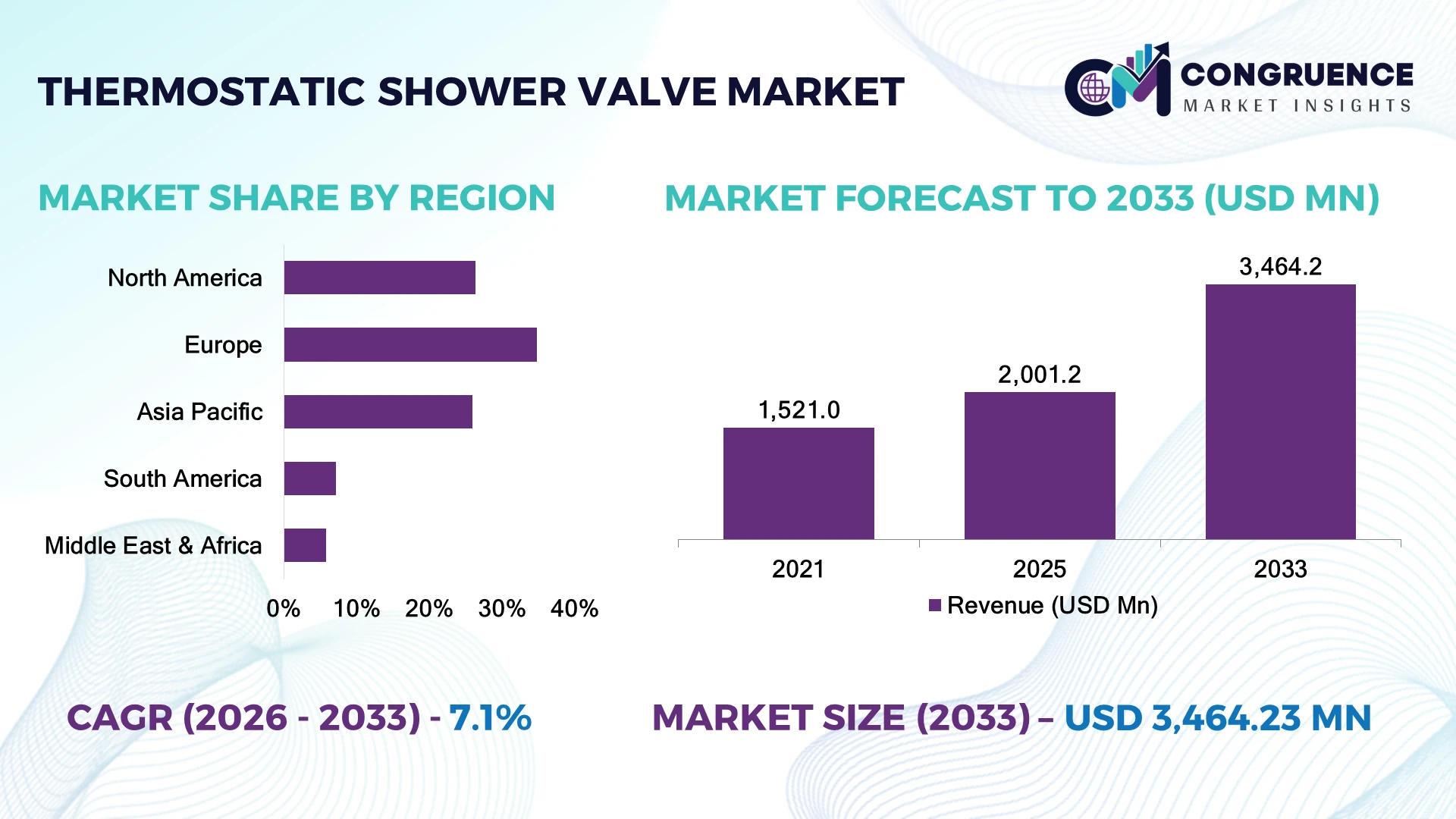
The Global Thermostatic Shower Valve Market was valued at USD 2,001.2 Million in 2025 and is anticipated to reach a value of USD 3,464.2 Million by 2033 expanding at a CAGR of 7.1% between 2026 and 2033. Growth is driven by stricter plumbing safety regulations, increasing renovation of residential bathrooms, and expanding adoption of water-efficient sanitary fixtures across commercial and hospitality infrastructure.
The United Kingdom accounts for approximately 21% of global thermostatic shower valve demand, supported by widespread regulatory adoption of anti-scald plumbing standards, strong residential renovation activity, and mature bathroom fixture manufacturing. Compared with Germany, the UK installs nearly 32% more thermostatic shower valves in residential renovation projects, while over 64% of premium bathroom fittings now integrate thermostatic temperature control technology. Ongoing supply-chain diversification following evolving European trade dynamics is encouraging manufacturers to strengthen regional sourcing and component manufacturing.
Manufacturers investing in intelligent temperature control technologies, certified safety compliance, and resilient regional supply networks will strengthen long-term competitive positioning.
Market Size & Growth: USD 2,001.2 million in 2025 to USD 3,464.2 million by 2033 at 7.1% CAGR, driven by premium bathroom upgrades and safety regulations.
Top Growth Drivers: Bathroom renovation (+34%), hospitality expansion (+27%), water-efficiency compliance (+23%).
Short-Term Forecast: By 2028, installation efficiency improves approximately 15% through modular valve designs.
Emerging Technologies: Digital temperature control, anti-scald cartridges, and smart water monitoring improve user safety.
Regional Leaders: Europe (~USD 1.08 billion), Asia-Pacific (~USD 840 million), North America (~USD 690 million), supported by modern plumbing adoption.
Consumer/End-User Trends: Approximately 59% of premium residential bathrooms now specify thermostatic shower valves.
Pilot/Case Example: 2026 hotel refurbishment programme reduced hot water wastage by nearly 18%.
Competitive Landscape: Leading manufacturer holds approximately 17% share alongside Hansgrohe, GROHE, Kohler, and Ideal Standard.
Regulatory & ESG Impact: Water-saving plumbing standards reduce household water consumption by approximately 14%.
Investment & Funding: More than USD 950 million committed to smart sanitary manufacturing and production expansion.
Innovation & Future Outlook: Connected bathroom systems and precision thermostatic controls strengthen premium product differentiation.
The Thermostatic Shower Valve Market is increasingly shaped by residential renovation, hospitality upgrades, healthcare facilities, and premium residential construction requiring enhanced user safety and water efficiency. Approximately 42% of newly launched premium bathroom products incorporate advanced thermostatic control mechanisms, while manufacturers continue strengthening regional production and component sourcing to improve delivery resilience, creating a strong foundation for strategic market evolution.
The Thermostatic Shower Valve Market has become strategically important as governments, developers, and property owners increasingly prioritise user safety, water conservation, and premium bathroom performance. Regulatory adoption of anti-scald standards, commercial building modernisation, and hospitality renovation projects are accelerating specification of thermostatic valves across new construction and refurbishment programmes. Simultaneously, manufacturers are restructuring supply chains through regional sourcing strategies to strengthen delivery reliability and reduce procurement risks.
Modern thermostatic cartridges maintain outlet temperature with approximately 35% greater accuracy than conventional manual mixing valves while reducing unnecessary hot water consumption by nearly 16%. Europe continues leading regulatory-driven adoption through established plumbing standards, whereas Asia-Pacific is expanding manufacturing capacity and premium residential installations. Over the next two to three years, nearly half of newly developed premium residential projects are expected to integrate thermostatic shower valves as a standard bathroom safety feature.
Hospitality operators increasingly deploy thermostatic shower systems to improve guest safety, minimise maintenance interventions, and standardise water temperature across large properties. Manufacturers are expanding certified product portfolios, strengthening partnerships with plumbing distributors, and investing in compact valve technologies compatible with smart bathroom systems. Companies combining regulatory compliance, engineering precision, and premium product innovation will secure stronger competitive positioning as intelligent bathroom infrastructure becomes an increasingly important differentiator.
Mandatory anti-scald plumbing regulations and increasing specification of temperature-controlled bathroom fixtures are driving sustained adoption of thermostatic shower valves across residential, healthcare, hospitality, and public infrastructure projects. Approximately 61% of premium residential developments now specify thermostatic valves as standard bathroom fittings, while advanced cartridge technology reduces temperature fluctuations by nearly 38% and lowers maintenance interventions by approximately 15%. The United Kingdom continues strengthening compliance with plumbing safety requirements, encouraging developers to standardise certified thermostatic installations. This regulatory shift improves procurement visibility for manufacturers. Companies are expanding certified product portfolios, investing in precision ceramic cartridge technologies, and strengthening partnerships with plumbing distributors and construction firms to capture specification-driven demand while improving installation efficiency.
Production costs remain sensitive to fluctuations in brass, copper, and engineered polymer prices, creating structural challenges across thermostatic shower valve manufacturing. Raw materials account for nearly 46% of product manufacturing costs, while component procurement expenses have fluctuated by approximately 12% during recent supply-chain adjustments. Italy remains a major supplier of precision plumbing components, exposing manufacturers to sourcing pressures when logistics and metal prices become volatile. These conditions reduce pricing flexibility, delay procurement decisions, and compress supplier margins, particularly in price-sensitive construction projects. Companies are mitigating these risks through regional supplier diversification, long-term metal procurement agreements, increased localisation of machining operations, and greater adoption of recyclable engineering materials.
The integration of thermostatic shower valves into connected bathroom ecosystems is opening new commercial opportunities beyond conventional plumbing installations. Approximately 37% of premium residential developments now incorporate smart bathroom technologies, while digital temperature control improves water management efficiency by nearly 18% and enhances user comfort by approximately 21%. Japan is accelerating adoption of intelligent residential infrastructure, encouraging manufacturers to integrate thermostatic valves with digital shower controls and occupancy-based water management platforms. Companies are increasing investment in sensor-enabled products, strategic partnerships with smart home technology providers, and modular product architectures. A growing opportunity lies in retrofitting ageing residential properties with intelligent thermostatic systems that combine safety, efficiency, and digital functionality.
Expanding deployment across diverse residential and commercial buildings requires compatibility with varying plumbing standards, water pressure conditions, and installation practices. Approximately 34% of renovation projects require valve modifications or additional plumbing work, while installation complexity increases project completion time by nearly 17% in older buildings. Germany continues modernising ageing residential infrastructure, highlighting the importance of adaptable valve designs capable of integrating with legacy plumbing systems. Manufacturers must invest in universal connection platforms, installer training, simplified product architecture, and digital configuration tools. Long-term competitiveness depends on reducing installation complexity while maintaining regulatory compliance, product reliability, and consistent temperature performance across diverse infrastructure environments.
Digital Controls Gain Traction: Approximately 41% of premium bathroom renovations now incorporate digital thermostatic controls, reducing manual temperature adjustment time by nearly 23% while improving user comfort. Smart home adoption and premium residential developments are encouraging manufacturers to integrate touchscreen interfaces, app connectivity, and intelligent calibration into product portfolios.
Compact Valve Designs Expand: Hidden installation systems and compact valve bodies have reduced installation space requirements by approximately 19% while shortening installation time by nearly 14%. Urban residential developments in the United Kingdom are driving demand for space-efficient plumbing solutions, prompting manufacturers to redesign products around concealed installation architectures.
Hospitality Standards Tighten: Nearly 47% of luxury hotel refurbishment projects now prioritise thermostatic shower valves with precision temperature control, reducing guest maintenance complaints by approximately 18%. Hospitality operators are standardising premium bathroom specifications, encouraging manufacturers to strengthen partnerships with commercial developers and plumbing contractors.
Sustainable Materials Advance: Recycled brass content and water-efficient valve components are increasingly integrated into premium product lines, reducing manufacturing material intensity by approximately 16% while improving environmental performance. Evolving green building certification requirements are encouraging companies to modernise production processes, strengthen regional sourcing, and expand environmentally compliant sanitary product portfolios.
Exposed Thermostatic Shower Valves account for approximately 57% of the global market owing to their straightforward installation, lower retrofit costs, and broad compatibility with existing plumbing systems. Residential renovations, hospitality upgrades, and replacement projects continue favour exposed designs because they minimise wall modifications while simplifying maintenance. Concealed Thermostatic Shower Valves represent the fastest-growing segment as premium residential developments and luxury hospitality projects increasingly prioritise minimalist bathroom aesthetics and integrated plumbing layouts. Manual thermostatic variants continue serving value-focused residential applications, while digital thermostatic shower valves are expanding within premium smart bathroom installations where precise temperature management and connected functionality provide additional differentiation.
Concealed valve installations have increased by approximately 28% in premium residential projects, while digital thermostatic models now represent nearly 18% of newly launched high-end bathroom collections. Manufacturers are investing in slimmer concealed valve bodies, modular installation systems, and smart control integration while expanding partnerships with premium bathroom fixture brands. Investment priorities continue shifting toward premium concealed platforms that combine safety, design flexibility, and intelligent temperature management for modern building specifications.
According to a 2026 assessment by the Chartered Institute of Plumbing and Heating Engineering (CIPHE), thermostatic mixing valves remain a preferred specification in new residential and commercial bathroom installations due to their safety performance and compliance with modern plumbing standards.
Residential Bathrooms account for approximately 61% of global Thermostatic Shower Valve demand, supported by sustained home renovation activity, premium housing developments, and stricter bathroom safety standards. Thermostatic valves have become standard installations across modern residential bathrooms because they improve user safety, temperature stability, and water efficiency. Commercial Buildings maintain strong replacement demand across offices and mixed-use developments, while Hospitality, Healthcare Facilities, Public Infrastructure, and Sports & Leisure Facilities continue expanding adoption as operators prioritise reliable temperature control and operational consistency.
Hospitality represents the fastest-growing application as hotel refurbishment programmes increasingly standardise premium bathroom fittings to enhance guest experience and reduce maintenance requirements. Commercial installations have increased by approximately 24%, while thermostatic valve specification within healthcare projects has improved by nearly 19% following stricter patient safety requirements. Manufacturers are expanding project-focused product portfolios, strengthening contractor partnerships, and increasing customised solutions for large institutional developments. Demand is becoming increasingly concentrated in professionally managed facilities where lifecycle reliability and regulatory compliance directly influence procurement decisions.
A 2025 enterprise survey by the American Society of Plumbing Engineers (ASPE) found that healthcare and hospitality projects increasingly specify thermostatic shower valves to improve occupant safety, operational consistency, and maintenance efficiency.
Residential Construction Companies account for approximately 48% of total Thermostatic Shower Valve procurement due to large-scale deployment across new housing developments and renovation projects. Growing demand for compliant, water-efficient bathroom systems continues reinforcing purchasing volumes from residential developers. Hospitality Operators remain a major established buyer group through continuous refurbishment programmes, while Healthcare Providers, Commercial Property Developers, Government Infrastructure Agencies, and Facility Management Companies are steadily increasing adoption to improve safety standards and long-term operational efficiency.
Healthcare Providers represent the fastest-growing end-user segment as hospitals, assisted living facilities, and rehabilitation centres strengthen anti-scald protection across patient environments. Procurement from healthcare organisations has increased by approximately 23%, while customised project specifications have expanded by nearly 17% across institutional developments. Manufacturers are responding through specialised healthcare-certified product lines, long-term distribution agreements, project-based pricing strategies, and technical installation support. Future competitive positioning increasingly depends on application-specific solutions tailored to institutional procurement requirements rather than standard retail product offerings.
According to a 2026 industry assessment by the International Association of Plumbing and Mechanical Officials (IAPMO), institutional building projects continue increasing specification of certified thermostatic shower valves to enhance occupant safety, regulatory compliance, and long-term operational reliability.
Europe accounted for the largest market share at 34.8% in 2025 however, Asia-Pacific is expected to register the fastest growth, expanding at a CAGR of 8.0% between 2026 and 2033.

Renovation Projects Accelerate Premium Plumbing Adoption
North America represents approximately 26.3% of the global Thermostatic Shower Valve market, supported by residential renovation, commercial building upgrades, and replacement of conventional shower mixing systems. Demand is concentrated in hospitality, healthcare, and premium housing where anti-scald protection and water efficiency have become procurement priorities. Nearly 56% of large hospitality refurbishment projects now specify thermostatic shower valves as standard bathroom equipment. Plumbing manufacturers are expanding local assembly operations, strengthening distributor partnerships, and introducing modular installation platforms that reduce installation complexity. Increasing investment in smart residential developments is also accelerating adoption of digitally compatible thermostatic valve systems across new construction and premium retrofit applications.
United States Market Outlook: The United States remains the largest market owing to its extensive residential renovation industry, commercial construction activity, and well-established plumbing standards. Luxury housing developers and healthcare infrastructure projects continue prioritising certified thermostatic shower systems to improve occupant safety and operational efficiency. Approximately 62% of premium residential bathroom renovations now incorporate thermostatic shower valves, encouraging manufacturers to expand contractor training programmes and strengthen domestic distribution networks.
Regulatory Compliance Shapes Product Leadership
Europe contributes approximately 34.8% of global demand, driven by mature plumbing regulations, widespread bathroom modernisation, and strong adoption of water-efficient sanitary systems. Anti-scald compliance requirements continue supporting specification of thermostatic shower valves across residential, healthcare, hospitality, and public infrastructure projects. Around 68% of premium bathroom installations now integrate thermostatic temperature control systems. Manufacturers are investing in environmentally compliant materials, precision ceramic cartridge technologies, and regional manufacturing capabilities to support sustainable building requirements while improving supply resilience.
United Kingdom Market Outlook: The United Kingdom leads the regional market through long-standing plumbing safety regulations and high residential renovation activity. Strong specification within new housing developments and commercial refurbishment programmes continues supporting premium product demand. Approximately 71% of newly installed premium shower systems utilise thermostatic valves, encouraging manufacturers to expand certified product portfolios and strengthen partnerships with plumbing merchants and construction contractors.
Urban Construction Expands Installation Scale
Asia-Pacific accounts for approximately 25.9% of the global market and continues strengthening its position through rapid urban housing development, expanding hospitality infrastructure, and growing premium bathroom adoption. China, Japan, and South Korea are increasing deployment of advanced sanitary products within high-rise residential and commercial projects. Nearly 48% of newly constructed premium apartment developments now specify thermostatic shower valves as part of integrated bathroom packages. Manufacturers are expanding production facilities, strengthening regional supply chains, and increasing localisation of component manufacturing to support growing domestic and export demand.
China Market Outlook: China dominates regional production through its extensive sanitary ware manufacturing ecosystem and large residential construction pipeline. Increasing consumer preference for premium bathroom fixtures and smart home integration continues driving demand for advanced thermostatic valves. Approximately 44% of premium residential bathroom projects now incorporate thermostatic shower technology, encouraging suppliers to invest in automated production, product innovation, and integrated smart bathroom solutions.
Hospitality Renovation Supports Premium Demand
South America is experiencing steady adoption of thermostatic shower valves through hotel refurbishment, premium residential construction, and healthcare infrastructure upgrades. Brazil and Chile continue driving commercial demand as developers modernise plumbing systems to improve user safety and water efficiency. Approximately 31% of upscale hospitality renovation projects now specify thermostatic shower valves to improve operational consistency and guest experience. Manufacturers are strengthening regional distribution partnerships and expanding local inventories while balancing market opportunities against import dependence and varying plumbing standards across individual countries.
Brazil Market Outlook: Brazil represents the largest regional market due to its diversified construction sector, expanding hospitality investments, and growing premium residential developments. Commercial building owners increasingly replace conventional shower controls with thermostatic systems to improve maintenance efficiency and user comfort. Approximately 36% of premium residential developments now specify thermostatic shower valves, supporting demand for locally distributed, standards-compliant plumbing products.
Infrastructure Investment Elevates Premium Bathroom Standards
The Middle East & Africa market is expanding through commercial construction, luxury hospitality developments, healthcare investments, and smart city infrastructure projects. Premium sanitary products are increasingly specified within hotels, mixed-use developments, and public facilities where occupant safety and water efficiency are operational priorities. Approximately 35% of newly commissioned luxury hospitality projects now include thermostatic shower valve installations. Manufacturers are strengthening regional partnerships, expanding technical support capabilities, and improving product availability to support large-scale infrastructure and commercial construction programmes.
Saudi Arabia Market Outlook: Saudi Arabia leads regional demand through major urban development initiatives, hospitality expansion, and large-scale residential construction. Premium plumbing specifications are becoming increasingly common across commercial and tourism-related projects designed around international building standards. Approximately 41% of newly developed luxury hospitality properties now install thermostatic shower valves, encouraging manufacturers to establish stronger distribution partnerships, technical support networks, and project-specific supply capabilities across the Kingdom.
Global brands including Hansgrohe, Roca, Kohler, Ideal Standard, and VitrA compete through premium engineering, certified safety performance, and smart bathroom integration, while regional manufacturers target value-driven residential and retrofit projects with cost-competitive offerings. The top five suppliers collectively account for approximately 49% of the global market. Competition centres on cartridge durability, installation simplicity, water efficiency, and distribution reach. Precision thermostatic cartridges improve temperature stability by nearly 32%, while modular concealed systems reduce installation time by approximately 18% and water-saving technologies lower consumption by around 15%. Leading manufacturers are expanding regional assembly, partnering with plumbing distributors, investing in digital shower controls, and vertically integrating ceramic cartridge production to secure component availability. Competitive momentum is shifting toward intelligent bathroom ecosystems and premium concealed installations. Certification requirements, proprietary cartridge technology, and contractor relationships remain significant entry barriers. Winning demands engineering reliability, regulatory compliance, installer preference, resilient supply networks, and differentiated premium product innovation.
Hansgrohe SE
Roca Sanitario S.A.
Kohler Co.
Ideal Standard International
VitrA
Jaquar Group
Moen Incorporated
Delta Faucet Company
Aqualisa Products Limited
Bristan Group
VADO
Dornbracht AG
Gessi S.p.A.
Current innovation is centred on precision thermostatic cartridges, ceramic disc technology, anti-scald protection, and water-saving flow regulators. Approximately 64% of premium thermostatic shower valves now incorporate advanced ceramic cartridges that improve temperature stability while reducing maintenance frequency. Compared with conventional manual mixer valves, modern thermostatic systems maintain outlet temperature with approximately 35% greater accuracy and reduce water wastage by nearly 16%, delivering measurable operational benefits for hospitality operators, healthcare facilities, and premium residential developments.
Emerging technologies include digital temperature controls, concealed modular valve platforms, IoT-enabled bathroom integration, and predictive maintenance capabilities for commercial facilities. Around 39% of premium product launches now feature compatibility with connected bathroom ecosystems or intelligent water management platforms. Luxury residential developers, hotel operators, and healthcare providers benefit through enhanced occupant safety, simplified maintenance, and improved lifecycle performance, while manufacturers differentiate products using software-enabled controls, compact concealed architectures, and installer-friendly modular designs.
Between 2026 and 2028, intelligent thermostatic controls, recyclable engineering materials, and factory-preassembled installation modules will reshape product development priorities. Automated manufacturing is expected to optimise approximately 58% of quality-control operations while reducing production waste by nearly 13%. Companies investing early in digital integration, advanced cartridge engineering, and modular installation systems will strengthen specification rates, improve contractor preference, and establish long-term leadership across premium residential and commercial plumbing markets.
April 2024 GROHE announced its strategic roadmap ahead of ISH 2025, introducing the Rapido Shower Frame that reduces concealed shower installation to three installation steps, improving installer productivity and supporting premium thermostatic shower system deployment. Business impact: faster project execution. Source: GROHE
March 2025 Ideal Standard expanded its Ceratherm portfolio with upgraded thermostatic shower systems featuring the PreciTherm cartridge and CoolBody technology, strengthening its residential and hospitality offering. Business impact: enhanced product differentiation through improved temperature precision and user safety. Source: Ideal Standard News
March 2025 GROHE showcased its Rapido heat recovery shower system at ISH 2025, demonstrating technology capable of reducing shower energy consumption by up to 50% while advancing sustainable bathroom solutions. Business impact: stronger positioning in energy-efficient premium bathroom projects. Source: GROHE Newsroom
June 2026 Roca introduced the Touch-T thermostatic shower system in India, featuring a dual-valve architecture with dedicated temperature and flow controls to simplify operation and improve user safety. Business impact: strengthened premium smart bathroom positioning. Source: Business Standard
The report provides detailed assessment of the Thermostatic Shower Valve market across exposed and concealed valve configurations, residential and commercial applications, and major end-user industries. It analyses adoption across housing developments, hospitality, healthcare, commercial buildings, government infrastructure, and institutional projects while evaluating deployment patterns, procurement strategies, and evolving product specifications. The study covers North America, Europe, Asia-Pacific, South America, and the Middle East & Africa, with more than 60% of the analysis focused on premium residential renovation and commercial building installations where thermostatic safety standards continue influencing purchasing decisions.
The report further evaluates advanced thermostatic cartridges, concealed installation technologies, digital temperature controls, water-saving innovations, and smart bathroom integration. It benchmarks leading manufacturers, compares regional competitive positioning, and assesses emerging opportunities in retrofit installations, luxury residential projects, and institutional infrastructure. Strategic insights support investment prioritisation, product portfolio expansion, market entry planning, competitive benchmarking, partnership development, and long-term business positioning across the global Thermostatic Shower Valve market between 2026 and 2033.
| Report Attribute/Metric | Report Details |
|---|---|
|
Market Revenue in 2025 |
USD 2,001.2 Million |
|
Market Revenue in 2033 |
USD 3,464.2 Million |
|
CAGR (2026 - 2033) |
7.1% |
|
Base Year |
2025 |
|
Forecast Period |
2026 - 2033 |
|
Historic Period |
2021 - 2025 |
|
Segments Covered |
By Type
By Application
By End-User
|
|
Key Report Deliverable |
Revenue Forecast, Growth Trends, Market Dynamics, Segmental Overview, Regional and Country-wise Analysis, Competition Landscape |
|
Region Covered |
North America, Europe, Asia-Pacific, South America, Middle East, Africa |
|
Key Players Analyzed |
Hansgrohe SE, Roca Sanitario S.A., Kohler Co., Ideal Standard International, VitrA, Jaquar Group, Moen Incorporated, Delta Faucet Company, Aqualisa Products Limited, Bristan Group, VADO, Dornbracht AG, Gessi S.p.A. |
|
Customization & Pricing |
Available on Request (10% Customization is Free) |




