Global Thermochromic Materials Market Report Overview
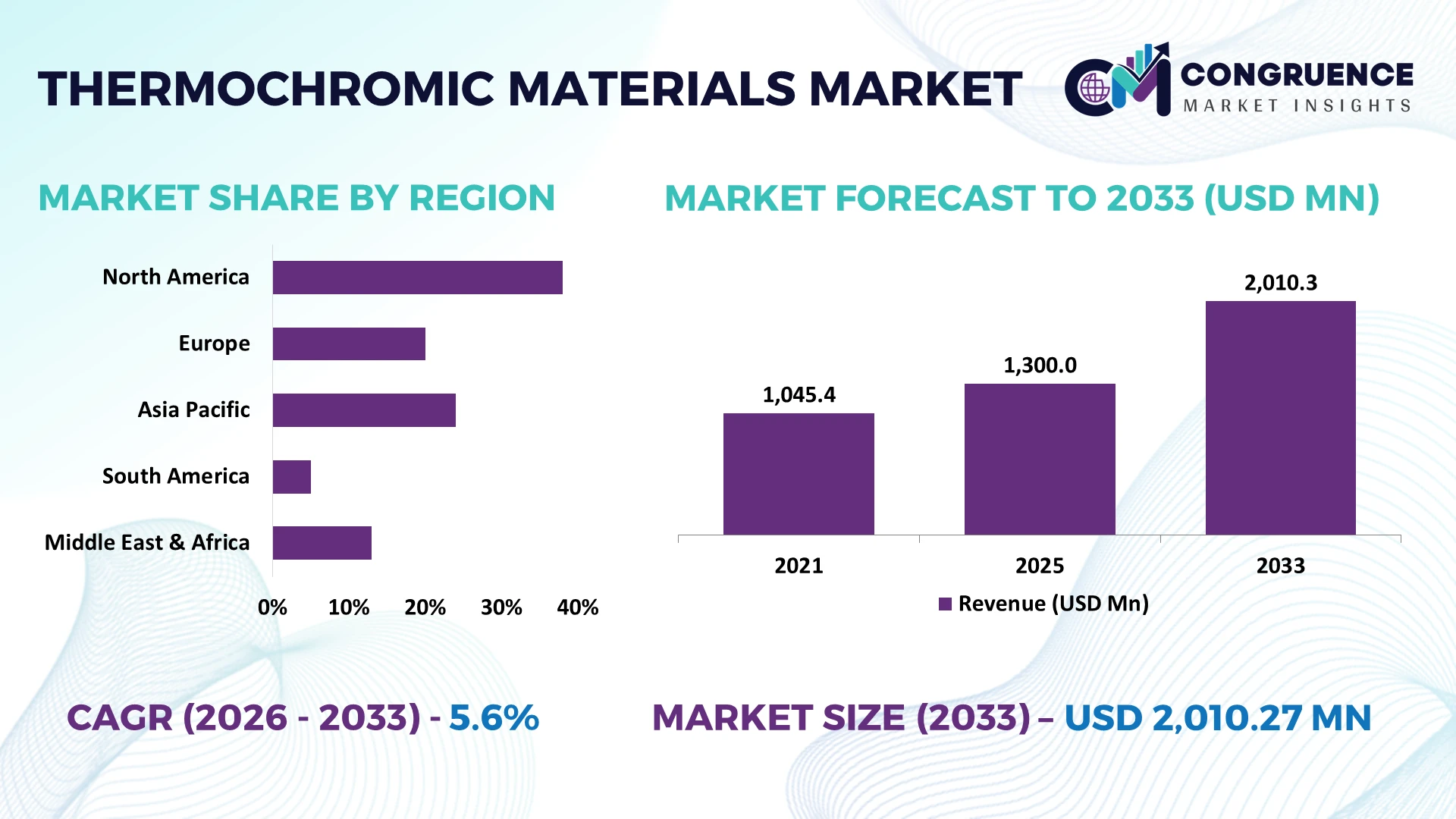
The Global Thermochromic Materials Market was valued at USD 1300 Million in 2025 and is anticipated to reach a value of USD 2010.27 Million by 2033 expanding at a CAGR of 5.6% between 2026 and 2033. Growth is driven by smart packaging applications, 31°C temperature-responsive pigments, pharmaceutical cold-chain indicators, and advanced thermochromic coatings.
China anchors Asia-Pacific's thermochromic materials manufacturing ecosystem, supported by specialty chemical production, microencapsulation capabilities, and industrial printing infrastructure. An indicative regional allocation places Asia-Pacific at 40% of global demand, compared with North America's 29% and Europe's 25%. China's manufacturing modernization strategy supports investment in automated pigment processing and functional coatings. Commercial thermochromic formulations operate across activation temperatures of −10°C to 69°C, while precision liquid crystal systems offer approximately ±0.5–1°C temperature sensitivity, strengthening opportunities in healthcare, electronics, and intelligent packaging.
Strategically, suppliers should prioritize high-stability pigments, precision temperature calibration, and regional production partnerships to capture premium industrial applications.
Key Highlights of the Global Thermochromic Materials Market
-
Market Size & Growth: USD 1,300 million in 2025, reaching USD 2,010.27 million by 2033 at 5.6% CAGR, driven by intelligent packaging integration.
-
Top Growth Drivers: Indicative 2025 demand shares include smart packaging at 36%, functional coatings at 28%, and specialty textiles at 16%.
-
Short-Term Forecast: By 2028, projected market demand reaches approximately USD 1,531 million, representing 17.8% expansion against 2025.
-
Emerging Technologies: Microencapsulation, liquid crystal pigments, and smart thermal sensors support switching temperatures from −10°C to 69°C.
-
Regional Leaders: Indicative 2033 values reach Asia-Pacific USD 844 million, North America USD 563 million, and Europe USD 482 million, reflecting differentiated industrial adoption.
-
Consumer/End-User Trends: Reversible formulations account for an estimated 63% of material demand, supporting reusable visual indicators and interactive products.
-
Pilot/Case Example: A 2026 cold-chain research project demonstrated thermal indicator stability across 20 cycles and smartphone-based temperature calibration with a 98.45% correlation magnitude.
-
Competitive Landscape: Chromatic Technologies, OliKrom, Matsui International, LCR Hallcrest, and New Prismatic Enterprise compete in specialty pigments; individual shares are not established.
-
Regulatory & ESG Impact: EU Regulation 2025/40 strengthens packaging recyclability requirements toward 2030, influencing functional ink selection and material compatibility.
-
Investment & Funding: A 10% illustrative allocation of projected incremental market value equals approximately USD 71 million for production expansion and coating technology.
-
Innovation & Future Outlook: Thermochromic photonic films have demonstrated 2,000 thermal cycles, supporting next-generation smart textiles and durable temperature-responsive surfaces.
The thermochromic materials market is advancing through pharmaceutical temperature indicators, interactive consumer packaging, security printing, and responsive architectural coatings. Advanced leuco dye systems enable reversible color transitions, while liquid crystal pigments provide temperature discrimination approaching ±0.5°C under specified conditions. Research-stage photonic films have demonstrated durability across 2,000 thermal cycles, strengthening their potential for repeated-use applications. China's specialty chemical supply chain supports industrial pigment processing, while European packaging requirements increase attention to formulation compatibility. Between 2026 and 2028, competitive differentiation will increasingly depend on thermal accuracy, ultraviolet stability, and scalable microencapsulation.
What Is the Strategic Relevance and Future Pathways of the Thermochromic Materials Market?
Thermochromic materials are becoming strategically important as manufacturers integrate temperature-responsive functionality into pharmaceutical packaging, security printing, automotive components, and intelligent textiles. Temperature-sensitive pigments enable visual condition monitoring without batteries or electronic circuitry, reducing component requirements compared with sensor-based indicators. China's specialty chemical manufacturing ecosystem supports industrial scalability, while Europe's Packaging and Packaging Waste Regulation, targeting recyclable packaging by 2030, encourages material compatibility and sustainable ink formulations. Manufacturers are consequently prioritizing encapsulation stability, regulatory compliance, and application-specific pigment development.
Technology differentiation increasingly centers on thermal precision and durability. Liquid crystal formulations can provide temperature discrimination approaching ±0.5°C under controlled conditions, whereas conventional leuco dye pigments primarily deliver threshold-based color transitions. In Japan, precision formulation expertise supports healthcare and electronics applications, while India offers opportunities in pharmaceutical logistics and specialty printing. Reversible systems also enable repeated temperature indication, reducing replacement requirements in reusable applications.
Between 2026 and 2028, manufacturers are expected to prioritize qualification targets exceeding 1,000 thermal cycles and tighter switching-temperature tolerances. Pharmaceutical cold-chain labels provide a practical deployment pathway, indicating threshold exposure during distribution. Companies investing in automated microencapsulation, coating partnerships, and calibrated formulations will strengthen product differentiation. Competitive advantage will increasingly depend on verified thermal performance, manufacturing consistency, and integration efficiency rather than pigment pricing alone.
Thermochromic Materials Market Dynamics
DRIVER:
Expansion of Intelligent Packaging and Temperature Monitoring
Increasing adoption of temperature-sensitive packaging is strengthening demand for thermochromic inks, microencapsulated pigments, and functional labels. In pharmaceutical logistics, the standard refrigerated distribution range of 2–8°C creates opportunities for visual temperature-exposure indicators. Indicative market segmentation places smart packaging at 36% of thermochromic material applications, while functional coatings represent approximately 28%. The European Union's pharmaceutical serialization framework further reinforces investment in advanced packaging infrastructure, although serialization itself does not mandate thermochromic indicators. Manufacturers are developing irreversible threshold indicators and reversible temperature-responsive labels for specialized distribution environments. Integrating visual indicators into existing printed packaging reduces dependence on separate electronic components, creating a commercially attractive route for high-volume packaging converters.
RESTRAINT:
Pigment Cost Sensitivity and Formulation Constraints
Specialty pigment production faces cost pressures from microencapsulation processing, binder compatibility, and ultraviolet protection requirements. An indicative application allocation places 16% of demand in specialty textiles, where repeated washing and abrasion impose additional formulation requirements. For a manufacturer operating at a 20% gross margin, a 5% increase in production costs without price recovery reduces gross margin to approximately 15.8%, assuming unchanged selling prices. China's concentration in chemical intermediates creates procurement exposure for overseas formulators, particularly those purchasing specialized dyes and encapsulation inputs. Companies are responding through alternative supplier qualification, longer procurement contracts, and localized finishing operations. The decisive constraint is maintaining consistent switching temperatures while controlling formulation costs across commercial production batches.
OPPORTUNITY:
Advanced Thermal Indicators and Smart Surface Integration
Next-generation thermochromic technologies create opportunities in reusable medical indicators, energy-responsive coatings, and temperature-sensitive industrial components. Research-stage photonic materials demonstrating 2,000 thermal cycles illustrate the potential for durable applications beyond conventional disposable labels. In India, pharmaceutical packaging manufacturers can integrate threshold-sensitive inks into existing printing processes, avoiding additional electronic monitoring hardware for applications requiring visual indication only. A 10% reduction in coating waste would increase usable output from 90% to 100% of input relative to the original production baseline, equivalent to an 11.1% improvement in usable yield. Companies investing in precision deposition, bio-based encapsulation research, and converter partnerships can commercialize differentiated products. Printable thermal indicators represent an attractive entry point for manufacturers already operating automated packaging lines.
CHALLENGE:
Industrial Scale-Up and Long-Term Performance Validation
Commercial scalability requires consistent pigment response across coating thicknesses, substrate materials, production speeds, and environmental conditions. A 5% variation in coating weight can alter optical intensity, while a 2°C switching-temperature deviation can undermine applications requiring narrow thermal thresholds. These figures represent illustrative engineering sensitivities rather than established industry averages. Japanese electronics manufacturers and German specialty coating producers face demanding qualification requirements for precision applications, particularly where ultraviolet exposure and repeated thermal cycling affect color stability. Companies must establish standardized testing protocols, automated optical inspection, and application-specific durability benchmarks. Reducing batch rejection from 5% to 2% would increase acceptable production output by approximately 3.2%. Long-term competitiveness depends on reproducible thermal performance, validated operating lifetimes, and reliable integration into industrial manufacturing systems.
Thermochromic Materials Market Latest Trends
-
Precision Color Calibration Gains Importance: Thermochromic pigment manufacturers are shifting toward tighter activation-temperature specifications and automated color measurement. Commercial formulations include switching points near 15°C, 31°C, and 45°C, while precision liquid crystal systems can resolve temperature differences approaching 0.5°C. Japanese specialty chemical companies are incorporating spectrophotometric inspection and controlled coating deposition to improve batch reproducibility. For a production line with 5% initial color-related rejects, reducing defects to 2% increases accepted output by approximately 3.2%, improving material utilization without additional equipment capacity.
-
Durability Testing Becomes More Rigorous: Manufacturers are extending qualification beyond initial color response to ultraviolet exposure, abrasion, and repeated thermal cycling. Research-stage thermochromic films have demonstrated 2,000 switching cycles, establishing a useful performance reference for advanced formulations. German coating developers increasingly emphasize accelerated weathering and substrate-specific adhesion testing. Extending validated service life from 500 to 1,000 cycles doubles the permitted switching frequency before replacement, where cycling determines product lifetime. Suppliers are responding with protective topcoats, improved encapsulation shells, and application-specific testing protocols.
-
Digital Printing Workflows Expand: Thermochromic inks are being adapted for shorter production runs, variable graphics, and digitally managed color specifications. Inkjet-compatible formulations must control particle size, viscosity, and dispersion stability to prevent nozzle obstruction. A reduction in changeover time from 60 to 45 minutes improves setup efficiency by 25%, illustrating the operational advantage of standardized formulations. Indian specialty printers are positioned to serve customized promotional and security applications through automated registration, controlled curing, and lower-volume production scheduling. Ink suppliers are prioritizing converter qualification and printhead compatibility.
-
Packaging Material Compatibility Takes Priority: European packaging converters are reassessing functional ink chemistry under Regulation 2025/40, with general recyclability requirements applying from 2030. Thermochromic coatings must preserve substrate recovery and avoid interfering with sorting or recycling operations. A 10% reduction in coating application weight, where achievable without losing optical performance, directly lowers pigment consumption by 10%. Suppliers are developing thinner functional layers and conducting recyclability assessments with packaging partners. The emerging competitive advantage is delivering equivalent visual functionality with less specialty material per package.
Segmentation Analysis
By Type
Leuco Dye-Based Materials Lead Commercial Adoption
Leuco Dye-Based Materials dominate the thermochromic materials market, accounting for an estimated 46% of global demand in 2025, supported by cost-effective production, versatile activation temperatures, and compatibility with printing and coating processes. Their microencapsulated formulations enable reversible color transitions across paper, plastics, and textile substrates, making them commercially attractive for high-volume applications. Liquid Crystal-Based Materials represent approximately 21% of indicative demand, offering greater temperature discrimination for precision thermal indicators and specialized electronic components. Manufacturers are strengthening pigment encapsulation and dispersion control to improve formulation stability, coating uniformity, and processing reliability.
Inorganic Thermochromic Materials are gaining relevance in durable industrial coatings where thermal resistance and environmental stability influence purchasing decisions. Reversible Materials represent an estimated 63% of functionality-based demand, reflecting their suitability for repeated temperature indication. Irreversible Materials are positioned for faster adoption in single-event thermal exposure monitoring, particularly where permanent evidence of temperature excursions is essential. Suppliers are directing development toward calibrated activation thresholds, improved color retention, and application-specific durability. Investment priorities increasingly favor specialized formulations with measurable performance differentiation over standardized decorative pigments.
- In 2025, the European Commission's Packaging and Packaging Waste Regulation established a framework for packaging recyclability from 2030. This reinforces the commercial importance of compatible thermochromic formulations, particularly microencapsulated leuco dye systems integrated into printed packaging.
By Application
Smart Packaging Dominates Functional Material Deployment
Smart Packaging leads the thermochromic materials market with an estimated 36% share in 2025, supported by temperature-responsive labels, interactive product packaging, and visual condition indicators. Packaging converters benefit from integrating thermochromic inks into established printing processes without adding electronic components. Temperature Indicators represent approximately 22% of indicative application demand, particularly across pharmaceutical logistics, industrial temperature monitoring, and specialized equipment labeling. Food and Beverage Monitoring is gaining commercial relevance through visible thermal exposure indicators, although such indicators cannot independently establish food safety or freshness. Manufacturers are refining activation thresholds and coating compatibility to support repeatable visual performance across different packaging substrates.
Security Printing is positioned for accelerated adoption as brands incorporate temperature-responsive authentication features into product labels and documents. Textiles and Apparel applications emphasize interactive garments, specialty prints, and color-changing accessories, while Building and Construction applications explore temperature-responsive surface treatments. Suppliers are expanding partnerships with packaging converters, security printers, and functional coating developers. Competitive differentiation increasingly depends on maintaining visual contrast, controlling printing costs, and delivering consistent switching behavior during industrial production.
- The European Commission's 2025 packaging regulatory framework requires greater attention to material composition and recyclability. Functional ink manufacturers serving packaging applications must therefore align pigment chemistry and coating architecture with evolving packaging design requirements.
By End-User
Packaging Manufacturers Anchor Industrial Demand
Packaging Manufacturers represent the leading end-user group, accounting for an estimated 38% of global thermochromic materials demand in 2025. Their position reflects large-scale printing infrastructure, established material procurement networks, and integration of temperature-sensitive inks into commercial packaging. Textile and Apparel Companies account for an indicative 17% share, using reversible pigments in specialty garments and interactive fabric printing. Automotive Manufacturers deploy thermochromic coatings in selected interior components, decorative surfaces, and temperature-indication applications. Packaging buyers prioritize activation consistency, ink compatibility, and production efficiency, encouraging suppliers to develop standardized pigment dispersions and converter-specific formulations.
Healthcare and Medical Device Companies are positioned as a high-growth end-user group because pharmaceutical handling and temperature-sensitive medical products require clearly defined thermal exposure conditions. Electronics Manufacturers increasingly evaluate thermochromic materials for localized heat indication, while Construction Companies explore functional architectural coatings. Suppliers are developing customized switching-temperature ranges and application-specific qualification programs. Strategic investment is shifting toward technical collaboration with device manufacturers, specialty coating processors, and industrial printing partners, where validated performance supports differentiated pricing and longer customer relationships.
- The International Energy Agency's Global EV Outlook 2025 projected electric car sales exceeding 20 million units in 2025, representing more than 25% of worldwide car sales. This expands the automotive manufacturing base for evaluating advanced functional interior materials.
Region-Wise Market Insights
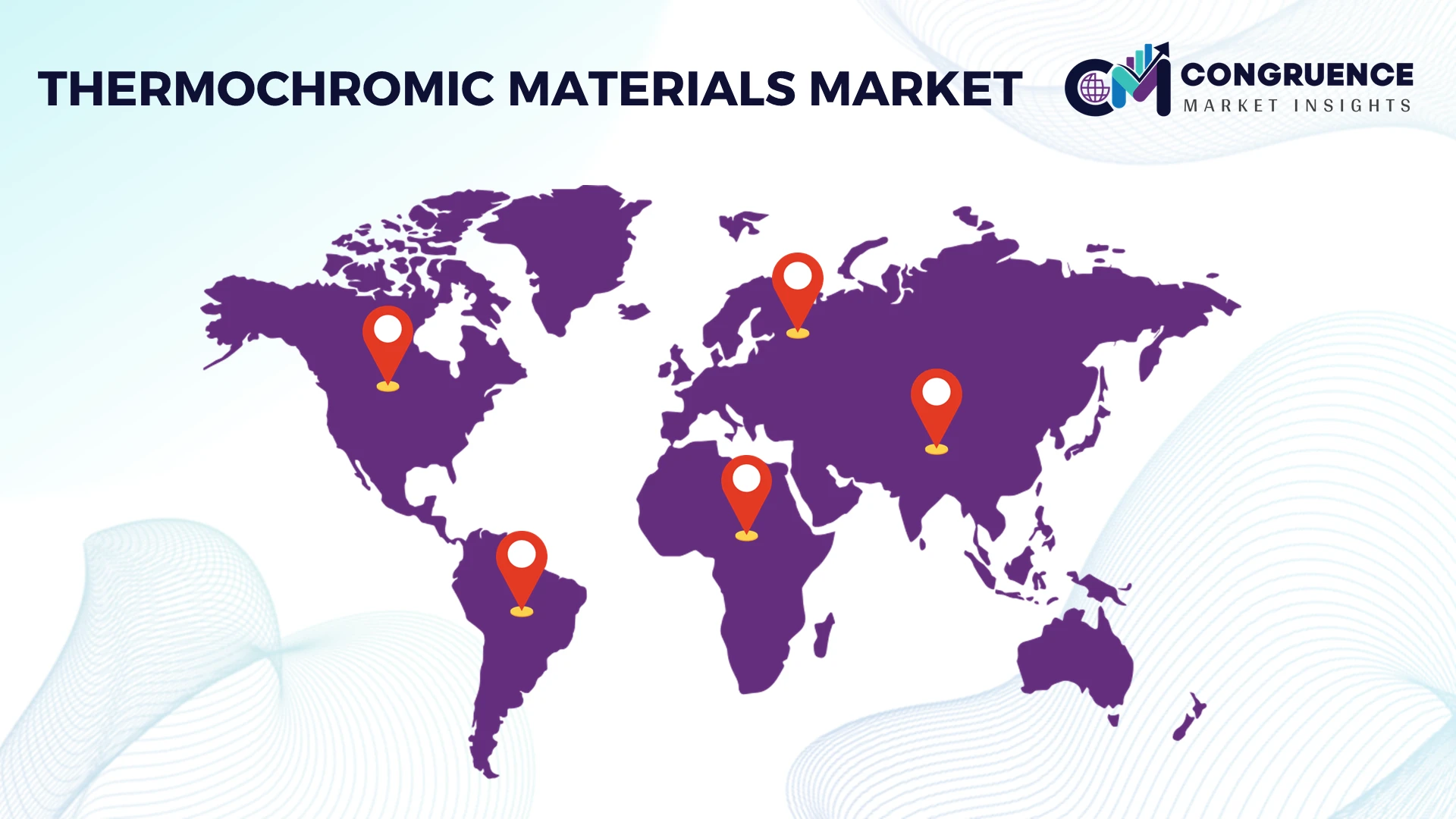
Asia-Pacific accounted for the largest market share at 40% in 2025 however, Asia-Pacific is expected to register the fastest growth, expanding at a CAGR of 6.8% between 2026 and 2033.
North America Thermochromic Materials Market
Advanced Functional Inks and Industrial Product Differentiation
North America accounted for an estimated 29% of global thermochromic materials demand in 2025, supported by specialty ink manufacturers, pharmaceutical packaging converters, and industrial coating developers. The United States anchors regional commercialization through temperature-responsive authentication technologies, promotional printing, and specialized thermal indication products. Chromatic Technologies strengthens the regional manufacturing ecosystem through proprietary color-changing ink formulations and application development. Canada's specialty packaging industry provides additional opportunities for thermochromic labeling, particularly where temperature visibility supports distribution processes. Mexico's expanding automotive and electronics manufacturing base creates opportunities for localized functional coating integration. Under the United States–Mexico–Canada Agreement, cross-border manufacturing networks support regional procurement and component processing. Manufacturers are prioritizing production compatibility, calibrated activation thresholds, and shorter customer qualification cycles. A 5% reduction in coating waste directly lowers specialty pigment consumption per production batch.
United States Market Outlook: The United States benefits from established specialty chemical research, pharmaceutical manufacturing, and advanced packaging infrastructure. The FDA's 2–8°C refrigerated storage requirements for relevant pharmaceutical products create applications for calibrated thermal exposure indicators. Domestic suppliers are developing irreversible temperature-sensitive labels and integrating specialized pigments into industrial printing systems, strengthening opportunities for customized formulations and technical service agreements.
Europe Thermochromic Materials Market
Sustainable Coating Innovation and Regulatory Modernization
Europe represented approximately 25% of global thermochromic materials demand in 2025, reflecting established specialty chemical capabilities, functional printing technologies, and industrial coating expertise. Germany, France, and the United Kingdom support advanced applications involving security printing, architectural materials, and precision thermal indicators. The European Union's Packaging and Packaging Waste Regulation 2025/40 introduces stricter packaging sustainability requirements, with general recyclability obligations beginning in 2030. This regulatory transition is encouraging manufacturers to evaluate encapsulation chemistry, ink migration, and compatibility with material recovery systems. French specialty pigment developers are advancing temperature-responsive formulations for industrial monitoring and authentication, while German converters emphasize production reliability and standardized coating performance. European manufacturers are increasingly combining pigment development with substrate engineering. Reducing functional coating thickness by 10%, while maintaining optical performance, provides a corresponding reduction in material consumption and improves resource efficiency.
Germany Market Outlook: Germany's automotive manufacturing, industrial chemicals, and precision engineering infrastructure supports thermochromic coating development. The country produced approximately 4.1 million passenger cars in 2024, providing a substantial industrial base for evaluating advanced interior surfaces and temperature-responsive components. German chemical manufacturers also benefit from established testing laboratories, automated coating equipment, and strong industrial customer qualification networks.
Asia-Pacific Thermochromic Materials Market
Manufacturing Scale and Specialty Pigment Supply Integration
Asia-Pacific leads the global thermochromic materials industry with an estimated 40% market share in 2025, supported by extensive pigment processing, industrial printing, and specialty chemical manufacturing. China dominates regional production infrastructure, while Japan contributes high-performance thermochromic inks and precision color-changing formulations. South Korea strengthens demand through electronics manufacturing and advanced functional materials, whereas India provides an expanding pharmaceutical packaging and textile processing ecosystem. Regional manufacturers benefit from integrated chemical supply chains and established coating equipment production. China's manufacturing sector accounted for approximately 32% of global manufacturing value added in 2024, highlighting its industrial scale advantage. Japanese companies are focusing on pigment uniformity and controlled activation temperatures, while Chinese suppliers compete through production capacity and formulation customization. Regional investment increasingly targets automated dispersion, encapsulation consistency, and export-oriented specialty ink manufacturing.
China Market Outlook: China maintains a competitive advantage through concentrated chemical manufacturing clusters in Jiangsu, Zhejiang, and Guangdong. Its industrial ecosystem supports large-scale pigment synthesis, microencapsulation, and packaging material conversion. The country's 2025 manufacturing modernization initiatives encourage advanced process automation and higher-value chemical products. Domestic producers are expanding temperature-responsive ink portfolios and strengthening relationships with electronics, textile, and packaging manufacturers.
South America Thermochromic Materials Market
Packaging Modernization and Specialty Printing Adoption
South America represented an indicative 4% of global thermochromic materials demand in 2025, with Brazil accounting for the largest industrial application base. Regional consumption is concentrated in specialty packaging, promotional printing, consumer goods labeling, and selected textile applications. Brazil's established food processing and cosmetics industries create commercial opportunities for temperature-responsive graphics and functional packaging differentiation. Argentina and Chile provide smaller application markets associated with pharmaceutical distribution and specialty printing services. Local converters generally depend on imported functional pigments, increasing sensitivity to exchange rates, shipping costs, and supplier lead times. Manufacturers are addressing these constraints through domestic ink blending, regional distribution partnerships, and customized coating services. A 10% reduction in imported pigment inventory requirements would release working capital equivalent to 10% of the previous inventory value, improving operational flexibility for regional converters.
Brazil Market Outlook: Brazil provides the strongest regional industrial foundation through its packaging converters, consumer goods manufacturers, and chemical processing infrastructure. The country has more than 200 million inhabitants, supporting a substantial domestic consumer products market. São Paulo's printing and packaging clusters offer opportunities for thermochromic inks in promotional labeling, beverage packaging, and specialty authentication applications, encouraging partnerships between domestic converters and international pigment suppliers.
Middle East & Africa Thermochromic Materials Market
Industrial Diversification and Climate-Responsive Material Applications
The Middle East & Africa accounted for an estimated 2% of global thermochromic materials demand in 2025, reflecting an emerging application base across industrial coatings, packaging, construction materials, and specialty printing. Saudi Arabia and the United Arab Emirates are strengthening advanced manufacturing capabilities through industrial diversification programs and investment in specialty chemical infrastructure. South Africa provides an established packaging and industrial printing base, while Egypt's expanding manufacturing ecosystem supports additional functional material applications. High ambient temperatures create demanding operating conditions for thermochromic coatings, particularly where ultraviolet exposure and repeated thermal cycling affect performance. Regional suppliers are prioritizing pigment stability, substrate adhesion, and climate-specific formulation development. Manufacturers are also establishing distribution relationships with international chemical suppliers to improve material availability. Temperature-responsive building surfaces represent a specialized opportunity where long-term durability can be demonstrated.
Saudi Arabia Market Outlook: Saudi Arabia's Vision 2030 industrial diversification program supports investment in advanced materials, specialty chemicals, and manufacturing localization. The National Industrial Development and Logistics Program targets stronger domestic industrial capabilities and supply-chain integration. The country's high-temperature operating environment creates opportunities for thermochromic coatings in industrial identification, architectural surfaces, and specialized temperature-indication applications, particularly when ultraviolet resistance and switching reliability meet demanding specifications.
Market Competition Landscape
The thermochromic materials market features competition between specialty pigment innovators, industrial ink formulators, and cost-focused Asian manufacturers. Chromatic Technologies, SpotSee, OliKrom, Matsui International, and Hali Pigment compete through application expertise, temperature accuracy, and manufacturing flexibility. An illustrative competitive concentration scenario assigns the five leading suppliers a combined 38% share, reflecting a fragmented industry structure rather than verified company disclosures. Asian manufacturers emphasize scalable pigment processing, while European specialists prioritize precision formulations and technical customization. Reducing coating waste by 10% improves material efficiency, whereas lowering production defects from 5% to 2% increases acceptable output by approximately 3.2%. Companies strengthen positioning through microencapsulation innovation, distributor partnerships, and specialized coating development. Competition is shifting toward validated thermal performance, ultraviolet durability, and application-specific integration. Complex pigment chemistry, qualification requirements, and switching-temperature consistency remain substantial entry barriers. Winning suppliers combine reliable formulations, competitive processing costs, responsive technical support, and established industrial distribution networks to secure customer contracts.
Companies Profiled in the Thermochromic Materials Market Report
-
Chromatic Technologies Inc.
-
SpotSee
-
OliKrom SAS
-
Matsui International Company Inc.
-
Hali Pigment Co., Ltd.
-
Kolortek Co., Ltd.
-
New Prismatic Enterprise Co., Ltd.
-
Smarol Industry Co., Ltd.
-
QCR Solutions Corp.
-
SFXC
-
FX Pigments Pvt. Ltd.
-
New Color Chemical Co., Ltd.
-
Indestructible Paint Limited
-
L'Arca S.r.l.
Technology Insights for the Thermochromic Materials Market
Microencapsulated leuco dyes remain central to commercial thermochromic inks, enabling reversible color transitions at calibrated activation temperatures, including 15°C, 31°C, and 45°C. Liquid crystal formulations provide narrower temperature discrimination, approaching ±0.5°C under controlled conditions. Automated pigment dispersion and spectrophotometric inspection improve coating consistency across packaging and textile substrates. Reducing production rejection from 5% to 2% increases acceptable output by approximately 3.2%, demonstrating the operational value of digital quality control. Packaging converters benefit from integrating these formulations into established printing infrastructure without electronic sensing components.
Emerging technologies include inorganic thermochromic pigments, photonic films, and ultraviolet-resistant encapsulation systems. Research-stage photonic materials have demonstrated 2,000 thermal cycles, supporting applications requiring repeated temperature indication. Compared with conventional formulations qualified for 500 cycles, achieving 1,000 cycles delivers a 100% improvement in switching endurance. Precision coating equipment also enables thinner functional layers; reducing pigment deposition by 10% lowers material consumption proportionally. Specialty chemical manufacturers gain differentiation through durability validation, controlled switching thresholds, and substrate compatibility.
Between 2026 and 2028, development priorities will shift toward printable thermal indicators, automated optical calibration, and recyclable coating architectures. Healthcare packaging suppliers and precision electronics manufacturers benefit most from verified thermal accuracy, while lower-cost pigment producers face increasing qualification requirements.
Recent Developments in the Global Thermochromic Materials Market
-
June 2025: OliKrom unveiled VisioKrom at the Paris Air Show, following five years of development with industrial partners. The thermochromic tracer enables visual inspection of anticorrosion treatments, improving coating traceability without modifying existing industrial processing equipment. Source: olikrom.com
-
January 2026: University of Central Florida researchers introduced tunable photonic materials inspired by biological color-changing mechanisms. The innovation targets thermal sensing, textiles, and reconfigurable displays, establishing one alternative to conventional pigment-dependent coloration and addressing structural-color manufacturing scalability challenges. Source: ucf.edu
-
April 2026: University of Michigan Engineering researchers demonstrated an organic phosphor switching reversibly between two emission colors following heat or solvent exposure. The molecular innovation supports layered information encoding, creating a research pathway for temperature-responsive authentication and advanced security materials. Source: engin.umich.edu
-
June 2026: Yale University researchers demonstrated light-patterned thermochromic behavior using an anthracene heterodimer ligand. The technique enables selective activation of material properties without conventional photoresist processing, supporting precision patterning and advanced functional material integration in emerging nanoscale devices. Source: yale.edu
Scope of the Thermochromic Materials Market Report
The Thermochromic Materials Market Report examines five material categories: Leuco Dye-Based Materials, Liquid Crystal-Based Materials, Inorganic Thermochromic Materials, Reversible Materials, and Irreversible Materials. Application coverage includes Smart Packaging, Temperature Indicators, Textiles and Apparel, Building and Construction, Food and Beverage Monitoring, and Security Printing. The analysis evaluates six end-user industries, emphasizing manufacturing integration, pigment durability, temperature sensitivity, and commercial deployment. Indicative segmentation places Leuco Dye-Based Materials at 46% of material demand, highlighting established formulation advantages.
Regional coverage spans North America, Europe, Asia-Pacific, South America, and the Middle East & Africa, with Asia-Pacific representing an estimated 40% market share. The report examines microencapsulation, photonic materials, precision coatings, and temperature-responsive inks alongside competitive strategies and industrial partnerships. Its 2026–2033 outlook supports investment prioritization, geographic expansion, technology selection, and long-term competitive positioning.
Thermochromic Materials Market Report Summary
| Report Attribute/Metric | Report Details |
|---|
Market Revenue in 2025 | USD 1300 Million |
Market Revenue in 2033 | USD 2010.27 Million |
CAGR (2026 - 2033) | 5.6% |
Base Year | 2025 |
Forecast Period | 2026 - 2033 |
Historic Period | 2021 - 2025 |
Segments Covered | y TypeLeuco Dye-Based Materials Liquid Crystal-Based Materials Inorganic Thermochromic Materials
By ApplicationBuilding and Construction Food and Beverage Monitoring
By End-UserTextile and Apparel Companies Electronics Manufacturers Healthcare and Medical Device Companies
|
Key Report Deliverable | Revenue Forecast, Growth Trends, Market Dynamics, Segmental Overview, Regional and Country-wise Analysis, Competition Landscape |
Region Covered | North America, Europe, Asia-Pacific, South America, Middle East, Africa |
Key Players Analyzed | Chromatic Technologies Inc., SpotSee, OliKrom SAS, Matsui International Company Inc., Hali Pigment Co., Ltd., Kolortek Co., Ltd., New Prismatic Enterprise Co., Ltd., Smarol Industry Co., Ltd., QCR Solutions Corp., SFXC, FX Pigments Pvt. Ltd., New Color Chemical Co., Ltd., Indestructible Paint Limited, L'Arca S.r.l. |
Customization & Pricing | Available on Request (10% Customization is Free) |





