
Reports
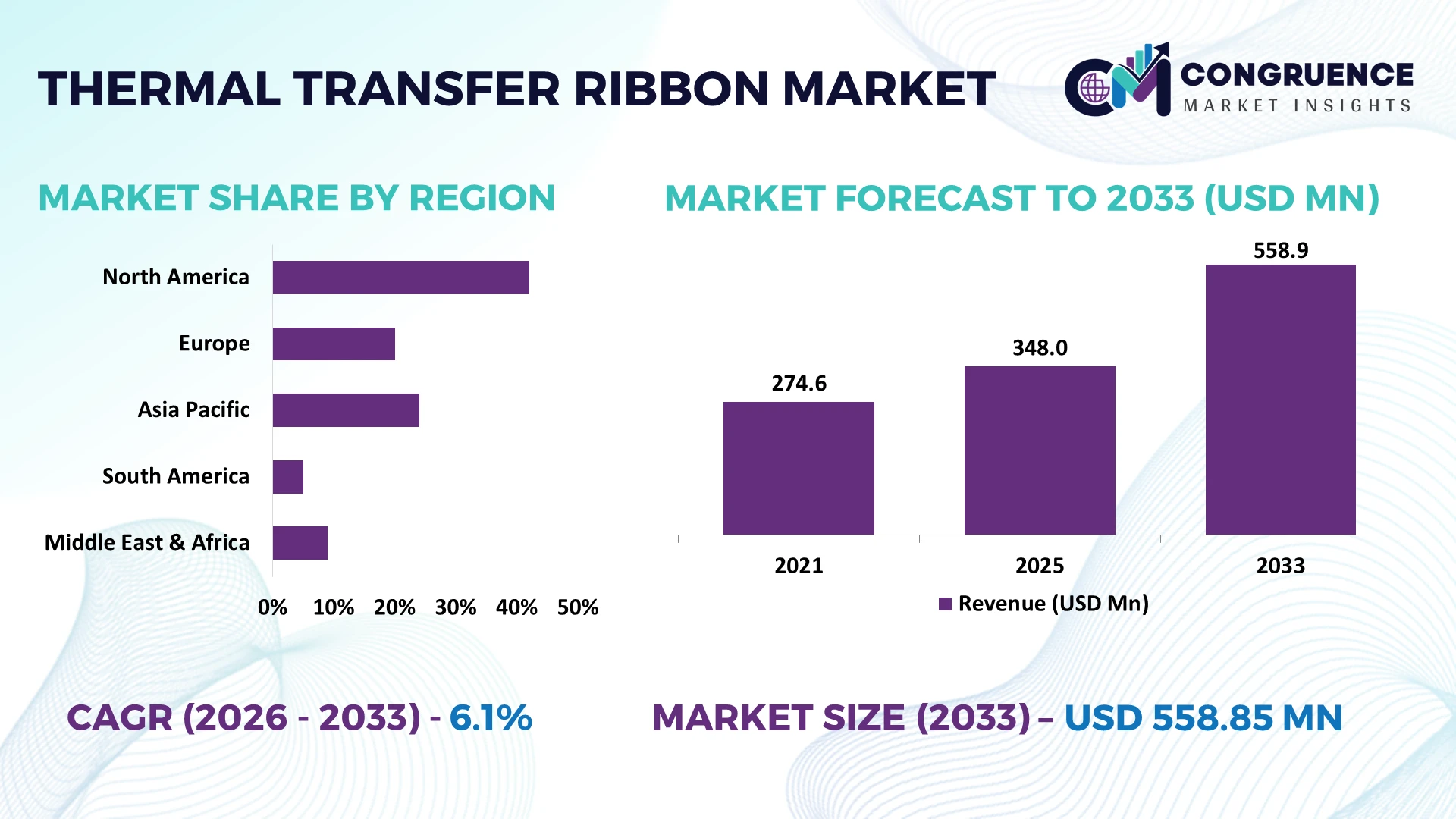
The Global Thermal Transfer Ribbon Market was valued at USD 348 Million in 2025 and is anticipated to reach a value of USD 558.85 Million by 2033 expanding at a CAGR of 6.1% between 2026 and 2033. Growth is driven by barcode traceability, ecommerce fulfillment, pharmaceutical serialization, automated logistics labeling, and migration toward durable resin and wax resin printing for harsh industrial environments.
China represents the dominant country market, accounting for an estimated 24% of global demand, supported by manufacturing, ecommerce, electronics, logistics, and export labeling. China handled 174.5 billion express parcels in 2024, creating substantial barcode and shipping label consumption, while manufacturing represented 24.9% of national economic output. Compared with the United States, China combines greater manufacturing concentration with high volume parcel operations. US China supply chain restructuring is simultaneously increasing traceability requirements across diversified manufacturing and logistics networks.
Ribbon producers combining localized coating capacity, durable formulations, printer compatibility, and dependable supply are positioned strongest as labeling becomes embedded in automated traceability workflows.
Market Size & Growth: USD 348 million in 2025 reaches USD 558.85 million by 2033 at 6.1% CAGR, driven by automated barcode labeling, serialization, and logistics traceability.
Top Growth Drivers: Ecommerce fulfillment at 19%, pharmaceutical serialization at 16%, and manufacturing traceability at 14% represent the strongest demand drivers for durable thermal transfer printing.
Short Term Forecast: By 2028, automated print and apply workflows can reduce manual labeling intervention by 30%, improving throughput across warehouses, manufacturing lines, and distribution centers.
Emerging Technologies: Near edge printing, RFID enabled labels, and automated verification are advancing, with industrial thermal printers reaching speeds above 14 inches per second.
Regional Leaders: Asia Pacific approaches USD 220 million, North America USD 145 million, and Europe USD 130 million by 2033 as automated identification expands across production and logistics.
End User Trends: China processed 174.5 billion express parcels in 2024, reinforcing high volume requirements for shipping labels, barcode identification, and variable information printing.
Pilot/Case Example: Automated logistics labeling deployments can process more than 60 packages per minute, reducing manual identification bottlenecks across high throughput distribution operations.
Competitive Landscape: ARMOR IIMAK holds an estimated 25% global position, competing with DNP, Ricoh, ITW, and Fujicopian across wax, wax resin, and resin ribbon technologies.
Regulatory & ESG Impact: EU packaging rules target 100% recyclable packaging by 2030, increasing pressure for compatible ribbon, label, adhesive, and substrate combinations supporting circular packaging systems.
Investment & Funding: More than USD 1 trillion in annual global ecommerce sales creates sustained investment requirements across automated warehousing, barcode printing, fulfillment, and identification infrastructure.
Innovation & Future Outlook: Advanced resin formulations can withstand temperatures above 150°C, shifting premium ribbon demand toward electronics, automotive, chemical, healthcare, and other high durability identification applications.
The Thermal Transfer Ribbon Market is increasingly shaped by automated identification across ecommerce fulfillment, manufacturing, pharmaceuticals, food distribution, electronics, and transportation. Wax ribbons remain important for economical paper labeling, while wax resin and resin formulations are gaining strategic relevance where abrasion, chemicals, heat, and long service life determine print durability. China’s 174.5 billion express parcels processed in 2024 illustrate the operational scale supporting barcode consumables. Supply chain diversification is also expanding traceability across production locations, pushing ribbon manufacturers toward specialized coatings, near edge compatibility, sustainable formulations, and dependable regional supply networks as labeling becomes integral to digital operations.
Thermal transfer ribbons are becoming strategically important as manufacturers, logistics operators, pharmaceutical companies, and retailers embed machine readable identification into production and distribution. China processed 174.5 billion express parcels in 2024, illustrating the scale of labeling consumption. Supply chain restructuring is extending traceability across additional production locations, increasing requirements for durable barcodes, serialized labels, and consistent print quality.
Near edge thermal transfer systems support printing speeds above 14 inches per second, delivering over 40% higher throughput than conventional 10 inch per second workflows. Asia Pacific benefits from manufacturing and parcel scale, while Europe emphasizes regulated product identification and packaging compliance. Through 2028, automated print and apply deployment will deepen across warehouses, pharmaceutical packaging, electronics assembly, and food distribution as enterprises reduce manual labeling intervention.
A high throughput distribution line processing 60 packages per minute can integrate automated printing, application, and barcode verification without separate manual identification. Ribbon producers are consequently investing in resin chemistry, printer compatibility, regional coating capacity, and OEM partnerships. Competitive leadership will depend on converting ribbon durability, printing speed, and supply reliability into measurable operating continuity.
Digital traceability across logistics and manufacturing is the primary demand driver because every automated identification event requires reliable machine readable printing. China processed 174.5 billion express parcels in 2024, while online retail represented 26.8% of total Chinese retail sales, intensifying shipping label consumption. Manufacturing contributes roughly 25% of China's economic output, creating another concentrated requirement for inventory, component, and compliance identification. Supply chain diversification following global logistics disruptions is extending barcode control across additional factories and distribution nodes. Ribbon manufacturers are responding by expanding wax resin and resin formulations, strengthening regional converting capacity, and partnering with printer and label suppliers. The strategic shift is from selling printing consumables toward supporting continuous traceability infrastructure, where ribbon failure directly disrupts automated material movement.
Thermal transfer ribbon production remains exposed to fluctuations in polyester film, wax, resin, pigments, solvents, and energy costs, limiting pricing flexibility for converters serving high volume contracts. PET film typically represents more than 70% of ribbon substrate mass, making polyester availability particularly important to manufacturing economics. Standard ribbon constructions commonly use films near 4.5 microns thick, leaving limited scope for material reduction without affecting coating stability and printer compatibility. Petroleum linked feedstock volatility and shipping disruptions between Asian coating hubs and overseas converting markets can compress margins before contract prices reset. Producers are reducing exposure through dual sourcing, localized slitting operations, longer procurement contracts, and formulation optimization. The critical constraint is therefore not ribbon consumption but maintaining consistent coating quality while controlling input costs across long customer qualification cycles.
Premium opportunity is shifting toward RFID integration, near edge printing, linerless workflows, and specialized resin ribbons engineered for demanding identification environments. Industrial printers operating above 14 inches per second support high throughput packaging, while automated print and apply systems can process more than 60 packages per minute. Resin formulations capable of tolerating temperatures above 150°C expand addressable applications across electronics, automotive components, chemicals, and durable asset identification. European packaging regulation is also encouraging material compatibility and recyclability across labels, adhesives, ribbons, and packaging substrates. Producers are investing in lower impact coatings, RFID compatible formulations, printer qualification partnerships, and application specific R&D. A non obvious opportunity lies in specification driven ribbons, where regulatory durability and substrate compatibility protect margins better than commodity wax products.
Scaling advanced thermal transfer printing requires ribbons, printheads, substrates, adhesives, printer settings, verification software, and automated applicators to operate as one qualified system. Industrial printers can exceed 14 inches per second, while distribution lines surpass 60 packages per minute, leaving milliseconds for accurate printing, placement, and barcode verification. At the same time, GS1 migration toward two dimensional barcodes is targeting broad retail adoption by 2027, increasing requirements for data density and print readability. Poor ribbon and substrate matching creates smearing, incomplete transfer, premature printhead wear, and rejected labels even when individual components meet specification. Suppliers must strengthen testing laboratories, OEM collaboration, application engineering, and standardized qualification processes. Long term competitiveness depends on guaranteeing readable identification across increasingly automated, interconnected labeling environments rather than simply supplying coated film.
Premium Ribbons Gain Mix: Buyers are shifting from commodity wax toward wax resin and resin grades as labeling extends into chemicals, electronics, automotive components, and healthcare. Resin ribbons tolerate temperatures above 150°C, while industrial printers exceed 14 inches per second. Manufacturers are expanding formulation portfolios and substrate testing to capture higher value applications where abrasion resistance and lifecycle readability outweigh initial consumable cost.
Two Dimensional Codes Reshape Printing: GS1 Sunrise 2027 is pushing retailers toward two dimensional barcode readiness while conventional linear codes remain operational. QR and DataMatrix formats carry substantially more information within comparable label areas, increasing print quality requirements. Ribbon suppliers are optimizing ink transfer, edge definition, and printer compatibility as brands prepare packaging and retail workflows for richer traceability data.
Sustainable Constructions Reduce Material Use: Packaging regulation is changing ribbon and label design, particularly in Europe where packaging must become recyclable at scale by 2030. Thinner PET carriers near 4.5 microns and optimized coatings reduce material consumption without sacrificing transfer performance. Producers are developing lower impact formulations, recyclable packaging configurations, and manufacturing efficiency programs, turning sustainability compliance into a product engineering requirement rather than solely a procurement criterion.
Near Edge Printing Gains Speed: High throughput packaging operations are adopting near edge ribbons as flexible packaging and automated identification demand faster variable printing. Compatible industrial systems operate above 14 inches per second and automated lines can exceed 60 labeled packages per minute. Suppliers are improving release coatings, heat response, and OEM qualification while converters expand near edge inventories to reduce downtime across continuous packaging operations.
Wax remains the leading type with an estimated 45% market share, reflecting low printing cost, broad printer compatibility, and extensive use on coated and uncoated paper labels. Its mature supply base supports logistics, retail, and general manufacturing where moderate durability is sufficient. Wax Resin represents the performance middle ground, providing stronger abrasion and moisture resistance without the premium cost of Resin. Color ribbons serve identification and branding requirements, while Specialty formulations address unusual substrates, security applications, and demanding operating conditions.
Resin is the fastest advancing type as electronics, automotive, healthcare, and industrial users require resistance to chemicals, heat, abrasion, and prolonged handling. Premium resin formulations can tolerate temperatures above 150°C, shifting procurement toward performance based specifications. Wax Resin and Resin together account for an estimated 45% of demand as durability requirements strengthen. Manufacturers are responding with application specific chemistries, thinner carrier films, expanded substrate qualification, and OEM partnerships, redirecting innovation spending toward higher margin performance ribbons.
Barcode Labels lead applications with an estimated 32% market share because manufacturing, inventory control, warehousing, and retail operations require persistent machine readable identification. Shipping Labels provide another high volume consumption base, while Product Labels and Packaging Labels combine identification with regulatory and commercial information. Retail Tags remain concentrated in merchandise identification, whereas Asset Tags require greater abrasion and lifecycle durability. Industrial thermal printing above 14 inches per second supports these repetitive labeling environments while preserving variable data capability.
Healthcare Labels represent the fastest advancing application as patient identification, laboratory specimens, medical devices, and pharmaceutical workflows demand durable and accurately readable information. Healthcare and Asset Tags increasingly favor Wax Resin or Resin formulations rather than basic Wax because exposure and handling conditions are more demanding. China processed 174.5 billion express parcels in 2024, demonstrating the operational scale supporting Shipping Label consumption. Ribbon suppliers are expanding specialized formulations, automated print compatibility, verification support, and label converter partnerships as application requirements become increasingly differentiated.
Manufacturing represents the leading end user with an estimated 30% market share because production plants continuously label components, work in progress inventory, finished goods, containers, and traceability records. Retail and Logistics generate high volume demand through merchandise identification and fulfillment, while Automotive operations require durable labels throughout assembly and component lifecycles. Food & Beverage uses thermal transfer printing for packaging, batch identification, and distribution control, making ribbon reliability important across temperature changing supply chains.
Healthcare is the fastest advancing end user as digital patient identification and specimen tracking increase machine readable labeling intensity. Pharmaceuticals reinforce this shift through serialization and packaging controls, while Logistics increasingly automates print and apply workflows capable of processing more than 60 packages per minute. Retail remains important as two dimensional codes enter consumer facing packaging. Producers are responding with sector specific Resin and Wax Resin portfolios, healthcare qualification support, logistics partnerships, and printer optimized formulations. Competitive positioning increasingly depends on solving each industry's durability and throughput requirements rather than competing solely on ribbon price.
North America accounted for the largest market share at 35.05% in 2025 however, Asia Pacific is expected to register the fastest growth, expanding at a CAGR of 8.05% between 2026 and 2033.
Automation Deepens Labeling Infrastructure
North America maintains a strong thermal transfer ribbon position through automated warehousing, pharmaceutical traceability, retail distribution, food labeling, and advanced manufacturing. The United States drives deployment through mature barcode infrastructure and extensive use of industrial thermal printers in fulfillment centers and production plants. North America represented about 35% of global demand in 2025, supported by high label consumption across logistics intensive enterprises. ARMOR IIMAK operates ribbon manufacturing in Buffalo, New York, strengthening localized supply for converters and distributors. Increasing warehouse automation is shifting procurement toward wax resin and resin ribbons engineered for continuous printing, synthetic labels, and demanding environments. Canadian food processing and pharmaceutical distribution add requirements for durable identification. Suppliers with domestic inventory, technical qualification capability, and rapid slitting services hold an operational advantage when large customers prioritize continuity and printer compatibility.
United States Market Outlook: The United States combines extensive fulfillment infrastructure with manufacturing, healthcare, pharmaceutical, chemical, and automotive labeling requirements. Local production strengthens supply resilience, while enterprise adoption of automated print and apply systems increases demand for consistent ribbon performance. High throughput printers exceeding 14 inches per second are raising qualification requirements for coatings, substrates, and printhead compatibility.
Compliance Drives Durable Identification
Europe represents roughly one quarter of global thermal transfer ribbon demand, supported by Germany, France, the United Kingdom, Italy, and other industrialized markets. Germany anchors consumption through automotive manufacturing, machinery, chemicals, pharmaceuticals, and logistics, where durable identification is embedded in production control. EU traceability and packaging requirements are increasing attention to readable variable information throughout product lifecycles. Manufacturers are consequently optimizing resin and wax resin ribbons for chemical resistance, synthetic substrates, and automated labeling. Sustainability is also influencing ribbon architecture as converters reduce packaging material and evaluate thinner PET carriers, recyclable cores, and lower impact manufacturing. Western European users increasingly treat ribbon selection as part of an integrated label system rather than an isolated consumable purchase. This favors suppliers offering technical testing, printer qualification, local inventory, and application engineering alongside coating performance.
Germany Market Outlook: Germany's manufacturing base creates concentrated demand for component identification, automotive labels, chemical resistant markings, and warehouse barcodes. Manufacturing contributes about one fifth of national economic output, reinforcing industrial labeling intensity. Suppliers targeting German customers increasingly differentiate through durable resin formulations, traceability performance, substrate qualification, and dependable converter partnerships rather than competing only through commodity wax ribbon pricing.
Manufacturing Scale Concentrates Ribbon Demand
Asia Pacific commands about 36% of global thermal transfer ribbon demand, reflecting dense manufacturing, electronics production, ecommerce fulfillment, and export packaging activity across China, Japan, India, and South Korea. China provides exceptional operational scale: its express delivery network processed 174.5 billion parcels in 2024, generating sustained requirements for shipping, sorting, inventory, and warehouse labels. Japan combines advanced ribbon chemistry with established printing technology expertise, while India is expanding organized logistics and manufacturing identification. Electronics and automotive supply chains increasingly require resin grades that preserve barcode readability under heat, abrasion, chemicals, and repeated handling. Producers are strengthening local converting, slitting, technical support, and inventory positions to shorten fulfillment cycles. The region's competitive advantage increasingly rests on combining coating scale with application specific performance rather than relying exclusively on low production costs.
China Market Outlook: China combines high volume parcel movement with electronics, automotive, machinery, consumer goods, and export manufacturing, creating diversified ribbon consumption. Manufacturing contributes about 25% of national economic output. Domestic converters compete aggressively in standard grades, pushing premium suppliers toward specialized resin chemistry, near edge compatibility, technical service, and high durability applications where qualification standards protect pricing.
Logistics Modernization Broadens Deployment
South America represents about 6% of global thermal transfer ribbon demand, with Brazil providing the region's largest concentration of manufacturing, retail, ecommerce, food processing, pharmaceuticals, and logistics activity. Barcode infrastructure is expanding as distributors modernize warehouses and manufacturers strengthen inventory visibility across increasingly complex domestic supply chains. Brazil's extensive food and beverage sector creates recurring requirements for batch, packaging, pallet, and distribution labels, while automotive manufacturing supports durable component identification. Compared with mature automated markets, deployment remains more fragmented and price sensitivity keeps wax ribbons important. Suppliers are addressing this structure through local slitting, distributor partnerships, inventory availability, and broader wax resin portfolios. The strongest operational opportunity lies in replacing inconsistent imported supply with locally supported products capable of maintaining printer uptime across geographically dispersed industrial customers.
Brazil Market Outlook: Brazil combines large consumer distribution networks with automotive, pharmaceutical, chemical, food, and industrial production. Local converting and stocking reduce exposure to international lead times and currency driven procurement disruption. Ribbon suppliers can strengthen positioning through Portuguese language technical support, printer compatibility testing, distributor coverage, and product portfolios spanning economical wax through durable resin grades.
Logistics Investment Modernizes Identification
Middle East and Africa represents about 5% of global thermal transfer ribbon demand, with the UAE, Saudi Arabia, and South Africa forming important deployment centers. Gulf logistics hubs are increasing barcode requirements across imported food, pharmaceuticals, retail distribution, aviation logistics, and temperature controlled warehousing. Saudi industrial diversification is also expanding manufacturing identification as domestic production receives greater investment. The UAE's role as a reexport and distribution hub supports high throughput labeling for goods moving between Asia, Europe, and Africa. South Africa provides a comparatively established retail and industrial printing ecosystem. Market development remains constrained by fragmented distribution outside major commercial centers, making local inventory strategically important. Global suppliers are strengthening reseller networks and regional availability to reduce replenishment delays and support customers requiring specialized wax resin and resin grades.
United Arab Emirates Market Outlook: The UAE's logistics infrastructure makes it a strategic ribbon distribution and consumption center. Jebel Ali connects more than 150 ports globally, supporting substantial cargo identification and warehouse labeling requirements. Suppliers with Dubai based inventory, converter relationships, and rapid technical support gain an advantage serving logistics, healthcare, food distribution, retail, and reexport operations.
ARMOR IIMAK, Dai Nippon Printing, Ricoh, ITW ShineMark, and Zebra compete globally through coating technology, distribution reach, printer compatibility, and specialized ribbon portfolios, while Todaytec and regional converters pressure standard wax pricing. The top five suppliers collectively control about 52% of the market, creating moderate concentration around established coating and distribution platforms. ARMOR IIMAK alone holds roughly 14%, while leading Japanese suppliers compete through materials engineering and premium resin performance. Cost focused suppliers target commodity applications, where procurement savings can exceed 10%, while premium formulations justify higher pricing through durability and printhead protection. Competition increasingly centers on localized slitting, near edge compatibility, solvent reduction, recyclable cores, and application specific chemistry. ARMOR IIMAK operates converting infrastructure across five continents and coats 1,000 meters of film per minute on its newest production line. Coating expertise, qualification cycles, and distribution scale remain entry barriers. Winning requires reliable supply, formulation depth, rapid customization, and proven printer compatibility.
ARMOR IIMAK
Dai Nippon Printing
Ricoh Company
ITW
Zebra Technologies
Hangzhou Todaytec Digital Technology
Dynic Corporation
Fujicopian
General Co., Ltd.
Union Chemicar
Mitsubishi Chemical Group
SATO Holdings
Brady Corporation
TSC Auto ID
Current thermal transfer technology is advancing through thinner PET carriers, solvent free coatings, high sensitivity inks, and optimized backcoats. AWR XL uses 3.35 micrometre PET, cutting plastic waste 26% while delivering 40% more printer uptime. Compared with conventional 4.5 micrometre carriers, the thinner architecture reduces material consumption while extending roll length, directly lowering changeover frequency and inventory handling.
Emerging systems integrate RFID enabled ribbon recognition, automated printer configuration, near edge printing, and smarter barcode verification. High speed formulations now reach 18 inches per second, while application optimized resin chemistry improves resistance to heat, chemicals, abrasion, and moisture. Automated ribbon detection can eliminate manual media configuration, benefiting logistics operators and manufacturers running mixed labeling workflows where setup errors create downtime and rejected labels.
From 2026 through 2028, disruptive development will center on ultra thin carriers, lower energy transfer chemistry, recyclable components, and digitally connected print ecosystems. Thin film platforms already reduce plastic use by 15% to 26%, establishing a measurable sustainability benchmark. Suppliers controlling coating chemistry, film engineering, converting, and printer qualification gain competitive advantage because they can optimize the complete transfer system. Investment now matters as customers increasingly evaluate ribbons on uptime, waste, energy, traceability, and total lifecycle operating cost.
December 2025 ARMOR IIMAK launched AWR XL, using 3.35 micrometre PET and zero solvent formulation. The ribbon cuts plastic waste 26% and provides 40% more printer uptime, reducing roll changes and logistics burden for global industrial labeling users.
November 2024 Todaytec launched T209 universal wax resin ribbon, engineered for low printing temperatures, high density and stronger scratch resistance. Its optimized formulation supports high speed printing, broadening efficient barcode production across office and specialized labeling applications workflows.
September 2026 International Media Products showcased Z107XL at LOUPE Americas, using thin film technology for 20% longer ribbon length and printing up to 18 ips. Reduced changeovers increase productivity while lowering plastic consumption across high throughput labeling operations.
April 2024 Ricoh highlighted B125CS, its first general purpose resin thermal transfer ribbon, supporting PP, PET and coated paper. Testing specifies scratch resistance near 1,000 cycles, strengthening one ribbon compatibility across electronics, medical, logistics and process control applications.
The Thermal Transfer Ribbon Market Report covers Wax, Wax Resin, Resin, Color, and Specialty products across Barcode Labels, Product Labels, Shipping Labels, Asset Tags, Packaging Labels, Retail Tags, and Healthcare Labels. End user assessment spans Manufacturing, Retail, Logistics, Healthcare, Food & Beverage, Pharmaceuticals, and Automotive, while technology coverage examines thin PET carriers, solvent free coatings, near edge printing, RFID enabled identification, and high durability resin chemistry.
Regional analysis evaluates North America, Europe, Asia Pacific, South America, and Middle East and Africa through manufacturing intensity, logistics automation, regulatory requirements, converting capacity, and supply localization. Advanced ribbons now support printing speeds up to 18 inches per second, while thinner films reduce plastic consumption by 15% to 26%. The report supports 2026 through 2033 investment planning, production expansion, partnership selection, portfolio positioning, and identification of premium application opportunities.
| Report Attribute/Metric | Report Details |
|---|---|
Market Revenue in 2025 | USD 348 Million |
Market Revenue in 2033 | USD 558.85 Million |
CAGR (2026 - 2033) | 6.1% |
Base Year | 2025 |
Forecast Period | 2026 - 2033 |
Historic Period | 2021 - 2025 |
Segments Covered | By Type
By Application
By End-User
|
Key Report Deliverable | Revenue Forecast, Growth Trends, Market Dynamics, Segmental Overview, Regional and Country-wise Analysis, Competition Landscape |
Region Covered | North America, Europe, Asia-Pacific, South America, Middle East, Africa |
Key Players Analyzed | ARMOR IIMAK, Dai Nippon Printing, Ricoh Company, ITW, Zebra Technologies, Hangzhou Todaytec Digital Technology, Dynic Corporation, Fujicopian, General Co., Ltd., Union Chemicar, Mitsubishi Chemical Group, SATO Holdings, Brady Corporation, TSC Auto ID |
Customization & Pricing | Available on Request (10% Customization is Free) |




