
Reports
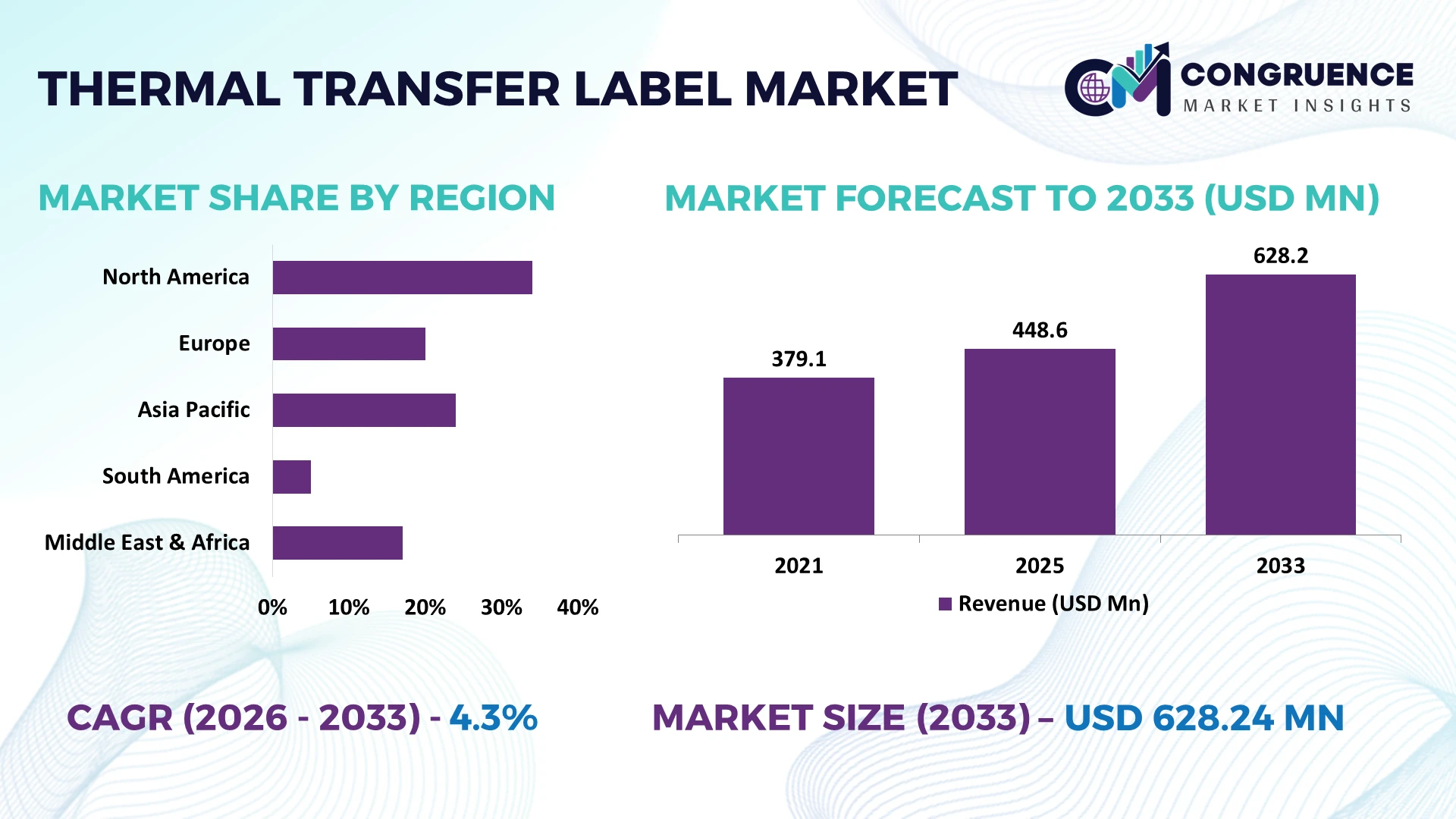
The Global Thermal Transfer Label Market was valued at USD 448.59 Million in 2025 and is anticipated to reach a value of USD 628.24 Million by 2033 expanding at a CAGR of 4.3% between 2026 and 2033. Growth is driven by automated warehouse labeling, pharmaceutical serialization, durable barcode requirements, and rising use of synthetic thermal-transfer substrates in logistics, food, healthcare, and industrial packaging.
The United States remains the dominant country, accounting for roughly 29% of global demand, supported by large-scale logistics automation, pharmaceutical traceability, food packaging, and e-commerce fulfillment investments. More than 80% of North American regional demand is concentrated in the U.S., compared with China’s roughly 48% share of Asia-Pacific demand. Adoption of automated barcode workflows exceeds 60% across major distribution operations, reinforced by post-Red Sea supply-chain diversification.
Strategic priority should center on high-durability materials, automated printing, and compliance-ready labels in North America while capturing faster industrial adoption across Asia-Pacific.
Market Size & Growth: USD 448.59 Million in 2025 rising to USD 628.24 Million by 2033 at 4.3% CAGR, driven by automated logistics and durable barcode labeling.
Top Growth Drivers: Logistics automation contributes 30.05%, healthcare and pharmaceuticals 8.02%, while polypropylene adoption advances at 7.15%.
Short-Term Forecast: By 2028, automated print-and-apply workflows are positioned to reduce manual labeling costs by 8–12% and improve throughput by 10%.
Emerging Technologies: AI-assisted print inspection, RFID-ready labels, and advanced PP/polyester substrates are reshaping high-performance labeling.
Regional Leaders: North America is projected near USD 224 Million by 2033; Asia-Pacific approaches USD 190 Million; Europe exceeds USD 115 Million as automation expands.
Consumer/End-User Trends: Logistics and transportation represented 30.05% of 2025 demand, with e-commerce fulfillment increasingly using machine-readable labels.
Pilot/Case Example: 2024 automated warehouse deployments achieved approximately 15% faster labeling throughput through integrated print-and-apply systems.
Competitive Landscape: North America leads at about 35.10% share, with Zebra Technologies, Avery Dennison, Brady, SATO, and Honeywell strengthening competitive positioning.
Regulatory & ESG Impact: Serialization and traceability requirements are increasing demand for compliant labels, while liner reduction programs target 5–10% material savings.
Investment & Funding: More than USD 1 Billion is being directed across warehouse automation, smart manufacturing, and traceability infrastructure, expanding label-printing capacity.
Innovation & Future Outlook: Next-generation thermal transfer labels will integrate RFID, variable data, recyclable substrates, and connected inspection, shifting competition toward intelligent supply-chain performance.
The Thermal Transfer Label Market is gaining traction across logistics, pharmaceuticals, food processing, electronics, and automated retail, where durable barcode readability is critical. Paper represented 47.86% of 2025 demand, while polypropylene is advancing rapidly for heat- and chemical-resistant applications. Supply-chain restructuring following Red Sea disruptions is accelerating traceability and inventory-control investments, strengthening demand for reliable labeling systems and supporting the strategic shift toward automated, connected packaging operations.
Warehouse automation and regulated product identification are the strongest structural drivers, with logistics applications representing about 30% of demand and automated print-and-apply systems improving throughput by 10–15%. Pharmaceutical serialization is also expanding the requirement for durable variable-data labels, particularly across U.S. distribution networks. As labor-intensive labeling becomes less viable, companies are integrating thermal printers with conveyors, scanners, and warehouse management systems. Manufacturers are responding through automation partnerships and higher-capacity printer platforms. A non-obvious advantage is reduced exception handling: consistent barcode quality limits downstream scanning failures, improving fulfillment continuity beyond the direct labeling operation.
Thermal transfer labeling remains exposed to substrate, ribbon, adhesive, and electronic-component volatility, with material costs capable of shifting 5–10% across procurement cycles. Imported specialty films account for a meaningful share of premium applications in countries such as India, increasing exposure to currency movements and freight disruptions. Supply interruptions can extend procurement lead times by 10–15%, directly affecting production scheduling and inventory buffers. Companies are mitigating this pressure through dual sourcing, localized converting, longer-term supplier contracts, and broader material qualification. The strategic constraint is not printer availability alone; qualification requirements for specialized labels can slow substitution when regulated products require validated materials.
Connected labeling creates an underdeveloped opportunity as RFID-ready substrates, AI-assisted inspection, and cloud-managed print environments gain traction. Automated inspection can reduce labeling defects by approximately 15%, while centralized fleet management can lower printer-related service interventions by 8–10%. Japan and South Korea offer particularly strong opportunities because electronics and precision manufacturing require high-quality identification across complex production flows. Companies are investing in software-enabled printers, recyclable synthetic substrates, and ecosystem partnerships with warehouse-automation providers. The strategic opportunity lies in positioning labels as data-enabling infrastructure rather than consumables, allowing suppliers to capture value through equipment, software, materials, and managed-service relationships.
Scaling intelligent thermal transfer operations introduces integration challenges across enterprise resource planning, warehouse management, scanners, printers, and industrial networks. Approximately 20–30% of deployment effort in complex facilities can be tied to configuration, validation, and workflow integration rather than printer installation itself. Cybersecurity exposure also rises as connected printers become networked endpoints, particularly in highly automated U.S. and European distribution facilities. Companies must strengthen device authentication, software controls, maintenance training, and interoperability standards while investing in skilled technical teams. The critical long-term challenge is achieving consistent performance across multi-site environments; fragmented printer fleets and inconsistent configurations can erode the efficiency gains created by automation.
2D Barcode Transition Accelerates: GS1’s 2027 retail-readiness program is pushing enterprises to upgrade scanning and printing workflows, with pilots already active in more than 45 countries representing about 85% of global GDP. Companies are redesigning thermal labels for coexistence with linear and 2D codes, improving traceability and reducing future rework.
Warehouse Automation Intensifies: Zebra’s 2025 research shows 64% of warehouse leaders plan higher modernization spending, while 63% plan AI and augmented-reality deployment within five years. Thermal printing is increasingly integrated with conveyors, machine vision, and print-and-apply systems, shifting label operations from manual stations toward continuous automated workflows.
Traceability Becomes Data-Rich: Healthcare and regulated industries are moving beyond basic identification toward labels carrying batch, expiry, and serial information. GS1 notes that healthcare implementations span more than 70 countries, encouraging manufacturers to combine thermal transfer printing with GS1 DataMatrix and serialization workflows for stronger authentication and recall control.
Waste Reduction Drives Labeling: Retailers are linking variable-data labeling with expiry management, dynamic markdowns, and food-waste reduction. Woolworths achieved 21% higher productivity and 40% lower food waste using GS1 DataMatrix, demonstrating that label technology can influence inventory economics. Companies are therefore prioritizing connected printing and verification rather than treating labels as standalone consumables.
Paper Labels remain the leading type, representing approximately 47.9% of demand because of low material cost, high print compatibility, and established use across shipping, retail, and product identification. Their broad installed base keeps them dominant, while Synthetic Labels capture higher-value applications requiring moisture, abrasion, and chemical resistance. Polyester Labels hold a specialized position in industrial environments, where durability supports longer asset identification cycles.
Polypropylene Labels are the fastest-growing type, advancing at roughly 7% as food, beverage, chemical, and outdoor applications shift toward moisture-resistant substrates. Synthetic formats collectively gain around 3–5 percentage points in demanding applications as enterprises prioritize lifecycle performance over initial material cost. Manufacturers are expanding polypropylene and polyester portfolios, while maintaining paper capacity for high-volume customers. The non-obvious investment shift is toward substrate specialization, enabling suppliers to protect margins through application-specific performance rather than volume alone.
Barcode Labeling leads with approximately 34% of demand because machine-readable identification is embedded across distribution, manufacturing, retail, and inventory workflows. Product Identification remains a mature, high-volume application, while Shipping & Logistics is strengthening as automated fulfillment expands. Asset Tracking and Retail Labeling serve more specialized workflows, with demand increasingly tied to real-time inventory visibility and compliance.
Shipping & Logistics is the fastest-growing application, supported by roughly 10–15% higher throughput from integrated print-and-apply workflows compared with manual labeling. Asset Tracking is also gaining traction as enterprises extend label lifecycles across equipment and returnable assets. Companies are integrating thermal printers with scanners, conveyors, warehouse management systems, and machine vision. The operational implication is significant: labels are becoming workflow-control points, not simply identification media, increasing investment in connected printing infrastructure.
Logistics is the leading end-user, accounting for approximately 30% of demand because high-volume fulfillment centers require continuous barcode generation, shipment identification, and automated sorting. Retail remains a major buyer due to store-level labeling and inventory requirements, while Manufacturing maintains strong adoption for work-in-process and finished-goods identification. Healthcare prioritizes serialization and traceability, whereas Food & Beverage increasingly emphasizes expiry and batch control.
Healthcare is among the fastest-expanding end-user groups, with adoption supported by traceability requirements implemented across more than 70 countries. Demand is shifting from basic labels toward serialized formats containing batch, expiry, and product identifiers. Companies are responding with sector-specific materials, validated printing workflows, and partnerships linking printers with enterprise traceability platforms. Food & Beverage is simultaneously prioritizing variable-data labels that support dynamic markdowns and waste reduction, creating a stronger value proposition beyond simple identification.
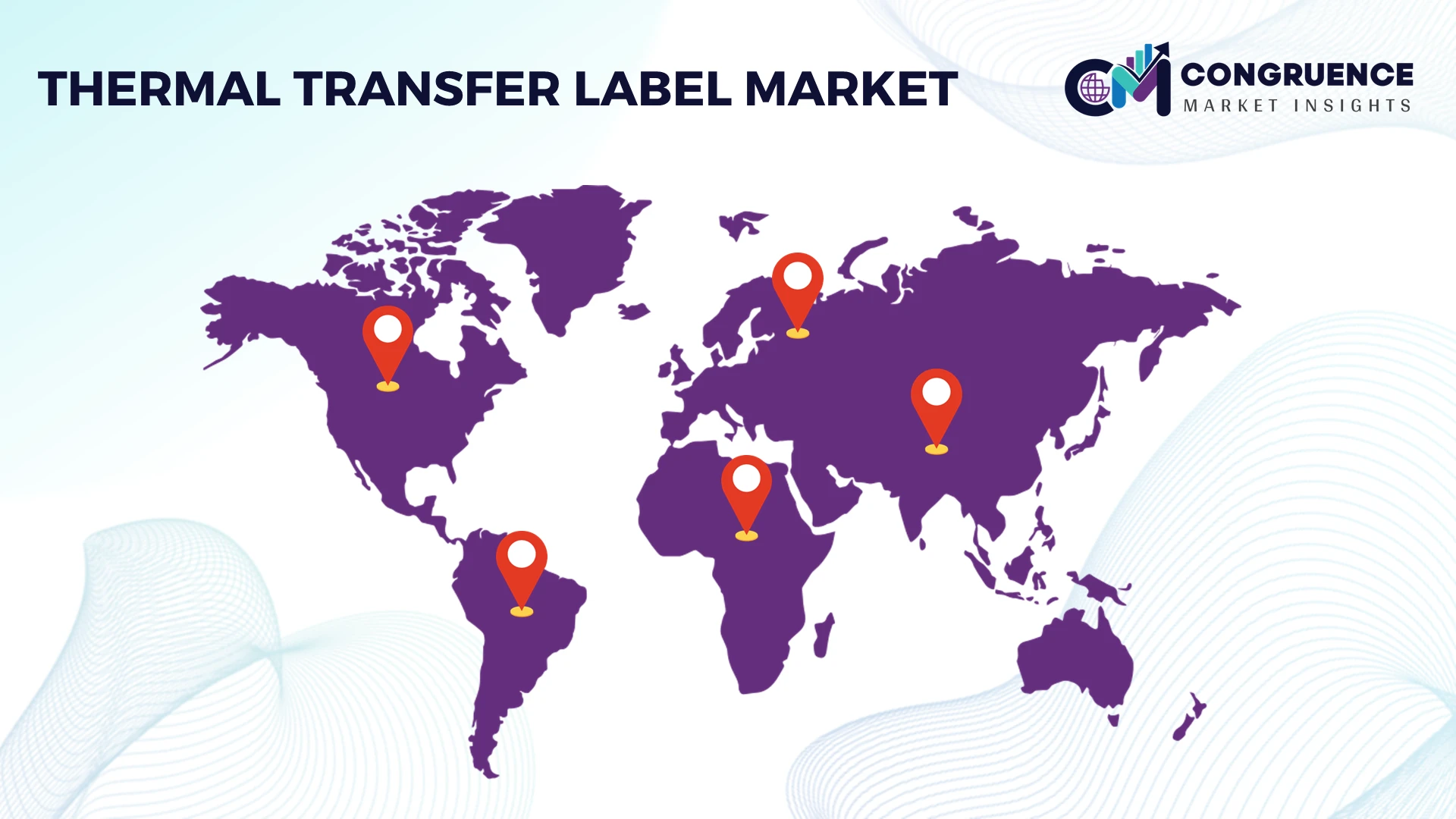
North America accounted for the largest market share at 35.1% in 2025 however, Asia-Pacific is expected to register the fastest growth, expanding at a CAGR of 5.1% between 2026 and 2033.
Automation and traceability reshape high-volume labeling
North America remains the leading Thermal Transfer Label Market, supported by concentrated logistics infrastructure, pharmaceutical manufacturing, food processing, and automated fulfillment operations. The U.S. represents the region’s dominant demand center, with approximately 80% of regional consumption concentrated across major distribution and manufacturing corridors. Automated print-and-apply deployment is expanding across large warehouses, where integrated workflows improve labeling throughput by approximately 10–15%. Pharmaceutical serialization and retail barcode modernization are also increasing requirements for high-resolution, durable variable-data labels. Companies are responding by expanding printer fleets, strengthening consumables supply, and partnering with warehouse-automation providers. The region’s strategic advantage is its mature enterprise software ecosystem, enabling thermal labeling to function as part of broader inventory and traceability infrastructure rather than as a standalone printing process.
United States Market Outlook: The United States remains the region’s primary operational hub, supported by extensive e-commerce fulfillment, pharmaceutical distribution, food logistics, and automated warehousing. More than 60% of major warehouse operators are prioritizing modernization-related technology investments, strengthening demand for connected printers, barcode verification, and automated label application.
Regulatory traceability accelerates sustainable modernization
Europe is shaped by stringent product identification, pharmaceutical traceability, food labeling, and sustainability requirements. Germany, the United Kingdom, France, and Italy account for a substantial portion of regional industrial labeling demand, with Germany holding the strongest manufacturing base. Automated labeling penetration is estimated at more than 55% across major high-volume logistics environments, supporting demand for integrated thermal printing and inspection. Sustainability is increasingly influencing procurement, with enterprises evaluating thinner materials, recyclable substrates, and liner-reduction strategies alongside print performance. Companies are responding through substrate redesign, localized converting, and partnerships with automation integrators. The region’s distinctive advantage is regulatory-driven standardization, which supports premium demand for validated and traceable labels while encouraging suppliers to differentiate through material efficiency and compliance-ready product engineering.
Germany Market Outlook: Germany combines advanced automotive, chemical, pharmaceutical, and industrial manufacturing with highly automated production environments. More than 50% of large manufacturing facilities use digitally connected identification workflows, creating strong demand for durable polyester and synthetic labels. Suppliers are increasingly emphasizing automated inspection and production-line integration.
Manufacturing scale drives rapid deployment expansion
Asia-Pacific is the fastest-expanding market environment, supported by China’s electronics manufacturing, Japan’s precision industries, South Korea’s semiconductor ecosystem, and India’s expanding logistics infrastructure. China accounts for roughly 48% of regional demand, reflecting its enormous manufacturing and export base. Automated warehouse and production-line labeling deployments are increasing by approximately 10% annually as manufacturers connect printers with enterprise resource planning and warehouse-management platforms. Electronics and automotive supply chains increasingly require high-resolution labels resistant to heat, abrasion, and chemicals. Companies are expanding local converting capacity, establishing supplier partnerships, and tailoring synthetic substrates for industrial applications. The region’s non-obvious advantage is its ability to combine high-volume label production with rapid equipment adoption, allowing suppliers to scale customized solutions faster than mature markets.
China Market Outlook: China remains the region’s strongest manufacturing and export center, creating sustained demand across electronics, automotive, consumer goods, and logistics. Automated identification is becoming standard in large industrial facilities, with major manufacturers increasingly integrating thermal printers into production execution systems. Domestic converters are strengthening local supply and reducing dependence on imported specialty materials.
Brazilian logistics modernization strengthens demand
South America is led by Brazil, where food processing, beverage production, retail distribution, pharmaceuticals, and agricultural exports create the strongest thermal labeling requirements. Brazil represents approximately 55% of regional demand, supported by its large consumer market and extensive industrial supply chains. Automated warehouse labeling remains less developed than in North America, but deployment is expanding as distribution operators modernize inventory and shipment controls. Integrated barcode workflows can reduce manual labeling intervention by around 10%, improving consistency in high-volume facilities. Companies are responding through regional converting partnerships, distributor expansion, and localized substrate offerings. Currency volatility and imported equipment costs remain operational considerations, making local service capability strategically important. Suppliers that combine competitive pricing with reliable consumables availability are positioned to capture modernization-driven demand.
Brazil Market Outlook: Brazil offers the strongest country-level opportunity through its food, beverage, agricultural export, retail, and pharmaceutical ecosystems. More than half of South America’s thermal labeling demand is concentrated in the country, while expanding warehouse automation is encouraging broader adoption of print-and-apply systems and durable synthetic substrates.
Infrastructure investment accelerates connected labeling
Middle East & Africa demand is increasingly linked to logistics infrastructure, retail modernization, pharmaceutical distribution, food processing, and industrial diversification. The United Arab Emirates and Saudi Arabia form major deployment hubs because of investments in automated logistics and large-scale distribution facilities. Automated identification deployment across new logistics projects is rising by approximately 10–12%, supporting demand for thermal printers, barcode labels, and variable-data systems. Saudi Arabia’s industrial diversification programs and the UAE’s logistics infrastructure expansion are encouraging suppliers to establish regional service networks and inventory hubs. Companies are prioritizing partnerships with system integrators rather than relying solely on direct equipment sales. The strategic shift is toward connected warehouse ecosystems, where thermal labeling supports inventory accuracy, shipment routing, and traceability across increasingly automated facilities.
Saudi Arabia Market Outlook: Saudi Arabia is emerging as a strategically important deployment center through logistics infrastructure, food distribution, pharmaceuticals, and industrial diversification. New automated distribution facilities increasingly incorporate barcode-based identification, creating demand for durable thermal labels and integrated print-and-apply equipment. Suppliers with local technical support and rapid consumables availability hold a competitive advantage.
Zebra Technologies, Avery Dennison, SATO Holdings, Brady Corporation, and Honeywell compete as global technology and labeling leaders, while regional converters challenge them through pricing and customized substrates. The top five collectively control roughly 28% of the market, leaving meaningful room for specialized suppliers. Competition centers on printer reliability, substrate performance, supply-chain availability, and workflow integration; advanced systems can improve labeling throughput by 10–15%, while localized sourcing can reduce material costs by 5–8%. Global players are expanding automation portfolios, forming software and logistics partnerships, and strengthening consumables ecosystems. Regional producers are countering with shorter lead times, application-specific labels, and flexible minimum-order quantities. The competitive shift is moving from standalone printer sales toward integrated hardware, consumables, software, and service models. Entry barriers remain high where customers require validated materials, technical support, and established distribution. Winning players will combine dependable supply, connected printing, customization, and lifecycle economics rather than compete on unit price alone.
Zebra Technologies Corporation
Avery Dennison Corporation
SATO Holdings Corporation
Brady Corporation
Honeywell International Inc.
TSC Auto ID Technology Co., Ltd.
Toshiba Tec Corporation
Seiko Epson Corporation
Brother Industries, Ltd.
GoDEX International Co., Ltd.
Printronix Auto ID
Intermec Technologies
Label-Aire
Weber Packaging Solutions
Current thermal transfer systems increasingly combine high-resolution printheads, automated print-and-apply modules, barcode verification, and network connectivity. Modern industrial printers reach 18 inches per second, while connected workflows improve throughput by 10–15% and reduce manual intervention by 8–12%. Approximately 55–60% of large automated labeling environments now use connected printing infrastructure, giving logistics and manufacturing operators stronger uptime and traceability.
Emerging technologies include AI-based predictive maintenance, cloud label management, RFID integration, and advanced synthetic substrates. SATO’s next-generation systems use AI condition monitoring, while cloud-connected printing eliminates driver installation and update workloads. Predictive maintenance can reduce unplanned downtime by 1–2%, while centralized management cuts administrative handling by 1–2%. Adoption is strongest among high-volume warehouses and regulated manufacturers.
Disruptive integration will accelerate through 2026–2028 as thermal printers become intelligent network endpoints. New platforms deliver approximately 10% better operational efficiency than legacy preventive-maintenance workflows, while RFID-enabled labels extend identification beyond printed barcodes. Global technology leaders benefit most because they can combine hardware, software, consumables, and services. Companies acting now on connected fleets, AI diagnostics, and recyclable substrates will secure stronger cost control, uptime, and differentiation as labeling infrastructure becomes increasingly digital.
August 2025 — SATO opened a Thailand factory with 5,700 m² of floor area and 7 million m² annual capacity, strengthening regional label and tag supply for manufacturing and logistics. The THB/JPY-backed expansion targets approximately 50% higher supply-product sales by fiscal 2030.
April 2025 — Avery Dennison opened its first India RFID inlay and label production facility in Pune, becoming the country’s first ARC-certified RFID inlay manufacturer. The localization improves lead times and strengthens smart-label supply for pharmaceuticals, FMCG, retail, and logistics. Source: (Avery Dennison)
May 2025 — SATO and Loftware launched cloud-connected label printing for AEP-equipped SATO printers, eliminating printer-driver installation, troubleshooting, updates, and management. The solution connects multiple compatible printer models with Loftware Cloud, improving centralized control and supply-chain agility. Source:
May 2026 — SATO’s CL4-SXR received the Red Dot Design Award after launching in January, combining predictive maintenance with the company’s fastest label-printing performance. The printer uses recycled ABS resin and first-label printing to reduce setup waste. Source: (Sato Global)
The Thermal Transfer Label Market Report covers Paper Labels, Synthetic Labels, Polypropylene Labels, and Polyester Labels across Product Identification, Barcode Labeling, Shipping & Logistics, Asset Tracking, and Retail Labeling. End-user analysis spans Retail, Manufacturing, Logistics, Healthcare, and Food & Beverage, with regional coverage across North America, Europe, Asia-Pacific, South America, and Middle East & Africa.
The report evaluates adoption patterns, automated print-and-apply deployment, barcode modernization, RFID integration, cloud-connected printing, AI-enabled maintenance, and recyclable substrate development. With logistics representing approximately 30% of demand and paper labels accounting for nearly 48%, the analysis identifies mature volume pools alongside higher-performance material opportunities. Competitive assessment covers major technology providers, label manufacturers, partnerships, expansion strategies, and application-specific innovation, supporting investment planning, market-entry decisions, capacity expansion, supplier positioning, and strategic priorities through 2026–2033.
| Report Attribute/Metric | Report Details |
|---|---|
Market Revenue in 2025 | USD 448.59 Million |
Market Revenue in 2033 | USD 628.24 Million |
CAGR (2026 - 2033) | 4.3% |
Base Year | 2025 |
Forecast Period | 2026 - 2033 |
Historic Period | 2021 - 2025 |
Segments Covered | By Type
By Application
By End-User
|
Key Report Deliverable | Revenue Forecast, Growth Trends, Market Dynamics, Segmental Overview, Regional and Country-wise Analysis, Competition Landscape |
Region Covered | North America, Europe, Asia-Pacific, South America, Middle East, Africa |
Key Players Analyzed | Zebra Technologies Corporation, Avery Dennison Corporation, SATO Holdings Corporation, Brady Corporation, Honeywell International Inc., TSC Auto ID Technology Co., Ltd., Toshiba Tec Corporation, Seiko Epson Corporation, Brother Industries, Ltd., GoDEX International Co., Ltd., Printronix Auto ID, Intermec Technologies, Label-Aire, Weber Packaging Solutions |
Customization & Pricing | Available on Request (10% Customization is Free) |




