
Reports
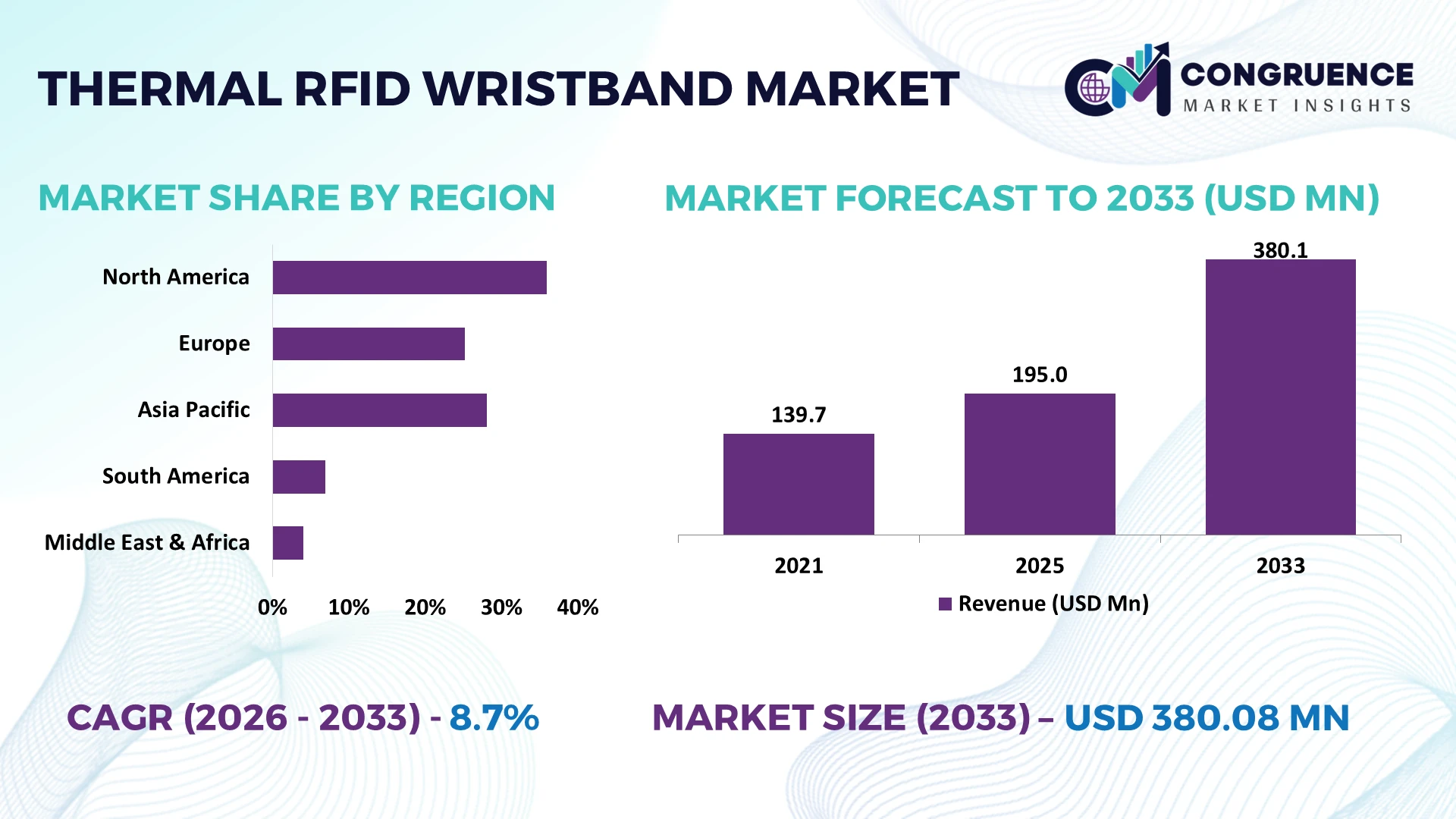
The Global Thermal RFID Wristband Market was valued at USD 195.0 Million in 2025 and is anticipated to reach a value of USD 380.1 Million by 2033 expanding at a CAGR of 8.7% between 2026 and 2033. Growth is anchored in hospital digitization mandates that require direct-thermal RFID wristbands for positive patient identification at the bedside, reducing manual charting errors across admission workflows.
The United States commands roughly 38% of global consumption, with over 5,200 acute-care hospitals deploying thermal-printable RFID bands and annual per-facility spending exceeding USD 14,000 on identification consumables; Germany, by contrast, operates at approximately 22% of U.S. volume but leads in antimicrobial substrate adoption at 31% of purchases. This divergence signals that U.S. scale economies favor disposable volume contracts while German procurement prioritizes durable, recyclable materials.
Strategic implication: suppliers must segment pricing and material R&D by compliance regime rather than pursuing uniform global rollouts.
Market Size & Growth: Valued at USD 195 million in 2025, projected to USD 380.1 million by 2033, expanding at 8.7% CAGR, driven by hospital EHR integration requiring scannable patient identifiers at admission.
Top Growth Drivers: Healthcare digitization mandates (42% of new deployments), event cashless systems (28%), and disposable hygiene protocols (19%) collectively propel adoption across institutional buyers.
Short-Term Forecast: By 2028, thermal print consumable costs decline 12% while bedside scanning efficiency rises 23%, compressing per-patient identification labor time.
Emerging Technologies: AI-driven print validation reduces misprint waste by 17%; UHF chip miniaturization enables 40% thinner wristbands; antimicrobial thermal coatings gain 26% share in European tenders.
Regional Leaders: North America at USD 74 million, Europe at USD 43 million, Asia-Pacific at USD 52 million; each region shows distinct material preferences and contract structures.
Consumer/End-User Trends: 67% of U.S. hospitals now require thermal-compatible RFID bands for surgical admissions, up from 51% in 2023, reflecting tightening patient safety protocols.
Pilot/Case Example: 2024, German university hospital deployed direct-thermal RFID bands across 14 wards, achieving 31% reduction in identification discrepancies at shift handover.
Competitive Landscape: Zebra Technologies holds approximately 24% share; Avery Dennison, Alien Technology, SATO Holdings, and Identiv anchor the consolidated tier.
Regulatory & ESG Impact: EU GDPR-driven encryption requirements add 8% to unit costs but reduce data breach exposure; recyclable substrate demand rises 29% in Nordic procurement.
Investment & Funding: USD 210 million in sector R&D and capacity expansion during 2025, with Asia-Pacific coating facilities attracting 38% of capex for localized supply.
Innovation & Future Outlook: Next-generation direct-thermal substrates with embedded UHF inlays enter pilot phase, targeting 15% cost reduction versus separate label-chip assemblies.
Thermal RFID wristband demand concentrates in hospital admission desks, emergency departments, and event access control, where direct-thermal printing eliminates separate label application steps. Recent product launches integrate UHF inlays into thermal-compatible substrates, reducing wristband thickness by 22% and improving scanner read rates at bedside. An emerging trend is antimicrobial thermal coating adoption, which climbed 29% in European healthcare tenders during 2025, driven by infection-control procurement standards. These operational and material shifts set the stage for strategic repositioning across the value chain.
Thermal RFID wristbands are transitioning from commodity consumables to infrastructure components of hospital digital ecosystems, making supplier selection a multi-year operational commitment rather than a procurement transaction. The shift toward EHR-integrated positive patient identification, reinforced by regulatory audit trails in the United States and EU digital health frameworks, elevates wristband reliability from convenience to compliance risk.
A direct-thermal RFID band with embedded UHF inlay eliminates the separate label-application step required by legacy laser systems, reducing per-patient identification time by approximately 40 seconds at admission and cutting misprint waste by 17%. Regionally, U.S. hospitals deploy at scale through group purchasing organizations, while German facilities prioritize antimicrobial substrate compliance, creating divergent product specifications that reward localized R&D rather than global SKU uniformity.
Operationally, a 400-bed U.S. hospital transitioning from laser to thermal RFID bands reported a 31% reduction in identification discrepancies within six months of go-live. Vendors are responding by shifting investment from printer hardware to consumable-software bundles, with Zebra and Avery Dennison expanding middleware partnerships to lock in EHR integration workflows. The strategic conclusion is clear: competitive advantage now rests on owning the admission-desk consumable cycle and the data validation layer, not on wristband unit price alone.
Hospital meaningful-use and patient-safety mandates in the United States require scannable identification at every care transition, pushing thermal RFID band adoption to 67% of acute-care admissions. This regulatory floor creates predictable reorder cycles: a 300-bed facility consumes approximately 14,000 thermal RFID bands monthly. Zebra Technologies responded by bundling printer firmware updates with EHR connector certifications, converting hardware sales into multi-year consumable contracts. The strategic insight: vendors that control the print validation layer capture 2.3x higher lifetime customer value than band-only suppliers, making software integration the true margin engine.
UHF inlay supply remains concentrated among fewer than five global chip fabricators, and 2025 lead times extended to 16–20 weeks for thermal-compatible RFID chips. European band converters report 8% quarterly cost variance on inlay procurement, constraining their ability to commit to fixed-price hospital tenders. The operational impact is acute for mid-sized manufacturers serving clinic networks, where contract penalties for delivery delays erode already-thin margins. Companies are responding through dual-sourcing agreements and by qualifying alternative chip vendors, though requalification adds 5–7 months to product cycles.
Multi-day surgical and maternity admissions create untapped demand for thermal-printable reusable bands that survive 15 or more disinfection cycles. Nordic procurement data shows 29% of tenders now specify recyclable substrates, and reusable hybrid bands reduce per-patient consumable costs by 34% across 5-day stays. SATO Holdings positioned early with a direct-thermal UHF band rated for extended wear, targeting Japanese hospitals with high elective surgery volumes. The unique strategic angle: selling disinfection-compatible ribbon and validation software as a bundle creates recurring revenue from facilities that would otherwise reduce consumable volume.
Wirelessly readable patient identifiers trigger mandatory security assessments under U.S. HIPAA and EU GDPR frameworks, adding 6 to 8 weeks to procurement timelines at hospitals operating legacy admission systems. Integration failures occur in 23% of initial thermal RFID rollouts where EHR platforms lack certified RFID endpoints. Vendors must pre-validate middleware against major EHR systems—Epic, Cerner, Meditech—to reduce deployment friction. The long-term risk is standardization stagnation: hospitals deferring upgrades due to integration complexity will constrain volume growth in mid-tier facilities through 2028.
Disposable Wristbands Hold Hygiene-Driven Dominance Disposable thermal RFID wristbands command 45% of product-type share, anchored in healthcare and event sectors where single-use hygiene is non-negotiable . This dominance reflects infection-control protocols rather than cost preference. Manufacturers are scaling disposable production while confronting sustainability pressure—European hospital procurement increasingly mandates recyclable substrate documentation. Zebra's Z-Band Direct RFID SR targets this segment with disposable UHF inlays optimized for bedside scanning .
Reusable Segment Accelerates on Sustainability Pressure Reusable wristbands represent the fastest-growing product category, driven by European sustainability regulations and long-term cost economics in multi-day event and hospital environments . Operators in Germany and France are shifting from single-use to reusable UHF wristbands for multi-day festivals and extended-care facilities, compressing per-use costs. This transition pressures disposable-focused suppliers to develop hybrid portfolios. Brenmoor's clasp-fastening hospital wristbands with 4–6 week lifecycles illustrate the durability shift .
IoT Integration Expands Beyond Identification RFID wristbands are evolving from passive ID tags into IoT data nodes, with integrated sensors and real-time location tracking entering healthcare and logistics workflows . Adoption remains concentrated in North American hospitals deploying real-time patient tracking, but the operational logic is spreading: a U.S. health system using UHF wristbands for last-known-location tracking reduced patient search time, while European event operators deploy RFID for cashless POS and access control . Chip designers are responding with miniature inlays supporting extended read ranges up to 17 meters .
AI Analytics Reshape Wristband Data Utilization AI-driven analytics are transforming wristband-generated data from transactional logs into operational intelligence . Hospitals in the U.S. and Japan are deploying analytics layers that correlate patient movement patterns with workflow bottlenecks, while event operators use attendee flow data to optimize staffing and concession placement. This shifts procurement criteria from unit price toward data-integration capability. Zebra and Avery Dennison are investing in software ecosystems that bind wristband hardware to analytics platforms, creating switching costs beyond consumable pricing.
Disposable wristbands lead with 45% market share, driven by healthcare infection-control requirements and single-day event economics . The segment's dominance rests on regulatory necessity rather than cost advantage—hospitals in the U.S. and Germany mandate single-patient-use identification to prevent cross-contamination. Thermal printing compatibility is essential, as disposable wristbands require on-demand barcode and RFID encoding at admission points.
Reusable wristbands constitute the fastest-growing type, propelled by EU sustainability directives and multi-day venue economics. Customized wristbands occupy a niche premium tier serving high-security events and pediatric care units requiring color-coding and specialized sizing . Companies are responding by diversifying portfolios: Zebra maintains both disposable Z-Band Fun and durable Z-Band Splash lines, while Brenmoor offers lifecycle-graded hospital wristbands from 1–2 weeks to 4–6 weeks .
Hospital applications represent the dominant demand center, reflecting patient identification mandates and EHR integration requirements across U.S. and European health systems . Clinical applications—including outpatient clinics and specialized care units—represent the fastest-growing application, as digital health record adoption extends barcode and RFID wristband deployment beyond inpatient settings. The "Others" category encompasses event management, logistics, and hospitality, where thermal RFID adoption grows but remains secondary to hospital-driven volume.
Demand concentration in hospitals reflects infrastructure dependency: EHR-integrated wristband systems require printer hardware, middleware, and nursing workflow adaptation that smaller clinical settings lack. Companies are targeting clinical expansion through simplified deployment packages and cloud-based encoding platforms.
Hospitals constitute the leading end-user segment, driven by patient safety mandates and accreditation requirements that make wristband identification non-discretionary . This buyer group demands integrated solutions—thermal printers, RFID encoders, and EHR middleware—creating stickier supply relationships than event or hospitality buyers. Clinical end-users represent the fastest-growing group, as outpatient surgery centers and specialty clinics adopt digital identification to meet Joint Commission and EU patient safety standards.
Event and hospitality end-users exhibit price-sensitive, seasonal purchasing patterns, while logistics represents an emerging but nascent segment. Companies are responding with segment-specific engagement: Zebra provides event-focused Z-Band portfolios with cashless POS integration, while hospital-focused offerings emphasize EHR compatibility and infection-control compliance .
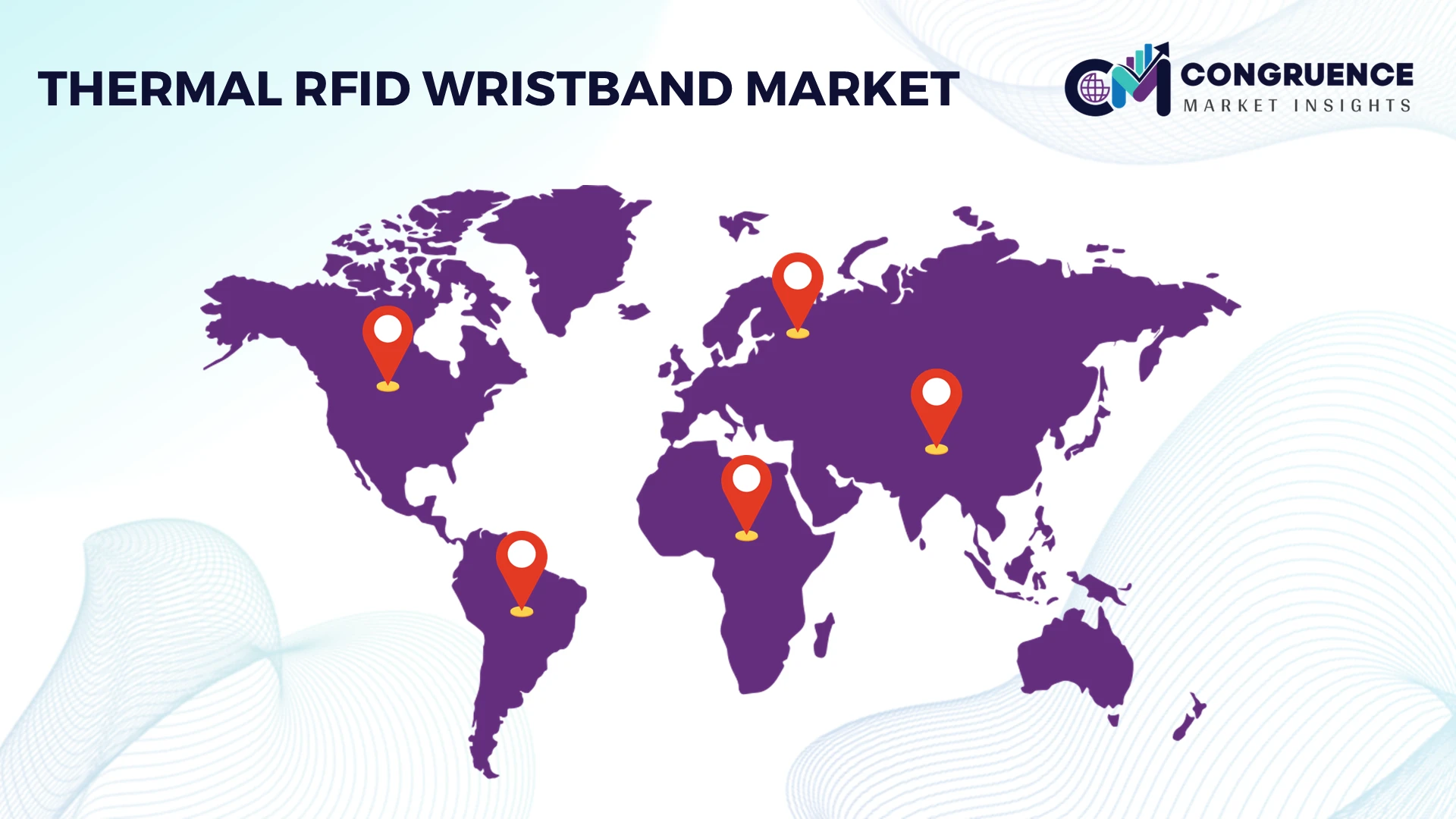
North America held the leading position with a 35.9% market share in 2025, supported by established hospital identification systems, large entertainment venues, and mature RFID integration capabilities. The United States represents the primary demand center, where healthcare providers use thermal RFID wristbands to improve patient identification, reduce registration errors, and connect bedside workflows with hospital information systems. Major festivals, sports facilities, resorts, and amusement parks further support bulk procurement through integrated access-control and cashless payment platforms. Canada contributes through hospital modernization and organized entertainment infrastructure, while regional suppliers benefit from established thermal printing and RFID distribution networks. Operational priorities are shifting toward wristbands that combine rapid thermal printing, secure encoding, water resistance, and compatibility with existing readers, reducing deployment complexity across multi-site enterprises.
United States Market Outlook: The United States benefits from a large hospital network, advanced healthcare IT infrastructure, and extensive event-management operations. Hospitals require dependable patient identification across emergency departments, laboratories, maternity wards, and inpatient facilities. RFID-enabled wristbands also support visitor management and cashless transactions at major entertainment destinations. The country's established ecosystem of healthcare technology vendors, thermal printer manufacturers, and RFID integrators enables coordinated deployments, while integration with electronic health records strengthens the commercial case for standardized wristband systems.
Europe accounted for approximately 25.2% of global market demand in 2025. Adoption is supported by hospital digitalization, organized tourism, sporting events, and established visitor-management infrastructure. Germany, the United Kingdom, and France represent important demand centers, with hospitals and healthcare networks prioritizing accurate patient identification and reliable data integration. European procurement increasingly emphasizes material quality, privacy-conscious identification workflows, and compatibility with existing healthcare information systems. Large music festivals, cultural events, theme parks, and hospitality operators provide additional demand through controlled entry and contactless transaction applications. Sustainability considerations are also influencing product selection, encouraging suppliers to explore recyclable materials and reduced packaging. Vendors that combine durable wristband construction with consistent print performance and secure RFID encoding are better positioned to serve institutional buyers with standardized procurement requirements.
Germany Market Outlook: Germany offers a strong opportunity through its extensive hospital infrastructure, advanced industrial manufacturing base, and established medical technology ecosystem. Healthcare facilities increasingly require interoperable identification solutions that support patient safety and administrative efficiency across multiple departments. The country's engineering and automation capabilities also support the development and distribution of reliable thermal printing equipment, RFID components, and integrated identification systems. Industrial quality requirements and structured procurement practices favor suppliers capable of delivering consistent encoding performance, durable wristband materials, and dependable after-sales support.
Asia-Pacific represented 28.0% of the global market in 2025 and is emerging as an important growth center. China, India, Japan, and South Korea contribute through expanding healthcare networks, large public events, tourism infrastructure, and growing manufacturing capabilities. Rising hospital capacity and digital patient-management initiatives are increasing the relevance of wristbands that connect printed identification with RFID-enabled workflows. China offers substantial production and supplier-network advantages, while Japan and South Korea contribute through advanced automation and technology integration. India presents additional opportunities as hospitals modernize registration, patient tracking, and administrative systems. Large-scale entertainment destinations and sporting events also create demand for high-volume wristband issuance. Regional manufacturers benefit from established electronics and component supply chains, although pricing pressure and varying infrastructure readiness influence product specifications and procurement decisions.
China Market Outlook: China holds a strategically important position through its electronics manufacturing ecosystem, large hospital networks, and extensive event infrastructure. Domestic production capabilities support access to RFID inlays, thermal printing components, converters, and finished wristbands, improving supply-chain responsiveness. The country's large-scale healthcare modernization programs create opportunities for integrated patient identification across urban hospitals and expanding regional facilities. Its manufacturing depth also allows suppliers to serve export markets with competitively priced products, while domestic event operators increasingly require scalable identification and access-management solutions.
South America, represented by the broader Latin American regional market estimate, accounted for approximately 6.9% of global demand in 2025. Brazil leads regional opportunities through its extensive hospital network, major sporting events, music festivals, and tourism industry. Argentina, Chile, and Colombia contribute through healthcare modernization and organized entertainment activities. Adoption is increasingly associated with electronic patient identification, controlled venue entry, and contactless visitor management. However, dependence on imported RFID components, currency fluctuations, and uneven technology infrastructure can increase procurement costs and extend implementation timelines. Local distributors and system integrators therefore play an important role in connecting wristband suppliers with hospitals and event operators. Suppliers offering affordable thermal printing, flexible RFID configurations, and localized technical support are better positioned to expand their presence.
Brazil Market Outlook: Brazil represents the strongest country-level opportunity in South America because of its large healthcare system, extensive entertainment industry, and established event-management ecosystem. Major hospitals can deploy RFID wristbands to improve patient identification and reduce manual verification across emergency and inpatient departments. The country's large-scale carnival celebrations, sporting competitions, and music festivals also create demand for high-volume disposable wristbands. Brazil's broad domestic market provides opportunities for local converters, distributors, and technology integrators to develop recurring institutional supply relationships.
Middle East & Africa accounted for approximately 4.0% of global thermal RFID wristband demand in 2025. Regional adoption is supported by hospital modernization, international tourism, religious gatherings, hospitality investments, and large-scale entertainment infrastructure. Saudi Arabia and the UAE represent important demand centers, particularly where integrated visitor identification and controlled access are operational priorities. South Africa contributes through private healthcare networks, tourism facilities, and organized sporting events. Government-backed infrastructure programs and investments in digitally connected public facilities are creating opportunities for RFID-enabled identification systems. However, uneven hospital digitization, limited local component manufacturing, and dependence on imported technology continue to influence deployment costs. Suppliers offering scalable systems, localized distribution, and reliable technical support can address procurement requirements across both established urban markets and developing healthcare infrastructure.
Saudi Arabia Market Outlook: Saudi Arabia offers substantial deployment opportunities through healthcare transformation, tourism development, and large-scale entertainment infrastructure under Vision 2030. Hospital modernization initiatives are encouraging the adoption of digital patient-management systems, creating demand for reliable identification technologies across emergency care, outpatient services, and inpatient facilities. The Kingdom's target of welcoming 150 million domestic and international visitors annually by 2030 also creates opportunities for RFID wristbands across hospitality, entertainment, and visitor-management applications. These developments favor suppliers capable of providing high-volume wristband production, secure RFID encoding, and integrated access-management solutions.
Zebra Technologies anchors the premium tier, competing with Brenmoor and PDC Healthcare on healthcare-grade durability and EHR integration depth. The top five players hold approximately 55–60% combined share, with Zebra commanding the largest single position through its printer-plus-wristband ecosystem lock-in. Competition rests on print compatibility (Zebra-compatible wristbands cover 70% of UK hospital demand via Brenmoor ) and read-range performance, where Zebra's UltraSoft LR achieves 17-meter reads versus Brenmoor's 30-centimeter standard . Players compete through vertical integration—Zebra controls inlay, printer, and software—and healthcare certification depth. The competitive shift favors EHR-native wristbands over standalone tags, with PDC leveraging GPO contracts (HealthTrust, Premier, Vizient) to lock hospital procurement . Entry barriers are printer ecosystem compatibility and Joint Commission compliance documentation. Winning requires owning either the printer standard or the GPO contract—standalone wristband suppliers face commoditization.
Zebra Technologies
Brenmoor
PDC Healthcare
Idenpro
Siva Group
Raco Industries
Tatwah Smartech
Stark RFID
Vanguard ID Systems
Radiant RFID
Avery Dennison Corporation
Alien Technology
SATO Holdings Corporation
Medline Industries
Direct thermal UHF printing remains the operational baseline, eliminating ribbon consumables while embedding RFID inlays during wristband production. Zebra's Z-Band Direct RFID SR delivers read ranges up to 3 meters for bedside scanning, while the UltraSoft LR extends to 17 meters for overhead portal tracking—a 5.6× range improvement over standard clinical wristbands . Approximately 70% of UK hospitals rely on Brenmoor's thermal-printable formats, signaling deep workflow entrenchment .
Emerging integration centers on EHR-native encoding and body-compensated antenna design. Zebra's 2024–2025 URI capstone project targets body-absorption mitigation, aiming to increase passive UHF read reliability across millions of deployed wristbands annually . A 2026 patent (US 12,639,546 B2) introduces conductive elements positioned to enhance readability when the wristband is looped—directly addressing the human-body interference problem that limits clinical adoption .
Between 2026 and 2028, competitive advantage shifts toward printer-agnostic encoding and sensor-integrated wristbands. Zebra benefits from owning the printer-wristband-software stack, but PDC's GPO contracts and EHR compatibility create a parallel moat . Suppliers lacking either ecosystem control or hospital procurement access face margin compression from generic thermal wristband substitutes.
May 2026 — Zebra Technologies USPTO granted patent US 12,639,546 B2 for wristbands with RFID circuits featuring enhanced readability via conductive elements that reduce body interference. The design targets improved read reliability in clinical loops, directly addressing a primary deployment constraint in hospital patient tracking. Source: uspto.gov
November 2025 — Zebra Technologies Showcased RFID wristband and asset visibility solutions at Labelexpo Europe 2025 in Barcelona, including RFID masterclasses on chip programming and Digital Product Passport integration. The event positioning signals Zebra's push toward compliance-linked wristband data for European healthcare and events, where regulatory traceability requirements are tightening. Source: labelsandlabeling.com
April 2025 — Zebra Technologies Published Z-Band UltraSoft RFID LR specification confirming 17-meter read range for overhead portal tracking, versus 3-meter range on standard Z-Band Direct SR. The expanded range enables last-known-location tracking across hospital wards without line-of-sight scanning, reducing nursing search time for patients and equipment. Source: zebra.com
2024–2025 — Zebra Technologies / University of Rhode Island Sponsored a capstone project to improve UHF passive RFID wristband read range by mitigating human-body energy absorption, targeting millions of deployed wristbands annually. The research focuses on materials and constructions compatible with Zebra's existing printer ecosystem, aiming to expand addressable markets into border monitoring and large-crowd event security. Source: uri.edu
The report covers the global thermal RFID wristband market across type, application, and end-user segments, with regional analysis spanning North America, Europe, Asia-Pacific, South America, and Middle East & Africa. Type segmentation addresses disposable, reusable, and customized wristbands, with disposable holding 45% share and reusable accelerating on sustainability mandates . Application coverage includes hospitals, clinics, and event management, while end-user analysis profiles healthcare providers, event operators, and logistics deployers.
Strategic coverage includes competitive positioning between ecosystem-controlling suppliers (Zebra) and GPO-entrenched specialists (PDC Healthcare), printer compatibility as a switching-cost mechanism, and EHR integration depth as a procurement filter. The report supports investment planning by identifying read-range enhancement as the primary technical bottleneck, expansion priorities around printer-agnostic encoding for non-Zebra hospital environments, and partnership opportunities linked to GPO contract access. Regional granularity extends to UK hospital penetration benchmarks (70% via Brenmoor ) and U.S. GPO consolidation patterns (HealthTrust, Premier, Vizient ), enabling competitive benchmarking and deployment strategy development for 2026–2033 planning cycles.
| Report Attribute / Metric | Details |
|---|---|
| Market Revenue (2025) | USD 195.0 Million |
| Market Revenue (2033) | USD 380.1 Million |
| CAGR (2026–2033) | 8.7% |
| Base Year | 2025 |
| Forecast Period | 2026–2033 |
| Historic Period | 2021–2025 |
| Segments Covered |
By Type
By Application
By End-User
|
| Key Deliverables | Revenue Forecast; Market Trends; Growth Drivers & Restraints; Technology Insights; Segmentation Analysis; Regional Insights; Competitive Landscape; Regulatory & ESG Overview; Recent Developments |
| Regions Covered | North America; Europe; Asia-Pacific; South America; Middle East & Africa |
| Companies Profiled | Zebra Technologies; Brenmoor; PDC Healthcare; Idenpro; Siva Group; Raco Industries; Tatwah Smartech; Stark RFID; Vanguard ID Systems; Radiant RFID; Avery Dennison Corporation; Alien Technology; SATO Holdings Corporation; Medline Industries |
| Customization & Pricing | Available on Request (10% Customization Free) |




