
Reports
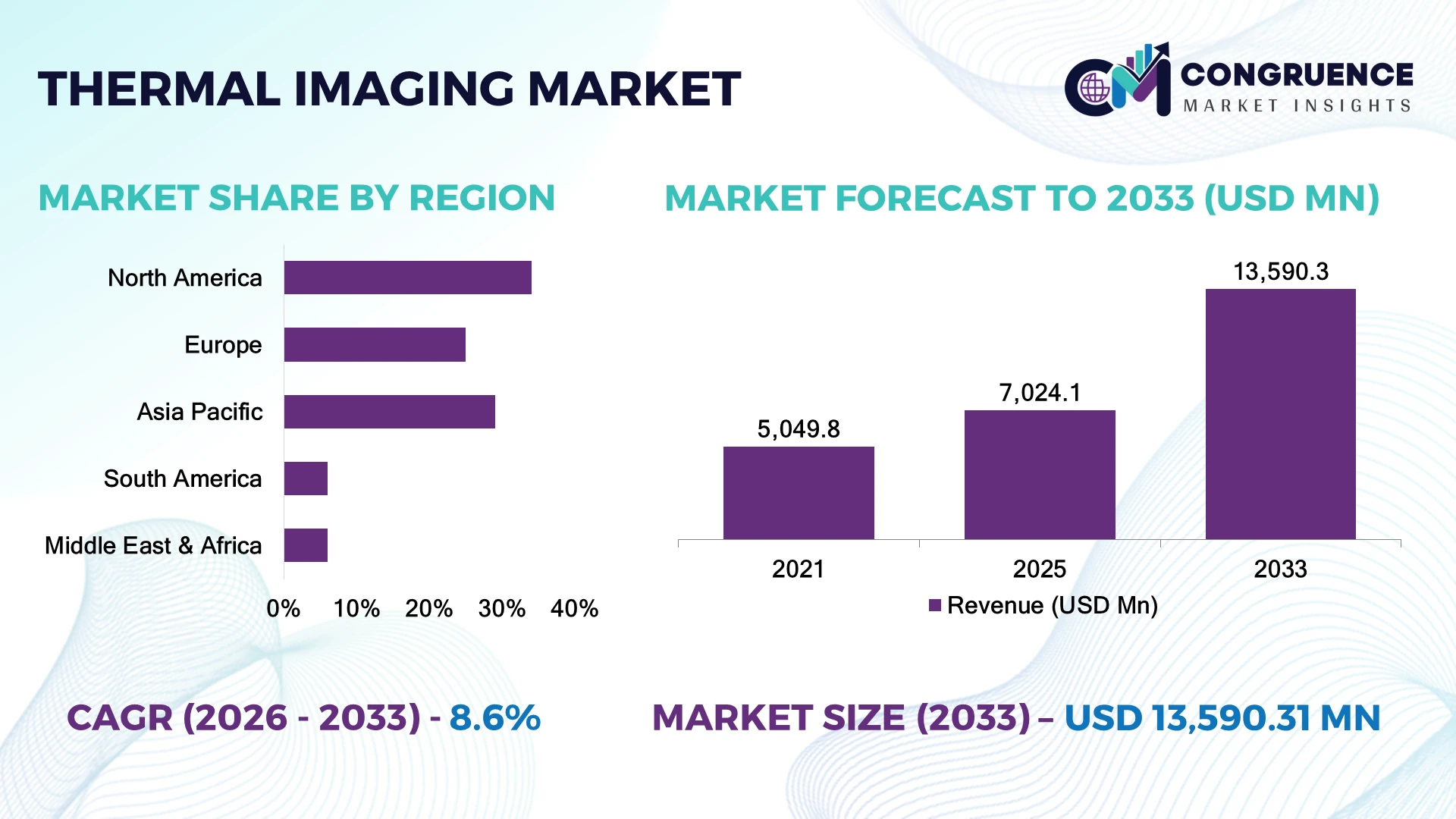
The Global Thermal Imaging Market was valued at USD 7,024.1 Million in 2025 and is anticipated to reach a value of USD 13,590.3 Million by 2033 expanding at a CAGR of 8.6% between 2026 and 2033. Growth is driven by AI-enabled condition monitoring, defense modernization, automated electrical inspections, automotive night vision, and demand for non-contact temperature measurement across industrial assets.
The United States remains a strategic center for defense-grade infrared systems, aerospace applications, and industrial inspection, supported by defense expenditure of approximately USD 997 billion in 2024. China strengthens the competitive landscape through domestic sensor manufacturing, electronics production, and cost-oriented camera systems. The Russia–Ukraine war has reinforced the operational importance of thermal sensors in unmanned platforms and night surveillance, while export controls on sensitive components have increased supply-chain scrutiny.
Companies should balance high-performance sensor development with cost-efficient uncooled platforms, secure component sourcing, and application-specific software to compete across defense and commercial markets.
Market Size & Growth: The market is valued at USD 7,024.1 million in 2025 and is projected to reach USD 13,590.3 million by 2033, supported by industrial automation and AI-assisted inspection.
Top Growth Drivers: Defense modernization, predictive maintenance, and infrastructure inspection are three major demand drivers; global military expenditure increased 6.8% in real terms in 2023.
Short-Term Forecast: By 2028, wider integration of automated alerts and centralized reporting is expected to reduce manual inspection workloads; actual savings depend on asset type and deployment design.
Emerging Technologies: AI-based anomaly detection, compact uncooled microbolometers, and multispectral imaging are expanding use beyond conventional temperature measurement.
Regional Leaders: North America leads in defense and advanced industrial applications, Europe emphasizes energy and manufacturing inspection, and Asia Pacific benefits from electronics production and infrastructure deployment.
Consumer/End-User Trends: Utilities and manufacturers increasingly use fixed thermal cameras for continuous monitoring rather than relying exclusively on periodic handheld inspections.
Pilot/Case Example: The U.S. Department of Energy’s AirBEM project evaluates drone-mounted infrared imaging for building-envelope audits, combining thermal anomaly detection with automated building analysis.
Competitive Landscape: Teledyne FLIR, Fluke, Hikmicro, Guide Sensmart, and Leonardo compete across industrial, commercial, and defense applications; leadership varies by product category.
Regulatory & ESG Impact: Thermal inspections help identify heat loss and overheating equipment, supporting energy-efficiency programs and preventive maintenance without physical contact.
Investment & Funding: Defense procurement and industrial automation budgets remain important investment channels, while partnerships increasingly connect camera hardware with analytics and asset-management software.
Innovation & Future Outlook: Competitive advantage is shifting from detector specifications alone toward integrated imaging, AI interpretation, secure supply chains, and application-specific workflows.
The thermal imaging market is expanding across electrical maintenance, building diagnostics, industrial process control, perimeter security, and unmanned systems. AI-assisted image interpretation is helping users prioritize thermal anomalies rather than manually review every image, while compact uncooled sensors are broadening deployment in portable and embedded equipment. Supply-chain scrutiny around infrared detectors and optical materials is also encouraging manufacturers to diversify sourcing and qualify alternative components, making integration capability and component resilience increasingly important to purchasing decisions.
Thermal imaging is becoming a strategic industrial technology because it identifies heat signatures that visible-light cameras cannot reliably detect, supporting equipment reliability, situational awareness, and safer remote inspection. Its value is strongest where an undetected fault can cause expensive downtime, fire risk, production loss, or a safety incident. This is moving thermal imaging from a standalone camera purchase toward a connected monitoring capability.
Technology selection shapes deployment economics. Uncooled long-wave infrared cameras generally suit routine maintenance and fixed monitoring, while cooled infrared systems support applications requiring greater sensitivity or longer-range detection. AI-enabled analytics further reduce the need for operators to interpret every frame manually, although performance depends on calibration, environmental conditions, and the quality of training data. North American defense and industrial users prioritize performance and system integration, while price-sensitive commercial markets in China and India create opportunities for compact, lower-cost devices.
Over the next two to three years, manufacturers are positioned to expand fixed-camera networks, embedded thermal modules, and software-linked inspection services. A utility can use continuous thermal monitoring to flag abnormal heating at electrical connections before a failure develops, while industrial operators can connect alerts to maintenance workflows. Suppliers that combine dependable hardware, analytics, cybersecurity, and lifecycle support will be better positioned than vendors competing on camera price alone.
Industrial operators are shifting from scheduled checks toward condition-based maintenance, increasing the value of non-contact thermal monitoring across motors, switchgear, transformers, and production equipment. Even a small reduction in unplanned downtime can justify installation where critical assets operate continuously; the actual benefit depends on failure frequency and asset criticality. In the United States and Germany, manufacturers are integrating thermal readings with maintenance software and automated alarm systems. Electrification, higher equipment utilization, and expanding data-center infrastructure reinforce this need. Suppliers are responding with fixed radiometric cameras, edge analytics, and software integrations. The non-obvious advantage is not simply earlier fault detection: standardized thermal records also help maintenance teams prioritize work across geographically dispersed facilities.
High-performance infrared detectors, precision optics, calibration requirements, and specialized packaging can raise acquisition and maintenance costs, particularly for cooled or defense-grade systems. Procurement also faces supply-chain exposure because certain detector materials and advanced components have limited qualified sources. Export controls and geopolitical tensions have made component traceability and supplier diversification more important for cross-border programs. These constraints can lengthen qualification cycles and reduce margins for manufacturers unable to secure stable supply. Companies are mitigating exposure through multi-sourcing, longer-term procurement agreements, localized assembly, and product designs that support alternative components. Buyers should compare lifecycle cost and service availability rather than purchase price alone, especially for installations requiring continuous operation.
Compact uncooled detectors and embedded thermal modules create opportunities in automotive night vision, smart buildings, industrial edge devices, and connected security systems. The commercial opportunity increasingly lies in combining thermal data with visible imagery and software that classifies anomalies, tracks temperature changes, and routes alerts to operators. In India, expanding power infrastructure and manufacturing investment create potential demand for lower-cost inspection systems, while Japan and South Korea offer advanced electronics and automotive integration opportunities. Manufacturers are investing in miniaturization, application programming interfaces, and partnerships with automation vendors. A less obvious opportunity is retrofitting existing facilities: adding thermal monitoring to selected critical assets can deliver actionable data without replacing an entire control or maintenance infrastructure.
Scaling thermal imaging across large facilities requires consistent calibration, correct camera placement, reliable connectivity, and interpretation that accounts for emissivity, reflections, weather, and operating load. A camera can flag a temperature anomaly without identifying its root cause, so false alarms and inconsistent inspection practices can undermine user confidence. Integration becomes more complex when sites operate different camera generations, analytics platforms, and maintenance systems. Companies must establish common data standards, validate alerts against field conditions, and train technicians to distinguish actionable faults from environmental effects. Cybersecurity also matters when networked cameras connect to operational technology systems. Vendors that provide secure firmware updates, interoperable software, calibration support, and practical training can reduce deployment friction and improve long-term customer retention.
AI-Assisted Anomaly Classification: Thermal systems increasingly pair infrared frames with AI models that classify unusual heating patterns and prioritize alerts. This shifts workflows from manual image review toward exception-based maintenance. Manufacturers are integrating analytics at the camera or edge gateway, where processing latency and network dependence matter. Performance should be assessed using validated false-alarm and missed-detection rates rather than headline AI accuracy alone.
Smaller Embedded Thermal Modules: Compact uncooled sensors are expanding thermal capabilities in handheld devices, automotive platforms, and connected equipment. Miniaturization reduces integration barriers, while lower component counts can simplify product design. Suppliers are focusing on module-level integration, developer support, and scalable manufacturing to reach higher-volume commercial applications beyond traditional specialist cameras.
Continuous Asset Monitoring: Utilities, data centers, and manufacturing plants are deploying fixed thermal cameras to monitor critical equipment between scheduled inspections. The operational shift is from isolated measurements to time-series temperature data, helping teams distinguish persistent heating from short-lived operating changes. Vendors are connecting alerts with maintenance systems and emphasizing reliable operation, calibration, and secure network integration.
Supply-Chain Resilience by Design: Export controls and strategic competition over advanced sensing components are encouraging manufacturers to qualify alternative suppliers and reconsider component dependencies. The response includes diversified sourcing, regional assembly, and product architectures that accommodate different detector options. Buyers increasingly assess traceability, service continuity, and upgrade support alongside image resolution and sensitivity.
Uncooled thermal imaging systems are estimated to account for approximately 67% of the global market, supported by lower operating complexity, compact designs, and suitability for industrial inspections, building diagnostics, security cameras, and portable devices. Their ability to operate without cryogenic cooling makes them practical for high-volume commercial deployment and continuous monitoring. Cooled thermal imaging systems serve specialized applications requiring enhanced sensitivity, longer-range detection, or detailed imaging in demanding defense and aerospace environments. Although their higher acquisition and maintenance costs limit broader adoption, cooled systems remain strategically important for mission-critical applications. The remaining market includes specialized thermal imaging configurations and emerging integrated solutions, where performance requirements and application-specific engineering influence purchasing decisions.
Cooled systems are positioned for faster adoption in selected high-performance applications as defense modernization, airborne surveillance, and advanced sensing requirements intensify. Their growth is driven by capability needs rather than broad price substitution. Meanwhile, continued miniaturization and software integration strengthen the commercial appeal of uncooled products. Manufacturers are prioritizing improved detector resolution, image-processing performance, and AI-enabled interpretation, while expanding product portfolios to serve both high-volume and specialist markets. For investors and suppliers, the key distinction is between scalable uncooled platforms and higher-value cooled systems, where technical differentiation and qualification requirements can support stronger customer retention.
Defense and surveillance are estimated to represent approximately 42% of thermal imaging applications, reflecting sustained use in night observation, border monitoring, airborne sensing, and vehicle-based situational awareness. Thermal imaging operates independently of visible illumination, making it valuable in low-light environments and selected adverse-weather conditions. Industrial inspection and predictive maintenance form another major application area, using temperature anomalies to identify overheating electrical connections, mechanical wear, and process irregularities. Building diagnostics, firefighting, automotive sensing, and other specialized uses broaden the market, although adoption varies with regulatory requirements, operating conditions, and equipment budgets. Defense applications generally emphasize detection performance and system reliability, while commercial users place greater weight on affordability, ease of deployment, and integration with existing workflows.
Industrial inspection and predictive maintenance are positioned for faster adoption as manufacturers digitize maintenance operations and utilities monitor increasingly complex electrical infrastructure. Automated thermal alerts and integration with asset-management software are shifting use from periodic manual surveys toward continuous condition monitoring. Companies are responding with fixed-camera networks, portable inspection equipment, embedded sensors, and analytics platforms tailored to specific operating environments. Automotive and building applications offer additional opportunities as compact sensors become easier to integrate into larger systems. Commercial demand is therefore becoming less dependent on standalone camera purchases and more closely tied to measurable operational outcomes, including reduced inspection effort, earlier fault identification, and improved maintenance prioritization.
Military and defense organizations are estimated to account for approximately 46% of the global thermal imaging market, reflecting procurement of thermal sights, airborne electro-optical systems, vehicle-mounted sensors, and surveillance equipment. These buyers prioritize detection capability, ruggedness, system compatibility, and long-term supplier support. Industrial and manufacturing users represent a significant commercial customer group, deploying thermal cameras for equipment monitoring, process control, and preventive maintenance. Utilities, commercial infrastructure operators, transportation organizations, public-safety agencies, and other specialized users extend demand across power networks, buildings, railways, and emergency response. Defense purchasing is typically specification-driven and program-based, whereas commercial procurement more often depends on total cost of ownership, ease of integration, and demonstrable maintenance or safety benefits.
Industrial and manufacturing end-users are positioned for faster adoption as predictive maintenance programs connect thermal measurements with digital asset-management systems. Utilities and data-center operators are also expanding monitoring of critical electrical equipment, where early identification of abnormal heating can support operational continuity. In response, suppliers are developing scalable fixed-camera systems, affordable handheld devices, software subscriptions, and integration partnerships with automation providers. Public-safety and infrastructure customers require specialized configurations, while smaller industrial buyers often need simpler installation and flexible pricing. Competitive positioning increasingly depends on matching product performance to the buyer’s operating environment and providing reliable calibration, analytics, cybersecurity, and after-sales support—not merely offering higher image resolution.
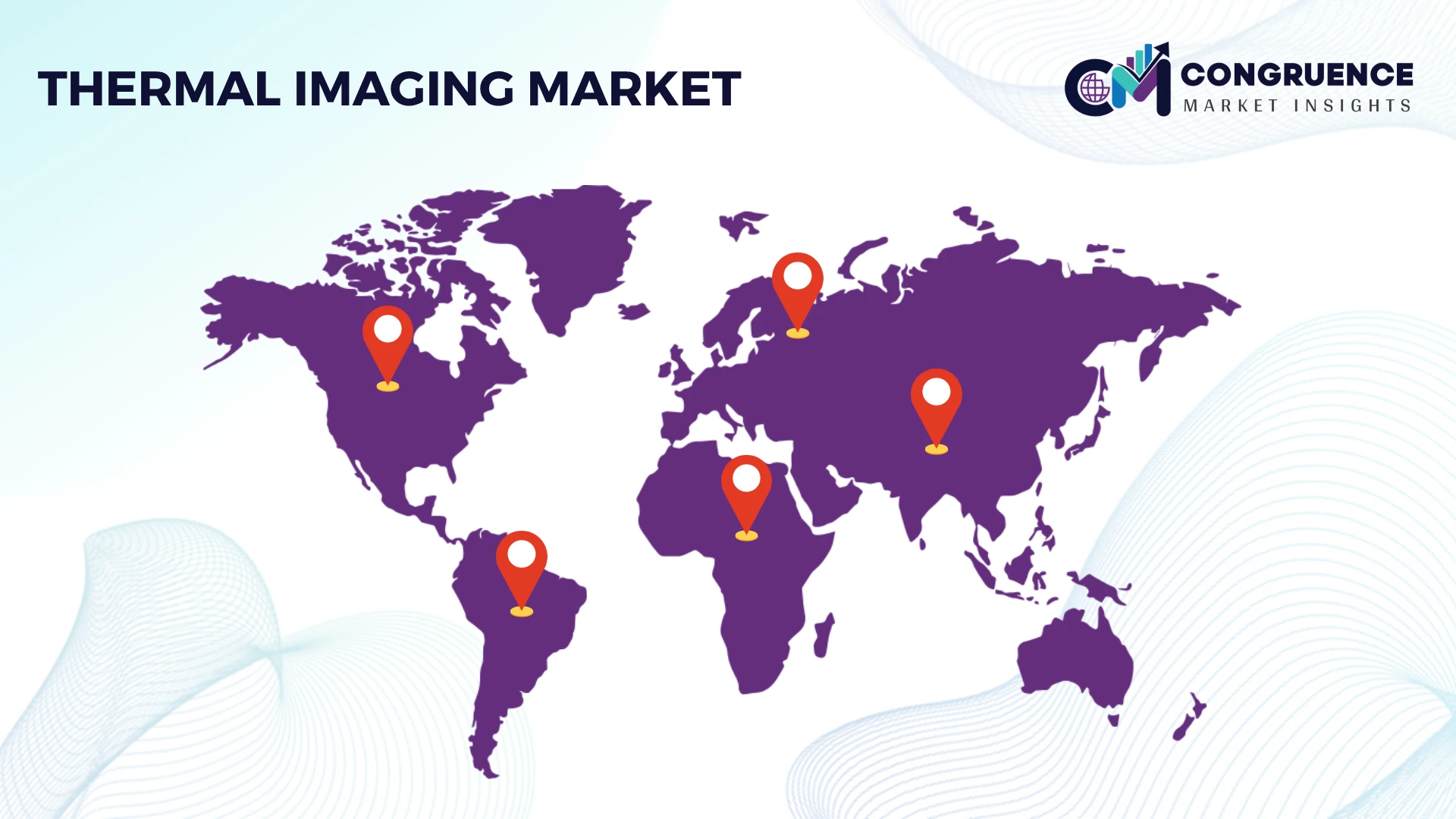
North America accounted for the largest market share at 34.0% in 2025 however, Asia-Pacific is expected to register the fastest growth, expanding at a CAGR of 9.4% between 2026 and 2033.
Defense Modernization and Industrial Monitoring Sustain Regional Leadership
North America is estimated to account for approximately 34.0% of the global thermal imaging market in 2025, supported by defense procurement, established infrared technology suppliers, and widespread industrial inspection requirements. The United States drives regional demand through military surveillance, aerospace systems, critical-infrastructure protection, and predictive maintenance across utilities and manufacturing. Canada contributes through mining, energy infrastructure, public safety, and remote-site monitoring. In June 2025, Teledyne FLIR OEM announced NDAA compliance for its Neutrino, Boson, Hadron, and Lepton thermal camera modules, strengthening their suitability for U.S. government-related programs. This emphasis on sourcing compliance demonstrates how procurement requirements increasingly influence product selection. Suppliers that combine dependable sensor performance with secure supply chains and software integration are positioned to retain higher-value contracts.
United States Market Outlook: The United States remains the principal national market within North America because of its defense-industrial ecosystem, advanced aerospace programs, and large installed base of electrical and manufacturing infrastructure. The country's military expenditure reached approximately USD 997 billion in 2024, reinforcing the scale of its broader defense procurement environment, although this figure covers all military spending rather than thermal imaging specifically. Demand extends from airborne infrared systems and border surveillance to data-center inspection and industrial maintenance. Suppliers are prioritizing secure component sourcing, ruggedized modules, and integration with unmanned platforms and analytics software to address government and enterprise requirements.
Defense Readiness and Energy-Efficient Infrastructure Shape Adoption
Europe is estimated to represent approximately 25.0% of global thermal imaging demand in 2025, with defense modernization, industrial automation, building diagnostics, and energy infrastructure supporting adoption. Germany contributes through advanced manufacturing, automotive engineering, and electrical-equipment inspection, while France and the United Kingdom support demand through aerospace, defense electronics, and public-safety applications. European energy-efficiency requirements also sustain demand for thermal surveys that identify heat loss, insulation defects, and equipment inefficiencies. The business opportunity increasingly extends beyond camera sales to inspection services and software-supported diagnostics. Suppliers are responding with radiometric handheld systems, fixed-monitoring platforms, and integrated imaging solutions designed for industrial reliability, regulatory documentation, and lifecycle maintenance.
Germany Market Outlook: Germany is strategically important because of its dense manufacturing base, automotive supply chain, industrial automation capabilities, and energy-intensive production facilities. Thermal imaging supports electrical inspections, process monitoring, machine maintenance, and building-envelope assessments across these industries. Germany's automotive sector produced approximately 4.1 million passenger cars in 2024, reflecting the scale of its manufacturing ecosystem rather than a direct measure of thermal-camera demand. Opportunities are strongest where manufacturers can integrate infrared measurements with factory automation and maintenance systems. Vendors offering reliable calibration, interoperable software, and application-specific engineering are well positioned to serve German industrial customers.
Manufacturing Scale and Domestic Sensor Development Accelerate Deployment
Asia-Pacific is estimated to account for approximately 29.0% of the global thermal imaging market in 2025 and is positioned as the fastest-growing regional market. China combines domestic infrared-device manufacturing with demand from security, industrial inspection, electronics, and infrastructure monitoring. Japan and South Korea contribute through automotive engineering, semiconductor manufacturing, and precision industrial applications, while India presents opportunities in defense modernization, power infrastructure, railways, and industrial safety. China's expanding domestic production ecosystem supports broader product availability across price categories. In India, local defense manufacturing and infrastructure investment increase the importance of supplier qualification and service support. Companies are strengthening regional distribution, developing application-specific products, and improving sensor affordability to serve both high-performance and volume-oriented markets.
China Market Outlook: China is a key regional market because of its combination of infrared-device manufacturing, electronics supply chains, domestic technology development, and broad industrial demand. Thermal imaging is used across security systems, electrical inspections, manufacturing operations, and selected automotive and infrastructure applications. One industry estimate places China's thermal imaging camera production at approximately 2.1 million units in 2025, reflecting the expansion of domestic manufacturing capacity; this figure should be treated as an indicative industry estimate rather than an official national production statistic. Domestic suppliers benefit from scale and local integration, while competition increasingly depends on detector performance, software capabilities, product reliability, and export-market compliance.
Mining, Energy Infrastructure, and Remote Inspection Drive Selective Demand
South America is estimated to account for approximately 6.0% of the global thermal imaging market in 2025. Demand is concentrated in Brazil and Chile, where mining, power generation, electrical distribution, industrial processing, and public safety create practical use cases. Mining operators use thermal inspections to monitor electrical equipment, rotating machinery, and selected high-temperature processes, while utilities apply infrared cameras to identify overheating connections and maintenance priorities. However, import dependence, currency volatility, uneven technical-service coverage, and budget constraints can slow adoption outside major industrial centers. Suppliers are therefore emphasizing distributor partnerships, rugged handheld cameras, localized training, and service availability. The strongest commercial opportunities involve critical assets where avoiding unplanned shutdowns provides a clear operational justification for investment.
Brazil Market Outlook: Brazil is the principal national opportunity in South America because of its large industrial economy, extensive electricity network, mining operations, oil and gas assets, and agricultural processing infrastructure. Thermal imaging supports electrical maintenance, equipment inspection, facility security, and monitoring in geographically dispersed operations. In April 2026, Brazil's National Mining Agency established a remote-monitoring framework incorporating geospatial intelligence, satellite imagery, aerial surveys, and automated alerts into mining oversight. Although this initiative is not exclusively thermal-imaging focused, it strengthens the operating environment for data-led inspection technologies. Suppliers that partner with industrial service providers and provide local support can address the practical barriers associated with remote-site deployment.
Infrastructure Expansion and Security Modernization Support Adoption
The Middle East & Africa region is estimated to represent approximately 6.0% of the global thermal imaging market in 2025, with demand concentrated in Gulf infrastructure projects, energy operations, border security, mining, and industrial facilities. Saudi Arabia and the United Arab Emirates invest in infrastructure, security systems, and industrial diversification, creating applications for perimeter surveillance, electrical inspection, and facility monitoring. In Africa, mining operations, utilities, and selected public-safety programs provide demand, although procurement budgets and maintenance infrastructure vary significantly between countries. Harsh temperatures, dust, and remote operating conditions increase the importance of equipment durability and serviceability. Vendors are strengthening local distribution and system-integration partnerships, particularly where projects require thermal cameras to operate within broader security or industrial-control platforms.
Saudi Arabia Market Outlook: Saudi Arabia is strategically significant because of its energy infrastructure, industrial diversification agenda, large-scale construction activity, and investment in security and smart infrastructure. Thermal imaging is relevant to oil and gas facilities, electrical substations, industrial plants, perimeter protection, and remote asset inspection. The country's Vision 2030 program spans multiple sectors and supports broader modernization of infrastructure and industrial operations, although it does not represent a dedicated thermal-imaging investment allocation. Suppliers can position themselves through partnerships with local system integrators, ruggedized camera offerings, and maintenance services suited to high-temperature and dusty environments. Demand will depend on project specifications, procurement cycles, and the ability to deliver reliable support after installation.
The market combines global technology leaders Teledyne FLIR, Fluke, and Leonardo DRS with cost-focused Asian manufacturers such as HIKMICRO and Raytron. Teledyne FLIR competes across OEM modules, industrial cameras, and multispectral systems; Fluke emphasizes inspection workflows, while Leonardo DRS targets defense and unmanned platforms. Chinese suppliers compete aggressively on detector manufacturing scale, pricing, and product breadth, whereas European specialists such as Lynred differentiate through infrared detector technology. For the broader market, the top five players’ combined share is estimated at approximately 56%, although concentration varies by application and product category. Competition increasingly hinges on detector sensitivity, embedded analytics, supply-chain compliance, and integration speed. Recent product strategies include AI-enabled modules, radiometric sensing, and automation-ready cameras. High-volume manufacturers benefit from vertical integration, while specialist suppliers rely on performance differentiation and customer qualification. Entry barriers include detector expertise, precision optics, calibration, certification, and defense procurement requirements. Winning requires dependable performance, secure sourcing, application-specific integration, and lifecycle support.
Thermal imaging development is shifting from standalone infrared capture toward integrated sensing, radiometric measurement, and edge-based interpretation. Multispectral systems combine thermal and visible imagery to preserve heat signatures while adding scene detail, reducing reliance on separate manual image alignment. Teledyne FLIR’s MIX platform targets synchronized thermal-visible research workflows, while radiometric Boson+ modules provide pixel-level temperature data with sensitivity of 20 millikelvin or better. These capabilities strengthen measurement consistency in industrial inspection, defense, and research applications.
Edge AI is another competitive differentiator. Teledyne FLIR’s Boson+ IQ development kit combines thermal sensing with processing rated at 50 trillion operations per second and typical power consumption of 2.5 watts. This supports local inference where latency, connectivity, or data-security constraints make cloud processing less practical. In industrial cameras, wider optics also improve coverage: Optris introduced a 120-degree lens for its PI 640i in 2025, enabling fewer camera positions for suitable wide-area monitoring layouts. Actual installation savings depend on geometry and process conditions.
Established inspection brands retain advantages through calibration, reporting, and maintenance ecosystems, while OEM module suppliers benefit from integration into robotics, vehicles, and unmanned platforms. Higher-resolution imaging can improve detail, but it also increases processing and data-management demands. Between 2026 and 2028, buyers are expected to prioritize interoperable analytics, compact radiometric modules, and automation-ready cameras. Suppliers that validate performance in real operating environments and simplify system integration will be better positioned than those competing on detector specifications alone.
February 2026 — Teledyne FLIR launched A6450 long-life cooled MWIR cameras for continuous industrial automation and non-destructive testing. The launch targets 24/7 production monitoring, addressing maintenance barriers associated with cooled cameras. Source: FLIR.com
May 2026 — Leonardo DRS introduced the Tenum 640 Orbit uncooled LWIR camera module for unmanned air, ground, and maritime systems. The 640-class product targets high-volume OEM integration, helping platform developers manage size, weight, power, and cost constraints. Source: LeonardoDRS.com
October 2025 — Optris introduced a 120-degree ultra-wide-angle lens for its PI 640i infrared camera. The wider field of view supports monitoring of multiple process stations and large facilities, potentially reducing camera-position requirements in suitable industrial layouts. Source: Optris.com
April 2026 — HIKMICRO announced AI-powered SuperScene mode, applying embedded scene expertise to simplify thermal inspections for trade professionals and DIY users. The launch signals a shift toward guided interpretation and broader accessibility rather than image capture alone. Source: HIKMICRO.com
The report evaluates the global thermal imaging market across major product types, including cooled and uncooled systems, handheld cameras, fixed thermal cameras, and embedded imaging modules. Application coverage includes defense and surveillance, industrial inspection, predictive maintenance, building diagnostics, automotive sensing, firefighting, and infrastructure monitoring. End-user analysis examines military organizations, manufacturers, utilities, commercial infrastructure operators, public-safety agencies, and other specialist buyers. Regional coverage spans North America, Europe, Asia-Pacific, South America, and the Middle East and Africa, with country-level analysis of key manufacturing and deployment markets.
Technology coverage includes infrared detector development, radiometric measurement, multispectral imaging, AI-enabled analytics, edge processing, and integration with automation and asset-management systems. Competitive assessment compares global suppliers, regional manufacturers, OEM module providers, and application specialists across product performance, pricing, sourcing, and service capabilities. The report supports investment planning, market-entry evaluation, product portfolio decisions, partnership selection, and regional expansion priorities for 2026–2033. It also identifies how defense procurement, industrial digitization, supply-chain resilience, and demand for continuous monitoring are reshaping competitive positioning and technology priorities.
| Report Attribute/Metric | Report Details |
|---|---|
|
Market Revenue in 2025 |
USD 7,024.1 Million |
|
Market Revenue in 2033 |
USD 13,590.3 Million |
|
CAGR (2026 - 2033) |
8.6% |
|
Base Year |
2025 |
|
Forecast Period |
2026 - 2033 |
|
Historic Period |
2021 - 2025 |
|
Segments Covered |
By Type
By Application
By End-User
|
|
Key Report Deliverable |
Revenue Forecast, Growth Trends, Market Dynamics, Segmental Overview, Regional and Country-wise Analysis, Competition Landscape |
|
Region Covered |
North America, Europe, Asia-Pacific, South America, Middle East, Africa |
|
Key Players Analyzed |
Teledyne FLIR, Fluke Corporation, Leonardo DRS, BAE Systems, L3Harris Technologies, HIKMICRO, Raytron Technology, Lynred, Seek Thermal, Guide Sensmart, Optris, InfraTec, Thermoteknix Systems, SATIR |
|
Customization & Pricing |
Available on Request (10% Customization is Free) |




