
Reports
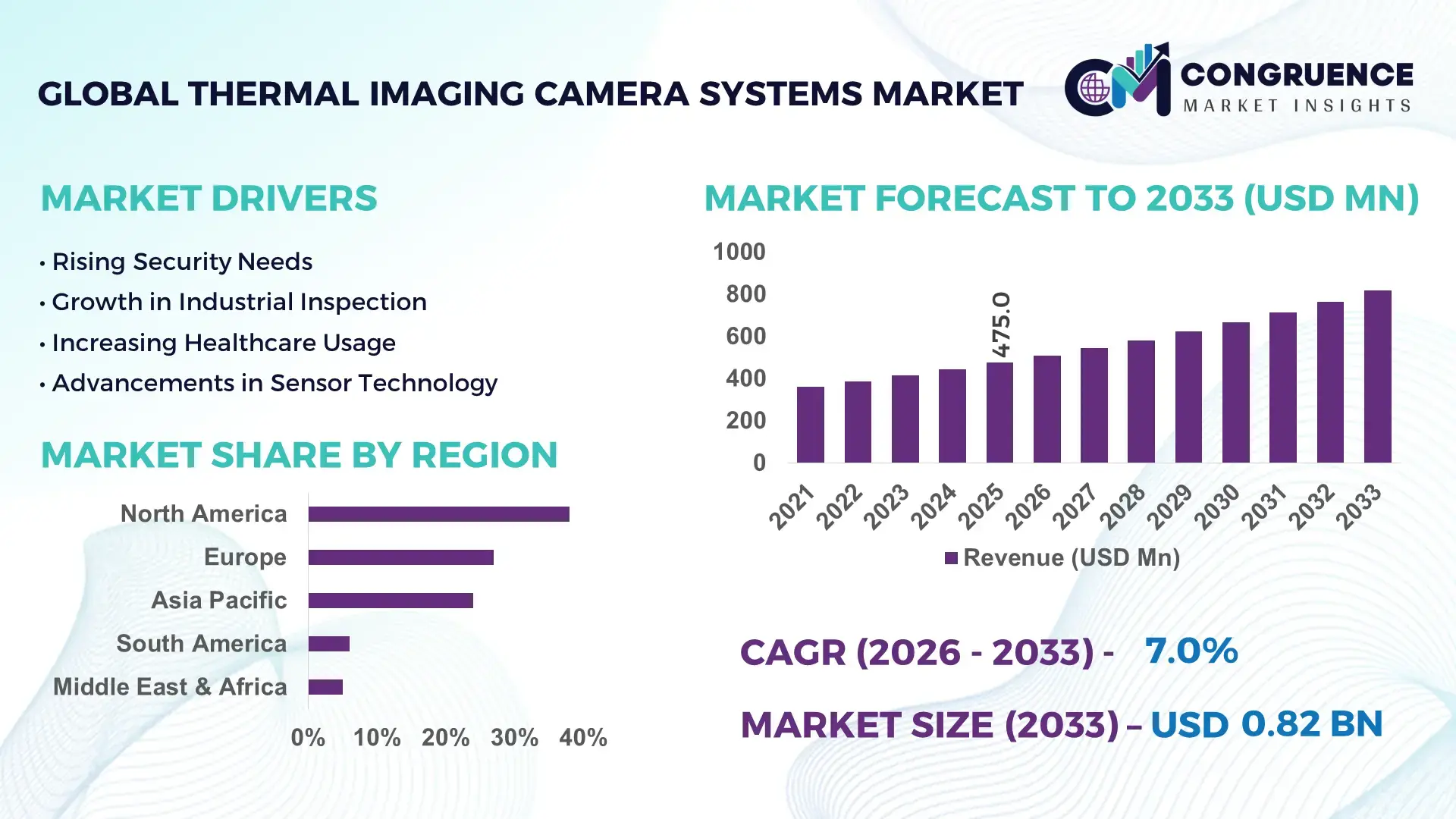
The Global Thermal Imaging Camera Systems Market was valued at USD 475.0 Million in 2025 and is anticipated to reach a value of USD 816.1 Million by 2033 expanding at a CAGR of 7% between 2026 and 2033, according to an analysis by Congruence Market Insights. The growth is primarily driven by increasing adoption across industrial safety, surveillance, and predictive maintenance applications.
The United Statesremains the most influential country in the Thermal Imaging Camera Systems Market, supported by strong defense spending exceeding USD 800 billion annually and advanced manufacturing infrastructure. Over 65% of industrial facilities in the U.S. have integrated thermal imaging for predictive maintenance, while adoption in commercial security systems exceeds 48% across critical infrastructure sites. The country also hosts over 40% of global thermal imaging R&D investments, with significant advancements in uncooled infrared sensors and AI-integrated imaging systems improving detection accuracy by more than 30%.
Market Size & Growth: USD 475.0 Million in 2025, projected to reach USD 816.1 Million by 2033, growing at 7% CAGR driven by rising demand for real-time thermal diagnostics.
Top Growth Drivers: Industrial automation adoption (62%), security surveillance expansion (55%), predictive maintenance efficiency gains (48%).
Short-Term Forecast: By 2028, system efficiency is expected to improve by 28% through AI-based anomaly detection integration.
Emerging Technologies: AI-enabled thermal analytics, edge computing integration, and compact uncooled infrared sensors.
Regional Leaders: North America (~USD 310 Million by 2033) driven by defense usage, Asia-Pacific (~USD 260 Million) with manufacturing expansion, Europe (~USD 180 Million) focusing on energy efficiency compliance.
Consumer/End-User Trends: Increasing adoption among industrial plants, utilities, and smart city infrastructure with over 52% usage in safety monitoring.
Pilot or Case Example: In 2024, a smart grid pilot reduced equipment downtime by 34% using thermal imaging diagnostics.
Competitive Landscape: Market leader holds ~22% share, followed by major players including FLIR Systems, Fluke Corporation, Testo SE, and Hikvision.
Regulatory & ESG Impact: Governments mandate thermal inspections in energy systems, reducing emissions losses by up to 18%.
Investment & Funding Patterns: Over USD 1.2 Billion invested in thermal imaging innovations and smart monitoring systems globally.
Innovation & Future Outlook: Integration with IoT platforms and AI-driven analytics is expected to transform predictive diagnostics and surveillance capabilities.
Thermal Imaging Camera Systems are widely deployed across defense (28%), industrial manufacturing (25%), and energy & utilities (18%) sectors, with increasing integration of AI-based analytics improving fault detection accuracy by over 30%. Regulatory mandates on workplace safety and energy efficiency are accelerating adoption, particularly in North America and Europe, while Asia-Pacific shows rapid consumption growth due to industrial expansion and infrastructure modernization.
The Thermal Imaging Camera Systems Market is strategically positioned at the intersection of industrial automation, national security, and energy efficiency optimization. Organizations are increasingly leveraging thermal imaging as a core component of predictive maintenance frameworks, where AI-enabled thermal analytics deliver nearly 35% improvement in fault detection accuracy compared to traditional visual inspection methods. This measurable performance gain is driving enterprise-wide deployments across manufacturing, utilities, and transportation sectors.
From a regional perspective, North America dominates in volume due to strong defense and infrastructure investments, while Asia-Pacific leads in adoption with over 58% of large-scale manufacturing enterprises integrating thermal imaging solutions into operational workflows. This divergence highlights the role of industrialization and automation maturity in shaping market pathways. In the short term, by 2028, AI-integrated thermal imaging systems are expected to reduce unplanned equipment downtime by approximately 30%, significantly improving operational efficiency across asset-intensive industries.
Compliance and ESG considerations are also influencing market expansion, with firms committing to energy efficiency targets such as reducing thermal energy losses by up to 20% by 2030. These initiatives are particularly relevant in utilities and oil & gas sectors, where heat loss detection directly impacts sustainability metrics.
A micro-scenario illustrates this trend: in 2025, a U.S.-based manufacturing firm implemented AI-driven thermal monitoring across its production lines and achieved a 32% reduction in maintenance costs while improving system uptime by 27%. Such outcomes demonstrate the tangible business value of advanced thermal imaging technologies.
Looking ahead, the Thermal Imaging Camera Systems Market is expected to evolve into a critical pillar supporting resilience, regulatory compliance, and sustainable industrial growth, with continued innovation in sensor miniaturization, AI integration, and real-time analytics shaping its future trajectory.
The Thermal Imaging Camera Systems Market is experiencing steady expansion driven by technological advancements, increasing safety regulations, and the rising need for non-contact temperature measurement solutions. Industries such as manufacturing, defense, healthcare, and energy are increasingly adopting thermal imaging for operational monitoring and risk mitigation. The growing complexity of industrial systems has amplified the demand for predictive maintenance tools, where thermal imaging plays a crucial role in identifying anomalies before system failures occur.
Furthermore, the integration of artificial intelligence and IoT-enabled platforms has significantly enhanced the functionality of thermal imaging systems, enabling real-time data analysis and automated alerts. Regulatory frameworks related to workplace safety and environmental compliance are also contributing to market growth, as organizations are required to monitor thermal inefficiencies and prevent hazardous incidents. However, high initial investment costs and technical limitations in certain environmental conditions continue to influence adoption patterns. Overall, the market reflects a balance between strong technological momentum and evolving industrial requirements.
The increasing reliance on predictive maintenance across industrial sectors is a major driver of the Thermal Imaging Camera Systems Market. Thermal imaging enables early detection of overheating components, electrical faults, and mechanical wear, reducing the likelihood of unexpected equipment failures. Studies indicate that predictive maintenance can lower maintenance costs by up to 25% and reduce equipment downtime by nearly 30%, making thermal imaging an essential tool for asset-intensive industries. In manufacturing environments, over 60% of facilities have integrated some form of thermal monitoring to enhance operational reliability. Additionally, utilities and power generation sectors are adopting thermal imaging for grid monitoring, with more than 45% of substations using infrared inspections to detect thermal anomalies. The technology’s non-invasive nature allows continuous monitoring without interrupting operations, further increasing its value proposition. As industries continue to prioritize efficiency and cost optimization, the demand for thermal imaging systems is expected to grow significantly.
Despite its advantages, the Thermal Imaging Camera Systems Market faces notable restraints due to high upfront costs and technical complexities. Advanced thermal imaging systems equipped with high-resolution sensors and AI capabilities can cost significantly more than conventional monitoring tools, limiting adoption among small and medium enterprises. Approximately 40% of SMEs cite cost barriers as a primary reason for delaying investment in thermal imaging technologies. Additionally, the accuracy of thermal imaging systems can be affected by environmental conditions such as humidity, dust, and reflective surfaces, which may distort temperature readings. This necessitates specialized training for operators, increasing operational expenses. In some industrial settings, integration with existing monitoring infrastructure can also be challenging, requiring additional investment in software and compatibility solutions. These factors collectively slow down widespread adoption, particularly in cost-sensitive markets and developing regions.
The integration of artificial intelligence presents significant opportunities for the Thermal Imaging Camera Systems Market by enhancing data interpretation and decision-making capabilities. AI-powered thermal imaging systems can analyze temperature patterns in real time, enabling automated detection of anomalies with over 30% higher accuracy compared to manual analysis. This advancement is particularly valuable in industries such as manufacturing, healthcare, and security. In smart cities, thermal imaging is increasingly being integrated into surveillance systems, with over 50% of new urban security projects incorporating thermal sensors for enhanced monitoring. The healthcare sector also offers promising opportunities, as thermal imaging is used for early detection of conditions such as inflammation and circulatory issues. Furthermore, the development of compact, cost-effective sensors is expanding the accessibility of thermal imaging technology, allowing new market entrants and applications to emerge.
Regulatory compliance and data integration complexities pose significant challenges to the Thermal Imaging Camera Systems Market. Different regions have varying standards for thermal imaging usage, particularly in sectors such as healthcare and surveillance, where data privacy and accuracy are critical. Organizations must ensure compliance with these regulations, which can increase implementation time and costs. Moreover, integrating thermal imaging data with existing enterprise systems remains a challenge, as many organizations operate on legacy infrastructure. Approximately 35% of companies report difficulties in aligning thermal imaging outputs with their current data analytics platforms. This can limit the effectiveness of thermal imaging solutions and reduce return on investment. Additionally, ensuring data security and preventing unauthorized access to thermal imaging systems is becoming increasingly important, particularly in critical infrastructure applications.
Rapid AI Integration Enhancing Detection Accuracy: AI-enabled thermal imaging systems are improving anomaly detection accuracy by over 30%, with nearly 58% of newly deployed systems incorporating machine learning algorithms. These solutions enable automated diagnostics, reducing manual inspection time by approximately 40% across industrial facilities and energy grids.
Expansion in Smart Infrastructure and Surveillance: Around 52% of smart city projects now include thermal imaging systems for security and monitoring applications. Adoption in critical infrastructure such as airports and power plants has increased by over 45%, driven by the need for real-time threat detection and operational safety.
Miniaturization and Cost Reduction in Sensors: Advances in uncooled infrared sensor technology have reduced device size by nearly 35% while lowering production costs by 20%. This has enabled broader adoption in portable devices and handheld systems, particularly in field inspections and emergency response operations.
Growing Adoption in Renewable Energy and Utilities: Thermal imaging is now used in over 60% of solar and wind energy installations for performance monitoring and fault detection. The technology helps improve energy efficiency by up to 25% by identifying heat losses and equipment inefficiencies in real time.
The Thermal Imaging Camera Systems Market is segmented based on type, application, and end-user, each contributing uniquely to overall market development. Different system configurations cater to varied industrial needs, ranging from high-resolution fixed installations to portable handheld devices. Applications span across defense, industrial inspection, healthcare, and commercial surveillance, reflecting the versatility of thermal imaging technology. End-user adoption is influenced by regulatory requirements, operational efficiency goals, and technological advancements. Increasing integration of AI and IoT is further shaping segmentation trends, enabling enhanced functionality and broader adoption across sectors.
Thermal Imaging Camera Systems are categorized into handheld, fixed/installed, and portable compact systems. Handheld systems dominate the market with approximately 46% share due to their flexibility, ease of use, and widespread application in maintenance, inspection, and emergency services. These devices are particularly popular in industrial environments where mobility and rapid diagnostics are essential. Fixed/installed systems account for nearly 32% of the market, primarily used in continuous monitoring applications such as perimeter security and industrial automation. However, portable compact systems are emerging as the fastest-growing segment, expected to expand at a CAGR of around 9%, driven by advancements in miniaturization and increasing demand for cost-effective solutions. These systems are gaining traction in sectors such as construction and utilities, where lightweight and affordable devices are preferred. Other niche systems collectively contribute around 22% of the market, serving specialized applications such as aerospace and research.
• A 2025 industrial technology report highlighted that over 70% of maintenance engineers prefer handheld thermal cameras for routine inspections, citing ease of deployment and faster diagnostics.
Key applications of Thermal Imaging Camera Systems include surveillance & security, industrial inspection, healthcare diagnostics, and energy management. Surveillance & security leads with approximately 38% share, driven by increasing demand for advanced monitoring systems in critical infrastructure and defense sectors. Industrial inspection follows with around 30% adoption, as manufacturers leverage thermal imaging for predictive maintenance and quality control. Healthcare diagnostics is the fastest-growing application, expanding at an estimated CAGR of 10%, supported by increasing use in non-invasive diagnostics and early disease detection. Energy management applications also hold a significant share, particularly in utilities and renewable energy sectors. Consumer adoption trends indicate that over 42% of hospitals are exploring thermal imaging for diagnostic purposes, while nearly 55% of industrial enterprises have implemented thermal monitoring solutions.
• A 2025 global health technology study reported that thermal imaging systems were deployed in over 120 hospitals to support non-contact screening and diagnostic procedures.
The primary end-users of Thermal Imaging Camera Systems include defense & military, industrial manufacturing, healthcare, and energy & utilities. Defense & military lead the segment with approximately 34% share, driven by extensive use in surveillance, targeting, and reconnaissance operations. Industrial manufacturing accounts for around 28%, reflecting strong adoption for predictive maintenance and process optimization. Healthcare is the fastest-growing end-user segment, with an estimated CAGR of 11%, fueled by increasing demand for non-invasive diagnostic tools. Energy & utilities contribute significantly, particularly in monitoring infrastructure and improving efficiency. Adoption trends show that nearly 60% of large-scale manufacturing facilities have integrated thermal imaging into their operations, while over 40% of healthcare institutions are piloting such technologies.
• A 2025 industry analysis indicated that over 500 manufacturing plants globally implemented thermal imaging systems to enhance operational safety and reduce equipment failures.
North America accounted for the largest market share at 38% in 2025 however, Asia-Pacific is expected to register the fastest growth, expanding at a CAGR of 8.6% between 2026 and 2033.
North America’s leadership is supported by over 65% industrial adoption of predictive maintenance technologies and more than 48% deployment across critical infrastructure surveillance. Europe follows with approximately 27% share, driven by strict energy efficiency regulations impacting over 52% of industrial facilities. Asia-Pacific holds nearly 24% share, with China, India, and Japan collectively contributing over 70% of regional demand due to rapid industrialization and infrastructure investments. South America accounts for around 6% share, primarily led by Brazil with increasing adoption in energy and mining sectors. The Middle East & Africa contributes approximately 5%, with over 40% usage concentrated in oil & gas operations and large-scale construction projects. Across regions, over 58% of enterprises are integrating thermal imaging into safety and operational monitoring frameworks, reflecting strong global demand.
North America holds approximately 38% share of the Thermal Imaging Camera Systems Market, driven by strong demand from defense, industrial manufacturing, and energy sectors. Over 70% of large manufacturing plants utilize thermal imaging for predictive maintenance and safety monitoring. Regulatory mandates related to workplace safety and energy efficiency have led to over 50% adoption in utilities and power infrastructure. Technological advancements such as AI-integrated thermal systems and IoT-enabled monitoring platforms are improving operational efficiency by nearly 30%. A key player, Teledyne FLIR, continues to innovate by launching compact, high-resolution thermal cameras for industrial and security applications. Consumer behavior in this region reflects higher enterprise adoption, particularly in healthcare and finance sectors, where over 45% of organizations are implementing thermal imaging for risk assessment and compliance monitoring.
Europe accounts for nearly 27% of the Thermal Imaging Camera Systems Market, with Germany, the UK, and France being the key contributors. Over 55% of industrial facilities in these countries are required to comply with energy efficiency directives, driving adoption of thermal imaging for heat loss detection. Regulatory bodies promoting carbon reduction have influenced over 48% of enterprises to integrate thermal monitoring systems. Emerging technologies such as AI-enabled diagnostics and smart grid integration are gaining traction, with over 35% of new installations featuring advanced analytics capabilities. Companies like Testo SE are focusing on developing precision thermal imaging solutions for industrial and environmental applications. Consumer behavior in Europe shows strong alignment with regulatory compliance, where demand is driven by the need for transparent and efficient monitoring systems.
Asia-Pacific represents around 24% of the Thermal Imaging Camera Systems Market and ranks as the fastest-growing region in terms of volume demand. China, India, and Japan collectively account for over 70% of regional consumption, driven by large-scale manufacturing and infrastructure projects. More than 60% of industrial facilities in China have adopted thermal imaging for quality control and equipment monitoring. Rapid urbanization and smart city initiatives have increased adoption in surveillance applications by over 50%. The region is also a hub for technological innovation, with significant advancements in low-cost infrared sensors and AI integration. Hikvision, a major regional player, is expanding its product portfolio with advanced thermal cameras for security and industrial use. Consumer behavior reflects strong growth driven by industrialization and increasing adoption of digital monitoring solutions.
South America holds approximately 6% share of the Thermal Imaging Camera Systems Market, with Brazil and Argentina being the leading contributors. The energy and mining sectors account for over 60% of regional demand, as thermal imaging is widely used for equipment monitoring and safety compliance. Infrastructure development projects have increased adoption by nearly 35%, particularly in urban and industrial areas. Government incentives promoting energy efficiency have encouraged over 30% of enterprises to implement thermal imaging systems. Local players and distributors are focusing on expanding access to cost-effective solutions for industrial users. Consumer behavior in this region shows demand closely tied to industrial operations, with growing interest in improving operational efficiency and reducing downtime.
The Middle East & Africa region accounts for approximately 5% of the Thermal Imaging Camera Systems Market, with significant demand from oil & gas, construction, and infrastructure sectors. Countries such as the UAE and South Africa contribute over 60% of regional demand. Thermal imaging is used in more than 45% of oil & gas facilities for monitoring equipment and ensuring safety compliance. Technological modernization initiatives have led to a 30% increase in adoption of advanced monitoring systems. Trade partnerships and government-led infrastructure projects are further supporting market growth. Regional players are focusing on deploying thermal imaging solutions for large-scale industrial operations. Consumer behavior reflects strong demand driven by industrial safety requirements and infrastructure development.
United States – 34% Market share: The growth is driven by high defense spending, advanced manufacturing adoption, and strong integration of predictive maintenance technologies.
China – 22% Market share: The expansion is supported by large-scale industrial production capacity, rapid infrastructure development, and strong demand in surveillance applications.
The Thermal Imaging Camera Systems Market is moderately fragmented, with over 35 active global and regional competitors competing across industrial, defense, and commercial segments. The top five companies collectively account for approximately 52% of the market, indicating a competitive yet innovation-driven environment. Leading players are focusing on product differentiation through high-resolution sensors, AI-enabled analytics, and compact system designs.
Strategic initiatives such as mergers, partnerships, and new product launches are shaping the competitive landscape. Over 40% of companies have introduced AI-integrated thermal imaging solutions to enhance performance and expand application areas. Additionally, nearly 30% of market participants are investing in R&D for sensor miniaturization and cost optimization to cater to emerging markets.
The market is also witnessing increased collaboration between technology providers and industrial enterprises, with more than 25% of companies entering strategic alliances to develop customized solutions. Innovation trends such as edge computing integration and IoT connectivity are further intensifying competition. As demand grows across sectors, companies are prioritizing scalability, accuracy, and real-time analytics to strengthen their market position.
Fluke Corporation
Testo SE & Co. KGaA
Hikvision Digital Technology Co., Ltd.
Axis Communications AB
Opgal Optronic Industries Ltd.
InfraTec GmbH
Seek Thermal Inc.
L3Harris Technologies Inc.
Leonardo DRS
Xenics NV
Allied Vision Technologies GmbH
Workswell s.r.o.
ULIS (Sofradir Group)
Technological advancements are playing a pivotal role in shaping the Thermal Imaging Camera Systems Market, particularly through innovations in sensor design, artificial intelligence, and connectivity. Uncooled infrared sensor technology has improved significantly, with sensitivity levels increasing by over 35% and device sizes reducing by nearly 30%, enabling broader deployment in portable and handheld devices. These advancements have made thermal imaging systems more accessible and cost-effective across industrial and commercial applications.
AI integration is transforming thermal imaging by enabling automated anomaly detection and predictive analytics. Systems equipped with machine learning algorithms can process thermal data in real time, improving fault detection accuracy by over 30% and reducing inspection time by approximately 40%. Additionally, edge computing capabilities are being incorporated into thermal cameras, allowing on-device data processing and reducing latency by up to 25%.
Connectivity is another key area of innovation, with over 50% of new thermal imaging systems featuring IoT integration for seamless data sharing and remote monitoring. Cloud-based platforms are enabling centralized management of thermal data, supporting large-scale industrial operations. Furthermore, advancements in multispectral imaging and fusion technologies are enhancing the ability to combine thermal and visible light data, improving situational awareness in security and defense applications. These technological developments are positioning thermal imaging as a critical tool for modern industrial ecosystems.
• In February 2026, Teledyne FLIR OEM announced advancements in infrared imaging and high-volume production capabilities, delivering thousands of thermal imaging modules dailywhile introducing new models like the Neutrino ISR series to support defense, automotive, and industrial applications. Source: www.teledyne.com
• In January 2026, Teledyne FLIR OEM launched the Tura automotive thermal camera, an ASIL-B compliant longwave infrared system designed for ADAS and autonomous vehicles, enabling detection of pedestrians and obstacles beyond headlight range to enhance vehicle safety.
• In September 2025, Teledyne FLIR OEM introduced the Boson+ IQ development kit, combining advanced thermal sensors with Prism AI software to enable rapid deployment of edge AI-based thermal imaging solutions across industrial, security, and defense applications.
• In November 2024, Teledyne FLIR Defense deployed its UltraFORCE 380X-HD imaging systemfor airborne surveillance and maritime rescue operations, integrating thermal, visual, and infrared capabilities into a compact platform supporting high-definition day/night monitoring.
The Thermal Imaging Camera Systems Market Report provides a comprehensive analysis of key segments, technologies, applications, and regional dynamics shaping the industry landscape. The scope includes detailed segmentation by type, covering handheld, fixed, and portable thermal imaging systems, which collectively address diverse operational requirements across industries. Applications analyzed in the report span surveillance and security, industrial inspection, healthcare diagnostics, and energy management, reflecting the wide-ranging utility of thermal imaging technologies.
From a geographic perspective, the report covers major regions including North America, Europe, Asia-Pacific, South America, and the Middle East & Africa, with insights into country-level performance and adoption patterns. Over 60% of the analysis focuses on industrial and infrastructure applications, highlighting the critical role of thermal imaging in predictive maintenance and safety compliance.
The report also explores technological advancements such as AI integration, IoT-enabled monitoring, and sensor miniaturization, which are influencing product innovation and market expansion. Additionally, it examines industry-specific use cases, including deployment in over 50% of smart city projects and more than 60% of renewable energy installations.
Emerging segments such as portable compact systems and AI-powered analytics platforms are also included, offering insights into future growth opportunities. The report is designed to support strategic decision-making by providing a holistic view of market trends, competitive positioning, and technological evolution within the Thermal Imaging Camera Systems Market.
| Report Attribute / Metric | Details |
|---|---|
| Market Revenue (2025) | USD 475.0 Million |
| Market Revenue (2033) | USD 816.1 Million |
| CAGR (2026–2033) | 7% |
| Base Year | 2025 |
| Forecast Period | 2026–2033 |
| Historic Period | 2021–2025 |
| Segments Covered |
By Type
By Application
By End-User Insights
|
| Key Report Deliverables | Revenue Forecast; Market Trends; Growth Drivers & Restraints; Technology Insights; Segmentation Analysis; Regional Insights; Competitive Landscape; Regulatory & ESG Overview; Recent Developments |
| Regions Covered | North America; Europe; Asia-Pacific; South America; Middle East & Africa |
| Key Players Analyzed | Teledyne FLIR LLC; Fluke Corporation; Testo SE & Co. KGaA; Hikvision Digital Technology Co., Ltd.; Axis Communications AB; Opgal Optronic Industries Ltd.; InfraTec GmbH; Seek Thermal Inc.; L3Harris Technologies Inc.; Leonardo DRS; Xenics NV; Allied Vision Technologies GmbH; Workswell s.r.o.; ULIS (Sofradir Group) |
| Customization & Pricing | Available on Request (10% Customization Free) |




