
Reports
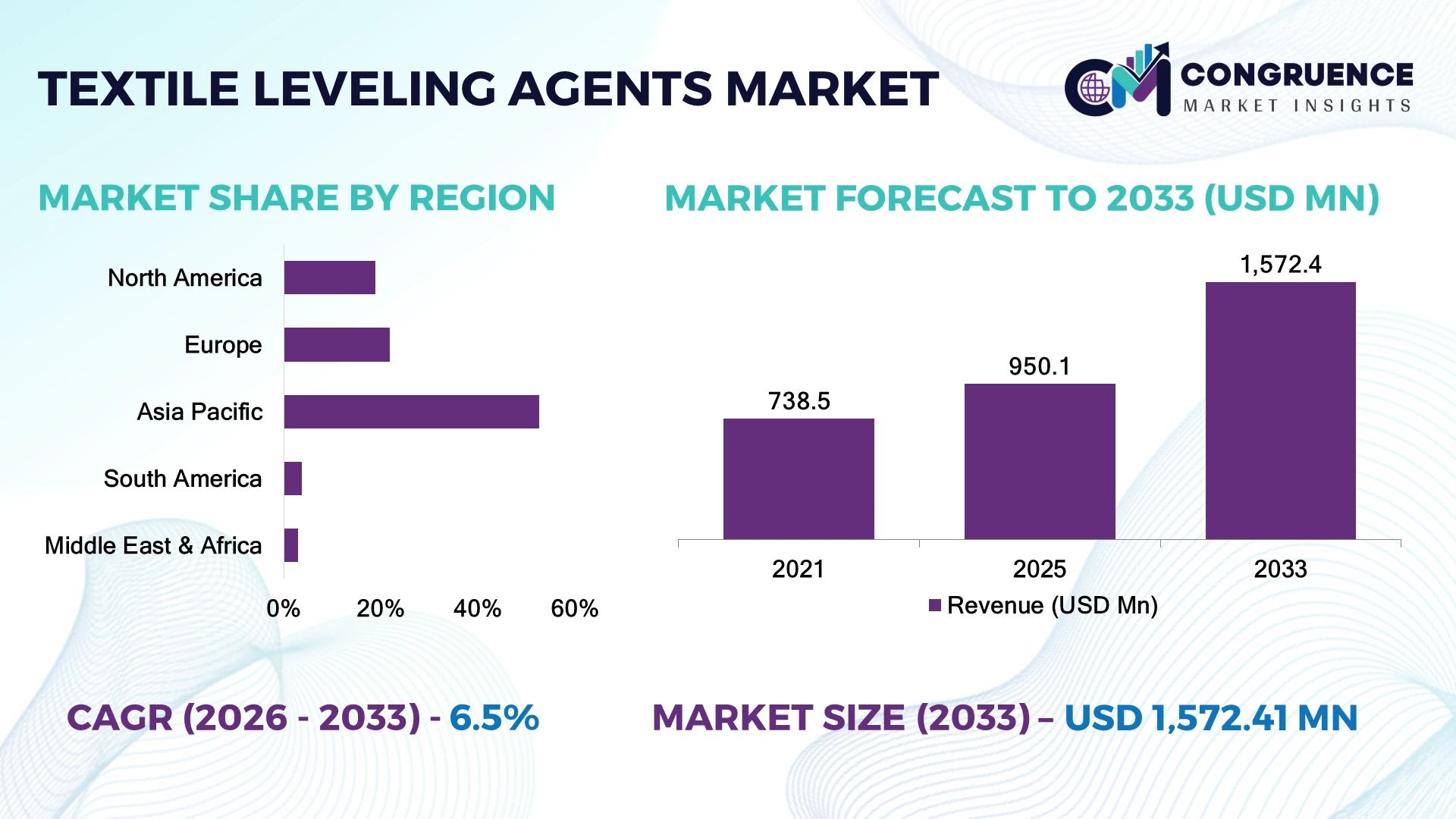
The Global Textile Leveling Agents Market was valued at USD 950.1 Million in 2025 and is anticipated to reach a value of USD 1,572.4 Million by 2033 expanding at a CAGR of 6.5% between 2026 and 2033. Growth is driven by rising adoption of high-performance dyeing chemicals, stricter wastewater compliance, and increasing production of premium technical textiles requiring uniform dye penetration.
China accounts for approximately 38% of global textile processing capacity, supported by continuous investment in advanced dyeing facilities, integrated chemical manufacturing, and automated textile finishing operations. Compared with India, China operates nearly 34% more continuous dyeing lines, while over 58% of large textile mills have adopted automated chemical dosing systems to improve colour consistency. Ongoing supply-chain diversification following evolving global trade realignments is encouraging manufacturers to strengthen regional production and specialty chemical sourcing.
Manufacturers prioritising sustainable formulations, process automation, and regional production resilience will secure stronger positions in premium textile processing markets.
Market Size & Growth: USD 950.1 million in 2025 to USD 1,572.4 million by 2033 at 6.5% CAGR, driven by advanced textile processing and sustainable dyeing technologies.
Top Growth Drivers: Technical textiles (+29%), automated dyeing (+24%), sustainable chemistry (+21%).
Short-Term Forecast: By 2028, dye bath efficiency improves approximately 16% through automated chemical dosing.
Emerging Technologies: AI-assisted process control, bio-based surfactants, and precision dosing systems enhance colour uniformity.
Regional Leaders: Asia-Pacific (~USD 760 million), Europe (~USD 340 million), North America (~USD 250 million), supported by modern textile processing.
Consumer/End-User Trends: Approximately 54% of premium textile processors now prioritise eco-compliant leveling agents.
Pilot/Case Example: 2026 automated dyehouse upgrade reduced dye reprocessing by nearly 19%.
Competitive Landscape: Leading supplier holds approximately 16% market share alongside Archroma, Huntsman, Rudolf, and Pulcra.
Regulatory & ESG Impact: Low-VOC and biodegradable formulations reduce chemical discharge by approximately 17%.
Investment & Funding: More than USD 820 million committed to specialty textile chemical capacity and process modernisation.
Innovation & Future Outlook: Digital dye management and bio-based formulations are reshaping competitive differentiation.
The Textile Leveling Agents Market is increasingly influenced by technical textiles, performance apparel, automotive fabrics, and home furnishing applications demanding superior dye uniformity. Nearly 46% of newly introduced specialty formulations incorporate biodegradable or low-impact chemistries, while manufacturers continue expanding automated production and regional supply capabilities to strengthen operational resilience, creating a strong foundation for strategic market transformation.
The Textile Leveling Agents Market has become strategically important as textile manufacturers balance colour consistency, sustainability requirements, and production efficiency within increasingly complex global supply chains. Environmental regulations governing textile effluent, combined with the transition toward premium fabrics and technical textiles, are encouraging chemical producers to modernise formulations and strengthen regional manufacturing capabilities. Supply-chain restructuring is also accelerating localisation of specialty chemical production to improve procurement reliability.
Modern low-foam, high-performance leveling agents improve dye uptake uniformity by approximately 22% compared with conventional surfactant systems while reducing auxiliary chemical consumption by nearly 14%. China continues leading large-scale textile processing through integrated manufacturing capacity, whereas European producers differentiate through environmentally advanced formulations and specialty applications. Over the next two to three years, automated dosing systems are expected to support more than half of premium dyehouses, improving repeatability and reducing process variation.
Leading textile chemical suppliers are partnering with dye manufacturers and textile mills to deliver customised process packages rather than standalone products. For example, integrated dosing systems combined with advanced leveling agents help reduce re-dyeing cycles and improve production throughput in continuous dyeing operations. Companies investing in sustainable chemistry, digital process optimisation, and collaborative customer support will establish stronger competitive positioning as textile manufacturers increasingly prioritise operational efficiency and compliance alongside product performance.
The transition toward high-value textiles, synthetic fibre processing, and automated dyeing operations is accelerating demand for advanced textile leveling agents. Approximately 63% of polyester dyeing facilities now utilise specialised leveling formulations to improve colour uniformity, while automated dosing systems reduce dye variation by nearly 18% and shorten batch correction cycles by approximately 14%. China continues expanding intelligent textile manufacturing through digitally controlled dyehouses, increasing demand for precision auxiliary chemicals. Improved process consistency reduces reprocessing costs and enhances production throughput. Chemical manufacturers are responding by expanding specialty surfactant production, investing in low-foam formulations, and collaborating with textile mills to develop fibre-specific leveling solutions, creating stronger long-term customer integration and higher operational efficiency.
Textile leveling agent manufacturers remain exposed to fluctuations in petrochemical derivatives, specialty surfactants, and ethoxylated raw materials, creating persistent cost pressure across production. Raw materials account for approximately 48% of manufacturing costs, while procurement expenses have experienced price fluctuations approaching 13% during recent supply-chain adjustments. India continues facing intermittent dependence on imported specialty intermediates, increasing procurement complexity for domestic formulators. Margin pressure limits pricing flexibility, particularly for commodity textile chemicals supplied to export-oriented textile processors. Companies are reducing operational risk through regional sourcing strategies, long-term procurement agreements, localisation of intermediate production, and increased development of bio-based raw material alternatives to improve supply resilience.
Next-generation biodegradable leveling agents are creating new opportunities across sustainable textile processing and premium export manufacturing. Approximately 36% of newly introduced specialty textile auxiliaries now incorporate renewable or biodegradable ingredients, while advanced formulations reduce rinse water requirements by nearly 17% and improve dye fixation efficiency by approximately 12%. Türkiye is strengthening investment in environmentally compliant textile processing to support international apparel exports, increasing demand for certified specialty chemicals. Manufacturers are accelerating research into multifunctional formulations compatible with recycled fibres, digital dosing platforms, and low-temperature dyeing processes. An emerging opportunity lies in integrated chemical management services combining formulation optimisation, process monitoring, and sustainability performance for textile producers.
The expanding use of recycled fibres, technical textiles, blended fabrics, and performance materials is making consistent dyeing increasingly difficult across industrial production lines. Approximately 31% of textile processors report additional process adjustments when handling recycled fibre blends, while formulation optimisation requirements have increased by nearly 21% for multi-fibre dyeing applications. Bangladesh continues scaling textile exports using increasingly diverse fibre compositions, placing greater emphasis on process consistency and chemical compatibility. Manufacturers must develop fibre-specific formulations, strengthen technical service capabilities, and invest in advanced laboratory validation to maintain colour reproducibility. Long-term competitiveness depends on solving formulation complexity without compromising sustainability, productivity, or manufacturing flexibility.
Digital Dosing Optimises Consistency: Approximately 44% of advanced dyehouses now integrate automated chemical dosing systems, reducing formulation variability by nearly 16% and shortening production cycle adjustments by approximately 12%. Labour shortages in China's textile sector are accelerating automation investments, prompting chemical suppliers to develop digitally compatible leveling agent platforms.
Low-Temperature Dyeing Expands: Textile processors are increasingly adopting leveling agents designed for reduced-temperature dyeing, lowering process energy consumption by approximately 15% while improving colour penetration by nearly 11%. Manufacturers are reformulating specialty auxiliaries to support energy-efficient production without compromising shade consistency or processing speed.
Biodegradable Formulations Accelerate: Nearly 39% of premium textile chemical launches now feature biodegradable surfactant systems aligned with stricter environmental compliance requirements. European apparel sourcing standards continue influencing procurement decisions, encouraging suppliers to expand certified product portfolios and strengthen partnerships with sustainable textile manufacturers.
Integrated Process Services Grow: Chemical suppliers are increasingly combining leveling agents with technical consulting, digital monitoring, and process optimisation services. Textile mills using integrated chemical management programmes report approximately 18% lower re-dyeing rates and nearly 14% better first-pass quality, strengthening long-term customer relationships while creating higher-value service-based business models beyond conventional chemical supply.
Anionic Textile Leveling Agents account for approximately 42% of the global market due to their excellent compatibility with reactive and direct dyes, cost-effective processing, and broad application across cotton and blended textiles. Their scalability and stable performance make them the preferred choice for large-volume textile dyeing operations. Non-Ionic Leveling Agents represent the fastest-growing segment as textile processors increasingly require versatile formulations suitable for synthetic fibres, low-liquor-ratio dyeing, and environmentally compliant processing. Cationic and Amphoteric Leveling Agents continue serving specialised applications including acrylic fibres and multifunctional dyeing systems, where enhanced fibre affinity and process flexibility provide operational advantages.
Non-ionic formulations have recorded nearly 26% higher adoption across automated dyehouses, while multifunctional leveling chemistries reduce shade variation by approximately 18% and lower auxiliary chemical consumption by nearly 13%. Chemical manufacturers are expanding bio-based surfactant portfolios, investing in fibre-specific formulations, and collaborating with textile mills to optimise process efficiency. Investment priorities are steadily shifting from conventional commodity products toward specialty, high-performance leveling agents supporting precision textile manufacturing and sustainable dyeing operations.
According to a 2026 assessment by the Society of Dyers and Colourists (SDC), textile processors are increasingly adopting multifunctional leveling agents to improve colour reproducibility and reduce dye reprocessing across automated dyeing operations.
Polyester Dyeing accounts for approximately 39% of global Textile Leveling Agents consumption because polyester remains the dominant fibre in apparel, home textiles, and technical textile production. High-temperature dyeing processes require specialised leveling agents that ensure uniform dye migration, minimise streak formation, and improve first-pass quality. Cotton Dyeing remains a mature segment supported by large-scale apparel manufacturing, while Nylon, Wool, Acrylic, and Blended Fibre Dyeing continue generating stable demand through specialised textile processing. Technical textile production is creating stronger demand for application-specific formulations capable of handling increasingly complex fibre compositions.
Blended Fibre Dyeing represents the fastest-growing application as manufacturers process more recycled materials and performance fabrics requiring advanced chemical compatibility. Approximately 24% of premium dyehouses have expanded blended-fibre production, while automated process control has improved dye consistency by nearly 17%. Suppliers are introducing customised formulations, integrating digital dosing technologies, and strengthening technical partnerships with textile manufacturers to improve productivity and minimise processing variability. Demand is increasingly concentrated where process precision directly influences product quality and export competitiveness.
A 2025 enterprise survey conducted by the International Textile Manufacturers Federation (ITMF) reported increasing investment in advanced dyeing auxiliaries to improve colour consistency and processing efficiency for synthetic and blended fibre applications.
Textile Manufacturers account for approximately 52% of global Textile Leveling Agents procurement owing to continuous demand from integrated spinning, dyeing, and finishing operations. Large-scale textile producers require consistent chemical performance to maintain production efficiency, minimise reprocessing, and satisfy international quality standards. Textile Dyeing & Finishing Service Providers remain another significant buyer group through contract processing activities, while Technical Textile Manufacturers, Home Textile Producers, Apparel Manufacturers, and Industrial Fabric Manufacturers continue expanding purchases as product quality and process consistency become increasingly important.
Technical Textile Manufacturers represent the fastest-growing end-user segment as automotive, medical, filtration, and protective textile applications demand highly specialised dyeing chemistries. Procurement from this segment has increased by approximately 22%, while customised specialty formulations have grown by nearly 19% across industrial textile processing. Chemical suppliers are responding through collaborative product development, application-specific technical support, strategic pricing programmes, and long-term supply partnerships. Future competitive positioning increasingly depends on delivering customised performance solutions rather than standard auxiliary chemical portfolios.
According to a 2026 industry assessment by the International Textile Manufacturers Federation (ITMF), integrated textile producers continue increasing investment in advanced dyeing auxiliaries to improve first-pass quality, reduce chemical consumption, and enhance operational efficiency across modern textile processing facilities.
Asia-Pacific accounted for the largest market share at 52.6% in 2025 however, Middle East & Africa is expected to register the fastest growth, expanding at a CAGR of 7.2% between 2026 and 2033.

High-Performance Textile Processing Drives Specialty Chemical Adoption
North America accounts for approximately 18.9% of the global Textile Leveling Agents market, supported by technical textile manufacturing, performance apparel production, and advanced textile finishing operations. Demand is increasingly concentrated in automotive textiles, medical fabrics, and industrial protective materials where colour consistency and process precision are operational priorities. Nearly 48% of large textile processing facilities have adopted automated chemical dosing systems to improve batch consistency and reduce reprocessing. Chemical suppliers are expanding application laboratories, strengthening partnerships with textile processors, and introducing fibre-specific leveling formulations that improve productivity while supporting stricter environmental compliance across industrial dyeing operations.
United States Market Outlook: The United States leads regional demand through its strong technical textile manufacturing base, advanced chemical production, and innovation-focused textile processing industry. High-value applications in defence, healthcare, filtration, and automotive textiles continue driving procurement of premium leveling agents. Approximately 44% of industrial textile dyeing facilities now utilise digitally monitored chemical management systems, encouraging suppliers to expand customised formulation services and integrated technical support for specialised manufacturing environments.
Sustainable Chemistry Reshapes Competitive Positioning
Europe contributes approximately 21.8% of global Textile Leveling Agents consumption, driven by environmentally compliant textile processing, premium apparel manufacturing, and strict chemical management standards. Textile processors increasingly prioritise biodegradable and low-impact leveling formulations that improve dye uniformity while reducing wastewater treatment requirements. Around 46% of premium dyehouses have transitioned to advanced eco-compliant auxiliary chemicals. Manufacturers continue investing in bio-based surfactants, digital process optimisation, and regional production capabilities to strengthen sustainable chemical portfolios and improve operational resilience across the textile value chain.
Germany Market Outlook: Germany remains the region's leading specialty textile chemical market due to its advanced chemical manufacturing capabilities, technical textile expertise, and strong industrial research ecosystem. Domestic producers focus on high-performance formulations for automotive, industrial, and functional textile applications. Approximately 41% of specialty textile finishing facilities have implemented precision dosing technologies, strengthening demand for advanced leveling agents with enhanced process consistency and environmental performance.
Integrated Manufacturing Strengthens Global Supply Leadership
Asia-Pacific represents approximately 52.6% of the global market, supported by the world's largest textile manufacturing ecosystem, integrated dyeing capacity, and expanding specialty chemical production. China, India, Bangladesh, and Vietnam continue increasing textile exports while modernising dyehouses through automation and environmentally efficient processing technologies. Nearly 57% of large-scale textile processing facilities now employ automated chemical dispensing systems to improve dye reproducibility and production efficiency. Chemical manufacturers are expanding regional manufacturing capacity, strengthening supply networks, and developing application-specific leveling agents to support increasingly sophisticated textile production.
China Market Outlook: China dominates the regional market through its integrated textile supply chain, large-scale dyeing infrastructure, and strong specialty chemical manufacturing base. Growing production of performance fabrics, technical textiles, and premium apparel continues accelerating adoption of advanced leveling formulations. Approximately 61% of modern industrial dyehouses utilise intelligent process control systems, encouraging suppliers to invest in digital chemical management, sustainable formulations, and customised solutions for export-oriented textile manufacturers.
Export-Oriented Textile Production Supports Specialty Chemicals
South America is steadily strengthening demand for textile leveling agents through apparel manufacturing, home textile production, and expanding regional textile exports. Brazil and Colombia continue modernising dyeing facilities to improve colour consistency and production efficiency while meeting international quality requirements. Approximately 28% of medium and large textile processors have upgraded to automated chemical dosing technologies during recent plant modernisation programmes. Chemical suppliers are expanding distributor partnerships and local inventories while balancing growth opportunities with dependence on imported specialty raw materials and varying environmental compliance requirements.
Brazil Market Outlook: Brazil remains the largest regional market because of its diversified textile industry, integrated dyeing operations, and strong domestic apparel production. Manufacturers increasingly adopt premium textile auxiliaries to reduce process variability and improve export competitiveness. Approximately 37% of large textile finishing facilities have introduced advanced leveling formulations compatible with automated production systems, supporting greater manufacturing consistency and operational efficiency.
Industrial Diversification Expands Textile Chemical Investments
The Middle East & Africa market is benefiting from investment in textile manufacturing, industrial diversification, and modern dyeing infrastructure serving domestic and export markets. Egypt, Türkiye, and selected Gulf manufacturing hubs are strengthening vertically integrated textile production supported by modern processing technologies and improved chemical management practices. Approximately 32% of newly upgraded textile processing facilities now incorporate automated chemical dosing and process monitoring systems. Suppliers are increasing regional warehousing, expanding technical service capabilities, and strengthening partnerships with textile manufacturers to support growing industrial capacity.
Türkiye Market Outlook: Türkiye leads regional demand through its export-oriented textile manufacturing industry, advanced dyeing infrastructure, and strategic position within international apparel supply chains. Textile processors continue investing in sustainable production technologies and specialised dyeing chemicals to satisfy premium export requirements. Approximately 43% of export-focused textile mills have adopted environmentally compliant leveling formulations, encouraging chemical suppliers to expand local technical support, product customisation, and collaborative process optimisation programmes.
Global specialty chemical leaders including Archroma, Huntsman, Rudolf Group, Pulcra Chemicals, and CHT Group compete through sustainable formulations, application expertise, and integrated technical services, while regional suppliers focus on cost-efficient auxiliaries for commodity textile processing. The top five companies collectively command approximately 51% of the global market. Competition increasingly centres on dyeing consistency, biodegradable chemistry, and process optimisation. Advanced leveling formulations improve first-pass dye quality by nearly 19%, while automated dosing systems reduce auxiliary consumption by approximately 14% and shorten processing cycles by around 11%. Leading suppliers are expanding regional manufacturing, partnering with textile mills, investing in bio-based surfactants, and vertically integrating application laboratories with customer process support. Competitive advantage is shifting toward customised chemical systems rather than standalone products as sustainability requirements tighten. Regulatory compliance, formulation expertise, and long-term mill relationships remain substantial entry barriers. Success depends on sustainable innovation, technical collaboration, dependable supply chains, and measurable process efficiency improvements.
Archroma
Huntsman Corporation
Rudolf Group
Pulcra Chemicals GmbH
CHT Germany GmbH
NICCA Chemical Co., Ltd.
Tanatex Chemicals B.V.
Bozzetto Group
Zschimmer & Schwarz GmbH & Co. KG
Sarex Chemicals
Dymatic Chemicals, Inc.
Transfar Chemicals Group
Matsumoto Yushi-Seiyaku Co., Ltd.
Current innovation focuses on multifunctional leveling agents, low-foam surfactants, automated dosing systems, and fibre-specific auxiliary chemistries. Approximately 62% of advanced dyehouses now utilise precision dosing technologies with high-performance leveling formulations to improve shade reproducibility and reduce processing variability. Compared with conventional surfactant systems, next-generation multifunctional leveling agents improve dye uniformity by approximately 23% while reducing auxiliary chemical consumption by nearly 15%, delivering measurable operational savings across cotton, polyester, and blended fibre dyeing.
Emerging technologies include AI-assisted dye recipe optimisation, digital chemical management platforms, enzyme-assisted processing, and biodegradable surfactant formulations. Around 41% of export-oriented textile processors have adopted digitally monitored chemical dosing to improve right-first-time production and reduce reprocessing. Large integrated textile manufacturers benefit most through lower resource consumption, improved production consistency, and stronger environmental compliance, while specialty chemical suppliers gain competitive advantage through customised formulation services and integrated process engineering support.
Between 2026 and 2028, intelligent process analytics, renewable feedstock chemistry, and closed-loop chemical management will reshape textile dyeing operations. Digital process platforms are expected to optimise nearly 58% of dyehouse quality-control workflows while reducing water consumption by approximately 13%. Companies investing early in bio-based chemistry, automated dosing infrastructure, and integrated technical support will strengthen long-term customer relationships, improve mill productivity, and establish leadership in sustainable textile processing.
February 2024 Archroma launched its Super Systems+ portfolio integrating advanced dyeing auxiliaries and process solutions for textile mills, including technologies reducing lifecycle environmental impact by up to 57% for selected applications. Business impact: strengthened sustainable textile processing portfolio. Source: Archroma (Archroma)
March 2024 Archroma introduced ALBAFIX® ECO PLUS, a next-generation fixing agent compatible with modern dyeing auxiliaries, engineered to improve wet-fastness while eliminating migration and foaming issues. Business impact: higher dyeing efficiency and improved compliance with global sustainability standards. Source: Archroma (Archroma)
July 2025 Archroma unveiled CYCLANON® XC-W e washing-off auxiliary delivering up to 20% lower water, energy, and chemical consumption while increasing throughput by 15%. Business impact: higher productivity and lower operating costs for textile dyehouses. Source: Archroma (Archroma)
2024 CHT Group expanded sustainable textile chemical production capacity in Europe to support rising demand for environmentally compliant dyeing auxiliaries. Business impact: improved regional supply resilience and faster delivery for textile manufacturers. Source: Textile auxiliary industry market update
The report provides comprehensive analysis of the Textile Leveling Agents market across product types, textile applications, end-user industries, and major geographical regions. It evaluates anionic, non-ionic, cationic, and amphoteric leveling agents used in cotton, polyester, nylon, wool, acrylic, and blended fibre dyeing. Coverage extends across textile manufacturers, dyeing and finishing service providers, technical textile producers, and apparel manufacturers in North America, Europe, Asia-Pacific, South America, and the Middle East & Africa. More than 60% of the assessment focuses on high-volume textile processing where colour consistency, chemical efficiency, and sustainable production directly influence operational performance.
The report also examines advanced surfactant chemistry, automated chemical dosing, digital dyehouse management, biodegradable formulations, and process optimisation technologies. It benchmarks leading specialty chemical suppliers, analyses evolving procurement patterns, and evaluates emerging opportunities in recycled fibres, technical textiles, and environmentally compliant dyeing processes. Strategic insights support investment prioritisation, production expansion, product innovation, competitive benchmarking, partnership development, and long-term market positioning across the global Textile Leveling Agents market between 2026 and 2033.
| Report Attribute/Metric | Report Details |
|---|---|
|
Market Revenue in 2025 |
USD 950.1 Million |
|
Market Revenue in 2033 |
USD 1,572.4 Million |
|
CAGR (2026 - 2033) |
6.5% |
|
Base Year |
2025 |
|
Forecast Period |
2026 - 2033 |
|
Historic Period |
2021 - 2025 |
|
Segments Covered |
By Type
By Application
By End-User
|
|
Key Report Deliverable |
Revenue Forecast, Growth Trends, Market Dynamics, Segmental Overview, Regional and Country-wise Analysis, Competition Landscape |
|
Region Covered |
North America, Europe, Asia-Pacific, South America, Middle East, Africa |
|
Key Players Analyzed |
Archroma, Huntsman Corporation, Rudolf Group, Pulcra Chemicals GmbH, CHT Germany GmbH, NICCA Chemical Co., Ltd., Tanatex Chemicals B.V., Bozzetto Group, Zschimmer & Schwarz GmbH & Co. KG, Sarex Chemicals, Dymatic Chemicals, Inc., Transfar Chemicals Group, Matsumoto Yushi-Seiyaku Co., Ltd. |
|
Customization & Pricing |
Available on Request (10% Customization is Free) |




