
Reports
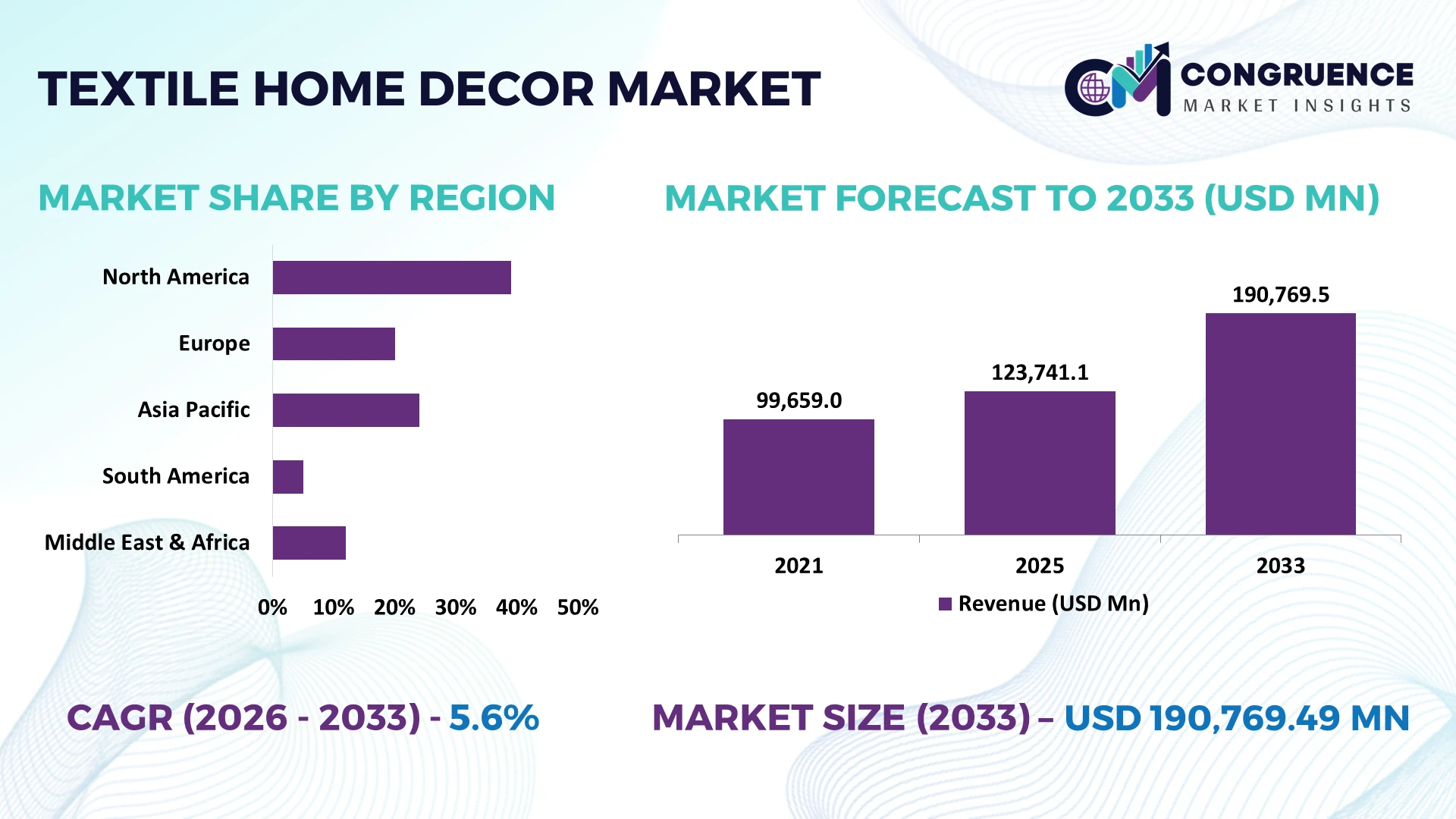
The Global Textile Home Decor Market was valued at USD 123741.07 Million in 2025 and is anticipated to reach a value of USD 190769.49 Million by 2033 expanding at a CAGR of 5.56% between 2026 and 2033. Growth is driven by digital textile printing, smart manufacturing, recycled-fiber adoption, and faster customization across bedding, curtains, upholstery, and decorative fabrics.
China remains the dominant production hub, accounting for about 52.4% of global home-textile exports in 2024, while its textile manufacturing ecosystem combines large-scale capacity with automated and digital production. Shaoxing alone represents roughly 25% of global fabric trading volume. India, by comparison, holds about 10% of global home-textile trade, strengthening its China+1 position amid supply-chain diversification and geopolitical trade tensions.
Strategically, manufacturers should prioritize digital production, sustainable materials, and diversified sourcing to defend margins and capture premium home-decor demand.
Market Size & Growth: USD 123.74 billion in 2025 rising to USD 190.77 billion by 2033, supported by digital printing and automated textile production.
Top Growth Drivers: Digital customization 18%, recycled-fiber adoption 15%, automation 12%.
Short-Term Forecast: By 2028, automated production is positioned to reduce processing costs 8% and improve throughput 12%.
Emerging Technologies: AI design, digital textile printing, robotic handling, and recycled-fiber processing are reshaping advanced home-decor manufacturing.
Regional Leaders: Asia-Pacific is projected near USD 105 billion, Europe USD 43 billion, and North America USD 32 billion by 2033, driven by e-commerce, premium interiors, and sustainable-product adoption.
Consumer Trends: Nearly 60% of Indian home-textile exports target the U.S., reinforcing demand for differentiated bedding, carpets, and furnishing textiles.
Pilot/Case Example: In 2024–25, smart textile investments in Shaoxing added 12 digital printing lines, cutting labor requirements through AI-integrated production.
Competitive Landscape: China leads with about 52.4% of global home-textile exports; key competitors include India, Türkiye, Pakistan, and Bangladesh.
Regulatory & ESG Impact: Tighter wastewater controls are accelerating digital printing, while recycled-material adoption is targeting double-digit reductions in material-related environmental impact.
Investment & Funding: Shaoxing textile enterprises invested approximately USD 29.4 billion in specialized printing equipment since 2024, accelerating automation and AI integration.
Innovation & Future Outlook: Smart fabrics, AI-assisted design, low-water printing, and circular fibers will shift competition toward customization, traceability, and resource efficiency.
The Textile Home Decor Market is increasingly concentrated around premium bedding, upholstery, curtains, carpets, and digitally customized furnishings, with automation improving production efficiency by roughly 8–12%. Sustainable fibers and low-water printing are gaining traction as manufacturers respond to tightening environmental requirements and China+1 sourcing strategies. This transition strengthens the strategic importance of technology-led production, diversified supply chains, and differentiated product design.
The Textile Home Decor Market is becoming strategically important as brands compete on customization, sustainability, speed-to-market, and supply-chain resilience rather than volume alone. Digital textile printing can reduce setup time by up to 70% versus conventional screen printing, while automated cutting can improve material utilization by 8–12%. These gains are pushing manufacturers toward integrated, data-driven production.
China retains scale advantages through dense textile clusters, while India is gaining strategic relevance through China+1 sourcing and expanding technical capabilities. Over the next 2–3 years, adoption of digital printing, automated inspection, and recycled-fiber processing is positioned to increase by 10–15% across advanced manufacturing facilities. This shift will favor suppliers capable of delivering shorter production runs without sacrificing consistency.
Operationally, manufacturers in Zhejiang are combining digital printing with automated quality inspection to support faster customized orders. Companies are redirecting capital toward smart machinery, sustainable inputs, and supplier partnerships rather than standalone capacity expansion. Strategic positioning will increasingly depend on manufacturing agility, traceability, and resource efficiency, making technology-enabled production a decisive competitive advantage.
Digital customization is becoming a primary structural driver as online furnishing platforms demand shorter runs and faster design cycles. Digital textile printing can reduce setup time by 60–70%, while automated cutting improves fabric utilization by approximately 8–12%. In China, textile clusters around Zhejiang are expanding digitally integrated production to support customized bedding, curtains, upholstery, and decorative fabrics. European manufacturers are pairing automation with recycled inputs to meet tighter sustainability expectations. Companies are responding through equipment modernization, software partnerships, and vertically integrated production. The non-obvious advantage is reduced dependence on minimum-order volumes, enabling manufacturers to profitably serve fragmented premium segments.
Cotton, synthetic fibers, dyes, and energy remain significant cost variables, with raw-material volatility capable of shifting manufacturing costs by 5–10%. Water-intensive dyeing and finishing also face increasing compliance pressure, particularly in China and European supply chains. Smaller manufacturers often lack capital for closed-loop water systems and advanced effluent treatment, constraining modernization. Companies are mitigating exposure through multi-country sourcing, longer procurement contracts, recycled-fiber substitution, and localized processing partnerships. The operational constraint is not simply material pricing; fragmented supplier qualification can slow product launches and weaken inventory responsiveness. Manufacturers with diversified inputs and stronger supplier visibility therefore gain greater cost-control flexibility.
AI-assisted design, digital printing, and recycled-fiber processing create attractive opportunities in premium and customized home furnishings. Automated design workflows can shorten sampling cycles by 20–30%, while digitally controlled printing reduces water consumption substantially compared with conventional wet processes. India is particularly positioned to capture China+1 orders as exporters expand sustainable bedding and furnishing capacity. Over the next three years, smart production adoption across advanced textile facilities is expected to rise by roughly 10–15%. Companies are investing in digital design platforms, circular-material partnerships, and automated finishing. A distinctive opportunity lies in small-batch personalization, where flexible production can command higher margins than standardized commodity textiles.
Scaling smart textile production requires integration across design software, printing equipment, automated inspection, enterprise systems, and traceability platforms. Interoperability gaps can reduce equipment utilization by 5–8%, while skilled-operator shortages increasingly affect advanced manufacturing deployment. Bangladesh and India face particular pressure to modernize workforce capabilities as exporters move toward higher-value furnishings. Cybersecurity also becomes more relevant as connected production systems expand across distributed facilities. Companies must address these barriers through standardized machine interfaces, technical training, managed automation partnerships, and stronger digital controls. The strategic challenge is achieving consistent performance across multiple production sites; isolated automation investments deliver weaker returns than fully integrated manufacturing ecosystems.
Digital Customization Accelerates: On-demand textile printing is expanding as brands reduce sampling cycles by 20–30% and small-batch production costs by roughly 10–15%. Chinese manufacturers are integrating digital design-to-print workflows to handle shorter runs, faster SKU rotation, and personalized curtains and cushions, strengthening responsiveness under volatile supply conditions.
Circular Materials Gain Traction: Sustainability-led sourcing is moving from marketing to procurement, with certified materials among reporting brands rising from 58% to 67% in 2024. Textile Exchange data also shows recycled fibers represented 7.6% of global fiber production, prompting manufacturers to restructure sourcing contracts and increase certified cotton and recycled polyester inputs.
Traceability Becomes Operational: Supply-chain transparency is becoming a production requirement as companies map fiber origins, certifications, and supplier performance. Textile Exchange reported 82% of polyester sourced by participating brands had unknown country-of-origin data, creating pressure for digital traceability systems. Manufacturers are consolidating suppliers and deploying chain-of-custody platforms to reduce compliance friction and improve procurement visibility.
Smart Production Reshapes Workflows: Automated inspection, digital cutting, and connected production controls are reducing manual intervention by approximately 10–15% while improving defect detection and throughput. India-based exporters are prioritizing integrated machinery and workforce upskilling as labor availability and China+1 sourcing reshape production economics. The non-obvious shift is that automation increasingly supports product-mix flexibility, not only higher-volume output.
Upholstery remains the leading type, estimated at approximately 27% market share, supported by high fabric consumption across sofas, chairs, headboards, and commercial furnishings. Its dominance reflects scalable production, repeat replacement cycles, and compatibility with performance textiles. Curtains & drapes follow at roughly 22%, benefiting from thermal, acoustic, and light-control fabrics, while bedding accounts for about 20% as brands expand coordinated bedroom collections.
Rugs & carpets represent around 18%, but their customization and premium-material adoption are accelerating faster than mature categories, with demand growth supported by digitally printed patterns and recycled fibers. Cushions & throws remain smaller at approximately 13% yet provide retailers with rapid SKU expansion and low-complexity seasonal collections. Companies are therefore prioritizing upholstery innovation while using rugs, cushions, and throws to test designs before broader product deployment.
Living Rooms lead the application mix at approximately 38% share because sofas, curtains, rugs, and cushions create the highest concentration of textile surfaces within a single household space. Bedrooms follow at nearly 31%, supported by bedding and coordinated furnishing sets. Manufacturers increasingly bundle products across these mature applications, improving inventory turnover by an estimated 8–12% through shared fabrics, colors, and design libraries.
Outdoor Spaces are the fastest-growing application, approaching 15% share as solution-dyed polyester, UV-resistant fabrics, water-repellent coatings, and modular furnishings expand deployment. Dining Areas represent about 16%, with table textiles and upholstered seating maintaining steady replacement demand. Companies are shifting product development toward weather-resistant collections and automated finishing, while retailers are integrating indoor-outdoor product families to increase cross-selling and reduce separate sourcing complexity.
Residential users represent the dominant end-user group at approximately 55% share, reflecting recurring purchases across bedding, curtains, upholstery, rugs, and decorative accessories. Hotels follow at about 17%, where standardized room packages create larger order volumes and repeat procurement. Restaurants account for roughly 10%, while Interior Designers contribute approximately 8% through specification-led premium projects and customized furnishing programs.
Hospitality Properties are the fastest-expanding buyer group, reaching nearly 10% share as renovation programs emphasize durable, coordinated textiles and differentiated interiors. Commercial buyers increasingly require performance testing, fire resistance, stain protection, and documented material credentials. Companies are responding with hospitality-specific collections, designer partnerships, volume contracts, and customization platforms. The strategic shift is toward specification-driven selling, where technical performance and traceability increasingly determine supplier selection alongside aesthetics.
North America accounted for the largest market share at 31% in 2025 however, Asia-Pacific is expected to register the fastest growth, expanding at a CAGR of 6.8% between 2026 and 2033.

Premiumization and automated replenishment reshape furnishing textiles
North America represents about 31% of global Textile Home Decor demand, supported by strong replacement cycles, e-commerce penetration, and premium residential furnishing. The U.S. concentrates regional demand, with digitally enabled retailers increasingly using shorter production runs and data-led inventory planning. Approximately 42% of major furnishing retailers prioritize digitally coordinated product launches, strengthening demand for rapid sampling and flexible textile manufacturing. Mexico is gaining manufacturing relevance as nearshoring reduces lead times for selected furnishing categories by an estimated 15–20%. Companies are expanding supplier networks, investing in automated cutting and inspection, and establishing regional production partnerships.
United States Market Outlook: The U.S. remains the region's principal demand center, supported by large-scale furniture retail, hospitality renovation, and online home-furnishing channels. Approximately 60% of textile home-decor purchasing is concentrated in residential applications, while premium performance fabrics increasingly support higher-value furnishing specifications.
Sustainability regulation drives material and process redesign
Europe holds approximately 24% of global Textile Home Decor demand, with Germany, Italy, France, and the United Kingdom supporting substantial premium furnishing activity. Circular materials, traceability, durability, and low-impact processing are becoming procurement differentiators as European sustainability requirements tighten. Around 35% of established textile manufacturers have increased certified or recycled-material sourcing, accelerating product redesign across bedding, upholstery, and decorative fabrics. Italy retains a strong position in design-intensive textiles, while Germany emphasizes process efficiency and industrial automation. Companies are responding through supplier consolidation, digital product passports, recycled-fiber partnerships, and low-water finishing systems.
Germany Market Outlook: Germany combines sophisticated retail infrastructure with advanced industrial automation and strong sustainability compliance capabilities. Manufacturers increasingly deploy automated inspection, digital inventory systems, and certified materials, while hospitality and contract-furnishing projects create recurring demand for durable, specification-driven textile products.
Manufacturing scale meets China+1 supply-chain restructuring
Asia-Pacific commands approximately 38% of global Textile Home Decor activity and remains the principal manufacturing base for curtains, upholstery, bedding, rugs, and decorative fabrics. China anchors production through integrated textile clusters, while India, Vietnam, and Bangladesh are expanding export-oriented capacity. China accounts for more than half of global home-textile exports, whereas India is strengthening its position through China+1 procurement diversification. Digitally controlled printing and automated finishing are increasingly deployed in major manufacturing hubs, reducing production-cycle times by roughly 10–15%. Companies are balancing Chinese scale with Southeast Asian and Indian capacity additions to reduce geopolitical and logistics exposure.
China Market Outlook: China remains the dominant manufacturing center because vertically integrated clusters connect fiber, spinning, weaving, dyeing, printing, and finished home-textile production. Zhejiang and Jiangsu continue to support high-volume manufacturing, while digital printing and automated inspection increasingly strengthen customization and quality consistency.
Brazilian manufacturing modernization supports localized supply
South America represents approximately 7% of global Textile Home Decor demand, with Brazil accounting for the majority of regional manufacturing and consumption. Domestic textile production provides advantages in cotton availability, established spinning and weaving infrastructure, and proximity to large furnishing markets. Brazilian manufacturers are increasingly modernizing dyeing, finishing, and digital design workflows, with automated equipment improving throughput by approximately 8–12% in upgraded facilities. Argentina and Chile remain important demand markets but rely more heavily on imported specialized textiles and premium furnishings. Currency volatility and logistics costs continue to influence procurement decisions, encouraging localized sourcing and longer supplier agreements.
Brazil Market Outlook: Brazil's integrated textile ecosystem provides a structural advantage through domestic fiber availability and established manufacturing capabilities. The country produces more than 1.5 million tonnes of cotton annually in strong harvest years, supporting downstream textile production and reducing dependence on imported raw materials.
Hospitality investment accelerates specification-led textile demand
Middle East & Africa accounts for approximately 5% of global Textile Home Decor demand, with the Gulf states driving premium hospitality, luxury residential, and commercial furnishing requirements. Saudi Arabia and the United Arab Emirates are expanding hotel, resort, retail, and mixed-use infrastructure, creating demand for fire-resistant, stain-resistant, and custom-designed textiles. Large hospitality projects can require 20–30% more specialized textile specifications than standard residential orders, increasing the importance of technical suppliers. African markets remain more fragmented, with South Africa, Egypt, and Morocco supporting regional manufacturing and distribution. Companies are responding through hospitality partnerships, regional warehousing, customized collections, and local finishing capabilities.
Saudi Arabia Market Outlook: Saudi Arabia is becoming a major project-driven textile market through large hospitality and mixed-use developments. Expanding hotel infrastructure is increasing demand for contract-grade upholstery, bedding, curtains, and carpets, while local procurement initiatives encourage suppliers to establish regional manufacturing, finishing, and distribution partnerships.
The Textile Home Decor Market pits global integrated manufacturers such as Welspun Living, Trident, and Mohawk Industries against regional textile specialists and design-led suppliers including Ralph Lauren Home and IKEA's sourcing ecosystem. The top five players collectively represent approximately 18% of fragmented global supply, leaving substantial room for regional challengers. Competition centers on price, customization, supply reliability, and material innovation, with automation delivering 8–12% productivity gains and digital printing reducing sampling cycles by 20–30%. Leading companies are expanding manufacturing clusters, integrating recycled fibers, partnering with retailers, and strengthening direct-to-consumer channels. The competitive shift is moving from scale-only manufacturing toward flexible, traceable, technology-enabled production. Entry barriers remain strongest in certified sourcing, automated capacity, retailer relationships, and quality consistency. Winning suppliers will combine cost discipline with rapid customization, diversified sourcing, reliable delivery, and measurable sustainability performance.
Welspun Living Limited
Trident Limited
Mohawk Industries, Inc.
IKEA
Ralph Lauren Corporation
Shaw Industries Group, Inc.
Milliken & Company
J. C. Penney Company, Inc.
Himatsingka Seide Limited
D'Decor Home Fabrics
Nitori Holdings Co., Ltd.
Springs Global
Evezary Co., Ltd.
Bombay Dyeing & Manufacturing Company Limited
Digital textile printing, AI-assisted design, automated cutting, and machine-vision inspection are becoming core production technologies across bedding, curtains, upholstery, and decorative fabrics. Digital workflows can reduce sampling and setup time by 20–30% versus conventional processes, while automation improves material utilization by 8–12%. Adoption is strongest among export-oriented manufacturers integrating design, production, inventory, and analytics platforms.
Emerging technologies include robotic handling, predictive maintenance, RFID-enabled traceability, and recycled-fiber processing. Welspun Living reports 42% of sales from innovative and branded products, while its digital transformation targets real-time visibility and automation. Connected manufacturing can improve operational efficiency by 10–15% and reduce manual quality intervention by 5–8%, giving vertically integrated producers an advantage in customization and shorter production cycles.
From 2026–2028, AI-driven product development, digital twins, automated inspection, and textile-to-textile recycling will increasingly influence capital allocation. Compared with legacy screen-printing workflows, digital production can improve sampling speed by up to 70%, enabling faster SKU launches and lower minimum-order economics. Companies combining automation with traceability and circular materials will capture premium contracts faster than cost-only competitors, making integrated smart factories the priority investment.
March 2025 Welspun Living expanded its U.S. home-textile footprint through Christy Home, following a $12.5 million pillow facility launch in Ohio. The expansion strengthens localized production and distribution. Source: welspunliving.com
September 2025 Textile Exchange reported global fiber production reached 132 million tonnes in 2024, while recycled fibers represented 7.6%. The data intensified industry focus on circular-material sourcing and recycling investment. Source: textileexchange.org
2024 Trident continued scaling its integrated home-textile platform, operating 790,000 spindles, 360 million towel capacity, and 13 million sheet-set capacity. The scale strengthens export competitiveness and manufacturing integration. Source: tridentindia.com
September 2025 Textile Exchange reported certified cotton represented 34% of global cotton production, reinforcing traceable sourcing requirements. The shift strengthens supplier differentiation through certified materials and sustainability-focused procurement. Source: textileexchange.org
The Textile Home Decor Market Report covers Curtains & Drapes, Upholstery, Rugs & Carpets, Cushions & Throws, and Bedding across Living Rooms, Bedrooms, Dining Areas, and Outdoor Spaces. End-user coverage includes Residential, Hotels, Restaurants, Interior Designers, and Hospitality Properties, with analysis spanning North America, Europe, Asia-Pacific, South America, and Middle East & Africa.
The report evaluates digital textile printing, AI-assisted design, automation, machine vision, traceability, recycled fibers, and smart manufacturing adoption. It also examines competitive positioning, supply-chain restructuring, sustainability requirements, and deployment patterns. With upholstery, living-room applications, and residential buyers representing major demand pools, the analysis helps companies prioritize capacity, technology investment, sourcing diversification, partnerships, product innovation, and market-entry strategies through 2026–2033.
| Report Attribute/Metric | Report Details |
|---|---|
Market Revenue in 2025 | USD 123741.07 Million |
Market Revenue in 2033 | USD 190769.49 Million |
CAGR (2026 - 2033) | 5.56% |
Base Year | 2025 |
Forecast Period | 2026 - 2033 |
Historic Period | 2021 - 2025 |
Segments Covered | By Type
By Application
By End-User
|
Key Report Deliverable | Revenue Forecast, Growth Trends, Market Dynamics, Segmental Overview, Regional and Country-wise Analysis, Competition Landscape |
Region Covered | North America, Europe, Asia-Pacific, South America, Middle East, Africa |
Key Players Analyzed | Welspun Living Limited, Trident Limited, Mohawk Industries, Inc., IKEA, Ralph Lauren Corporation, Shaw Industries Group, Inc., Milliken & Company, J. C. Penney Company, Inc., Himatsingka Seide Limited, D'Decor Home Fabrics, Nitori Holdings Co., Ltd., Springs Global, Evezary Co., Ltd., Bombay Dyeing & Manufacturing Company Limited |
Customization & Pricing | Available on Request (10% Customization is Free) |




