
Reports
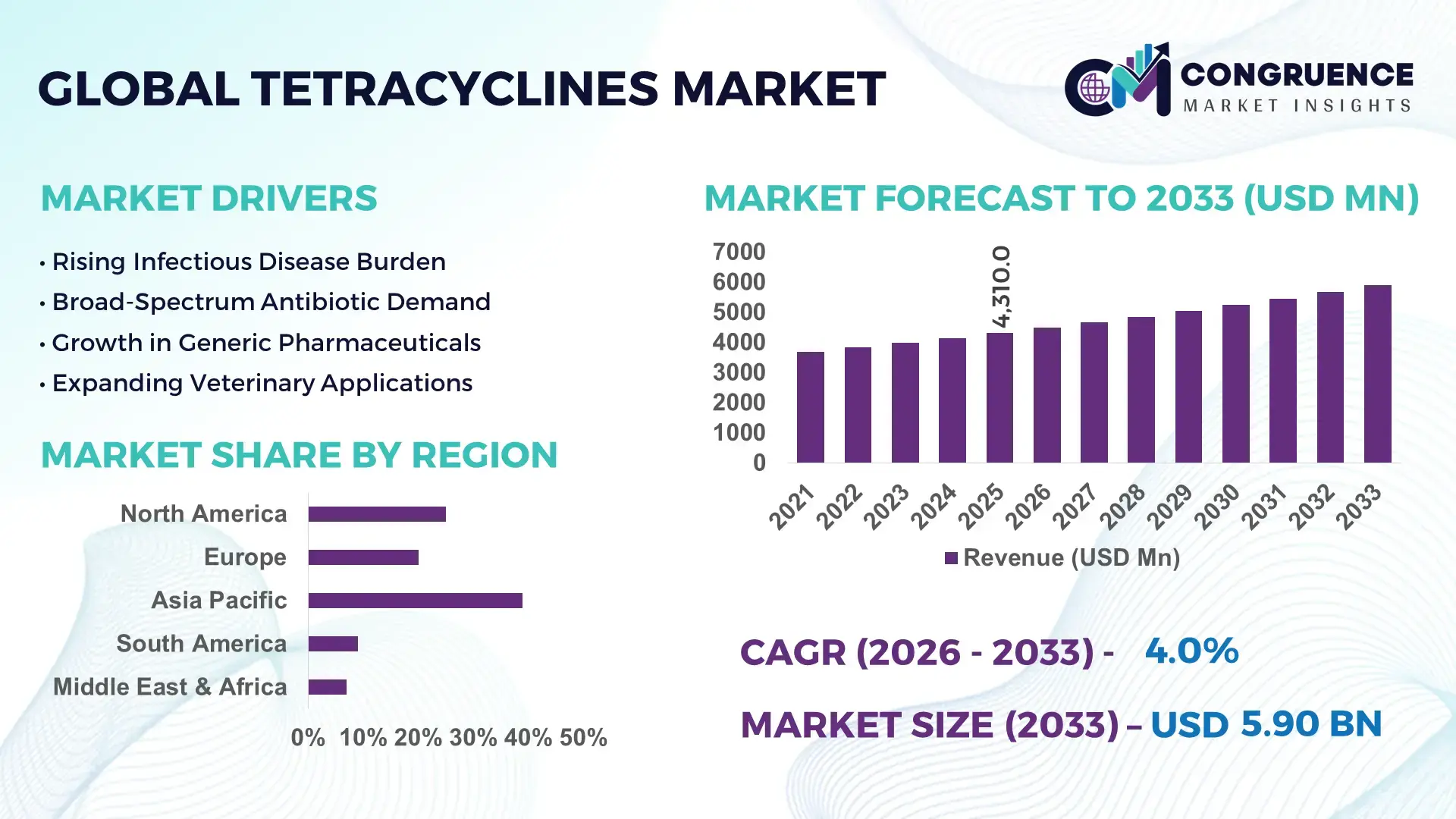
The Global Tetracyclines Market was valued at USD 4310 Million in 2025 and is anticipated to reach a value of USD 5898.53 Million by 2033 expanding at a CAGR of 4% between 2026 and 2033. Growth is largely driven by expanding veterinary and human therapeutic usage and rising antibiotic demand in emerging economies.
In China, the dominant producer, annual antibiotic output exceeds 180,000 metric tons with over USD 1.2 Billion in capacity investments recorded by leading bulk drug manufacturers. China’s mills have expanded fermentation and downstream processing lines by 22% between 2021 and 2025 to meet global supply needs. Advanced bioreactor technologies and continuous processing systems implemented in Shaanxi and Jiangsu provinces have reduced production cycle times by up to 18%, while China’s regulatory framework now supports accelerated approvals for fermentation-derived APIs used in major clinical applications such as acne management and livestock disease control.
Market Size & Growth: Valued at USD 4310 Million in 2025, projected to reach USD 5898.53 Million by 2033 at a 4% CAGR due to expanded therapeutic formulations and broader disease treatment protocols.
Top Growth Drivers: Increased adoption in veterinary therapeutics (28%), broader clinical indications (19%), enhanced production efficiencies (15%).
Short-Term Forecast: By 2028, manufacturing cost per kg expected to improve by 12% with optimized supply chains and bioprocess scaling.
Emerging Technologies: Innovations in continuous bioprocessing; enzyme engineering for high-yield fermentation; AI-enabled quality control systems.
Regional Leaders: North America at ~USD 1650 Million by 2033 with strong clinical pipeline demand; Europe at ~USD 1420 Million supported by agro-veterinary use; Asia-Pacific at ~USD 1980 Million driven by manufacturing expansion.
Consumer/End-User Trends: Rising use in livestock health programs and dermatologist-prescribed regimens; preference for extended-release formulations.
Pilot or Case Example: A 2025 pilot in Europe showed an 11% reduction in cycle time using advanced bioreactors for oxytetracycline production.
Competitive Landscape: Market leader with approximately 26% share, followed by key players with competitive portfolios in generic and branded antibiotics.
Regulatory & ESG Impact: Stricter antibiotic stewardship regulations and environmental effluent standards influencing process upgrades and waste management practices.
Investment & Funding Patterns: Over USD 450 Million in recent capital investments across CDMOs and API expansions, with increased venture funding for bioprocess innovation.
Innovation & Future Outlook: Focus on greener synthesis pathways, precision fermentation, and novel delivery forms for improved therapeutic index in human and animal health.
The Tetracyclines Market remains integral to human and veterinary antibiotic portfolios, with hospital, dermatology, and livestock health sectors contributing significantly to demand. Recent innovations include microencapsulated formulations that enhance bioavailability and next‑generation fermentation catalysts that improve yields. Regulatory frameworks emphasizing antibiotic stewardship and reduced environmental impact are shaping production strategies. Regional consumption patterns show robust uptake in Asia‑Pacific’s livestock sector, stable clinical use in North America, and growth in specialty indications across Europe. Emerging trends include integration of digital process controls and sustainability‑linked financing for infrastructure upgrades, positioning the market for steady expansion through 2033.
The strategic relevance of the Tetracyclines Market stems from its critical role in both human and veterinary healthcare, addressing a broad spectrum of bacterial infections and contributing to livestock health management in agriculture. As countries intensify efforts against infectious diseases and antimicrobial resistance, tetracycline‑based therapies remain integral to treatment protocols and preventive regimens, reinforcing healthcare system resilience. Nano‑encapsulated tetracyclines deliver 15% improvement in bioavailability compared to conventional oral tablets, underscoring the impact of next‑generation formulation technologies in enhancing patient compliance. North America dominates in volume, while Asia‑Pacific leads in adoption with 62% of enterprises leveraging cost‑effective generic formulations in densely populated markets. By 2028, sustained-release oral delivery systems are expected to cut dosing frequency by 20%, improving adherence outcomes and reducing overall treatment costs.
Strategic investments in manufacturing capacity, digital monitoring of usage patterns, and real‑time resistance tracking will shape future pathways. Firms are committing to ESG metric improvements such as 25% reduction in effluent antibiotic loads by 2030, aligning production practices with environmental safety standards. In 2025, China-based Zhejiang Pharmaceutical achieved 18% reduction in production cycle time through AI-enabled bioreactor optimization, demonstrating the potential of automation and data analytics in complex bio-manufacturing processes. Looking ahead, the Tetracyclines Market will remain a pillar of resilience, compliance, and sustainable growth as healthcare demand evolves and regulatory frameworks strengthen.
Rising global infectious disease prevalence significantly drives the Tetracyclines Market by expanding the demand for effective antibiotic treatments in both community and clinical settings. Bacterial infections such as respiratory tract infections, skin and soft tissue disorders, and urinary tract infections are increasing worldwide, emphasizing the need for reliable broad‑spectrum antibiotics. Healthcare providers often prescribe tetracyclines due to their wide applicability against various pathogens, especially in regions where access to newer antibiotics may be limited. Additionally, growing awareness of animal health and disease prevention in livestock farming boosts the veterinary segment, as tetracyclines are widely used to manage bacterial diseases in poultry, swine, and cattle. This driver is supported by strategic initiatives to improve antibiotic availability and maintain public health outcomes in response to persistent disease burdens.
Antimicrobial resistance (AMR) and stringent regulatory frameworks present notable restraints on the Tetracyclines Market. Rising resistance levels among common bacterial strains reduce the clinical effectiveness of conventional tetracyclines, prompting prescribers and policymakers to limit their use in favor of alternative therapeutics or targeted regimens. Regulatory authorities in numerous regions enforce tighter controls on antibiotic prescriptions and veterinary applications to curb misuse and limit resistance spread. These measures often translate into complex compliance protocols, documentation requirements, and usage restrictions for manufacturers and healthcare providers, increasing operational overheads. In some markets, surveillance and residue monitoring mandates add further compliance costs for producers, particularly in animal health exports. Such constraints necessitate increased investment in stewardship programs and adherence to evolving regulatory standards, which can constrain market volume growth.
Value‑added formulations and technological integration represent significant opportunities in the Tetracyclines Market. Innovations in controlled‑release tablets, extended‑release delivery systems, and combination therapies with targeted antimicrobial profiles enhance clinical efficacy and patient compliance, appealing to both human and veterinary healthcare practitioners. Digital health tools, such as AI‑enabled dosing calculators and resistance tracking platforms, offer new value propositions for antibiotic stewardship and optimized utilization. Additionally, emerging markets with large livestock populations and expanding healthcare access present opportunities for cost‑effective tetracycline solutions paired with education programs for proper usage. Investments in sustainable manufacturing technologies and environmentally friendly processes may attract corporate and public‑sector support, further expanding market reach. These opportunities enable stakeholders to differentiate offerings, enhance treatment outcomes, and align with modern healthcare delivery expectations.
Escalating compliance costs and environmental concerns pose significant challenges for the Tetracyclines Market. Manufacturers face increased regulatory scrutiny related to antibiotic residues, discharge standards, and waste management protocols, which require upgraded infrastructure and ongoing monitoring. Compliance with stringent labeling, residue testing, and withdrawal period regulations in veterinary sectors adds complexity and cost to production and distribution processes. Moreover, environmental and sustainability pressures demand investment in green chemistry practices and reduced effluent loads, straining budgets, particularly for small and mid‑sized producers. These challenges can delay product launches, compress margins, and necessitate strategic reallocation of resources toward compliance rather than expansion initiatives, hindering overall market agility in adapting to evolving industry expectations.
• Expansion of Advanced Fermentation Technologies: Advanced fermentation technologies are driving higher production efficiency in the Tetracyclines market. Facilities implementing continuous fermentation methods report up to 18% reduction in cycle times and a 12% increase in overall yield. Adoption is highest in Asia-Pacific, with over 65% of new production lines using automated bioreactors, while North America leads in real-time process monitoring integration at 48% of enterprises.
• Increasing Use in Veterinary Applications: Veterinary applications now account for nearly 42% of tetracycline utilization globally. Livestock producers are increasingly adopting long-acting formulations, reducing dosing frequency by 25% and improving herd compliance. Europe demonstrates the highest adoption rate, with 58% of large-scale farms implementing tetracycline-based preventive therapies, while Latin America shows the fastest growth in usage among small-to-medium operations.
• Adoption of Digital Quality Control Tools: Digital quality control and AI-based analytics are increasingly integrated into production lines, improving batch consistency by 15% and reducing defect rates by 10%. Asia-Pacific leads in implementation, with 52% of production facilities deploying AI-enabled monitoring, whereas North America emphasizes predictive maintenance, cutting downtime by 11% across major plants.
• Focus on Sustainability and Green Manufacturing: Environmental and sustainability initiatives are reshaping manufacturing practices. Approximately 37% of tetracycline production plants have adopted effluent recycling systems, achieving up to 28% reduction in wastewater discharge. Europe continues to lead, with 44% of manufacturers implementing green chemistry measures, while Asia-Pacific is catching up with a 32% increase in renewable energy integration for production processes.
The Tetracyclines Market demonstrates a well-defined segmentation structure across product types, applications, and end-user groups, reflecting its dual relevance in human healthcare and animal health management. Product differentiation is driven by molecular composition and duration of action, while application-based segmentation highlights varying therapeutic and preventive use cases. End-user insights reveal distinct consumption patterns between hospitals, livestock producers, pharmaceutical manufacturers, and outpatient care providers. Demand intensity differs by segment due to regulatory controls, prescribing behavior, and disease prevalence. Veterinary usage remains structurally significant, supported by large-scale livestock populations, while human therapeutic use emphasizes formulation quality and compliance. Together, these segmentation layers provide clarity on volume concentration, innovation momentum, and shifting adoption behaviors across healthcare and agricultural ecosystems.
The Tetracyclines Market by type includes tetracycline, doxycycline, minocycline, oxytetracycline, and other derivative formulations. Doxycycline currently leads the segment, accounting for approximately 38% of total usage, supported by its broad-spectrum efficacy, longer half-life, and reduced dosing frequency in both human and veterinary applications. Oxytetracycline follows with nearly 26% adoption, driven primarily by extensive use in livestock disease control and aquaculture. Minocycline represents around 14%, favored in dermatology and neurological infection treatments due to higher tissue penetration. The remaining formulations, including first-generation tetracycline variants and niche derivatives, collectively contribute 22%, serving regulated, price-sensitive, and specialized therapeutic markets.
Doxycycline is also the fastest-growing type, expanding at an estimated 4.8% CAGR, fueled by rising prescription volumes for respiratory infections, zoonotic diseases, and vector-borne illnesses.
Application-based segmentation of the Tetracyclines Market spans human therapeutics, veterinary medicine, aquaculture, and research and laboratory use. Veterinary medicine leads with approximately 44% share, supported by widespread use in poultry, swine, and cattle disease prevention programs. Human therapeutic applications account for around 36%, driven by use in dermatology, respiratory infections, and sexually transmitted infections. Aquaculture contributes close to 12%, while research and laboratory usage collectively represents 8%, supporting antimicrobial testing, formulation development, and resistance studies.
Human therapeutic applications represent the fastest-growing segment, advancing at an estimated 5.1% CAGR. Growth is supported by increased outpatient treatment volumes, standardized infection protocols, and greater reliance on oral broad-spectrum antibiotics. Sustained-release tetracycline formulations have improved patient compliance by approximately 20% in dermatological treatments.
End-user segmentation of the Tetracyclines Market includes hospitals and clinics, livestock and poultry farms, pharmaceutical manufacturers, and research institutions. Livestock and poultry farms dominate with approximately 41% share, reflecting routine therapeutic and preventive usage in intensive animal health management systems. Hospitals and clinics follow with around 34%, driven by outpatient and inpatient antibiotic prescriptions. Pharmaceutical manufacturers account for nearly 15%, utilizing tetracyclines for formulation, combination therapies, and contract manufacturing, while research institutions contribute the remaining 10% through antimicrobial development and resistance monitoring.
Hospitals and clinics represent the fastest-growing end-user group, expanding at an estimated 5.4% CAGR, supported by rising infection incidence, expanded outpatient care, and improved prescribing guidelines. Adoption of extended-release tetracycline formulations has increased by 23% in urban hospitals, reducing readmission rates associated with non-adherence.
Asia-Pacific accounted for the largest market share at 39% in 2025 however, Europe is expected to register the fastest growth, expanding at a CAGR of 4.6% between 2026 and 2033.

Asia-Pacific’s leadership is supported by high-volume antibiotic manufacturing hubs, with China and India jointly contributing over 60% of global tetracycline API output. North America follows with approximately 27% share, driven by stable prescription volumes and veterinary demand. Europe holds close to 23% share, supported by regulated clinical use and sustainability-led manufacturing upgrades. South America and the Middle East & Africa together account for the remaining 11%, with rising livestock healthcare needs and improving access to essential medicines. Regional disparities are evident in formulation preferences, regulatory stringency, and adoption of environmentally compliant production technologies, shaping differentiated growth pathways across global markets.
How is advanced healthcare infrastructure shaping antibiotic utilization patterns?
The North America Tetracyclines Market accounts for approximately 27% of global demand, supported by consistent prescription volumes across hospitals, outpatient clinics, and veterinary healthcare systems. Human therapeutics represent nearly 58% of regional consumption, while veterinary applications contribute around 42%, reflecting strong livestock health management practices. Regulatory oversight emphasizes antimicrobial stewardship, influencing controlled prescription behavior and increased monitoring of antibiotic usage. Technological advancements such as digital prescription systems and AI-enabled pharmacovigilance platforms are improving dosage accuracy and compliance tracking. Local pharmaceutical manufacturers are investing in extended-release formulations to reduce dosing frequency and improve adherence. Consumer behavior shows higher adoption in urban healthcare networks, with nearly 64% of tertiary hospitals preferring doxycycline-based regimens due to predictable efficacy and standardized treatment outcomes.
Why is regulatory alignment redefining antibiotic adoption across healthcare systems?
The Europe Tetracyclines Market represents roughly 23% of global usage, with Germany, France, and the United Kingdom collectively accounting for over 55% of regional demand. Veterinary applications remain significant at 46%, particularly in regulated livestock farming, while human therapeutic use contributes 54%. Sustainability initiatives and strict environmental compliance requirements are influencing manufacturing practices, including wastewater treatment and residue monitoring. Digital traceability systems are increasingly adopted to track antibiotic distribution and usage. Several European pharmaceutical firms are optimizing fermentation processes to reduce environmental impact while maintaining supply stability. Consumer behavior reflects heightened regulatory awareness, with healthcare providers prioritizing explainable prescribing decisions and documented compliance with antibiotic stewardship frameworks.
How are scale and manufacturing intensity reshaping global supply dynamics?
The Asia-Pacific Tetracyclines Market ranks first globally by volume, accounting for approximately 39% of total consumption. China, India, and Japan are the top consuming and producing countries, with China alone contributing over 45% of regional output. Large-scale fermentation infrastructure, cost-efficient production, and vertically integrated supply chains support high-volume availability. Manufacturing clusters in eastern China and western India have expanded API capacity by more than 20% over the past five years. Regional innovation hubs are increasingly deploying automated bioreactors and digital quality control tools. Consumer behavior reflects high adoption in veterinary and agricultural sectors, with over 60% of livestock farms relying on tetracycline-based treatments for disease management.
What role does agricultural expansion play in antibiotic demand patterns?
The South America Tetracyclines Market accounts for approximately 7% of global share, led by Brazil and Argentina, which together contribute nearly 70% of regional consumption. Veterinary use dominates with close to 62% share, driven by expanding poultry and cattle industries. Infrastructure improvements in pharmaceutical distribution and cold-chain logistics are improving access to essential antibiotics. Government policies supporting domestic pharmaceutical manufacturing and regional trade agreements are facilitating market stability. Local producers are expanding generic antibiotic portfolios to meet cost-sensitive demand. Consumer behavior shows strong linkage to agricultural cycles, with higher seasonal demand corresponding to livestock disease prevention programs.
How is healthcare access expansion influencing antibiotic utilization?
The Middle East & Africa Tetracyclines Market contributes around 4% of global demand, with growth concentrated in countries such as Saudi Arabia, UAE, South Africa, and Egypt. Human therapeutic applications account for nearly 57% of usage, while veterinary demand represents 43%, supported by developing livestock sectors. Healthcare infrastructure investments and expanding public health coverage are improving access to essential antibiotics. Technological modernization includes adoption of centralized procurement platforms and electronic inventory management systems. Local pharmaceutical players are focusing on import substitution and regional distribution partnerships. Consumer behavior varies widely, with urban centers showing higher prescription adherence compared to rural regions where accessibility remains a key factor.
China – 34% market share
Dominance driven by large-scale API production capacity, vertically integrated manufacturing, and strong export-oriented antibiotic supply chains.
United States – 21% market share
Leadership supported by high prescription volumes, advanced healthcare infrastructure, and sustained veterinary antibiotic demand across livestock and companion animal segments.
The competitive environment of the Tetracyclines Market is characterized by a moderately fragmented structure with a mix of large-scale API manufacturers, integrated pharmaceutical companies, and regional generic drug producers. More than 40 active manufacturers participate globally, with the top five companies collectively accounting for approximately 58% of total market supply, indicating moderate consolidation balanced by strong regional competition. Market positioning is largely influenced by production scale, fermentation efficiency, regulatory compliance capability, and access to veterinary and human healthcare distribution networks.
Strategic initiatives increasingly focus on capacity expansion, backward integration into raw materials, and partnerships with contract development and manufacturing organizations to ensure supply stability. Over the past three years, nearly 35% of leading players have upgraded fermentation facilities, achieving yield improvements of 10–18% and wastewater discharge reductions exceeding 20%. Product launches are concentrated around extended-release formulations and improved salt variants to enhance dosing efficiency and patient adherence. Mergers and acquisitions activity remains selective, accounting for fewer than 12% of competitive moves, with most players favoring organic growth and technology-driven optimization. Innovation trends shaping competition include AI-enabled bioprocess control, digital quality monitoring, and sustainability-linked manufacturing investments, all of which are becoming key differentiators in supplier selection by healthcare providers and veterinary buyers.
Pfizer Inc.
Teva Pharmaceutical Industries Ltd.
Sun Pharmaceutical Industries Ltd.
Cipla Limited
Zhejiang Pharmaceutical Co., Ltd.
Alvogen
Aurobindo Pharma Limited
Lupin Limited
North China Pharmaceutical Group
Sandoz International GmbH
Technological advancement is playing a central role in improving efficiency, compliance, and sustainability across the Tetracyclines Market. Modern fermentation technologies have significantly enhanced production performance, with continuous and fed-batch bioprocessing systems delivering yield improvements of 12–20% compared to conventional batch methods. Automated bioreactors equipped with real-time sensors now enable precise control over pH, oxygen, and nutrient levels, reducing batch variability by nearly 15% and minimizing product loss. These systems are increasingly deployed across large-scale manufacturing hubs in Asia-Pacific and Europe, where high-volume output and regulatory consistency are critical.
Digital transformation is reshaping quality assurance and operational oversight. AI-driven process analytics and machine learning models are being used to predict fermentation deviations and equipment failures, cutting unplanned downtime by approximately 10–14%. Advanced chromatography and membrane-based purification technologies have improved API purity levels beyond 99.5%, supporting stricter regulatory requirements in both human and veterinary applications. In formulation development, sustained-release and microencapsulation technologies are extending drug activity duration by up to 30%, reducing dosing frequency and improving treatment adherence.
Sustainability-focused technologies are also gaining momentum. Wastewater treatment innovations, including closed-loop effluent recycling and enzymatic degradation of antibiotic residues, have enabled reductions of 20–28% in antibiotic discharge loads. Energy-efficient drying and crystallization systems are lowering power consumption by nearly 18% per production cycle. Together, these technologies are strengthening supply reliability, enhancing regulatory compliance, and positioning the Tetracyclines Market for long-term operational resilience and responsible growth.
• In January 2024, Zhejiang Hisun Pharmaceutical announced the acquisition of a new tetracycline production facility in China, expanding production capacity and strengthening its global distribution networks for broad-spectrum antibiotic treatments.
• In 2024, Teyi Pharmaceutical launched an enteric-coated oxytetracycline tablet formulation, enhancing gastric tolerance and differentiation in a crowded antibiotic portfolio while supporting better treatment adherence across clinical and veterinary applications. (24lifesciences.com)
• In April 2025, Zydus Cadila entered a strategic partnership with Sandoz to co-develop and manufacture doxycycline APIs and finished dosage forms targeted at North American markets, enhancing supply reliability and formulation availability.
• In March 2025, Sun Pharmaceutical Industries announced a strategic collaboration with Lupin Pharmaceuticals to co-develop and co-manufacture tetracycline HCl API and generic formulations for select emerging markets, deepening joint capabilities in essential antibiotics.
The scope of the Tetracyclines Market Report encompasses a comprehensive assessment of the global landscape covering product types, applications, end-user industries, regional distribution, and enabling technologies shaping the market ecosystem. The report evaluates multiple tetracycline classes including doxycycline, oxytetracycline, minocycline, and legacy tetracycline variants, together representing over 95% of current commercial usage. Application coverage spans human therapeutics, veterinary medicine, aquaculture, and research applications, with veterinary and livestock-related use accounting for more than 40% of total global consumption.
Geographically, the report analyzes five major regions—Asia-Pacific, North America, Europe, South America, and the Middle East & Africa—covering more than 30 key countries. Asia-Pacific is assessed as the primary production and volume center, while North America and Europe are evaluated for their regulatory-driven usage patterns, formulation innovation, and stewardship-led demand. The report further examines consumption intensity across hospital networks, outpatient clinics, livestock farms, pharmaceutical manufacturers, and research institutions, capturing end-user adoption rates ranging from large-scale enterprise users to small and mid-sized operators.
Technological scope includes fermentation advancements, AI-enabled process control, digital quality monitoring, sustained-release formulations, and environmentally compliant manufacturing systems. Over 60% of large manufacturers are now assessed under digital transformation and sustainability readiness metrics. The report also addresses regulatory frameworks, antibiotic stewardship programs, environmental compliance requirements, and trade dynamics influencing supply continuity. Emerging segments such as long-acting veterinary formulations, aquaculture disease management solutions, and low-residue antibiotics are included to provide forward-looking strategic relevance.
| Report Attribute/Metric | Report Details |
|---|---|
|
Market Revenue in 2025 |
USD V2025 Million |
|
Market Revenue in 2033 |
USD V2033 Million |
|
CAGR (2026 - 2033) |
4% |
|
Base Year |
2025 |
|
Forecast Period |
2026 - 2033 |
|
Historic Period |
2021 - 2025 |
|
Segments Covered |
By Types
By Application
By End-User
|
|
Key Report Deliverable |
Revenue Forecast, Growth Trends, Market Dynamics, Segmental Overview, Regional and Country-wise Analysis, Competition Landscape |
|
Region Covered |
North America, Europe, Asia-Pacific, South America, Middle East, Africa |
|
Key Players Analyzed |
Pfizer Inc., Teva Pharmaceutical Industries Ltd., Sun Pharmaceutical Industries Ltd., Cipla Limited, Zhejiang Pharmaceutical Co., Ltd., Alvogen, Aurobindo Pharma Limited, Lupin Limited, North China Pharmaceutical Group, Sandoz International GmbH |
|
Customization & Pricing |
Available on Request (10% Customization is Free) |




