
Reports
The Global Test Management Software Market was valued at USD 484.6 Million in 2025 and is anticipated to reach a value of USD 958.54 Million by 2033 expanding at a CAGR of 8.9% between 2026 and 2033. Enterprise-wide DevOps integration, AI-driven defect prediction, and accelerated release cycles across BFSI, healthcare, and SaaS platforms are driving over 41% faster testing workflows and reducing manual QA dependency by nearly 35% in advanced software delivery environments.
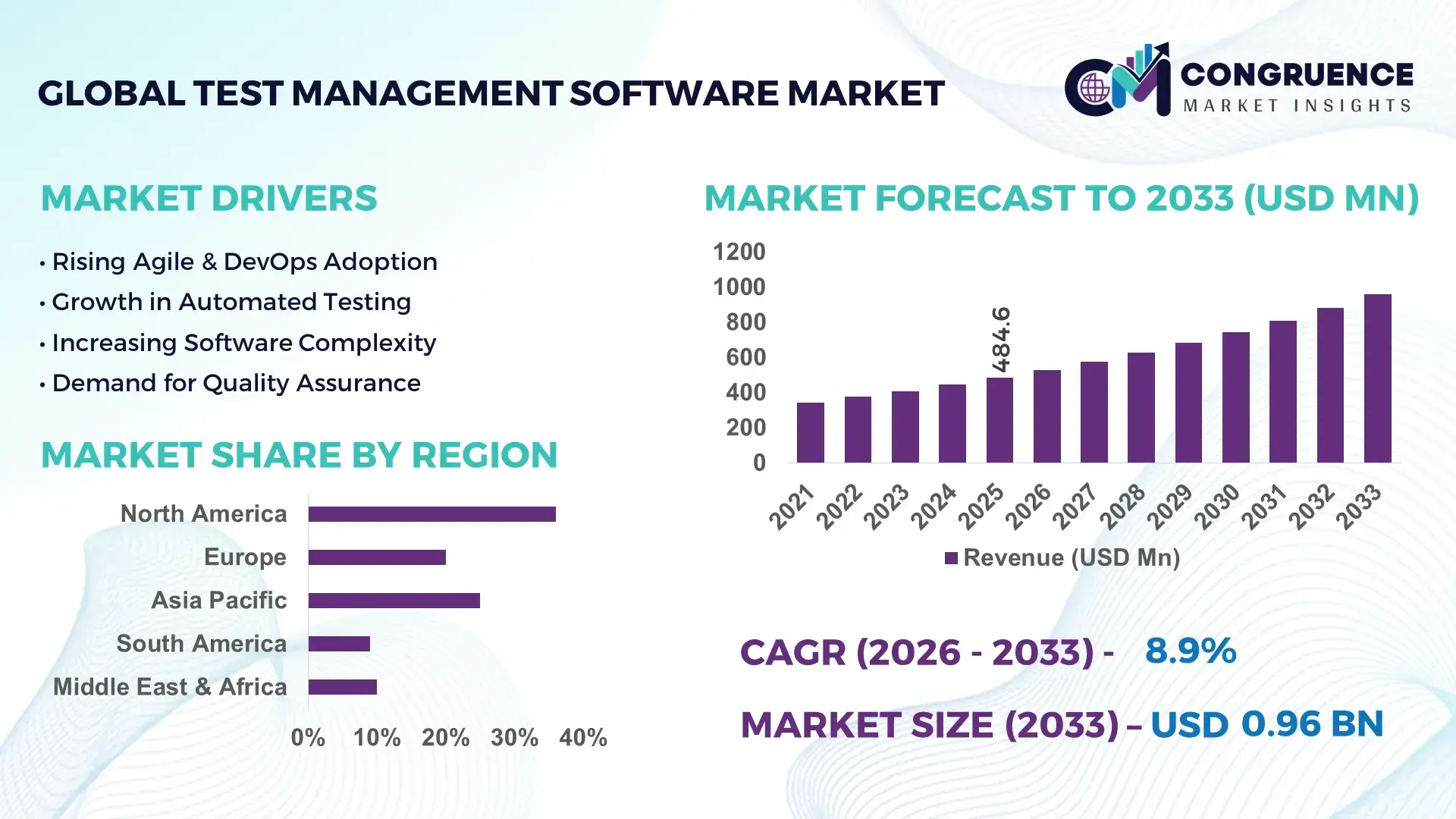
The United States dominates the global test management software market with approximately 36% share, supported by large-scale cloud modernization programs, federal cybersecurity mandates, and rising AI software deployment across regulated sectors. More than 68% of enterprise application teams in the country integrated centralized test orchestration platforms by early 2026, compared with below 45% adoption across several developing markets. Major investments from banking, defense, and healthcare technology firms continue to expand automated testing ecosystems, while software resiliency requirements intensified after multiple global ransomware incidents and stricter digital compliance enforcement. The country also leads in enterprise-grade API testing adoption, with automation penetration exceeding 61% across large SaaS development pipelines.
Organizations prioritizing scalable, AI-enabled test management platforms with integrated analytics and cross-cloud compatibility are positioned to improve release reliability, lower defect leakage, and strengthen long-term software governance strategies.
Market Size & Growth: Market reached USD 484.6 Million in 2025 and advances toward USD 958.54 Million by 2033, supported by AI-led quality engineering and enterprise DevOps acceleration.
Top Growth Drivers: Cloud-native application testing rose 44%, automated regression adoption increased 39%, and enterprise Agile deployment expanded 36% globally.
Short-Term Forecast: By 2027, intelligent test automation platforms are projected to reduce QA execution time by 32% and defect escape rates by 27%.
Emerging Technologies: AI-assisted bug triaging, low-code automation, and predictive analytics improved test efficiency by over 34% across large enterprise deployments.
Regional Leaders: North America exceeded USD 180 Million with high cybersecurity integration, Europe crossed USD 120 Million through compliance-driven adoption, while Asia-Pacific expanded rapidly through SaaS outsourcing demand.
Consumer/End-User Trends: Nearly 58% of software enterprises shifted toward centralized test lifecycle platforms to support hybrid cloud delivery and remote engineering teams.
Pilot/Case Example: In 2026, a global banking modernization project reduced production defects by 29% after deploying AI-enabled continuous testing infrastructure.
Competitive Landscape: Top vendors collectively controlled nearly 48% market share, with strong competition among enterprise-focused cloud testing platform providers.
Regulatory & ESG Impact: Digital compliance frameworks and secure software regulations increased audit-focused testing investments by 31% across financial and healthcare industries.
Investment & Funding: Global investments surpassed USD 1.2 Billion through strategic partnerships, AI testing startups, and cloud-based QA expansion initiatives.
Innovation & Future Outlook: Autonomous testing agents, self-healing scripts, and cross-platform observability tools are reshaping high-growth enterprise software quality strategies.
Banking, healthcare, and enterprise SaaS sectors collectively contribute over 57% of total demand as organizations intensify digital release management and compliance-focused testing operations. AI-powered test orchestration, self-healing automation scripts, and analytics-driven defect tracking are improving execution efficiency across distributed engineering environments. North America maintains strong enterprise deployment leadership, while Asia-Pacific records accelerated adoption through outsourced software development expansion and cloud migration initiatives. Increasing software supply chain security regulations are also reshaping procurement priorities, pushing vendors toward integrated governance-focused testing ecosystems. These structural shifts are setting the foundation for deeper strategic competition and platform consolidation across the advanced global test management software industry.
The test management software market has become strategically critical as enterprises accelerate cloud-native development, AI deployment, and cybersecurity compliance modernization across financial services, healthcare, and telecom infrastructure. Rising software complexity and shortened release cycles are forcing organizations to replace fragmented QA environments with centralized testing orchestration platforms. Regulatory shifts linked to digital resilience standards in the United States and Europe are also increasing demand for traceable, audit-ready testing frameworks, particularly after multiple high-profile software outage incidents disrupted banking and airline operations during 2025–2026.
AI-enabled test management systems now execute regression validation nearly 43% faster than legacy manual QA workflows while reducing duplicate defect reporting by approximately 31%. The United States leads enterprise-scale deployment through advanced DevSecOps integration, whereas India and Vietnam are emerging as high-volume implementation hubs due to software outsourcing expansion and lower operational costs. Over the next two years, more than 55% of large enterprise engineering teams are expected to integrate predictive testing analytics into release management pipelines to improve deployment consistency.
A leading European banking transformation program recently consolidated over 120 testing environments into a unified cloud-based platform, reducing release delays by 26% and improving compliance reporting accuracy. Software vendors are responding through AI-focused acquisitions, cloud partnerships, and platform interoperability investments to strengthen enterprise retention and operational scalability. Companies that prioritize intelligent testing ecosystems with integrated governance capabilities will secure stronger competitive positioning as software reliability becomes a core enterprise performance benchmark.
Enterprise migration toward AI-enabled DevOps environments is accelerating demand for advanced test management software across banking, telecom, and healthcare infrastructure. Nearly 64% of large software teams adopted continuous testing pipelines in 2026, while automated defect classification improved issue-resolution efficiency by 37%. The rapid expansion of cloud-native applications and stricter cybersecurity regulations in the United States are increasing pressure on enterprises to strengthen software traceability and release governance. This operational shift is reducing tolerance for disconnected QA systems and manual reporting structures. In response, software providers are expanding AI-assisted orchestration capabilities, investing in low-code testing automation, and forming strategic cloud partnerships to secure enterprise contracts. Companies integrating predictive analytics into testing operations are achieving faster deployment validation and lower production failure exposure.
Legacy enterprise infrastructure continues to restrict seamless deployment of modern test management software, particularly across manufacturing, government, and financial institutions operating fragmented application environments. Around 46% of enterprises still rely on partially manual QA workflows, while integration costs for hybrid testing ecosystems increased nearly 22% due to compatibility customization requirements. German industrial firms and Japanese financial institutions face operational delays because older ERP platforms often lack API-ready architectures needed for centralized testing automation. These limitations reduce deployment scalability, increase implementation timelines, and weaken cross-platform visibility. To reduce operational disruption, enterprises are prioritizing phased modernization strategies, localized integration partnerships, and container-based deployment models. Vendors focusing on interoperability layers and modular architecture are gaining strategic advantage in highly regulated enterprise environments.
Predictive analytics and autonomous QA execution are creating high-value opportunities across large-scale enterprise software ecosystems. AI-driven testing models are improving defect prediction accuracy by nearly 41%, while self-healing automation frameworks reduced script maintenance workloads by 33% during enterprise deployments in 2026. India’s expanding SaaS development sector and Singapore’s digital infrastructure initiatives are accelerating demand for scalable cloud-based testing governance platforms. Rising adoption of generative AI applications is also increasing the need for continuous validation tools capable of monitoring algorithm behavior and compliance consistency. In response, technology providers are increasing R&D spending on intelligent orchestration engines, AI-assisted root-cause analysis, and cross-cloud observability frameworks. Vendors delivering integrated analytics with governance automation are positioned to capture high-margin enterprise transformation contracts.
Managing secure testing operations across hybrid cloud, edge computing, and multi-vendor software environments remains a major execution challenge for the test management software market. More than 52% of enterprises reported increased vulnerability exposure linked to fragmented testing pipelines, while software compliance audit workloads expanded by 28% after stricter digital resilience regulations were introduced across Europe and North America. Large organizations handling sensitive financial or healthcare data face growing pressure to maintain encrypted testing environments without compromising deployment speed. Workforce shortages in advanced QA automation and cybersecurity engineering are also slowing implementation consistency. To sustain long-term competitiveness, companies are investing in zero-trust testing architecture, AI-driven compliance monitoring, and secure cloud-native testing frameworks. Vendors capable of balancing governance, scalability, and operational agility will strengthen enterprise retention in increasingly regulated software ecosystems.
AI-Led Test Orchestration Expansion Enterprise software teams increased AI-assisted test case generation adoption by 48% during 2026 as release cycles shortened across banking and SaaS environments. Intelligent automation reduced manual validation workloads by nearly 34% and improved defect prioritization speed by 29%. Following stricter cybersecurity compliance requirements in the United States and Europe, vendors are integrating predictive analytics and self-healing automation into centralized testing platforms through cloud partnerships and DevSecOps restructuring initiatives.
Cross-Platform Governance Integration Large enterprises are consolidating fragmented QA operations into unified governance frameworks capable of managing cloud, mobile, API, and web testing simultaneously. Nearly 57% of telecom and healthcare organizations migrated toward integrated test lifecycle environments to strengthen audit visibility and deployment consistency. This transition reduced duplicated testing tasks by 26% while improving compliance reporting accuracy. Companies are responding through platform interoperability investments and strategic acquisitions focused on multi-environment orchestration capabilities.
Low-Code Automation Adoption Shift Demand for low-code testing environments accelerated as global shortages of advanced QA engineers increased enterprise operational pressure. More than 42% of mid-sized software firms deployed low-code automation frameworks in 2026 to reduce onboarding complexity and improve release scalability. Indian outsourcing providers are restructuring delivery models around reusable automation libraries, enabling faster enterprise deployment while lowering regression execution costs by approximately 31%.
API-Centric Validation Priorities API testing has become operationally critical as enterprises expand microservices architecture and AI-powered application ecosystems. Nearly 61% of cloud-native software deployments now prioritize API validation before frontend release cycles, compared with below 40% three years earlier. Financial institutions and logistics providers are increasing investments in continuous integration pipelines and runtime monitoring tools to reduce transaction failures, strengthen interoperability, and improve deployment resilience across distributed digital infrastructure.
Cloud-Based Software remains the dominant segment in the test management software market, accounting for nearly 44% of enterprise deployments due to superior scalability, remote collaboration capability, and seamless DevOps integration. Large organizations increasingly prefer cloud-native testing ecosystems because they reduce infrastructure maintenance costs by approximately 28% while enabling centralized governance across distributed engineering teams. Hybrid Testing Platforms represent the fastest-growing segment as enterprises operating legacy and cloud environments seek flexible deployment architectures capable of balancing compliance control with operational scalability. Automated Testing Tools continue gaining strategic importance, with automation penetration surpassing 59% in advanced SaaS development pipelines during 2026. In contrast, On-Premise Software maintains relevance within defense, government, and regulated banking environments requiring localized data governance, while Manual Testing Tools are increasingly restricted to exploratory validation and niche workflow testing. Vendors are expanding AI-driven orchestration features, interoperability layers, and subscription-based deployment models to strengthen enterprise retention and multi-environment adoption.
Functional Testing continues to dominate the application landscape, representing nearly 38% of total testing operations due to its essential role in validating enterprise workflows, transaction stability, and software compliance before deployment. API Testing is emerging as the fastest-growing application segment as enterprises accelerate microservices adoption and AI-driven application integration across financial services and cloud-native software ecosystems. More than 61% of large SaaS providers expanded API validation investments during 2026 to improve interoperability and reduce integration failures. Regression Testing remains strategically critical within continuous delivery pipelines, where automated validation reduced release rollback incidents by approximately 27%. Performance Testing is gaining traction among telecom and streaming platform providers handling high-volume digital traffic, while Mobile Application Testing and Web Application Testing continue expanding alongside cross-device customer engagement growth. Companies are scaling unified testing frameworks, AI-assisted automation, and real-time analytics integration to improve deployment consistency and reduce software downtime.
IT and Telecom remains the leading end-user segment in the test management software market, contributing nearly 35% of enterprise demand due to high-volume software deployment cycles, complex network infrastructure, and continuous cloud service expansion. The Healthcare segment is emerging as the fastest-growing buyer group as hospitals, diagnostics platforms, and digital health providers increase investments in secure application validation and regulatory compliance testing. More than 54% of healthcare software projects integrated automated testing frameworks during 2026 to improve deployment reliability and patient data protection. BFSI organizations continue strengthening adoption through AI-enabled fraud detection system validation and cybersecurity-focused testing governance, while Retail enterprises prioritize omnichannel application performance and mobile commerce stability. Manufacturing firms are increasingly integrating test management platforms within industrial IoT environments, whereas Government Sector demand is rising through national cybersecurity modernization initiatives. Vendors are responding with sector-specific compliance modules, flexible pricing models, and strategic cloud partnerships tailored to enterprise operational requirements.
North America accounted for the largest market share at 36% in 2025 however, Asia-Pacific is expected to register the fastest growth, expanding at a CAGR of 10.8% between 2026 and 2033.
Enterprise DevSecOps Consolidation Accelerates Deployment Scale
North America maintains leadership in the test management software market through advanced cloud infrastructure, mature DevOps ecosystems, and high enterprise software modernization intensity. The region contributes approximately 36% of global deployment activity, supported by strong adoption across BFSI, telecom, healthcare, and SaaS industries. More than 67% of large enterprises in the United States integrated centralized test orchestration platforms during 2026 to strengthen release governance and cybersecurity compliance. Increasing regulatory scrutiny around software resiliency and digital infrastructure protection is accelerating investment in AI-enabled testing automation and predictive defect analytics. Technology vendors are expanding strategic cloud partnerships and interoperability capabilities to support multi-environment deployment consistency and enterprise-scale quality engineering operations.
United States Market Outlook: The United States remains the strategic center of enterprise software quality engineering due to large-scale cloud migration, advanced cybersecurity mandates, and strong AI integration across regulated industries. Nearly 61% of enterprise software teams adopted AI-assisted testing workflows in 2026, improving regression validation speed and operational visibility. Federal digital modernization initiatives and rising software supply-chain security requirements are pushing enterprises toward centralized testing governance models with integrated compliance tracking capabilities.
Compliance-Centric Modernization Reshapes Enterprise QA
Europe is strengthening its position through compliance-driven software modernization and increasing enterprise investment in secure digital infrastructure. The region accounts for nearly 28% of global adoption activity, with Germany, the United Kingdom, and France leading enterprise-grade testing deployments across manufacturing, banking, and healthcare systems. Stricter digital resilience regulations and data governance standards increased enterprise spending on traceable testing workflows by approximately 29% during 2026. Companies are accelerating migration toward AI-enabled quality engineering platforms capable of supporting multilingual, cross-border application environments. Strategic collaborations between cloud providers and enterprise software integrators are also improving deployment flexibility and operational scalability across regulated industries.
Germany Market Outlook: Germany continues leading regional industrial software validation through strong manufacturing digitization, automotive software integration, and Industry 4.0 infrastructure expansion. More than 52% of industrial software providers in the country increased investment in automated testing governance frameworks to support connected factory operations and cybersecurity compliance. Enterprise demand is particularly strong for hybrid deployment architectures capable of balancing cloud scalability with localized data-control requirements.
Large-Scale Outsourcing and Cloud Adoption Momentum
Asia-Pacific is emerging as the fastest-growing test management software market due to rapid cloud adoption, expanding software outsourcing operations, and aggressive digital infrastructure investments. The region represents approximately 24% of global deployment activity, with India, China, and Singapore driving enterprise testing modernization across telecom, fintech, and SaaS ecosystems. More than 58% of regional software development firms accelerated automation integration during 2026 to improve release scalability and reduce manual QA dependency. The growing shift toward AI-powered applications and mobile-first digital services is increasing demand for API validation, performance testing, and cross-platform orchestration capabilities. Vendors are expanding regional delivery centers, cloud alliances, and AI-enabled automation offerings to capture high-volume enterprise transformation projects.
India Market Outlook: India has become a strategic hub for scalable software testing operations due to its extensive IT services ecosystem, expanding SaaS sector, and large engineering workforce. Nearly 64% of enterprise outsourcing projects integrated automated testing platforms in 2026 to improve deployment consistency and reduce delivery timelines. Domestic cloud infrastructure expansion and rising demand for AI application validation are also strengthening investment in intelligent quality engineering platforms across banking and telecom environments.
Digital Banking Expansion Drives Enterprise Adoption
South America is witnessing steady enterprise adoption of test management software as digital banking, telecom modernization, and e-commerce expansion increase pressure on software deployment reliability. The region contributes nearly 7% of global market activity, with Brazil and Chile leading cloud-based testing infrastructure implementation. Around 43% of financial technology firms increased investment in automated regression and API testing frameworks during 2026 to improve transaction stability and mobile application performance. However, fragmented legacy infrastructure and uneven cloud integration continue limiting deployment scalability across certain sectors. Companies are responding through managed testing partnerships, localized cloud deployment strategies, and modular automation integration to improve operational efficiency and reduce implementation complexity.
Brazil Market Outlook: Brazil dominates regional demand through rapid fintech expansion, enterprise cloud migration, and strong digital payment ecosystem growth. More than 49% of banking software modernization projects integrated centralized testing governance platforms during 2026 to improve compliance monitoring and release validation speed. Increasing investment in secure mobile transaction infrastructure is also accelerating demand for performance testing and API-centric quality assurance environments.
Government-Led Digital Infrastructure Modernization Expands Demand
The Middle East & Africa market is expanding through government-backed digital transformation programs, smart city infrastructure development, and growing enterprise cybersecurity investment. The region accounts for nearly 5% of global deployment activity, with the United Arab Emirates and Saudi Arabia leading cloud-native testing infrastructure adoption across banking, telecom, and public-sector systems. More than 38% of enterprise modernization projects implemented automated testing governance frameworks during 2026 to improve software resiliency and operational transparency. Increasing deployment of AI-enabled public services and digital payment ecosystems is strengthening demand for centralized testing orchestration and compliance monitoring tools. Vendors are increasing regional partnerships, managed service capabilities, and cloud localization strategies to support large-scale infrastructure modernization initiatives.
United Arab Emirates Market Outlook: The United Arab Emirates is strengthening its regional leadership through smart government initiatives, enterprise cloud acceleration, and advanced cybersecurity modernization programs. Approximately 46% of large public-sector digital transformation projects deployed centralized testing automation frameworks in 2026 to improve service reliability and audit traceability. Rising investment in AI-driven citizen services and financial technology infrastructure is also increasing demand for scalable multi-environment testing ecosystems.
The test management software market is led by global platform providers competing against specialized automation vendors and cloud-native QA innovators. Major competition exists among Microsoft, Tricentis, SmartBear, Broadcom, and OpenText, while emerging SaaS-focused firms challenge established enterprise vendors through faster deployment and lower customization costs. The top five players collectively control nearly 48% of market activity, supported by strong enterprise integration ecosystems and long-term cloud partnerships. Competition increasingly centers on AI-enabled automation, interoperability, analytics depth, and deployment speed, with intelligent test orchestration reducing regression workloads by approximately 35% and improving release validation efficiency by 28%. Vendors are strengthening market position through acquisitions, DevOps alliances, regional delivery expansion, and industry-specific compliance capabilities. Consolidation pressure is rising as enterprises demand unified testing governance across cloud, API, and mobile environments. Success increasingly depends on scalable AI-driven automation, cross-platform integration strength, cybersecurity readiness, and enterprise-grade deployment flexibility.
Microsoft
Tricentis
SmartBear
OpenText
Broadcom
IBM
Atlassian
Perforce Software
Parasoft
Keysight Technologies
QMetry
Inflectra
PractiTest
TestRail
AI-driven test orchestration platforms are reshaping enterprise quality engineering by automating defect prediction, regression prioritization, and test case generation across cloud-native environments. More than 61% of large software enterprises integrated AI-assisted testing workflows during 2026, reducing manual validation workloads by nearly 34% and improving release cycle efficiency by 29%. Advanced API testing frameworks and predictive analytics engines are also improving deployment stability across banking, telecom, and SaaS ecosystems. Companies deploying centralized AI-enabled testing governance platforms are gaining stronger operational visibility and lower defect leakage across multi-cloud application environments.
Emerging technologies including low-code automation, self-healing test scripts, and agentic quality engineering are accelerating enterprise adoption. AI-powered test generation tools now create automated API test cases up to 80% faster than traditional scripting environments, while intelligent regression frameworks reduce maintenance effort by approximately 33%. Compared with legacy manual QA systems, modern autonomous testing platforms improve execution scalability by nearly 45% across distributed DevOps pipelines. Large enterprises in the United States and India are increasingly integrating these tools with continuous integration environments to strengthen deployment consistency and cybersecurity compliance.
Between 2026 and 2028, competitive advantage will increasingly favor vendors capable of combining AI governance, cloud interoperability, and real-time observability within unified testing ecosystems. Organizations accelerating intelligent automation adoption are expected to reduce software rollback incidents by over 25% while improving engineering throughput and operational resilience.
March 2026 – Tricentis launched its agentic quality engineering platform with AI Workspace integration, enabling autonomous testing orchestration and accelerating enterprise release validation workflows by nearly 30% across connected application ecosystems. Source: Tricentis
May 2025 – SmartBear acquired QMetry to strengthen enterprise-grade test management and codeless automation capabilities, supporting faster software delivery workflows and expanding scalable integrated QA ecosystem deployment efficiency. Source: SmartBear
May 2026 – Tricentis and SAP expanded AI-assisted enterprise continuous testing integration, enabling automated SAP test-case generation directly within enterprise workflows and reducing manual testing complexity across transformation projects. Source: DBTA
February 2026 – SmartBear advanced AI-ready API quality automation through Swagger ecosystem enhancements, improving API reuse by 30% and strengthening enterprise software governance across AI-driven application development environments.
The report provides comprehensive analysis of the global test management software market across deployment models, testing technologies, enterprise applications, and end-user industries between 2026 and 2033. It evaluates operational trends across Cloud-Based Software, On-Premise Software, Automated Testing Tools, Manual Testing Tools, and Hybrid Testing Platforms while assessing adoption dynamics in Functional Testing, API Testing, Regression Testing, Performance Testing, Mobile Application Testing, and Web Application Testing. The study covers deployment intensity across IT and Telecom, BFSI, Healthcare, Manufacturing, Retail, and Government sectors, with more than 60% of enterprise demand concentrated in digitally intensive industries.
The report also delivers region-wise assessment covering North America, Europe, Asia-Pacific, South America, and Middle East & Africa, highlighting enterprise modernization activity, cloud integration trends, AI-enabled automation adoption, and cybersecurity-driven testing governance expansion. Strategic insights include competitive positioning, deployment scalability, interoperability trends, investment priorities, and emerging quality engineering frameworks shaping enterprise software delivery ecosystems. The analysis supports expansion planning, partnership evaluation, infrastructure modernization, and long-term operational decision-making across evolving global software testing environments.
| Report Attribute/Metric | Report Details |
|---|---|
|
Market Revenue in 2025 |
USD 484.6 Million |
|
Market Revenue in 2033 |
USD 958.54 Million |
|
CAGR (2026 - 2033) |
8.9% |
|
Base Year |
2025 |
|
Forecast Period |
2026 - 2033 |
|
Historic Period |
2021 - 2025 |
|
Segments Covered |
By Type
By Application
By End-User
|
|
Key Report Deliverable |
Revenue Forecast, Growth Trends, Market Dynamics, Segmental Overview, Regional and Country-wise Analysis, Competition Landscape |
|
Region Covered |
North America, Europe, Asia-Pacific, South America, Middle East, Africa |
|
Key Players Analyzed |
Microsoft, Tricentis, SmartBear, OpenText, Broadcom, IBM, Atlassian, Perforce Software, Parasoft, Keysight Technologies, QMetry, Inflectra, PractiTest, TestRail |
|
Customization & Pricing |
Available on Request (10% Customization is Free) |




