
Reports
The Global Test and Measurement Equipment Market was valued at USD 13370.05 Million in 2025 and is anticipated to reach a value of USD 21961.71 Million by 2033 expanding at a CAGR of 6.4% between 2026 and 2033. Growth is being driven by accelerating 5G network validation, semiconductor node advancements below 5nm, EV power electronics testing requirements, and expanding aerospace qualification programs requiring high-precision measurement accuracy.
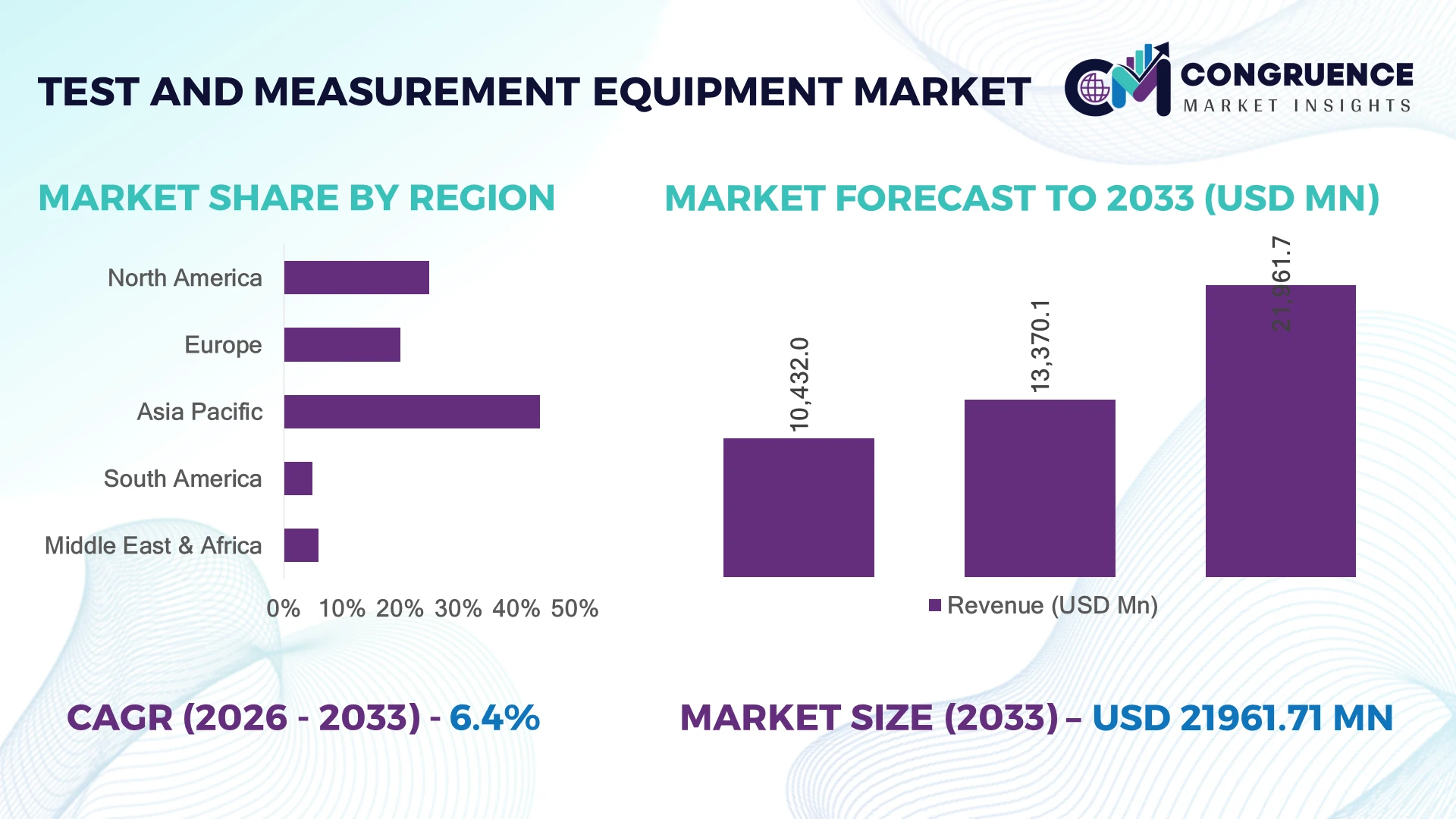
The United States remains the dominant country, accounting for approximately 31% of global demand, supported by semiconductor fabrication investments exceeding USD 50 billion and strong aerospace, defense, and telecommunications testing activity. In comparison, China holds nearly 24% market share, driven by domestic electronics manufacturing and industrial automation deployment, while advanced digital instrumentation adoption exceeds 65% among large manufacturing facilities. Ongoing technology competition and supply-chain localization initiatives continue to influence equipment procurement strategies across major economies.
Organizations prioritizing high-performance automated testing platforms and software-defined measurement architectures are positioned to secure faster product validation cycles, stronger quality control, and greater operational resilience.
Market Size & Growth: USD 13,370.05 million in 2025 rising to USD 21,961.71 million by 2033 at 6.4% CAGR, supported by expanding semiconductor and EV testing requirements.
Top Growth Drivers: 5G infrastructure testing (+18%), EV electronics validation (+22%), semiconductor manufacturing expansion (+16%).
Short-Term Forecast: By 2028, automated testing platforms improve inspection efficiency by 25% while reducing validation time by 18%.
Emerging Technologies: AI-assisted diagnostics, software-defined instrumentation, and cloud-connected testing systems increase productivity by 20–30%.
Regional Leaders: North America exceeds USD 7.0 billion, Asia-Pacific surpasses USD 8.5 billion, Europe reaches USD 4.5 billion; automation adoption continues accelerating across all regions.
Consumer/End-User Trends: Over 68% of electronics manufacturers are integrating automated measurement systems to improve throughput and consistency.
Pilot/Case Example: In 2026, advanced RF testing deployments reduced network validation cycles by 28% and improved defect detection rates by 19%.
Competitive Landscape: Leading vendors collectively control approximately 45% market share, with major competition centered on precision, automation, and software integration.
Regulatory & ESG Impact: Energy-efficient testing systems lower laboratory power consumption by nearly 15% while supporting compliance requirements.
Investment & Funding: More than USD 8 billion in manufacturing and testing infrastructure investments support regional expansion and supply-chain resilience.
Innovation & Future Outlook: Next-generation AI-enabled measurement platforms and digital twins reduce development iterations by up to 30%, strengthening competitive positioning.
The Test and Measurement Equipment Market is increasingly focused on high-frequency communications, electric vehicle systems, industrial automation, and advanced semiconductor production. Recent innovations include AI-powered analytics, cloud-based calibration management, and software-defined instrumentation platforms. More than 60% of large-scale manufacturers are expanding automated testing capabilities to improve product quality and throughput. As supply-chain localization and compliance requirements intensify, demand is shifting toward integrated, data-centric testing ecosystems, setting the foundation for broader strategic market developments.
Test and measurement equipment has become a strategic enabler of industrial competitiveness as manufacturers accelerate product complexity across semiconductors, electric vehicles, aerospace systems, and advanced communications networks. The market is increasingly linked to supply-chain restructuring and domestic manufacturing initiatives, particularly in the United States, China, and India, where localized production and quality assurance requirements are expanding. More than 70% of advanced electronics production lines now rely on automated testing workflows to reduce validation bottlenecks and improve production consistency.
Technology migration is reshaping operational economics. Modern software-defined and AI-assisted testing platforms deliver up to 30% faster measurement cycles and reduce calibration-related downtime by nearly 20% compared with conventional standalone instruments. The United States leads in high-end RF and semiconductor testing innovation, while China demonstrates larger deployment scale across electronics manufacturing facilities. A practical example is EV battery testing, where automated systems have reduced fault-detection times by approximately 25%, enabling faster product qualification and lower warranty exposure.
Over the next two to three years, adoption of connected test architectures is expected to exceed 60% among large industrial facilities. Companies are expanding partnerships with automation providers, increasing R&D spending, and integrating cloud-based analytics into testing ecosystems. Organizations that build scalable, data-driven validation capabilities will secure stronger operational efficiency, faster innovation cycles, and a more defensible competitive position.
The rapid expansion of semiconductor manufacturing, electric vehicle production, and next-generation communication networks is increasing demand for precision testing capabilities. More than 65% of advanced electronics manufacturers are investing in automated validation systems, while EV-related testing workloads have increased by over 20% across major production hubs. In the United States, semiconductor fabrication expansion programs are creating new requirements for high-frequency and ultra-precision measurement solutions. This demand shift improves product reliability, accelerates qualification cycles, and reduces production defects. In response, equipment suppliers are expanding calibration networks, investing in software-defined instrumentation, and forming partnerships with automation providers. A notable strategic insight is that testing capacity is increasingly becoming a manufacturing constraint, making validation infrastructure a critical differentiator rather than a support function.
Advanced test platforms require substantial investment in instrumentation, software integration, and calibration services, creating adoption barriers for mid-sized manufacturers. Precision electronic components and specialized semiconductors account for nearly 35% of system costs, while calibration and maintenance expenses can represent 10–15% of annual operating budgets. Supply-chain concentration in specific Asian manufacturing hubs continues to create procurement challenges and lead-time variability. These constraints directly affect deployment speed, profitability, and production planning. Companies are mitigating risks through supplier diversification, localized sourcing strategies, and long-term procurement contracts. A key operational insight is that lifecycle ownership costs increasingly influence purchasing decisions more than initial equipment pricing, particularly for high-volume manufacturing environments.
The convergence of artificial intelligence, industrial automation, and connected manufacturing environments is creating new value pools for test and measurement providers. AI-enabled diagnostic systems can improve anomaly detection accuracy by approximately 25%, while automated testing workflows reduce inspection times by nearly 30%. India and Vietnam are emerging as attractive deployment markets as electronics manufacturing investments accelerate and factory automation adoption rises. The shift toward digital factories is encouraging companies to develop cloud-connected measurement ecosystems and predictive maintenance capabilities. Equipment vendors are increasing R&D investment, building software partnerships, and expanding analytics offerings. A less obvious opportunity lies in converting testing data into operational intelligence, allowing manufacturers to optimize yield, reduce waste, and improve asset utilization beyond traditional quality-control functions.
As testing environments become more software-centric and interconnected, integration complexity is emerging as a major execution challenge. More than 40% of industrial facilities report difficulties integrating legacy instruments with modern automation platforms, while specialized engineering talent shortages exceed 20% in several advanced manufacturing markets. Increasing cybersecurity requirements for connected testing environments add further implementation pressure, particularly in semiconductor and defense applications. These challenges affect deployment consistency, scalability, and long-term technology utilization. Companies must strengthen workforce development programs, invest in interoperability frameworks, and collaborate with software and automation partners to simplify deployment. A critical strategic insight is that organizations unable to integrate measurement data seamlessly into production systems risk losing operational visibility and competitive responsiveness despite significant equipment investments.
AI-Powered Test Automation Expansion: Electronics manufacturers are increasing deployment of AI-assisted testing platforms, with automated fault detection accuracy improving by nearly 25% and testing throughput rising 20%. Labor shortages in advanced manufacturing and pressure to shorten validation cycles are accelerating adoption. Companies are integrating machine learning algorithms into oscilloscopes and analyzers while expanding software partnerships to reduce manual intervention and improve production consistency across high-volume facilities.
Software-Defined Instrumentation Adoption: More than 55% of large testing environments are transitioning toward software-defined architectures, reducing hardware dependency and lowering upgrade costs by approximately 15%. Technology transitions in semiconductor and telecommunications industries require faster protocol adaptation than traditional systems can support. Vendors are restructuring product portfolios around modular platforms, enabling enterprises to scale testing capabilities without frequent equipment replacement while improving utilization rates.
High-Frequency Network Validation Growth: Deployment of advanced wireless infrastructure has increased demand for RF and microwave testing, with utilization of high-frequency measurement solutions rising over 18%. Network complexity and spectrum efficiency requirements are driving continuous validation across telecom operations. Equipment providers are expanding calibration services, developing higher-bandwidth analyzers, and strengthening ecosystem partnerships to support increasingly complex communications environments and reduce deployment delays.
Connected Calibration Ecosystems Emergence: Cloud-connected calibration and asset-management systems are becoming standard across enterprise laboratories, improving equipment availability by nearly 22% and reducing unplanned downtime by 15%. Regulatory traceability requirements and distributed manufacturing operations are encouraging centralized measurement management. Companies are investing in digital calibration workflows and remote diagnostics, creating a less obvious advantage through lifecycle optimization rather than solely focusing on measurement performance.
Oscilloscopes remain the leading segment due to their broad applicability across electronics validation, semiconductor characterization, embedded system development, and communication testing. Their ability to capture complex signal behavior in real time makes them indispensable for high-speed design verification and production diagnostics. Approximately 32% of equipment deployments involve oscilloscopes, supported by integration with automated testing platforms and advanced analytics software. Companies continue expanding bandwidth capabilities and AI-assisted waveform analysis to strengthen product differentiation and improve engineering productivity.
Network analyzers represent the fastest-growing segment as demand increases for RF infrastructure, high-frequency communications, and advanced semiconductor packaging validation. Adoption rates for network analyzers have increased by nearly 18% across telecommunications and aerospace projects. Spectrum analyzers remain strategically important for wireless performance testing, while signal generators support design validation and protocol simulation. Multimeters continue to hold a strong position in maintenance and industrial diagnostics due to cost efficiency and deployment simplicity. Manufacturers are prioritizing modular architectures, software integration, and collaborative development partnerships to address evolving enterprise testing requirements and shifting investment priorities.
Electronics Testing remains the dominant application segment, supported by rising complexity in semiconductors, consumer electronics, industrial electronics, and embedded systems. Nearly 35% of testing workloads originate from electronics-focused environments where precision validation and defect detection are operational priorities. Manufacturers are expanding automated testing lines and integrating AI-based analytics to improve throughput by approximately 20%. The segment benefits from continuous product launches and shorter design cycles, making advanced measurement infrastructure essential for maintaining quality and speed.
Automotive Testing is emerging as the fastest-growing application due to expanding electric vehicle production, battery management systems, and advanced driver-assistance technologies. Testing requirements within automotive environments have increased by more than 22% as vehicle electronics content continues to expand. Telecommunications Testing remains critical for wireless infrastructure deployment, while Aerospace Testing focuses on reliability and compliance validation. Industrial Automation and Research & Development applications are increasingly adopting connected measurement ecosystems to improve operational visibility. Companies are scaling deployment networks, enhancing software integration capabilities, and investing in specialized testing solutions aligned with sector-specific requirements.
Electronics Manufacturing represents the largest end-user segment due to extensive deployment across semiconductor fabrication, printed circuit board production, and electronic assembly operations. Around 38% of equipment procurement activity originates from electronics manufacturing facilities where quality control, process validation, and production optimization depend heavily on precision measurement systems. Companies serving this segment are expanding software functionality, introducing subscription-based analytics, and offering customized testing ecosystems to improve long-term customer retention and operational efficiency.
Automotive is the fastest-growing end-user category as vehicle electrification and software-defined vehicle architectures increase testing intensity across development and production environments. Testing demand from automotive manufacturers has expanded by nearly 20% over recent years. Telecommunications continues investing in network validation infrastructure, while Aerospace & Defense prioritizes reliability and mission-critical performance verification. Industrial Manufacturing increasingly adopts connected diagnostics for predictive maintenance applications, and Research Institutions remain influential adopters of advanced measurement technologies. Vendors are responding through targeted partnerships, sector-specific product customization, and integrated service models designed to strengthen competitive positioning in high-value customer segments.
Asia-Pacific accounted for the largest market share at 41% in 2025 however, Asia-Pacific is expected to register the fastest growth, expanding at a CAGR of 7.1% between 2026 and 2033.
Semiconductor and Defense Testing Leadership
North America maintains a strong position in high-performance test and measurement equipment through advanced semiconductor manufacturing, aerospace programs, telecommunications infrastructure, and defense modernization. The region accounts for approximately 28% of global demand, supported by extensive deployment of RF testing systems, automated validation platforms, and precision calibration networks. Investments in domestic semiconductor fabrication continue to increase demand for high-bandwidth oscilloscopes and network analyzers. More than 65% of large electronics facilities have integrated automated testing environments to improve production consistency and reduce validation cycles. Equipment vendors are strengthening software capabilities and expanding service networks to support increasingly complex manufacturing ecosystems.
United States Market Outlook: The United States remains the region’s strategic center due to its concentration of semiconductor fabrication facilities, defense contractors, telecommunications operators, and advanced research institutions. Expansion of domestic chip manufacturing and next-generation communications infrastructure is increasing demand for precision measurement systems. More than 70% of advanced electronics development programs utilize automated testing workflows, while enterprises continue investing in software-defined instrumentation and AI-assisted diagnostics to accelerate qualification processes and improve operational efficiency.
Industrial Modernization and Compliance-Driven Deployment
Europe benefits from strong demand across automotive engineering, industrial automation, aerospace manufacturing, and advanced telecommunications infrastructure. The region represents approximately 24% of global market activity, supported by extensive adoption of precision testing technologies for regulatory compliance, product reliability, and energy-efficiency requirements. Manufacturers are increasingly deploying connected measurement platforms to improve traceability and production control. Industrial modernization initiatives have contributed to a nearly 18% increase in automated testing integration across advanced manufacturing facilities. Companies are prioritizing digital calibration systems and high-accuracy instrumentation to strengthen operational resilience and quality assurance performance.
Germany Market Outlook: Germany serves as the region’s primary testing and measurement hub due to its leadership in industrial automation, automotive engineering, and precision manufacturing. The country maintains extensive deployment of measurement technologies across electric vehicle production, factory automation, and advanced electronics development. Approximately 40% of large industrial facilities have expanded smart manufacturing capabilities, increasing demand for integrated testing systems that support real-time monitoring, predictive diagnostics, and process optimization.
Manufacturing Scale and Electronics Production Dominance
Asia-Pacific leads the global market through its concentration of semiconductor fabrication, consumer electronics production, telecommunications infrastructure deployment, and industrial manufacturing activity. The region contributes approximately 41% of global demand and hosts a significant share of electronics production capacity. Advanced testing system deployment has increased by more than 20% across major manufacturing hubs as companies pursue higher quality standards and faster product development cycles. Continuous investment in automation, 5G infrastructure, and semiconductor expansion is strengthening demand for oscilloscopes, spectrum analyzers, and network testing platforms. Equipment suppliers are expanding local partnerships and service capabilities to support growing deployment requirements.
China Market Outlook: China remains the largest national market within Asia-Pacific due to its extensive electronics manufacturing ecosystem, telecommunications infrastructure, and industrial modernization programs. The country continues expanding semiconductor production and advanced manufacturing capabilities, creating substantial demand for automated validation systems. More than 60% of large-scale electronics facilities have adopted advanced digital testing environments, while enterprises are increasing investment in precision measurement technologies to improve product quality, production efficiency, and export competitiveness.
Industrial Upgrades Supporting Equipment Adoption
South America is experiencing steady demand growth driven by telecommunications expansion, industrial automation projects, energy infrastructure upgrades, and electronics assembly activities. The region accounts for approximately 4% of global market participation, with adoption concentrated in major industrial economies. Investments in manufacturing modernization and digital infrastructure are encouraging wider deployment of automated testing solutions. Industrial facilities implementing connected monitoring technologies have reported productivity improvements exceeding 12%. While infrastructure limitations and import dependency remain challenges, companies are increasing local technical support capabilities and strengthening distribution networks to improve equipment accessibility and deployment efficiency.
Brazil Market Outlook: Brazil represents the region’s most significant market due to its industrial manufacturing base, telecommunications investments, and growing automation initiatives. Demand is expanding across electronics assembly, energy infrastructure, and automotive production environments. Large enterprises are increasing deployment of automated testing systems to improve operational reliability and product consistency. The country has also strengthened industrial digitization efforts, supporting wider adoption of measurement technologies used in quality assurance and predictive maintenance applications.
Infrastructure Investment and Digital Transformation Momentum
The Middle East & Africa market is being shaped by large-scale infrastructure development, telecommunications modernization, industrial diversification initiatives, and energy-sector technology upgrades. The region contributes approximately 3% of global demand, with deployment concentrated around major industrial and infrastructure projects. Telecommunications operators and industrial enterprises are expanding testing capabilities to support network quality and operational reliability. Recent digital infrastructure programs have increased advanced testing equipment deployment by nearly 15% across selected high-investment markets. Vendors are focusing on partnerships, technical training, and localized service models to improve market penetration and long-term customer engagement.
Saudi Arabia Market Outlook: Saudi Arabia leads regional demand through industrial diversification programs, smart infrastructure investments, and advanced telecommunications deployment. The country is increasing adoption of measurement technologies across energy, manufacturing, and digital infrastructure projects. More than 50% of large-scale industrial modernization initiatives now incorporate advanced testing and validation systems. Continued investment in automation, network expansion, and industrial technology ecosystems is strengthening demand for high-precision instrumentation and integrated testing solutions.
The market is led by Keysight Technologies, Rohde & Schwarz, Anritsu Corporation, Teledyne Technologies, Fortive, and National Instruments, competing across precision instrumentation, software integration, and automated testing ecosystems. Global leaders compete against specialized regional suppliers that focus on cost-efficient solutions and localized service capabilities. The top five players collectively account for approximately 48% of market activity, reflecting moderate concentration with strong technology differentiation. Competition increasingly centers on measurement accuracy, automation performance, and software-enabled workflows, with AI-assisted platforms improving testing productivity by 20–30% and reducing validation times by nearly 25%. Companies are expanding calibration networks, forming automation partnerships, investing in cloud-connected diagnostics, and integrating hardware with analytics platforms. A major competitive shift involves migration toward software-defined instrumentation and connected testing architectures. High R&D requirements, certification demands, and enterprise integration complexity create substantial entry barriers. Winning requires superior measurement performance, scalable automation, rapid innovation cycles, and strong lifecycle service capabilities.
Keysight Technologies
Rohde & Schwarz
Anritsu Corporation
Teledyne Technologies
National Instruments
Fortive Corporation
Yokogawa Electric Corporation
Advantest Corporation
Viavi Solutions Inc.
EXFO Inc.
Chroma ATE Inc.
GW Instek
Hioki E.E. Corporation
B&K Precision Corporation
The current technology landscape is dominated by software-defined instrumentation, AI-assisted analytics, and automated validation platforms. More than 65% of advanced electronics manufacturers now deploy automated testing environments to reduce manual intervention and improve measurement consistency. AI-enabled diagnostic systems improve anomaly detection accuracy by approximately 25%, while automated workflows reduce validation time by nearly 20%. Integration between oscilloscopes, spectrum analyzers, and cloud-based analytics platforms is enabling faster root-cause identification and more efficient product qualification across semiconductor, telecommunications, and industrial automation environments.
Emerging technologies are centered on high-frequency measurement, digital twins, and cloud-connected calibration ecosystems. Adoption of software-defined architectures has surpassed 55% among large enterprise laboratories due to their flexibility and lower lifecycle costs. Compared with traditional hardware-centric systems, modern software-defined platforms deliver up to 30% faster protocol updates and reduce upgrade-related costs by nearly 15%. Enterprises are increasingly integrating AI models with RF testing and network validation processes to improve performance visibility and accelerate deployment of next-generation communications infrastructure.
Between 2026 and 2028, disruptive innovation will focus on photonic testing, AI-driven autonomous validation, and digital engineering environments. Companies serving semiconductor, data center, and advanced wireless markets will benefit most as demand shifts toward ultra-high-speed validation. Organizations investing now in connected, intelligent testing ecosystems can secure faster development cycles, stronger compliance readiness, and sustainable competitive differentiation.
February 2026 – Keysight Technologies launched the Infiniium XR8 real-time oscilloscopes featuring a new ADC and DSP architecture that accelerates acquisition, analysis, and reporting by up to 3x. The innovation shortens digital validation cycles and improves laboratory throughput for high-speed electronics development.
March 2026 – Keysight Technologies introduced the N4378A Lightwave Component Analyzer with fully calibrated measurements up to 220 GHz for next-generation optical transceiver validation. The platform strengthens testing capabilities for AI-driven data centers and high-speed optical interconnect development. Source: keysight.com
January 2026 – Keysight Technologies released its Wireless Coexistence Test Solution, automating wireless performance validation and reducing manual testing effort through repeatable compliance workflows. The solution helps organizations identify interference risks earlier and improve regulatory readiness across connected-device ecosystems. Source: nasdaq.com
November 2025 – Rohde & Schwarz and Nokia demonstrated an AI-powered 6G receiver test platform that improved uplink distance by 10–25% during real-world validation. The collaboration supports more cost-efficient future 6G deployment strategies and faster commercialization of advanced wireless technologies. Source: reddit reference to Nokia announcement
This report provides comprehensive analysis of the Test and Measurement Equipment Market across key product categories including oscilloscopes, signal generators, spectrum analyzers, multimeters, and network analyzers. It evaluates demand patterns across electronics testing, telecommunications testing, automotive testing, aerospace testing, industrial automation, and research & development environments. The study further assesses adoption trends among electronics manufacturing companies, telecommunications operators, automotive manufacturers, aerospace and defense organizations, industrial enterprises, and research institutions. More than 60% of advanced manufacturing facilities are expanding automated testing capabilities, making technology integration a critical assessment area.
The report covers North America, Europe, Asia-Pacific, South America, and the Middle East & Africa, highlighting deployment concentration, industrial activity, and technology adoption dynamics. It examines software-defined instrumentation, AI-enabled analytics, cloud-connected calibration systems, high-frequency testing platforms, and emerging digital validation ecosystems. Strategic insights support investment prioritization, competitive benchmarking, market-entry planning, partnership evaluation, and expansion decisions between 2026 and 2033, while identifying high-growth application clusters and evolving enterprise procurement priorities.
| Report Attribute/Metric | Report Details |
|---|---|
Market Revenue in 2025 | USD 13370.05 Million |
Market Revenue in 2033 | USD 21961.71 Million |
CAGR (2026 - 2033) | 6.4% |
Base Year | 2025 |
Forecast Period | 2026 - 2033 |
Historic Period | 2021 - 2025 |
Segments Covered | By Type
By Application
By End-User
|
Key Report Deliverable | Revenue Forecast, Growth Trends, Market Dynamics, Segmental Overview, Regional and Country-wise Analysis, Competition Landscape |
Region Covered | North America, Europe, Asia-Pacific, South America, Middle East, Africa |
Key Players Analyzed | Keysight Technologies, Rohde & Schwarz, Anritsu Corporation, Teledyne Technologies, National Instruments, Fortive Corporation, Yokogawa Electric Corporation, Advantest Corporation, Viavi Solutions Inc., EXFO Inc., Chroma ATE Inc., GW Instek, Hioki E.E. Corporation, B&K Precision Corporation |
Customization & Pricing | Available on Request (10% Customization is Free) |




