
Reports
The Global Terminal Tractor Market was valued at USD 1329 Million in 2025 and is anticipated to reach a value of USD 2166.6 Million by 2033 expanding at a CAGR of 6.3% between 2026 and 2033. Rising deployment of electric terminal tractors, automated yard operations, expanding container ports, and modernization of intermodal freight infrastructure are accelerating procurement across logistics, shipping, and warehouse operators.
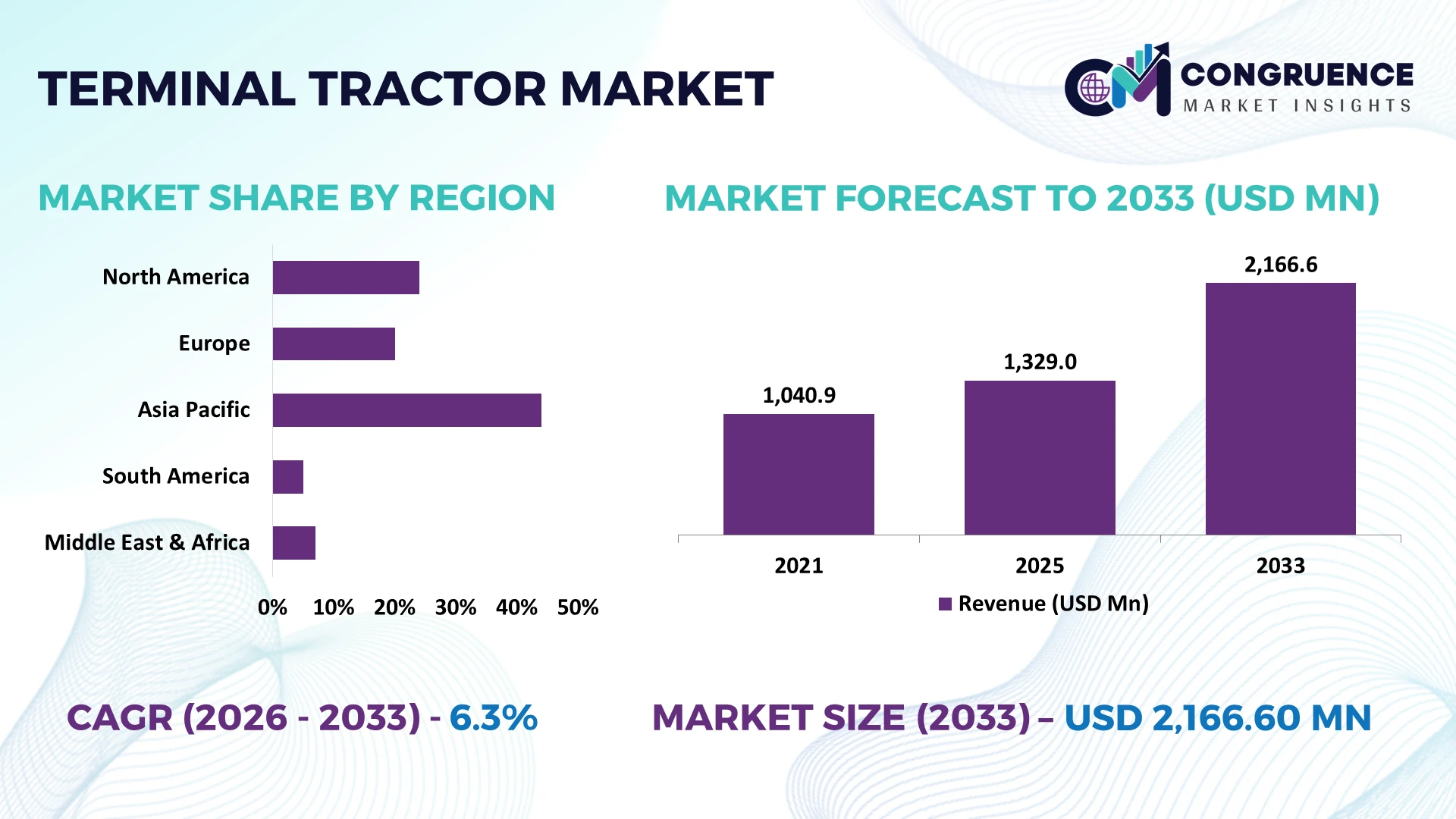
China dominates the global terminal tractor market with approximately 31% of annual demand, backed by large-scale port infrastructure, strong domestic manufacturing, and accelerating fleet electrification across major logistics hubs. The United States accounts for nearly 21% of demand through high-volume intermodal rail terminals and distribution centers. Following continued supply-chain adjustments after Red Sea shipping disruptions, more than 15% of new terminal tractor deployments at leading Chinese ports are electric, compared with below 10% across many mature Western terminals.
Manufacturers investing in electrified platforms, smart fleet management, and high-capacity port ecosystems are positioned to secure stronger long-term commercial contracts.
Market Size & Growth: USD 1329 Million in 2025 is projected to reach USD 2166.6 Million by 2033 at a CAGR of 6.3%, driven by fleet electrification, automated logistics, and expanding port infrastructure.
Top Growth Drivers: Port automation improves yard productivity by around 18%, electric terminal tractors reduce operating costs by nearly 25%, and intermodal freight activity is increasing by approximately 7% across major trade corridors.
Short-Term Forecast: By 2028, intelligent fleet management systems are expected to reduce idle time by 15% while increasing trailer handling efficiency by 12%.
Emerging Technologies: AI-based fleet dispatching, autonomous driving assistance, and lithium-ion battery platforms improve operational productivity by 10%–20% across advanced terminal operations.
Regional Leaders: Asia Pacific is projected to reach nearly USD 920 Million, North America around USD 610 Million, and Europe approximately USD 420 Million, supported by rapid smart-port and electric fleet adoption.
Consumer/End-User Trends: More than 40% of major logistics operators are prioritizing zero-emission terminal equipment to improve sustainability and reduce lifetime operating costs.
Pilot/Case Example: A 2025 electric terminal tractor deployment at a large logistics hub reduced energy costs by over 30% while lowering maintenance expenses by nearly 20%.
Competitive Landscape: Kalmar leads with an estimated 16% global market share, followed by Terberg, Capacity Trucks, Orange EV, and MAFI with strong positions across ports and distribution terminals.
Regulatory & ESG Impact: Zero-emission equipment initiatives and stricter emissions standards are reducing fleet carbon emissions by 20%–35% at early-adopting logistics facilities.
Investment & Funding: More than USD 1 Billion has been committed to port electrification, charging infrastructure, and fleet modernization, supported by strategic partnerships and regional expansion projects.
Innovation & Future Outlook: Next-generation autonomous terminal tractors, connected telematics, and high-density battery systems are strengthening operational efficiency while shifting competition toward integrated smart-yard solutions.
Terminal tractors are becoming increasingly important across container ports, intermodal rail terminals, e-commerce distribution hubs, and industrial logistics parks where faster trailer movement directly improves asset utilization. Advanced electric powertrains, AI-enabled fleet management, and predictive maintenance platforms have increased connected fleet adoption beyond 35% among large operators. As emissions regulations tighten and global supply chains continue shifting toward resilient regional logistics networks, technology-led fleet modernization is becoming a central competitive strategy across the Terminal Tractor Market.
The Terminal Tractor Market is becoming strategically important as ports, intermodal rail terminals, and large distribution hubs prioritize equipment modernization to improve asset utilization and reduce turnaround times. Ongoing supply-chain restructuring and stricter emissions regulations are shifting procurement toward connected, electric, and digitally managed terminal fleets. Fleet operators increasingly evaluate equipment based on lifecycle productivity rather than acquisition cost, strengthening demand for intelligent yard logistics solutions that improve operational resilience.
Electric terminal tractors equipped with telematics deliver approximately 22% lower operating costs and 18% higher equipment availability than conventional diesel models through predictive maintenance and optimized energy management. China is expanding deployment through large-scale smart-port modernization programs, while the United States is focusing on electrifying intermodal freight terminals and high-volume logistics parks with advanced fleet management platforms. Over the next two to three years, connected fleet penetration is expected to exceed 45% among major terminal operators as AI-enabled dispatch systems become standard across high-throughput facilities.
A leading container terminal deploying autonomous-ready electric terminal tractors has reduced trailer transfer cycles by nearly 16% while improving equipment utilization through centralized fleet monitoring. Manufacturers are expanding partnerships with charging infrastructure providers, software developers, and battery suppliers to deliver integrated logistics ecosystems. Companies establishing scalable digital platforms alongside low-emission equipment portfolios will secure stronger competitive positioning as terminal operations become increasingly data-driven and efficiency focused.
Rapid investment in smart logistics infrastructure is accelerating terminal tractor replacement across ports and distribution centers. Electric terminal tractors reduce energy and maintenance expenses by nearly 25%, while AI-enabled fleet management improves trailer movement efficiency by approximately 15%. China continues expanding automated port infrastructure, and the United States is modernizing intermodal freight hubs to improve cargo throughput and emissions performance. These operational improvements are encouraging fleet standardization across large logistics operators. In response, manufacturers are expanding electric product portfolios, strengthening battery technology partnerships, and increasing localized production capacity to shorten delivery timelines. Companies capable of combining vehicle electrification with digital fleet intelligence are strengthening long-term positions in high-utilization terminal operations.
Deployment remains constrained by uneven charging infrastructure, battery sourcing challenges, and high capital investment requirements. Electric terminal tractors typically require 20%–30% higher upfront investment than comparable diesel units, while charging infrastructure can account for an additional 10%–15% of project costs. Battery material supply fluctuations continue affecting procurement schedules, particularly for manufacturers dependent on imported components. These constraints slow fleet replacement cycles and reduce investment flexibility for medium-sized logistics operators. To minimize risk, companies are diversifying battery suppliers, expanding local component sourcing, and negotiating long-term procurement agreements. Modular charging strategies and phased fleet deployment are also improving investment efficiency while reducing operational disruption.
Autonomous driving technologies, AI-powered dispatch platforms, and predictive maintenance systems are creating new value beyond equipment sales. Connected fleet platforms improve equipment utilization by approximately 18% while reducing unplanned downtime by nearly 20%. Singapore continues investing in automated port ecosystems, creating strong demand for intelligent terminal equipment integrated with digital logistics platforms. Manufacturers are expanding software partnerships, investing in autonomous navigation capabilities, and developing fleet-as-a-service business models. A notable strategic opportunity lies in combining electrification with centralized operational analytics, enabling logistics operators to optimize trailer allocation, maintenance scheduling, and energy consumption from a single integrated platform.
The long-term challenge extends beyond vehicle deployment to integrating intelligent fleets across complex logistics environments. Autonomous-ready terminal tractors require seamless communication with warehouse systems, port operating platforms, and fleet management software, increasing implementation complexity by nearly 30% compared with conventional deployments. Cybersecurity requirements have intensified as connected equipment fleets continue expanding, while shortages of skilled technicians are extending commissioning timelines by roughly 15% in several industrial markets. Companies must strengthen software interoperability, workforce training, and digital infrastructure investments to ensure consistent operational performance. Organizations capable of delivering secure, standardized, and scalable terminal ecosystems will establish stronger competitive advantages as automated logistics operations continue expanding.
Smart Fleet Orchestration Expands Connected telematics, AI-based dispatching, and predictive maintenance platforms are becoming standard across high-volume logistics operations. Connected fleet adoption has exceeded 40% among large terminal operators, reducing idle time by nearly 15% and increasing equipment utilization by around 18%. Labor shortages and demand for real-time yard visibility are encouraging manufacturers to integrate software partnerships and cloud-based fleet management into new vehicle deliveries.
Battery Ecosystems Gain Priority Electric terminal tractor deployment is accelerating as fleet operators invest in charging infrastructure and energy optimization. Fast-charging systems now reduce charging downtime by approximately 35%, while lithium-ion battery efficiency has improved by nearly 20% compared with earlier platforms. China continues expanding electric port equipment programs, prompting manufacturers to establish battery supply agreements and localized assembly to strengthen delivery reliability.
Automation Reshapes Yard Operations Autonomous-ready terminal tractors are moving from pilot projects to commercial deployment in advanced logistics hubs. Automated trailer movement has shortened transfer cycle times by nearly 16% while reducing operator intervention by approximately 30%. Terminal operators are restructuring workflows through digital control centers and equipment automation to improve consistency despite ongoing workforce shortages and increasing cargo volumes.
Integrated Logistics Platforms Emerge Fleet operators increasingly require terminal tractors to communicate directly with warehouse management, transport scheduling, and port operating systems. More than 45% of newly deployed premium fleets now include integrated digital platforms, reducing manual planning activities by around 22%. Equipment manufacturers are responding through software acquisitions, technology alliances, and integrated service offerings that strengthen long-term customer retention beyond traditional vehicle sales.
Diesel terminal tractors continue leading the market with an estimated 56% share because of proven reliability, extensive fueling infrastructure, and suitability for continuous heavy-duty operations across ports and intermodal terminals. Many fleet operators continue selecting diesel platforms where charging infrastructure remains limited or round-the-clock utilization is essential. Hybrid models account for approximately 12% of deployments, offering lower fuel consumption without requiring complete infrastructure transformation. Manufacturers continue improving diesel efficiency and emissions performance while expanding hybrid offerings for customers transitioning toward lower-emission operations.
Electric terminal tractors represent the fastest-growing segment as operators prioritize operating cost reductions, emissions compliance, and fleet digitization. Electric fleet deployment has increased by nearly 28% across major container terminals, while autonomous-ready platforms remain below 5% but are expanding rapidly through pilot programs and smart-port investments. Manufacturers are strengthening battery technology partnerships, increasing localized production, and integrating telematics to differentiate products. Investment priorities are steadily shifting toward electric and autonomous-ready platforms capable of supporting long-term operational modernization.
Ports remain the largest application, accounting for approximately 48% of terminal tractor deployment because of continuous trailer movement, container handling intensity, and large-scale cargo operations. High equipment utilization and ongoing port modernization programs continue supporting replacement demand. Intermodal terminals represent the fastest-growing application as rail freight integration and inland logistics networks expand, with deployment increasing by nearly 20% across major freight corridors. Operators are investing in connected fleet management to improve trailer scheduling and reduce equipment idle time by around 15%.
Distribution centers and warehouses are increasing adoption as e-commerce fulfillment requires faster trailer movement and improved yard visibility. Manufacturing facilities continue using terminal tractors for internal logistics, particularly within automotive and heavy industrial production complexes. Equipment suppliers are responding through modular product configurations, integrated software solutions, and service partnerships tailored to different operating environments, enabling customers to optimize productivity while reducing lifecycle operating costs.
Port operators account for approximately 38% of total terminal tractor demand because of intensive container handling requirements, infrastructure scale, and continuous fleet replacement programs. Large port authorities are standardizing connected and electric equipment to improve operational efficiency and emissions performance. Transportation & Logistics Providers represent the fastest-growing end-user segment, with fleet modernization programs expanding by nearly 22% as integrated logistics services become increasingly data driven. Manufacturers are developing customized fleet solutions supported by telematics, maintenance contracts, and charging infrastructure partnerships.
Logistics companies continue strengthening demand through expansion of intermodal freight services and dedicated trailer operations, while warehouse operators are increasing procurement to support automated distribution centers. Manufacturing companies maintain stable purchasing activity for internal material movement and plant logistics. Suppliers are differentiating through flexible financing, digital fleet management platforms, and long-term service agreements, enabling customers to improve utilization rates while supporting operational scalability across diverse logistics environments.
Asia-Pacific accounted for the largest market share at 41% in 2025 however, North America is expected to register the fastest growth, expanding at a 7.1% between 2026 and 2033.
Advanced Fleet Electrification and Digital Yard Management
North America represents approximately 29% of the global Terminal Tractor Market, supported by extensive intermodal freight infrastructure, automated distribution centers, and large container terminals. The United States and Canada continue replacing aging diesel fleets with electric and connected terminal tractors to improve operational efficiency and emissions performance. More than 35% of newly procured terminal tractors across major logistics operators now include telematics and predictive maintenance capabilities. Investments in charging infrastructure, smart yard management platforms, and autonomous equipment trials are strengthening fleet productivity while reducing trailer turnaround times. Manufacturers are expanding partnerships with logistics providers and software developers to deliver integrated fleet solutions that improve equipment utilization across ports and inland freight hubs.
United States Market Outlook: The United States leads regional demand through its extensive network of container ports, intermodal rail terminals, and large-scale distribution centers. Major logistics operators continue expanding electric fleet deployment while integrating AI-enabled dispatch systems across high-volume facilities. More than 40% of premium fleet purchases now include connected telematics platforms, enabling predictive maintenance, optimized trailer scheduling, and improved equipment utilization throughout complex freight operations.
Sustainable Port Modernization Drives Procurement
Europe accounts for nearly 24% of global market demand, driven by strict emissions regulations, automated cargo handling, and continuous investment in green logistics infrastructure. Port authorities are accelerating replacement of conventional terminal equipment with electric alternatives while expanding digital fleet management capabilities. Approximately 32% of new terminal tractor deployments now support low-emission operations across major logistics corridors. Infrastructure modernization and cross-border freight integration continue strengthening demand for intelligent yard equipment. Equipment manufacturers are increasing regional production, expanding battery technology partnerships, and introducing modular platforms that simplify fleet transition while supporting operational flexibility across diverse logistics environments.
Germany Market Outlook: Germany remains the region's strategic market due to its advanced manufacturing ecosystem, inland logistics network, and leadership in industrial automation. Large logistics operators continue integrating electric terminal tractors with warehouse management systems and rail freight infrastructure. Automated logistics facilities have increased connected equipment deployment by approximately 18%, strengthening demand for intelligent fleet management and energy-efficient terminal operations.
Large-Scale Port Expansion and Manufacturing Leadership
Asia-Pacific leads the Terminal Tractor Market with approximately 41% market share, supported by extensive port infrastructure, strong manufacturing capability, and rapid logistics modernization. China, Japan, and South Korea continue investing in automated container terminals and electrified cargo handling equipment to improve throughput and operational efficiency. More than 45% of new terminal tractor deployments across leading ports incorporate connected fleet technologies and advanced energy management systems. Expanding export activity and inland logistics development continue supporting equipment demand. Manufacturers are increasing localized production, battery integration, and software-enabled fleet platforms to strengthen competitiveness across high-volume logistics operations.
China Market Outlook: China dominates regional deployment through its extensive container port network, domestic manufacturing capacity, and large-scale smart-port investment programs. Major ports continue expanding electric terminal tractor fleets supported by advanced charging infrastructure and centralized fleet management platforms. Electric equipment represents more than 15% of active terminal tractor operations at several leading Chinese ports, reinforcing the country's leadership in intelligent logistics equipment deployment.
Port Infrastructure Upgrades Strengthen Demand
South America represents an emerging market where container terminal expansion and agricultural export logistics are driving equipment modernization. Brazil, Chile, and Colombia continue improving port infrastructure to increase cargo handling efficiency and reduce operational bottlenecks. Approximately 18% of terminal operators are upgrading fleets with connected equipment to improve trailer movement and maintenance planning. Limited charging infrastructure and uneven investment capacity remain execution constraints, yet modernization projects continue supporting steady procurement activity. Manufacturers are expanding distributor networks, strengthening aftermarket support, and forming regional partnerships to improve service availability and equipment reliability across growing logistics hubs.
Brazil Market Outlook: Brazil remains the region's largest opportunity due to expanding container terminals, agricultural export operations, and industrial logistics activity. Investments in port modernization and inland freight connectivity continue improving equipment utilization across major logistics corridors. Fleet operators are increasingly adopting telematics-enabled terminal tractors to optimize maintenance scheduling and reduce operational downtime across high-throughput cargo facilities.
Strategic Logistics Corridor Investments Accelerate Modernization
The Middle East & Africa market is benefiting from large-scale logistics corridor development, port expansion, and industrial diversification initiatives. Gulf countries continue investing in automated cargo terminals, free trade zones, and integrated logistics parks that require high-performance terminal equipment. Approximately 20% of new procurement projects now include electric-ready or digitally connected terminal tractors. Infrastructure modernization and expanding transshipment activity are encouraging adoption of advanced fleet management technologies. Manufacturers are strengthening regional partnerships, expanding service networks, and supporting customers through long-term maintenance agreements that improve operational reliability across rapidly developing logistics ecosystems.
United Arab Emirates Market Outlook: The United Arab Emirates leads regional market activity through world-class port infrastructure, integrated logistics hubs, and sustained investment in smart cargo operations. Major terminal operators continue deploying connected fleet technologies to improve equipment utilization and cargo flow efficiency. Ongoing expansion of automated logistics facilities and digital port operations is strengthening long-term demand for advanced terminal tractor solutions across the country.
The Terminal Tractor Market is led by Kalmar, Terberg, Orange EV, Capacity Trucks, MAFI, and TICO, with global technology leaders competing against regional manufacturers focused on cost efficiency and localized support. The top five players collectively account for approximately 58% of market share. Competition centers on electrification, autonomous readiness, lifecycle operating costs, delivery speed, and fleet customization. Electric platforms reduce operating costs by nearly 25%, while integrated telematics improve fleet utilization by approximately 18%, creating clear competitive differentiation. Leading manufacturers are expanding production capacity, forming battery and software partnerships, and strengthening vertical integration to secure component supply and accelerate product development. Regional suppliers compete through faster delivery, tailored configurations, and responsive aftermarket services. Rising investment in smart ports and digital logistics is shifting competition from hardware toward integrated fleet ecosystems. High capital requirements, technology integration expertise, and established service networks remain significant entry barriers. Long-term success depends on combining operational efficiency, digital capability, reliable support, and scalable low-emission solutions.
Kalmar
Terberg Special Vehicles
Orange EV
Capacity Trucks
MAFI Transport-Systeme
TICO (Terminal Investment Corporation)
Mol CY
SANY Group
Sinotruk
CVS Ferrari
Autocar LLC
Orange EV Asia
Dongfeng Commercial Vehicle
XCMG Group
Terminal tractor technology is shifting from conventional diesel platforms toward connected electric fleets supported by telematics, predictive maintenance, and intelligent energy management. Electric drivetrains reduce operating costs by approximately 22% while improving energy efficiency by nearly 18% compared with legacy diesel systems. Around 35% of newly procured premium terminal tractors now integrate cloud-based fleet monitoring, enabling real-time asset visibility and maintenance scheduling. These technologies help logistics operators increase equipment utilization, minimize downtime, and optimize trailer movement across high-volume ports and distribution centers.
Emerging technologies include AI-driven dispatching, autonomous-ready drive-by-wire systems, high-power fast charging, and digital twin-enabled fleet optimization. AI-assisted yard management improves trailer allocation efficiency by approximately 15%, while predictive maintenance reduces unexpected equipment failures by nearly 20%. Connected fleet deployment has exceeded 40% among leading logistics operators, with manufacturers integrating software platforms through strategic technology partnerships. Companies adopting these capabilities gain stronger operational consistency, faster cargo handling, and lower lifecycle maintenance costs compared with conventional fleet management approaches.
Between 2026 and 2028, autonomous terminal tractors, centralized fleet orchestration, and battery optimization platforms will reshape competitive positioning. Autonomous-ready equipment improves operational productivity by nearly 16% over conventional manually dispatched fleets while reducing idle movement. Manufacturers investing in integrated hardware, software, and charging ecosystems will strengthen customer retention, whereas operators delaying digital modernization risk lower asset utilization and reduced competitiveness in increasingly automated logistics environments.
March 2024 Kalmar partnered with Forterra to develop the AutoTT autonomous terminal tractor, integrating Forterra's AutoDrive platform with Kalmar's drive-by-wire architecture. Commercial rollout targets late 2026 following pilot deployments. Business impact: accelerates autonomous yard operations.
July 2024 TICO Manufacturing introduced the next-generation Pro-Spotter Electric terminal tractor with expanded battery and driveline options from multiple suppliers, improving fleet configuration flexibility. Business impact: enables broader customer customization and simplified electrification planning.
March 2025 Kalmar officially launched sales of the third-generation Ottawa OT2 EV electric terminal tractor in North America, featuring charging up to 150 kW and validated through 240 hours of climate performance testing. Business impact: strengthens commercial electric fleet deployment. Source: kalmarglobal.com
May 2026 Kalmar introduced the fully electric TT7 EV terminal tractor for Europe, expanding its TT7 platform with a battery-electric model designed for ports and logistics yards. Business impact: supports zero-emission fleet transitions across European cargo terminals.
This report delivers comprehensive analysis of the Terminal Tractor Market across diesel, electric, hybrid, and autonomous vehicle categories while evaluating demand across ports, distribution centers, warehouses, intermodal terminals, and manufacturing facilities. The assessment covers logistics companies, port operators, warehouse operators, manufacturing companies, and transportation & logistics providers across North America, Europe, Asia-Pacific, South America, and the Middle East & Africa. More than 40% of current fleet modernization activity is concentrated on connected and electric terminal equipment, reflecting accelerating operational transformation.
The study examines technology adoption, competitive positioning, deployment patterns, fleet electrification, autonomous vehicle development, telematics integration, and digital yard management between 2026 and 2033. It also evaluates regional investment priorities, enterprise expansion strategies, infrastructure modernization, and emerging logistics ecosystems. Business insights support product planning, market entry, partnership evaluation, capacity expansion, and long-term competitive strategy while identifying high-potential application segments and evolving procurement priorities across mature and emerging logistics markets.
| Report Attribute/Metric | Report Details |
|---|---|
Market Revenue in 2025 | USD 1329 Million |
Market Revenue in 2033 | USD 2166.6 Million |
CAGR (2026 - 2033) | 6.3% |
Base Year | 2025 |
Forecast Period | 2026 - 2033 |
Historic Period | 2021 - 2025 |
Segments Covered | By Type
By Application
By End-User
|
Key Report Deliverable | Revenue Forecast, Growth Trends, Market Dynamics, Segmental Overview, Regional and Country-wise Analysis, Competition Landscape |
Region Covered | North America, Europe, Asia-Pacific, South America, Middle East, Africa |
Key Players Analyzed | Kalmar, Terberg Special Vehicles, Orange EV, Capacity Trucks, MAFI Transport-Systeme, TICO (Terminal Investment Corporation), Mol CY, SANY Group, Sinotruk, CVS Ferrari, Autocar LLC, Orange EV Asia, Dongfeng Commercial Vehicle, XCMG Group |
Customization & Pricing | Available on Request (10% Customization is Free) |




