
Reports
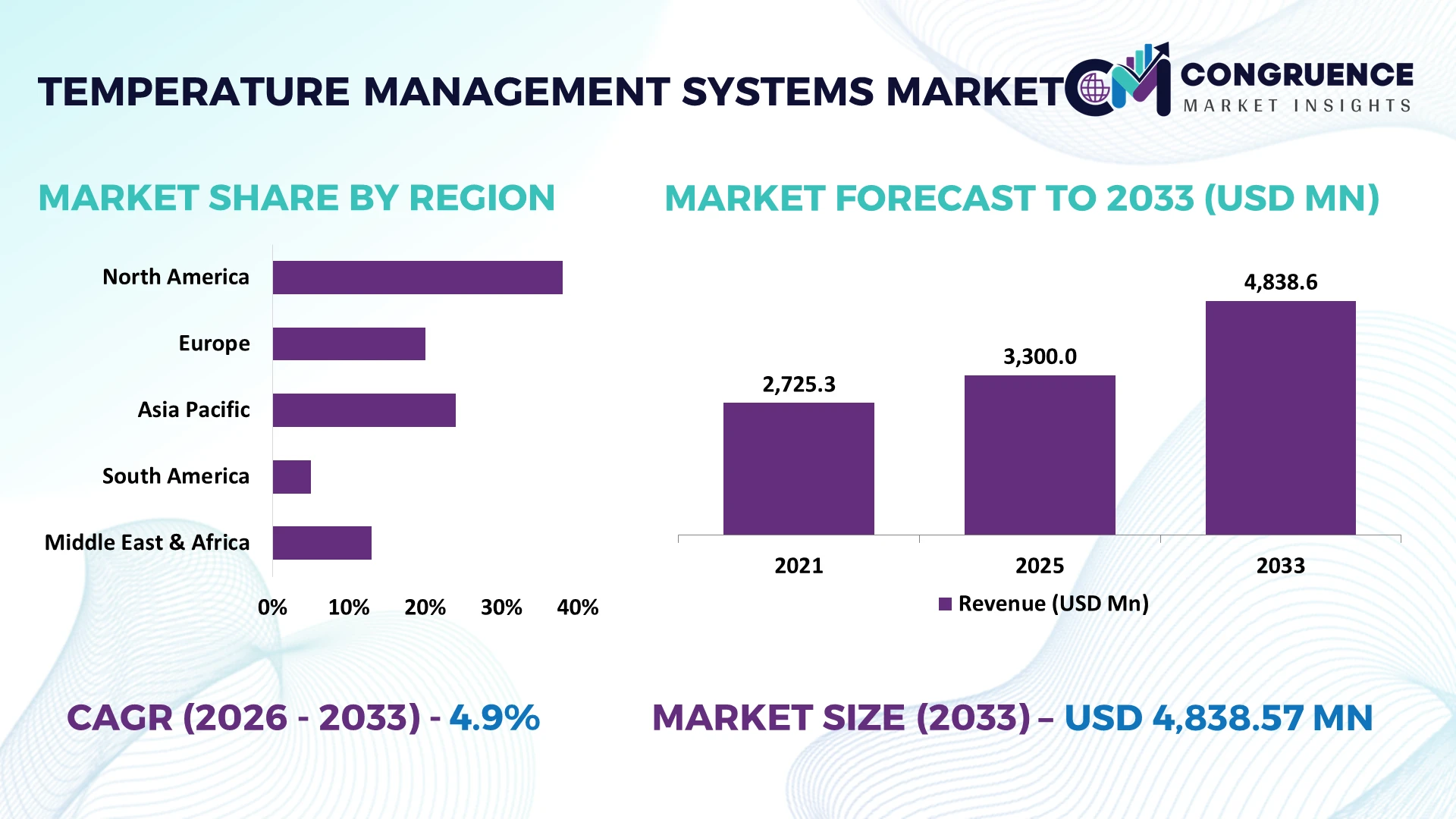
The Global Temperature Management Systems Market was valued at USD 3300 Million in 2025 and is anticipated to reach a value of USD 4838.57 Million by 2033 expanding at a CAGR of 4.9% between 2026 and 2033. Growth is being driven by expanding surgical volumes, stricter perioperative temperature control protocols, rising critical care admissions, and rapid integration of intelligent patient warming and cooling technologies across hospitals and emergency care facilities.
The United States leads the global Temperature Management Systems Market with approximately 36% market share, supported by over USD 1.5 billion in annual hospital investments focused on critical care modernization, advanced operating rooms, and connected medical devices. Compared with Germany, where adoption is accelerating through hospital digitalization initiatives, U.S. deployment of automated temperature monitoring systems is around 30% higher. Continued healthcare resilience programs following evolving global public health preparedness priorities in 2026 further strengthen procurement activity and technology upgrades.
For manufacturers and healthcare providers, prioritizing innovation, localized production, and intelligent temperature management platforms will strengthen competitive positioning across high-value clinical segments.
Market Size & Growth: USD 3300 Million in 2025, reaching USD 4838.57 Million by 2033 at 4.9% CAGR, supported by expanding advanced surgical infrastructure and connected critical-care technologies.
Top Growth Drivers: Rising surgical procedures (+18%), ICU modernization (+22%), and automated patient monitoring adoption (+27%) continue accelerating global demand.
Short-Term Forecast: By 2028, smart temperature management platforms improve clinical workflow efficiency by 16% while reducing equipment downtime by 12%.
Emerging Technologies: AI-enabled monitoring, automated thermal regulation, and advanced hydrogel-based patient interfaces improve temperature accuracy by up to 20%.
Regional Leaders: North America approaches USD 1.75 Billion, Europe exceeds USD 1.25 Billion, and Asia-Pacific nears USD 1.10 Billion, driven by hospital expansion and regional manufacturing investments.
Consumer/End-User Trends: More than 64% of tertiary hospitals prioritize integrated temperature management systems within digital operating room upgrades.
Pilot/Case Example: In 2026, a multi-hospital deployment reduced perioperative hypothermia incidents by 24% while improving recovery workflow efficiency by 15%.
Competitive Landscape: Leading manufacturers collectively account for nearly 48% market share, with companies including 3M, Stryker, ZOLL Medical, Gentherm Medical, and ICU Medical strengthening global portfolios.
Regulatory & ESG Impact: Energy-efficient device designs reduce power consumption by approximately 14%, aligning with healthcare sustainability targets and procurement standards amid evolving global supply chain localization.
Investment & Funding: More than USD 850 Million supports manufacturing expansion, strategic partnerships, and next-generation thermal management platform development.
Innovation & Future Outlook: Predictive analytics, cloud-connected monitoring, and wearable temperature management technologies strengthen precision care while supporting broader regional healthcare expansion.
Temperature Management Systems Market demand is expanding across operating rooms, intensive care units, trauma centers, and neonatal care, where precision thermal control directly improves clinical outcomes. AI-assisted monitoring, portable warming technologies, and integrated digital platforms are accelerating product innovation, with smart device adoption increasing by approximately 25%. Ongoing medical device localization initiatives and resilient healthcare supply-chain strategies are reinforcing procurement decisions, setting the stage for deeper strategic market evaluation.
Temperature management systems are becoming a strategic priority as healthcare providers focus on outcome-based care, operating room efficiency, and critical care standardization. Infrastructure modernization, digital patient monitoring, and supply-chain restructuring are reshaping procurement strategies, encouraging hospitals to replace standalone thermal devices with integrated platforms. This transition strengthens vendor differentiation through software-enabled monitoring, predictive maintenance, and interoperable clinical workflows that improve asset utilization and patient safety.
Modern automated temperature management systems deliver approximately 18% higher thermal precision and reduce clinician intervention by nearly 25% compared with conventional manual systems, lowering workflow complexity across high-acuity environments. The United States leads large-scale deployment through advanced hospital networks and connected operating rooms, while Japan emphasizes compact, energy-efficient systems for aging-care infrastructure. Over the next two to three years, intelligent monitoring integration is expected to exceed 45% across newly commissioned tertiary hospitals, reflecting accelerating digital adoption and procurement standardization.
A 2026 multi-site hospital implementation demonstrated a 20% reduction in perioperative hypothermia events after deploying AI-assisted patient warming systems integrated with centralized monitoring. Manufacturers are expanding localized production, strengthening clinical partnerships, and investing in interoperable product portfolios to improve deployment flexibility. Companies that combine intelligent thermal management with digital healthcare ecosystems will secure stronger competitive positioning, higher operational efficiency, and greater long-term relevance across modern healthcare infrastructure.
Growing investment in surgical modernization and critical care capacity is accelerating adoption of advanced temperature management systems. More than 68% of tertiary hospitals now prioritize integrated patient temperature monitoring during complex procedures, while automated thermal management improves workflow efficiency by approximately 17% and reduces postoperative complications by nearly 14%. The United States continues expanding smart operating room infrastructure, supported by stricter perioperative quality standards and healthcare digitization initiatives. In response, manufacturers are increasing domestic production, introducing AI-enabled monitoring platforms, and forming strategic partnerships with hospital networks. The most successful suppliers are differentiating through interoperable systems that integrate seamlessly with electronic clinical workflows rather than competing solely on hardware performance.
High acquisition costs and integration requirements continue limiting deployment across mid-sized healthcare facilities. Advanced temperature management platforms typically require 20–30% higher implementation expenditure than conventional equipment, while interoperability challenges extend deployment timelines by nearly 18%. Germany and several developing healthcare markets face procurement delays due to budget prioritization and certification requirements for connected medical devices. These constraints reduce purchasing flexibility and slow replacement cycles despite growing clinical demand. To mitigate operational risks, manufacturers are expanding localized assembly, negotiating long-term procurement contracts, and introducing modular platforms compatible with existing hospital infrastructure, reducing implementation complexity while improving lifecycle cost efficiency.
Rapid digital transformation is creating new opportunities beyond conventional operating room applications. AI-assisted predictive temperature control improves monitoring accuracy by approximately 21%, while cloud-enabled device management reduces maintenance requirements by nearly 16%. India is accelerating investments in tertiary hospitals and digital healthcare infrastructure, creating strong demand for scalable, connected temperature management platforms. Companies are strengthening R&D capabilities, collaborating with software developers, and expanding intelligent product ecosystems that support remote diagnostics and centralized asset management. A less-recognized opportunity lies in integrating temperature management with predictive clinical analytics, enabling hospitals to optimize patient outcomes while improving equipment utilization across multiple care environments.
Long-term competitiveness depends on seamless integration across increasingly connected healthcare ecosystems. Nearly 32% of hospitals report interoperability challenges when integrating advanced thermal management systems with legacy clinical information platforms, while cybersecurity compliance requirements increase implementation effort by approximately 15%. Japan and other digitally advanced healthcare markets demand secure data exchange and standardized device communication before large-scale procurement. Companies must strengthen software validation, cybersecurity architecture, and workforce training to ensure deployment consistency across complex hospital environments. Organizations that successfully combine secure connectivity, standardized interoperability, and scalable digital infrastructure will achieve stronger operational resilience and sustained competitive differentiation.
Advanced AI Monitoring Integration Automated temperature management platforms with AI-assisted monitoring are expanding across tertiary hospitals, improving thermal accuracy by approximately 19% and reducing clinician intervention by 24%. Healthcare digitization programs in the United States and stricter perioperative quality standards are accelerating deployment. Manufacturers are integrating predictive analytics with centralized monitoring platforms, enabling faster clinical decisions while lowering equipment management workloads and improving patient throughput.
Localized Manufacturing Expansion Supply-chain diversification has become a major operational priority following medical device sourcing disruptions. More than 35% of leading manufacturers are increasing regional production capacity, while localized procurement reduces component lead times by nearly 22% and inventory exposure by 18%. Companies are restructuring supplier networks, expanding strategic partnerships, and qualifying multiple component vendors to improve production continuity and procurement resilience across healthcare systems.
Portable Thermal Care Adoption Compact patient warming and cooling systems are gaining traction in ambulatory care and emergency medicine, with portable device utilization increasing by approximately 28% during 2026. Deployment flexibility shortens treatment preparation time by nearly 16%, supporting higher patient turnover. Manufacturers are expanding lightweight product portfolios, improving battery performance, and introducing modular accessories that simplify deployment across mobile healthcare environments.
Connected Clinical Ecosystems Integration with electronic medical records and hospital asset management platforms is reshaping operational workflows, with connected device deployment increasing by approximately 31% and maintenance response times improving by 20%. Japanese healthcare providers are prioritizing interoperable medical equipment as workforce shortages encourage greater automation. Companies are strengthening software partnerships and cloud-enabled service capabilities, transforming temperature management systems into intelligent clinical infrastructure rather than standalone therapeutic devices.
Patient Warming remains the leading segment, accounting for approximately 47% of the Temperature Management Systems Market due to its extensive use in perioperative care, trauma management, and critical care. Hospitals prioritize these systems because they integrate easily with operating room workflows, reduce hypothermia-related complications, and support standardized surgical protocols. Surface Cooling continues to hold an important position for emergency and post-operative applications, benefiting from relatively lower deployment costs and straightforward clinical implementation. Manufacturers continue improving thermal precision, with automated control functions enhancing treatment consistency by nearly 18%.
Intravascular Cooling represents the fastest-growing segment as advanced neurological and cardiac interventions increasingly require precise core temperature regulation. Adoption has expanded by approximately 24% across specialized hospitals equipped with advanced critical care capabilities. Neonatal Cooling maintains strategic relevance through dedicated neonatal intensive care programs, where therapeutic hypothermia remains an established treatment protocol. Companies are expanding specialized product portfolios, strengthening hospital partnerships, and investing in intelligent temperature monitoring technologies, reflecting a clear shift toward application-specific thermal management solutions with higher clinical value.
Perioperative Care leads the market with an estimated 42% share, reflecting routine use of active temperature management before, during, and after surgical procedures. Increasing surgical complexity and standardized patient safety protocols continue concentrating demand within operating rooms. Automated temperature regulation improves perioperative workflow efficiency by approximately 17% while reducing unintended hypothermia events by nearly 20%. Critical Care follows as a mature segment where integrated monitoring platforms support patients requiring continuous thermal regulation across intensive care settings.
Neurology is emerging as the fastest-growing application due to expanding therapeutic hypothermia protocols and advanced neurocritical care capabilities. Cardiac Care continues strengthening demand as temperature optimization improves outcomes following complex cardiovascular procedures, while Neonatal Care remains strategically important through specialized neonatal intensive care services. Manufacturers are introducing interoperable monitoring platforms, expanding clinical training partnerships, and developing application-focused solutions that improve deployment flexibility across multiple hospital departments.
Hospitals account for approximately 69% of total demand due to high surgical volumes, intensive care infrastructure, and comprehensive emergency services requiring continuous temperature management capabilities. Large healthcare systems increasingly deploy integrated platforms that improve equipment utilization by approximately 19% while supporting standardized clinical workflows. Specialty Clinics maintain a focused role in cardiovascular, neurological, and neonatal services where specialized thermal regulation enhances treatment precision. Emergency Care Centers continue expanding deployment for trauma stabilization and acute patient management.
Ambulatory Surgical Centers represent the fastest-growing end-user segment as minimally invasive procedures increase and healthcare providers prioritize operational efficiency. Adoption of compact temperature management systems has increased by approximately 26%, supported by shorter procedure times and simplified device integration. Manufacturers are responding through flexible pricing models, customized portable systems, and strategic partnerships with outpatient healthcare networks. Competitive positioning increasingly depends on delivering scalable solutions that balance performance, ease of deployment, and lower operating costs across diverse clinical environments.
North America accounted for the largest market share at 39.2% in 2025 however, Asia-Pacific is expected to register the fastest growth, expanding at a 6.3% CAGR between 2026 and 2033.
Advanced Hospital Digitalization Driving Clinical Standardization
North America maintains the largest position in the Temperature Management Systems Market through extensive deployment across surgical centers, intensive care units, and trauma hospitals. Nearly 39.2% of global demand originates from the region, supported by advanced healthcare infrastructure, high procedural volumes, and rapid integration of connected patient monitoring platforms. More than 72% of large hospital networks have incorporated automated temperature management into perioperative workflows, improving procedural consistency and reducing manual intervention. Investment continues in smart operating rooms, while enterprise procurement increasingly favors interoperable medical devices with predictive maintenance capabilities. Manufacturers are expanding service networks, strengthening hospital partnerships, and accelerating software-enabled product development to improve deployment efficiency and long-term equipment utilization.
United States Market Outlook: The United States remains the regional technology leader due to extensive tertiary healthcare infrastructure, strong medical device innovation, and widespread adoption of digital operating rooms. More than 75% of high-volume academic hospitals utilize advanced patient warming or cooling systems within standardized perioperative protocols. Domestic manufacturers continue investing in intelligent monitoring platforms, localized production, and clinical collaborations that strengthen deployment scale and accelerate technology commercialization.
Healthcare Modernization and Regulatory Alignment Strengthen Adoption
Europe continues to strengthen its market position through hospital modernization, patient safety initiatives, and widespread replacement of aging medical equipment. Approximately 28% of global deployment is concentrated across major healthcare systems where automated temperature regulation supports standardized surgical care and critical care management. Energy-efficient medical technologies and stricter clinical quality requirements encourage procurement of intelligent thermal management systems. Healthcare providers are increasing investment in connected devices capable of reducing workflow variation by nearly 16%. Manufacturers are expanding regional partnerships, improving localized technical support, and introducing interoperable platforms aligned with evolving healthcare digitalization strategies.
Germany Market Outlook: Germany represents the region's strongest operational market through advanced hospital infrastructure, medical engineering expertise, and strong procurement capacity. More than 68% of university hospitals have expanded digital patient monitoring capabilities alongside thermal management upgrades. Domestic healthcare providers continue prioritizing integrated clinical systems that improve operational efficiency while supporting long-term equipment standardization and regulatory compliance.
Healthcare Expansion Accelerates Large-Scale Deployment
Asia-Pacific is emerging as the fastest-expanding regional market, supported by rapid healthcare infrastructure development, expanding domestic manufacturing, and increasing adoption of advanced surgical technologies. Large investments in hospital capacity, combined with rising critical care demand, are accelerating procurement of intelligent temperature management platforms. Approximately 34% of newly commissioned tertiary hospitals across key economies are integrating automated thermal regulation systems during initial infrastructure development. Manufacturers are strengthening regional production, expanding distributor partnerships, and localizing product portfolios to improve affordability and supply-chain resilience.
China Market Outlook: China leads regional deployment through extensive hospital construction, growing domestic medical device manufacturing, and government-supported healthcare modernization. More than 30% of newly installed operating room equipment packages now include advanced patient temperature management capabilities. Domestic manufacturers are increasing automation, expanding export capacity, and investing in intelligent medical technologies to strengthen both national and international competitiveness.
Critical Care Expansion Supporting Equipment Adoption
South America is experiencing steady market development as public and private healthcare providers expand surgical capacity and intensive care infrastructure. Brazil, Argentina, and Chile are increasing investment in hospital modernization programs that prioritize advanced patient monitoring technologies. Approximately 18% growth in procurement of connected critical care equipment has supported broader deployment of temperature management systems across leading healthcare institutions. Budget limitations remain in selected markets, encouraging phased procurement and long-term equipment replacement strategies. Companies are responding through distributor expansion, localized service capabilities, and flexible commercial partnerships that improve market accessibility.
Brazil Market Outlook: Brazil remains the largest market within South America due to its extensive hospital network and expanding private healthcare sector. More than 60% of advanced surgical facilities have upgraded perioperative monitoring technologies during recent modernization programs. Manufacturers continue strengthening regional partnerships, improving technical service coverage, and introducing scalable product configurations suited to diverse healthcare providers.
Healthcare Infrastructure Investment Reshaping Clinical Capacity
The Middle East & Africa market is advancing through sustained healthcare infrastructure investment, specialized hospital development, and modernization of critical care facilities. Gulf countries continue deploying advanced medical technologies within newly commissioned hospitals, while African healthcare systems increasingly prioritize high-acuity patient management. Approximately 21% of new tertiary healthcare projects incorporate integrated patient temperature management technologies during facility commissioning. Companies are expanding regional distribution networks, strengthening clinical training programs, and improving after-sales support to enhance long-term equipment utilization and deployment consistency.
Saudi Arabia Market Outlook: Saudi Arabia leads regional adoption through significant healthcare infrastructure investment and large-scale hospital expansion under national healthcare transformation initiatives. More than 40% of newly developed tertiary hospitals incorporate intelligent perioperative monitoring platforms, including advanced temperature management systems. Global manufacturers are strengthening local partnerships, expanding technical support operations, and introducing digitally integrated clinical solutions aligned with the country's healthcare modernization priorities.
The Temperature Management Systems Market is led by global manufacturers including Stryker, ZOLL Medical, ICU Medical, Gentherm Medical, and 3M, competing against specialized thermal therapy innovators and regional medical device suppliers. The top five players collectively control approximately 58% of the market, reflecting moderate consolidation supported by strong clinical portfolios and established hospital relationships. Competition centers on thermal precision, digital integration, service responsiveness, and lifecycle costs rather than pricing alone. AI-enabled monitoring improves workflow efficiency by nearly 18%, while predictive maintenance reduces equipment downtime by approximately 15%, strengthening technology-led differentiation. Companies are expanding manufacturing capacity, pursuing hospital partnerships, enhancing software interoperability, and vertically integrating critical components to improve supply reliability. Regional manufacturers compete through cost-efficient customization and faster delivery. Regulatory approvals, clinical validation, and hospital procurement requirements remain significant entry barriers. Success increasingly depends on combining intelligent connected platforms, dependable supply chains, clinical evidence, and responsive service capabilities that deliver measurable operational value.
Stryker Corporation
ZOLL Medical Corporation
ICU Medical, Inc.
Gentherm Medical
3M Company
Smiths Medical
Drägerwerk AG & Co. KGaA
The Surgical Company
Inspiration Healthcare Group plc
Barkey GmbH & Co. KG
Cincinnati Sub-Zero Products, LLC
EM-MED Sp. z o.o.
Becton, Dickinson and Company
Belmont Medical Technologies
Advanced automated temperature management platforms are replacing conventional standalone warming and cooling systems through integrated sensors, closed-loop control, and real-time patient monitoring. Modern systems improve temperature regulation accuracy by approximately 18% while reducing manual clinical intervention by nearly 24%. More than 65% of newly equipped tertiary hospitals now prioritize interoperable thermal management solutions, enabling standardized perioperative workflows, faster treatment decisions, and improved equipment utilization across critical care environments.
Emerging technologies between 2026 and 2028 include AI-assisted predictive temperature regulation, cloud-enabled device management, and wearable thermal sensors integrated with electronic medical records. Intelligent monitoring reduces response times by around 16%, while predictive maintenance lowers unexpected equipment downtime by nearly 20%. Compared with legacy manual systems, AI-enabled platforms deliver approximately 22% greater workflow efficiency through automated alerts and adaptive temperature adjustments. Companies investing in connected software ecosystems gain stronger differentiation as hospitals increasingly evaluate interoperability alongside clinical performance.
Disruptive innovation is shifting competition toward intelligent healthcare platforms rather than standalone hardware. Edge-enabled analytics, digital twins for equipment performance, and wireless patient monitoring are expected to exceed 40% deployment across newly commissioned smart hospitals by 2028. Technology leaders combining precision thermal therapy with cybersecurity, remote diagnostics, and software-based clinical decision support will strengthen operational efficiency, accelerate procurement success, and secure long-term competitive advantage as healthcare infrastructure becomes increasingly digital.
January 2024 ZOLL Medical received FDA clearance and CE Mark for its upgraded Thermogard platform, becoming the first system combining intravascular and surface temperature management in one console, expanding clinical flexibility and improving workflow efficiency.
July 2024 Research and Markets highlighted expanding U.S. adoption of patient temperature management technologies, projecting continued deployment across surgical and cardiac care driven by rising procedural volumes and broader clinical utilization, strengthening supplier investment priorities. )
March 2025 The U.S. FDA cleared ZOLL's VitalTemp Universal Pad for the Thermogard HQ and Thermogard XP systems, extending surface cooling capabilities with a standardized disposable pad that broadens treatment flexibility and supports streamlined hospital deployment. Source: https://www.fda.gov/
February 2026 ZOLL announced European MDR approval for its new Zenix Monitor/Defibrillator, strengthening its connected critical-care portfolio and supporting broader integration across acute care environments, reinforcing long-term enterprise positioning in advanced patient monitoring.
The report provides a comprehensive assessment of the Temperature Management Systems Market across Surface Cooling, Intravascular Cooling, Patient Warming, and Neonatal Cooling technologies, evaluating their deployment maturity, clinical integration, and operational advantages. It analyzes applications spanning Perioperative Care, Critical Care, Cardiac Care, Neurology, and Neonatal Care, together with end-user demand across Hospitals, Ambulatory Surgical Centers, Specialty Clinics, and Emergency Care Centers. The study covers more than 12 leading companies and evaluates technology adoption, procurement strategies, deployment patterns, and competitive positioning across five major regions.
The analysis delivers strategic insights into digital temperature management, AI-enabled monitoring, connected medical devices, and workflow automation shaping healthcare infrastructure between 2026 and 2033. It highlights regional deployment trends, enterprise expansion priorities, product innovation, and evolving purchasing behavior while supporting investment planning, competitive benchmarking, partnership evaluation, manufacturing expansion, and long-term market positioning across both established healthcare systems and emerging clinical care environments.
| Report Attribute/Metric | Report Details |
|---|---|
Market Revenue in 2025 | USD 3300 Million |
Market Revenue in 2033 | USD 4838.57 Million |
CAGR (2026 - 2033) | 4.9% |
Base Year | 2025 |
Forecast Period | 2026 - 2033 |
Historic Period | 2021 - 2025 |
Segments Covered | By Type
By Application
By End-User
|
Key Report Deliverable | Revenue Forecast, Growth Trends, Market Dynamics, Segmental Overview, Regional and Country-wise Analysis, Competition Landscape |
Region Covered | North America, Europe, Asia-Pacific, South America, Middle East, Africa |
Key Players Analyzed | Stryker Corporation, ZOLL Medical Corporation, ICU Medical, Inc., Gentherm Medical, 3M Company, Smiths Medical, Drägerwerk AG & Co. KGaA, The Surgical Company, Inspiration Healthcare Group plc, Barkey GmbH & Co. KG, Cincinnati Sub-Zero Products, LLC, EM-MED Sp. z o.o., Becton, Dickinson and Company, Belmont Medical Technologies |
Customization & Pricing | Available on Request (10% Customization is Free) |




