
Reports
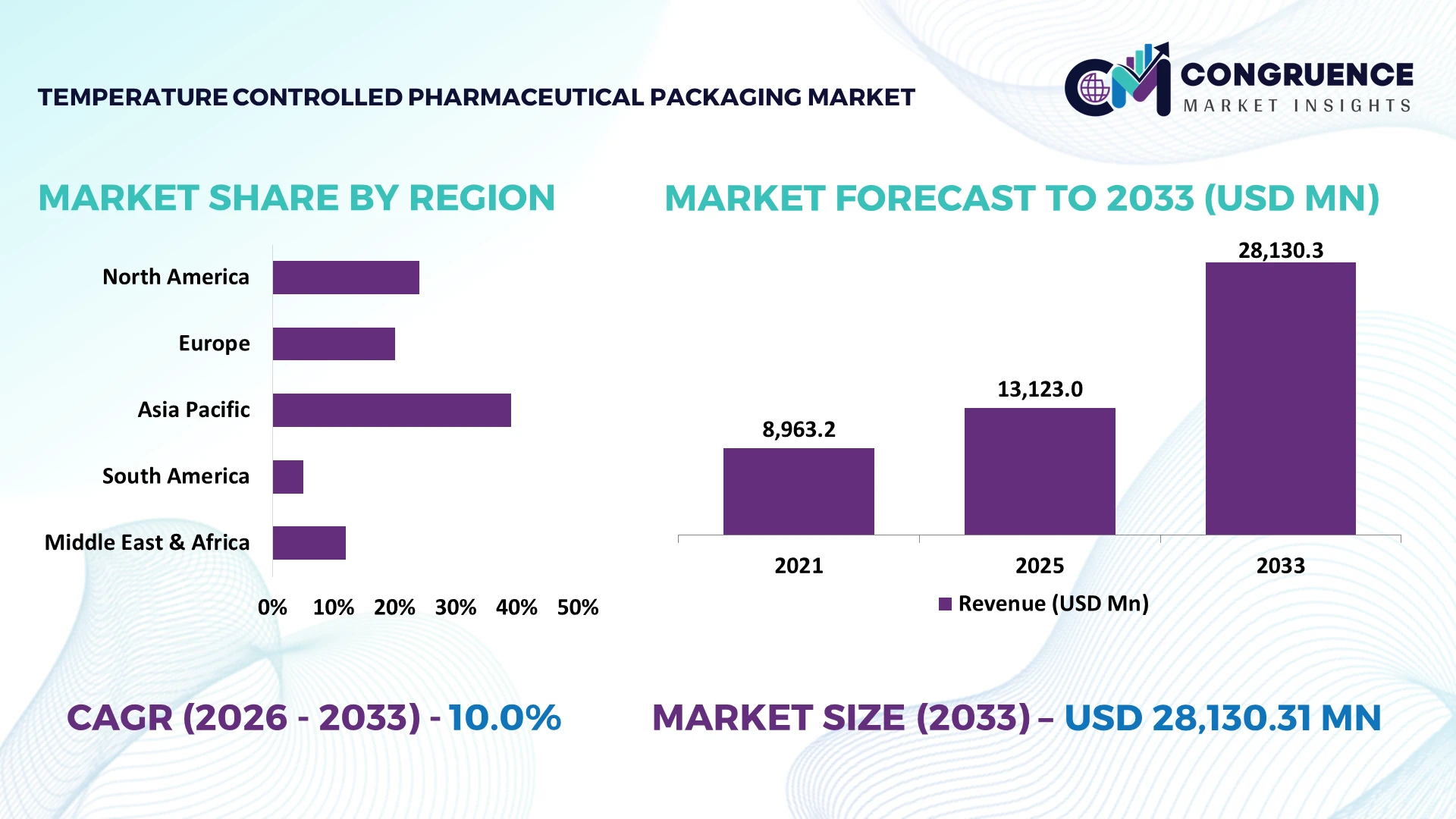
The Global Temperature Controlled Pharmaceutical Packaging Market was valued at USD 13123 Million in 2025 and is anticipated to reach a value of USD 28130.31 Million by 2033 expanding at a CAGR of 10% between 2026 and 2033. Growth is driven by the rapid commercialization of biologics, GLP-1 therapies, cell and gene therapies, and stricter temperature-excursion controls across global pharmaceutical logistics.
The United States remains the dominant country market, accounting for an estimated 29% share, supported by extensive biologics manufacturing, clinical-trial distribution, and advanced cold-chain infrastructure. Refrigerated packaging represents about 45% of U.S. temperature-controlled applications. More than USD 500 billion in announced U.S. pharmaceutical manufacturing and R&D investments through 2030 are strengthening domestic supply chains. India, meanwhile, sends nearly 40% of pharmaceutical exports to the U.S., reinforcing cross-border cold-chain demand.
The strategic implication is clear: suppliers combining reusable thermal systems, real-time monitoring, and regulatory-grade traceability are best positioned to capture high-value pharmaceutical logistics contracts.
Market Size & Growth: USD 13.12 billion in 2025 rising to USD 28.13 billion by 2033 at a 10% CAGR, driven by biologics, GLP-1 therapies, and stricter cold-chain controls.
Top Growth Drivers: Biologics adoption 45%, digital monitoring 30%, reusable packaging 25% are reshaping high-growth pharmaceutical logistics.
Short-Term Forecast: By 2028, automated monitoring is positioned to lift shipment visibility by 20% and reduce manual compliance work by 15%.
Emerging Technologies: AI forecasting, IoT sensors, vacuum-insulated panels, and phase-change materials are accelerating advanced thermal protection and predictive logistics.
Regional Leaders: Asia Pacific is projected at about USD 8.9 billion, North America USD 8.2 billion, and Europe USD 6.7 billion, with reusable and digitally monitored packaging gaining adoption.
Consumer/End-User Trends: Around 45% of U.S. temperature-controlled applications use refrigerated formats, reflecting strong biologics and injectable-drug utilization.
Pilot/Case Example: In 2020, a 30,000-shipment reusable-packaging trial reduced carbon-footprint potential by 78%, demonstrating measurable ESG and lifecycle advantages.
Competitive Landscape: Pelican BioThermal leads at an estimated 10% share, competing closely with Cold Chain Technologies, va-Q-tec, CSafe, Softbox Systems, and Envirotainer.
Regulatory & ESG Impact: Reusable systems can reduce greenhouse-gas emissions by about 48%, while GDP-aligned monitoring strengthens auditability and temperature compliance.
Investment & Funding: More than USD 500 billion in announced U.S. pharmaceutical manufacturing and R&D investment is accelerating localized capacity and associated cold-chain infrastructure.
Innovation & Future Outlook: Next-generation packaging will integrate AI risk prediction, smart sensors, recyclable insulation, and reusable thermal systems, shifting competition toward resilient, data-enabled supply chains.
The Temperature Controlled Pharmaceutical Packaging Market is gaining traction across biologics, vaccines, insulin, injectables, and cell and gene therapies, where precise thermal stability is critical. Around 45% of U.S. applications use refrigerated formats, while reusable VIP and phase-change-material systems are improving sustainability. Geopolitical supply-chain localization is accelerating regional packaging capacity, creating a strategic shift toward traceable, resilient cold-chain ecosystems.
Temperature controlled pharmaceutical packaging is becoming strategically important because biologics, vaccines, insulin, and cell therapies increasingly depend on uninterrupted thermal integrity. The market is shifting from passive protection toward digitally monitored, GDP-aligned logistics as pharmaceutical manufacturers restructure supply chains around regional production and faster distribution. This transformation is making packaging performance a competitive differentiator rather than a logistics afterthought.
Advanced vacuum-insulated panels and phase-change materials can reduce thermal-performance losses by roughly 20–30% versus conventional insulated systems, while IoT-enabled sensors provide continuous shipment visibility. The United States leads in sophisticated deployment, whereas India is expanding cost-efficient cold-chain infrastructure around Hyderabad, Mumbai, and Bengaluru. Over the next 2–3 years, connected monitoring adoption across high-value shipments is positioned to exceed 50%, increasing exception detection and reducing temperature excursions.
A practical deployment model combines reusable containers, real-time sensors, and centralized analytics for biologics distribution. Companies are increasing investment in reusable fleets, localized packaging production, sensor partnerships, and qualification laboratories to shorten replenishment cycles. The strategic priority is clear: suppliers that combine thermal reliability, digital traceability, reuse economics, and regulatory compliance will secure stronger pharmaceutical logistics relationships and sustain competitive advantage.
The strongest growth driver is the expanding use of biologics and temperature-sensitive injectables, with refrigerated pharmaceutical applications representing roughly 45% of U.S. temperature-controlled shipments. Cell and gene therapies are intensifying requirements for validated thermal protection, while digital monitoring adoption is approaching 50% among advanced logistics operations. U.S. pharmaceutical manufacturers are consequently prioritizing reusable containers, phase-change materials, and IoT-enabled tracking. The operational impact is substantial: better excursion detection reduces product-loss exposure and strengthens compliance documentation. Companies are responding through partnerships with packaging specialists, localized container fleets, and qualification centers. A non-obvious shift is that packaging suppliers increasingly compete on data visibility and recovery logistics, not insulation performance alone.
High material and validation costs remain a structural restraint, particularly for smaller pharmaceutical distributors. Advanced insulation systems can carry 20–40% higher upfront costs than conventional formats, while qualification and reverse-logistics expenses add further complexity. Temperature-controlled packaging also depends on specialized materials, including phase-change compounds and vacuum-insulated panels, exposing manufacturers to supply volatility. India faces greater infrastructure disparities than the United States, especially outside major pharmaceutical hubs, limiting standardized deployment. Companies are mitigating pressure through multi-year procurement contracts, supplier diversification, domestic component sourcing, and reusable packaging pools. The sharp operational issue is lifecycle economics: a technically superior container becomes commercially unattractive when return rates fall below roughly 70%, making fleet utilization a critical profitability metric.
The largest emerging opportunity lies in intelligent reusable packaging combining IoT sensors, AI-based excursion prediction, and advanced insulation. Reusable systems can reduce packaging-related waste by approximately 40–60% compared with single-use alternatives, while connected monitoring can improve shipment visibility by more than 25%. India, Singapore, and the United Arab Emirates offer attractive deployment opportunities as pharmaceutical distribution networks modernize and temperature-sensitive exports increase. Companies are investing in sensor integration, cloud analytics, and regional refurbishment hubs rather than selling containers as standalone products. A distinctive opportunity is packaging-as-a-service, where pharmaceutical customers pay for validated thermal capacity, monitoring, reverse logistics, and compliance data as one integrated offering, improving recurring utilization and reducing capital intensity.
Long-term competitiveness depends on integrating thermal packaging with fragmented logistics software, warehouse systems, and regulatory workflows. Interoperability gaps can affect 15–25% of digitally tracked shipment processes, while sensor connectivity remains inconsistent across international routes. Japan and Germany demonstrate stronger automation maturity than many emerging pharmaceutical logistics markets, increasing competitive pressure on suppliers serving global manufacturers. Cybersecurity also becomes more important as packaging telemetry moves into centralized cloud platforms. Companies must invest in standardized APIs, secure device architectures, automated calibration, and workforce training to maintain deployment consistency. The non-obvious challenge is data credibility: inaccurate sensor calibration or fragmented records can undermine otherwise compliant shipments. Packaging providers therefore need integrated validation, cybersecurity, and analytics capabilities to protect long-term customer trust.
Smart Monitoring Becomes Standard: IoT-enabled temperature tracking is moving across pharmaceutical shipments, with connected monitoring adoption approaching 50% in advanced logistics networks. Real-time alerts reduce manual checks by roughly 20%, while companies are integrating sensors with cloud platforms to strengthen GDP documentation and exception management.
Reusable Systems Gain Ground: Reusable thermal packaging is expanding as companies target 40–60% reductions in packaging waste and lower lifecycle costs. U.S. pharmaceutical distributors are shifting from single-use containers toward returnable fleets, supported by reverse-logistics partnerships and standardized refurbishment workflows.
Urban Cold Chains Decentralize: India is moving toward smaller cold-chain-ready warehouses, with about 60% of pharmaceutical products requiring regulated storage conditions. Mumbai and Hyderabad are seeing stronger deployment of IoT monitoring, backup power, and multi-temperature facilities, shortening last-mile handling and improving delivery responsiveness.
Resilience Drives Network Redesign: Geopolitical disruptions are forcing pharmaceutical companies to diversify routes and packaging inventories; the 2026 Middle East conflict disrupted more than 20% of global air cargo. Manufacturers are increasing regional stock buffers, alternate carriers, and packaging capacity to protect temperature-sensitive shipments.
Passive Packaging remains the leading type, estimated at approximately 42% share, because validated insulation and phase-change materials provide scalable thermal protection without requiring powered infrastructure. Insulated Shippers account for nearly 30%, benefiting from standardized parcel distribution and lower handling complexity. Active Packaging represents about 18% but is the fastest-moving category as high-value biologics require tighter temperature control and extended transit resilience. Refrigerated Containers retain strategic importance for bulk and multimodal pharmaceutical movements, particularly where continuous cooling is essential. Companies are prioritizing hybrid designs, advanced insulation, and reusable formats to improve thermal duration by 15–25% while reducing logistics complexity. Investment is shifting toward active systems for premium therapies, while passive formats remain the volume backbone.
Biologics lead application demand at an estimated 38% share, reflecting stringent temperature requirements, high product value, and expanding injectable therapies. Temperature-Sensitive Drugs follow at about 30%, supported by insulin, specialty injectables, and other refrigerated medicines. Vaccines remain a mature, high-volume application at roughly 20%, while Clinical Trial Materials account for around 12% and represent the fastest-growing operational niche as decentralized trials increase sample movements. Companies are deploying validated shippers, real-time sensors, and lane-specific packaging to reduce excursion exposure by approximately 15–20%. The competitive implication is shifting from basic cold protection toward application-specific qualification, particularly for biologics and trial materials requiring tighter chain-of-custody controls.
Pharmaceutical Companies represent the dominant end-user group, estimated at approximately 48% share, because global manufacturers manage high shipment volumes, validated distribution networks, and stringent quality systems. Biotechnology Companies hold about 24% and are the fastest-growing buyer group as biologics pipelines and personalized therapies expand. Contract Research Organizations account for nearly 12%, supported by growing clinical-trial logistics, while Healthcare Providers and Specialty Distributors collectively represent about 16%. Biotechnology buyers increasingly demand smaller, highly qualified shipment formats, pushing suppliers toward customization and sensor integration. Pharmaceutical companies, by contrast, emphasize fleet scalability and total-cost optimization. Companies are responding with dedicated packaging programs, long-term service agreements, and partnerships covering validation, reverse logistics, and digital monitoring.
North America accounted for the largest market share at 36% in 2025 however, Asia-Pacific is expected to register the fastest growth, expanding at a CAGR of 12% between 2026 and 2033.
Digitized Cold-Chain Infrastructure Strengthens Market Leadership
North America holds approximately 36% of global demand, supported by concentrated biologics manufacturing, sophisticated distribution networks, and high adoption of validated thermal packaging. The United States dominates regional deployment, particularly across Boston, New Jersey, California, and North Carolina pharmaceutical clusters. More than 50% of high-value temperature-sensitive shipments increasingly incorporate digital monitoring or electronic temperature logging. Pharmaceutical companies are expanding reusable container fleets and integrating IoT telemetry with transportation-management platforms. Cold Chain Technologies, Pelican BioThermal, and other specialized suppliers are strengthening partnerships with drug manufacturers and logistics providers. The region’s operational advantage lies in established qualification infrastructure and faster adoption of premium packaging formats, allowing suppliers to compete on shipment reliability and data visibility rather than price alone.
United States Market Outlook: The United States remains the region’s principal demand center because of its large biologics pipeline, extensive clinical-trial activity, and mature healthcare logistics infrastructure. More than 40% of pharmaceutical shipments requiring controlled temperatures move through specialized distribution networks, supporting sustained adoption of validated reusable and active packaging.
Regulatory Precision Accelerates Sustainable Packaging Conversion
Europe represents approximately 29% of global market activity, supported by Germany, Switzerland, France, the United Kingdom, and Belgium as major pharmaceutical manufacturing and distribution hubs. GDP compliance, sustainability targets, and cross-border logistics are accelerating adoption of reusable thermal systems and digital monitoring. Reusable packaging penetration is estimated at 35–40% across sophisticated pharmaceutical logistics operations, while advanced phase-change systems increasingly replace conventional gel-based configurations. European manufacturers are prioritizing lower-waste designs as environmental requirements tighten. Companies are responding through regional refurbishment centers, packaging-as-a-service models, and partnerships with pharmaceutical logistics providers. The key structural advantage is dense cross-border infrastructure, although diverse national compliance requirements increase qualification complexity and favor suppliers with standardized validation capabilities.
Germany Market Outlook: Germany combines a major pharmaceutical manufacturing base with highly automated logistics infrastructure. Approximately 45% of temperature-controlled pharmaceutical operations in leading industrial networks use digital monitoring technologies, strengthening demand for connected packaging, automated qualification, and reusable systems designed for high-frequency distribution.
Manufacturing Scale Drives Cold-Chain Localization
Asia-Pacific accounts for approximately 24% of global demand and is expanding its packaging infrastructure around pharmaceutical manufacturing and export hubs in China, India, Japan, South Korea, and Singapore. China and India are strengthening domestic production while pharmaceutical exporters increasingly require validated temperature-controlled distribution. India’s pharmaceutical industry supplies medicines to more than 200 countries, increasing demand for export-ready thermal packaging. Digital temperature monitoring adoption across advanced pharmaceutical logistics is approaching 35%, while insulated shippers remain widely used for cost-sensitive shipments. Companies are establishing local packaging plants, technology partnerships, and regional service centers to reduce import dependence and shorten replenishment cycles. The strategic shift is toward localized manufacturing of insulation materials and reusable containers, improving resilience against international freight disruption.
India Market Outlook: India offers strong manufacturing and export advantages, supported by large-scale vaccine, generic-drug, biologics, and clinical-trial activity. Major pharmaceutical clusters around Hyderabad, Mumbai, Ahmedabad, and Bengaluru are driving sophisticated cold-chain deployment. Export-oriented manufacturers increasingly require validated packaging capable of maintaining integrity across long international transit routes.
Pharmaceutical Distribution Modernization Supports Adoption
South America contributes approximately 7% of global demand, with Brazil accounting for nearly 55% of regional consumption because of its pharmaceutical manufacturing scale and extensive healthcare distribution network. Temperature-sensitive vaccines, biologics, insulin, and specialty medicines are strengthening requirements for validated thermal packaging. Brazil’s major pharmaceutical corridors around São Paulo and Minas Gerais are adopting more digital monitoring, with connected shipment tracking approaching 25% of sophisticated logistics operations. Infrastructure remains uneven outside major urban centers, increasing reliance on insulated shippers and passive packaging. Companies are responding through distributor partnerships, localized inventory hubs, and reusable-container pilots. The strongest competitive opportunity lies in reducing last-mile temperature excursions while controlling reverse-logistics costs across geographically dispersed delivery networks.
Brazil Market Outlook: Brazil remains the region’s most strategically significant market because of its pharmaceutical production capacity and nationwide healthcare distribution requirements. Approximately 30% of temperature-sensitive pharmaceutical movements are concentrated around major metropolitan logistics corridors, supporting investment in validated packaging, monitoring systems, and regional distribution infrastructure.
Healthcare Infrastructure Investment Reshapes Cold-Chain Capacity
Middle East & Africa represents approximately 4% of global demand, with the United Arab Emirates, Saudi Arabia, and South Africa emerging as key deployment centers. Gulf countries are investing heavily in pharmaceutical logistics, airport infrastructure, specialty distribution, and healthcare localization. Dubai and Abu Dhabi increasingly function as pharmaceutical transit and re-export hubs, supporting greater use of validated refrigerated containers and insulated shippers. Digital monitoring adoption in advanced regional logistics networks is estimated at 25%, while pharmaceutical free-zone development is improving temperature-controlled warehousing. Companies are responding through regional partnerships, local inventory placement, and integrated packaging-logistics contracts. Extreme heat remains a decisive operational factor, making thermal-duration performance and contingency planning more commercially important than in temperate markets.
United Arab Emirates Market Outlook: The UAE benefits from advanced airport logistics, pharmaceutical free zones, and strong re-export activity. Dubai’s temperature-controlled logistics infrastructure supports high-value pharmaceutical movements across the Middle East, Africa, and South Asia, encouraging suppliers to deploy longer-duration thermal packaging, real-time monitoring, and specialized handling services.
The Temperature Controlled Pharmaceutical Packaging Market features global specialists such as Pelican BioThermal, Cold Chain Technologies, CSafe, Softbox Systems, va-Q-tec, and Envirotainer competing across premium thermal logistics. The top five players collectively hold an estimated 32% share, leaving substantial space for regional specialists and technology-focused entrants. Competition centers on thermal performance, customization, lifecycle economics, and delivery reliability, with advanced systems commanding 15–25% higher pricing than basic formats. Reusable solutions can reduce packaging waste by 40–60%, shifting purchasing toward total lifecycle cost rather than acquisition price. Leaders are expanding refurbishment networks, forming pharmaceutical partnerships, integrating IoT monitoring, and localizing production. The competitive landscape is shifting toward digitally connected, reusable systems as pharmaceutical customers demand traceability alongside thermal protection. High validation requirements, qualification costs, and global service coverage remain significant entry barriers. Winning suppliers will combine validated performance, scalable reverse logistics, digital visibility, and application-specific customization.
Pelican BioThermal
Cold Chain Technologies
CSafe
Softbox Systems
va-Q-tec
Envirotainer
Sonoco Products Company
Cryoport
Inmark
EcoCooL
Exeltainer
Sealed Air
American Aerogel
SkyCell
Vacuum-insulated panels, phase-change materials, IoT sensors, and reusable thermal systems are defining current technology deployment. Advanced passive containers can extend protection by 15–25% versus conventional insulation, while digital monitoring improves exception detection by 20%. Connected monitoring is approaching 50% adoption across sophisticated pharmaceutical logistics, giving manufacturers stronger compliance visibility and reducing manual intervention.
Emerging systems integrate AI-based lane-risk prediction, GPS telemetry, cloud analytics, and smart packaging identifiers. AI-supported routing can reduce avoidable handling and logistics costs by 1–2%, while automated data capture improves documentation efficiency by 2%. Hybrid containers are gaining traction because they combine passive thermal stability with digital visibility; SkyCell’s fleet exceeds 5,000 containers, signaling commercial deployment beyond pilot programs.
From 2026–2028, advanced active containers, predictive analytics, recyclable insulation, and packaging-as-a-service will shift competition toward measurable lifecycle performance. Advanced active designs can provide more than 170 hours of autonomy, versus below 100 hours for typical conventional active containers, representing over 70% longer protection. Premium suppliers and integrated logistics partners benefit most as pharmaceutical buyers prioritize resilience, traceability, and sustainability. This advantage matters most for biologics and cell therapies, where excursion prevention protects product value and strengthens supplier qualification.
March 2025 Cold Chain Technologies acquired Global Cold Chain Solutions, adding manufacturing sites in Australia and India. The transaction expanded APAC thermal-packaging capabilities and strengthened pharmaceutical supply, giving CCT greater production reach and customer support across life-science lanes. Source: packaging-gateway.com
March 2025 Envirotainer launched RelEye RKN with more than 130 hours of autonomy and real-time monitoring. Six airlines approved the unit at launch, expanding connected small-pallet capability and improving resilience, payload efficiency, and sustainability for pharmaceutical airfreight operators. Source: envirotainer.com
October 2025 Cold Chain Technologies, Teva, and Kuehne+Nagel validated sea transport from Germany to Australia using a PCM thermal blanket. The shipment arrived in condition, demonstrating ocean freight viability and creating a lower-cost, sustainable alternative to air cargo. Source: coldchaintech.com
September 2025 Envirotainer’s RelEye was recognized as an “Advanced Active” container in WHO vaccine-shipping guidelines, with autonomy up to 170 hours at 2–8°C. The designation strengthens procurement credibility and accelerates adoption of higher-performance connected packaging for vaccine logistics. Source: who.int
The report covers the Temperature Controlled Pharmaceutical Packaging Market across Active Packaging, Passive Packaging, Insulated Shippers, and Refrigerated Containers, with application analysis spanning Vaccines, Biologics, Clinical Trial Materials, and Temperature-Sensitive Drugs. End-user coverage includes Pharmaceutical Companies, Biotechnology Companies, Contract Research Organizations, Healthcare Providers, and Specialty Distributors. Regional assessment encompasses North America, Europe, Asia-Pacific, South America, and the Middle East & Africa.
The study evaluates technology adoption, reusable packaging, phase-change materials, vacuum-insulated panels, IoT monitoring, connected containers, and emerging AI-enabled cold-chain systems. It examines deployment patterns, segment positioning, operational efficiency, sustainability, infrastructure readiness, and competitive strategies. With approximately 36% of market activity concentrated in North America and connected monitoring approaching 50% across advanced logistics networks, the report supports investment planning, geographic expansion, partnership decisions, product prioritization, and competitive positioning through 2026–2033.
| Report Attribute/Metric | Report Details |
|---|---|
Market Revenue in 2025 | USD 13123 Million |
Market Revenue in 2033 | USD 28130.31 Million |
CAGR (2026 - 2033) | 10% |
Base Year | 2025 |
Forecast Period | 2026 - 2033 |
Historic Period | 2021 - 2025 |
Segments Covered | By Type
By Application
By End-User
|
Key Report Deliverable | Revenue Forecast, Growth Trends, Market Dynamics, Segmental Overview, Regional and Country-wise Analysis, Competition Landscape |
Region Covered | North America, Europe, Asia-Pacific, South America, Middle East, Africa |
Key Players Analyzed | Pelican BioThermal, Cold Chain Technologies, CSafe, Softbox Systems, va-Q-tec, Envirotainer, Sonoco Products Company, Cryoport, Inmark, EcoCooL, Exeltainer, Sealed Air, American Aerogel, SkyCell |
Customization & Pricing | Available on Request (10% Customization is Free) |




