
Reports
The Global Telepresence Service Robots Market was valued at USD 600 Million in 2025 and is anticipated to reach a value of USD 1994.34 Million by 2033 expanding at a CAGR of 16.2% between 2026 and 2033. Growth is driven by hybrid-work infrastructure, hospital virtual-care workflows, autonomous navigation, AI-enabled perception, and enterprise demand for remote inspection and expert presence without employee travel.
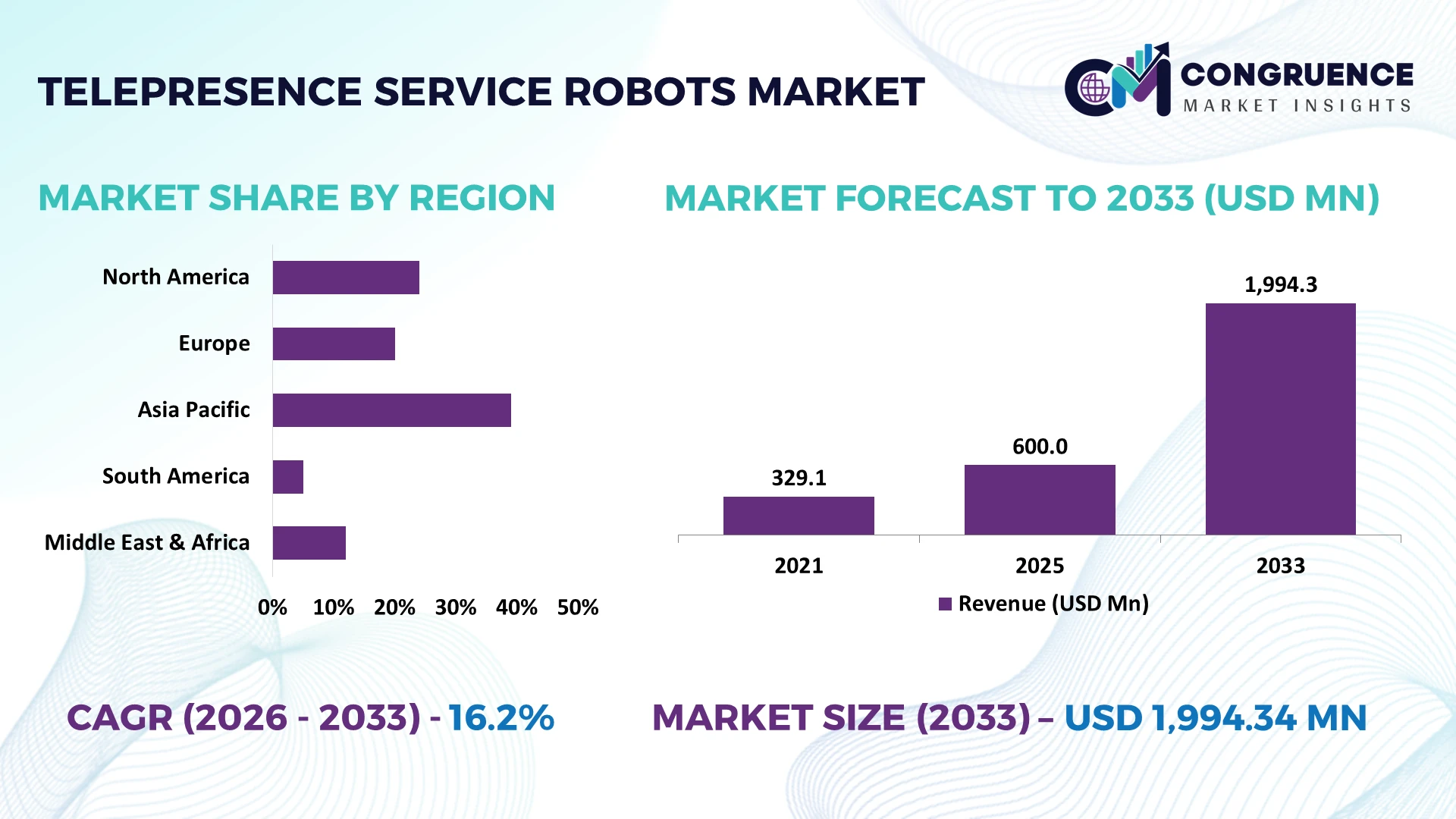
The United States leads with an estimated 34% global share, supported by hospital networks, universities, technology enterprises, and mature cloud infrastructure. More than 20% of U.S. healthcare organizations use robotic technologies across clinical or operational workflows. China operates at greater manufacturing scale and benefits from its robotics supply chain; amid U.S.–China technology restrictions, localization of cameras, sensors, compute modules, and connectivity hardware is becoming strategically important.
Buyers should prioritize interoperable autonomous platforms, secure communications, and suppliers with resilient component sourcing because deployment economics increasingly depend on software capability and lifecycle support rather than robot hardware alone.
Market Size & Growth: USD 600 million in 2025 advances to USD 1,994.34 million by 2033 at 16.2% CAGR, driven by autonomous remote-presence workflows.
Top Growth Drivers: Hybrid operations contribute approximately 35%, healthcare digitalization 30%, and remote inspection requirements 20% of deployment momentum.
Short-Term Forecast: By 2028, improved autonomy and fleet management are positioned to reduce human navigation intervention by approximately 25%, improving robot utilization.
Emerging Technologies: AI vision, autonomous SLAM navigation, 5G connectivity, and edge computing are increasing navigation accuracy, security, and real-time interaction across advanced deployments.
Regional Leaders: By 2033, North America approaches USD 650 million, Asia-Pacific USD 620 million, and Europe USD 470 million, led by enterprise, healthcare, and education adoption respectively.
Consumer/End-User Trends: Healthcare and enterprise facilities collectively represent approximately 55% of deployments as buyers prioritize remote consultation, inspection, collaboration, and specialist access.
Pilot/Case Example: In 2025, hospital telepresence workflows reduced specialist travel requirements by approximately 20% in selected remote-care deployments, strengthening distributed clinical coverage.
Competitive Landscape: Double Robotics holds an estimated 15% share, competing with OhmniLabs, Ava Robotics, VGo Communications, and Suitable Technologies across enterprise and institutional deployments.
Regulatory & ESG Impact: Remote-presence deployment can reduce business-travel requirements by 15–25%, supporting corporate emissions targets while increasing pressure for secure video and patient-data handling.
Investment & Funding: Robotics funding exceeded USD 7 billion globally across major 2025 funding rounds, strengthening AI autonomy, sensing, navigation, and commercial service-robot ecosystems.
Innovation & Future Outlook: Autonomous docking, multimodal AI, 5G, and fleet orchestration will shift 30%+ of advanced deployments toward increasingly self-directed remote-presence operations through 2028.
The Telepresence Service Robots Market is moving from manually driven video platforms toward autonomous mobile collaboration systems for hospitals, offices, factories, education, and remote inspection. AI perception and SLAM navigation are reducing operator intervention by approximately 25%, while 5G and edge computing improve interaction quality. Supply-chain localization and cybersecurity requirements are simultaneously reshaping procurement, establishing the strategic context for deployment decisions.
Telepresence service robots are becoming strategically important because enterprises, hospitals, universities, and industrial sites are shifting remote collaboration from fixed video terminals toward mobile, autonomous presence. The key market shift is digital infrastructure modernization: Wi-Fi 6/6E, private 5G, edge computing, and cloud fleet-management platforms now support lower-latency navigation and more reliable multi-site deployment. In hospitals, remote specialist access and ward rounding reduce physical travel requirements while extending scarce expertise across distributed facilities.
Compared with legacy manually driven telepresence systems, autonomous SLAM-enabled robots can reduce operator navigation intervention by roughly 20–30%, improving utilization and lowering supervision time. The United States leads enterprise and healthcare deployment, while China benefits from greater robotics manufacturing depth and localized component ecosystems. South Korea and Japan remain strong in service-robot engineering and smart-facility integration. Through 2026–2028, adoption will increasingly favor autonomous docking, AI vision, and centralized fleet control across multi-building environments.
A practical deployment model uses robots for remote ICU rounding, factory inspection, or hybrid-office walkthroughs while one operator supervises multiple units. Vendors are responding through hospital partnerships, enterprise software integration, and component localization. Competitive advantage will depend on secure autonomy, interoperable fleet management, and reliable lifecycle support rather than hardware mobility alone.
Enterprise and healthcare buyers are moving from static videoconferencing toward mobile telepresence systems that combine two-way communication with autonomous navigation. AI-enabled SLAM can reduce manual driving intervention by approximately 25%, while autonomous docking can raise daily robot availability by 15–20% by limiting charging-related downtime. In the United States, hospitals, universities, and technology campuses are integrating mobile robots into remote rounding, specialist consultation, security observation, and hybrid-work workflows. Private 5G and Wi-Fi 6 deployments are strengthening connectivity in larger facilities, removing a key operational bottleneck. Vendors are responding by embedding fleet analytics, obstacle avoidance, and cloud-based scheduling into their platforms. The strategic shift is clear: buyers increasingly value workflow integration and labor leverage more than simple video mobility.
Telepresence deployments remain constrained by inconsistent indoor connectivity, fragmented software environments, and dependence on specialized sensors, cameras, batteries, and compute modules. Enterprise Wi-Fi dead zones can reduce effective robot availability by 10–20% in large facilities, while battery degradation can cut usable runtime by approximately 15% after intensive multi-shift operation. U.S.–China technology restrictions and semiconductor supply-chain localization are also affecting sourcing strategies for embedded processors and vision hardware. Hospitals face an additional interoperability burden because robots must operate alongside electronic health records, identity systems, and secure communications platforms. Companies are reducing exposure through multi-supplier component strategies, modular hardware designs, local service inventories, and software APIs. Operationally, platform standardization now matters as much as acquisition cost because integration failures directly limit fleet scalability.
The strongest opportunity lies in transforming telepresence robots from single-purpose communication devices into multi-function autonomous service platforms. AI vision, edge inference, and fleet orchestration can allow one operator to supervise 3–5 robots while reducing routine navigation workload by roughly 30%. In Japan and South Korea, smart hospitals, campuses, and commercial buildings provide strong test environments for robots combining telepresence with inspection, wayfinding, documentation, and environmental monitoring. Private 5G can further reduce communication latency by more than 50% compared with congested legacy wireless environments under controlled deployments. Vendors are investing in vertical software, API ecosystems, and partnerships with healthcare IT and facility-management providers. The non-obvious opportunity is recurring software and fleet-service income, which can become more strategically valuable than one-time hardware sales.
Long-term deployment depends on solving cybersecurity, remote-access governance, and operational consistency across large robot fleets. Telepresence units combine cameras, microphones, cloud connectivity, and mobile access, creating a broader attack surface than fixed conferencing endpoints. Enterprises commonly report that more than 70% of connected devices require continuous security monitoring, while patching delays can leave 10–15% of distributed endpoints outside target update windows. In healthcare, these risks intensify because robots can enter patient areas and interact with protected clinical information. Companies must invest in encrypted communications, device identity, zero-trust access, over-the-air patching, and centralized fleet telemetry. The strategic challenge is not building a capable robot; it is maintaining hundreds of secure, compliant, continuously available units across different networks, facilities, and regulatory environments.
Autonomy Replaces Manual Navigation: Telepresence fleets are shifting toward SLAM, obstacle avoidance, and autonomous docking, cutting operator navigation intervention by approximately 25–30% and potentially improving productive availability by 15–20%. Vendors are embedding mapping, route scheduling, and centralized fleet controls, allowing enterprises to scale robots without proportionally expanding operator headcount.
Hospitals Formalize Robotic Telepresence Workflows: U.S. healthcare systems increasingly deploy mobile units for specialist consultations, remote rounding, interpretation, and isolation-room communication. Virtual-care workflows can reduce avoidable clinician travel by 20–30% while connecting specialists within minutes. Vendors are strengthening healthcare integrations, encrypted communications, and configurable carts as hospitals standardize remote-care infrastructure.
Robots Gain Multi-Purpose Workflows: Enterprises are expanding robots beyond video meetings into facility walkthroughs, equipment observation, security checks, and remote troubleshooting. Combining telepresence and inspection can increase individual robot utilization by 20–35% versus meeting-only deployments. Manufacturers are adding higher-resolution cameras, environmental sensors, APIs, and workflow software to capture multiple operational budgets.
Hardware Supply Chains Regionalize: Semiconductor restrictions and electronics-supply uncertainty are pushing robot developers toward multi-sourcing of cameras, LiDAR, processors, batteries, and communication modules. Component localization can shorten replacement lead times by 15–25%, while modular designs reduce maintenance downtime by roughly 20%. U.S. and Chinese suppliers are increasingly developing geographically differentiated component ecosystems and service inventories.
Wheeled Systems lead the Telepresence Service Robots Market with approximately 42% share, reflecting their favorable balance of mobility, payload capacity, battery efficiency, and deployment cost. Their established differential-drive architectures simplify navigation through hospitals, offices, campuses, and commercial buildings while supporting cameras, displays, microphones, and environmental sensors. Mobile Systems represent another established category, particularly where flexible room-to-room communication outweighs advanced autonomy. Desktop Systems remain relevant for fixed or semi-mobile remote interaction where physical navigation provides limited incremental value.
Autonomous Systems are the fastest-growing type as SLAM, AI vision, obstacle avoidance, and self-docking reduce dependence on continuous remote driving. Autonomous navigation can lower manual intervention by approximately 25–30%, while automated charging can improve operational availability by 15–20%. Humanoid Systems remain an emerging premium category because mechanical complexity and higher deployment requirements constrain scale. Manufacturers are consequently directing engineering investment toward autonomous wheeled platforms, modular sensor packages, fleet-management software, and standardized APIs rather than mechanically complex form factors.
Remote Collaboration accounts for approximately 34% of telepresence service robot demand, supported by distributed workforces, geographically separated technical teams, and enterprise requirements for mobile interaction beyond conference rooms. Robots allow remote employees and specialists to navigate facilities independently rather than depending on an onsite person carrying a device. Corporate Communication remains closely linked to this use case, although deployment increasingly concentrates on executive presence, hybrid events, and multi-site operational coordination. Education uses robots for remote classroom participation, campus access, and continuity for geographically or physically absent students.
Healthcare is the fastest-growing application as telepresence moves into specialist consultation, ward rounds, isolation-room communication, and multidisciplinary workflows. Robotic virtual-presence models can reduce clinician travel requirements by approximately 20–30% and accelerate specialist access by more than 25% in distributed settings. Facility Inspection is also gaining operational relevance as high-resolution imaging and sensors extend robots beyond communication. Suppliers are responding with healthcare-grade security, stronger cameras, autonomous routing, and integration APIs, shifting investment toward mission-specific software rather than universal hardware.
Hospitals represent the leading end-user segment with approximately 30% share because telepresence robots address specialist shortages, distributed clinical coverage, infection-control workflows, and continuous communication requirements. Unlike conventional video systems, mobile platforms can move between wards, patient rooms, and clinical teams without requiring dedicated equipment at every location. Corporate Offices remain significant through hybrid collaboration and remote site access, while Educational Institutions use robots to connect absent students, visiting lecturers, and geographically separated campuses.
Manufacturing Facilities represent the fastest-growing end-user group as operators extend telepresence into remote troubleshooting, plant walkthroughs, supplier audits, and equipment observation. Combining visual collaboration with inspection can increase robot utilization by approximately 20–35% compared with meeting-only use. Hospitality Businesses remain an emerging segment for remote concierge, property supervision, and event interaction. Vendors are targeting these groups with vertical software packages, leasing models, sensor customization, and systems-integration partnerships. Investment is shifting toward fleets capable of generating operational value across multiple workflows rather than single-purpose communication.
North America accounted for the largest market share at 36% in 2025 however, Asia-Pacific is expected to register the fastest growth, expanding at a CAGR of 18.4% between 2026 and 2033.
Healthcare and Enterprise Fleets Scale
North America holds approximately 36% of telepresence service robot demand, supported by mature hospital digital infrastructure, hybrid enterprise operations, advanced wireless networks, and established robotics integrators. U.S. healthcare systems increasingly use mobile platforms for specialist rounding, patient observation, interpretation, and remote consultation, while corporate deployments emphasize multi-site collaboration and facility walkthroughs. Approximately 86.9% of U.S. hospitals offered telehealth services by 2023, creating substantial infrastructure compatibility for robotic telepresence. Private 5G, Wi-Fi 6, cloud fleet management, and autonomous docking are reducing dependence on continuously operated robots. Canadian adoption concentrates around healthcare, higher education, and geographically distributed organizations. Vendors are responding with encrypted video, centralized device administration, API integration, and leasing models, shifting competition toward recurring fleet services and uptime rather than standalone hardware functionality.
United States Market Outlook: The United States combines sophisticated hospital networks, enterprise IT infrastructure, robotics engineering, and high telehealth penetration. Organizations increasingly require HIPAA-compatible communications, remote device administration, and integration with existing collaboration platforms. Deployment economics favor vendors capable of supporting multiple robots centrally, particularly across hospital groups, technology campuses, universities, and geographically distributed industrial facilities.
Compliance-Driven Automation Shapes Deployment
Europe represents approximately 25% of global demand, with Germany, France, the United Kingdom, the Netherlands, and Nordic countries providing the strongest institutional deployment environments. Hospitals, universities, manufacturers, and corporate campuses increasingly integrate telepresence robots with broader digital-workplace and service-automation programs. Germany provides particular strength through industrial robotics expertise and Industry 4.0 infrastructure, supporting remote factory walkthroughs and engineering collaboration. Europe installed approximately 92,000 industrial robots during 2023, demonstrating a mature automation ecosystem transferable to professional service robotics. GDPR requirements simultaneously raise expectations around camera access, data storage, identity management, and encrypted communications. Vendors are adapting through privacy-by-design software, localized cloud infrastructure, configurable data-retention controls, and systems-integration partnerships. Sustainability strategies also support remote-presence workflows where replacing specialist travel delivers measurable operational and emissions benefits without disrupting technical collaboration.
Germany Market Outlook: Germany combines advanced manufacturing facilities, industrial automation expertise, research institutes, and strong enterprise connectivity. Manufacturing accounts for roughly one-fifth of national economic output, creating attractive deployment environments for remote inspection and engineering support. Suppliers targeting Germany increasingly integrate telepresence with factory digitalization, autonomous navigation, secure enterprise networks, and predictive-maintenance workflows rather than positioning robots purely as communication devices.
Manufacturing Scale Accelerates Robot Commercialization
Asia-Pacific accounts for approximately 28% of global telepresence service robot demand and combines the strongest manufacturing ecosystem with rapidly expanding service-robot deployment. China, Japan, South Korea, Singapore, and India provide distinct adoption pathways spanning hospitals, factories, schools, corporate campuses, and hospitality facilities. China installed approximately 276,000 industrial robots in 2023, giving domestic manufacturers extensive access to motors, batteries, sensors, controllers, cameras, and navigation components. Japan and South Korea contribute sophisticated service-robot engineering, while Singapore offers highly connected test environments for autonomous systems. Component localization is becoming strategically significant as U.S.–China semiconductor controls alter processor and advanced electronics sourcing. Manufacturers are responding by developing domestic supply networks, lower-cost autonomous platforms, localized AI stacks, and vertically integrated production. This scale advantage supports faster product iteration and increasingly competitive export pricing.
China Market Outlook: China offers the strongest manufacturing advantage through dense electronics, battery, actuator, sensor, and robotics supply chains. The country accounted for approximately 51% of global industrial robot installations in 2023, illustrating its automation scale. Telepresence manufacturers can leverage Shenzhen and other technology clusters to shorten component sourcing, prototype cycles, and hardware customization while progressively localizing navigation and AI computing technologies.
Remote Expertise Drives Selective Deployment
South America represents approximately 5% of global telepresence service robot demand, with Brazil accounting for the largest deployment concentration. Adoption remains selective, centered on private hospitals, universities, industrial facilities, corporate offices, and geographically dispersed operations where specialist travel carries significant time and cost penalties. Brazil’s large healthcare system and manufacturing base create practical use cases for remote consultation, technical troubleshooting, training, and facility walkthroughs. More than 80% of Brazil’s population uses the internet, supporting cloud-connected services, although inconsistent enterprise-grade connectivity outside major urban centers restricts autonomous fleet scalability. Chile and Colombia provide smaller opportunities in healthcare, mining, education, and corporate operations. Vendors are addressing affordability through leasing, robotics-as-a-service, modular configurations, and local distribution partnerships, reducing upfront procurement barriers while improving maintenance responsiveness.
Brazil Market Outlook: Brazil provides the region’s strongest combination of healthcare scale, universities, manufacturing operations, and enterprise digitalization. São Paulo concentrates technology integrators and sophisticated private healthcare infrastructure, creating a practical entry point for vendors. Commercial success depends on local technical support, Portuguese-language interfaces, flexible financing, and robots capable of maintaining reliable performance across variable network conditions.
Smart Infrastructure Creates Deployment Hubs
Middle East & Africa represents approximately 6% of global telepresence service robot demand, with deployment concentrated in the United Arab Emirates, Saudi Arabia, Israel, and South Africa. Gulf smart-city investment, advanced hospitals, premium hospitality, universities, and digitally modernized corporate facilities provide suitable environments for connected service robots. The UAE achieved 99% internet usage, supporting cloud-controlled mobility and high-definition video interaction across commercial environments. Saudi Arabia is simultaneously expanding digital health and smart infrastructure under Vision 2030, encouraging automation trials across hospitals and large facilities. Outside major hubs, connectivity quality, maintenance coverage, and specialist robotics skills remain limiting factors. Suppliers are therefore prioritizing distributor partnerships, remote diagnostics, fleet-management software, and robotics-as-a-service models. Successful deployment increasingly follows infrastructure concentration rather than population scale, making digitally advanced cities the primary commercial gateways.
United Arab Emirates Market Outlook: The UAE combines high-quality connectivity, smart-building investment, advanced private healthcare, international business activity, and concentrated hospitality infrastructure. Dubai and Abu Dhabi provide attractive environments for autonomous telepresence across hospitals, hotels, exhibitions, campuses, and corporate facilities. Vendors benefit from centralized urban deployment patterns that simplify fleet servicing, technical support, demonstrations, and enterprise partnership development.
Telepresence service robot competition pits established specialists such as Double Robotics, Ava Robotics, OhmniLabs, VGo Communications, and Pudu Robotics against broader autonomous service-robot suppliers entering remote collaboration. The top five account for approximately 45% of deployments, leaving procurement fragmented across enterprise, healthcare, education, and industrial workflows. Double Robotics competes through simplicity and installed familiarity, while Ava and autonomous-platform vendors differentiate through navigation, security, and fleet integration. Autonomous routing can reduce operator intervention by 25–30%, while self-docking raises productive availability by roughly 15–20%; modular hardware can lower maintenance downtime by about 20%. Vendors are expanding software subscriptions, integrator partnerships, vertical applications, and localized service networks. Competition is shifting from remotely driven video hardware toward autonomous, centrally managed fleets. Cybersecurity certification, navigation reliability, component availability, and enterprise integration create substantial entry pressure. Winning requires secure autonomy, dependable uptime, vertical workflow integration, competitive lifecycle economics, and scalable after-sales support across deployments.
Double Robotics
Ava Robotics
OhmniLabs
VGo Communications
Pudu Robotics
Blue Ocean Robotics
RobotLAB
temi Global
InTouch Health
AMY Robotics
Camanio
PadBot
Wicron
Endurance Robotics
Current telepresence platforms combine autonomous SLAM navigation, depth sensing, collision avoidance, encrypted WebRTC video, and cloud fleet management. Double 3 uses stereovision, ultrasonic sensing, 13-megapixel cameras, and four-hour runtime, while temi V3 navigates to 5-centimeter accuracy. Compared with manually driven legacy platforms, autonomous routing can reduce navigation intervention by 25–30%, improving operator productivity and multi-site availability.
Emerging systems integrate omnidirectional mobility, edge AI, workflow APIs, secure telehealth software, and automated docking. Ava’s healthcare platform combines 1080p video, a 21.5-inch display, 9-liter storage, and 3D collision avoidance, demonstrating convergence between communication and hospital logistics. AI-assisted routing and centralized administration can improve fleet utilization by 15–20%; adoption is shifting from isolated units toward managed enterprise fleets across hospitals and industrial sites.
Disruptive technology is moving toward embodied AI, multimodal perception, and robots that combine telepresence with delivery, inspection, and clinical workflows. VSee’s 2026 autonomous telehealth robot integrates virtual rounding, specialist coverage, and supplies delivery, eliminating onsite staff assistance for navigation. Through 2026–2028, platforms integrating AI orchestration, autonomous mobility, cybersecurity, and interoperable APIs should gain deployment share. Healthcare networks, manufacturers, and vendors controlling software ecosystems benefit most because multifunction robots spread hardware costs across more workflows, improving utilization while strengthening recurring service relationships.
August 2024 — OhmniLabs debuted OhmniCare Mobile Telehealth Robot for veteran healthcare evaluation at National SimVET, joining nine robotics companies. The healthcare-focused platform strengthened remote patient access and positioned mobile telepresence for clinical workflows requiring specialist presence without physical travel. Source: ohmnilabs.com
December 2024 — Symbotic completed its acquisition of OhmniLabs, combining large-scale AI automation with mobile healthcare robots, computer vision, and in-house manufacturing. The transaction expanded Symbotic beyond warehouse automation and created a platform for faster robotics innovation across healthcare environments. Source: symbotic.com
February 2025 — Ava Robotics introduced the Ava Healthcare Robot, combining autonomous mobility, encrypted telemedicine, a 21.5-inch 1080p display, and 9-liter storage. The platform reduces staff-dependent cart movement while enabling remote specialists to reach patient bedsides and support clinical workflows. Source: avarobotics.com
March 2026 — VSee launched its autonomous telehealth AI robot at HIMSS 2026, integrating virtual rounding, telestroke response, specialist coverage, and supplies delivery. The system removes onsite navigation assistance, enabling health systems to consolidate several manual workflows onto one platform. Source: vseehealth.com
The Telepresence Service Robots Market Report evaluates Wheeled Systems, Desktop Systems, Autonomous Systems, Mobile Systems, and Humanoid Systems across Remote Collaboration, Healthcare, Education, Corporate Communication, and Facility Inspection. End-user coverage includes Hospitals, Corporate Offices, Educational Institutions, Manufacturing Facilities, and Hospitality Businesses. Regional analysis spans North America, Europe, Asia-Pacific, South America, and Middle East & Africa, with country-level assessment of deployment infrastructure, digital readiness, robotics manufacturing, and procurement conditions.
The scope examines SLAM navigation, LiDAR, depth sensing, AI vision, autonomous docking, edge computing, secure video, fleet orchestration, and embodied AI. Wheeled systems represent approximately 42% of type demand, while hospitals account for about 30% of end-user deployment. The 2026–2033 assessment supports technology investment, market entry, partnership selection, product positioning, geographic expansion, and competitive planning, including emerging opportunities in autonomous telehealth, remote industrial inspection, and multifunction robotic workflows.
| Report Attribute/Metric | Report Details |
|---|---|
Market Revenue in 2025 | USD 600 Million |
Market Revenue in 2033 | USD 1994.34 Million |
CAGR (2026 - 2033) | 16.2% |
Base Year | 2025 |
Forecast Period | 2026 - 2033 |
Historic Period | 2021 - 2025 |
Segments Covered | By Type
By Application
By End-User
|
Key Report Deliverable | Revenue Forecast, Growth Trends, Market Dynamics, Segmental Overview, Regional and Country-wise Analysis, Competition Landscape |
Region Covered | North America, Europe, Asia-Pacific, South America, Middle East, Africa |
Key Players Analyzed | Double Robotics, Ava Robotics, OhmniLabs, VGo Communications, Pudu Robotics, Blue Ocean Robotics, RobotLAB, temi Global, InTouch Health, AMY Robotics, Camanio, PadBot, Wicron, Endurance Robotics |
Customization & Pricing | Available on Request (10% Customization is Free) |




