
Reports
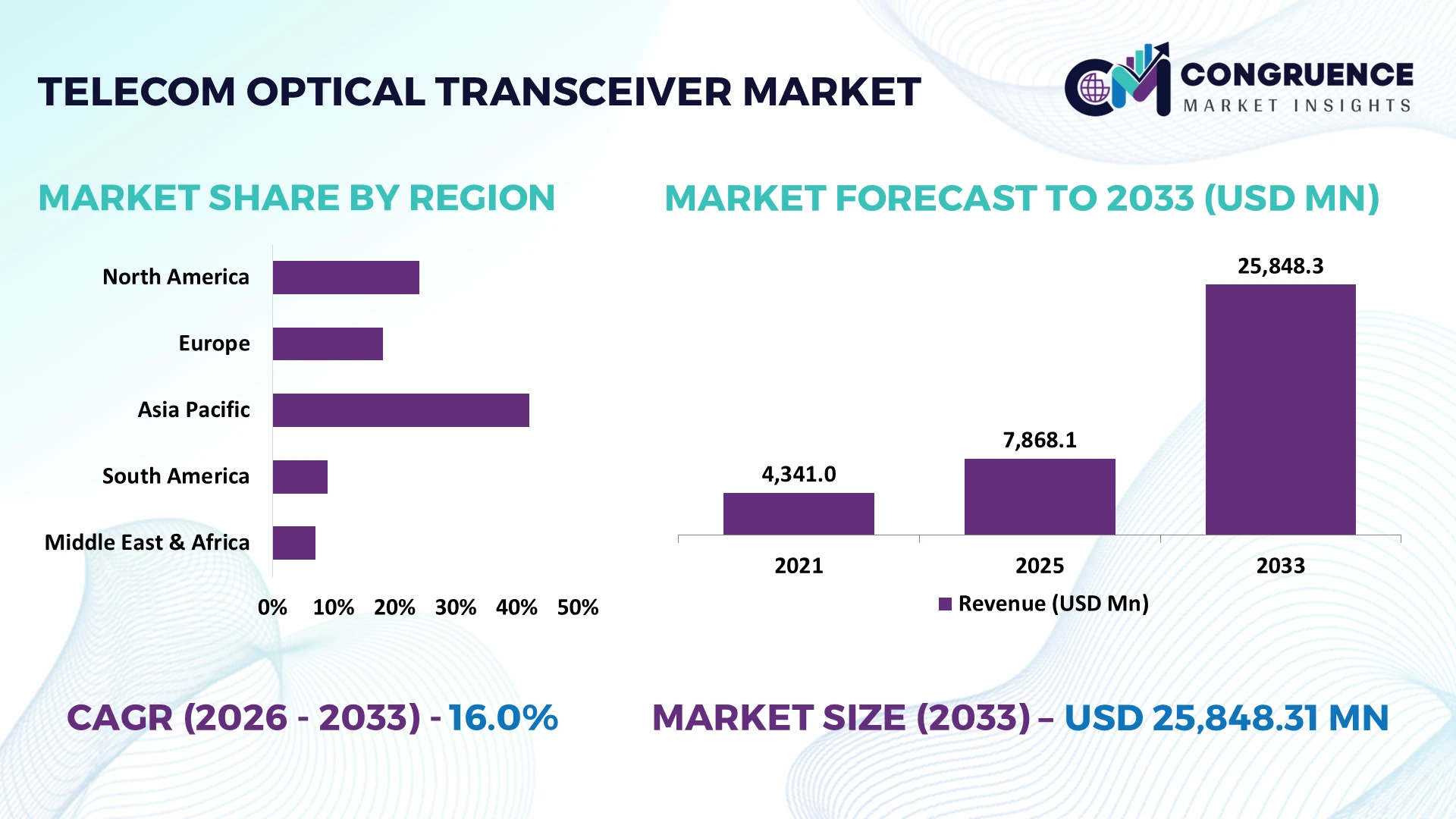
The Global Telecom Optical Transceiver Market was valued at USD 7,868.1 Million in 2025 and is anticipated to reach a value of USD 25,848.3 Million by 2033 expanding at a CAGR of 16.03% between 2026 and 2033. AI cluster interconnect density and 800G/1.6T datacom upgrades are redefining transceiver demand from telecom-grade commodity to AI infrastructure bottleneck component.
China commands approximately 64% of global datacom optical transceiver consumption, anchored by hyperscale buildouts from Alibaba, Tencent, and Baidu alongside a manufacturing base that supplies roughly two-thirds of global unit volume. The United States follows with about 17% share, yet its hyperscalers remain structurally dependent on Chinese module capacity for 800G and emerging 1.6T deployments.
Strategic implication: supply-chain geography now carries as much weight as transceiver throughput specifications in procurement decisions.
Market Size & Growth: Valued at USD 7,868.1 Million in 2025, forecast to USD 25,848.3 Million by 2033, driven by AI-driven 800G/1.6T datacom upgrades displacing legacy telecom-grade modules.
Top Growth Drivers: AI cluster optical interconnect demand (60%+ Ethernet transceiver sales growth in AI networks), hyperscaler capex expansion (Meta and Oracle doubling investments by 2026), and 5G fronthaul densification.
Short-Term Forecast: By 2026, 1.6T module shipments approach 10 million units, while linear pluggable optics reduce per-port power consumption by approximately 30% versus DSP-based equivalents.
Emerging Technologies: Co-packaged optics (CPO) for scale-up connectivity, silicon photonics wafer-scale manufacturing, and linear-drive pluggable optics (LPO) reshaping cost structures.
Regional Leaders: China (~USD 5.0 Billion, 64% datacom share, hyperscale domestic demand), North America (~USD 1.3 Billion, 17% share, AI cluster deployment), Japan (~USD 0.5 Billion, 6% share, precision component supply).
Consumer/End-User Trends: Datacom applications capture 39.53% of global transceiver demand in 2026, as cloud operators prioritize intra-data-center bandwidth over traditional telecom transport.
Pilot/Case Example: 2025—Innolight 1.6T OSFP modules deployed in North American hyperscale AI clusters, enabling 207% year-over-year revenue growth for the supplier.
Competitive Landscape: Innolight leads with approximately 27% datacom transceiver revenue share; Coherent (~17%), Eoptolink, Lumentum (~6%), and Accelink round out the top tier.
Regulatory & ESG Impact: FCC draft restrictions on Chinese transceivers threaten to reprice 60% of global datacom module supply, while CPO adoption targets 30%+ power reduction for AI scale-up fabrics.
Investment & Funding: Chinese module makers have committed over USD 1 billion to Thai and Southeast Asian manufacturing capacity, seeking tariff and regulatory diversification.
Innovation & Future Outlook: 3.2T transceiver development and linear receive optics (LRO) signal a strategic shift from pluggable commoditization toward vertically integrated photonic engines.
The Telecom Optical Transceiver Market is pivoting decisively toward AI-optimized datacom architectures, with 800G modules serving as the volume workhorse while 1.6T ramps into hyperscale deployments. Linear pluggable optics and co-packaged solutions are emerging as power-efficient alternatives to conventional DSP-based designs, with LPO variants targeting roughly 30% power reduction. A parallel trend is the geographic diversification of manufacturing, as Chinese suppliers expand Thai production lines to hedge against regulatory exposure in North American markets. These dynamics set the stage for a strategic reassessment of where transceiver value accrues—and who controls it.
Optical transceivers have shifted from peripheral telecom plumbing to mission-critical AI infrastructure, where a single missing batch of 800G modules can idle billion-dollar GPU clusters. The FCC’s proposed restrictions on Chinese transceivers expose a structural vulnerability: Western suppliers lack the cleanroom capacity and automated packaging scale to absorb Chinese volume within 12 to 24 months, risking multi-quarter delays in hyperscale cluster turn-ups. This supply-chain restructuring is forcing procurement teams to weigh geopolitical provenance alongside wavelength and reach specifications.
Technology comparison underscores the stakes. Linear pluggable optics eliminate the DSP chip, cutting per-port power consumption by approximately 30% and reducing bill-of-materials costs for hyperscale operators, though at the expense of reach and interoperability flexibility. Regionally, China’s 64% datacom consumption share reflects domestic hyperscale buildouts capped at lower-density clusters due to export controls, while North America’s 17% share concentrates on the highest-value 800G and 1.6T allocations. Over the next two to three years, 1.6T module shipments approaching 10 million units annually will test whether Thai and Malaysian assembly lines can satisfy U.S. compliance requirements without Chinese R&D provenance.
A practical deployment example: Innolight’s 2025 ramp of 1.6T OSFP modules for North American cloud giants drove 207% year-over-year quarterly revenue growth, demonstrating how early qualification with hyperscalers translates into disproportionate share gains. Companies are responding by front-loading capacity investments in Southeast Asia, pursuing joint development models with cloud operators, and locking in upstream laser and DSP supply through multi-year agreements. The strategic conclusion is unambiguous: competitive positioning now hinges on regulatory-compliant manufacturing footprints and co-development relationships with hyperscalers, not merely transceiver throughput leadership.
Hyperscale AI training clusters are hitting copper interconnect limits, forcing a structural migration to optical transceivers for rack-to-rack and cluster-to-cluster fabrics. Datacom optical component revenue exceeded USD 19 billion in 2025, a 70% increase over 2024, with over 42 million high-speed modules shipped. Innolight’s 800G and 1.6T allocations with North American cloud providers generated 61% year-over-year revenue growth in 2025, prompting the company to expand Thai assembly capacity and deepen co-development engagements with Google and Microsoft. The strategic insight: transceiver qualification cycles now precede GPU cluster deployment timelines, making supplier selection an AI infrastructure decision rather than a procurement formality.
The FCC’s proposed restrictions on Chinese optical transceivers threaten to reprice roughly 60% of global datacom module supply, with Chinese manufacturers accounting for nearly two-thirds of global unit volume. Innolight’s U.S. revenue concentration reached 57.3% in 2025, rising to 61.7% in early 2026, leaving the leading supplier structurally exposed to regulatory action. Western alternatives Coherent and Lumentum hold approximately 17% and 6% revenue share respectively, but lack the cleanroom capacity and automated packaging yield to absorb Chinese volume within a 12-to-24-month horizon. Companies are mitigating through Thai manufacturing expansion and non-Chinese R&D partnerships, yet these measures buffer rather than eliminate compliance risk.
Linear pluggable optics (LPO) and linear receive optics (LRO) eliminate the DSP chip from transceiver architectures, targeting approximately 30% per-port power reduction and meaningful bill-of-materials savings for hyperscale operators. With data center applications projected to capture 39.53% of global transceiver demand in 2026, LPO adoption offers hyperscalers a path to both capex relief and ESG-aligned power efficiency targets. Credo Technology introduced ZeroFlap optical transceivers in October 2025 supporting 400G, 800G, and 1.6T speeds with improved energy efficiency, signaling merchant silicon momentum behind linear architectures. The non-obvious opportunity lies in enterprise edge data centers, where LPO’s power and cost advantages could unlock adoption outside hyperscale environments.
The migration to 1.6T and co-packaged optics demands nanometer-level optical alignment precision at massive yields, a manufacturing competency concentrated in a narrow pool of Chinese and select Western engineers. With 1.6T module shipments forecast to approach 10 million units in 2026, qualification bottlenecks risk delaying hyperscale cluster turn-ups by multiple quarters. Co-packaged optics adoption for scale-up connectivity introduces additional integration complexity, requiring chip-level thermal management and known-good-die testing protocols that few assembly operations have scaled. Companies must invest in workforce training and automated optical alignment infrastructure across Thai, Malaysian, and U.S. facilities to prevent manufacturing yield from becoming the binding constraint on AI infrastructure deployment.
Thai Assembly Migration Accelerates Chinese module leaders are shifting volume assembly to Thailand at unprecedented pace, with Innolight and Eoptolink prioritizing Thai lines to hedge against U.S. regulatory exposure affecting roughly 60% of global datacom supply . This geographic diversification adds 15–20% to per-unit logistics and qualification costs but preserves access to North American hyperscaler allocations. Companies are pairing Thai capacity with non-Chinese laser sourcing to satisfy compliance audits ahead of potential FCC restrictions.
Linear Pluggable Optics Enter Volume Qualification LPO and LRO architectures are moving from lab trials to hyperscale qualification, targeting approximately 30% per-port power reduction versus DSP-based 800G modules. Credo’s ZeroFlap transceiver launch in late 2025 signaled merchant silicon readiness for 400G through 1.6T linear designs . Operators are re-evaluating switch compatibility matrices, as LPO’s reduced reach demands tighter fabric engineering—a workflow shift that favors vendors offering co-qualified switch-optics bundles.
Silicon Photonics Wafer-Scale Ramp Silicon photonics has emerged as the dominant platform for next-generation interconnects, driven by bandwidth density and a natural migration path toward co-packaged optics . Chinese vendors are investing in 300mm photonic wafer capacity to reduce dependence on indium phosphide laser supply, which remains constrained through mid-2026 . The non-obvious insight: silicon photonics lowers barriers for new entrants in modulator fabrication, potentially fragmenting the merchant optics market currently dominated by vertically integrated players.
1.6T Supply-Demand Equilibrium Looms LightCounting projects supply chain shortages easing by mid-2026, with 1.6T module shipments approaching 10 million units annually . Hyperscalers Meta and Oracle have doubled 2026 capex commitments, pulling forward transceiver orders. However, suppliers face a double-edged outcome: volume growth accelerates while pricing power erodes as allocation scarcity fades. Companies are responding by locking multi-year agreements with cloud operators and prioritizing 3.2T development to sustain differentiation.
The SFP family—encompassing SFP+, SFP28, and SFP56—commanded 35.7% of the optical transceiver market in 2025, sustained by backward compatibility, affordability, and pervasive deployment across enterprise switching, metro access, and broadband aggregation . These modules serve 1G to 25G applications where cost sensitivity dominates procurement decisions, and replacement cycles remain steady across both mature and emerging markets. QSFP28 follows as the workhorse for 100G data center fabrics, though its share is gradually yielding to higher-speed form factors.
The fastest-growing type is the 800G and emerging 1.6T OSFP/QSFP-DD segment, driven by AI cluster interconnect density and hyperscaler migration from 400G. Chinese vendors Innolight and Eoptolink have prioritized 1.6T qualification with North American cloud providers, while Coherent and Lumentum focus on 800G coherent variants for telecom transport. Mid-low speed transceivers retain relevance in price-sensitive telecom and enterprise segments, but investment priorities have decisively shifted toward 800G/1.6T capacity expansion and silicon photonics integration .
Datacom applications captured approximately 45% of the optical transceiver market in 2025, with cloud data center and AI cluster deployments representing the single largest demand concentration . The shift from 400G to 800G and 1.6T within hyperscale fabrics has made datacom the value anchor of the industry, as AI training clusters require optical interconnect densities that dwarf traditional enterprise or telecom transport requirements.
Telecom applications—encompassing 5G fronthaul, metro transport, and coherent long-haul—hold roughly 35% share and remain operationally critical but structurally mature . 5G deployment cycles have peaked in China, while North American and European operators prioritize 400ZR pluggable coherent optics for metro DCI rather than new fronthaul builds. Enterprise applications account for the remaining ~20%, with campus and colocation upgrades to 100G/400G providing incremental demand. The fastest-growing application sub-segment is AI cluster scale-up networking, where GPU-to-GPU optical connectivity is displacing copper at an accelerating pace.
IT and telecommunications operators represent the dominant end-user group, with hyperscale cloud providers—Amazon, Microsoft, Google, Meta, and Oracle—collectively accounting for the largest share of transceiver procurement value. Their AI infrastructure build-outs set product qualification timelines: when Meta qualifies an 800G module, the broader industry follows within 12 to 18 months. LightCounting data indicates optics spending by the top five cloud companies will reach 3.1% of their capex in 2026, up from 2.7% in 2025 .
The fastest-growing end-user segment is colocation data center operators, led by Equinix, Digital Realty, and NTT, which are upgrading interconnect fabrics to hyperscaler-grade 400G specifications as enterprise hybrid cloud workloads migrate to third-party facilities . This segment was historically served by lower-speed modules but now represents a meaningful incremental demand pool for 400G and early 800G deployments. Telecom operators remain steady buyers of coherent and 100G/200G modules but are not driving generational transitions. Companies are targeting colocation operators with cost-optimized 400G portfolios and extended service agreements, while hyperscalers receive co-development priority for 1.6T and LPO variants.
Asia-Pacific accounted for the largest market share at 38% in 2025 however, Middle East & Africa is expected to register the fastest growth, expanding at a CAGR of 19.7% between 2026 and 2033.

North America represents approximately 24% of global transceiver consumption, with United States hyperscale data center campuses driving the highest concentration of 800G and 1.6T deployments. The region’s operational advantage lies in early qualification cycles: Meta and Microsoft set generational adoption timelines that cascade to colocation and enterprise tiers within 12 to 18 months. Lumentum’s Thailand facility expansion targets volume production of 800G and 1.6T modules, positioning the company as a domestic-adjacent supplier to NVIDIA’s AI platform supply chain. Investment momentum remains concentrated in silicon photonics and linear pluggable optics qualification, with U.S. cloud operators funding co-development programs to reduce dependence on Chinese module assembly.
United States Market Outlook: The United States operates over 2,600 data centers, the densest hyperscale footprint globally, creating sustained pull for 400G and 800G transceivers across cloud, colocation, and enterprise segments. FCC regulatory posture on Chinese transceivers is reshaping procurement priorities, with domestic operators accelerating qualification of Coherent, Lumentum, and Source Photonics as compliant alternatives, driving a measurable shift toward non-Chinese supply chains.
Europe accounts for approximately 18% of global transceiver demand, with deployment concentration in Germany, the United Kingdom, and France focused on 400ZR coherent pluggables for metro DCI and 5G transport refresh cycles. The region’s structural distinction lies in regulatory-driven procurement: EU sovereignty initiatives and national broadband programs prioritize vendor diversification, creating openings for European and Japanese suppliers alongside established Chinese vendors. Operators including Deutsche Telekom and Orange are migrating legacy 100G coherent systems to 400G platforms, extending replacement cycles rather than pursuing hyperscale-grade 800G volume. Sustainability requirements embedded in public tenders are accelerating interest in linear pluggable optics for their measurable power reduction.
Germany Market Outlook: Germany anchors European demand through Deutsche Telekom’s metro and backbone modernization programs, with coherent 400G deployments prioritized across industrial and enterprise connectivity corridors. The country’s engineering base supports transceiver qualification and interoperability testing, while regulatory emphasis on supply-chain resilience favors vendors with EU-based assembly or certified non-Chinese manufacturing provenance.
Asia-Pacific commands approximately 42% of global transceiver consumption and dominates production, with China alone accounting for 64% of datacom module demand and supplying roughly two-thirds of global unit volume. The region’s operational advantage is structural: proximity between component suppliers, module assembly, and hyperscale customers compresses lead times and qualification cycles. Innolight and Eoptolink leverage this density to qualify 1.6T modules with North American cloud providers while serving domestic Alibaba and Tencent buildouts. Thailand and Malaysia are absorbing incremental assembly capacity as Chinese vendors hedge against U.S. regulatory exposure, with Lumentum and Coherent also expanding regional production.
China Market Outlook: China’s hyperscale ecosystem—Alibaba, Tencent, Baidu, and state-backed cloud operators—drives the highest absolute transceiver consumption globally, supported by domestic silicon photonics and laser supply chains that reduce import dependence. Export controls on advanced AI chips have redirected domestic investment toward optical interconnect optimization, creating parallel demand for 800G modules in constrained but high-density cluster architectures.
South America represents approximately 9% of global transceiver demand, with Brazil accounting for the majority of regional deployments. The region’s demand profile is distinct: rather than hyperscale AI clusters, growth is anchored by data center interconnection and submarine cable landing infrastructure. Brasscom projects USD 9 billion in Brazilian data center investment in 2025 alone, establishing a foundation for 400G and coherent 800G deployment. Cirion and BR.Digital are deploying Ciena’s WaveLogic 6 Extreme for 1.1 to 1.6 Tb/s single-carrier wavelengths, while V.tal’s 9,700 km Synapse submarine system, planned for 2026 construction, will require high-capacity line termination equipment at landing stations. Currency volatility and import tariff fragmentation constrain adoption pace.
Brazil Market Outlook: Brazil drives regional transceiver demand through São Paulo and Rio de Janeiro data center campuses, with internet service providers representing 64% of Padtec TMD400G acquisitions as they migrate directly from 100G to 400G coherent platforms. The country’s submarine cable landing infrastructure and expanding hyperscale colocation footprint create durable demand for coherent transport optics, though real depreciation pressure on imported equipment raises local currency costs by 10% to 15%.
Middle East & Africa accounts for approximately 7% of global transceiver consumption, with Saudi Arabia and the UAE anchoring regional demand through Vision 2030 digital infrastructure investment and NEOM data center pipelines. The region’s growth profile reflects lower hyperscale penetration but strategic sovereign funding: UAE hosts Equinix, AWS, and Google colocation facilities driving 100G and 400G enterprise demand, while South Africa’s Teraco Data Environments anchors sub-Saharan connectivity. Submarine cable landings on East and West African coasts are expanding international bandwidth capacity, creating incremental demand for coherent transceivers at landing stations and terrestrial backhaul points. Infrastructure financing constraints and lower AI cluster density temper volume relative to Asia-Pacific.
Saudi Arabia Market Outlook: Saudi Arabia’s NEOM and DataVolt data center programs represent the region’s most concentrated transceiver demand pipeline, backed by sovereign wealth funding and digital transformation mandates. The country’s strategic position as a bridge between Asian manufacturing and European connectivity routes supports submarine cable landing infrastructure investment, driving coherent 400G adoption for intercontinental and terrestrial transport links.
Innolight, Eoptolink, Coherent, Lumentum, and Ligent (Hisense) define the competitive core, with Chinese volume manufacturers clashing directly against Western coherent and component specialists. The top five players hold 49.9% combined revenue share, leaving the remainder fragmented across a dozen active suppliers. Competition pivots on three axes: hyperscaler qualification speed, silicon photonics integration depth, and regulatory-compliant manufacturing geography. Innolight’s 24.1% share reflects early 800G/1.6T ramp execution with North American cloud providers. The decisive shift is toward vertical integration—Innolight’s expanded Tower Semiconductor SiPho collaboration halves laser requirements per module, structurally lowering cost and supply-chain exposure. Entry barriers are no longer transceiver assembly; they are laser supply access, DSP silicon, and Thai or non-Chinese cleanroom capacity. Winning requires simultaneous leadership in photonic integration and geopolitical supply-chain engineering.
Innolight Technology
Eoptolink Technology
Coherent Corp.
Lumentum Holdings
Ligent Technologies (Hisense Broadband)
Accelink Technologies
Source Photonics
Broadcom Inc.
Cisco Systems
Fujitsu Optical Components
Sumitomo Electric Industries
Applied Optoelectronics
Molex, LLC
ATOP Corporation
Current production economics hinge on silicon photonics adoption, which cuts laser count per 800G/1.6T module by half and improves gross margins by roughly 6 percentage points for leading suppliers. Innolight’s SiPho-based 1.6T shipments now represent the margin-accretive product tier, outpacing legacy EML-based designs.
Emerging linear pluggable optics (LPO) eliminate the DSP chip, targeting approximately 30% per-port power reduction and simplifying thermal management in high-density AI racks. Coherent’s new 100G ZR QSFP-DCO demonstrates the opposite trajectory—coherent DSP integration extending into single-fiber bi-directional access, enabling 10x capacity on existing infrastructure. Both paths signal divergence: LPO wins short-reach AI fabrics, coherent DSP wins metro and access.
Disruptive co-packaged optics (CPO) remains pre-volume but strategically decisive. Lumentum’s ultra-high-power laser for external laser sources positions it as a CPO ecosystem supplier, while its R300 optical circuit switch cuts switching fabric power by up to 65%. From 2026 to 2028, suppliers integrating SiPho, LPO, and CPO-ready laser portfolios will capture hyperscaler co-development budgets; discrete pluggable assemblers face margin compression.
March 2025, Innolight & Tower Semiconductor Expanded SiPho collaboration ramps volume production, halving lasers per module for 400G/800G/1.6T, improving cost and supply-chain resilience. Source: towersemi.com
March 2025, Eoptolink Technology Unveiled industry-first 800G transceiver supporting multicore fiber at OFC 2025, reducing fiber count and installation complexity for AI data centers. Source: wirelessdesignonline.com
September 2025, Coherent Corp. Launched industry-first dual-laser 100G ZR QSFP-DCO enabling 10x capacity on existing single-fiber infrastructure for broadband access networks. Source: coherent.com
April 2025, Lumentum Holdings Announced 400/800G ZR+ L-band pluggable sampling, doubling usable wavelength range and fiber capacity for DCI and metro networks. Source: lumentum.com
The report delivers comprehensive coverage across form factors (SFP family, QSFP28, QSFP-DD, OSFP), data rates from sub-10G to 1.6T and emerging 3.2T, and applications spanning datacom, telecom transport, and enterprise networking. End-user segmentation addresses hyperscale cloud operators, colocation providers, telecom carriers, and enterprise buyers, with regional analysis across North America, Europe, Asia-Pacific, South America, and Middle East & Africa.
Quantitative indicators include segment share distribution—SFP family at 35.7%, 400G at 35.8% of datacom revenue, and top-five vendor concentration at 49.9%. The report supports investment planning through technology adoption curves (SiPho, LPO, CPO), supply-chain geography shifts toward Thailand, and competitive positioning frameworks for 2026–2033, enabling decisions on capacity expansion, partnership formation, and product portfolio prioritization.
| Report Attribute / Metric | Details |
|---|---|
| Market Revenue (2025) | USD 7,868.1 Million |
| Market Revenue (2033) | USD 25,848.3 Million |
| CAGR (2026–2033) | 16.03% |
| Base Year | 2025 |
| Forecast Period | 2026–2033 |
| Historic Period | 2021–2025 |
| Segments Covered |
By Type
By Application
By End-User
|
| Key Deliverables | Revenue Forecast; Market Trends; Growth Drivers & Restraints; Technology Insights; Segmentation Analysis; Regional Insights; Competitive Landscape; Regulatory & ESG Overview; Recent Developments |
| Regions Covered | North America; Europe; Asia-Pacific; South America; Middle East & Africa |
| Companies Profiled | Innolight Technology; Eoptolink Technology; Coherent Corp.; Lumentum Holdings; Ligent Technologies (Hisense Broadband); Accelink Technologies; Source Photonics; Broadcom Inc.; Cisco Systems; Fujitsu Optical Components; Sumitomo Electric Industries; Applied Optoelectronics; Molex, LLC; ATOP Corporation |
| Customization & Pricing | Available on Request (10% Customization Free) |




