
Reports
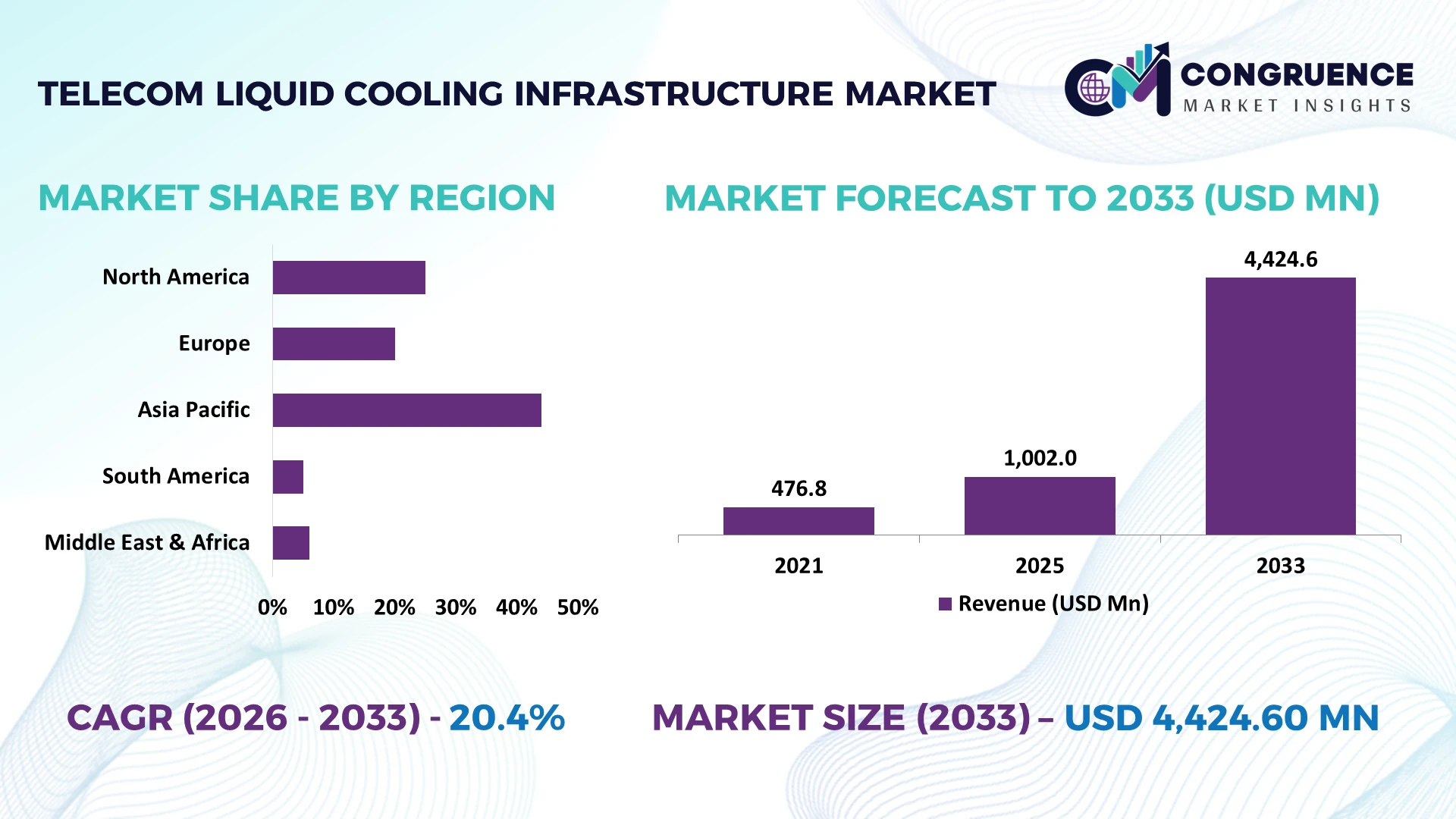
The Global Telecom Liquid Cooling Infrastructure Market was valued at USD 1002 Million in 2025 and is anticipated to reach a value of USD 4424.6 Million by 2033 expanding at a CAGR of 20.4% between 2026 and 2033. Rising power density in 5G baseband processing, edge data centers, and AI enabled telecom workloads is accelerating the replacement of conventional air cooling with direct to chip, immersion, and liquid assisted thermal management systems.
China holds the strongest deployment advantage, supported by 4.838 million 5G base stations at year end 2025, representing more than 70% of the global installed base. Its telecom ecosystem spans network equipment manufacturing, industrial automation, cloud computing, and AI infrastructure, with 5G coverage extending across urban and rural markets. The government's East Data, West Computing initiative further concentrates computing infrastructure in eight national hub regions. By comparison, China's 5G infrastructure scale substantially exceeds that of individual Western markets, strengthening domestic supplier integration and deployment economics.
Strategically, suppliers should prioritize China for manufacturing scale and operator partnerships while targeting North American and European edge infrastructure projects with high density thermal management requirements.
Market Size & Growth: USD 1,002 million in 2025, reaching USD 4,424.6 million by 2033 at 20.4% CAGR, driven by high density 5G and edge computing infrastructure.
Top Growth Drivers: 70%+ global 5G base station concentration in China, 22% direct liquid cooling adoption among surveyed data center operators, and 61% considering adoption.
Short-Term Forecast: By 2028, liquid cooling integration across AI and HPC facilities targets higher rack thermal capacity, with 45% average liquid cooled rack penetration reported among surveyed users.
Emerging Technologies: Direct to chip cooling, single phase immersion systems, and AI controlled coolant distribution improve thermal precision and equipment utilization.
Regional Leaders: Asia Pacific: USD 1,769.8 million; North America: USD 1,416 million; Europe: USD 929.2 million by 2033, using indicative regional allocation estimates. Adoption follows 5G expansion, AI infrastructure investment, and energy efficiency requirements.
Consumer & End User Trends: 61% of surveyed operators not yet using direct liquid cooling are considering deployment, indicating a substantial infrastructure conversion pipeline.
Pilot/Case Example: 2023 ITU T Recommendation L.1326 established liquid cooling requirements for centralized 5G baseband units, covering immersion, spray cooling, safety, and energy efficiency measurement.
Competitive Landscape: Vertiv, Huawei, Ericsson, Nokia, and Schneider Electric compete across telecom thermal management, liquid cooling equipment, and integrated infrastructure. No independently established telecom liquid cooling market share is available.
Regulatory & ESG Impact: China's national computing infrastructure program emphasizes energy efficient facilities, while ITU T standardization supports measurable cooling efficiency and safer deployment.
Investment & Funding: China's eight national computing hubs and expanding 5G infrastructure create large scale procurement opportunities for cooling equipment, coolant distribution units, and thermal management partnerships.
Innovation & Future Outlook: AI enabled thermal monitoring, modular cooling distribution, advanced dielectric fluids, and high density rack integration are shifting procurement toward complete cooling ecosystems rather than standalone equipment.
Demand is strengthening across 5G baseband units, telecom edge data centers, AI computing clusters, and high capacity network facilities where conventional air cooling faces thermal limitations. Direct to chip cooling, dielectric immersion systems, and intelligent coolant distribution are expanding the available deployment options. Industry adoption signals are significant, with 61% of surveyed operators considering direct liquid cooling despite not having deployed it. China's East Data, West Computing initiative reinforces demand for energy efficient computing infrastructure, while ITU T L.1326 standardization supports wider telecom integration. These developments create a strategic opportunity for suppliers to compete through integrated thermal management solutions.
Telecom liquid cooling infrastructure is becoming strategically important because thermal capacity increasingly determines how efficiently operators deploy 5G advanced networks, centralized radio access networks, and AI enabled edge computing. The shift from air cooled equipment to direct liquid cooling is changing infrastructure procurement, equipment design, and supplier relationships. ITU T Recommendation L.1326, approved in 2023, formalized requirements for immersion and spray cooling in centralized 5G baseband infrastructure, creating a clearer technical framework for adoption.
Technology economics are reshaping investment decisions. Unlike conventional air cooling, liquid cooling transfers heat directly from high density components, supporting substantially higher thermal loads. Uptime Institute's 2024 survey found that 22% of respondents already used direct liquid cooling, while 61% of nonusers considered future deployment. This indicates a sizeable conversion opportunity, although adoption remains concentrated in selected facilities.
Regional priorities differ considerably. China benefits from 4.838 million 5G base stations at the end of 2025, while North American operators prioritize AI infrastructure and high density edge facilities. During 2026–2028, suppliers should target modular cooling retrofits, standardized coolant distribution, and integrated monitoring. For example, telecom operators upgrading centralized baseband rooms can replace selected air cooled racks with liquid cooled systems rather than rebuild entire facilities. Competitive advantage will depend on retrofit compatibility, energy performance, and dependable local service partnerships.
Increasing thermal loads from centralized 5G baseband processing and AI enabled edge computing are accelerating liquid cooling adoption. China's 4.838 million 5G base stations at year end 2025 illustrate the infrastructure scale requiring advanced thermal management. Uptime Institute's 2024 survey found that 22% of respondents already deployed direct liquid cooling, while 61% of nonusers considered adoption. ITU T L.1326 specifically addresses immersion and spray cooling for centralized 5G baseband units. This standardization strengthens procurement confidence. Equipment manufacturers are responding through modular cooling systems, operator partnerships, and localized component production, making retrofit compatibility a competitive differentiator.
High retrofit complexity restricts liquid cooling penetration across conventional telecom facilities. Uptime Institute's 2024 survey found that 48% of direct liquid cooling users applied the technology to less than 10% of their IT racks, demonstrating the gap between initial adoption and infrastructure wide integration. Another 30% reported using liquid cooling in only a few servers. Existing air cooled equipment, facility layouts, coolant distribution requirements, and maintenance procedures complicate conversion. These limitations increase installation costs and extend deployment schedules. Suppliers are addressing the constraint through hybrid cooling architectures, standardized interfaces, modular distribution units, and long term maintenance agreements that reduce conversion requirements.
The transition toward AI enabled edge computing creates opportunities for modular direct to chip cooling, dielectric immersion, and intelligent coolant distribution. Uptime Institute reported that 61% of surveyed nonusers considered future direct liquid cooling deployment, establishing a substantial addressable adoption pipeline. Among existing users, 64% deployed water cooled cold plates and 30% used dielectric cooled cold plates, indicating established demand for component level thermal solutions. China's industrial computing hubs offer opportunities for integrated cooling infrastructure, while Indian telecom and data center operators represent emerging deployment customers. Manufacturers should prioritize R&D in leak detection, recyclable coolants, and modular retrofits to differentiate through lifecycle efficiency rather than equipment pricing alone.
Scaling liquid cooling across geographically distributed telecom infrastructure requires consistent coolant quality, leak monitoring, hydraulic balancing, and specialized maintenance capabilities. The 2024 Uptime Institute survey found that 48% of existing direct liquid cooling users covered less than 10% of their IT racks, highlighting the difficulty of achieving standardized deployment beyond initial installations. ITU T L.1326 also specifies safety requirements, liquid performance indicators, management procedures, and energy efficiency measurement for 5G baseband cooling. In India and other infrastructure expansion markets, operators must strengthen technician training, remote diagnostics, and component servicing. Suppliers that combine predictive monitoring with field service partnerships will secure stronger operational reliability and deployment consistency.
Direct to Chip Deployment Expands: Direct to chip cooling is gaining traction as AI enabled telecom workloads increase processor heat loads. IDC's 2025 Enterprise Infrastructure Pulse Survey recorded adoption at 31% in North America, 41% in Asia Pacific, and 14% in EMEA. Suppliers are expanding cold plate portfolios and coolant distribution partnerships to address regional deployment differences and high density rack requirements.
Hybrid Cooling Becomes Operational Standard: Operators are combining liquid cooled racks with conventional air cooling rather than replacing entire facilities. In 2025, 42% of surveyed organizations reported hybrid cooling in primary data centers, compared with 45% using fully air cooled systems. This transition reduces retrofit disruption and enables phased equipment upgrades. Infrastructure vendors are responding with integrated rear door heat exchangers and liquid distribution systems.
Retrofit Projects Reshape Procurement: Existing facility modernization is becoming a significant purchasing route. IDC's November 2025 survey found 46% of liquid cooling implementations involved retrofits, against 44% integrated into new facilities. This challenges suppliers to prioritize compatibility with existing racks, power infrastructure, and facility management systems. Telecom equipment manufacturers are increasingly coordinating cooling installations with network modernization contracts.
Specialist Skills Influence Deployment: Liquid cooling expansion is increasing dependence on trained thermal management personnel. AFCOM's 2026 survey reported workforce gaps affecting 87% of data center respondents, while 36% identified retraining and upskilling as a response. This makes installation and maintenance capabilities important procurement criteria. Suppliers are strengthening technical training, remote diagnostics, and service partnerships to reduce commissioning delays and operational dependence on scarce specialists.
Direct to Chip Cooling Leads Deployment
Direct to chip cooling represents an estimated 42% of the telecom liquid cooling infrastructure market's type mix, reflecting its compatibility with high performance processors, centralized baseband equipment, and dense computing racks. Its targeted heat removal, modular integration, and comparatively straightforward maintenance support wider enterprise adoption. Immersion cooling is the fastest emerging segment, with an estimated 24% share, supported by applications requiring intensive thermal management and reduced dependence on conventional airflow. Operators are increasingly evaluating immersion systems for specialized computing environments rather than replacing established cooling infrastructure universally.
Rear door heat exchangers remain relevant for hybrid retrofits, while liquid to air cooling supports facilities with limited liquid infrastructure. Liquid to liquid cooling serves installations requiring efficient heat transfer between equipment and facility loops. An estimated 55% of new advanced cooling evaluations prioritize direct component or rack level heat removal. Manufacturers are consequently expanding cold plate engineering, immersion partnerships, and modular coolant distribution portfolios, shifting investment toward integrated systems rather than standalone cooling equipment.
Telecom Data Centers Anchor Demand
Telecom data centers represent an estimated 34% of application demand, supported by centralized network processing, virtualization, cloud native infrastructure, and AI workloads. Their concentrated computing loads create stronger justification for direct to chip cooling and liquid distribution infrastructure. Edge computing sites are the fastest emerging application, representing an estimated 18% share, as operators distribute processing closer to connected devices and enterprise customers. An estimated 30% of new telecom edge infrastructure evaluations increasingly prioritize modular thermal management to accommodate constrained footprints and fluctuating computing loads.
5G base stations remain important for localized thermal management, particularly where compact equipment enclosures limit conventional airflow. Core network facilities require reliable cooling for continuous processing, while high density server rooms increasingly integrate hybrid liquid and air cooling. An estimated 25% of infrastructure modernization projects prioritize cooling compatibility alongside server and network upgrades. Suppliers are developing compact cooling units, remote monitoring, and standardized interfaces to serve distributed installations. Investment priorities are shifting toward scalable systems that accommodate both centralized computing clusters and geographically dispersed network infrastructure.
Telecom Operators Remain Core Buyers
Telecom operators represent an estimated 46% of end user demand, reflecting their ownership of extensive 5G infrastructure, centralized network facilities, and continuous operating environments. Their procurement priorities center on equipment reliability, thermal performance, maintenance access, and compatibility with existing network architecture. Colocation providers are the fastest emerging buyer group, with an estimated 21% share, as AI infrastructure customers increasingly require higher rack densities and specialized cooling capabilities. An estimated 35% of new liquid cooling procurement evaluations prioritize integrated installation and maintenance support, strengthening demand for turnkey supplier relationships.
Network equipment providers influence purchasing through integrated baseband and thermal management solutions, while data center operators purchase cooling infrastructure for concentrated computing workloads. Managed service providers increasingly coordinate deployment, monitoring, and maintenance across outsourced infrastructure. An estimated 40% of enterprise cooling procurement decisions favor consolidated vendor responsibility for complex installations. Manufacturers are responding through operator specific engineering, colocation partnerships, service agreements, and modular product portfolios. Competitive positioning increasingly depends on the ability to combine cooling hardware, network compatibility, and lifecycle support within one deployment model.
North America accounted for the largest market share at an estimated 34% in 2025; however, Asia-Pacific is expected to register the fastest growth, expanding at an estimated CAGR of 23.1% between 2026 and 2033.
AI Infrastructure Modernization Strengthens Advanced Cooling Adoption
North America represents the largest demand center for telecom liquid cooling infrastructure, supported by hyperscale data center investment, 5G network modernization, and increasing AI workloads. The region accounts for an estimated 34% of global market demand, with the United States contributing the majority through concentrated cloud infrastructure, telecom equipment procurement, and high density computing installations. Direct to chip cooling adoption reached 31% among surveyed North American data center organizations in IDC's 2025 Enterprise Infrastructure Pulse Survey. Canada contributes through colocation expansion and specialized computing facilities. Suppliers are strengthening local engineering, coolant distribution capabilities, and equipment partnerships to address installation requirements. The commercial priority is shifting toward integrated thermal management systems that support existing telecom infrastructure without extensive facility reconstruction.
United States Market Outlook: The United States dominates North American demand through hyperscale infrastructure, advanced network equipment manufacturing, and substantial AI computing investment. Its 5G standalone base station penetration reached 36.2% in 2025, supporting more sophisticated network architectures and distributed processing requirements. Telecom operators and infrastructure providers are prioritizing high density cooling systems, modular deployment, and partnerships with specialist thermal management manufacturers.
Energy Efficiency Regulation Accelerates Infrastructure Modernization
Europe accounts for an estimated 21% of global demand, supported by data center modernization, telecom network virtualization, and stringent energy efficiency requirements. Germany, France, the United Kingdom, and the Netherlands anchor procurement through established telecommunications infrastructure and colocation capacity. IDC's 2025 survey recorded direct to chip cooling adoption at 14% among surveyed EMEA organizations, indicating substantial room for technology conversion. The European Union's Energy Efficiency Directive strengthens reporting requirements for data center energy consumption, while Germany's Energy Efficiency Act increases pressure on facility performance and waste heat utilization. Equipment manufacturers are emphasizing warm water cooling, heat recovery integration, and lower environmental impact refrigerants. These requirements favor suppliers offering measurable lifecycle efficiency and regulatory compatible infrastructure rather than standalone cooling equipment.
Germany Market Outlook: Germany benefits from its industrial engineering capabilities, established telecommunications equipment ecosystem, and strong data center investment base. Its Energy Efficiency Act establishes efficiency and waste heat utilization requirements for data centers, encouraging operators to evaluate advanced thermal management. Manufacturers are positioning liquid cooling alongside industrial automation and facility modernization projects, creating opportunities for integrated cooling suppliers and engineering service providers.
Manufacturing Scale and 5G Expansion Drive Deployment
Asia Pacific represents an estimated 31% of global market demand and holds the strongest manufacturing and telecom infrastructure expansion advantage. China, Japan, South Korea, and India contribute through network modernization, semiconductor production, cloud computing, and data center construction. IDC's 2025 survey recorded direct to chip cooling adoption at 41% among surveyed Asia Pacific organizations, exceeding North America's 31% and EMEA's 14%. China benefits from extensive telecom equipment manufacturing and integrated electronics supply chains, while Japan and South Korea contribute advanced semiconductor and thermal engineering capabilities. India offers additional demand through expanding digital infrastructure and enterprise connectivity. Companies are increasing local production, forming component supply partnerships, and developing compact cooling systems for distributed network facilities.
China Market Outlook: China leads regional deployment through domestic telecom equipment manufacturing, large scale 5G infrastructure, and government supported computing hubs. Its 5G standalone base station penetration reached 34.8% in 2025, strengthening demand for advanced network processing and thermal management. Domestic equipment manufacturers benefit from established component ecosystems, while cooling suppliers are prioritizing integrated systems, localized production, and partnerships with telecommunications infrastructure developers.
Brazilian Data Center Expansion Creates New Cooling Demand
South America represents an estimated 7% of global demand, with Brazil accounting for the largest share of regional procurement. Data center investment, expanding cloud services, 5G commercialization, and enterprise digitalization are strengthening demand for advanced cooling infrastructure. Brazil's 5G standalone base station penetration reached 14.9% in 2025, indicating an ongoing transition toward more capable network architectures. Chile and Colombia offer additional opportunities through colocation facilities and digital infrastructure investment. However, financing constraints, imported equipment dependence, and limited specialist maintenance capacity influence deployment economics. Suppliers are responding through regional distribution agreements, modular cooling installations, and partnerships with data center developers. Brazil's concentrated infrastructure investment makes it a practical entry point for international cooling manufacturers seeking regional scale.
Brazil Market Outlook: Brazil leads South American demand through its telecommunications footprint, expanding hyperscale facilities, and established data center ecosystem. São Paulo remains a critical infrastructure hub, attracting cloud operators, colocation providers, and international technology investment. Cooling manufacturers can strengthen market access through local engineering partnerships, service networks, and equipment configurations suited to tropical operating conditions and variable facility infrastructure.
AI Infrastructure Investment Reshapes Cooling Requirements
The Middle East and Africa account for an estimated 7% of global demand, supported by sovereign digital infrastructure programs, telecommunications modernization, and hyperscale data center investment. Saudi Arabia and the United Arab Emirates are strengthening demand through AI computing facilities and large scale digital transformation initiatives, while South Africa provides an established data center market in Africa. High ambient temperatures increase the importance of thermal performance, coolant management, and facility reliability. Water availability also influences cooling technology selection, encouraging closed loop systems and efficient heat rejection. Infrastructure developers are pursuing modular deployments and international technology partnerships. Suppliers with regional maintenance capabilities and climate adapted equipment have an advantage over manufacturers offering conventional cooling configurations.
United Arab Emirates Market Outlook: The UAE benefits from substantial digital infrastructure investment, international cloud partnerships, and government backed AI development. Dubai and Abu Dhabi are attracting data center operators seeking high capacity computing infrastructure. The country's hot operating environment strengthens demand for closed loop liquid cooling, advanced heat exchangers, and intelligent thermal monitoring. Suppliers are positioning through modular infrastructure partnerships, localized service capabilities, and integrated cooling solutions.
The competitive landscape combines infrastructure integrators, specialist liquid cooling manufacturers, and telecom equipment suppliers. Vertiv, Schneider Electric, and Eaton compete through power, thermal management, and facility integration portfolios, while Huawei, Nokia, and Ericsson connect cooling requirements with telecom network deployments. CoolIT Systems, Asetek, LiquidStack, and Submer differentiate through direct to chip and immersion technologies; Delta Electronics competes through power and thermal engineering scale. The top five suppliers are estimated to hold 38% of the market, reflecting a fragmented structure with no single supplier controlling the value chain. Around 31% direct to chip adoption in surveyed North American facilities and 41% in Asia Pacific demonstrate how technology maturity shapes product competition. Companies are expanding coolant distribution capacity, validating systems with server OEMs, and building service partnerships. High integration costs, reliability qualification, and operator certification constrain new entrants. Winning requires proven thermal performance, interoperable designs, dependable supply, and lifecycle service.
Vertiv Holdings Co.
Schneider Electric SE
Huawei Technologies Co., Ltd.
Nokia Corporation
Ericsson
Delta Electronics, Inc.
Eaton Corporation plc
CoolIT Systems
Asetek A/S
LiquidStack
Submer Technologies
STULZ GmbH
Rittal GmbH & Co. KG
Iceotope Technologies Ltd.
Direct to chip cooling is becoming a priority for high density telecom computing, using cold plates and coolant distribution units to remove heat directly from processors. IDC's November 2025 survey found 16% adoption across surveyed AI and HPC infrastructure, while liquid assisted air cooling reached 55%. Targeted liquid cooling improves thermal control and supports higher rack densities, benefiting Vertiv, CoolIT Systems, and Schneider Electric through integrated cooling deployments.
Emerging technologies include single phase immersion, liquid to liquid heat exchange, and AI controlled coolant distribution. IDC recorded 28% immersion cooling usage and 45% liquid to air cooling usage. Compared with conventional air cooling, direct liquid cooling supports substantially higher heat removal capacity, with facility designs targeting 1–2% improvements in thermal management efficiency through optimized controls. Hybrid architectures also reduce retrofit complexity for existing telecom facilities.
Between 2026 and 2028, modular coolant distribution, predictive leak detection, and automated thermal monitoring will strengthen deployment flexibility. The 30 MW direct to chip installation delivered by Vertiv in India demonstrates commercial scaling. Suppliers combining cooling hardware, intelligent controls, and localized maintenance capabilities will gain advantages as telecom operators modernize centralized networks and AI enabled edge infrastructure.
February 2026: Schneider Electric opened its first Indian Motivair liquid cooling factory in Bengaluru, its third globally. The localization move positions India as a manufacturing and export hub, shortening supply chains for high density AI and telecom infrastructure for operators. Source: se.com
October 2026: Vertiv completed a direct to chip cooling deployment with CapitaLand India Trust at CLDC Mumbai 01, supporting 30 MW of AI workloads. The project validates local engineering, manufacturing, and commissioning capabilities for hyperscale thermal infrastructure at commercial scale. Source: vertiv.com
March 2025: SK Telecom signed an MoU with Giga Computing and SK Enmove to develop and validate direct liquid, immersion, and precision cooling. The three party collaboration combines server expertise and coolant fluids, strengthening integrated AI data center solutions globally. Source: sktelecom.com
October 2025: Zettabyte and Chief Telecom retrofitted a Taiwanese facility for direct to chip cooling, raising supported rack density from 20 kW to 100 kW in 45 days. The upgrade demonstrates faster brownfield conversion without rebuilding the entire site operationally. Source: datacenterdynamics.com
The report assesses five cooling types: direct to chip, immersion, rear door heat exchangers, liquid to air, and liquid to liquid. Applications cover telecom data centers, 5G base stations, core network facilities, edge computing sites, and high density server rooms. End user coverage includes telecom operators, network equipment providers, colocation providers, data center operators, and managed service providers.
Regional analysis spans North America, Europe, Asia Pacific, South America, and the Middle East and Africa, comparing country level infrastructure investment, manufacturing, network modernization, and regulation. Technology coverage includes coolant distribution units, cold plates, dielectric fluids, intelligent monitoring, and hybrid cooling across centralized and distributed telecom computing environments globally. Adoption indicators benchmark maturity and support supplier selection, investment planning, expansion priorities, competitive positioning, and strategic decisions through 2033.
| Report Attribute/Metric | Report Details |
|---|---|
Market Revenue in 2025 | USD 1002 Million |
Market Revenue in 2033 | USD 4424.6 Million |
CAGR (2026 - 2033) | 20.4% |
Base Year | 2025 |
Forecast Period | 2026 - 2033 |
Historic Period | 2021 - 2025 |
Segments Covered | y Type
By Application
By End-User
|
Key Report Deliverable | Revenue Forecast, Growth Trends, Market Dynamics, Segmental Overview, Regional and Country-wise Analysis, Competition Landscape |
Region Covered | North America, Europe, Asia-Pacific, South America, Middle East, Africa |
Key Players Analyzed | Vertiv Holdings Co., Schneider Electric SE, Huawei Technologies Co., Ltd., Nokia Corporation, Ericsson, Delta Electronics, Inc., Eaton Corporation plc, CoolIT Systems, Asetek A/S, LiquidStack, Submer Technologies, STULZ GmbH, Rittal GmbH & Co. KG, Iceotope Technologies Ltd. |
Customization & Pricing | Available on Request (10% Customization is Free) |




