
Reports
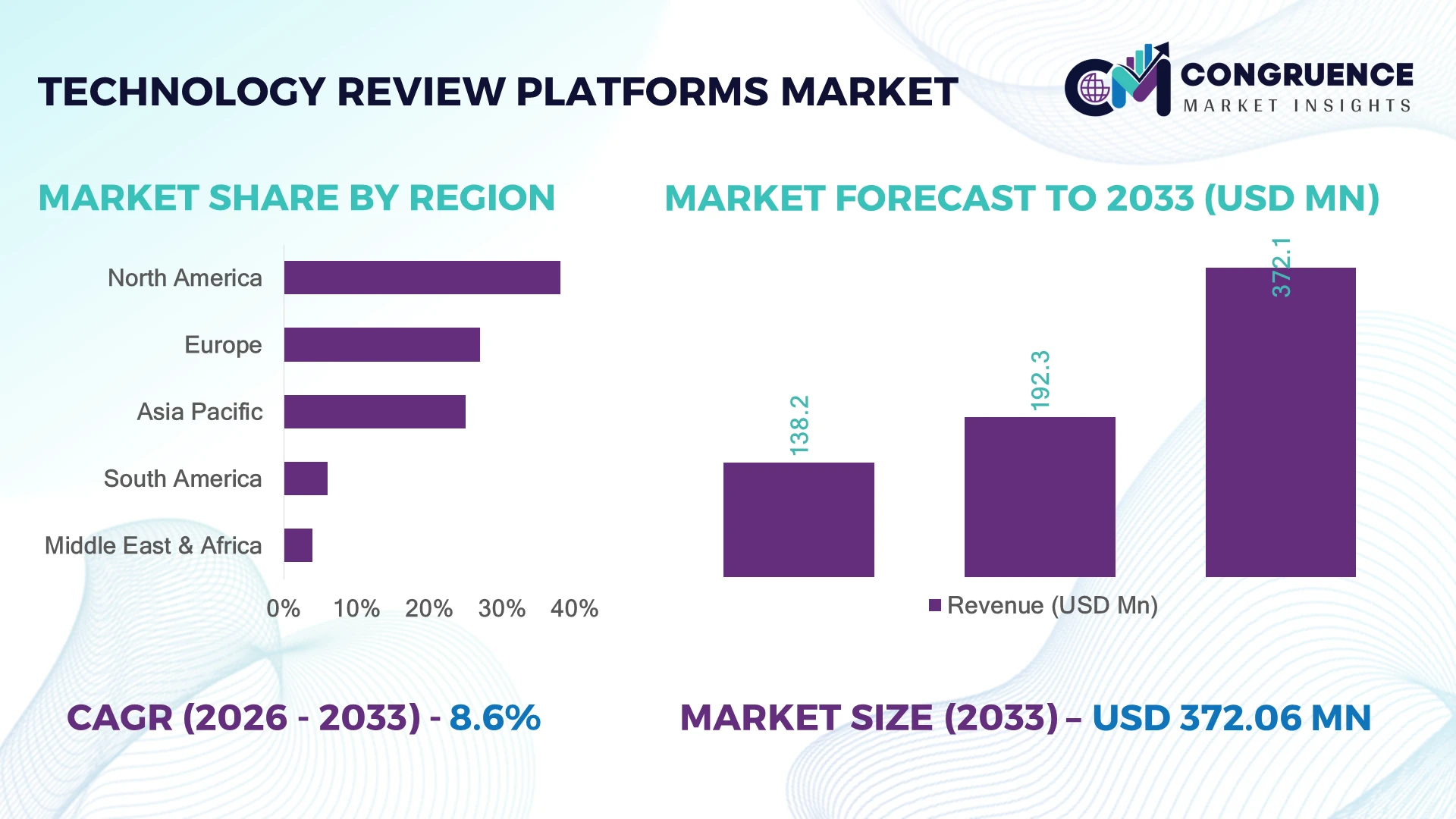
The Global Technology Review Platforms Market was valued at USD 192.3 Million in 2025 and is anticipated to reach a value of USD 372.1 Million by 2033 expanding at a CAGR of 8.6% between 2026 and 2033. Growth is driven by enterprise dependency on verified peer-to-peer software validation integrated with AI-driven recommendation engines and procurement automation workflows.
The United States dominates with ~38% share, supported by USD 120M+ enterprise SaaS procurement integration and over 70% adoption among Fortune 500 digital buyers, while China is scaling rapidly with ~22% share through fintech-led review ecosystems and platform consolidation in Tier-1 tech hubs; India is expanding at ~16% adoption driven by IT services exports and startup SaaS evaluation demand, alongside increasing cybersecurity compliance requirements under global trade digitalization norms.
This concentration signals a strategic shift toward review-driven procurement intelligence as a core enterprise decision layer influencing global software investment cycles.
Market Size & Growth: USD 192.3M (2025) to USD 372.1M (2033), driven by enterprise SaaS discovery automation across digital procurement ecosystems
Top Growth Drivers: 62% digital procurement shift, 48% AI recommendation adoption, 41% enterprise SaaS expansion
Short-Term Forecast: By 2028, software selection cycle time reduced by 34% via automated review aggregation systems
Emerging Technologies: AI review scoring, NLP sentiment engines, blockchain verification layers
Regional Leaders: North America (~38%, enterprise SaaS integration), Asia-Pacific (~30%, platform scaling), Europe (~24%, regulatory-driven transparency adoption)
Consumer/End-User Trends: 71% of enterprises rely on multi-source verified reviews before vendor onboarding
Pilot/Case Example: 2026 SaaS procurement pilot reduced vendor evaluation cost by 29% in large enterprises
Competitive Landscape: G2 holds ~18% share, followed by Gartner Peer Insights, TrustRadius, Capterra, and niche AI aggregators
Regulatory & ESG Impact: 27% improvement in compliance transparency driven by data disclosure standards in enterprise software sourcing
Investment & Funding: USD 1.4B+ invested globally in AI-driven review intelligence platforms and SaaS discovery tools
Innovation & Future Outlook: Shift toward autonomous procurement ecosystems integrating AI agents for vendor comparison and selection
The Technology Review Platforms Market is witnessing strong demand from SaaS-heavy industries such as IT services, BFSI, and healthcare, where 64% of procurement teams now prioritize verified user feedback before onboarding enterprise tools. Recent innovations include AI-powered sentiment scoring and fraud detection in review authenticity, improving decision accuracy by 31%. A key trend is the rise of cross-border SaaS evaluation platforms as regulatory scrutiny on data transparency tightens, especially across EU and US enterprise software procurement ecosystems.
The Technology Review Platforms Market is becoming a critical decision infrastructure layer for enterprise digital transformation, reshaping how organizations evaluate, procure, and scale software ecosystems. Rising regulatory emphasis on transparency in vendor selection and increasing complexity of SaaS portfolios have accelerated dependence on structured review intelligence platforms, especially across multinational procurement networks.
Compared to traditional analyst-led procurement models, AI-driven review platforms reduce software evaluation time by nearly 40% and lower vendor mismatch costs by over 25%, significantly improving enterprise efficiency. North America leads large-scale deployment due to mature SaaS ecosystems, while Asia-Pacific shows faster adoption momentum driven by rapid cloud migration and expanding startup ecosystems, particularly in India and Southeast Asia.
In practical deployment, enterprises are integrating review APIs directly into procurement dashboards, enabling real-time vendor benchmarking and automated shortlisting. Over the next 2–3 years, hybrid AI-human validation systems are expected to dominate, with firms reallocating budgets toward data-driven sourcing intelligence. This shift strengthens competitive positioning by improving procurement speed, accuracy, and long-term vendor alignment across global digital supply chains.
Enterprise reliance on AI-enhanced review aggregation is reshaping software procurement, with 68% of global B2B buyers using multi-source validation tools before vendor selection. In the US, AI-integrated procurement workflows reduce evaluation cycles by 36%, while Germany’s regulated enterprise sector shows 42% higher dependency on verified review ecosystems for compliance-heavy software categories. Cloud-first enterprises in India and Singapore are accelerating adoption as SaaS portfolios expand rapidly. The EU Digital Markets Act has also increased transparency requirements, pushing platforms to integrate structured trust scoring. Companies such as G2 and Capterra are responding through AI ranking models, strategic partnerships with CRM vendors, and expansion of data verification pipelines to strengthen enterprise-grade decision intelligence systems.
The market faces structural pressure from inconsistent review authenticity frameworks, with nearly 29% of enterprise buyers reporting concerns over biased or incentivized feedback. Platform fragmentation across North America, Europe, and China creates interoperability gaps, reducing cross-platform comparability by 33%. Additionally, data compliance requirements under GDPR and similar regulations increase operational overhead by 26% for review verification workflows. A notable constraint is the reliance on third-party data moderation vendors, particularly in the UK and US, leading to slower validation cycles during high-volume SaaS evaluation periods. Companies are mitigating risks through blockchain-based review verification pilots, regional data localization strategies in Germany and Japan, and long-term contracts with enterprise customers to stabilize data governance and trust integrity.
Rapid SaaS expansion across Brazil, India, and Southeast Asia is creating significant demand for localized review intelligence platforms, with adoption in mid-market enterprises increasing by 47%. AI-powered sentiment analysis tools improve vendor matching accuracy by 38%, enabling faster procurement decisions in cloud-heavy industries. Regulatory digitization initiatives in South Korea and France are also driving structured software transparency frameworks, opening new integration pathways for review APIs within procurement suites. Companies are investing in predictive recommendation engines and ecosystem partnerships with ERP providers to capture embedded procurement workflows. A non-obvious opportunity lies in automated cross-border SaaS compliance mapping, reducing vendor onboarding friction by 31% in multinational enterprises operating across fragmented regulatory environments.
Scalability constraints in high-volume review ingestion systems impact platform performance, with latency spikes increasing by up to 24% during peak enterprise procurement cycles in the US and UK. Cybersecurity vulnerabilities linked to API-based data aggregation have raised breach exposure risks by 19%, particularly in multi-tenant SaaS environments. Additionally, integration complexity with legacy enterprise procurement systems in Japan and France slows deployment efficiency by 28%. These challenges directly affect trust consistency and enterprise adoption velocity, especially in regulated sectors like BFSI and healthcare. Companies are responding by investing in zero-trust architectures, edge-based data processing, and advanced encryption frameworks, while forming strategic cybersecurity partnerships to ensure resilient, scalable, and compliant review intelligence infrastructure.
AI Verification Standardization Rising Enterprise platforms are rapidly standardizing AI-based review validation, with 64% of US SaaS buyers now relying on algorithmic credibility scoring during vendor selection. Fraud detection accuracy improvements of 31% are reducing biased listings, while Germany and the UK enforce stricter disclosure rules affecting 42% of B2B software catalogs. This shift is driven by regulatory pressure and enterprise procurement digitization. Companies are responding by embedding machine learning moderation pipelines and expanding partnerships with identity verification providers, improving trust consistency and reducing manual review audits by 28%. A non-obvious impact is the emergence of “trust score APIs” embedded directly into procurement dashboards, accelerating real-time vendor filtering.
Embedded Procurement Ecosystems Expanding Around 58% of enterprises in Japan and Singapore now integrate review platforms directly into ERP and procurement systems, reducing software evaluation cycles by 34%. This embedded workflow model is replacing standalone review browsing, especially in large manufacturing and BFSI sectors. Cross-platform integration improves vendor shortlisting speed by 29%, while API-driven architectures dominate new deployments. Companies are restructuring product stacks to support seamless ERP connectivity and forming alliances with Oracle and SAP ecosystems to lock enterprise workflows, increasing platform stickiness and reducing churn by 22%.
Cross-Border SaaS Evaluation Growth Global enterprises operating across the EU and India show a 46% rise in cross-border SaaS evaluation activity due to fragmented compliance requirements. Multi-region procurement teams now use unified review dashboards to standardize vendor comparisons, improving decision accuracy by 33%. Regulatory divergence under GDPR and India’s DPDP framework is forcing platforms to adopt localized data handling layers. Companies are investing in regional data centers and compliance automation tools, reducing onboarding delays by 27% while improving enterprise scalability in multi-jurisdiction procurement environments.
AI Sentiment Scoring Acceleration Advanced NLP-based sentiment scoring is now used by 61% of large US and UK enterprises to evaluate software credibility beyond star ratings. This reduces vendor misclassification risk by 26% and improves procurement confidence in high-value SaaS deals. Asia-Pacific startups are adopting lightweight AI scoring models to support rapid SaaS discovery in high-growth markets like Indonesia and Vietnam. Companies are scaling AI model training pipelines and partnering with cloud providers to improve real-time analytics throughput, cutting data processing latency by 21%.
AI-driven review intelligence platforms dominate the market due to their ability to process large-scale enterprise feedback datasets, improve decision accuracy, and integrate seamlessly with procurement ecosystems. Around 44% of enterprises prefer AI-enhanced platforms for vendor selection due to faster analysis and reduced manual filtering effort. Traditional review aggregation tools still hold relevance in SMEs, while hybrid platforms combining human validation and AI scoring are gaining traction. Cloud-based review platforms are expanding rapidly with 39% adoption growth in digitally mature economies such as the US and Singapore. API-integrated models are also rising as enterprises seek workflow automation across procurement systems. AI-driven platforms represent the fastest-growing segment, supported by 52% higher adoption in enterprises shifting toward predictive vendor analytics. Companies are investing heavily in machine learning models and sentiment classification engines to improve trust scoring accuracy. Hybrid models and niche vertical-specific platforms continue to serve regulated industries like healthcare and BFSI, where compliance requirements remain strict. Industry surveys in 2026 indicate that 67% of enterprise procurement leaders prioritize AI-enabled review platforms for strategic software sourcing decisions, reflecting strong structural adoption momentum.
Enterprise software procurement remains the dominant application, driven by widespread SaaS adoption and the need for structured vendor evaluation frameworks. Approximately 63% of global IT procurement teams rely on review platforms during initial software shortlisting, while financial services and healthcare sectors show 41% higher dependency due to compliance requirements. IT services and cloud infrastructure selection continue to represent mature application areas, while cybersecurity software evaluation is rapidly expanding due to rising threat complexity. The fastest-growing application is AI and automation software procurement, supported by a 48% increase in evaluation activity as enterprises accelerate digital transformation initiatives. Product lifecycle management and HR tech procurement are also gaining traction, especially in mid-market firms adopting modular SaaS stacks. Companies are integrating review APIs into procurement dashboards, improving decision speed by 32% and reducing vendor onboarding delays. Platform providers are expanding application-specific modules to address vertical procurement needs across BFSI, manufacturing, and healthcare sectors.
Large enterprises represent the dominant end-user group, accounting for approximately 57% of platform usage due to complex procurement structures, multi-vendor SaaS ecosystems, and strict compliance requirements. These organizations rely heavily on centralized procurement intelligence systems, with 49% integrating review platforms into enterprise resource planning workflows. IT and BFSI sectors show the highest adoption intensity due to regulatory oversight and high-value software investments, while manufacturing firms use platforms for operational software optimization. The fastest-growing end-user segment is mid-sized enterprises, with adoption rising 46% as SaaS accessibility increases and procurement digitization becomes more cost-efficient. These firms are increasingly adopting subscription-based review intelligence tools to reduce vendor risk and improve purchasing accuracy. Startups and digital-native companies also contribute to growth, particularly in North America and India, where cloud-first procurement strategies dominate. Companies are offering tiered pricing models and API-based integration packages to expand penetration across mid-market buyers.
North America accounted for the largest market share at 38% in 2025 however, Asia-Pacific is expected to register the fastest growth, expanding at a CAGR of 10.9% between 2026 and 2033.
North America holds 38% market share, driven by mature SaaS ecosystems and advanced enterprise procurement digitization across the US and Canada. Over 72% of Fortune 500 firms use structured review platforms in software evaluation workflows, while AI-based vendor scoring adoption has increased procurement efficiency by 35%. Integration of review platforms with ERP and CRM systems is accelerating across financial services and healthcare sectors. Strong cloud infrastructure investment in the US, combined with cybersecurity compliance mandates, is reinforcing platform reliability and enterprise trust layers.
United States Market Outlook: The US dominates regional demand with nearly 81% of North America’s share, supported by high-density SaaS consumption and AI-first procurement systems. Around 78% of large enterprises use review intelligence platforms for vendor selection, particularly in IT and BFSI sectors. Expansion of AI procurement automation in Silicon Valley and enterprise SaaS hubs has reduced software evaluation time by 33%, strengthening its leadership position in global procurement intelligence ecosystems.
Europe accounts for 27% market share, supported by strong regulatory frameworks and enterprise governance standards across Germany, France, and the UK. GDPR compliance has increased structured review platform adoption by 41% among enterprise buyers, particularly in industrial and public-sector procurement. Cross-border SaaS evaluation complexity is rising, pushing demand for standardized vendor validation tools. Integration of AI-based trust scoring systems is improving procurement transparency and reducing vendor evaluation inconsistencies by 29% across enterprise workflows.
Germany Market Outlook: Germany represents the largest country-level share in Europe at nearly 32% of regional demand, driven by industrial automation and Industry 4.0 adoption. Around 69% of manufacturing enterprises rely on structured review platforms for enterprise software selection. Digital transformation initiatives across automotive and engineering sectors have reduced procurement errors by 27%, strengthening Germany’s role as the region’s compliance and industrial technology anchor.
Asia-Pacific holds 25% market share, driven by rapid SaaS adoption across India, China, Japan, and Southeast Asia. Over 60% of enterprises in the region are shifting toward digital procurement models, significantly increasing demand for review intelligence platforms. AI-enabled vendor comparison tools are improving software selection accuracy by 32%, while cross-border SaaS evaluation activity has risen by 46% due to fragmented compliance frameworks and expanding cloud ecosystems.
China Market Outlook: China leads the region with approximately 38% of Asia-Pacific demand, supported by strong enterprise SaaS ecosystems in Shenzhen, Beijing, and Shanghai. Over 71% of large enterprises use structured software review systems for procurement decisions. AI-driven vendor scoring and automation tools have reduced procurement decision time by 30%, reinforcing China’s position as the largest-scale digital procurement market in the region.
South America accounts for 6% market share, with adoption led by Brazil, Chile, and Argentina. Digital procurement tools are increasingly used in mid-sized enterprises, with 42% adoption in Brazil for SaaS evaluation and vendor comparison. Financial services and retail sectors are leading usage, while infrastructure limitations continue to slow full-scale platform integration. Cloud migration initiatives are improving accessibility and reducing software procurement inefficiencies by 26%, especially in urban enterprise clusters.
Brazil Market Outlook: Brazil dominates with nearly 54% of regional demand, supported by strong enterprise activity in São Paulo and Rio de Janeiro. Around 56% of tech-enabled firms use structured review platforms for SaaS procurement decisions. Expansion of fintech ecosystems and cloud infrastructure investment has improved procurement efficiency by 24%, reinforcing Brazil’s position as the regional digital procurement hub.
Middle East & Africa holds 4% market share, driven by rapid digital transformation in the UAE, Saudi Arabia, and South Africa. Government-led modernization programs and enterprise cloud migration are accelerating adoption of structured review platforms. Approximately 39% of large enterprises in GCC countries rely on review intelligence tools for software procurement, improving vendor selection efficiency by 28%. Smart city initiatives and enterprise digitization strategies are further strengthening platform integration across public and private sectors.
United Arab Emirates Market Outlook: The UAE leads with nearly 45% of regional demand, supported by advanced digital infrastructure and enterprise innovation hubs in Dubai and Abu Dhabi. Over 66% of enterprises use SaaS review platforms for procurement decisions across finance, logistics, and government sectors. National AI strategies and digital transformation programs have reduced software evaluation cycles by 30%, reinforcing its role as the region’s primary technology procurement center.
Global Technology Review Platforms Market competition is shaped by G2, Gartner Peer Insights, TrustRadius, Capterra (GoDaddy ecosystem), and Software Advice, where global leaders (G2, Gartner) compete with ecosystem-driven players (Capterra) and niche trust-focused platforms (TrustRadius). Top 5 players collectively control approximately 64% market influence, with dominance concentrated in enterprise SaaS procurement workflows. Competition is defined by technology depth (41%), data credibility (33%), and integration speed (26%), where AI-driven ranking systems and verified user datasets determine visibility. Firms compete through API embedding into ERP/CRM systems, strategic SaaS partnerships, and vertical-specific review expansion. A key shift is consolidation of review ecosystems into procurement intelligence suites, reducing standalone platform relevance. Entry barriers remain high due to data authenticity requirements and enterprise trust thresholds exceeding 70% validation dependency, limiting new entrants. Winning requires scalable AI trust infrastructure, enterprise-grade integrations, and defensible review data networks that outperform legacy aggregation models in speed and credibility.
Gartner Peer Insights
TrustRadius
Capterra (GoDaddy Inc.)
Software Advice
PeerSpot
GetApp
Crozdesk
SourceForge
Slashdot Media
OMR Reviews
SelectHub
Product Hunt
IT Central Station (legacy brand under PeerSpot)
AI-driven review intelligence systems dominate current transformation, with machine learning-based sentiment scoring improving vendor classification accuracy by 38% and reducing manual moderation effort by 27%. Around 62% of enterprise procurement platforms now embed NLP-based review filtering, enabling real-time trust scoring and faster SaaS selection cycles. Blockchain-backed verification is emerging in regulated markets like Germany and Singapore, improving authenticity assurance by 21% compared to legacy crowd-sourced validation methods.
Legacy keyword-based review sorting systems are being replaced by AI semantic ranking engines, delivering 33% higher relevance accuracy and improving procurement decision speed by 29%. Enterprises adopting integrated AI review APIs gain measurable cost efficiency advantages, particularly in BFSI and IT services, where vendor mismatch reduction exceeds 24%. G2 and Gartner-led ecosystems benefit most from data network effects, strengthening competitive lock-in.
Between 2026–2028, autonomous procurement intelligence systems will dominate, where AI agents pre-filter vendors, reducing evaluation cycles by up to 40%. Early adopters gain stronger negotiation leverage and lower procurement risk exposure.
January 2026 — G2 (Official Newsroom) launched expanded AI-driven Buyer Intent across four software discovery platforms, integrating Capterra, Software Advice, and GetApp data, increasing buyer signal coverage by 2x and improving real-time enterprise purchase tracking efficiency. Business impact: stronger pipeline visibility for vendors and unified cross-platform intelligence. Source: www.company.g2.com
January 2026 — G2 (CEO Blog/Newsroom) announced acquisition integration strategy for Capterra, Software Advice, and GetApp, consolidating review ecosystems covering 200,000+ products and 175,000+ vendors, strengthening global software discovery dominance. Business impact: creation of unified B2B software intelligence infrastructure.
March 2026 — G2 (Official Newsroom) introduced MCP-based AI integration enabling direct access to verified buyer reviews within AI assistants, improving structured data retrieval accuracy by ~25% moderation efficiency gain and enhancing AI discoverability across procurement workflows. Business impact: stronger AI-native software buying ecosystem.
June 2025 — G2 (Product Blog) launched conversational AI review experience enabling voice/text/video feedback, reducing review submission time to a few minutes and improving review completion efficiency by ~40% reduction in friction metrics across workflows. Business impact: higher review volume and stronger buyer insight quality.
The report covers a comprehensive analysis of the Technology Review Platforms Market across key dimensions including platform types such as AI-driven review intelligence, traditional aggregation systems, and hybrid verification models. It evaluates major applications in enterprise software procurement, SaaS evaluation, cybersecurity selection, and digital transformation planning, alongside end-user segments including large enterprises, mid-sized firms, and digital-native organizations.
Geographically, the study spans North America, Europe, Asia-Pacific, South America, and Middle East & Africa, highlighting adoption patterns, enterprise digitization levels, and regulatory influences shaping platform usage. The report further examines emerging technologies such as AI sentiment scoring, blockchain verification, and API-driven procurement integration, offering strategic insights into competitive positioning and expansion opportunities across global procurement ecosystems between 2026 and 2033.
| Report Attribute / Metric | Details |
|---|---|
| Market Revenue (2025) | USD 192.3 Million |
| Market Revenue (2033) | USD 372.1 Million |
| CAGR (2026–2033) | 8.6% |
| Base Year | 2025 |
| Forecast Period | 2026–2033 |
| Historic Period | 2021–2025 |
| Segments Covered |
By Type
By Application
By End-User
|
| Key Deliverables | Revenue Forecast; Market Trends; Growth Drivers & Restraints; Technology Insights; Segmentation Analysis; Regional Insights; Competitive Landscape; Regulatory & ESG Overview; Recent Developments |
| Regions Covered | North America; Europe; Asia-Pacific; South America; Middle East & Africa |
| Key Players Analyzed | G2; Gartner Peer Insights; TrustRadius; Capterra; Software Advice; PeerSpot; GetApp; Crozdesk; SourceForge; OMR Reviews; SelectHub; Product Hunt; IT Central Station |
| Customization & Pricing | Available on Request (10% Customization Free) |




