
Reports
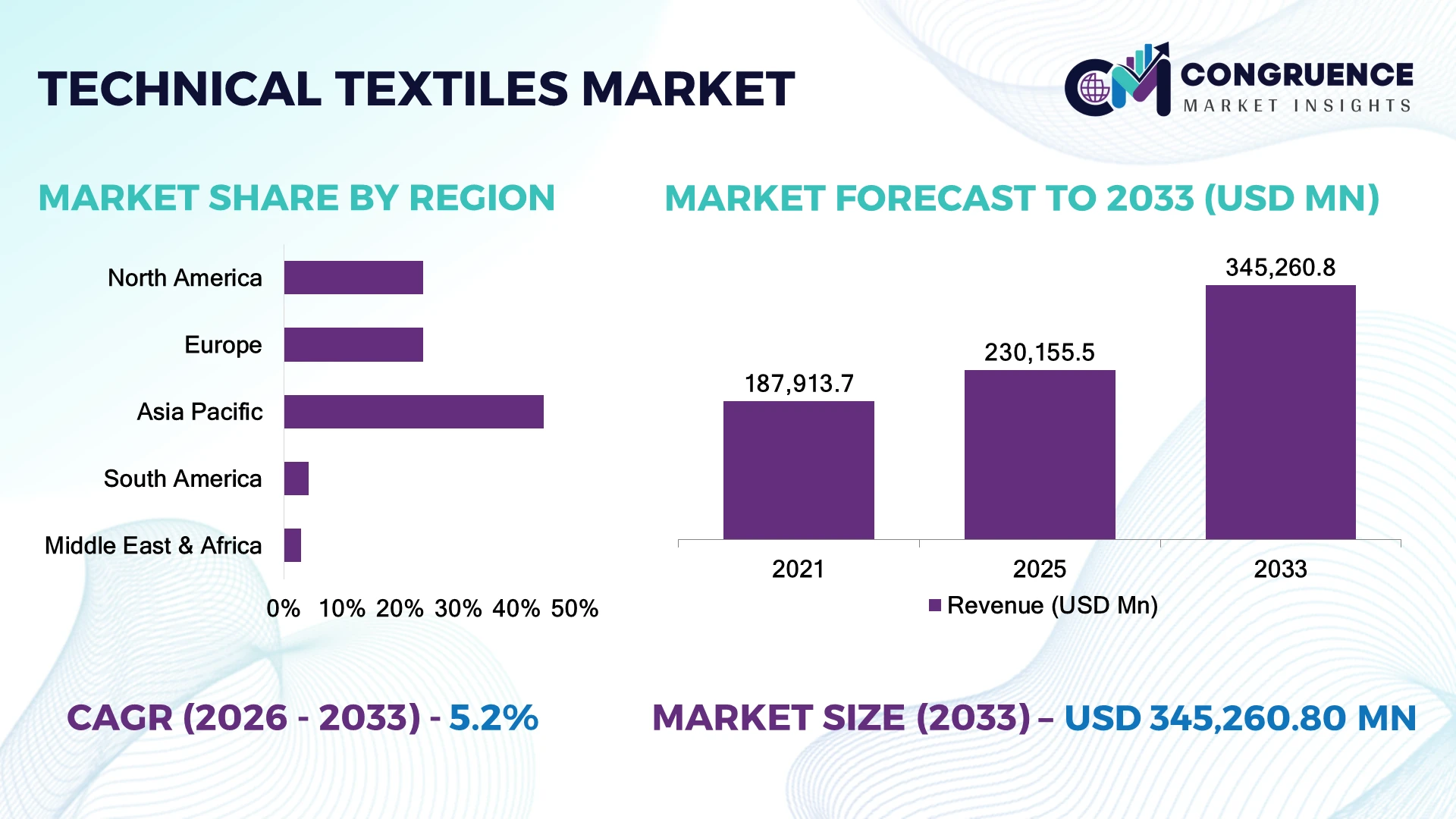
The Global Technical Textiles Market was valued at USD 230,155.5 Million in 2025 and is anticipated to reach a value of USD 345,260.8 Million by 2033 expanding at a CAGR of 5.2% between 2026 and 2033. Growth is driven by lightweight automotive composites, high-performance medical textiles, geotextiles for infrastructure reinforcement, and protective fabrics designed to meet increasingly demanding industrial and safety specifications.
China remains a leading technical textiles manufacturing hub, supported by extensive synthetic-fiber production, automotive supply chains, construction activity, and industrial filtration demand. Its manufacturing scale strengthens access to nonwovens, coated fabrics, and high-strength fibers, while India is expanding technical textile capacity through targeted industrial development programs. In 2025–2026, supply-chain diversification and infrastructure investment increased the strategic importance of localized production and application-specific materials. Compared with lower-cost commodity fabrics, advanced aramid, carbon-fiber, and engineered nonwoven products offer greater performance differentiation but require more specialized processing.
Manufacturers should prioritize high-performance materials, application engineering, and regional production capabilities to capture demand while controlling qualification costs and supply-chain exposure.
Market Size & Growth: The market was valued at USD 230.16 billion in 2025 and is projected to reach USD 345.26 billion by 2033, supported by infrastructure reinforcement, medical applications, and lightweight industrial materials.
Top Growth Drivers: Infrastructure modernization, demand for protective materials, and lightweight automotive components are strengthening technical textile adoption across industrial supply chains.
Short-Term Forecast: By 2028, automation and inline quality monitoring are expected to improve production consistency and reduce material waste in suitable nonwoven, coating, and composite-manufacturing operations.
Emerging Technologies: Electrospun nanofibers, advanced nonwovens, recycled high-performance fibers, and digitally controlled coating processes are expanding technical performance and application flexibility.
Regional Leaders: Asia-Pacific benefits from manufacturing scale, Europe emphasizes advanced materials and regulated applications, and North America maintains strong demand for medical, aerospace, filtration, and protective textiles.
Consumer/End-User Trends: Automotive, healthcare, construction, and industrial users increasingly specify performance-based materials that deliver durability, filtration, reinforcement, or protection beyond conventional textile functionality.
Pilot/Case Example: In 2025–2026, manufacturers continued developing recycled-fiber nonwovens and lightweight composite reinforcements, targeting lower material intensity while preserving application-specific strength and durability.
Competitive Landscape: Freudenberg Group, Berry Global, DuPont, Ahlstrom, and Toray Industries compete through process expertise, specialized fiber portfolios, technical qualification, and customer-specific material engineering.
Regulatory & ESG Impact: Product-safety standards, chemical-management requirements, and circular-material initiatives are increasing the importance of traceable inputs, controlled processing, and end-of-life planning.
Investment & Funding: Manufacturers are directing capital toward nonwoven capacity, filtration media, advanced composites, and process automation to serve higher-specification industrial applications.
Innovation & Future Outlook: Competitive differentiation is shifting from fabric volume toward engineered performance, material functionality, recycled-content development, and application-specific technical support.
The technical textiles market serves automotive, healthcare, construction, agriculture, filtration, aerospace, and personal-protection applications where conventional fabrics cannot consistently meet performance requirements. Buyers evaluate tensile strength, weight, permeability, thermal resistance, chemical compatibility, and lifecycle durability alongside price. Lightweight composites support vehicle-weight reduction, while geotextiles reinforce civil infrastructure and specialized nonwovens serve medical and filtration uses. Supply-chain diversification and growing emphasis on resource efficiency are encouraging manufacturers to develop recycled fibers and application-specific materials. Companies with reliable product qualification, specialized processing, and customer engineering capabilities are better positioned to capture demand for higher-value technical textile solutions.
Technical textiles are strategically important because material performance increasingly determines product safety, operating efficiency, durability, and compliance across industrial value chains. Automotive lightweighting, infrastructure modernization, medical filtration, and worker-protection requirements are expanding the role of engineered fibers beyond conventional textile applications. Manufacturers are also reassessing sourcing and production footprints to improve material availability and meet customer requirements for traceability and consistent specifications.
Conventional woven fabrics remain suitable for many established applications, while nonwovens, coated textiles, and high-strength fiber composites deliver targeted performance advantages. Automated fiber placement and precision coating can improve material utilization and process repeatability in appropriate production environments, although measurable savings vary by product and manufacturing line. China benefits from broad manufacturing scale, while Germany and the United States maintain strengths in specialized materials, engineering, and high-performance industrial applications. India is strengthening its position through technical textile development initiatives and investment in domestic production capabilities.
During 2026–2028, investment priorities will center on specialized nonwovens, filtration media, recycled-content materials, and automation that supports tighter quality control. For example, automotive suppliers can use engineered reinforcements to reduce component weight without compromising required mechanical performance. Manufacturers are expanding application laboratories, collaborating with OEMs, and developing materials for regulated end uses. Competitive advantage will depend on validated performance, dependable supply, and the ability to tailor materials to demanding industrial specifications.
Infrastructure reinforcement, industrial filtration, and automotive lightweighting are strengthening demand for engineered textiles that deliver specific mechanical and functional properties. Geotextiles improve separation, drainage, and soil reinforcement in road and rail projects, while high-strength fibers support durable industrial components. Nonwovens also provide controlled filtration and absorbency in healthcare and manufacturing. India's infrastructure programs and China's extensive industrial production create opportunities for locally manufactured geosynthetics, filtration media, and composite reinforcements. As buyers increasingly specify performance criteria rather than fabric price alone, suppliers are investing in application testing, automated production, and material customization. The strategic advantage lies in embedding technical textiles into customer designs early, where qualification requirements and performance consistency create stronger supplier relationships and reduce substitution based solely on price.
High-performance fibers, specialty coatings, and multilayer composite structures often require expensive inputs, specialized machinery, and controlled processing conditions. Carbon fiber and aramid products face cost barriers that limit substitution for conventional materials in price-sensitive applications. Producers also face exposure to petrochemical feedstock volatility, energy costs, and dependence on qualified chemical additives. These pressures can narrow margins when customers resist price increases or require extensive product validation before switching suppliers. Smaller manufacturers may lack the scale to negotiate favorable input contracts or maintain multiple certified production lines. Companies are responding through long-term sourcing agreements, process optimization, material substitution where technically acceptable, and closer customer collaboration. The key commercial constraint is achieving repeatable performance at a price that supports adoption beyond premium industrial applications.
Recycled technical fibers, advanced filtration media, electrospun nanofibers, and lightweight composite reinforcements create opportunities for manufacturers seeking higher-value applications. Automotive suppliers are evaluating lower-weight materials to improve vehicle efficiency, while construction buyers require durable geotextiles for drainage, separation, and soil stabilization. Medical and industrial users are also seeking filtration and barrier materials with tightly controlled performance. India's technical textile development initiatives provide an opportunity for domestic producers to strengthen manufacturing capabilities and reduce dependence on imported specialty products. Companies are responding through R&D partnerships, pilot production, and application-specific testing. A less obvious opportunity lies in designing products for easier separation and recycling at end of life, allowing suppliers to address material recovery requirements while differentiating beyond initial purchase price.
Technical textile products often require extensive testing for tensile strength, filtration efficiency, flame resistance, chemical compatibility, biocompatibility, or long-term durability. Qualification requirements vary by end use, making it difficult to transfer a formulation or manufacturing process directly between automotive, medical, aerospace, and construction applications. Multimaterial composites introduce additional challenges because separating fibers, resins, coatings, and adhesives can complicate recycling. Manufacturers must also maintain consistent specifications when changing fiber suppliers or incorporating recycled inputs. Companies are investing in standardized testing, traceability systems, pilot lines, and partnerships with research institutions and end users. The strategic challenge is to scale innovative materials without compromising safety, performance consistency, or recyclability. Commercial success depends on demonstrating application-level reliability rather than relying on laboratory performance alone.
Nonwovens Expand Across Industrial Uses — Nonwoven fabrics are gaining importance in filtration, medical barriers, automotive interiors, and insulation because their structure can be tailored to permeability, absorbency, and strength requirements. Manufacturers are refining fiber selection and bonding processes to improve consistency while controlling material use. Demand is shifting toward application-specific grades, making process control and customer qualification central to commercial differentiation.
Lightweight Composites Gain Automotive Attention — Automotive suppliers are using engineered reinforcements and high-strength fibers to reduce component weight while maintaining mechanical performance. Electric vehicle development reinforces the importance of lightweight structures, although savings depend on component design and the full material system. Suppliers are expanding composite engineering, simulation, and OEM collaboration to qualify solutions for demanding production environments.
Traceable Materials Reshape Procurement — Buyers are placing greater emphasis on recycled content, chemical compliance, and documented material origin. Product-specific requirements are encouraging manufacturers to improve supplier records, batch traceability, and chemical-management controls. Companies are adapting procurement systems and testing protocols to maintain specification consistency while introducing alternative fibers and recycled inputs into established industrial products.
Automation Improves Process Consistency — Digital monitoring, automated web handling, and precision coating are helping producers control thickness, defects, and material variation across nonwoven and coated-textile lines. These tools are particularly relevant where filtration performance, barrier integrity, or composite quality depends on consistent processing. Manufacturers are investing in inline inspection and process data to reduce rework, improve traceability, and support stricter customer qualification requirements.
Mobiltech, covering textiles used in vehicles and transportation systems, represents an estimated 24% of the global technical textiles market in 2025, supported by automotive interiors, tire reinforcement, seat belts, airbags, and lightweight composite components. Its dominance reflects established OEM supply chains, high-volume manufacturing, and stringent performance requirements. Indutech and Buildtech also maintain substantial demand through industrial filtration, conveyor systems, insulation, and infrastructure reinforcement. These mature segments benefit from repeat industrial consumption and long product-service lifecycles. Meanwhile, Meditech is among the fastest-expanding categories as healthcare providers require surgical gowns, wound-care materials, medical nonwovens, and filtration products. Protech benefits from workplace-safety requirements, while Agrotech, Geotech, Packtech, Sportech, Clothtech, Hometech, and Oekotech serve specialized agricultural, civil-engineering, packaging, sporting, apparel-component, household, and environmental applications.
Investment is increasingly shifting toward engineered nonwovens, high-strength fibers, functional coatings, and recyclable composite structures. Meditech and Protech are gaining strategic attention because product performance, barrier integrity, and regulatory qualification differentiate suppliers beyond price. An estimated 5–7% improvement in material utilization through process optimization is a potential operational target, not a uniform industry result. Manufacturers are responding through automated web formation, advanced fiber blending, application testing, and customer-specific product development. For investors, the strongest positioning combines established Mobiltech volumes with higher-value medical, protective, and industrial materials rather than relying exclusively on commodity textile production.
Automotive and transportation applications represent an estimated 23% of technical textile demand in 2025, driven by tire cords, airbags, seat belts, acoustic insulation, interior fabrics, and reinforcement materials. High vehicle production volumes and strict safety specifications sustain recurring demand, while lightweight composite structures help manufacturers address vehicle-efficiency targets. Construction and infrastructure applications also remain significant through geotextiles, roofing membranes, reinforcement fabrics, and insulation. Healthcare is among the fastest-growing application areas as medical nonwovens, protective gowns, wound dressings, and filtration materials gain importance. Agriculture, industrial filtration, packaging, sports, and protective clothing provide additional demand, with purchasing decisions shaped by application-specific durability, permeability, chemical resistance, and compliance requirements.
Electric vehicles are changing automotive material specifications by increasing interest in lightweight reinforcements, thermal-management textiles, and acoustic insulation. Healthcare buyers prioritize consistent barrier performance and product hygiene, while infrastructure contractors focus on geotextile strength, drainage, and service life. Application-specific automation and inline inspection can help manufacturers reduce defects and material waste; a 3–5% reduction in scrap is a reasonable optimization target for suitable production lines, not a universal measured outcome. Companies are expanding technical laboratories, developing specialized nonwoven grades, and partnering with OEMs and medical-product manufacturers. The commercial opportunity lies in qualifying materials for demanding end uses, where validated performance and reliable supply carry greater weight than low unit cost alone.
Industrial manufacturers represent an estimated 29% of technical textile demand in 2025, reflecting extensive use of filtration media, conveyor belts, insulation, reinforcement fabrics, and protective materials across production facilities. Their purchasing decisions emphasize durability, process compatibility, operating life, and predictable replacement cycles. Automotive OEMs and component suppliers form another major buyer group, requiring validated materials for safety-critical and lightweight components. Construction contractors, healthcare providers, agricultural operators, packaging producers, and defense organizations contribute through specialized procurement requirements. Healthcare-related buyers are among the fastest-expanding end-user groups, supported by demand for medical nonwovens, barrier products, filtration, and wound-care materials. Unlike industrial buyers focused on operating performance, healthcare customers place greater weight on hygiene, biocompatibility, and product qualification.
End-user strategies are becoming more application-specific. Industrial customers increasingly assess lifecycle costs rather than purchase price alone, while automotive OEMs prioritize weight, safety, and production-line compatibility. Healthcare manufacturers seek consistent quality and dependable supply, and construction buyers emphasize durability under local soil and weather conditions. An estimated 5–10% reduction in maintenance or replacement costs can be a target for well-matched engineered textile solutions, although actual savings depend on the application and baseline material. Suppliers are developing custom specifications, technical-service agreements, and co-validation programs with major buyers. Future demand is likely to favor companies that combine scalable manufacturing with specialized engineering, particularly where certification, performance testing, and long-term customer qualification create meaningful barriers to substitution.
Asia-Pacific accounted for the largest market share at an estimated 44.7% in 2025 however, Asia-Pacific is expected to register the fastest growth, expanding at an estimated CAGR of 6.1% between 2026 and 2033.
Advanced Industrial Materials and High-Specification Applications Strengthen Regional Demand
North America accounted for an estimated 24% of the global technical textiles market in 2025, supported by demand from aerospace, healthcare, defense, automotive, and industrial filtration. The United States anchors regional consumption through its advanced manufacturing base, medical-product industry, and procurement of protective materials. Manufacturers are prioritizing high-performance fibers, flame-resistant fabrics, filtration media, and lightweight composites, where certification and technical performance matter more than commodity pricing. Demand for localized supply has also increased as industrial buyers seek shorter replenishment cycles and greater supply-chain resilience. Investment is concentrating on specialized materials, automated production, and application engineering. Suppliers with established qualification capabilities and close relationships with aerospace, defense, and healthcare customers hold an advantage in high-specification contracts.
United States Market Outlook: The United States leads regional demand through its aerospace, defense, healthcare, and advanced manufacturing industries. Its technical-textile opportunity includes ballistic protection, medical nonwovens, industrial filtration, and composite reinforcement. Federal procurement requirements and occupational-safety standards reinforce demand for certified materials, while domestic manufacturing investments support supply reliability. Companies that combine material innovation with traceability, application testing, and dependable delivery can differentiate from lower-cost imports. Advanced fiber research and customer-specific engineering remain important competitive advantages for suppliers targeting high-value industrial applications.
Nonwoven Innovation and Circular-Material Requirements Reshape Production
Europe accounted for an estimated 24% of the global technical textiles market in 2025, supported by automotive engineering, industrial filtration, protective clothing, medical materials, and infrastructure applications. Germany, France, Italy, and the Nordic countries provide established capabilities in specialized fibers, nonwovens, and engineered fabrics. Sustainability requirements and chemical-management regulations are encouraging manufacturers to improve material traceability, process efficiency, and recycled-content development. Europe's nonwoven industry produced approximately 2.98 million tonnes in 2024, increasing 2.6% year over year. This recovery reinforces the importance of process flexibility and product specialization. Suppliers are investing in efficient production lines and higher-value materials to manage energy costs and maintain competitiveness against lower-cost international producers.
Germany Market Outlook: Germany remains a key European market because of its automotive, machinery, filtration, and industrial-engineering sectors. Technical textiles support vehicle interiors, tire reinforcement, industrial belts, protective equipment, and composite components. Manufacturers are increasingly integrating engineered fabrics into lightweight components and performance-critical systems. Germany's established network of automotive OEMs, chemical companies, and specialist textile producers supports collaborative material development and product qualification. Suppliers that combine consistent technical specifications with efficient production and recyclable material designs are positioned to serve demanding industrial customers.
Manufacturing Scale and Infrastructure Investment Accelerate Market Expansion
Asia-Pacific represented an estimated 44.7% of the global technical textiles market in 2025, making it the largest regional market. China, India, Japan, and South Korea support demand through automotive manufacturing, construction, healthcare, agriculture, and industrial production. China's broad synthetic-fiber supply chain provides scale in nonwovens, industrial fabrics, and composite materials, while Japan and South Korea contribute specialized materials and advanced manufacturing capabilities. India's road construction, healthcare demand, and industrial development initiatives are expanding opportunities for geotextiles, protective fabrics, and medical nonwovens. Companies are strengthening local production, automating quality control, and broadening product portfolios to serve cost-sensitive applications alongside high-performance segments. Regional competitiveness rests on combining manufacturing scale with increasingly sophisticated application engineering.
China Market Outlook: China is the region's most significant technical-textile manufacturing hub, supported by extensive synthetic-fiber production, automotive supply chains, construction activity, and industrial filtration demand. Its production scale allows manufacturers to serve domestic customers while supplying international markets. The country produced approximately 34.53 million motor vehicles in 2025, sustaining demand for tire cords, interior fabrics, airbags, and reinforcement materials. Domestic suppliers are expanding high-performance nonwovens and composite capabilities, while international companies compete through specialized formulations, process technology, and quality assurance. Cost efficiency combined with consistent technical performance remains central to winning industrial contracts.
Industrial Modernization and Infrastructure Projects Support Specialized Textile Demand
South America accounted for an estimated 4.3% of the global technical textiles market in 2025, with Brazil representing the principal manufacturing and consumption center. Demand arises from automotive production, agriculture, mining, construction, healthcare, and industrial processing. Geotextiles support soil stabilization and drainage, while agricultural textiles, filtration fabrics, conveyor materials, and protective products serve region-specific operating conditions. Brazil's vehicle manufacturing base also supports demand for tire reinforcement, interior fabrics, and safety-related materials. Adoption remains uneven because imported specialty fibers, currency volatility, and limited local production of certain advanced materials can increase procurement costs. Suppliers are focusing on regional distribution, cost-efficient product specifications, and local customer partnerships to improve availability and compete with imports.
Brazil Market Outlook: Brazil is South America's leading opportunity for technical textiles because of its automotive industry, extensive agricultural sector, mining operations, and infrastructure requirements. The country's production of approximately 2.64 million motor vehicles in 2025 supports demand for automotive fabrics, tire cords, and reinforcement materials. Agricultural operations also require crop-protection fabrics, nets, and industrial coverings, while road and drainage projects use geotextiles. Manufacturers that develop locally suitable products and strengthen distributor relationships can reduce supply delays and import exposure. Price competitiveness and dependable performance remain essential to expanding domestic production and industrial adoption.
Infrastructure Development and Industrial Diversification Create New Demand Pockets
The Middle East and Africa represented an estimated 3% of the global technical textiles market in 2025. Demand is supported by construction, oil and gas, mining, healthcare, agriculture, and workplace safety. Gulf economies require geotextiles, architectural membranes, filtration media, and protective fabrics for infrastructure and industrial operations. In Africa, South Africa and Morocco provide established automotive and industrial manufacturing activity, while other markets rely more heavily on imported technical materials. Harsh climates and demanding operating environments increase the importance of UV resistance, thermal stability, abrasion resistance, and long service life. Suppliers are targeting infrastructure contractors and industrial buyers through regional distributors, project-specific specifications, and partnerships that improve product availability and technical support.
Saudi Arabia Market Outlook: Saudi Arabia offers a strategic growth opportunity through infrastructure development, industrial diversification, energy projects, and large-scale construction. Technical textiles are relevant to geosynthetics, roofing and architectural membranes, industrial filtration, protective clothing, and materials used in oil and gas operations. The country's Vision 2030 investment program is encouraging domestic industrial capabilities and local procurement across multiple sectors. Suppliers can strengthen their position through partnerships with construction contractors, energy operators, and local manufacturers. Products engineered for heat, UV exposure, and abrasive environments have particular relevance, making durability and application-specific technical support important competitive differentiators.
Toray Industries, DuPont, Freudenberg Performance Materials, 3M, and Asahi Kasei compete globally with regional converters and application specialists such as Ahlstrom and Milliken. The market remains fragmented: one 2025 industry estimate places the top five suppliers’ combined share at approximately 8.1%, leaving substantial room for niche producers. Competition centers on price, fiber performance, certification, delivery reliability, and customer-specific engineering. Manufacturers target 3–5% reductions in material waste and 5–10% shorter process cycles through automation, though results vary by line. Freudenberg is expanding medical materials through acquisition; Toray and DuPont compete in advanced fibers and composites; regional firms defend cost-sensitive nonwoven and geotextile niches. Investment is shifting toward filtration, medical nonwovens, recyclable materials, and automated production rather than undifferentiated fabric capacity. Entry barriers include qualification testing, specialized machinery, technical know-how, and long customer approval cycles. Winning requires validated performance, dependable supply, application engineering, and cost discipline across specialized end markets at scale.
Technical textiles increasingly rely on engineered nonwovens, high-tenacity fibers, precision coatings, and composite reinforcement. Automated web formation and inline inspection can reduce defect-related waste by 3–5% on production lines, although results vary. Compared with conventional woven fabrics, purpose-designed nonwovens can reduce material use or processing steps in selected filtration, medical, and insulation applications. Adoption is strongest where permeability, barrier performance, and consistent quality matter.
High-performance aramid, carbon fiber, and polymer membranes deliver strength-to-weight, thermal, chemical, or filtration advantages unavailable from commodity textiles. Automated fiber placement and digital monitoring improve repeatability; a 5–10% cycle-time reduction is a realistic target in selected operations, not a universal benchmark. Aerospace, automotive, and protective-material suppliers benefit from qualification expertise, while converters compete in geotextiles, industrial fabrics, and bulk nonwovens. Integrated quality data strengthens traceability and batch control.
During 2026–2028, investment will focus on recycled-content fibers, recyclable composites, electrospun nanofibers, and AI-assisted inspection. These technologies improve material utilization and enable higher-value filtration, medical, and environmental products, but scaling depends on throughput, certification, and end-of-life economics. Companies are expanding application laboratories and partnering with OEMs to validate products before production. The priority is investing where measurable performance commands a premium while standardizing process control across mature product lines.
November 2025 Freudenberg agreed to acquire Toray’s remaining 25% stake in Japan Vilene Company for approximately €100 million, consolidating ownership of a major Japanese nonwovens producer. The move strengthens control over automotive, medical, electrical, and industrial textile portfolios. Source: Freudenberg.com
October 2025 The European Investment Bank committed €100 million toward Freudenberg’s €214 million research program focused on automation, digitalization, AI-supported processes, and new materials. The financing backs technical-textile innovation and strengthens industrial competitiveness, including advanced materials research programs. Source: EIB.eu
March 2025 EDANA reported Greater European nonwovens production rose 2.6% in 2024 to 2,976,400 tonnes, while output area increased 2.9% to 85.1 billion square metres. The data signals resilient regional capacity for medical and industrial applications across applications. Source: EDANA.org
April 2026 Arclin completed its approximately USD 1.8 billion acquisition of DuPont’s aramids business, including Kevlar and Nomex. The deal transfers strategic protective-fiber brands and expands Arclin’s scale in life-critical materials and industrial applications, and global manufacturing footprint. Source: Arclin.com
The report examines technical textiles by category, including Mobiltech, Indutech, Buildtech, Meditech, Protech, Geotech, Agrotech, Packtech, Sportech, Clothtech, Hometech, and Oekotech. Application coverage includes automotive and transportation, healthcare, construction, industrial filtration, agriculture, packaging, and protective equipment. End-user analysis covers industrial manufacturers, automotive suppliers, healthcare organizations, construction contractors, agricultural operators, and other specialized buyers. Regional assessment spans North America, Europe, Asia-Pacific, South America, and the Middle East and Africa, with country-level analysis of major manufacturing centers.
Technology coverage includes advanced nonwovens, high-performance fibers, coated fabrics, composite reinforcement, electrospun nanofibers, automation, and recycled-material development. Competitive analysis evaluates global producers and specialized regional suppliers, including product differentiation, manufacturing capabilities, qualification requirements, and supply-chain resilience. Segment indicators and application trends help decision-makers compare mature volume markets with higher-value specialist opportunities. The findings support investment allocation, manufacturing expansion, partnership selection, market-entry planning, and competitive positioning between 2026 and 2033, particularly in performance-critical applications where certification, durability, and technical service influence supplier selection.
| Report Attribute/Metric | Report Details |
|---|---|
|
Market Revenue in 2025 |
USD 230,155.5 Million |
|
Market Revenue in 2033 |
USD 345,260.8 Million |
|
CAGR (2026 - 2033) |
5.2% |
|
Base Year |
2025 |
|
Forecast Period |
2026 - 2033 |
|
Historic Period |
2021 - 2025 |
|
Segments Covered |
By Type
By Application
By End-User
|
|
Key Report Deliverable |
Revenue Forecast, Growth Trends, Market Dynamics, Segmental Overview, Regional and Country-wise Analysis, Competition Landscape |
|
Region Covered |
North America, Europe, Asia-Pacific, South America, Middle East, Africa |
|
Key Players Analyzed |
Toray Industries, Inc., Freudenberg Performance Materials, DuPont de Nemours, Inc., Arclin, 3M Company, Asahi Kasei Corporation, Ahlstrom, Magnera Corporation, Milliken & Company, Teijin Limited, Mitsui Chemicals, Inc., Johns Manville, SRF Limited, Kimberly-Clark Corporation |
|
Customization & Pricing |
Available on Request (10% Customization is Free) |




