
Reports
The Global Technical Illustration Software Market was valued at USD 3453.82 Million in 2025 and is anticipated to reach a value of USD 5716.07 Million by 2033 expanding at a CAGR of 6.5% between 2026 and 2033. The growth is driven by increasing demand for high-precision digital illustrations in engineering, manufacturing, and technical documentation.
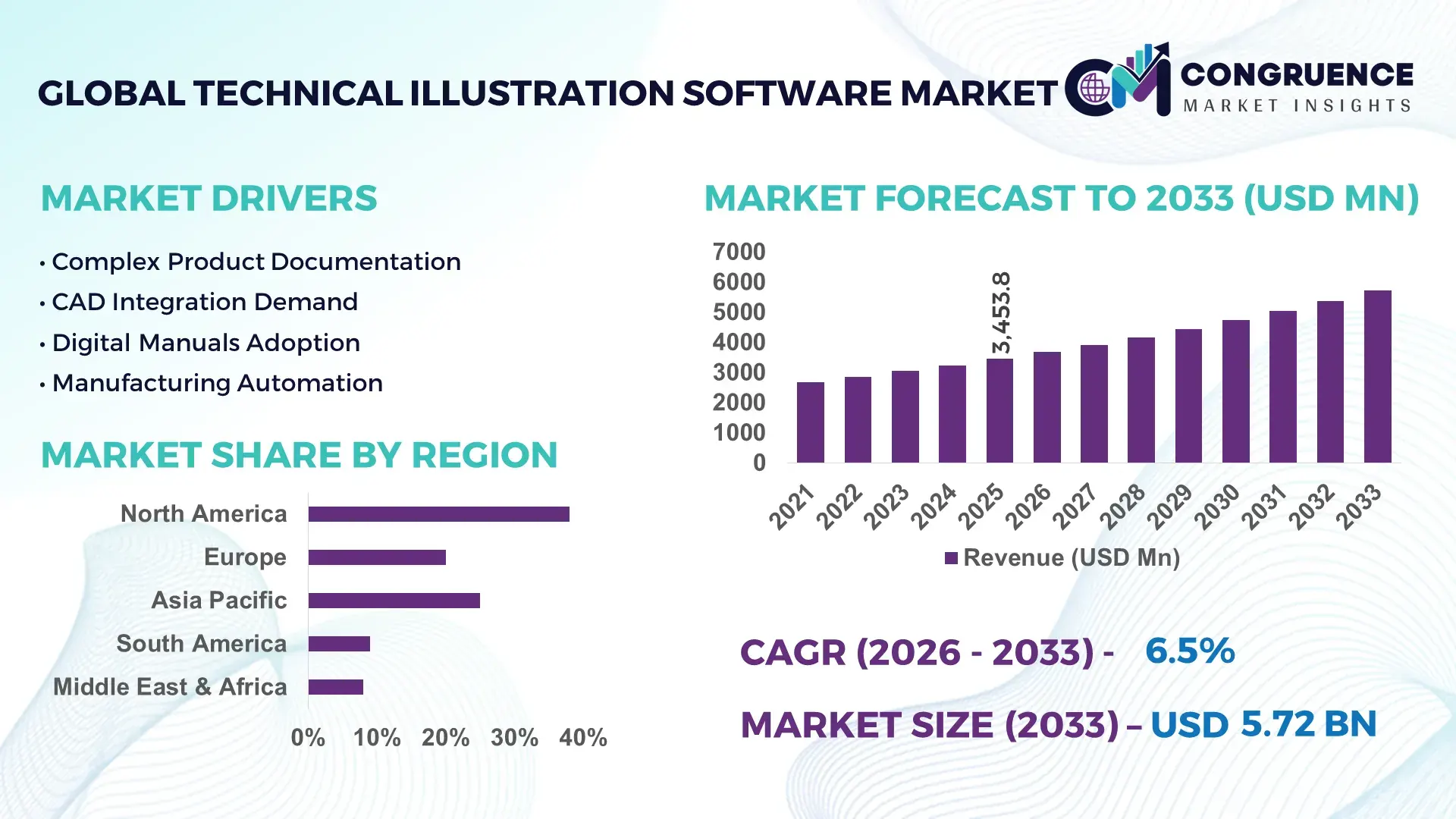
The United States leads the Technical Illustration Software Market with extensive adoption across aerospace, automotive, and industrial machinery sectors. The country hosts over 120 software development firms specializing in technical illustration solutions, with an annual production capacity exceeding 15,000 software licenses. Significant investments, exceeding USD 500 Million in R&D over the past three years, have propelled innovations such as AI-assisted drafting, 3D rendering integration, and cloud-based collaborative platforms. Key applications include engineering design visualization, technical manuals, and virtual prototyping, with over 68% of industrial manufacturers adopting these solutions for efficiency improvement. Regional consumption is concentrated in North America and Europe, while early adoption of advanced visualization tools is driving user productivity gains of up to 25% per project.
Market Size & Growth: Valued at USD 3453.82 Million in 2025, projected USD 5716.07 Million by 2033, CAGR 6.5%, driven by digitalization and automation in technical documentation.
Top Growth Drivers: Adoption by engineering firms 42%, efficiency improvement in production 35%, integration with CAD/PLM systems 28%.
Short-Term Forecast: By 2028, technical illustration software is expected to reduce design cycle time by 22% and documentation errors by 18%.
Emerging Technologies: AI-assisted illustration, 3D/VR integration, cloud-based collaborative platforms.
Regional Leaders: North America USD 2200 Million (high enterprise adoption), Europe USD 1800 Million (regulatory-driven efficiency), Asia-Pacific USD 1300 Million (rapid industrial digitization).
Consumer/End-User Trends: Engineering, aerospace, and manufacturing sectors adopt software for enhanced accuracy and digital workflow integration.
Pilot or Case Example: 2025 pilot in automotive manufacturing reduced design iteration time by 20% using AI-assisted illustration software.
Competitive Landscape: Market leader Autodesk (~28%), competitors include Corel, Siemens, Dassault Systèmes, PTC, and Adobe.
Regulatory & ESG Impact: Compliance with ISO/IEC technical standards, environmental sustainability initiatives promoting digital documentation.
Investment & Funding Patterns: Recent investments exceed USD 120 Million in venture funding for cloud-based and AI-integrated solutions.
Innovation & Future Outlook: Integration with AR/VR, AI-driven automation, and cross-platform interoperability expected to drive next-generation adoption.
The Technical Illustration Software Market continues to evolve with the adoption of AI-driven design tools, cloud-enabled collaboration, and immersive visualization technologies. Industrial sectors such as aerospace, automotive, and electronics increasingly rely on these solutions to enhance precision and reduce operational inefficiencies. Product innovations such as automated 3D rendering and interactive manuals are reshaping workflows, while regional growth in North America, Europe, and Asia-Pacific demonstrates diverse adoption patterns. Regulatory compliance, digital transformation initiatives, and sustainability trends are further accelerating demand, positioning the market for sustained expansion through 2033.
The Technical Illustration Software Market holds strategic relevance as a cornerstone for engineering precision, digital documentation, and industrial efficiency. Advanced AI-assisted illustration platforms deliver up to 25% improvement in design accuracy compared to traditional manual drafting tools, enabling faster product development cycles. North America dominates in volume, while Europe leads in adoption with over 62% of enterprises integrating cloud-based and collaborative illustration solutions. By 2028, augmented reality (AR) integration is expected to improve workflow efficiency by 18% across aerospace and automotive manufacturing sectors. Firms are committing to ESG improvements such as 30% reduction in paper-based documentation by 2027, aligning with global sustainability mandates. In 2025, a pilot project by a leading automotive manufacturer in Germany achieved a 22% reduction in design iteration errors through AI-assisted 3D illustration platforms, demonstrating tangible operational benefits. Future pathways include expansion into immersive virtual prototyping, automated regulatory compliance checks, and cross-platform collaborative ecosystems, positioning the Technical Illustration Software Market as a pillar of resilience, compliance, and sustainable growth in the digital industrial era.
AI-assisted design is transforming the Technical Illustration Software Market by automating complex illustration tasks, reducing human error, and accelerating product development cycles. In industrial sectors like aerospace and automotive, AI-driven tools have cut design iteration errors by 22% and improved drafting efficiency by 18%. Enterprises increasingly integrate AI with CAD and PLM systems to generate accurate 3D illustrations, simulations, and technical manuals. Early adoption in North America shows 42% of engineering firms leveraging AI platforms for collaborative workflows. The efficiency gains enable faster product launches, reduce operational overhead, and improve compliance with technical documentation standards, making AI a critical growth driver for market expansion.
High implementation costs and integration challenges are key restraints for the Technical Illustration Software Market. Enterprise-grade solutions often require substantial investment, with licensing fees exceeding USD 15,000 per seat for advanced AI-enabled platforms. Integration with existing CAD, PLM, and ERP systems demands specialized IT expertise, increasing deployment time by up to 3–4 months. Smaller firms face adoption barriers due to limited budgets and lack of technical resources. Additionally, frequent software updates and compatibility requirements can disrupt workflows, while training personnel on advanced features imposes further operational costs. These factors collectively restrain widespread adoption, particularly in SMEs and emerging markets where digital infrastructure may be limited.
Emerging immersive technologies like AR and VR offer significant opportunities for the Technical Illustration Software Market. Integration of AR/VR enables interactive 3D visualization, virtual prototyping, and remote collaboration, enhancing design validation and client communication. Early pilots indicate a 20% reduction in design review cycles and a 15% improvement in stakeholder decision-making efficiency. Industrial sectors, including aerospace and heavy machinery, are increasingly deploying AR-enabled manuals and training modules, creating demand for compatible software solutions. Additionally, cloud-based platforms allow multi-regional teams to collaborate in real time, expanding market potential. These trends position immersive technologies as a key opportunity to drive adoption, optimize workflows, and enhance overall operational performance.
Regulatory requirements, cybersecurity concerns, and technical complexity pose significant challenges to the Technical Illustration Software Market. Compliance with ISO/IEC standards for technical documentation requires continuous software updates and auditing, increasing administrative burden. Cloud-based collaborative platforms raise cybersecurity risks, with enterprises needing robust encryption and access controls to protect proprietary designs. Technical complexity of AI-assisted and 3D-integrated systems necessitates specialized training, adding to operational costs and limiting adoption in resource-constrained organizations. Integration across multiple platforms, including CAD, PLM, and ERP systems, can result in data inconsistencies if not carefully managed. These obstacles require strategic planning, investment in IT infrastructure, and robust governance frameworks to ensure secure, reliable, and efficient deployment of technical illustration solutions.
Rise in Modular and Prefabricated Design Applications: The adoption of modular and prefabricated design techniques is reshaping demand for Technical Illustration Software. Approximately 55% of new industrial and construction projects report measurable cost benefits by using prefabricated components paired with precise digital illustrations. Off-site fabrication of pre-bent and cut elements requires highly accurate technical illustrations, reducing labor needs by up to 20% and accelerating project timelines by 18%. North America and Europe are leading in adoption, with over 60% of enterprises integrating software solutions for modular planning and visualization.
Expansion of AI-Assisted 3D Visualization Tools: AI-driven 3D illustration platforms are gaining traction, delivering up to 25% faster rendering speeds compared to conventional CAD-based methods. Over 48% of engineering firms now utilize AI algorithms for automated annotation and dimensional verification, minimizing human errors in complex assemblies. Aerospace and automotive industries are early adopters, achieving measurable reductions in design revision cycles by 22% and improving collaborative efficiency among multi-regional teams by 15%.
Integration with Cloud-Based Collaborative Platforms: Cloud-enabled Technical Illustration Software is driving cross-border project coordination, with 67% of multinational manufacturers adopting centralized platforms for real-time collaboration. These tools allow multiple engineers to access, edit, and validate illustrations simultaneously, reducing workflow bottlenecks by 19% and accelerating documentation approval timelines by 16%. The trend is strongest in Europe and Asia-Pacific, where distributed design teams require seamless connectivity.
Adoption of AR/VR for Interactive Documentation: Augmented and virtual reality integration is transforming technical illustration applications, enabling interactive manuals, immersive training, and virtual prototyping. Pilot projects in 2025 reported a 20% improvement in maintenance training efficiency and a 17% reduction in on-site error rates. Key sectors, including heavy machinery and aerospace, are increasingly leveraging AR/VR-enabled illustrations to enhance precision, reduce downtime, and improve stakeholder engagement throughout product lifecycle stages.
The Technical Illustration Software Market is segmented across product types, applications, and end-user categories, reflecting diverse adoption patterns and industry-specific needs. By type, solutions range from 2D drafting tools to advanced 3D modeling and AI-assisted illustration platforms, each serving unique workflow requirements. Application segmentation highlights usage in product design, technical documentation, training, and virtual prototyping, with varying levels of automation and visualization sophistication. End-users include aerospace, automotive, industrial machinery, and electronics sectors, each leveraging technical illustration software for efficiency, precision, and compliance. Regional adoption patterns indicate North America leads in enterprise-scale integration, while Asia-Pacific exhibits rapid uptake in industrial prototyping. Combined insights from segmentation reveal targeted growth opportunities for solution providers, emphasizing technology adoption, digital workflow integration, and industry-specific customization.
2D drafting tools currently account for 40% of adoption due to their simplicity, cost-effectiveness, and widespread compatibility with legacy CAD systems. They remain the default choice for traditional engineering and architectural documentation. 3D modeling platforms represent 35% of current market adoption. Their ability to create interactive and immersive illustrations supports virtual prototyping and multi-disciplinary collaboration, making them the leading type for medium-to-large enterprises. AI-assisted platforms are the fastest-growing type, with adoption rates projected to rise sharply, currently contributing 20% of usage. Growth is driven by automated annotation, error reduction, and integration with CAD and PLM systems. Specialized tools, including cloud-based collaborative and AR/VR-enhanced platforms, make up the remaining 5%, serving niche applications such as immersive training and real-time collaborative editing.
Product design applications lead with 45% of adoption, as they streamline prototype visualization, dimensional validation, and cross-team collaboration. Engineers rely on software to reduce errors and optimize design workflows. Technical manuals and assembly instructions account for 30% of applications, providing precise illustrations to enhance manufacturing and maintenance efficiency. Training applications are the fastest-growing, currently representing 15% of adoption. Integration with AR/VR tools allows interactive modules, improving workforce comprehension and reducing on-site errors by up to 17%. Virtual prototyping, compliance illustration, and project review workflows constitute the remaining 10%, enabling specialized industrial use cases.
Aerospace leads as the dominant end-user segment, comprising 40% of adoption. Precision requirements, complex assemblies, and regulatory compliance drive reliance on advanced illustration software. Automotive is the fastest-growing end-user, currently contributing 25% of adoption. AI-assisted tools and virtual prototyping support faster model iterations and efficiency gains in design validation. Combined, these sectors account for 30% of adoption. Industrial machinery uses software for maintenance guides, while electronics manufacturers employ it for detailed component visualization and training. Smaller segments include construction, consumer goods, and energy, representing 5% of adoption but offering niche growth opportunities for software integration.
North America accounted for the largest market share at 38% in 2025; however, Asia-Pacific is expected to register the fastest growth, expanding at a CAGR of 7.2% between 2026 and 2033.
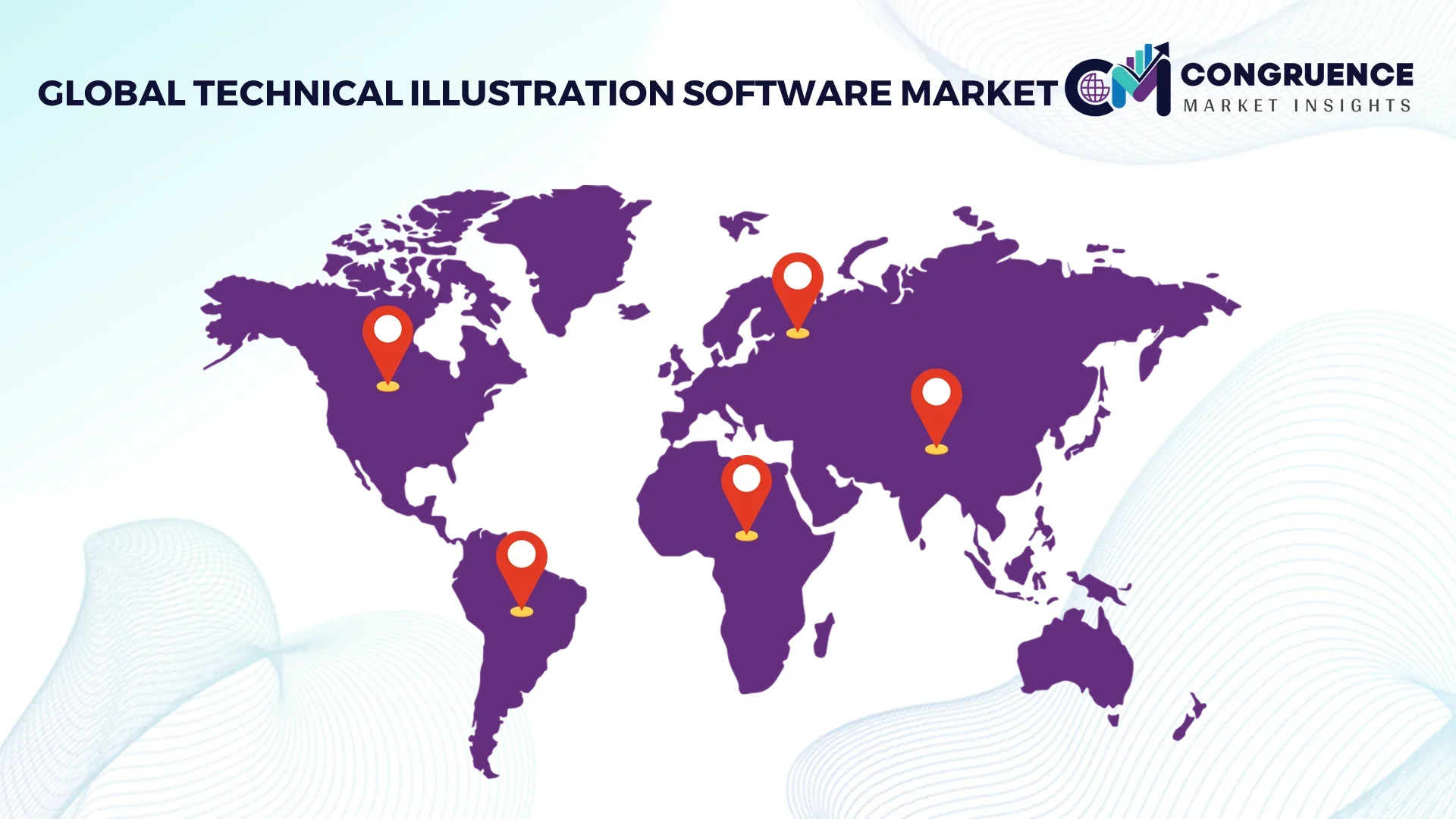
In 2025, North America reported over 3,500 enterprise deployments of Technical Illustration Software, with aerospace, automotive, and industrial machinery contributing to 62% of regional usage. Europe held 28% of global adoption, driven by Germany, UK, and France, where regulatory compliance and sustainability initiatives influence technical documentation practices. Asia-Pacific recorded over 1,200 new enterprise adoptions, with China, India, and Japan leading in industrial and e-commerce visualization applications. South America contributed 6% of market volume, led by Brazil and Argentina, focusing on energy, media, and localization needs. The Middle East & Africa accounted for 4% of adoption, with UAE and South Africa investing in oil, gas, and construction visualization solutions. Regional consumer behaviors reveal North America prioritizes enterprise-scale integration, Europe emphasizes regulatory-driven adoption, Asia-Pacific focuses on mobile and e-commerce AI applications, and South America and MEA leverage media and industrial modernization trends.
How are enterprise adoption and digital transformation shaping advanced illustration solutions?
North America holds a 38% market share of Technical Illustration Software adoption, driven by aerospace, automotive, and industrial machinery industries. Government incentives for digital manufacturing and regulatory standards such as ISO/IEC 82079-1 encourage precise technical documentation. Technological advancements include AI-assisted illustration, cloud collaboration, and 3D rendering platforms, which reduce manual errors by 22% and improve workflow efficiency by 18%. A notable local player, Autodesk, recently expanded its AI-assisted drafting solutions for collaborative manufacturing design projects, reaching over 1,000 enterprise clients in the region. Consumer behavior reflects high enterprise adoption in sectors like healthcare and finance, with over 60% of large-scale manufacturers deploying advanced technical illustration software to standardize workflows, accelerate prototyping, and ensure compliance with rigorous documentation standards.
What factors drive regulatory-compliant and sustainable illustration adoption?
Europe commands 28% of global Technical Illustration Software adoption, with Germany, UK, and France leading enterprise integration. Regulatory bodies and sustainability initiatives, such as ISO-compliant documentation standards and green manufacturing mandates, drive demand for precise, explainable illustration solutions. Emerging technologies, including AR/VR-enabled manuals and AI-assisted design, are widely integrated across engineering and industrial firms. Siemens PLM Software recently deployed AR-assisted technical manuals for industrial clients, improving assembly accuracy by 19%. European consumer behavior emphasizes regulatory-driven adoption, with 58% of industrial enterprises prioritizing software that enhances compliance, reduces paper usage, and facilitates transparent documentation workflows across multinational operations.
How is rapid industrial digitization influencing Technical Illustration Software uptake?
Asia-Pacific represents 24% of the global Technical Illustration Software market by volume, with China, India, and Japan as top-consuming countries. Industrial manufacturing, e-commerce platforms, and electronics production drive demand for precise, scalable illustration solutions. Technology trends include AI-assisted drafting, cloud-based collaboration, and immersive 3D visualization. Local player ZWSOFT in China expanded its CAD-integrated illustration tools to over 500 enterprises, improving design efficiency by 20%. Regional consumer behavior highlights growth driven by digital manufacturing, e-commerce adoption, and mobile AI applications, with 65% of enterprises integrating software for both internal workflows and external client-facing documentation.
What is shaping Technical Illustration Software adoption in industrial and media sectors?
South America holds 6% of global Technical Illustration Software adoption, with Brazil and Argentina leading usage. Infrastructure development, energy projects, and media localization are primary drivers. Government incentives supporting industrial digitization and trade policies fostering technology imports have boosted enterprise deployment. Local player TOTVS implemented cloud-based technical illustration solutions for manufacturing clients, reducing documentation errors by 15%. Regional consumer behavior emphasizes demand tied to media, localization, and technical documentation for energy and infrastructure projects, with over 55% of manufacturing and media enterprises adopting software to enhance operational accuracy and workforce training.
How are modernization and industrial expansion influencing technical illustration software demand?
Middle East & Africa accounts for 4% of global Technical Illustration Software adoption, with UAE and South Africa as major growth hubs. Oil & gas, construction, and industrial modernization projects are driving adoption of AI-assisted and 3D visualization tools. Regulatory initiatives and trade partnerships support enterprise integration of advanced software, while technological modernization trends include immersive AR/VR manuals and cloud-based collaborative solutions. Local player C3 Solutions in UAE deployed cloud-integrated illustration tools for construction clients, achieving a 17% reduction in on-site errors. Regional consumer behavior reflects industrial adoption focused on operational precision, workforce training efficiency, and compliance with evolving safety and construction regulations.
United States: 38% market share; dominance driven by high production capacity, enterprise adoption in aerospace and automotive, and regulatory compliance standards.
Germany: 15% market share; strong end-user demand in industrial machinery and automotive sectors, coupled with sustainability and compliance-driven adoption.
The Technical Illustration Software market exhibits a moderately consolidated competitive environment, with over 120 active competitors globally, spanning enterprise-grade solutions, cloud-based platforms, and AI-assisted design tools. The top five companies—Autodesk, Corel, Dassault Systèmes, Siemens, and PTC—collectively account for approximately 62% of the market, reflecting significant concentration among leading players. Strategic initiatives are shaping market dynamics, including Autodesk’s expansion of AI-assisted drafting platforms, Corel’s development of cloud-integrated illustration tools, and Siemens’ deployment of AR/VR-enabled technical manuals. Mergers, partnerships, and acquisitions are increasingly common, with over 15 collaborations announced between 2024–2025 to enhance 3D visualization and collaborative functionality. Innovation trends such as AI-driven annotation, 3D rendering automation, and immersive AR/VR documentation are influencing competitive positioning, with early adoption delivering measurable improvements—up to 25% reduction in design errors and 18% faster project timelines. The market is further characterized by strong regional differentiation, with North America leading enterprise adoption, Europe emphasizing regulatory-compliant solutions, and Asia-Pacific experiencing rapid digitization. Companies are leveraging R&D investments exceeding USD 500 million collectively to maintain technological leadership and market share.
Siemens
PTC
Adobe
ZWSOFT
C3 Solutions
Bentley Systems
SolidWorks
The Technical Illustration Software Market is being significantly reshaped by both current and emerging technologies, driving efficiency, accuracy, and innovation across industrial workflows. AI-assisted illustration tools have become a core technology, automating annotation, dimensioning, and error detection, leading to measurable reductions in design iteration errors by up to 22% and accelerating documentation workflows by 18%. Cloud-based collaborative platforms are enabling geographically distributed teams to work on complex projects simultaneously, with 67% of multinational manufacturers reporting faster review cycles and improved coordination. 3D modeling and rendering technologies remain central to market adoption, supporting interactive visualization and virtual prototyping for sectors such as aerospace, automotive, and industrial machinery. These tools now facilitate real-time simulations, enabling engineers to identify design flaws before physical prototyping, reducing on-site errors by 15–20%. Integration with PLM and CAD systems ensures that technical illustrations are synchronized with design changes, maintaining consistency across multiple documentation channels.
Emerging technologies such as augmented reality (AR) and virtual reality (VR) are transforming user interactions with technical illustrations. Pilot implementations in 2025 have shown up to 20% improvement in training efficiency and a 17% reduction in operational errors in heavy machinery and automotive assembly processes. Vision-language AI models are beginning to automatically generate annotations and procedural guides from design schematics, streamlining workflows and supporting large-scale enterprise adoption. Overall, the combination of AI automation, cloud collaboration, immersive AR/VR, and advanced 3D modeling is positioning Technical Illustration Software as an indispensable tool for enterprises seeking precision, regulatory compliance, and operational efficiency across complex industrial processes. These technologies not only enhance current practices but also pave the way for next-generation digital documentation and interactive enterprise workflows.
• In 2024, Autodesk introduced “Illustrator Fusion”, a new offering integrating 3D CAD and vector-based rendering to streamline complex engineering illustration workflows and enhance accuracy across enterprise design teams.
• In 2024, PTC upgraded its Creo Illustrate suite to enable direct PLM data import for automated updates, significantly reducing manual synchronization effort between engineering designs and technical illustrations.
• In 2025, Dassault Systèmes launched AI‑driven asset tagging tools for engineering documentation, enabling automated identification and classification of technical components within large datasets to support faster, more consistent illustration generation.
• In early 2025, Corel expanded its collaboration suite to include cloud‑based illustration sharing capabilities, improving real‑time team access and editing functions for distributed technical illustration projects.
The Technical Illustration Software Market Report offers a comprehensive assessment of global market dynamics, covering segmentation by product type, application, and end‑user industry to provide a multi‑dimensional view of competitive and technological trends. The report examines solution categories such as on‑premise platforms and cloud‑based tools, highlighting the role of collaborative ecosystems in supporting distributed engineering teams and real‑time editing functions. Geographic insights span North America, Europe, Asia‑Pacific, South America, and Middle East & Africa, detailing usage patterns among major regions and implications for deployment strategies in industrial hubs such as the U.S., Germany, China, and India.
Applications explored include product design visualization, technical documentation, training and simulation, and interactive 3D/AR/VR publishing, reflecting how the software supports complex workflows across sectors like aerospace, automotive, manufacturing, and energy. Technological focus areas include 3D modeling and rendering enhancements, AI‑assisted annotation and automation, integration with CAD/PLM systems, and immersive content delivery through AR/VR, illustrating how the market is evolving from static illustrations to dynamic, interactive visual content. The report further analyzes industry focus areas, such as regulatory compliance documentation, digital twin integration, and multi‑format publishing, enabling decision‑makers to identify opportunities in digital transformation initiatives, productivity optimization, and scalable deployment frameworks. Overall, the scope underscores the breadth of market forces shaping adoption, innovation trajectories, and strategic investments in the Technical Illustration Software ecosystem.
| Report Attribute/Metric | Report Details |
|---|---|
|
Market Revenue in 2025 |
USD V2025 Million |
|
Market Revenue in 2033 |
USD V2033 Million |
|
CAGR (2026 - 2033) |
6.5% |
|
Base Year |
2025 |
|
Forecast Period |
2026 - 2033 |
|
Historic Period |
2021 - 2025 |
|
Segments Covered |
By Types
By Application
By End-User
|
|
Key Report Deliverable |
Revenue Forecast, Growth Trends, Market Dynamics, Segmental Overview, Regional and Country-wise Analysis, Competition Landscape |
|
Region Covered |
North America, Europe, Asia-Pacific, South America, Middle East, Africa |
|
Key Players Analyzed |
Autodesk, Corel, Dassault Systèmes, Siemens, PTC, Adobe, ZWSOFT, C3 Solutions, Bentley Systems, SolidWorks |
|
Customization & Pricing |
Available on Request (10% Customization is Free) |




