
Reports
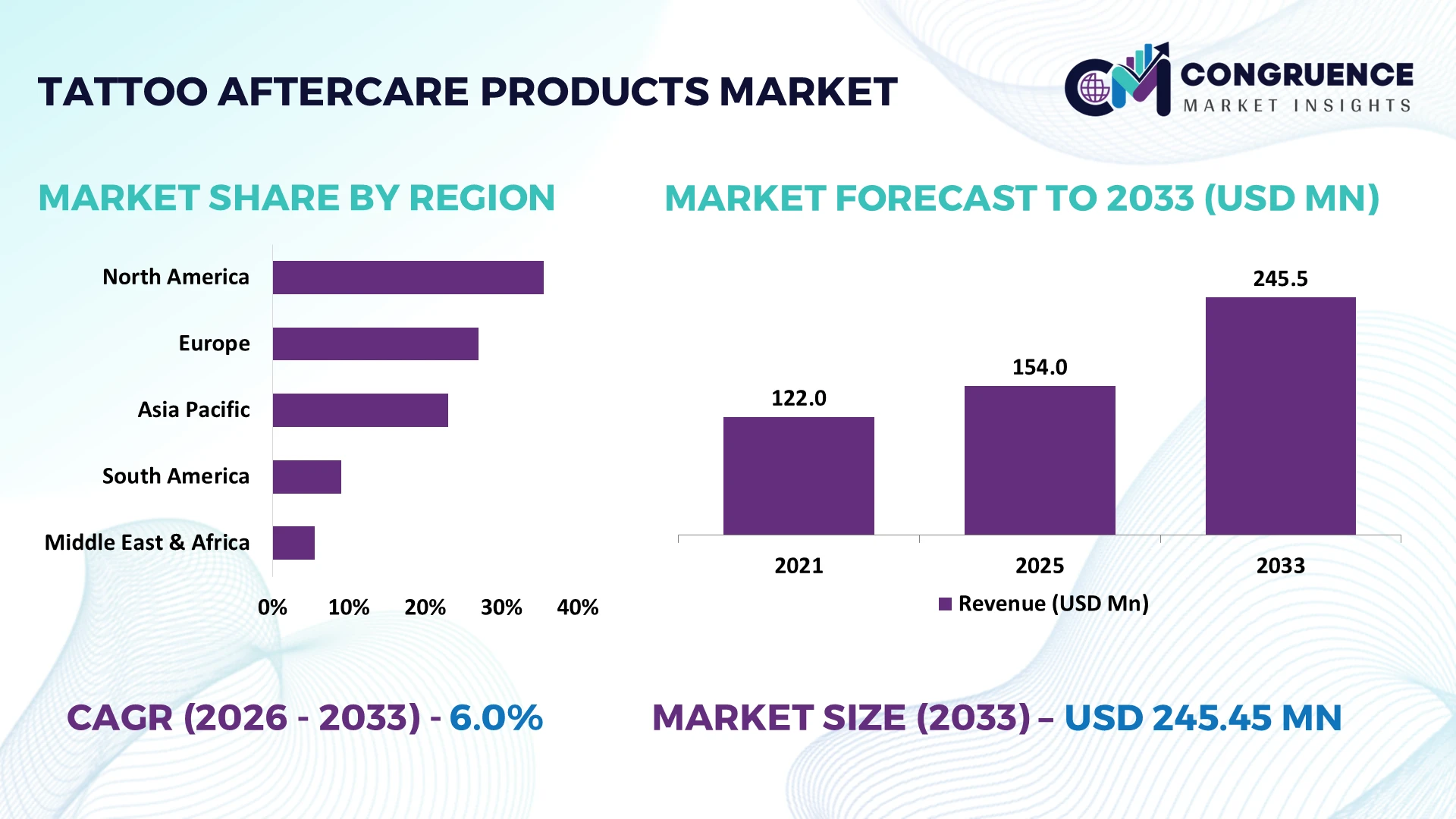
The Global Tattoo Aftercare Products Market was valued at USD 154.0 Million in 2025 and is anticipated to reach a value of USD 245.5 Million by 2033 expanding at a CAGR of 6.0% between 2026 and 2033. Growth is driven by increasing professional tattoo penetration, adoption of breathable second-skin healing films, and expanding availability of fragrance-free, dermatologically tested skin recovery formulations.
The United States dominates the global tattoo aftercare products market, supported by approximately 32% of American adults reporting at least one tattoo, compared with roughly 20% in several major European consumer surveys. The country's established professional tattoo studio network, specialty skincare retailers, and FDA-regulated cosmetics environment support product commercialization. Germany provides a significant European comparison, with growing demand for vegan-certified and sensitive-skin formulations.
Manufacturers prioritizing clinically substantiated ingredients, professional studio distribution, and convenient healing solutions are positioned to strengthen customer retention and premium product differentiation.
Market Size & Growth: Valued at USD 154.0 million in 2025, the global market is projected to reach USD 245.5 million by 2033, registering a 6.0% CAGR, supported by professional tattooing and advanced wound-protection products.
Top Growth Drivers: Tattoo prevalence among American adults reaches approximately 32%, while tattoo ownership among adults under 50 exceeds 40%, supporting recurring aftercare purchases and specialist skincare adoption.
Short-Term Forecast: By 2028, premium second-skin dressings and fragrance-free recovery products are positioned to increase their contribution to professional tattoo studio sales.
Emerging Technologies: Breathable polyurethane films, hydrogel-based formulations, and microbiome-conscious skincare represent 3 important product innovation directions.
Regional Leaders: North America, Europe, and Asia Pacific lead global consumption, supported respectively by professional studio networks, dermatological skincare preferences, and expanding urban tattoo culture.
Consumer/End-User Trends: Approximately 32% of American adults have tattoos, reinforcing demand for convenient cleansing, moisturizing, and healing protection.
Pilot/Case Example: In 2025, professional studio adoption of transparent second-skin dressings demonstrated the operational advantage of continuous protective coverage over conventional repeated bandaging.
Competitive Landscape: Hustle Butter, Tattoo Goo, After Inked, Mad Rabbit, and Eucerin compete through formulation differentiation, brand recognition, and professional recommendations.
Regulatory & ESG Impact: EU Regulation 2020/2081 restricts thousands of hazardous substances in tattoo inks, strengthening the wider industry's focus on ingredient transparency and consumer safety.
Investment & Funding: Brand investment increasingly targets direct-to-consumer platforms, dermatological product development, and professional studio partnerships, with funding concentrated on premium skincare positioning.
Innovation & Future Outlook: Advanced barrier-repair creams, biodegradable packaging, and personalized aftercare routines are reshaping product portfolios and digital consumer engagement.
The tattoo aftercare products industry increasingly serves professional tattoo studios, dermatology-focused skincare channels, and direct-to-consumer platforms. Breathable healing membranes, ceramide-enriched moisturizers, and vegan recovery balms are improving product differentiation. With approximately 32% of American adults reporting tattoo ownership, manufacturers are strengthening repeat-purchase strategies while responding to European cosmetic ingredient requirements and expanding demand for transparent formulations.
Tattoo aftercare products are becoming strategically important as professional tattooing converges with dermatological skincare, advanced wound protection, and premium personal care. Manufacturers increasingly compete on ingredient safety, skin-barrier restoration, and professional endorsement rather than basic moisturizing performance. With approximately 32% of American adults having at least one tattoo, established brands are expanding specialized recovery portfolios while strengthening direct-to-consumer distribution and ingredient traceability.
Advanced polyurethane healing films provide a technological alternative to conventional plastic-wrap protection by combining flexible coverage with moisture management and reduced dressing handling. Depending on product instructions and healing conditions, selected films remain in place for several days, compared with conventional coverings that require more frequent replacement. The United States leads in professional studio commercialization, while Germany emphasizes dermatological compatibility and formulation transparency. India offers opportunities through expanding metropolitan tattoo studios and digital skincare retail.
During 2027–2029, manufacturers are expected to prioritize fragrance-free formulations, recyclable packaging, and studio-integrated aftercare kits. Professional partnerships, standardized application guidance, and targeted skincare research will determine which brands convert tattoo ownership into sustained customer relationships and defensible competitive positioning.
Rising tattoo prevalence and stronger professional aftercare recommendations are accelerating demand for specialized skin recovery products. Approximately 32% of American adults report having tattoos, while ownership exceeds 40% among adults younger than 50, creating a substantial consumer base for protective films, antibacterial cleansing solutions, and moisturizing balms. Professional tattoo studios increasingly recommend structured healing routines to reduce irritation and maintain tattoo appearance. The shift toward fragrance-free skincare and breathable polyurethane dressings supports higher-value product adoption. Manufacturers such as Hustle Butter and After Inked are strengthening studio partnerships, expanding digital distribution, and emphasizing skin-compatible ingredients. Professional endorsement remains a decisive purchasing influence because aftercare recommendations are delivered immediately following tattoo procedures.
Ingredient restrictions, packaging expenses, and price-sensitive purchasing constrain tattoo aftercare product commercialization. The European Union's cosmetic regulatory framework requires safety assessments, ingredient documentation, and compliant labeling, increasing administrative requirements for smaller brands. Approximately 32% tattoo ownership among American adults does not translate directly into equivalent specialized aftercare adoption because conventional moisturizers remain accessible substitutes. Imported botanical oils, specialty polymers, and packaging components expose manufacturers to currency fluctuations and procurement uncertainty. Products incorporating 2 or 3 specialized functional ingredients often require additional formulation compatibility and stability testing. Companies are reducing exposure through local contract manufacturing, simplified ingredient portfolios, and diversified packaging suppliers. Competitive pricing increasingly depends on procurement discipline rather than premium branding alone.
Next-generation skin-barrier technologies create opportunities beyond conventional tattoo moisturizers. Ceramide-based creams, breathable hydrogel dressings, and microbiome-conscious formulations support differentiated recovery solutions for sensitive skin. With approximately 32% of American adults reporting tattoo ownership and more than 40% penetration among younger adults, specialized product segmentation offers opportunities for targeted replenishment programs. India and Brazil present additional potential through professional studio development, social-commerce distribution, and rising interest in premium personal care. Manufacturers are investing in vegan formulations, compact travel kits, and digitally personalized recovery instructions. Combining 2 complementary products, such as protective film and barrier-repair cream, creates bundled merchandising opportunities. Brands integrating studio education with subscription-based replenishment can strengthen customer lifetime value beyond initial tattoo healing.
Long-term competitiveness depends on demonstrating formulation safety and achieving consistent aftercare practices across fragmented tattoo studio networks. Approximately 32% tattoo prevalence among American adults creates a broad consumer population with different skin sensitivities, healing behaviors, and product preferences. Tattoo recovery commonly extends over 2–4 weeks, requiring appropriate cleansing, moisture management, and adherence to product-specific instructions. Incorrect application of adhesive films, excessive occlusion, or incompatible skincare ingredients can undermine product performance and consumer confidence. Companies must establish dermatological testing protocols, improve professional training, and develop accessible multilingual instructions. Manufacturers expanding into India and Germany also face differences in studio practices and consumer expectations. Standardized education and credible product validation will increasingly separate durable brands from marketing-led entrants.
Professional Retail Channels Become More Integrated: Tattoo studios are increasingly integrating aftercare products into checkout workflows, combining consultation, product selection, and post-procedure guidance. With approximately 32% of American adults reporting tattoo ownership and more than 40% penetration among adults under 50, retailers are prioritizing repeat-purchase engagement. Brands are expanding wholesale partnerships, introducing standardized studio merchandising, and using digital product education to improve conversion and inventory turnover.
Ingredient Transparency Reshapes Product Portfolios: European cosmetic labeling requirements and growing scrutiny of skincare ingredients are accelerating formulation documentation and packaging standardization. EU Regulation 1223/2009 establishes cosmetic compliance obligations, while Regulation 2020/2081 addresses tattoo ink substances. Manufacturers are consolidating ingredient inventories, improving batch traceability, and adopting digital labeling workflows. This reduces compliance complexity across multiple product lines and supports consistent international distribution.
Digital Commerce Changes Customer Acquisition: Online skincare purchasing is shifting tattoo aftercare marketing toward creator-led demonstrations, educational content, and mobile-first product discovery. The 18–34 and 35–49 age groups represent strategically important consumer cohorts. Brands are integrating customer reviews, automated replenishment messaging, and tattoo-specific product recommendations to improve conversion efficiency while reducing dependence on conventional advertising.
Packaging Optimization Strengthens Operational Efficiency: Manufacturers are redesigning tubes, pumps, and protective film packaging to improve dispensing accuracy and reduce unnecessary material consumption. Single-use sachets and 2-in-1 recovery kits are gaining merchandising relevance in professional studios. Suppliers are standardizing packaging dimensions, consolidating procurement, and adopting recyclable materials where technically suitable, improving logistics efficiency and reducing inventory complexity across distribution channels.
The tattoo aftercare products market is segmented by type into Moisturizer or Lotion or Oil, Soap or Foam or Cleansers, Balm or Salve or Ointment, and Others. Moisturizer or Lotion or Oil represents the leading segment, accounting for approximately 35% of global product demand, supported by daily application convenience, skin hydration, and compatibility with established skincare routines. Balm or Salve or Ointment maintains a strong position through protective formulations and professional tattoo artist recommendations.
Soap or Foam or Cleansers serves the initial cleansing stage, while Others, including protective films and specialized recovery products, represents the fastest-growing category as consumers adopt structured healing routines. Manufacturers are expanding fragrance-free portfolios, improving formulation stability, and introducing complementary product combinations to strengthen customer retention.
The tattoo aftercare products market is segmented by application into Personal and Tattoo Artist. Personal represents the dominant application, accounting for approximately 75–77% of market demand, supported by individual responsibility for cleansing, moisturizing, and protecting tattooed skin throughout recovery. Consumers increasingly purchase specialized lotions, balms, and cleansing solutions through online platforms and skincare retailers.
Tattoo Artist applications account for approximately 23–25%, reflecting professional use during tattoo procedures, initial skin protection, and post-treatment product recommendations. Although Personal maintains the largest consumption base, Tattoo Artist applications are gaining strategic importance through standardized studio protocols, professional product bundles, and branded aftercare partnerships. Manufacturers are developing studio-specific packaging, wholesale pricing programs, and convenient application formats to strengthen professional channel penetration.
The tattoo aftercare products market is segmented by end-user into Individual Consumers and Professional Tattoo Studios. Individual Consumers dominate the market, accounting for approximately 67.4% of demand in a 2025 industry segmentation estimate, reflecting direct purchases of moisturizing lotions, cleansing products, protective balms, and tattoo maintenance solutions. Professional Tattoo Studios represent approximately 32.6%, supported by initial treatment requirements, product recommendations, and bundled aftercare sales.
Professional Tattoo Studios are becoming an increasingly influential customer acquisition channel as manufacturers integrate retail merchandising with tattoo procedures. Individual purchasing remains concentrated around immediate healing requirements, while studios emphasize consistent product performance, convenient dispensing, and reliable wholesale availability. Manufacturers are introducing differentiated package sizes, artist-oriented promotional programs, and direct-to-consumer replenishment models.
North America accounted for the largest market share at 35.5% in 2025 however, Asia-Pacific is expected to register the fastest growth, expanding at a CAGR of 7.8% between 2026 and 2033.
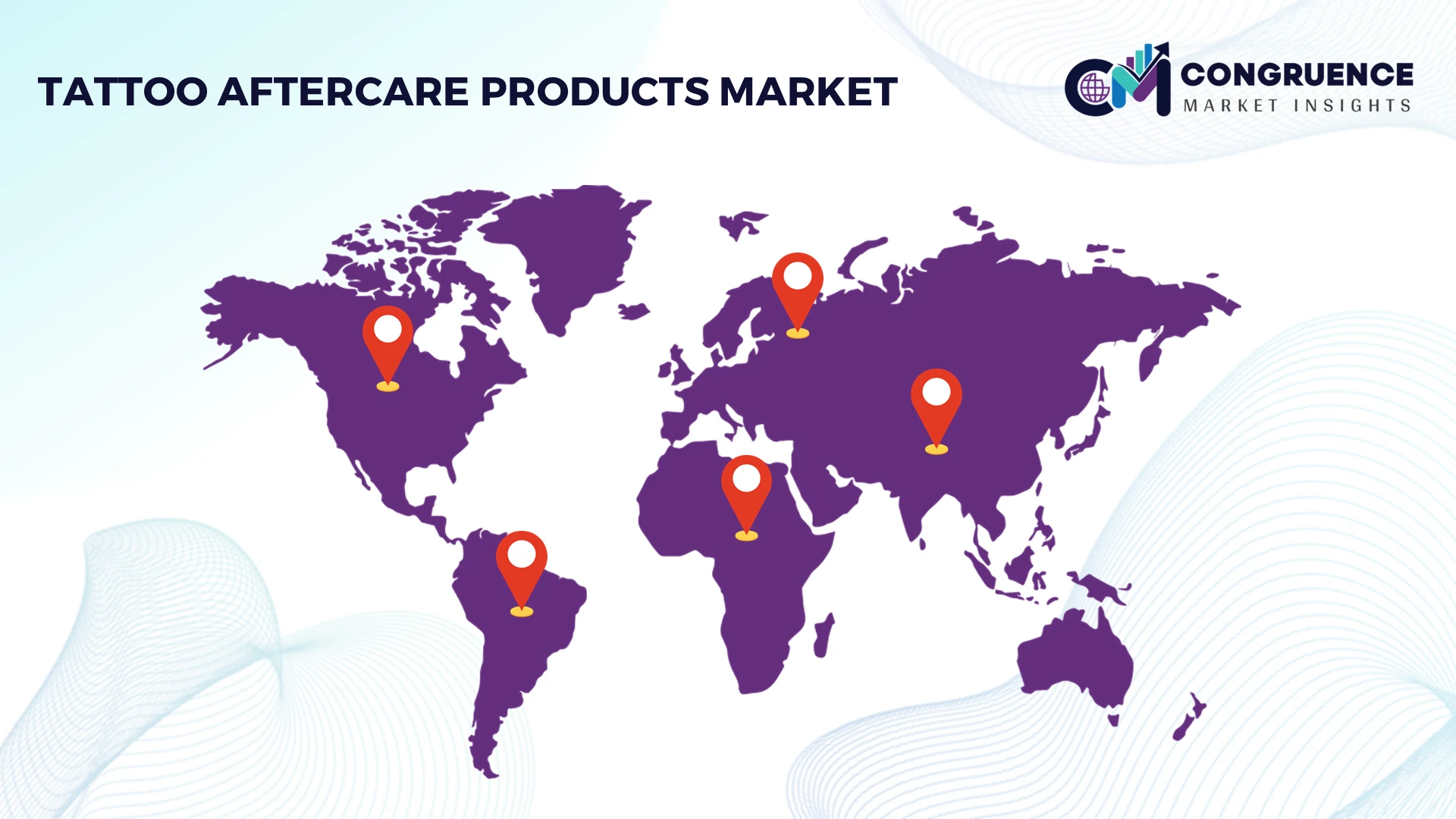
North America accounted for approximately 35.5% of the global tattoo aftercare products market in 2025, supported by established professional tattoo studios, advanced skincare retail networks, and strong consumer awareness of specialized healing formulations. The United States dominates regional consumption, while Canada contributes through expanding dermatological skincare distribution and professional tattoo services. Manufacturers increasingly prioritize fragrance-free moisturizers, breathable protective films, and specialized cleansing products that support structured recovery routines. Approximately 32% of American adults have at least one tattoo, reinforcing a substantial addressable consumer base. Companies including Hustle Butter, After Inked, and Tattoo Goo are strengthening professional partnerships and direct-to-consumer distribution. Advanced fulfillment infrastructure and established specialty retail channels enable faster product commercialization, while professional recommendations improve brand visibility and encourage repeat purchases across premium tattoo maintenance categories.
United States Market Outlook: The United States benefits from an extensive professional tattoo industry, established cosmetic manufacturing capabilities, and sophisticated digital retail infrastructure. Tattoo ownership exceeds 40% among adults younger than 50, creating opportunities for targeted skincare products and specialized recovery kits. Manufacturers are investing in dermatologically compatible formulations, subscription-based purchasing, and professional studio education. FDA cosmetic regulatory requirements also reinforce the importance of accurate labeling, ingredient safety, and responsible product positioning.
Europe represented approximately 27.0% of the global tattoo aftercare products market in 2025, supported by established tattoo cultures in Germany, France, Italy, Spain, and the United Kingdom. Regional manufacturers increasingly emphasize dermatological compatibility, vegan formulations, and transparent ingredient labeling to address evolving consumer expectations. EU Regulation 1223/2009 establishes cosmetic product safety and documentation requirements, influencing formulation development and distribution strategies. Germany and France maintain strong specialty skincare infrastructure, while Italy contributes through professional tattoo artistry and premium personal care consumption. Manufacturers are expanding fragrance-free recovery creams, protective balms, and recyclable packaging formats. Cross-border e-commerce enables specialized brands to reach multiple national markets without extensive physical retail networks. Compliance capabilities and professional endorsements increasingly determine market access, product differentiation, and long-term customer retention across European tattoo aftercare distribution channels.
Germany Market Outlook: Germany maintains a strategically important position through its advanced dermatological skincare industry, established pharmacy distribution, and strong consumer emphasis on ingredient safety. The country's cosmetics sector operates under EU Regulation 1223/2009, requiring structured product safety assessments and regulatory documentation. Manufacturers are prioritizing sensitive-skin formulations, vegan-certified ingredients, and professional tattoo studio partnerships. Established skincare manufacturing capabilities support product innovation, consistent quality control, and expansion into neighboring European markets.
Asia-Pacific accounted for approximately 23.0% of the global tattoo aftercare products market in 2025, supported by expanding professional tattoo services, increasing disposable income, and sophisticated beauty retail ecosystems. China, Japan, South Korea, India, and Australia represent important consumption and distribution markets. China contributes substantial cosmetic manufacturing capacity and e-commerce infrastructure, while Japan and South Korea emphasize specialized skincare formulations and premium packaging. India is experiencing increased professional tattoo activity across metropolitan centers, creating opportunities for affordable aftercare kits and locally distributed recovery products. Manufacturers are strengthening contract manufacturing relationships, expanding marketplace distribution, and introducing lightweight moisturizers suited to humid climates. Regional packaging and cosmetic ingredient supply chains support product customization and shorter replenishment cycles. Competitive advantage increasingly depends on localized formulations, accessible pricing, and partnerships with professional tattoo studios and digital beauty retailers.
China Market Outlook: China benefits from extensive personal care manufacturing infrastructure, advanced packaging supply chains, and established digital commerce platforms. The country's cosmetic industry operates under the Cosmetics Supervision and Administration Regulation, implemented in 2021, establishing requirements for product registration, notification, and safety management. Manufacturers are leveraging domestic production capabilities to develop competitively priced tattoo moisturizers, cleansing foams, and protective formulations. Integrated logistics networks support rapid distribution across major metropolitan consumer markets.
South America represented approximately 9.0% of the global tattoo aftercare products market in 2025, with Brazil accounting for the largest regional consumption base, followed by Argentina and other developing markets. Established tattoo communities in São Paulo, Rio de Janeiro, and Buenos Aires support demand for moisturizing balms, protective ointments, and specialized cleansing products. Brazil's extensive cosmetics manufacturing ecosystem provides opportunities for localized formulation development and domestic distribution. Manufacturers increasingly utilize professional tattoo studio partnerships, online marketplaces, and independent beauty retailers to improve product accessibility. However, imported specialty ingredients, exchange-rate volatility, and uneven distribution infrastructure create procurement challenges. Companies are responding through domestic contract manufacturing, simplified packaging formats, and competitive product positioning. Locally sourced botanical ingredients and professional artist recommendations provide opportunities to differentiate products while maintaining affordability in price-sensitive consumer segments.
Brazil Market Outlook: Brazil holds a leading regional position through its established beauty and personal care manufacturing industry and extensive professional tattoo community. ANVISA regulates cosmetic products under the country's sanitary framework, influencing product classification, labeling, and safety compliance. São Paulo serves as an important commercial center for tattoo services and specialty skincare distribution. Manufacturers are developing locally adapted moisturizers, botanical recovery balms, and accessible aftercare bundles to strengthen domestic market penetration.
The Middle East & Africa accounted for approximately 5.5% of the global tattoo aftercare products market in 2025, reflecting a developing but geographically concentrated consumer base. South Africa represents an established professional tattoo services market, while the United Arab Emirates contributes through premium skincare retail, international tourism, and cross-border beauty distribution. Tattoo-related cultural and regulatory considerations influence commercial opportunities across individual countries, making localized market strategies essential. Manufacturers primarily target specialized tattoo studios, international skincare retailers, and digital commerce channels. Dubai's logistics infrastructure supports imported premium aftercare products, while South African distributors emphasize accessible moisturizing formulations and professional artist partnerships. Companies are strengthening regional distribution agreements, introducing compact product formats, and improving multilingual consumer guidance. Market development depends on regulatory compatibility, professional service availability, and reliable access to specialized skincare products.
United Arab Emirates Market Outlook: The United Arab Emirates offers strategic advantages through Dubai's international logistics networks, premium personal care retail infrastructure, and established cosmetics import channels. The UAE's 5% value-added tax provides a defined commercial taxation framework for eligible retail transactions. International skincare brands can leverage regional distribution hubs to serve consumers across neighboring markets. Product registration, compliant labeling, and culturally appropriate marketing remain essential for successful commercialization of specialized tattoo aftercare formulations.
The global tattoo aftercare products market features competition between specialist brands Hustle Butter, Tattoo Goo, After Inked, Mad Rabbit, and H2Ocean, alongside dermatological skincare manufacturers and regional private-label suppliers. The leading five brands collectively hold an estimated 30–40% share, indicating fragmented competition rather than consolidated control. Premium formulations command differentiation through ingredient transparency, while conventional moisturizing products compete on affordability and accessibility. Approximately 32% tattoo ownership among American adults supports recurring consumer engagement, while professional studio recommendations influence purchasing decisions. Hustle Butter emphasizes botanical formulations, Mad Rabbit prioritizes digital branding, and After Inked strengthens professional distribution. Companies are expanding e-commerce operations, introducing specialized healing products, and developing artist partnerships. Competition increasingly shifts toward clinically credible skin-barrier protection and reliable ingredient sourcing. Regulatory documentation, product testing, and studio access create entry barriers. Winning requires verified product performance, competitive pricing, professional credibility, and dependable multichannel distribution capabilities.
Hustle Butter
Tattoo Goo
After Inked
Mad Rabbit
H2Ocean
INK-EEZE
Saniderm
Recovery Aftercare
Sorry Mom
Stories & Ink
Electric Ink
Balm Tattoo
Skin Candy
Viking Revolution
Advanced tattoo aftercare technologies increasingly combine breathable polyurethane films, ceramide enriched moisturizers, and controlled moisture management. Modern adhesive dressings provide continuous protective coverage, replacing conventional plastic wrapping that requires frequent removal. Selected protective films remain applied for several days, reducing dressing changes compared with traditional daily replacement routines. Professional studios benefit from simplified aftercare instructions, while manufacturers differentiate products through skin compatibility, adhesive performance, and improved application convenience.
Emerging technologies include hydrogel delivery systems, microbiome conscious formulations, and digital product authentication. Hydrogel matrices support controlled hydration, while barrier repair ingredients target skin comfort during recovery. With approximately 32% of American adults reporting tattoo ownership, personalized product recommendations represent a substantial consumer engagement opportunity. Brands integrating QR enabled instructions, ingredient traceability, and automated customer education strengthen professional relationships and improve product selection consistency across retail channels.
Between 2026 and 2028, innovation will increasingly prioritize biodegradable packaging, sensitive skin formulations, and digitally supported recovery protocols. Specialized brands such as Saniderm, After Inked, and Hustle Butter benefit from established professional distribution and formulation expertise. Manufacturers investing in dermatological validation, scalable packaging systems, and integrated studio partnerships will secure stronger competitive positioning as consumer expectations shift toward transparent, convenient, and professionally recommended healing solutions.
In 2026, Hustle Butter introduced fragrance-free tattoo balm in 1 fl oz and 5 fl oz formats, extending its vegan, petroleum-free portfolio. The expansion addresses fragrance-sensitive customers and supports professional studio and consumer distribution. Source: hustlebutter.com.
In 2025, Saniderm detailed its Flex bandage development, featuring a refined matte finish and redesigned adhesive intended to improve comfort for sensitive skin. The innovation strengthens product differentiation in protective tattoo dressings. Source: saniderm.com.
In 2026, Hustle Butter added mineral sunscreen lotion and stick formats, both offering SPF 50 protection. These products extend the brand's commercial positioning from initial tattoo recovery into long-term skincare and tattoo maintenance. Source: hustlebutter.com.
In 2026, Saniderm product catalog includes Tattoo Balm PLUS+ in a 1 oz format alongside foam soaps and protective dressings. This portfolio supports combined aftercare purchasing and broader professional studio merchandising. Source: saniderm.com.
The Tattoo Aftercare Products Market Report provides comprehensive analysis of industry structure, product innovation, competitive positioning, and geographic demand patterns between 2026 and 2033. Segmentation covers Moisturizer or Lotion or Oil, Soap or Foam or Cleansers, Balm or Salve or Ointment, and Others by type; Personal and Tattoo Artist by application; and Individual Consumers and Professional Tattoo Studios by end-user. Regional coverage includes North America, Europe, Asia-Pacific, South America, and the Middle East & Africa, with North America representing an estimated 35.5% market share in 2025.
The report evaluates breathable polyurethane films, hydrogel formulations, dermatological skincare innovations, digital distribution, and sustainable packaging. It examines professional studio partnerships, ingredient compliance, manufacturing localization, and emerging opportunities in India, Brazil, and the UAE. Strategic findings support investment prioritization, product portfolio development, regional expansion, and competitive benchmarking.
| Report Attribute / Metric | Details |
|---|---|
| Market Revenue (2025) | USD 154.0 Million |
| Market Revenue (2033) | USD 245.5 Million |
| CAGR (2026–2033) | 6.0% |
| Base Year | 2025 |
| Forecast Period | 2026–2033 |
| Historic Period | 2021–2025 |
| Segments Covered |
By Type
By Application
By End-User
|
| Key Report Deliverables | Revenue Forecast; Market Trends; Growth Drivers & Restraints; Technology Insights; Segmentation Analysis; Regional Insights; Competitive Landscape; Regulatory & ESG Overview; Recent Developments |
| Regions Covered | North America; Europe; Asia-Pacific; South America; Middle East & Africa |
| Key Players Analyzed | Hustle Butter; Tattoo Goo; After Inked; Mad Rabbit; H2Ocean; INK-EEZE; Saniderm; Recovery Aftercare; Sorry Mom; Stories & Ink; Electric Ink; Balm Tattoo; Skin Candy; Viking Revolution |
| Customization & Pricing | Available on Request (10% Customization Free) |




