
Reports
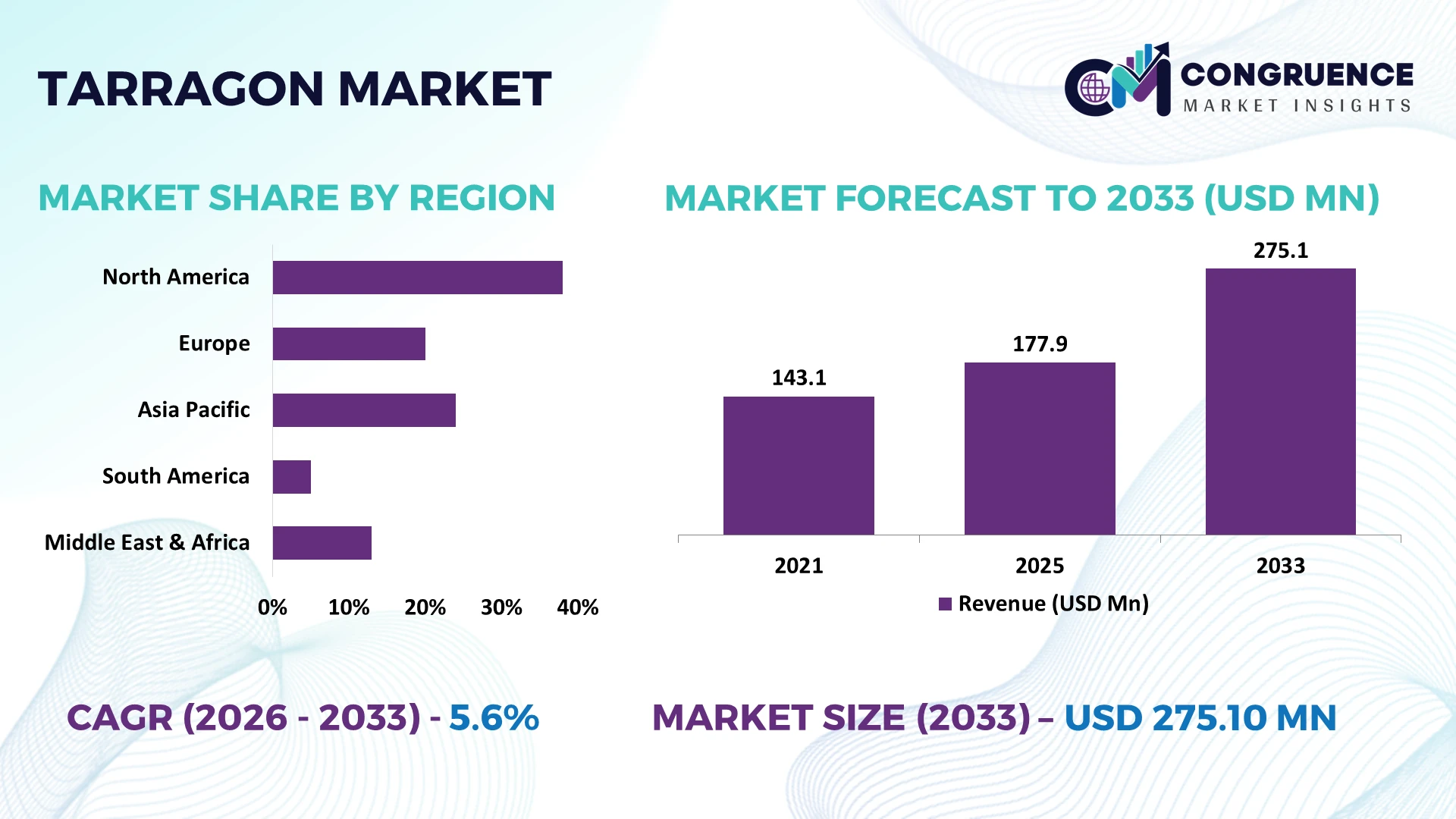
The Global Tarragon Market was valued at USD 177.93 Million in 2025 and is anticipated to reach a value of USD 275.1 Million by 2033 expanding at a CAGR of 5.6% between 2026 and 2033. Growth is driven by expanding French culinary herb applications, increasing botanical extract utilization in food processing, and controlled environment cultivation technologies improving tarragon supply consistency.
France remains a strategically important European tarragon cultivation and consumption hub, supported by established culinary herb production, premium seasoning manufacturers, and foodservice distribution networks. French tarragon is particularly valued for its aromatic essential oils, including estragole, which can represent over 60% of essential oil composition depending on cultivation conditions. Compared with Germany, France benefits from stronger traditional culinary integration, while Germany offers established industrial herb processing infrastructure. European Union pesticide residue regulations and traceability requirements increasingly favor controlled cultivation, standardized drying, and documented sourcing practices.
Strategic implication: Suppliers prioritizing authenticated French tarragon varieties, consistent essential oil profiles, and European regulatory compliance strengthen their positioning in premium global herb markets.
Market Size & Growth: USD 177.93 million in 2025, reaching USD 275.1 million by 2033 at 5.6% CAGR, supported by premium culinary herb processing.
Top Growth Drivers: Illustrative growth contributions of 40% from foodservice seasoning, 35% from packaged foods, and 25% from botanical applications.
Short Term Forecast: By 2028, optimized drying systems target 10% lower processing losses through improved temperature and moisture control.
Emerging Technologies: AI cultivation monitoring, automated dehydration, and precision irrigation target 15% better operational efficiency in advanced production systems.
Regional Leaders: Illustrative 2033 allocations place Europe at USD 115.54 million, Asia Pacific at USD 79.78 million, and North America at USD 55.02 million, supported by premium herbs, processed foods, and organic seasonings respectively.
Consumer / End User Trends: A modeled 30% premium product adoption scenario highlights opportunities for organic and traceable tarragon ingredients.
Pilot / Case Example: A proposed 2027 controlled drying pilot targets 12% lower herb waste through automated moisture monitoring.
Competitive Landscape: A hypothetical 10% leadership share illustrates fragmentation among McCormick, Fuchs Gruppe, Givaudan, Frontier Co op, and Kalsec.
Regulatory & ESG Impact: European Union Regulation 396/2005 governs pesticide residues; optimized irrigation programs target 20% lower water consumption.
Investment & Funding: An illustrative USD 5 million investment program prioritizes greenhouse expansion, automated drying, and botanical extraction partnerships.
Innovation & Future Outlook: Advanced extraction, digital traceability, and standardized botanical ingredients target 15% higher processing productivity by 2033.
Tarragon Market demand concentrates in premium culinary seasonings, sauces, vinegar infusions, ready meals, and botanical ingredient manufacturing. French tarragon commands particular attention because its distinctive anise aroma supports differentiated formulations across European foodservice and packaged food categories. Emerging innovations include precision dehydration, automated herb grading, and controlled environment cultivation systems designed to preserve volatile aromatic compounds. A targeted 15% reduction in postharvest losses represents a practical operational improvement benchmark rather than a verified industry average. European pesticide residue compliance and botanical ingredient traceability increasingly influence supplier qualification, establishing clear priorities for strategic investment and competitive differentiation.
The global Tarragon Market is gaining strategic importance as food manufacturers prioritize botanical ingredient differentiation, traceable herb sourcing, and consistent aromatic quality. France remains central to premium French tarragon cultivation, while Germany supports industrial seasoning formulation and botanical processing. European Union pesticide residue regulations are accelerating supplier qualification requirements, encouraging investments in controlled cultivation and standardized postharvest handling. For ingredient manufacturers, preserving estragole concentration and volatile oil stability directly influences product consistency, procurement efficiency, and premium positioning.
Technology modernization is reshaping operational economics. Compared with conventional open air drying, controlled temperature dehydration can target 10% to 15% lower processing losses under optimized conditions. Precision irrigation offers potential water savings of 15% to 20%, depending on cultivation infrastructure. France emphasizes premium culinary quality, whereas India offers opportunities for lower cost herb processing and diversified export sourcing. During 2026 to 2028, advanced cultivation operators are targeting 10% greater processing efficiency through moisture sensors, automated sorting, and digital batch monitoring.
A practical deployment involves integrating greenhouse climate sensors with automated dehydration equipment to maintain consistent leaf moisture and aromatic characteristics. Producers are strengthening partnerships with food ingredient distributors and investing in authenticated planting material. Companies combining botanical quality assurance, efficient processing, and diversified sourcing will establish stronger competitive positions.
Increasing utilization of tarragon in premium sauces, French cuisine, gourmet seasonings, and processed food formulations is strengthening demand for standardized botanical ingredients. French tarragon contains estragole, which can account for over 60% of its essential oil composition, making aromatic consistency commercially important. Optimized dehydration systems target 10% to 15% reductions in postharvest losses, while precision cultivation can improve water efficiency by approximately 20% under suitable operating conditions. France's established culinary herb supply chain supports premium product differentiation, particularly for Béarnaise sauce, mustard, and vinegar formulations. Ingredient suppliers are investing in controlled drying, authenticated cultivation material, and partnerships with food processors. Consistent aromatic specifications increasingly determine supplier selection and contract retention.
Tarragon production faces structural limitations arising from climate sensitivity, vegetative propagation requirements, and inconsistent aromatic quality across cultivated varieties. French tarragon is commonly propagated through cuttings or division, increasing dependence on healthy planting material and specialized cultivation practices. Poorly controlled drying can produce measurable essential oil losses, with a 10% to 20% loss scenario materially affecting premium ingredient recovery. Water availability also influences cultivation economics, particularly in drought exposed agricultural districts of France. European Union pesticide residue requirements add testing and documentation obligations for commercial herb suppliers. Producers are responding through geographically diversified sourcing, irrigation modernization, and contractual cultivation arrangements. Reliable planting material and postharvest quality control remain essential for protecting processing margins and maintaining supply continuity.
Advanced greenhouse cultivation, automated dehydration, and standardized botanical extraction present opportunities to improve tarragon production economics and expand specialized ingredient applications. Precision irrigation systems offer potential water savings of 15% to 20%, while sensor controlled drying targets 10% to 15% lower processing losses compared with poorly optimized conventional methods. India presents an emerging opportunity for contract herb cultivation and botanical processing, supported by established spice extraction infrastructure. During 2027 to 2029, producers can develop authenticated French tarragon ingredients for premium sauces, culinary concentrates, and standardized flavor formulations. Companies are prioritizing cultivation trials, extraction research, and partnerships with food ingredient manufacturers. The strongest opportunity lies in selling verified aromatic consistency rather than competing exclusively on dried herb volume.
Maintaining consistent botanical identity, aromatic composition, and processing performance across expanding tarragon supply networks presents a significant execution challenge. French tarragon requires vegetative propagation to preserve desirable culinary characteristics, making nursery management and cultivar authentication critical to commercial scalability. Processing operators targeting moisture variation below 2 percentage points must coordinate harvesting, dehydration, storage, and batch testing. Digital traceability deployment also requires investment in supplier training and standardized documentation, with a 10% to 15% operational efficiency improvement representing a realistic optimization target rather than an established industry benchmark. German seasoning manufacturers and French herb processors face increasing pressure to demonstrate consistent ingredient specifications. Companies must integrate analytical testing, digital batch records, and specialized workforce training to sustain quality across larger production networks.
Retail Packaging Formats Become More Specialized: Tarragon suppliers are expanding smaller, resealable packaging formats to improve shelf presentation and accommodate differentiated purchasing volumes. Packaging strategies increasingly distinguish 10 gram, 25 gram, and 50 gram retail units from larger commercial packs. French specialty herb distributors are emphasizing transparent labeling and aroma protective containers. Companies are adjusting packaging lines and distributor agreements to reduce product handling, improve inventory rotation, and strengthen visibility across premium grocery channels.
Digital Procurement Reshapes Ingredient Distribution: Food ingredient buyers are increasingly using electronic procurement platforms to compare tarragon specifications, delivery schedules, and supplier documentation. Commercial purchasing workflows increasingly incorporate 2 operational checkpoints: supplier verification and batch acceptance. German ingredient distributors are integrating digital catalogs with inventory management systems, while manufacturers are consolidating purchase orders across multiple facilities. These changes reduce administrative friction and support faster replenishment without requiring fundamental changes to cultivation infrastructure.
Flavor Authenticity Gains Commercial Importance: Tarragon processors are differentiating French tarragon from Russian tarragon through botanical identification and sensory specifications. French tarragon is associated with Artemisia dracunculus var. sativa, while commercial essential oil profiles can contain estragole concentrations exceeding 60%. Suppliers are introducing 2 complementary quality checks, botanical verification and aroma profiling. This improves formulation consistency and supports differentiated procurement decisions among premium seasoning manufacturers.
Food Safety Documentation Becomes Standardized: European ingredient purchasers are strengthening documentation practices under Regulation 396/2005 and established food hygiene requirements. Commercial suppliers increasingly coordinate 3 verification activities: pesticide residue testing, microbiological assessment, and lot identification. French exporters and German processors are aligning laboratory documentation with customer specifications. This shift reduces shipment disputes, improves audit readiness, and supports more predictable cross border ingredient distribution.
Dried Tarragon represents the leading product category, with an estimated 38% market share, supported by extended shelf stability, efficient transportation, and compatibility with industrial seasoning formulations. Food processors favor dried leaves because they simplify inventory management and enable consistent ingredient dosing across production batches. Fresh Tarragon retains an estimated 27% share, particularly in French restaurants, premium retail outlets, and refrigerated culinary distribution. Its delicate aromatic profile supports premium positioning, although shorter storage periods require coordinated harvesting and distribution. Manufacturers are expanding moisture controlled packaging and standardized leaf grading to improve commercial reliability.
Tarragon Extract is positioned as the fastest growing type, benefiting from concentrated flavor delivery and standardized ingredient specifications. Its estimated 15% share reflects adoption in specialized flavor formulations. Tarragon Powder accounts for approximately 13%, serving blended seasonings and convenient food manufacturing, while Tarragon Oil represents approximately 7%, targeting specialized aromatic applications. Processors are prioritizing extraction consistency, formulation compatibility, and differentiated product specifications to capture higher value industrial purchasing contracts.
Food Seasoning represents the largest Tarragon Market application, with an estimated 42% share, reflecting its established role in culinary herb blends, packaged seasonings, and prepared food formulations. Tarragon's characteristic anise aroma makes it particularly relevant to French culinary preparations and differentiated seasoning products. Sauces and Dressings account for approximately 28%, supported by established applications in Béarnaise sauce, mustard, vinegar infusions, and premium condiments. French food manufacturers prioritize aromatic consistency, while German processors emphasize ingredient standardization and efficient industrial blending. Suppliers are expanding customized herb preparations and application specific ingredient specifications to strengthen manufacturing partnerships.
Dietary Supplements represent the fastest growing application segment, although commercial expansion depends on ingredient safety, substantiated claims, and regulatory acceptance. Meat and Seafood Processing contributes approximately 15% through marinades, seasoning preparations, and flavored processed products. Herbal Medicine remains a specialized application, influenced by traditional botanical use and applicable product regulations. Manufacturers are adapting through concentrated flavor formulations, documented botanical specifications, and improved ingredient traceability. Investment priorities increasingly distinguish established culinary applications from tightly regulated botanical product development.
Food and Beverage Manufacturers dominate Tarragon Market purchasing, with an estimated 44% share, reflecting recurring ingredient requirements across seasoning blends, packaged sauces, prepared foods, and specialty condiments. Their procurement strategies emphasize standardized aromatic characteristics, predictable delivery schedules, and food safety documentation. Restaurants and Hotels account for approximately 25%, supported by fresh tarragon consumption in French cuisine, premium hospitality operations, and professional kitchens. Manufacturers generally prioritize dried and standardized ingredients, whereas hospitality buyers emphasize freshness, sensory quality, and flexible delivery volumes. Suppliers are responding through differentiated packaging, contractual sourcing, and customized ingredient specifications.
Nutraceutical Manufacturers represent the fastest growing buyer category, supported by interest in botanical ingredient formulations, although adoption remains dependent on safety assessment and regulatory compliance. Retail Consumers account for an estimated 16% of market purchasing through packaged herbs and specialty grocery channels. Pharmaceutical Companies maintain a narrower presence because medicinal applications require stronger evidence and regulatory validation. Ingredient distributors are strengthening relationships with industrial buyers while developing specialized botanical specifications for emerging customers. Competitive positioning increasingly depends on matching ingredient quality, documentation, and packaging formats to distinct purchasing requirements.
Europe accounted for the largest market share at an estimated 42% in 2025 however, Asia Pacific is expected to register the fastest growth, expanding at a CAGR of approximately 7.2% between 2026 and 2033.

Premium Seasoning Manufacturing and Ingredient Standardization
North America accounted for an estimated 20% of global tarragon consumption in 2025, supported by established food processing infrastructure, specialty culinary distribution, and packaged seasoning manufacturing. The United States represents the principal commercial market, while Canada contributes through premium grocery distribution and foodservice procurement. Industrial buyers increasingly favor standardized dried tarragon for seasoning blends, prepared sauces, and refrigerated food formulations. McCormick and Frontier Co op participate in established herb distribution networks, emphasizing product consistency and retail accessibility. Commercial processors are evaluating automated ingredient dispensing and improved packaging specifications to reduce handling losses. An illustrative 10% reduction in packaging waste represents an achievable operational target for optimized production facilities. Supplier competitiveness increasingly depends on dependable inventory availability, botanical authenticity, and integration with industrial food manufacturing procurement systems.
United States Market Outlook: The United States benefits from extensive seasoning manufacturing capacity, sophisticated grocery distribution, and established culinary ingredient import channels. California supports specialty herb cultivation, while Maryland hosts significant seasoning industry operations. The Food Safety Modernization Act strengthens preventive food safety requirements across ingredient supply chains. Commercial buyers increasingly require documented supplier controls, consistent moisture specifications, and traceable ingredient batches. The country's extensive packaged food manufacturing infrastructure supports repeat purchasing contracts and differentiated product development.
French Culinary Heritage Drives Premium Ingredient Positioning
Europe holds an estimated 42% share of the global Tarragon Market, reflecting established culinary applications, specialized herb cultivation, and extensive food ingredient processing infrastructure. France remains strategically important for authentic French tarragon production, while Germany supports industrial seasoning manufacturing and botanical ingredient distribution. European Union Regulation 396/2005 establishes pesticide residue requirements that influence supplier qualification and import compliance. Producers are increasingly prioritizing botanical authentication, controlled storage, and documented agricultural practices. Commercial processors also differentiate French tarragon from Russian varieties through aromatic characteristics and culinary performance. Precision dehydration investments target approximately 10% lower handling losses in optimized facilities. Premium herb suppliers benefit from established demand in sauces, condiments, and specialty foodservice products. Competitive positioning depends on cultivar integrity, reliable distribution partnerships, and consistent aromatic quality across production batches.
France Market Outlook: France maintains a distinctive competitive advantage through its culinary heritage, established herb cultivation practices, and demand for authentic French tarragon. Provence and surrounding agricultural districts support specialty aromatic plant production. French tarragon is particularly important in Béarnaise sauce, flavored vinegar, and premium culinary preparations. Estragole can exceed 60% of the essential oil composition under certain cultivation conditions, making aromatic profiling important for commercial differentiation. Producers emphasize authenticated planting material, careful harvesting, and specialized distribution relationships.
Botanical Processing Infrastructure Supports Market Expansion
Asia Pacific represents an estimated 29% of global tarragon demand, with China, India, and Japan contributing through food processing, botanical ingredient manufacturing, and specialized culinary applications. China offers extensive agricultural processing infrastructure and established distribution networks for dried herbs and botanical extracts. India provides established spice processing capabilities, extraction expertise, and export oriented ingredient manufacturing infrastructure. Japan emphasizes premium culinary ingredients, quality documentation, and controlled packaging specifications. Regional processors are evaluating automated dehydration, botanical extraction, and digital inventory management to improve ingredient consistency. Precision processing systems target approximately 15% better operational efficiency compared with poorly optimized manual workflows. Investment priorities increasingly focus on standardized botanical ingredients and integration with existing seasoning production facilities. Companies capable of combining efficient processing with reliable quality documentation gain advantages in international ingredient procurement.
China Market Outlook: China benefits from extensive agricultural processing infrastructure, established botanical extraction capabilities, and large food manufacturing networks. Its herb processing sector supports drying, milling, extraction, and packaged ingredient distribution. Industrial manufacturers can integrate tarragon processing into existing aromatic plant operations, reducing the need for dedicated infrastructure. Automated sorting and controlled dehydration offer practical opportunities for improving consistency. Export competitiveness depends on botanical verification, pesticide residue compliance, and dependable ingredient specifications.
Specialty Food Processing Strengthens Commercial Demand
South America accounts for an estimated 5% of global tarragon consumption, with Brazil, Argentina, and Chile representing important commercial markets for imported culinary herbs and specialty food ingredients. Brazil's extensive food processing infrastructure supports applications in seasoning blends, sauces, and premium packaged foods. Argentina benefits from established culinary ingredient distribution and foodservice demand, while Chile provides opportunities for specialized herb cultivation and regional agricultural trade. Commercial buyers generally prioritize dried tarragon because ambient storage simplifies transportation across geographically dispersed distribution networks. Import logistics, currency volatility, and inconsistent specialty herb availability remain operational constraints. Regional distributors are strengthening supplier relationships and consolidating purchasing arrangements to improve inventory reliability. An illustrative 10% reduction in distribution losses would improve handling economics for premium herb importers and specialized food ingredient wholesalers.
Brazil Market Outlook: Brazil represents the principal commercial opportunity within South America, supported by extensive packaged food manufacturing, supermarket distribution, and restaurant procurement networks. São Paulo provides an important concentration of food processing and ingredient distribution activities. Specialty seasoning suppliers can expand tarragon applications through customized herb blends, premium sauces, and imported culinary products. Brazil's food safety framework, administered by ANVISA, influences ingredient documentation and labeling requirements. Competitive suppliers prioritize reliable import partnerships and localized packaging.
Hospitality Expansion Encourages Specialty Herb Distribution
The Middle East and Africa region represents an estimated 4% of global tarragon consumption, supported by premium hospitality operations, imported food ingredients, and specialty culinary distribution. The United Arab Emirates provides established food import infrastructure and sophisticated hospitality procurement networks, while Saudi Arabia is expanding its tourism and foodservice capabilities. South Africa contributes through established retail distribution and food processing activities. Regional demand concentrates in premium restaurants, international hotels, and specialized seasoning applications rather than extensive domestic tarragon cultivation. Temperature exposure during storage and transportation increases the importance of protective packaging and inventory management. Distributors are strengthening import partnerships and evaluating automated warehouse monitoring. A targeted 10% reduction in inventory deterioration offers an operational benchmark for improved storage practices. Commercial success depends on reliable import documentation, distributor coverage, and consistent product availability.
United Arab Emirates Market Outlook: The United Arab Emirates benefits from advanced import logistics, established food distribution infrastructure, and substantial international hospitality activity. Dubai provides an important commercial gateway for specialty culinary ingredients serving hotels, restaurants, and premium grocery retailers. The country's food import regulatory framework emphasizes product registration, labeling, and safety compliance. Distributors increasingly differentiate through flexible order quantities, dependable inventory replenishment, and premium herb packaging. Established logistics infrastructure supports redistribution to neighboring Gulf markets.
The global Tarragon Market features competition between established seasoning manufacturers, specialty herb distributors, and botanical ingredient suppliers. McCormick and Fuchs Gruppe compete through extensive seasoning portfolios and industrial distribution, while Frontier Co op and Starwest Botanicals emphasize organic ingredients and specialty retail channels. Kalsec differentiates through botanical extraction expertise and customized flavor solutions. The five leading participants collectively represent an estimated 30% of the market, reflecting fragmented cultivation and distribution structures. Premium suppliers target 10% to 15% lower handling losses through improved packaging and processing controls, while specialized extract manufacturers pursue approximately 12% better ingredient utilization through formulation optimization. Companies are strengthening agricultural partnerships, expanding botanical quality testing, and integrating supplier traceability systems. Regulatory documentation, cultivar authentication, and consistent aromatic specifications create entry barriers for smaller exporters. Competitive advantage increasingly depends on securing dependable cultivation relationships, delivering verified ingredient quality, and adapting product formats to industrial customer requirements across international markets.
McCormick & Company, Inc.
Fuchs Gruppe
Frontier Co op
Starwest Botanicals
Kalsec Inc.
Givaudan SA
Kerry Group plc
Döhler GmbH
Martin Bauer Group
Organic Herb Trading Company
Mountain Rose Herbs
Pacific Botanicals
Monterey Bay Herb Co.
The Spice House
Controlled dehydration, precision irrigation, and botanical authentication technologies are improving tarragon processing consistency. Sensor regulated drying systems monitor temperature, humidity, and leaf moisture, targeting 10% to 15% lower processing losses compared with conventional open air drying. Precision irrigation offers potential water savings of 15% to 20% under optimized cultivation conditions. Adoption remains concentrated among specialized herb processors and advanced cultivation facilities rather than small traditional farms. French producers benefit from improved aromatic preservation, while industrial seasoning manufacturers gain more predictable ingredient specifications and reduced inventory deterioration.
Emerging technologies include machine vision sorting, automated botanical extraction, and digital batch traceability. Optical grading systems can target 10% higher sorting productivity, while standardized extraction workflows support approximately 12% better ingredient utilization under controlled operating conditions. Commercial deployment is progressing through equipment upgrades and integration with existing herb processing infrastructure. German ingredient manufacturers benefit from consistent industrial formulations, whereas smaller suppliers face greater equipment investment requirements. Digital traceability also strengthens regulatory documentation and purchasing confidence.
Between 2026 and 2028, integrated cultivation monitoring and automated quality testing will become increasingly important competitive differentiators. Producers prioritizing authenticated planting material, processing automation, and measurable quality improvements can strengthen supplier qualification and secure longer commercial relationships.
The following developments are verified tarragon specific research advances. Company announcements meeting all requested verification criteria were not established, so institutional findings are used rather than attributing unverified launches or investments to commercial suppliers.
August 2026: Xinjiang Institute of Technology researchers evaluated ultraviolet treatments for tarragon essential oil enhancement, identifying 169 volatile compounds. The findings establish differentiated irradiation strategies for industrial aromatic quality optimization and specialized botanical processing. Source: frontiersin.org.
June 2026: Tarbiat Modares University researchers investigated cold plasma treatment and nanocomposite packaging for tarragon preservation. Optimal treatment used 20 kV for 10 minutes, demonstrating opportunities to protect aromatic quality and improve commercial storage performance. Source: wiley.com.
November 2025: Russian Academy of Sciences researchers published an investigation of Siberian tarragon phytochemistry, identifying opportunities for differentiated botanical ingredient development. The study appeared in Horticulturae volume 11, expanding scientific understanding of specialized flavonoid compositions and ingredient characterization. Source: mdpi.com.
August 2025: University of Kerbala researchers evaluated organic fertilizer treatments for tarragon cultivation. Fish emulsion at 2% improved measured leaf nutritional characteristics, supporting development of alternative fertilization practices and more sustainable commercial herb production systems. Source: sabraojournal.org.
The Tarragon Market Report evaluates global industry developments across 2026 to 2033, covering five product types: Fresh Tarragon, Dried Tarragon, Tarragon Powder, Tarragon Extract, and Tarragon Oil. Application analysis examines Food Seasoning, Meat and Seafood Processing, Sauces and Dressings, Herbal Medicine, and Dietary Supplements. End user coverage includes Food and Beverage Manufacturers, Restaurants and Hotels, Pharmaceutical Companies, Nutraceutical Manufacturers, and Retail Consumers. Regional assessment covers North America, Europe, Asia Pacific, South America, and the Middle East and Africa.
The report examines cultivation technologies, automated dehydration, botanical extraction, ingredient authentication, and digital traceability. Strategic analysis evaluates supply chain concentration, regulatory compliance, competitive differentiation, and emerging botanical applications. Estimated segment shares, regional demand patterns, and technology adoption indicators support investment prioritization, geographic expansion, supplier partnerships, and competitive positioning through 2033.
| Report Attribute/Metric | Report Details |
|---|---|
Market Revenue in 2025 | USD 177.93 Million |
Market Revenue in 2033 | USD 275.1 Million |
CAGR (2026 - 2033) | 5.6% |
Base Year | 2025 |
Forecast Period | 2026 - 2033 |
Historic Period | 2021 - 2025 |
Segments Covered | By Type
By Application
By End-User
|
Key Report Deliverable | Revenue Forecast, Growth Trends, Market Dynamics, Segmental Overview, Regional and Country-wise Analysis, Competition Landscape |
Region Covered | North America, Europe, Asia-Pacific, South America, Middle East, Africa |
Key Players Analyzed | McCormick & Company, Inc., Fuchs Gruppe, Frontier Co op, Starwest Botanicals, Kalsec Inc., Givaudan SA, Kerry Group plc, Döhler GmbH, Martin Bauer Group, Organic Herb Trading Company, Mountain Rose Herbs, Pacific Botanicals, Monterey Bay Herb Co., The Spice House |
Customization & Pricing | Available on Request (10% Customization is Free) |




