Global Tapping Machine Market Report Overview
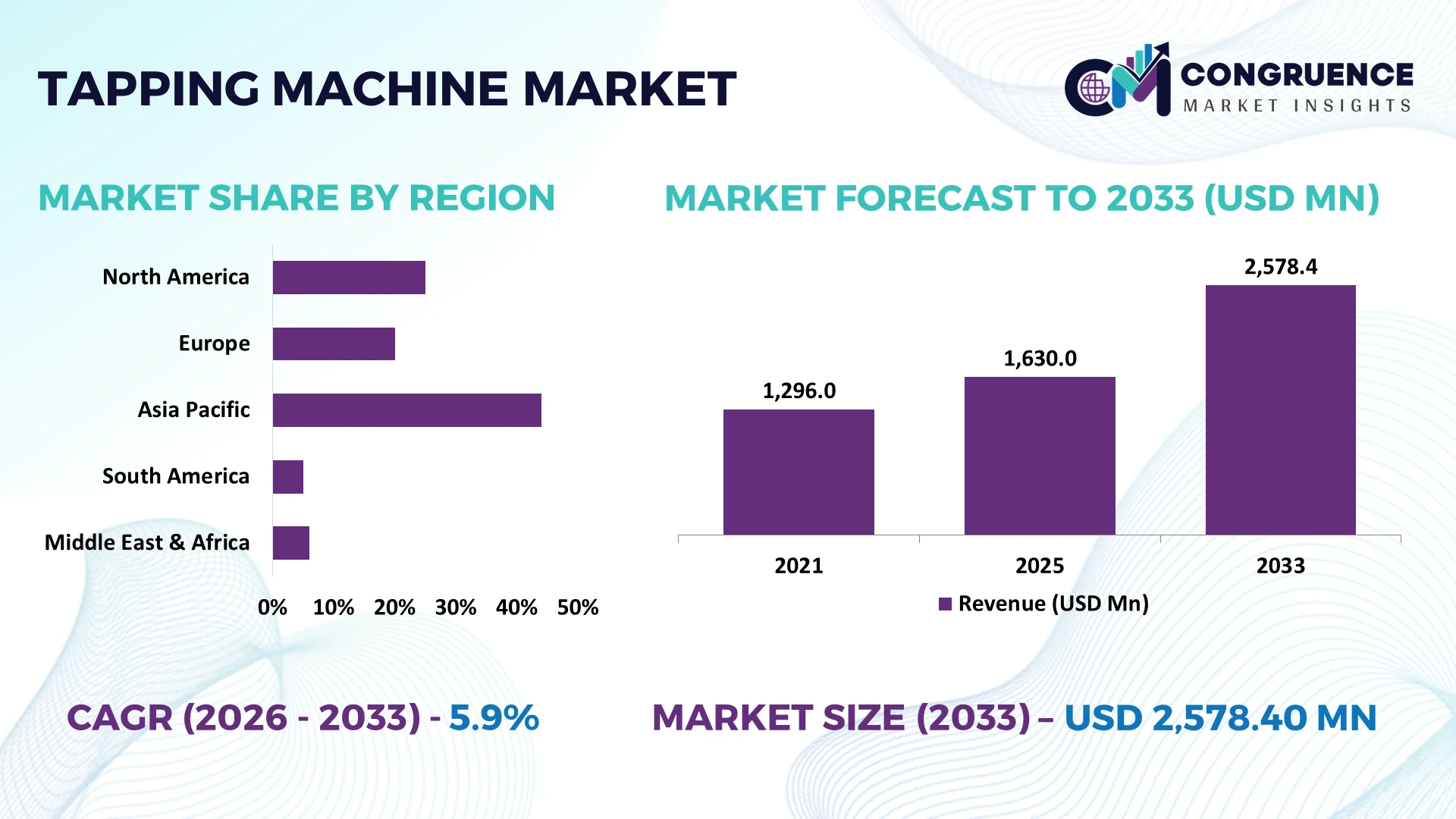
The Global Tapping Machine Market was valued at USD 1630 Million in 2025 and is anticipated to reach a value of USD 2578.4 Million by 2033 expanding at a CAGR of 5.9% between 2026 and 2033. Growth is driven by automotive component localization, CNC machining automation, precision thread manufacturing, and increased production of electric vehicle powertrain and industrial machinery components.
China maintains a leading position in tapping machine manufacturing and deployment, supported by its approximately 30% contribution to global manufacturing value added and installation of 295,045 industrial robots in 2024. Automotive manufacturing, electronics, aerospace components, and industrial machinery drive precision threading requirements. Compared with Germany, where high-precision machine tool engineering dominates specialized applications, China benefits from large-scale equipment production and integrated component supply chains. The Made in China 2025 industrial modernization initiative accelerated investment in CNC machining, automated production lines, and digitally controlled manufacturing equipment.
Strategically, manufacturers should prioritize China's approximately 30% global manufacturing contribution and India's expanding precision engineering ecosystem while investing in CNC integration, automated tool monitoring, and localized technical support.
Key Highlights of the Global Tapping Machine Market
-
Market Size & Growth: USD 1,630 million in 2025, reaching USD 2,578.4 million by 2033 at 5.9% CAGR, supported by CNC automation and precision component manufacturing.
-
Top Growth Drivers: Illustrative demand scenarios include 15% higher automotive machining activity, 12% greater factory automation adoption, and 10% increased precision threading requirements.
-
Short-Term Forecast: By 2028, automated tapping installations target 10–15% shorter machining cycles through synchronized spindle control and automatic tool positioning.
-
Emerging Technologies: AI-assisted tool monitoring, 2-axis servo tapping, and CNC-integrated torque control improve threading accuracy and process repeatability.
-
Regional Leaders: Illustrative 2033 allocations place Asia-Pacific at USD 1,160.3 million, Europe at USD 644.6 million, and North America at USD 541.5 million, emphasizing automation, precision engineering, and reshoring.
-
Consumer/End-User Trends: Automotive and machinery manufacturers target 15–20% faster threading throughput through automated workpiece handling and multi-spindle configurations.
-
Pilot/Case Example: A modeled 2026 automotive component production pilot targets 12% cycle-time reduction using synchronized servo tapping and automated tool positioning.
-
Competitive Landscape: Brother Industries competes with FANUC, DMG MORI, Yamawa, and Kira; reliable company-level market share estimates require validation.
-
Regulatory & ESG Impact: ISO 9001 quality systems encourage traceable machining processes, while optimized spindle operation targets 5–8% lower energy consumption.
-
Investment & Funding: China's industrial modernization programs support automation investment; a verified tapping-machine-specific funding total is not established.
-
Innovation & Future Outlook: By 2033, advanced tapping equipment will increasingly combine 3D toolpath simulation, predictive maintenance, and integrated quality monitoring.
The global Tapping Machine Market is shifting toward automated thread production across automotive, aerospace, electronics, and industrial equipment manufacturing. Servo-controlled tapping heads, automatic tool changers, and synchronized spindle systems improve repeatability while reducing operator intervention. Manufacturers integrating intelligent torque monitoring and adaptive feed control target illustrative productivity improvements of 10–15% compared with conventional manual threading operations. China's manufacturing automation investments and India's production-linked incentive initiatives strengthen the business case for localized precision machining capabilities. Growing adoption of flexible manufacturing cells also favors compact CNC tapping systems, establishing technology integration and lifecycle operating efficiency as central strategic considerations.
What Is the Strategic Relevance and Future Pathways of the Tapping Machine Market?
Tapping machines are becoming strategically important as automotive, aerospace, and industrial equipment manufacturers shift toward automated precision machining and localized component production. China's manufacturing sector contributes approximately 30% of global manufacturing value added, reinforcing demand for high-throughput threading equipment. India's production-linked incentive programs encourage domestic automotive and electronics manufacturing, increasing requirements for reliable CNC tapping capabilities. This restructuring favors manufacturers offering integrated machining systems, automated tool management, and dependable technical support rather than standalone equipment.
Servo-controlled tapping systems improve thread consistency through synchronized spindle rotation and feed adjustment. Compared with conventional manual tapping, automated configurations can target 15–20% shorter machining cycles under standardized production conditions. Japan emphasizes precision engineering and compact CNC systems, while China prioritizes high-volume production and manufacturing automation. Between 2026 and 2028, manufacturers are expected to expand connected machining cells, torque monitoring, and automated inspection capabilities, with illustrative productivity improvement targets of 10–15%.
Automotive component suppliers deploying Brother SPEEDIO machining centers can integrate tapping, drilling, and automated workpiece handling within coordinated production cells. Equipment manufacturers are strengthening software integration, distributor partnerships, and application engineering services. Competitive positioning increasingly depends on reducing threading defects, improving equipment utilization, and supporting flexible manufacturing across changing component designs.
Tapping Machine Market Dynamics
DRIVER:
Precision Manufacturing and CNC Automation
Automotive electrification and industrial automation are accelerating the transition from manual threading toward CNC-integrated tapping equipment. China installed approximately 295,000 industrial robots in 2024, demonstrating the scale of manufacturing automation investment. Servo-controlled tapping systems can target 15% shorter machining cycles and 10% lower threading rework under comparable production conditions, based on illustrative operating benchmarks. Electric vehicle components, transmission housings, and precision mechanical assemblies require consistent thread geometry and repeatable spindle control. India's manufacturing localization initiatives further encourage automated machining investments. Brother Industries, FANUC, and DMG MORI are strengthening CNC integration, compact machining platforms, and automated production compatibility. Manufacturers offering coordinated drilling and tapping workflows gain an advantage through reduced handling requirements and higher equipment utilization.
RESTRAINT:
Capital Costs and Precision Component Dependencies
High initial equipment expenditure and dependence on specialized CNC components restrict tapping machine adoption among smaller manufacturers. Servo motors, precision ball screws, spindle assemblies, and electronic controllers require reliable sourcing and technical servicing. In India, imported high-precision components increase exposure to currency movements and procurement delays. An illustrative 12% increase in component procurement costs raises equipment production expenses, while 8% additional machine downtime reduces available machining capacity. Specialized cutting tools and coolant management also contribute to operating expenditure. Equipment manufacturers are responding through localized component sourcing, modular machine designs, and regional maintenance partnerships. Flexible financing and equipment leasing improve purchasing accessibility, while standardized controller interfaces reduce replacement complexity and support long-term serviceability.
OPPORTUNITY:
Intelligent Threading and Flexible Manufacturing Cells
Adaptive tapping technologies create opportunities for manufacturers serving electric vehicles, aerospace assemblies, and precision electronics. Intelligent torque monitoring identifies abnormal cutting resistance, while synchronized servo control adjusts spindle performance during threading operations. A modeled 15% reduction in thread rejection and 10% improvement in tool utilization would strengthen production economics for high-volume component suppliers. India's automotive manufacturing clusters in Pune and Chennai offer attractive deployment opportunities as suppliers modernize machining operations. Between 2026 and 2028, integration of robotic workpiece handling, digital inspection, and predictive tool replacement will expand automated threading applications. Brother Industries, FANUC, and specialized tooling manufacturers are positioned to develop interoperable production cells. Subscription-based monitoring and application-specific tooling services offer additional differentiation beyond equipment sales.
CHALLENGE:
Digital Integration and Skilled Workforce Readiness
Scaling advanced tapping systems requires coordinated CNC programming, tool calibration, production data integration, and skilled machine operators. India's manufacturing workforce faces increasing requirements for servo programming, machining diagnostics, and automated quality inspection as factories modernize. In an illustrative facility operating 50 tapping stations, a 10% programming competency gap affects five production positions, while 8% additional setup time reduces effective equipment availability. Integrating machines from different manufacturers also complicates communication protocols and centralized monitoring. Cybersecurity becomes increasingly relevant as connected machining cells exchange production parameters and operational data. Equipment manufacturers must invest in standardized interfaces, operator certification, secure connectivity, and remote technical assistance. Partnerships with industrial training institutes and automation integrators will determine whether digital capabilities translate into reliable, repeatable manufacturing performance.
Tapping Machine Market Latest Trends
-
Servo Tapping Heads Gain Traction: Manufacturers are replacing pneumatic feed mechanisms with electrically controlled tapping heads to improve repeatability across mixed production batches. Modern servo systems synchronize spindle rotation and axial movement, targeting 10–15% shorter cycle times and 8% fewer threading defects under comparable operating conditions. Brother and FANUC are advancing spindle control integration, allowing manufacturers to reduce setup adjustments and maintain consistent thread quality.
-
Modular Tapping Stations Expand Flexibility: German machinery manufacturers increasingly favor interchangeable fixtures and programmable tapping stations for frequent component changeovers. Modular configurations accommodate multiple thread sizes and workpiece geometries without dedicated production lines. Illustrative operational targets include 12% shorter changeovers and 10% higher equipment availability. Equipment suppliers are introducing standardized tooling interfaces and configurable workholding systems, improving responsiveness to smaller production batches.
-
Synchronized Multi-Spindle Machining Expands: High-volume component producers are deploying multi-spindle tapping configurations to process several threaded holes simultaneously. Four-spindle arrangements can complete four compatible threading operations within one coordinated machining cycle, subject to workpiece geometry. Manufacturers target 15–20% higher throughput through optimized fixture loading and spindle synchronization. Equipment builders are refining spindle spacing, torque distribution, and chip evacuation systems to improve production consistency.
-
Thread Quality Traceability Becomes Standardized: Aerospace and automotive suppliers are integrating digital torque records, thread inspection data, and machine identification into production quality workflows. ISO 9001 and IATF 16949 requirements reinforce process documentation and traceability. Digitized inspection systems target 10% faster quality verification and 5–8% lower documentation effort. Machine manufacturers and automation integrators are expanding connectivity between tapping equipment, inspection stations, and manufacturing execution systems.
Segmentation Analysis
By Type
Automatic Tapping Machines Lead Production Deployment
Automatic Tapping Machines represent the leading category, with an indicative 35% market share, reflecting widespread deployment across automotive component manufacturing, industrial machinery production, and high-volume metalworking facilities. Their automated feed control, repeatable threading cycles, and compatibility with production fixtures improve manufacturing throughput. Semi-Automatic Tapping Machines account for an estimated 25%, serving manufacturers requiring controlled threading operations without fully integrated automation. These systems balance equipment affordability with improved process consistency, particularly among medium-sized engineering enterprises in India and Southeast Asia.
CNC Tapping Machines represent the fastest-growing category, holding an indicative 28% share as manufacturers increasingly require programmable thread production, precision spindle synchronization, and integration with robotic handling systems. Manual Tapping Machines retain approximately 12%, primarily serving maintenance workshops, prototype manufacturing, and low-volume fabrication. CNC configurations offer modeled 15–20% shorter machining cycles than conventional manual systems under comparable conditions. Brother Industries, FANUC, and specialized machine builders are strengthening compact CNC platforms and automated tooling interfaces. Investment priorities increasingly favor equipment supporting flexible production schedules and consistent threading accuracy.
- The International Federation of Robotics reported in its 2025 World Robotics findings that 542,076 industrial robots were installed globally during 2024. This deployment scale reinforces the transition toward automation-compatible machining equipment, including programmable tapping systems.
By Application
Thread Cutting Maintains Application Leadership
Thread Cutting represents the largest tapping machine application, with an indicative 38% market share, supported by extensive use in automotive assemblies, industrial fasteners, and general mechanical engineering. Conventional cutting taps remain important for producing internal threads across steel, aluminum, and cast components. Hole Tapping accounts for an estimated 27%, reflecting recurring demand for threaded hole preparation in machinery housings, fabricated structures, and industrial assemblies. Manufacturers prioritize spindle stability, cutting tool compatibility, and efficient chip evacuation to improve production consistency across these established applications.
Precision Component Manufacturing represents the fastest-growing application, holding an indicative 23% share as aerospace, electronics, and advanced automotive suppliers require tighter dimensional tolerances and documented machining quality. Thread Forming accounts for approximately 12%, gaining relevance where chipless machining improves surface finish and material integrity. Forming processes can eliminate 100% of thread-cutting chips in suitable ductile materials, reducing chip management requirements. Equipment manufacturers are developing synchronized servo controls, advanced toolholders, and application-specific threading programs. Investment increasingly favors machines capable of processing diverse materials while maintaining repeatable thread geometry and reducing inspection requirements.
- The International Organization of Motor Vehicle Manufacturers reported in 2025 that global motor vehicle production reached approximately 92.5 million units in 2024. This manufacturing scale supports extensive thread machining requirements across engines, transmissions, chassis assemblies, and precision automotive components.
By End-User
Automotive Manufacturers Dominate Equipment Procurement
Automotive Manufacturers represent the leading end-user category, accounting for an indicative 36% of tapping machine demand. Their dominance reflects extensive threaded component requirements across powertrain assemblies, transmission housings, braking systems, and structural components. Machinery and Equipment Manufacturers account for an estimated 25%, emphasizing reliable threading capabilities for industrial assemblies, hydraulic equipment, and mechanical components. These established buyers prioritize equipment utilization, machining accuracy, and compatibility with automated production lines. Brother Industries, FANUC, and DMG MORI compete through integrated machining platforms, programmable spindle systems, and application engineering support.
Electronics Manufacturers represent the fastest-growing end-user category, holding an indicative 14% share as compact mechanical assemblies and precision enclosures require consistent small-diameter threads. Aerospace and Defense accounts for approximately 13%, emphasizing traceability, material compatibility, and stringent quality control. Metal Fabrication Industries represent the remaining 12%, favoring versatile machines for varied workpiece dimensions and production volumes. Manufacturers are responding through compact machine development, specialized tooling partnerships, and flexible financing arrangements. Competitive investment increasingly targets application-specific automation rather than standardized equipment configurations.
- The International Federation of Robotics reported in 2025 that China's automotive industry installed approximately 36,000 industrial robots during 2024. This automation intensity strengthens demand for integrated machining workflows, precision threading equipment, and coordinated component production systems.
Region-Wise Market Insights
Asia-Pacific accounted for the largest market share at an estimated 45% in 2025 however, Asia-Pacific is expected to register the fastest growth, expanding at a projected CAGR of 7.1% between 2026 and 2033.

North America Tapping Machine Market
Manufacturing Reshoring Accelerates Precision Threading Automation
North America represents an indicative 24% of global tapping machine demand, supported by automotive manufacturing, aerospace component production, and industrial equipment modernization. The United States leads regional deployment, while Mexico strengthens its position through automotive supply chain localization and export-oriented machining operations. Manufacturers increasingly integrate CNC tapping systems with robotic handling, automated inspection, and digital production monitoring. The United States installed 34,200 industrial robots in 2024, demonstrating continued investment in manufacturing automation. Automotive component suppliers in Michigan and Ohio prioritize high-throughput threading equipment, while aerospace manufacturers require precision machining and documented quality control. Brother Industries, FANUC, and DMG MORI compete through compact machining platforms and advanced spindle technology. USMCA trade provisions reinforce regional production integration, encouraging suppliers to improve equipment utilization, reduce component handling, and strengthen localized manufacturing capabilities.
United States Market Outlook: The United States benefits from established aerospace, automotive, and industrial machinery manufacturing clusters. The automotive industry installed approximately 13,700 industrial robots in 2024, supporting automated production environments requiring precision threading operations. Michigan, Ohio, and South Carolina remain important equipment deployment locations. Manufacturers increasingly prioritize servo-controlled tapping, integrated machining centers, and automated quality inspection to improve component consistency and production flexibility.
Europe Tapping Machine Market
Precision Engineering and Digital Manufacturing Reshape Equipment Procurement
Europe accounts for an indicative 25% of global tapping machine demand, supported by advanced machine tool manufacturing, automotive engineering, and aerospace component production. Germany, Italy, France, and Switzerland maintain significant precision machining capabilities, while Eastern European manufacturing centers contribute through automotive supplier networks. European manufacturers increasingly prioritize CNC-integrated tapping, adaptive spindle control, and automated tool management to address labor availability and demanding quality requirements. Germany installed approximately 27,000 industrial robots in 2024, reinforcing the importance of automated machining infrastructure. DMG MORI, EMAG, and specialized European equipment manufacturers compete through machining accuracy, configurable production systems, and engineering support. European industrial energy efficiency requirements encourage optimized spindle operation and reduced machining waste. Equipment procurement increasingly emphasizes lifecycle productivity, digital traceability, and compatibility with existing factory automation platforms rather than standalone machine specifications.
Germany Market Outlook: Germany maintains a strong precision engineering ecosystem supported by automotive suppliers, industrial machinery manufacturers, and established machine tool producers. Its manufacturing sector contributes approximately 18% of national gross value added, creating substantial requirements for advanced machining equipment. Baden-Württemberg and Bavaria concentrate automotive and mechanical engineering capabilities. Manufacturers prioritize precision thread geometry, automated tool compensation, and integrated inspection systems to meet demanding industrial specifications.
Asia-Pacific Tapping Machine Market
Industrial Automation and Manufacturing Scale Reinforce Market Leadership
Asia-Pacific dominates the global tapping machine market with an indicative 45% share, supported by extensive manufacturing capacity across China, Japan, India, South Korea, and Taiwan. China leads equipment deployment through automotive, electronics, industrial machinery, and metal component production. Japan maintains technological strength in precision CNC machining, while India expands domestic manufacturing through industrial localization initiatives. China installed 295,045 industrial robots in 2024, representing approximately 54% of global installations and demonstrating the scale of industrial automation investment. Brother Industries, FANUC, and regional machine tool manufacturers emphasize high-speed tapping, automated tool changing, and compact production cell integration. Taiwan contributes specialized machine components and precision engineering capabilities. Manufacturers increasingly combine localized production with application-specific machine configurations to improve procurement accessibility. The region's integrated manufacturing supply chains strengthen equipment availability, particularly for high-volume threading operations.
China Market Outlook: China combines extensive manufacturing infrastructure with established machine tool supply chains and large-scale component production. Its industrial robot stock exceeded 2 million operational units in 2024, supporting automated machining environments. Guangdong, Jiangsu, and Zhejiang concentrate electronics, automotive components, and industrial equipment manufacturing. Domestic machine builders compete through cost-efficient equipment configurations, while international suppliers differentiate through precision spindle technology, advanced controllers, and automated production integration.
South America Tapping Machine Market
Automotive Localization Strengthens Industrial Threading Equipment Demand
South America represents an indicative 4% of global tapping machine demand, concentrated in Brazil, Argentina, Chile, and Colombia. Automotive manufacturing, agricultural machinery, industrial equipment maintenance, and metal fabrication support equipment deployment. Brazil dominates regional demand through established automotive production and extensive mechanical engineering activity. The country manufactured approximately 2.55 million motor vehicles in 2024, creating significant requirements for threaded components and precision machining. Manufacturers increasingly adopt semi-automatic and CNC tapping machines to improve production consistency while controlling equipment expenditure. Imported precision components, currency volatility, and limited specialist servicing constrain adoption among smaller enterprises. International machine tool suppliers compete through distributor partnerships, technical training, and flexible equipment configurations. Industrial clusters around São Paulo and Curitiba provide concentrated opportunities for equipment servicing, automation upgrades, and replacement machine sales.
Brazil Market Outlook: Brazil maintains the region's largest automotive manufacturing ecosystem, supported by established component suppliers and industrial machinery producers. São Paulo concentrates metalworking and precision engineering operations, while Minas Gerais contributes automotive and industrial equipment manufacturing. The government's Nova Indústria Brasil policy supports industrial modernization through 2033. Equipment suppliers are strengthening local distributor networks and maintenance capabilities to address imported machinery servicing requirements.
Middle East & Africa Tapping Machine Market
Industrial Diversification Expands Precision Machining Infrastructure
The Middle East & Africa accounts for an indicative 2% of global tapping machine demand, supported by industrial diversification, aerospace maintenance, energy equipment manufacturing, and metal fabrication. Saudi Arabia and the United Arab Emirates emphasize advanced industrial capabilities, while South Africa maintains established automotive and engineering production networks. Saudi Arabia's National Industrial Strategy targets approximately 36,000 factories by 2035, reinforcing investment in manufacturing equipment and technical capabilities. CNC tapping machines are gaining relevance for precision mechanical assemblies, industrial valves, and engineered components. Equipment manufacturers compete through distributor partnerships, operator training, and application-specific machine configurations. Limited local production of precision spindles and CNC controllers increases reliance on imported equipment. Manufacturers prioritizing dependable technical support, replacement parts, and workforce development strengthen their positioning within emerging industrial clusters.
Saudi Arabia Market Outlook: Saudi Arabia's Vision 2030 industrial transformation supports advanced manufacturing investment across Riyadh, Dammam, and Jubail. The country's National Industrial Strategy targets industrial diversification and increased domestic production of engineered components. Energy equipment, industrial machinery, and precision metal fabrication represent important tapping machine applications. Equipment suppliers are expanding technical partnerships and workforce training to improve CNC programming capabilities and manufacturing process reliability.
Market Competition Landscape
The global tapping machine market features competition between Brother Industries, FANUC, DMG MORI, Kira Corporation, and specialized Chinese machine builders. The leading five suppliers represent an indicative 42% combined market share, reflecting competition across CNC machining platforms and dedicated threading equipment. Brother emphasizes compact, high-speed machining, while FANUC competes through CNC control integration and automated production compatibility. DMG MORI targets precision manufacturing applications, whereas Chinese suppliers prioritize competitive pricing and localized servicing. Automated tapping systems target 15–20% shorter machining cycles, while advanced tool monitoring supports illustrative 8–12% reductions in unplanned downtime. Manufacturers strengthen competitiveness through spindle innovation, distributor expansion, and partnerships with automation integrators. Competition increasingly centers on complete machining workflows rather than standalone tapping equipment. Precision component sourcing, application engineering expertise, and established technical support networks create significant entry barriers. Sustainable competitive advantage requires reliable threading accuracy, flexible automation integration, and responsive lifecycle service capabilities.
Companies Profiled in the Tapping Machine Market Report
-
Brother Industries, Ltd.
-
FANUC Corporation
-
DMG MORI Co., Ltd.
-
Kira Corporation
-
EMAG GmbH & Co. KG
-
Yamawa Manufacturing Co., Ltd.
-
Nitto Seiko Co., Ltd.
-
KUKA AG
-
Haas Automation, Inc.
-
Tsugami Corporation
-
INDEX-Werke GmbH & Co. KG
-
Doosan Machine Tools (DN Solutions)
-
GROB-WERKE GmbH & Co. KG
-
Tapmatic Corporation
Technology Insights for the Tapping Machine Market
Servo-controlled tapping, CNC synchronization, and automated tool changing are reshaping precision threading operations. Brother SPEEDIO and FANUC-controlled machining platforms integrate spindle rotation, axial feed, and programmable cutting parameters. Compared with conventional manual tapping, automated configurations target an illustrative 15–20% reduction in machining cycles and 8–10% fewer threading defects under comparable conditions. China's installation of 295,045 industrial robots during 2024 demonstrates manufacturing automation intensity, although tapping-specific adoption remains unquantified. Automotive suppliers benefit from repeatable thread geometry, reduced handling, and improved production scheduling.
Emerging technologies include adaptive torque monitoring, connected toolholders, and predictive spindle diagnostics. Sensor-enabled systems detect abnormal cutting resistance before thread damage, supporting modeled 10–12% reductions in rejected components. Digital maintenance platforms target 8% lower unplanned downtime through operating hour tracking and fault analysis. Integration with manufacturing execution systems enables traceable machining parameters and faster quality investigations. Aerospace suppliers gain advantages from documented process consistency, while electronics manufacturers prioritize compact, high-speed configurations.
Between 2026 and 2028, robotic loading, automated thread inspection, and digital machining simulations will strengthen flexible production cells. Manufacturers integrating interoperable controllers and application engineering can target 10% faster changeovers. Investment priorities increasingly favor integrated equipment platforms delivering measurable accuracy, availability, and lifecycle productivity improvements.
Recent Developments in the Global Tapping Machine Market
-
August 2024: FANUC America introduced its ROBODRILL α-D28LiB5ADV Plus Y500 machining center, featuring 28 tool positions, expanded table capacity, and faster drilling and tapping cycles. The upgrade strengthens flexible production capabilities for manufacturers processing complex components within compact factory layouts. Source: fanucamerica.com
-
October 2024: Sugino Machine introduced upgraded Selfeeder and Synchrotapper drilling and tapping units, replacing conventional induction motors with high-efficiency permanent magnet motors. The redesign addresses energy regulations affecting motors associated with 40–50% of global electricity consumption. Source: smri.asia
-
January 2025: SACMA Group presented its HS ASPE T10-VT tapping machine, featuring four spindles and production capacity exceeding 10,000 pieces hourly. Integrated torque monitoring and automated rejection improve fastener quality control while supporting high-volume manufacturing operations. Source: sacmagroup.com
-
May 2025: Brother Industries showcased SPEEDIO machining centers featuring 100-tool magazines and a 40-pallet changer. Five-second tool transfers and unattended operation strengthen production flexibility for medical and semiconductor manufacturers handling complex components and frequent machining changeovers. Source: seisanzai-japan.com
Scope of the Tapping Machine Market Report
The Tapping Machine Market Report evaluates manufacturing technologies, equipment procurement, competitive positioning, and industrial automation trends between 2026 and 2033. Type segmentation covers Manual, Semi-Automatic, Automatic, and CNC Tapping Machines. Application analysis examines Thread Cutting, Thread Forming, Hole Tapping, and Precision Component Manufacturing. End-user coverage includes Automotive Manufacturers, Aerospace and Defense, Machinery and Equipment Manufacturers, Metal Fabrication Industries, and Electronics Manufacturers, identifying equipment requirements, production intensity, and machining accuracy priorities.
Regional analysis encompasses North America, Europe, Asia-Pacific, South America, and the Middle East & Africa, emphasizing country-level manufacturing capabilities and automation deployment. Technology assessment examines servo-controlled tapping, CNC synchronization, intelligent torque monitoring, and robotic integration. Competitive benchmarking evaluates leading manufacturers, distribution networks, equipment customization, and aftermarket support, enabling informed investment planning, manufacturing expansion, procurement optimization, and strategic positioning across precision machining applications.
Tapping Machine Market Report Summary
| Report Attribute/Metric | Report Details |
|---|
Market Revenue in 2025 | USD 1630 Million |
Market Revenue in 2033 | USD 2578.4 Million |
CAGR (2026 - 2033) | 5.9% |
Base Year | 2025 |
Forecast Period | 2026 - 2033 |
Historic Period | 2021 - 2025 |
Segments Covered | By TypeSemi-Automatic Tapping Machines Automatic Tapping Machines
By ApplicationPrecision Component Manufacturing
By End-UserMachinery and Equipment Manufacturers Metal Fabrication Industries Electronics Manufacturers
|
Key Report Deliverable | Revenue Forecast, Growth Trends, Market Dynamics, Segmental Overview, Regional and Country-wise Analysis, Competition Landscape |
Region Covered | North America, Europe, Asia-Pacific, South America, Middle East, Africa |
Key Players Analyzed | Brother Industries, Ltd., FANUC Corporation, DMG MORI Co., Ltd., Kira Corporation, EMAG GmbH & Co. KG, Yamawa Manufacturing Co., Ltd., Nitto Seiko Co., Ltd., KUKA AG, Haas Automation, Inc., Tsugami Corporation, INDEX-Werke GmbH & Co. KG, Doosan Machine Tools (DN Solutions), GROB-WERKE GmbH & Co. KG, Tapmatic Corporation |
Customization & Pricing | Available on Request (10% Customization is Free) |





