
Reports
The Global Takeout Container Market was valued at USD 1,860.0 Million in 2025 and is anticipated to reach a value of USD 2,876.2 Million by 2033 expanding at a CAGR of 5.6% between 2026 and 2033. Regulatory bans on expanded polystyrene across EU member states and shifting delivery economics toward temperature-retentive formats are forcing material substitution at scale.
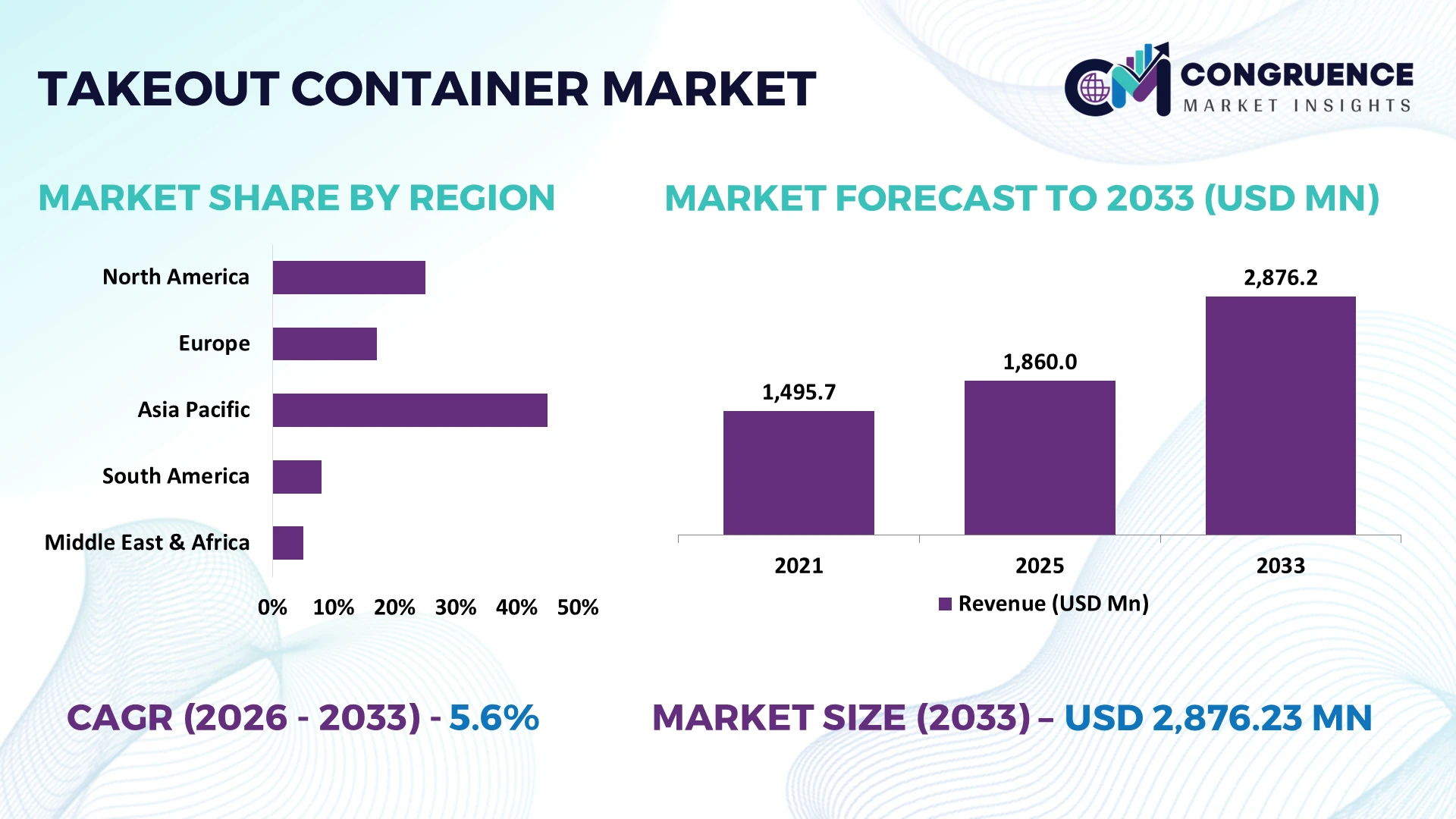
China anchors dominance with approximately 45% of global consumption, supported by 521 million online food delivery users and sustained investment in molded fiber and aluminum foil capacity; North America trails at roughly 29% share, where reusable-container pilots via DoorDash exceeded 50,000 orders across 10 countries, a 3x operational expansion over prior-year trials.
The strategic implication is clear, procurement teams must lock in compliant, high-performance supply ahead of 2030 recyclability mandates or absorb escalating reformulation costs.
Market Size & Growth: The market stands at USD 1,860.0 Million in 2025, advancing to USD 2,876.2 Million by 2033, propelled by EU Single-Use Plastics Directive enforcement and China's 521 million-user delivery ecosystem.
Top Growth Drivers: Regulatory phase-outs of expanded polystyrene (49% plastic material share under pressure), 90% of off-premises diners willing to order broader menus with better packaging, and 45% Asia-Pacific consumption concentration.
Short-Term Forecast: By 2027, automated thermoforming lines cut unit labor costs by 18–22% while AI vision inspection reduces defect rates to under 1.5%, compressing payback periods for mid-volume producers.
Emerging Technologies: AI-powered vision systems on aluminum foil lines, plant-protein coatings replacing plastic liners, and reusable deposit-return logistics platforms are scaling across European and North American delivery networks.
Regional Leaders: China (45% share, molded fiber expansion), North America (29%, reusable pilot infrastructure), Europe (21%, SUPD-compliant paperboard conversions).
Consumer/End-User Trends: 90% of off-premises customers report willingness to order temperature-sensitive items when vented, multi-layer containers preserve fried-food integrity.
Pilot/Case Example: Pizza Hut and Anchor Packaging's 2026 APR award-winning wing bowl incorporates post-consumer recycled polypropylene, saucing directly in-container to shorten prep time and recover food-grade PP at previously unattainable scale.
Competitive Landscape: Huhtamäki leads at approximately 5% share; top five players—Huhtamäki, Graphic Packaging, Dart Container, Reynolds, Pactiv Evergreen—hold roughly 19% combined.
Regulatory & ESG Impact: EU Regulation 2025/40 mandates all packaging recyclable by 2030 and 30% recycled content in PET contact-sensitive applications, forcing supplier recertification cycles.
Investment & Funding: Circular reusable infrastructure and automated aluminum foil lines attract capital, with DoorDash's 10-country reusable network validating reverse-logistics economics at commercial density.
Innovation & Future Outlook: Next-generation venting geometries extend delivery radius for moisture-sensitive foods, while modular production lines enable rapid changeovers between container formats, shifting competitive advantage toward supply-chain responsiveness.
The takeout container market beyond headline figures reveals concentrated demand in temperature-retentive formats and regulatory-compliant substrates. Aluminum foil takeaway containers alone represent a USD 1,661 million segment, with 42.46 billion units sold annually and 15% industry margins, driven by direct-heatability and recyclability advantages over legacy plastic. Huhtamäki and Just Eat Takeaway's rollout of plant-protein-coated paperboard boxes across 10 European markets demonstrates commercial-scale substitution: SUPD-compliant, fully recyclable, and compatible with existing waste streams without plastic separation. A 49% plastic share now faces structural erosion as EU recyclability deadlines compress procurement cycles. Operators that secure compliant supply early convert regulatory burden into competitive moat.
Takeout containers have shifted from commodity procurement to competitive infrastructure. EU Regulation 2025/40's 2030 recyclability mandate and 30% recycled-content thresholds for contact-sensitive PET make packaging a compliance asset requiring documentation, traceability, and supplier recertification—not a line-item cost to minimize. China's 45% consumption dominance and 521 million delivery users create scale advantages in molded fiber and aluminum tooling that Western producers cannot replicate without localized capacity investment.
Technology comparisons favor automated aluminum foil lines over legacy thermoforming: AI vision inspection cuts defect rates below 1.5%, servo-driven presses reduce energy consumption by 18–22%, and modular changeovers compress format-switching downtime from hours to minutes. Regionally, Europe leads compliance-driven paperboard conversion while North America prioritizes reusable logistics pilots—DoorDash's 50,000+ reusable orders across 10 countries validate reverse-logistics economics at urban density. Over the next 24–36 months, expect procurement teams to consolidate around suppliers with certified recycled-content streams and documented end-of-life pathways.
The Pizza Hut–Anchor Packaging wing bowl illustrates operational alignment: post-consumer recycled polypropylene, in-container saucing to shorten prep time, and APR-recognized recyclability that unlocks food-grade PP recovery at scale. Companies are shifting investment from volume capacity toward compliant-material tooling and reverse-logistics partnerships. The strategic conclusion is unambiguous: competitive positioning now depends on securing regulatory-compliant supply before enforcement deadlines, not after.
Enforcement of the EU Single-Use Plastics Directive, banning expanded polystyrene food containers across 27 member states, removes a legacy format representing approximately 49% of plastic foodservice packaging material share from compliant procurement. Simultaneously, 90% of off-premises customers indicate willingness to order broader menus when packaging preserves temperature and texture, creating demand-pull for engineered venting and multi-layer substrates. Huhtamäki has responded by partnering with Just Eat Takeaway to deploy plant-protein-coated paperboard boxes across 10 European markets—SUPD-compliant, recyclable in existing streams, and validated as plastic-free by the National Physical Laboratory. The operational insight: material substitution is no longer a sustainability pilot; it is a procurement prerequisite with defined deadlines.
Sustainable substrate conversion carries a measurable penalty: biodegradable raw materials and intricate processing elevate per-unit production costs, while 27% of restaurant operators in 2024 expected lower profitability year-over-year, constraining their capacity to absorb compliant-packaging surcharges. In North America, where plastic retains cost advantages, operators face a 29% regional consumption share with thinner margins than European counterparts navigating already-sunk compliance costs. Manufacturers are responding through localized material sourcing and long-term supply contracts to stabilize input pricing, but the structural gap between compliant and conventional container costs remains a direct drag on volume adoption in price-sensitive delivery channels.
DoorDash's reusable-container network exceeded 50,000 orders across 10 countries by April 2025, demonstrating that deposit-return reverse logistics achieves commercial viability at urban density. In China, 521 million delivery users create unmatched scale for standardized reusable formats and automated washing infrastructure. Separately, modular aluminum foil lines with regenerative drives and closed-loop scrap recycling reduce energy consumption by 18–22% while enabling rapid format changeovers. The non-obvious opportunity lies in third-party container-as-a-service models: operators lease compliant, tracked containers rather than purchase disposables, converting capital expenditure into operating expense while retaining ESG documentation for regulatory audits.
EU Regulation 2025/40 requires 30% recycled content in contact-sensitive PET by 2030, yet food-grade polypropylene recovery infrastructure remains geographically uneven—Pizza Hut's wing bowl required a bespoke design removing carbon black and mineral fillers to unlock recyclability at scale. In markets without mature sorting streams, compliant containers contaminate recycling batches, undermining the circular claims operators depend on for ESG reporting. Workforce gaps in automated line operation compound the problem: AI vision systems demand technicians capable of calibrating defect-detection thresholds, a skill set scarce outside established manufacturing hubs in Germany and China. Companies must invest in supplier traceability platforms and operator training or risk compliance failures that erode competitive positioning.
Reusable Networks Move Commercial DoorDash confirmed reusable-container orders exceeded 50,000 across 10+ countries and major US cities by April 2025, validating reverse-logistics viability in dense urban zones. The operational shift replaces single-use throughput with sanitization-and-redistribution cycles, pressuring converters to design durable formats while aggregators build collection infrastructure. Companies are responding through deposit-return pilots rather than waiting for mandate-driven adoption.
Venting Chemistry Extends Delivery Radius Multi-layered substrates and engineered venting systems now balance moisture release with heat retention, extending viable delivery range for fried and moisture-sensitive foods. National Restaurant Association data shows 90% of off-premises customers would order a wider variety of items if packaging preserved dine-in quality. This directly expands addressable menu categories for delivery-only kitchens, incentivizing QSR chains to upgrade container specifications rather than accept transit degradation.
Digital Packaging Selection Compresses Switching Time Zomato’s PackSwitch platform connected 10,000+ restaurants across 500+ Indian cities, facilitating over 100 million low-plastic orders by March 2026, with a supplier network exceeding 100 verified vendors. The non-obvious insight: restaurants lacked material-selection capability, not willingness—platform-guided specification by dish type removes technical friction that previously stalled adoption. Suppliers gain qualified demand pipelines without costly direct sales.
Plastic-Free Coatings Enter Commercial Service Lieferando Austria deployed Huhtamäki folding boxes with Xampla’s Morro plant-protein coating across 4,800 restaurant partners in late 2025, following UK and Germany trials. The coating delivers grease resistance and biodegradability without plastic lamination, eliminating a persistent barrier to fibre-format adoption in wet-food applications. Converters are now integrating coating capacity into moulding lines rather than treating barrier performance as an outsourced step.
Plastic containers retain the leading position with approximately 58% of total market share, sustained by cost advantages, barrier performance, and incumbent thermoforming infrastructure across North American and European foodservice chains. This dominance is structural rather than preferential: plastic formats integrate seamlessly with existing filling, sealing, and logistics systems, and converters have amortized production assets over decades. Paper containers represent the fastest-growing type, driven by regulatory pressure in India and the EU single-use plastics directive, with adoption concentrated in delivery-heavy urban markets where brand owners face EPR declaration obligations.
The strategic tension is visible in investment patterns: converters are extending plastic line life while allocating incremental capital to fibre moulding and coating capacity. Remaining types—aluminium and compostable formats—serve niche high-barrier and premium sustainability segments respectively, with aluminium benefiting from India’s 45,000-tonne capacity expansion. Companies are hedging through dual-format portfolios rather than committing fully to substitution.
Retail remains the largest application segment, anchoring demand through grocery-adjacent prepared food, deli counters, and takeaway-ready meal formats that require standardized container dimensions and stackability. This segment’s volume stability provides converters with baseline utilization rates, though growth is concentrated elsewhere. Online food delivery is the fastest-expanding application, with China’s online takeout user base reaching 521 million—48.8% of total internet users—demonstrating the scale at which delivery platforms reshape container demand.
The operational distinction matters: retail prioritizes cost-per-unit and shelf compatibility, while delivery demands leak resistance, thermal retention, and venting performance under transit stress. QSR and FSR chains are converging with delivery specifications, upgrading container SKUs to serve both dine-in takeaway and platform orders. Institutional catering remains a steady but less innovation-responsive application, though hospital and corporate contracts are beginning to specify sustainability criteria. Companies are prioritizing delivery-channel specifications in R&D while maintaining retail volume through existing format lines.
Commercial foodservice—QSR, FSR, and delivery-native kitchens—constitutes the dominant end-user group, with approximately 64% of total takeout packaging demand attributable to commercial foodservice operations. This concentration reflects order frequency and standardized format requirements: chain restaurants and cloud kitchens purchase in volume, specify performance criteria, and switch suppliers only when compliance or cost thresholds are breached. Household or consumer-direct purchases represent a smaller but steady segment, driven by convenience and bulk purchasing for home entertaining.
The fastest-growing end-user dynamic is platform-mediated procurement, where delivery aggregators influence packaging choices across thousands of restaurant partners. Zomato’s PackSwitch connects 100+ verified suppliers to restaurants that previously lacked technical selection capability. This shifts buying power from individual operators toward platform-curated supplier networks, compressing qualification cycles and favoring suppliers with pre-certified, application-specific formats. Institutional buyers—hospitals, schools, corporate cafeterias—are beginning to adopt sustainability criteria, though procurement cycles remain longer than commercial foodservice. Companies are responding by building platform-compatible product catalogs and dedicating account teams to aggregator relationships rather than relying solely on distributor networks.
Asia-Pacific accounted for the largest market share at 45% in 2025 however, Middle East & Africa is expected to register the fastest growth, expanding at a CAGR of 8.4% between 2026 and 2033.
North America holds approximately 25% of global market share, anchored by 1.2 million foodservice outlets and entrenched delivery-platform infrastructure across the United States and Canada. The operational dynamic is shifting from resin-price competition toward fibre-moulding capacity localization, as converters respond to state-level PFAS bans and brand-owner sustainability commitments. Investment is flowing into domestic moulded-fibre lines to reduce import dependence on Asian converters, with mid-sized operators prioritizing dual-format portfolios that preserve plastic thermoforming assets while building paper-based capacity.
United States Market Outlook: The US market benefits from mature recycling infrastructure and concentrated QSR chain procurement, where standardized container specifications enable volume purchasing across thousands of locations. Major chains are consolidating supplier relationships around converters with certified compostable and PFAS-free portfolios, reducing qualification overhead and improving supply continuity.
Europe accounts for approximately 17% of global market share, with regulatory pressure from the EU Single-Use Plastics Directive driving material substitution faster than in North America. The distinctive operational feature is platform-mediated adoption: Lieferando Austria distributed Huhtamäki folding boxes with Xampla's Morro plant-protein coating to 4,800 restaurant partners, following successful UK and Germany pilots that validated grease resistance and thermal performance under delivery conditions . This model compresses adoption timelines by removing individual restaurant procurement friction, positioning delivery aggregators as specification gatekeepers rather than passive intermediaries.
Germany Market Outlook: Germany's packaging value chain combines converter technical depth with delivery-platform scale, enabling rapid commercialization of barrier-coated fibre formats. Huhtamäki's manufacturing footprint and Xampla's coating integration demonstrate how German converters convert material innovation into distributable product catalogs for platform partners.
Asia-Pacific commands approximately 45% of global market share, with China's 521 million online food delivery users and India's enforcement of EPR packaging rules from April 2026 driving both volume and specification complexity. India's regulatory framework requires brand owners and delivery aggregators to register on the CPCB portal, declare packaging quantities, and meet recycling or composting targets, with penalties reaching INR 15 lakh per violation . This has catalyzed platform-led supplier qualification: Zomato's PackSwitch connects over 100 verified sustainable packaging suppliers to 10,000+ restaurants across 500+ cities, facilitating more than 100 million low-plastic orders by March 2026 .
India Market Outlook: India's domestic moulded-fibre and bagasse capacity is expanding to serve both EPR-compliant delivery demand and export orders, with converters integrating raw-material supply to compress costs and secure traceability documentation. The compliance burden favors suppliers with pre-certified inventories and documentation systems.
South America represents approximately 8% of global market share, with Brazil and Mexico driving demand through expanding delivery-platform penetration and urban QSR chain growth. The operational constraint is infrastructure asymmetry: recycling and composting systems lag commercial packaging adoption, creating a gap between brand-owner sustainability commitments and verifiable end-of-life outcomes. Converters are prioritizing cost-competitive fibre and paperboard formats that satisfy brand specifications without depending on municipal composting availability, while delivery platforms experiment with reusable-container pilots in dense urban zones.
Brazil Market Outlook: Brazil's large urban delivery market and growing QSR chain footprint create volume demand for standardized containers, with iFood's platform dominance enabling supplier qualification at scale. Domestic paperboard converters are expanding capacity to serve foodservice chains seeking alternatives to imported plastic formats.
Middle East & Africa holds approximately 5% of global market share, with Gulf Cooperation Council states investing in foodservice infrastructure and delivery-platform expansion accelerating container demand. The operational dynamic differs from mature markets: packaging specifications are being established concurrently with delivery ecosystem growth, allowing converters to shape format standards rather than displace entrenched incumbents. Regulatory frameworks are emerging rather than enforced, creating a window for suppliers to establish compliance-ready product portfolios before mandates tighten.
United Arab Emirates Market Outlook: The UAE's concentrated urban delivery market and high restaurant density support rapid adoption of standardized packaging formats, with Dubai serving as a regional distribution hub for converters supplying GCC foodservice chains. Platform-led sustainability initiatives are beginning to influence procurement specifications.
The takeout container market pits global fibre-integrated converters—Huhtamäki, Graphic Packaging, Dart, Novolex-Pactiv Evergreen—against regional cost leaders and platform-curated supplier networks. The top five players collectively hold approximately 19% share, confirming a fragmented structure where no single vendor dictates specification standards. Competition hinges on compliance-ready material portfolios (31% of institutional procurement decisions), supply-chain localization (US fibre capacity investment), and platform qualification speed (Zomato’s 100+ verified suppliers). Players are competing through vertical integration—Graphic Packaging’s Waco facility processing 15 million cups daily—and portfolio hedging between plastic and fibre lines. The decisive shift is regulatory: India’s April 2026 EPR enforcement creates a compliance barrier that favors converters with pre-certified inventories and documentation systems. Winning requires platform-compatible product catalogs, certified compostable capacity, and the speed to qualify suppliers before enforcement deadlines compress buyer options.
Huhtamäki Oyj
Graphic Packaging International
Dart Container Corporation
Novolex (including Pactiv Evergreen)
Genpak LLC
Sabert Corporation
Karat Packaging Inc.
BioPak
Vegware
Fabri-Kal
Reynolds Consumer Products
Sonoco Products Company
Georgia-Pacific
Dixie Consumer Products
Dry-formed fibre moulding now anchors commercial production, delivering approximately 80% lower CO₂ impact than plastic thermoforming while remaining compatible with paper recycling streams. Huhtamäki’s bio-based coated cups maintain under 10% plastic content, achieving recyclability without barrier performance loss . Adoption is accelerating: Dart’s entire moulded-fibre portfolio earned TÜV Austria home-compostable certification, signaling specification maturity for foodservice buyers .
Barrier chemistry is the emerging battleground. Plant-protein coatings replace polyethylene liners in wet-food applications, eliminating a persistent obstacle to fibre adoption in delivery formats. Graphic Packaging’s Boardio platform demonstrates format flexibility—round, octagonal, square canisters from a single machine—compressing changeover time for co-packers serving diverse brand portfolios .
Disruptive pressure comes from platform-mediated supplier qualification. Zomato’s PackSwitch connects restaurants to certified vendors, shifting specification authority from individual operators to aggregator-curated networks. Converters with pre-certified, platform-compatible catalogs capture demand without direct sales overhead; those without face exclusion from high-velocity delivery channels. Between 2026 and 2028, compliance documentation and barrier performance will determine which fibre suppliers scale—those treating coating chemistry and certification as core capabilities will convert regulatory pressure into durable account control.
July 2025 – Huhtamäki Launched compostable ice cream cups using bio-based coated paperboard with under 10% plastic content, recyclable and home-compostable, expanding sustainable foodservice portfolio for European dairy customers. Source: huhtamaki.com
November 2025 – Graphic Packaging Commenced operations at Waco, Texas recycled paperboard facility capable of processing 15 million paper cups daily, establishing North America’s most advanced recycled fibre platform. Source: graphicpkg.com
January 2025 – Pactiv Evergreen Launched molded fibre packaging line—plates, bowls, trays—compostable and recyclable, targeting foodservice operators facing single-use plastic restrictions across US states. Source: packnode.org
May 2025 – Dart Container All molded fibre products received TÜV Austria OK Compost HOME certification; portfolio contains minimum 96% renewable resources and is PFAS-free, meeting home composting standards. Source: corporate.dartcontainer.com
This report delivers a complete competitive and operational assessment of the takeout container market across plastic, paper, aluminium, and compostable formats, segmented by application (retail, online food delivery, QSR, institutional) and end-user (commercial foodservice, households, platforms). Regional coverage spans Asia-Pacific, North America, Europe, South America, and Middle East & Africa, with country-level analysis of regulatory enforcement, manufacturing capacity, and delivery-platform penetration.
Quantitative indicators include segment share distribution, adoption rates for fibre-based and certified compostable formats, capacity investments, and supplier qualification metrics. The report profiles leading converters, platform-mediated procurement models, and technology transitions in dry-forming and barrier chemistry. Strategic insights support investment planning, expansion prioritization, and competitive positioning through 2033, with particular attention to India’s EPR enforcement timeline, US fibre localization, and platform-driven specification authority.
| Report Attribute / Metric | Details |
|---|---|
| Market Revenue (2025) | USD 1,860.0 Million |
| Market Revenue (2033) | USD 2,876.2 Million |
| CAGR (2026–2033) | 5.6% |
| Base Year | 2025 |
| Forecast Period | 2026–2033 |
| Historic Period | 2021–2025 |
| Segments Covered |
By Type
By Application
By End-User
|
| Key Deliverables | Revenue Forecast; Market Trends; Growth Drivers & Restraints; Technology Insights; Segmentation Analysis; Regional Insights; Competitive Landscape; Regulatory & ESG Overview; Recent Developments |
| Regions Covered | North America; Europe; Asia-Pacific; South America; Middle East & Africa |
| Companies Profiled | Huhtamäki Oyj; Graphic Packaging International; Dart Container Corporation; Novolex (including Pactiv Evergreen); Genpak LLC; Sabert Corporation; Karat Packaging Inc.; BioPak; Vegware; Fabri-Kal; Reynolds Consumer Products; Sonoco Products Company; Georgia-Pacific; Dixie Consumer Products |
| Customization & Pricing | Available on Request (10% Customization Free) |




