
Reports
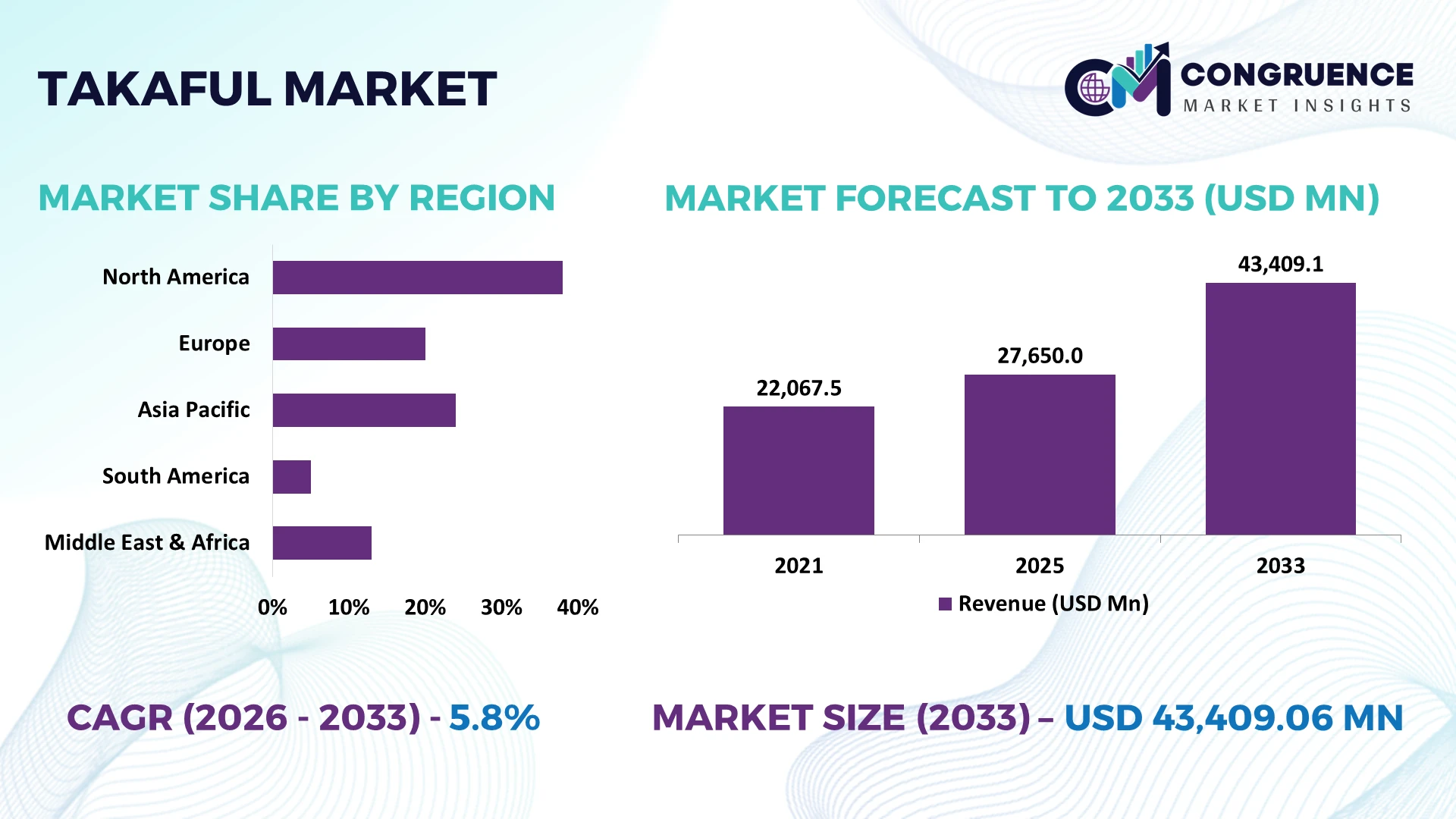
The Global Takaful Market was valued at USD 27650 Million in 2025 and is anticipated to reach a value of USD 43409.06 Million by 2033 expanding at a CAGR of 5.8% between 2026 and 2033. Growth is driven by compulsory motor and health coverage, Shariah-compliant financial inclusion, bancatakaful distribution, and digital insurance modernization.
Saudi Arabia is a leading national takaful market, supported by compulsory motor insurance, cooperative health coverage, and Vision 2030 financial-sector reforms. The Kingdom's insurance regulator targets insurance penetration of 4.3% of non-oil GDP by 2030, strengthening the strategic importance of protection products. Malaysia provides a contrasting model, with family takaful new-business penetration reported at approximately 19.6% in 2024. Saudi operators emphasize large-scale medical and motor coverage, while Malaysian providers lead in family protection, digital distribution, and bancatakaful integration.
Strategic implication: Takaful operators should prioritize health coverage efficiency, digital family protection products, and distribution partnerships tailored to national regulatory frameworks.
Market Size & Growth: USD 27,650 million in 2025, reaching USD 43,409.06 million by 2033 at 5.8% CAGR, supported by compulsory coverage and Shariah-compliant protection.
Top Growth Drivers: Malaysia recorded 19.63% family takaful penetration, 12.38% general takaful contribution growth, and 15.34% higher average family certificate size in 2025.
Short-Term Forecast: By 2028, digital claims automation targets an illustrative 15% reduction in processing time and 10% lower administrative costs.
Emerging Technologies: Three priorities—AI-assisted underwriting, automated claims processing, and embedded takaful—are reshaping distribution and operational efficiency.
Regional Leaders: Indicative 2033 allocations place the Middle East at USD 26,045.44 million, Southeast Asia at USD 13,022.72 million, and other markets at USD 4,340.90 million, reflecting different protection and distribution priorities.
Consumer/End-User Trends: Malaysia maintained 6.74 million active family takaful certificates in 2025, demonstrating established consumer participation.
Pilot/Case Example: Malaysia's 2025 family takaful sector issued 861,956 new certificates, demonstrating continued acquisition through established distribution channels.
Competitive Landscape: Saudi Arabia's Tawuniya is a leading cooperative insurer; its global takaful share is unverified. Competitors include Takaful Malaysia, Etiqa, Syarikat Takaful Brunei, and Prudential BSN Takaful.
Regulatory & ESG Impact: Saudi Arabia's insurance strategy targets 3.6% non-oil GDP penetration by 2030, strengthening regulatory modernization and protection coverage.
Investment & Funding: Saudi Arabia targets SAR 50 billion in insurance-sector risk-based capital by 2030, emphasizing capital strengthening and investment capacity.
Innovation & Future Outlook: Saudi Arabia targets 23 million health insurance beneficiaries and 16 million insured vehicles, reinforcing digital servicing and scalable protection platforms.
The takaful market provides Shariah-compliant protection through participant-funded risk-sharing arrangements covering family, health, motor, property, and commercial risks. Demand is strengthening through compulsory insurance requirements, bancatakaful partnerships, and digitally distributed protection products. Malaysia recorded 19.63% family takaful penetration in 2025, demonstrating established participation in cooperative insurance. Operators are adopting automated underwriting, digital certificates, claims analytics, and embedded distribution to improve accessibility and servicing efficiency. Saudi Arabia's insurance-sector modernization is also increasing the importance of regulatory compliance, capital management, and customer protection, establishing the strategic priorities shaping future market competition.
The takaful market is becoming strategically important as compulsory insurance, financial inclusion, and regulatory modernization reshape Shariah-compliant risk protection. Saudi Arabia's Vision 2030 reforms are strengthening insurance infrastructure, while Malaysia's established family takaful ecosystem demonstrates the importance of bancatakaful distribution. Malaysia recorded approximately 19.63% family takaful penetration in 2025, highlighting established consumer participation. Competition increasingly centers on customer acquisition efficiency, claims transparency, and sustainable participant risk funds rather than product availability alone.
Digital underwriting, automated claims validation, and integrated payment systems are transforming operating models. Compared with conventional document-based processing, an illustrative automation scenario targets 20% faster certificate issuance and 15% lower administrative expenditure. Malaysian operators can integrate family protection into banking applications, enabling customers to obtain coverage through existing digital channels. Saudi insurers are strengthening health insurance administration and provider connectivity, while Indonesian operators emphasize affordable protection and broader distribution access.
Between 2026 and 2028, operators will prioritize embedded takaful, predictive claims analytics, and automated participant fund reporting. A modeled 10% improvement in policy servicing productivity supports scalable distribution. Companies investing in interoperable platforms, actuarial capabilities, and strategic banking partnerships will strengthen retention, operating resilience, and long-term competitive positioning.
Compulsory motor and health insurance frameworks are strengthening demand for Shariah-compliant protection products. Saudi Arabia's insurance modernization agenda targets broader coverage, while Malaysia maintains established family and general takaful distribution networks. Malaysia recorded approximately 19.63% family takaful penetration in 2025, demonstrating substantial consumer participation. In an illustrative distribution scenario, bancatakaful integration increases certificate conversion by 12%, while automated onboarding reduces application abandonment by 15%. Operators are expanding banking partnerships, digital quotation platforms, and simplified protection products. The strategic advantage extends beyond customer acquisition: recurring contribution collection through established financial channels improves certificate persistency and reduces servicing friction, supporting more predictable participant fund administration.
Takaful operators face structural limitations involving retakaful availability, capital adequacy, and differing regulatory requirements across jurisdictions. Specialized Shariah-compliant risk transfer capacity remains narrower than conventional reinsurance options, complicating protection against large claims events. In an illustrative underwriting scenario, a 10% increase in retakaful pricing raises risk transfer expenditure, while a modeled 15% increase in required capital buffers reduces funds available for expansion. Malaysia's risk-based capital framework and Saudi Arabia's evolving insurance supervision create distinct compliance requirements. Operators are diversifying retakaful arrangements, improving actuarial pricing, and strengthening capital management. Competitive advantage increasingly depends on maintaining adequate protection capacity without compromising participant fund sustainability or affordability.
Embedded microtakaful presents opportunities to extend affordable protection through banking applications, telecommunications platforms, and digital commerce ecosystems. Indonesia's extensive digital financial services infrastructure creates a distribution pathway for consumers underserved by conventional insurance channels. Under an illustrative deployment model, automated enrollment reduces acquisition costs by 20%, while simplified digital claims processing improves settlement productivity by 15%. Operators are developing modular protection products, application programming interfaces, and partnerships with digital financial service providers. A modeled 10% improvement in certificate renewal performance further strengthens customer economics. The non-obvious opportunity lies in integrating small protection contributions into recurring financial transactions, reducing collection friction and improving accessibility without expanding physical distribution networks.
Long-term takaful expansion depends on secure digital infrastructure, accurate risk assessment, and transparent participant fund administration. Operators integrating banking applications, healthcare systems, and third-party distribution platforms face increasing cybersecurity and data governance complexity. In an illustrative operating scenario, a 10% rise in fraudulent claims increases investigation requirements, while a 15% improvement in automated anomaly detection reduces manual review workloads. Malaysia's digital insurance modernization and Saudi Arabia's expanding health insurance infrastructure require reliable data exchange and consistent regulatory reporting. Companies must invest in cybersecurity, actuarial analytics, Shariah governance systems, and specialist workforce development. Sustainable competitiveness depends on protecting participant information, maintaining claims integrity, and demonstrating transparent surplus allocation across increasingly interconnected distribution ecosystems.
• Medical Claims Scrutiny Intensifies: Saudi takaful operators are strengthening provider billing audits as medical inflation and treatment utilization pressure participant risk funds. Illustrative claims analytics programs target 12% fewer billing discrepancies and 15% faster adjudication. Insurers are integrating hospital data, refining treatment authorization workflows, and expanding healthcare partnerships to protect underwriting margins without restricting legitimate coverage.
• Certificate Persistency Gains Strategic Priority: Malaysian family takaful providers are emphasizing renewals rather than relying exclusively on new certificate issuance. With approximately 6.74 million active family takaful certificates reported in 2025, retention management carries significant operational importance. Modeled digital engagement programs target 8% fewer contribution lapses and 10% faster reinstatements. Operators are strengthening automated reminders and customer servicing.
• Risk Pool Segmentation Becomes Granular: Takaful providers are refining participant grouping to manage claims volatility and maintain equitable contribution structures. Illustrative actuarial segmentation targets 10% greater pricing accuracy and 12% fewer unexpected claims deviations. Saudi insurers are strengthening underwriting analytics and portfolio monitoring, while Malaysian operators integrate customer behavior indicators into renewal assessments and protection product design.
• Surplus Transparency Shapes Customer Confidence: Family takaful operators increasingly emphasize participant fund performance, surplus allocation, and accessible financial disclosures. Modeled digital reporting workflows reduce reconciliation time by 20% and reporting errors by 10%. Providers are integrating automated fund accounting and customer dashboards. Clear surplus reporting strengthens governance credibility and helps differentiate cooperative protection from conventional insurance offerings.
Family Takaful represents the leading product type, accounting for an indicative 40% of global takaful demand in 2025. Its position reflects established long-term protection requirements, savings-linked coverage, and bancatakaful distribution in Malaysia and other established markets. General Takaful accounts for approximately 28%, supported by motor, property, and commercial risk protection. Family products benefit from recurring participant contributions and established financial institution partnerships, whereas general products typically involve shorter coverage periods and more frequent underwriting adjustments. Operators are expanding digital certificate management, simplified protection packages, and automated contribution collection. Investment priorities increasingly emphasize persistency, participant fund stability, and efficient customer servicing rather than distribution volume alone.
Health Takaful represents the fastest-growing type, with an indicative 22% share, supported by expanding medical coverage requirements and healthcare financing modernization. Investment-Linked Takaful accounts for approximately 10%, serving customers seeking combined protection and Shariah-compliant investment exposure. Health operators are strengthening hospital network integration and claims analytics, while investment-linked providers focus on portfolio transparency and suitability assessments. Competitive differentiation depends on disciplined risk pricing, accessible digital servicing, and products aligned with distinct customer protection needs.
Life and Family Protection represents the leading application, accounting for an indicative 35% of global takaful demand in 2025. Long-term financial security requirements, household protection planning, and established bancatakaful networks support this position. Motor Insurance contributes approximately 25%, reflecting compulsory vehicle coverage requirements in major markets. Health Coverage represents an estimated 22%, supported by medical insurance adoption and healthcare financing reforms. Property and Asset Protection accounts for approximately 11%, serving residential and commercial coverage requirements. Operators are strengthening underwriting automation, digital servicing, and distribution partnerships to improve acquisition efficiency. Life protection providers prioritize contribution persistency, whereas motor operators emphasize rapid claims settlement and repair network management.
Health Coverage represents the fastest-growing application as Saudi Arabia expands insurance infrastructure and healthcare provider integration. Business Risk Protection accounts for an indicative 7%, addressing commercial liability and operational exposure. Health takaful providers are investing in electronic claims submission, medical utilization analytics, and hospital network coordination. Property and business protection operators emphasize risk assessment and tailored coverage. Demand is becoming operationally critical where compulsory coverage, medical cost management, and transparent participant fund administration intersect.
Individuals and Families represent the leading end-user group, accounting for an indicative 55% of global takaful demand in 2025. Their dominance reflects household protection requirements, motor coverage, medical insurance, and established family takaful participation. Small and Medium Enterprises represent approximately 20%, supported by commercial asset protection and business continuity requirements. Large Corporations account for an estimated 17%, emphasizing specialized risk assessment, employee protection, and coordinated coverage administration. Operators are strengthening digital customer onboarding, banking partnerships, and simplified certificate structures to serve households efficiently. Corporate customers require customized underwriting and service agreements, while individual participants prioritize affordability, claims accessibility, and transparent contribution arrangements.
Small and Medium Enterprises represent the fastest-growing end-user group as digital business platforms and financial institutions expand access to commercial protection. Government and Public Institutions account for an indicative 8%, reflecting institutional insurance requirements and public-sector risk management. Providers are developing modular SME protection packages, automated renewal workflows, and specialized corporate servicing capabilities. Competitive positioning increasingly depends on distribution economics, risk segmentation, and the ability to serve customers with differing coverage complexity.
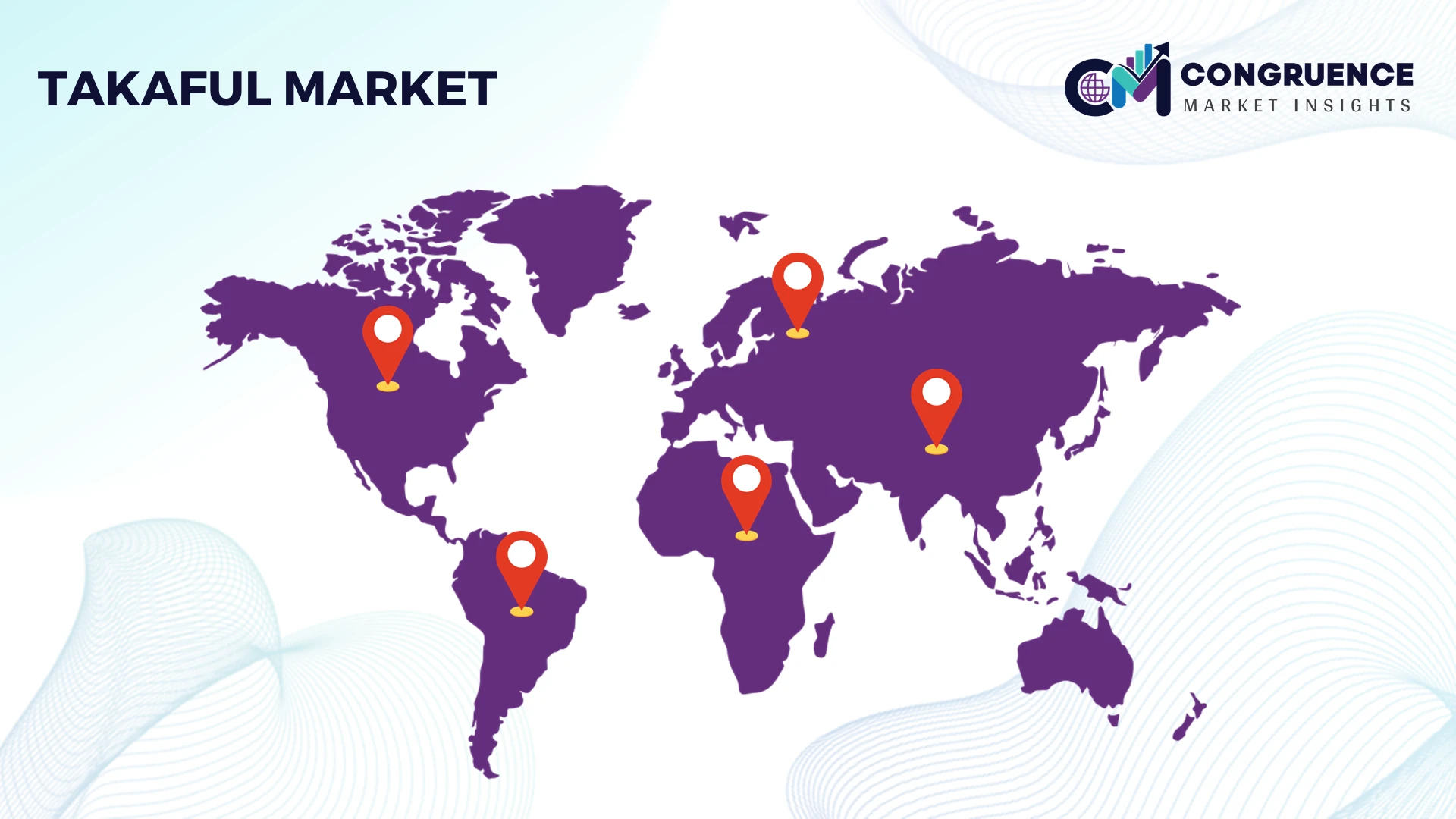
Middle East & Africa accounted for the largest market share at an indicative 62% in 2025 however, Asia-Pacific is expected to register the fastest growth, expanding at an indicative CAGR of 7.2% between 2026 and 2033.
Niche Protection Distribution and Regulatory Market Access
North America represents an indicative 3% of global takaful demand in 2025, reflecting limited dedicated takaful infrastructure compared with established Islamic finance markets. The United States and Canada offer specialized opportunities through community-oriented protection services, Islamic financial institutions, and digital insurance distribution. However, conventional insurance remains dominant, and dedicated takaful offerings face licensing, actuarial, and distribution constraints. The United States has 50 state insurance regulatory jurisdictions, creating additional compliance complexity for operators seeking broad market access. Digital customer acquisition and partnerships with licensed insurers offer alternatives to building extensive physical distribution networks. Providers evaluating market entry must distinguish genuine participant risk-sharing arrangements from conventional insurance products marketed to similar customer groups. Commercial viability depends on regulatory authorization, sufficient risk pooling, and dependable claims administration rather than demographic demand alone.
United States Market Outlook: The United States offers opportunities for specialized family protection and commercial risk coverage through established insurance distribution infrastructure. State-level licensing requirements shape product availability, while digital insurance platforms support targeted customer acquisition. With insurance supervision distributed across 50 states, prospective takaful operators require jurisdiction-specific compliance planning. Partnerships with licensed carriers and specialist financial institutions provide a practical route for testing demand without assuming nationwide product availability.
Regulatory Compliance and Specialized Islamic Insurance Distribution
Europe accounts for an indicative 5% of global takaful demand in 2025, with market activity concentrated in specialized Islamic finance and protection services. The United Kingdom provides an established Islamic financial services ecosystem, while other European markets present varying regulatory and commercial conditions. Insurance providers must satisfy prudential supervision, consumer protection, and product governance requirements alongside Shariah-compliant operating principles. The European Union's Solvency II framework applies risk-based capital requirements to authorized insurers, influencing capital planning and market entry economics. Providers are evaluating digital distribution, specialist partnerships, and tailored protection arrangements rather than pursuing extensive branch networks. Market development remains constrained by limited dedicated takaful capacity and the complexity of establishing sustainable participant risk pools. Competitive differentiation depends on regulatory credibility, transparent product structures, and efficient customer servicing.
United Kingdom Market Outlook: The United Kingdom benefits from established Islamic banking expertise, specialist financial advisers, and a developed insurance regulatory environment. The Financial Conduct Authority and Prudential Regulation Authority provide distinct supervisory responsibilities for relevant insurance activities. The country's financial services ecosystem supports specialist distribution partnerships, although dedicated takaful product availability remains limited. Operators must demonstrate adequate capitalization, appropriate governance, and commercially sustainable risk-sharing structures before scaling.
Family Protection Penetration and Digital Distribution Leadership
Asia-Pacific represents an indicative 30% of global takaful demand in 2025, supported by established markets in Malaysia, Indonesia, Brunei, and Pakistan. Malaysia leads regional product development through family takaful, bancatakaful distribution, and established regulatory supervision. Indonesia offers substantial long-term potential through financial inclusion initiatives and its expanding Islamic financial services ecosystem. Malaysia reported approximately 19.63% family takaful penetration in 2025, demonstrating established consumer participation. Operators are strengthening digital certificate issuance, contribution collection, and automated claims administration to improve distribution efficiency. Regional competition increasingly emphasizes customer persistency, product affordability, and sustainable participant fund management. Malaysian providers prioritize established protection portfolios, while Indonesian operators focus on widening access and improving distribution economics. Companies investing in scalable technology platforms and locally adapted products strengthen their competitive positioning.
Malaysia Market Outlook: Malaysia remains a leading takaful innovation center through established family protection providers, Islamic banking partnerships, and Bank Negara Malaysia's regulatory framework. Approximately 6.74 million active family takaful certificates were reported in 2025, demonstrating substantial participation. Takaful Malaysia, Etiqa, and Prudential BSN Takaful compete through differentiated protection products and distribution capabilities. Investment priorities include customer retention, claims automation, and transparent participant fund administration.
Early-Stage Islamic Finance and Protection Market Development
South America represents an indicative 1% of global takaful demand in 2025, reflecting limited dedicated product availability and relatively undeveloped Islamic insurance distribution infrastructure. Brazil and Argentina offer potential entry points through specialized financial services and commercial protection requirements, although conventional insurance remains dominant. Market development depends on regulatory authorization, distribution economics, and the ability to establish commercially viable participant risk pools. Brazil's insurance market is supervised by SUSEP, requiring prospective providers to address established insurance licensing and solvency requirements. Digital distribution offers a comparatively efficient approach to reaching geographically dispersed customers. However, limited specialist underwriting capacity and low product familiarity constrain immediate scalability. Providers evaluating entry must prioritize partnerships, consumer education, and regulatory feasibility before committing to extensive distribution investment.
Brazil Market Outlook: Brazil offers the region's most substantial insurance infrastructure and an established financial technology ecosystem. Its insurance sector operates under SUSEP supervision, creating a defined regulatory environment for prospective market participants. Dedicated takaful penetration remains unverified and commercially limited. Operators considering Brazil should evaluate licensed distribution partnerships, Shariah governance requirements, and digital customer acquisition economics before introducing specialized protection products.
Compulsory Insurance Expansion and Cooperative Protection Modernization
The Middle East & Africa represents an indicative 62% of global takaful demand in 2025, supported by Saudi Arabia's substantial cooperative insurance sector and established Islamic insurance activity across Gulf and selected African markets. Saudi Arabia leads regional demand through compulsory motor insurance, healthcare coverage, and regulatory modernization. The United Arab Emirates, Bahrain, and Sudan maintain distinct Islamic insurance ecosystems, while other markets present varying levels of penetration. Saudi Arabia's insurance sector strategy targets 23 million health insurance beneficiaries and 16 million insured vehicles by 2030, highlighting the scale of protection infrastructure development. Operators are strengthening claims administration, hospital connectivity, and digital distribution capabilities. Regional competition increasingly emphasizes actuarial discipline, efficient risk pooling, and regulatory compliance. Providers with established distribution networks and robust capital management retain significant operational advantages.
Saudi Arabia Market Outlook: Saudi Arabia is a major national market through compulsory health and motor coverage and the Kingdom's cooperative insurance framework. The Insurance Authority's modernization agenda is strengthening regulatory supervision, capital requirements, and sector development. Tawuniya, Bupa Arabia, and other insurers compete through medical provider networks, claims capabilities, and corporate relationships. Saudi insurance penetration targets and digital infrastructure investment reinforce opportunities for efficient Shariah-compliant protection administration.
The takaful market features competition between established Saudi cooperative insurers, Malaysian family takaful specialists, and regional Islamic insurance providers. Tawuniya, Takaful Malaysia, Etiqa, Prudential BSN Takaful, and Syarikat Takaful Brunei represent influential operators; their combined global market share remains unverified. Saudi providers compete through medical networks and compulsory coverage distribution, while Malaysian operators emphasize family protection, bancatakaful partnerships, and certificate persistency. Malaysia's 19.63% family takaful penetration demonstrates established participation, while modeled claims automation targets 15% faster processing and digital servicing targets 10% lower administrative costs. Companies are investing in actuarial analytics, embedded distribution, and customer retention platforms. Competition is shifting toward sustainable participant funds, transparent surplus management, and efficient digital administration. Regulatory capital requirements, retakaful capacity, and Shariah governance create substantial entry barriers.
The Company for Cooperative Insurance (Tawuniya)
Syarikat Takaful Malaysia Keluarga Berhad
Etiqa Family Takaful Berhad
Prudential BSN Takaful Berhad
Syarikat Takaful Brunei Darussalam Sdn Bhd
Bupa Arabia for Cooperative Insurance
Al Rajhi Company for Cooperative Insurance
Walaa Cooperative Insurance Company
Qatar Islamic Insurance Group
Islamic Arab Insurance Company (SALAMA)
Abu Dhabi National Takaful Company
Pak-Qatar Family Takaful Limited
Takaful Emarat Insurance PSC
Takaful International Company B.S.C.
Current takaful technologies integrate digital certificate issuance, automated contribution collection, actuarial pricing engines, and claims management platforms. Family Takaful represents an indicative 40% of product demand, reinforcing investment in recurring payment infrastructure. Compared with document based enrollment, automated identity verification and electronic underwriting target a modeled 20% reduction in processing time. Malaysian operators benefit from bancatakaful integration, which connects banking applications with protection administration, improving customer onboarding, contribution persistency, and servicing efficiency.
Emerging technologies include artificial intelligence assisted claims assessment, predictive lapse analytics, and application programming interfaces connecting healthcare providers with takaful administrators. Under illustrative conditions, automated claims triage reduces manual review workloads by 15%, while predictive engagement targets 10% fewer certificate lapses. Health Takaful holds an indicative 22% share, signaling demand for integrated medical administration. Saudi insurers investing in provider connectivity gain advantages through faster authorization, improved fraud detection, and more consistent participant fund monitoring.
Between 2026 and 2028, disruptive capabilities will emphasize explainable underwriting models, privacy preserving data exchange, and automated Shariah governance reporting. Smart contract based workflows offer programmable contribution allocation, although operational adoption remains limited. Modeled reconciliation automation targets 25% faster fund reporting. Operators combining transparent algorithms, cybersecurity controls, and interoperable platforms will strengthen regulatory confidence and competitive differentiation.
August 2025: Takaful Malaysia and Bank Muamalat introduced Malaysia's first Cyber Takaful Protection, priced from RM14.80 annually. The 12-month coverage addresses online scams and unauthorized transactions, expanding affordable digital risk protection through banking distribution channels. Source: bernama.com
May 2026: FWD Takaful and MBSB Bank established a 10-year bancatakaful partnership and introduced Takaful SmartGain. The arrangement combines Islamic banking distribution with family protection and savings products, expanding customer access and strengthening long-term distribution capabilities. Source: fwd.com.my
July 2025: Etiqa Philippines officially launched Takaful after completing regulatory and product approvals. The July 10 launch established an additional Shariah-compliant protection offering in the Philippine insurance market, broadening product choice and supporting Islamic financial inclusion. Source: etiqa.com.ph
May 2025: Insurans Islam TAIB Holdings launched Brunei's first takaful e-commerce platform, integrating access to general and family protection products. The digital channel reduces dependence on physical distribution and supports online customer acquisition across both business segments. Source: thebruneian.news
The Takaful Market Report examines industry structure, protection demand, and competitive developments between 2026 and 2033. Type segmentation covers Family Takaful, General Takaful, Health Takaful, and Investment-Linked Takaful. Application analysis evaluates Life and Family Protection, Health Coverage, Property and Asset Protection, Motor Insurance, and Business Risk Protection. End-user coverage includes Individuals and Families, Small and Medium Enterprises, Large Corporations, and Government and Public Institutions. Family Takaful represents an indicative 40% of market demand.
Regional assessment covers North America, Europe, Asia-Pacific, South America, and the Middle East & Africa. Technology coverage includes automated underwriting, digital certificate administration, claims analytics, embedded distribution, and participant fund reporting. The report evaluates regulatory frameworks, retakaful capacity, distribution partnerships, product innovation, and competitive positioning to support investment planning, geographic expansion, and strategic decisions.
| Report Attribute/Metric | Report Details |
|---|---|
Market Revenue in 2025 | USD 27650 Million |
Market Revenue in 2033 | USD 43409.06 Million |
CAGR (2026 - 2033) | 5.8% |
Base Year | 2025 |
Forecast Period | 2026 - 2033 |
Historic Period | 2021 - 2025 |
Segments Covered | By Type
By Application
By End-User
|
Key Report Deliverable | Revenue Forecast, Growth Trends, Market Dynamics, Segmental Overview, Regional and Country-wise Analysis, Competition Landscape |
Region Covered | North America, Europe, Asia-Pacific, South America, Middle East, Africa |
Key Players Analyzed | The Company for Cooperative Insurance (Tawuniya), Syarikat Takaful Malaysia Keluarga Berhad, Etiqa Family Takaful Berhad, Prudential BSN Takaful Berhad, Syarikat Takaful Brunei Darussalam Sdn Bhd, Bupa Arabia for Cooperative Insurance, Al Rajhi Company for Cooperative Insurance, Walaa Cooperative Insurance Company, Qatar Islamic Insurance Group, Islamic Arab Insurance Company (SALAMA), Abu Dhabi National Takaful Company, Pak-Qatar Family Takaful Limited, Takaful Emarat Insurance PSC, Takaful International Company B.S.C. |
Customization & Pricing | Available on Request (10% Customization is Free) |




