
Reports
The Global Tahini Sauce Market was valued at USD 534.2 Million in 2025 and is anticipated to reach a value of USD 725.5 Million by 2033 expanding at a CAGR of 3.9% between 2026 and 2033. Growth is driven by the shift toward ready-to-use Mediterranean sauces, clean-label formulations, flavored tahini variants, and expanding hummus, foodservice, and plant-based meal applications.
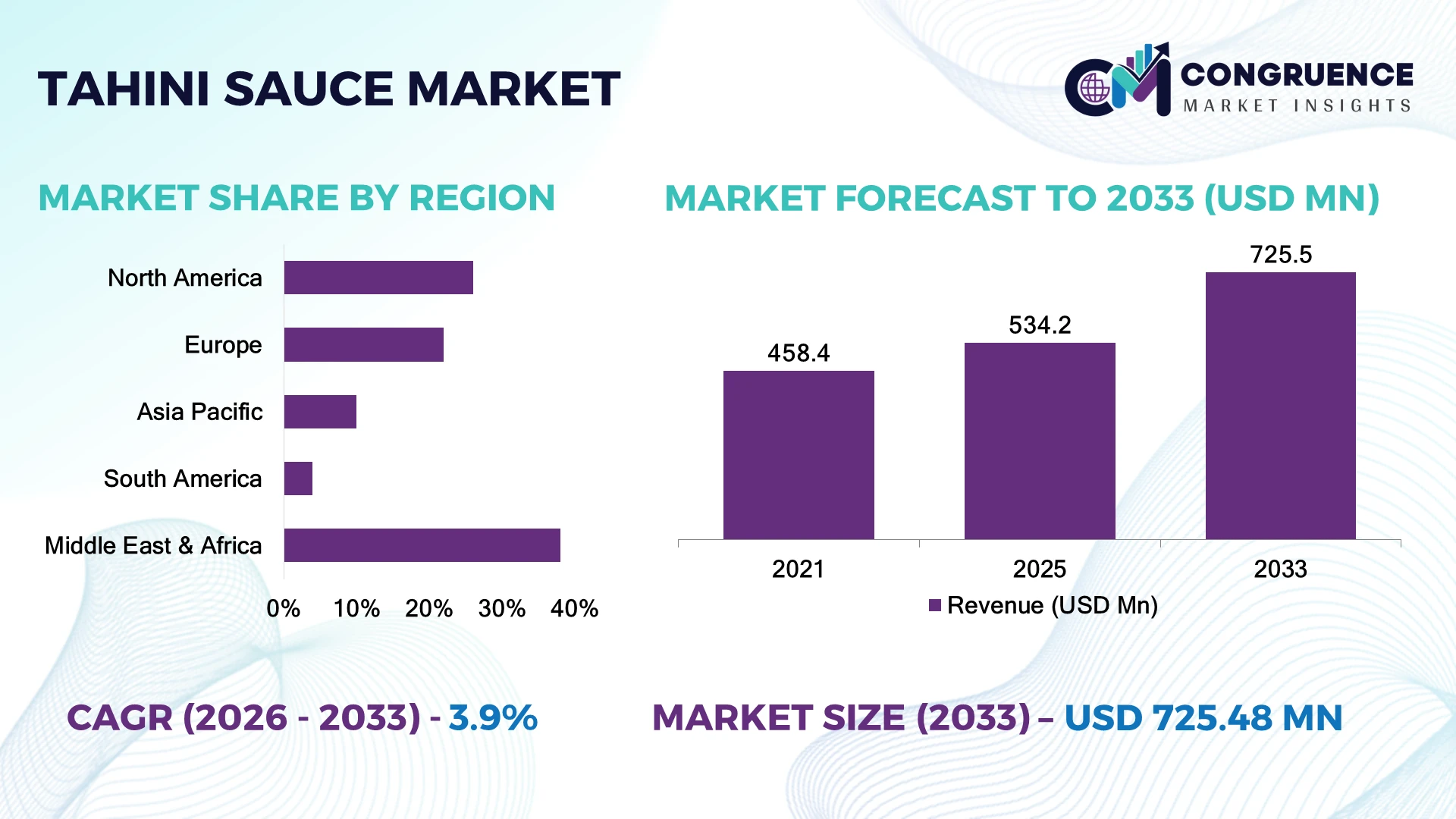
The Middle East & Africa dominates with about 38% of global demand, while North America contributes approximately 26%; the United States represents the region’s principal commercial market. India remains a major sesame supplier, producing roughly 801,000 tonnes annually, while geopolitical disruption in Sudan is pushing processors toward diversified sourcing, inventory buffers, and longer-term procurement contracts.
Strategically, producers should prioritize secure sesame procurement, scalable processing, convenient formats, and differentiated formulations.
Market Size & Growth: USD 534.2 Million in 2025 is projected to reach USD 725.5 Million by 2033 at a 3.9% CAGR, driven by ready-to-use sauce innovation and Mediterranean foodservice expansion.
Top Growth Drivers: Plant-based applications 61%, clean-label innovation 31%, and flavored-product development 27% are reshaping high-growth demand.
Short-Term Forecast: By 2028, automated milling, filling, and viscosity control can improve processing efficiency by 10–15% while reducing manual handling.
Emerging Technologies: Inline viscosity monitoring, automated filling, digital traceability, and AI-supported demand planning are strengthening quality consistency and inventory control.
Regional Leaders: Middle East & Africa represents about USD 276.7 Million, North America about USD 188.6 Million, and Europe about USD 159.6 Million by 2033; retail and foodservice adoption continues expanding.
Consumer/End-User Trends: Unflavored products represent roughly 78% of U.S. demand, while squeeze and ready-to-use formats increasingly target convenience-focused consumers.
Pilot/Case Example: 2025 sesame expansion in Sudan’s Gadaref area increased cultivated acreage from approximately 650,000 to 1.25 million acres, strengthening supply potential despite geopolitical disruption.
Competitive Landscape: Middle Eastern producers retain the strongest regional position, while Soom Foods, Mighty Sesame Co., Halwani Bros, Al Wadi Al Akhdar, and Prince Tahina compete through branding, formulation, packaging, and distribution.
Regulatory & ESG Impact: Sesame allergen controls and traceability requirements are strengthening quality systems, while clean-label products represent approximately 31% of recent innovation.
Investment & Funding: Supplier investment is increasingly directed toward sourcing diversification, automated filling, private-label production, and regional distribution, particularly where import exposure exceeds 70%.
Innovation & Future Outlook: Garlic-lemon, harissa, zhoug, miso, single-serve, and ready-to-use formats are shifting tahini from a traditional ingredient toward a broader everyday condiment platform.
The global Tahini Sauce Market is increasingly centered on sauces and dips, foodservice preparation, and premium retail formats. Sauces and dips account for approximately 48% of market volume, while hulled tahini represents nearly 60% of usage. Supply-chain pressure linked to sesame-producing markets is simultaneously accelerating supplier diversification and quality-control investment, creating a transition toward more resilient commercial models.
Tahini sauce is becoming strategically important because it is moving beyond traditional Middle Eastern cuisine into standardized foodservice, packaged meals, retail condiments, and plant-based formulations. Its ability to function as both an ingredient and ready-to-use sauce gives manufacturers multiple commercialization routes, increasing the importance of formulation flexibility, packaging efficiency, and reliable sesame procurement.
The supply chain is being restructured around multi-country sourcing, longer-term contracts, regional inventories, and stronger quality testing. This is particularly relevant as geopolitical disruption in Sudan affects a major sesame-producing market. Middle Eastern producers retain scale and heritage consumption, while North American and European brands emphasize premiumization, convenience, and modern retail positioning.
Technology is creating an operational advantage. Automated grinding, inline viscosity control, and precision filling can improve processing efficiency by approximately 10–15% compared with fragmented batch workflows. Over the next 2–3 years, manufacturers are positioned to expand single-serve packaging, ready-to-use sauces, and digitally managed inventory. Companies are adjusting investment toward automated processing, supplier partnerships, private-label capacity, and regional distribution. Competitive strength will increasingly depend on combining dependable sesame supply with consistent texture, rapid product development, and scalable packaging.
The strongest structural driver is the transition from tahini paste toward application-ready sauces for restaurants, prepared foods, and convenience meals. Sauces and dips represent approximately 48% of market volume, while foodservice channels increasingly require standardized viscosity and portion control. Clean-label formulations account for roughly 31% of recent product innovation, reinforcing demand for simplified ingredient systems. Geopolitical disruption affecting sesame supply in Sudan is also encouraging manufacturers to establish multi-country procurement networks. Companies are responding with flavored ready-to-use products, squeeze packaging, automated filling, and longer-term supplier contracts. The non-obvious advantage is SKU flexibility: a standardized tahini base can support several flavor profiles without requiring entirely separate production systems, improving manufacturing utilization and accelerating commercialization.
Sesame supply concentration remains a significant constraint, particularly for processors dependent on imports. India produces roughly 801,000 tonnes of sesame, while Sudan remains a major origin despite severe geopolitical disruption. For import-dependent manufacturers, raw-material and freight exposure can create 10–20% swings in procurement costs during periods of supply stress. Quality variability also increases testing requirements for moisture, contaminants, aflatoxin, and oil content. These pressures directly affect margins, production scheduling, and finished-product pricing. Companies are reducing exposure through multi-origin procurement, forward contracts, regional inventory buffers, and supplier qualification programs. The strategic pressure point is not sesame availability alone but maintaining consistent seed characteristics across origins without changing roasting, milling, or flavor specifications.
Ready-to-use formats create a differentiated opportunity as consumers and foodservice operators prioritize speed and portion consistency. Squeeze and single-serve products can reduce dispensing and preparation time by approximately 20–30% compared with conventional jar-based handling. Flavored formulations represent about 27% of recent innovation, creating room for garlic-lemon, harissa, chili, miso, and herb combinations. Asia-Pacific offers additional whitespace because consumption remains well below established Middle Eastern markets. Companies are positioning through smaller pack sizes, private-label partnerships, e-commerce launches, and localized flavor development. The strongest strategic opportunity is to treat tahini as a modular sauce platform: manufacturers can use one controlled base formulation across retail, foodservice, meal kits, and prepared-food applications while adjusting flavor and packaging to each channel.
The key execution challenge is maintaining consistent viscosity, particle size, oil distribution, flavor, and shelf stability across different production lines and packaging formats. Hulled tahini accounts for approximately 60% of usage, increasing the importance of standardized processing for mainstream products, while unhulled formulations require different texture and flavor controls. Automated process monitoring can reduce batch variability by approximately 8–12%, but adoption requires capital investment and technical integration. Warm and humid logistics environments also place additional pressure on emulsion stability and packaging performance. Companies must integrate roasting, grinding, filling, quality testing, and traceability rather than optimize each stage independently. The long-term competitive advantage will favor processors capable of reproducing identical sensory and physical specifications across retail jars, squeeze bottles, pouches, and bulk foodservice formats.
Clean-Label Reformulation Accelerates: Organic and clean-label tahini launches increased to about 31% in 2025, while vegan or plant-based claims appeared on more than 40% of new products. Manufacturers are reformulating with fewer additives, no-added-sugar profiles, and recognizable sesame ingredients. Tightening allergen and traceability requirements are pushing processors toward validated supplier audits and lot-level testing, improving compliance while increasing quality-control costs.
Flavored Formats Gain Shelf Space: Flavored tahini SKUs reached approximately 27% of recent product innovation, up from about 19% in 2023. Garlic-lemon, chili, herb, harissa, and miso combinations are expanding usage beyond traditional hummus and mezze. Companies are using modular flavor systems and co-manufacturing partnerships to shorten development cycles, while squeeze formats and single-serve packs have increased from about 8% to 15%, improving convenience and foodservice throughput.
Foodservice Packaging Gets Smarter: Single-serve and portion-controlled formats are gaining traction as QSRs, meal-kit operators, airlines, and catering businesses standardize sauce dispensing. Foodservice packs now represent roughly 30–35% of tahini volume in several developed channels, while single-serve adoption has approached 15%. Manufacturers are scaling pouches, squeeze containers, and bulk dispensing systems to reduce preparation time, portion variability, and back-of-house handling.
Supply Chains Become More Resilient: Sesame procurement is shifting toward multi-country sourcing, forward contracts, rapid aflatoxin screening, and regional inventory buffers as weather disruptions and geopolitical instability affect availability. Approximately 42% of processors face material margin pressure from annual sesame-cost volatility, encouraging procurement diversification and supplier qualification. Companies are also improving roasting and de-hulling efficiency, with by-product utilization creating additional cost and sustainability benefits.
Hulled tahini leads the global market with approximately 56–60% share, supported by its smoother texture, milder flavor, and stronger compatibility with mainstream sauce formulations. Around 54% of food manufacturers favor hulled sesame for commercial production because it provides more consistent emulsification and texture. Unhulled tahini accounts for roughly 40–44% and remains stronger in traditional Middle Eastern products and health-focused formulations where higher fiber content and a more pronounced sesame profile influence purchasing. Companies continue investing in de-hulling, roasting, and milling controls to improve consistency while reducing processing losses.
Unhulled tahini represents the faster-developing niche, particularly among natural-food retailers and premium consumers seeking minimally processed products. Approximately 37% of health-focused consumers show preference for unhulled varieties, compared with broader mainstream acceptance of hulled products. The mature hulled segment therefore remains the volume anchor, while unhulled products support premium positioning and differentiation. Manufacturers are expanding both portfolios rather than replacing one format with another, using hulled variants for scale and unhulled formulations for specialty channels.
Sauces and dips represent the leading application at approximately 39–48% of global consumption, supported by widespread use in hummus, falafel, shawarma, salads, wraps, and plant-based meals. Foodservice establishments contribute roughly 42% of demand within this application, while around 45% of new product activity focuses on flavored or ready-to-use tahini sauces. Companies are expanding foodservice contracts and introducing standardized viscosity profiles to improve dispensing and batch preparation across restaurant networks.
Paste and spreads account for approximately 34–37%, remaining a mature application supported by household consumption and retail distribution. Halva and other sweets contribute around 15–27%, retaining stronger relevance in traditional Middle Eastern and Mediterranean markets. Sauces and dips are expanding faster because ready-to-use formats reduce preparation requirements and support menu customization. Approximately 34% of retail demand is increasingly linked to convenient packaged formats, prompting manufacturers to prioritize squeeze bottles, pouches, and portion-controlled packs. The strategic shift is from selling tahini primarily as an ingredient toward supplying application-ready culinary systems.
Household consumers represent the leading end-user group, accounting for approximately 50–55% of global tahini sauce demand. Household adoption is supported by use across spreads, hummus, salads, baking, cooking, and snack preparation, with online grocery and recipe-led discovery expanding trial in North America and Europe. Retail consumers increasingly favor convenient squeeze formats, organic formulations, and flavored variants. Companies are responding with smaller pack sizes, resealable packaging, direct-to-consumer programs, and premium formulations designed for routine home use.
Restaurants and catering services form the fastest-growing commercial end-user group, supported by Mediterranean QSR expansion, meal kits, institutional catering, and demand for standardized sauces. Food manufacturers remain strategically important because tahini functions as an ingredient in ready meals, dressings, dips, bakery products, and confectionery. Foodservice operators increasingly prioritize consistent viscosity, portion control, and bulk packaging, while manufacturers are developing customized formulations and contract-production programs. Around 35–36% of ready-to-use tahini demand is associated with foodservice channels, reinforcing their growing purchasing influence. Competitive positioning is therefore shifting from consumer branding alone toward dual-channel strategies combining retail penetration with long-term foodservice and industrial contracts.
Middle East & Africa accounted for the largest market share at 38% in 2025 however, Asia-Pacific is expected to register the fastest growth, expanding at a CAGR of 4.01% between 2026 and 2033.

North America holds approximately 26% of global tahini sauce demand, with the United States accounting for roughly 80–82% of regional consumption. Supermarkets and hypermarkets remain the primary distribution channel, representing about 68% of sales, while online channels contribute nearly 18%. Mediterranean fast-casual restaurants, hummus producers, and plant-based food manufacturers are increasing tahini usage in dressings, bowls, wraps, and ready-to-use sauces. U.S. processors are also expanding flavored SKUs and portion-controlled packaging, with single-serve formats reaching approximately 15% adoption in relevant foodservice applications. Sesame allergen labeling requirements are strengthening supplier traceability and quality-control workflows. Companies are responding through national retail partnerships, localized inventory, automated filling, and diversified sesame procurement.
United States Market Outlook: The United States is the region's dominant commercial market, accounting for approximately 80–82% of North American consumption. Its advantage comes from extensive supermarket distribution, established hummus manufacturing, strong foodservice penetration, and advanced e-commerce infrastructure. Online distribution already represents roughly 18–24% of sales, supporting rapid product testing and national rollout of premium, flavored, and convenient tahini formats.
Europe accounts for approximately 22% of global tahini sauce demand and has developed a mature premium retail ecosystem around organic, vegan, and Mediterranean food products. Germany, the United Kingdom, and France represent major consumption and redistribution hubs, while Turkey provides an important manufacturing and traditional-consumption base. Online and specialty grocery channels are expanding alongside conventional supermarkets, increasing visibility for premium and flavored products. Around 30–35% of European retail innovation is concentrated in organic, clean-label, or differentiated Mediterranean products. Harmonized food labeling and allergen requirements are pushing manufacturers toward tighter supplier documentation and batch traceability. Companies are responding with organic certifications, recyclable packaging, private-label partnerships, and regional production agreements to reduce logistics exposure and improve shelf availability.
Germany Market Outlook: Germany serves as a major European import, distribution, and retail hub for Mediterranean food products. Its extensive supermarket network and developed organic-food channel provide strong infrastructure for premium tahini. Approximately 30% of European specialty-food redistribution passes through major Western European logistics hubs, strengthening Germany's position for regional product circulation and private-label expansion.
Asia-Pacific represents approximately 10% of global tahini sauce demand but is the fastest-developing regional opportunity as urban consumers become more familiar with Mediterranean, Middle Eastern, vegan, and health-oriented foods. Australia, Japan, South Korea, China, and India account for approximately 75–80% of regional volume. Per-capita consumption remains only around 0.1–0.3 kg in many markets, substantially below mature consumption levels, leaving significant whitespace for adoption. Retail represents about 60% of regional distribution, while online channels contribute approximately 25%. Companies are responding with smaller packages, localized flavors, digital-first marketing, and partnerships with modern grocery chains. Local processing can reduce import dependence by approximately 10–15%, creating an incentive for regional manufacturing and sesame-processing investment.
China Market Outlook: China represents the largest individual Asia-Pacific market, accounting for approximately 35% of regional demand. Large urban populations, expanding modern grocery infrastructure, and growing interest in international cuisines support product discovery. Manufacturers are increasingly using e-commerce, premium supermarkets, and foodservice partnerships to introduce tahini through salad dressings, bakery products, dips, and plant-based meal applications.
South America represents approximately 4% of global tahini sauce demand, making it a smaller but increasingly structured market. Brazil and Argentina provide the strongest commercial bases through large urban populations, modern grocery networks, and expanding specialty-food distribution. Retail supermarkets account for the majority of packaged sales, while online grocery is strengthening access to imported and premium tahini products. Imports remain important because regional sesame-processing capacity is less developed than in established Middle Eastern production hubs. Approximately 20–25% of newer product activity is concentrated in premium, organic, or specialty formulations. Companies are managing higher logistics exposure through distributor partnerships, consolidated shipments, and localized packaging. The strategic opportunity lies in moving from niche imported products toward locally blended and application-specific formats for foodservice and modern retail.
Brazil Market Outlook: Brazil is the most strategically significant South American market because of its population scale, developed supermarket infrastructure, and established food-processing industry. Large urban centers provide efficient routes for specialty-food distribution, while domestic sesame production offers a foundation for greater local sourcing. Manufacturers can strengthen competitiveness by combining regional procurement with local filling and retail partnerships.
Middle East & Africa is the leading global market, accounting for approximately 38% of tahini sauce demand in 2025. The region benefits from deeply established consumption patterns, sesame-processing infrastructure, and extensive use of tahini in hummus, falafel, salads, sauces, sweets, and foodservice. Traditional and bulk channels account for approximately 60–65% of regional volume, while modern retail contributes about 35–40%. Turkey, Egypt, Israel, Lebanon, and Saudi Arabia form important production and consumption centers. Regional processors supply approximately 40–45% of international tahini trade, reinforcing the region's strategic importance to global procurement. Companies are investing in automated milling, bulk filling, export certification, and modern retail packaging while diversifying sourcing to manage geopolitical and agricultural volatility.
Turkey Market Outlook: Turkey is the most strategically significant country within the region's tahini industry, combining large domestic consumption with established sesame-processing and export infrastructure. It accounts for approximately 31.7% of the regional market in available industry estimates. Manufacturers benefit from proximity to European and Middle Eastern markets, established food-processing expertise, and broad retail distribution, supporting both traditional and premium packaged tahini production.
The market pits global branded specialists such as Soom Foods and Mighty Sesame against Middle Eastern producers including Halwani Bros, Al Wadi Al Akhdar, and Prince Tahina, while organic and private-label suppliers compete on price and customization. The top five players collectively hold an estimated 28% share, leaving a fragmented field. Competition centers on sesame quality, grinding consistency, supply security, packaging convenience, and retail distribution. Premium brands command roughly 10–15% price premiums, while squeeze and ready-to-use formats can reduce preparation time by 20–30% for foodservice operators. Companies are expanding retail footprints, partnering with distributors, launching flavored variants, and integrating sourcing with processing to protect margins. The competitive shift is moving from traditional tahini paste toward application-ready sauces, traceable sourcing, and everyday condiment formats. Entry barriers include food-safety certification, sesame procurement relationships, consistent milling capability, and retailer access. Winners will combine reliable supply, differentiated formulations, scalable packaging, and strong foodservice execution.
Soom Foods
Mighty Sesame Co.
Cedar's Mediterranean Foods
Halwani Bros
Al Wadi Al Akhdar
Prince Tahina Ltd.
Haitoglou Family Foods
Kevala
Dipasa USA Inc.
Carwari International Pty Ltd
SESAJAL
Belazu
Tahini processing is shifting from conventional batch grinding toward automated roasting, colloid milling, inline viscosity monitoring, and controlled emulsification. Automated lines can improve throughput by 10–15% versus fragmented batch workflows, while tighter particle-size control reduces texture variation by about 8–12%. Adoption remains concentrated among larger processors, but brands increasingly specify standardized milling parameters to support consistent retail and foodservice performance.
Packaging technology is becoming a competitive differentiator. No-stir squeeze systems, precision filling, lightweight pouches, and portion-control formats can reduce preparation and dispensing time by 20–30% compared with jar-based handling. Around 15% of newer convenience-oriented tahini formats now use squeeze packaging. Soom Foods and Mighty Sesame benefit because branded convenience formats create more consumption occasions, while bulk suppliers retain cost advantages through production runs and simpler packaging.
From 2026 to 2028, digital quality control will gain importance as processors connect roasting, grinding, filling, and traceability data. AI-assisted demand planning can reduce inventory variance by roughly 5–10%, while automated inspection strengthens allergen and batch documentation. The biggest competitive advantage will come from integrating process control with procurement intelligence, enabling faster response to sesame-price volatility and retailer specifications. Companies investing now will enter 2028 with stronger consistency, lower labor dependence, and faster commercialization.
December 2024 — Soom Foods: Soom announced that, effective December 20, 2024, it was moving direct wholesale ordering to local distributors after more than 10 years of direct customer service. The company said the new partnerships would improve fulfillment speed and efficiency, strengthening its foodservice distribution model. Source: Soom Foods
2025 — Soom Foods: Soom expanded its retail portfolio around squeeze-format tahini, listing Everyday Tahini, Harissa Tahini, and Mediterranean Herb Tahini alongside its premium and organic tahini products. The company positions the squeeze products as ready-to-use condiments designed to eliminate stirring and preparation. Source: Soom Foods
2025 — Halwani Bros: Halwani Bros expanded its foodservice positioning around sesame products, custom packaging, private-label solutions, and catering-size packs. Its official foodservice platform emphasizes regional supply-chain capability, vertical integration from sourcing through delivery, and customized solutions for high-volume kitchens. Source: Halwani
April 2025 — Halwani Bros: The company published new tahini-focused applications, including Tahini French Toast, alongside other contemporary recipes. This reflects continued positioning of tahini beyond traditional applications and supports broader household and foodservice usage. Source: Halwani
The Tahini Sauce Market Report covers product types including hulled and unhulled tahini, with analysis across sauces and dips, paste and spreads, halva and sweets, and other application areas. End-user coverage spans households, restaurants and catering services, and food manufacturers. The assessment tracks mature consumption centers alongside emerging adoption in Asia-Pacific and South America, where packaged and convenience-oriented formats are gaining visibility.
Regional coverage includes North America, Europe, Asia-Pacific, South America, and the Middle East & Africa, with country-level analysis focused on production, distribution, foodservice penetration, retail channels, and sourcing conditions. The report evaluates automated milling, viscosity control, squeeze packaging, digital quality systems, and traceability technologies, alongside competitive positioning and supply-chain resilience. These insights support investment planning, market-entry decisions, expansion priorities, product development, partnership strategy, and competitive positioning through 2026–2033.
| Report Attribute / Metric | Details |
|---|---|
| Market Revenue (2025) | USD 534.2 Million |
| Market Revenue (2033) | USD 725.5 Million |
| CAGR (2026–2033) | 3.9% |
| Base Year | 2025 |
| Forecast Period | 2026–2033 |
| Historic Period | 2021–2025 |
| Segments Covered |
By Type
By Application
By End-User
|
| Key Deliverables | Revenue Forecast; Market Trends; Growth Drivers & Restraints; Technology Insights; Segmentation Analysis; Regional Insights; Competitive Landscape; Regulatory & ESG Overview; Recent Developments |
| Regions Covered | North America; Europe; Asia-Pacific; South America; Middle East & Africa |
| Companies Profiled | Soom Foods; Mighty Sesame Co.; Cedar's Mediterranean Foods; Halwani Bros; Al Wadi Al Akhdar; Prince Tahina Ltd.; Haitoglou Family Foods; Kevala; Dipasa USA Inc.; Carwari International Pty Ltd; SESAJAL; Belazu |
| Customization & Pricing | Available on Request (10% Customization Free) |




