
Reports
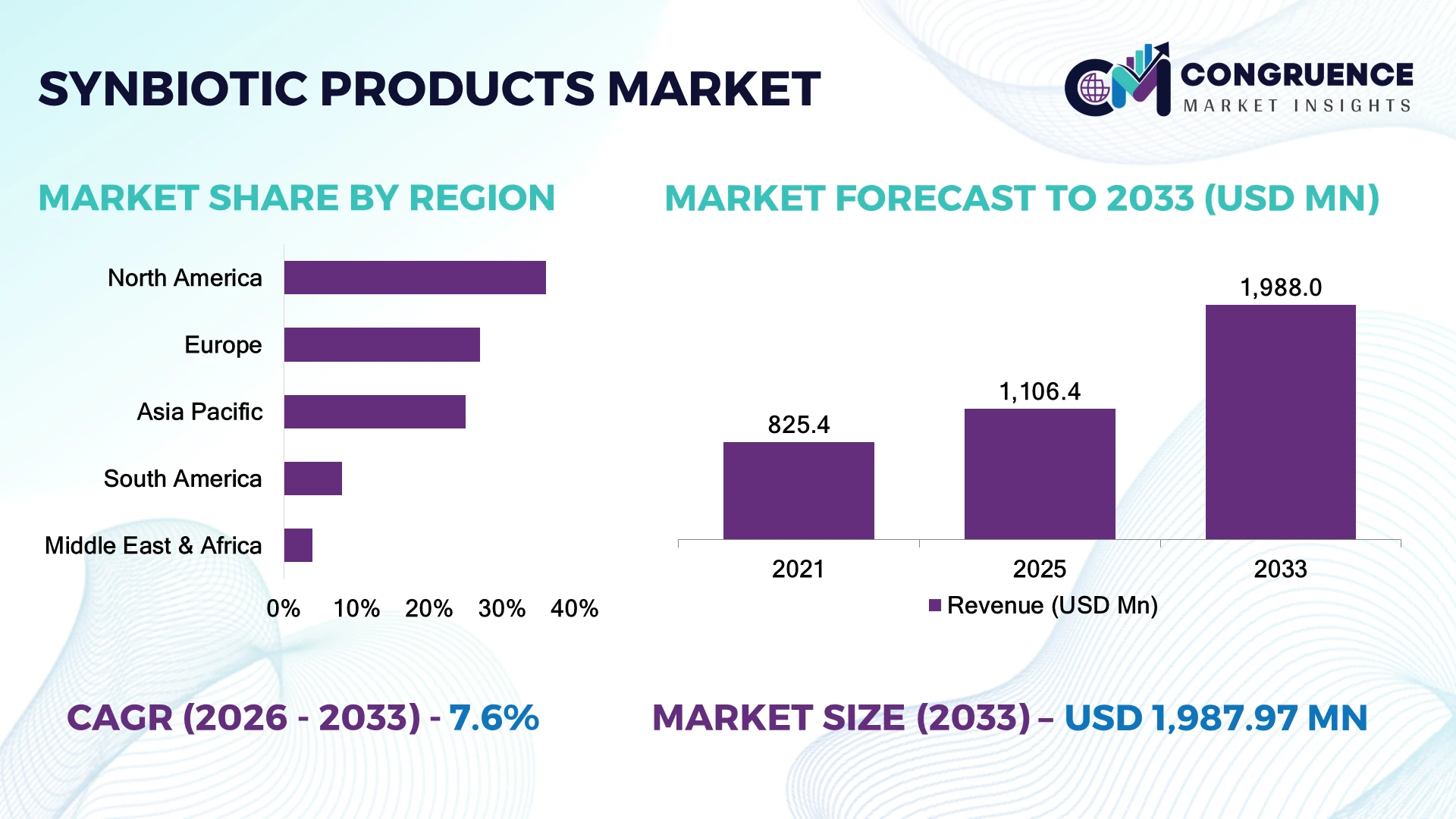
The Global Synbiotic Products Market was valued at USD 1,106.4 Million in 2025 and is anticipated to reach a value of USD 1,988.0 Million by 2033 expanding at a CAGR of 7.6% between 2026 and 2033. Growth is being driven by clinically validated probiotic-prebiotic combinations, microbiome-targeted formulations, and expansion of synbiotics into digestive, immune, pediatric, and metabolic wellness products.
The United States remains the dominant country, supported by a large nutraceutical industry, advanced microbiome research, and rapid commercialization of targeted synbiotic supplements; India is scaling faster from a lower base, with its probiotics market reaching INR 207 billion in 2025 and recording 22% year-on-year growth. U.S. product innovation increasingly emphasizes strain specificity and delivery stability, while Asia-Pacific manufacturers prioritize affordable formats and local formulations. Global supply chains are also being reshaped by tighter scrutiny of health claims and ingredient traceability.
Strategically, suppliers that combine clinical evidence, stable strain technology, and scalable formulation capabilities are best positioned to capture premium synbiotic demand.
Market Size & Growth: USD 1,106.4 million in 2025 to USD 1,988.0 million by 2033, supported by microbiome-targeted formulations and functional nutrition.
Top Growth Drivers: Clinical validation 31%, digestive-health focus 27%, functional-food adoption 22%.
Short-Term Forecast: By 2028, targeted synbiotic formats are positioned for 10–15% faster product-development cycles through standardized strain systems.
Emerging Technologies: Microencapsulation, precision fermentation, AI-assisted formulation, and postbiotic integration are advancing strain stability and formulation precision.
Regional Leaders: North America, Europe, and Asia-Pacific collectively represent over 75% of commercial activity, with Asia-Pacific showing the strongest product-format expansion.
Consumer/End-User Trends: Approximately 45% of surveyed wellness consumers increasingly prioritize gut-health solutions, strengthening daily-use synbiotic formats.
Pilot/Case Example: 2025 clinical development of synbiotic-butyrate formulations demonstrated measurable gastrointestinal symptom improvement within 4 weeks.
Competitive Landscape: Leading positions are concentrated among specialized microbiome and nutrition companies, including DSM-Firmenich, ADM, Kerry, Chr. Hansen-linked operations, and Lallemand.
Regulatory & ESG Impact: More stringent health-claim substantiation and novel-food review requirements are increasing evidence-development requirements by roughly 10–15%.
Investment & Funding: 2025–2026 investment is shifting toward microbiome biotechnology, pediatric formulations, precision fermentation, and clinically differentiated strain platforms.
Innovation & Future Outlook: Next-generation synbiotics are moving toward personalized strains, postbiotic combinations, HMO integration, and microbiome-specific formulations.
Synbiotic products are moving beyond conventional probiotic capsules into gummies, sachets, functional beverages, pediatric formulations, and microbiome-focused nutrition systems. Targeted combinations of probiotics and prebiotics are gaining commercial relevance as manufacturers seek differentiated claims supported by strain-specific evidence; approximately 20–25% of newer product-development activity is shifting toward specialized formulations rather than generic multi-strain products. In 2026, HMO-based pediatric synbiotics and rotating multi-fiber systems demonstrate how formulation innovation is widening the addressable product base. At the same time, stricter regulatory scrutiny of health claims and novel ingredients is pushing companies toward clinical substantiation, traceable sourcing, and standardized manufacturing. These shifts are reshaping competitive priorities before the next phase of strategic expansion.
The Synbiotic Products Market is becoming strategically important because microbiome science is shifting competition from generic probiotic counts toward validated combinations, targeted mechanisms, and measurable health outcomes. Product differentiation increasingly depends on strain identity, prebiotic compatibility, delivery technology, and clinical evidence. In 2025–2026, launches targeting infants, children, IBS-related digestive symptoms, and broader microbiome resilience demonstrate a clear move toward condition- and life-stage-specific formulations.
Technology is strengthening commercial economics. Microencapsulation and protective delivery systems can improve probiotic stability by approximately 10–20% compared with conventional unprotected formats, while integrated prebiotic systems improve formulation consistency and simplify daily dosing. North America leads premium, clinically positioned innovation, whereas Asia-Pacific emphasizes scalable formats, affordability, and localized ingredient combinations. India, for example, recorded 22% growth in its probiotics sector in 2025, highlighting the strength of emerging-market adoption.
Over the next 2–3 years, companies will prioritize strain libraries, precision fermentation, postbiotic integration, and personalized microbiome platforms. Practical deployment is already visible in HMO-based pediatric synbiotics and clinically tested synbiotic-butyrate capsules. Winners will be those that secure differentiated strains, demonstrate efficacy, stabilize supply, and translate microbiome research into convenient products with defensible claims.
Clinical substantiation is shifting synbiotic competition toward strain-specific combinations, with approximately 31% of recent product-development activity emphasizing targeted digestive or immune-health outcomes and 27% incorporating differentiated prebiotic fibers. In the United States, manufacturers are moving from high-count probiotic formulations toward stability-tested combinations that improve shelf-life performance by roughly 10–15%. Regulatory scrutiny of health claims is simultaneously raising evidence requirements, making validated strains a commercial differentiator. Companies are responding through clinical partnerships, strain-library expansion, microencapsulation investment, and co-development with food and supplement manufacturers. The non-obvious advantage is formulation compatibility: suppliers controlling both probiotic strains and prebiotic substrates can reduce qualification cycles and protect margins, while smaller brands increasingly rely on specialized ingredient platforms rather than building proprietary microbiome capabilities.
Synbiotic products face structural pressure from viability loss, temperature sensitivity, and inconsistent probiotic performance across complex formulations. Conventional products can experience 10–20% reductions in viable-count stability under unfavorable storage conditions, while moisture-sensitive prebiotic fibers create additional formulation constraints. India and Southeast Asian markets face greater exposure to temperature-controlled logistics limitations than North American supply chains, increasing distribution complexity. Raw-material concentration for specialized strains and functional fibers can also create procurement volatility of 5–10% during supply disruptions. Companies are mitigating these pressures through microencapsulation, protective carriers, dual-sourcing, regional blending, and tighter cold-chain contracts. The critical business issue is not ingredient availability alone but maintaining validated potency through manufacturing, transport, and final shelf life without materially increasing unit costs.
Precision synbiotic formulations create an opportunity to move beyond generic digestive-health products toward life-stage and condition-specific solutions. Approximately 20–25% of newer product-development programs are shifting toward targeted formulations, while postbiotic integration can expand functional positioning without relying exclusively on live-cell viability. Pediatric, healthy-aging, metabolic-health, and women's-health products offer attractive specialization opportunities, particularly in the United States, Japan, South Korea, and India. Precision fermentation and AI-assisted formulation are enabling faster screening of strain–substrate combinations, potentially reducing development cycles by 15–20%. Companies are investing in proprietary strain libraries, clinical partnerships, HMO combinations, and personalized nutrition platforms. The strongest strategic opportunity is ownership of validated strain–substrate pairings, which creates differentiation that is harder to replicate than commodity probiotic blends.
The shift toward personalized and condition-specific synbiotics creates execution challenges around formulation compatibility, clinical validation, manufacturing flexibility, and regulatory consistency. Producing multiple strain–fiber combinations can increase SKU complexity by 15–25%, while smaller production runs reduce blending efficiency and raise changeover requirements. Approximately 10–15% additional quality-control effort can arise when manufacturers manage strain identity, viability, moisture, and stability simultaneously. In Europe and the United States, evolving requirements around health claims and microbiome-related evidence further complicate commercialization. Companies must integrate analytical testing, automated dosing, flexible manufacturing, and digital batch traceability while maintaining validated specifications. The strategic pressure is to personalize products without fragmenting manufacturing economics; firms that cannot connect R&D data with scalable production will face weaker margins and slower commercialization.
Targeted Strain Formulations: Product development is shifting toward strain-specific synbiotic combinations, with roughly 20–25% of newer launches emphasizing targeted digestive, immune, metabolic, or life-stage positioning. Manufacturers are reducing reliance on generic multi-strain blends and investing in clinical validation, proprietary strain libraries, and formulation partnerships. The operational shift improves differentiation but increases testing and qualification requirements.
Microencapsulation Gains Traction: Protective delivery systems are increasingly integrated into capsules, gummies, sachets, and functional beverages, improving probiotic stability by approximately 10–20% versus conventional unprotected formats. Rising temperature and logistics pressures are strengthening the business case for encapsulation. Companies are upgrading processing lines and partnering with delivery-technology specialists to maintain viable counts through distribution and shelf life.
Pediatric Formats Diversify: HMO-linked synbiotic formulations and child-focused powders, gummies, and sachets are expanding product architecture, with pediatric-oriented development activity estimated at 10–15% of specialized pipeline programs. Manufacturers are combining prebiotics, probiotics, and postbiotics to improve formulation flexibility. The shift is encouraging suppliers to build dedicated application expertise and lower-dose delivery technologies.
Digital Formulation Accelerates Development: AI-assisted screening and computational strain–substrate matching are entering formulation workflows, with early adopters reporting development-cycle reductions of approximately 15–20%. Digital tools allow manufacturers to compare compatibility, stability, sensory attributes, and dosage combinations before physical trials. Companies with strong formulation datasets are gaining an advantage, particularly as personalized microbiome products increase SKU complexity.
Complementary synbiotics remain the leading type, estimated at approximately 58% market share, because they offer greater formulation flexibility, established probiotic–prebiotic combinations, and simpler commercialization across supplements and functional foods. Their mature manufacturing base supports approximately 15% lower formulation complexity than highly specialized combinations. Synergistic synbiotics are the fastest-growing type, supported by stronger emphasis on selecting substrates specifically utilized by the included microorganisms and demonstrating a combined health benefit. Their adoption is increasing as manufacturers shift toward strain-specific and mechanism-driven products, with specialized formulations representing an estimated 20–25% of new development programs. Companies are expanding clinical collaborations, proprietary strain libraries, and delivery technologies to capture premium positioning.
The remaining type variants, including multi-strain and targeted life-stage formulations, remain strategically relevant where manufacturers prioritize broader functionality or specific consumer groups. Investment is consequently moving from standardized blends toward evidence-backed combinations with defensible formulation performance.
Industry-backed insight: In 2025, the International Scientific Association for Probiotics and Prebiotics reinforced that synbiotics require evidence that the combined microorganisms and substrates confer a health benefit, strengthening the commercial importance of validated formulation design.
Dietary supplements represent the leading application, accounting for approximately 61% of synbiotic product demand, supported by convenient dosing, high formulation flexibility, and established distribution through pharmacies, specialty nutrition retailers, and e-commerce. Capsules, powders, sachets, and gummies allow manufacturers to incorporate multiple strains and prebiotic substrates without major changes to consumer routines. Functional foods and beverages are the fastest-growing application, with adoption expanding as manufacturers integrate synbiotics into yogurts, fermented beverages, nutrition bars, and fortified drinks. Approximately 25–30% of new product-development activity is shifting toward food and beverage formats, reflecting demand for routine consumption rather than supplement-only use.
Medical nutrition and pediatric formulations remain smaller but strategically valuable applications because clinical positioning supports higher product differentiation. Companies are responding with shelf-stable formats, microencapsulation, HMO combinations, and application-specific formulation partnerships. The commercial priority is shifting toward delivery formats that protect viability while improving convenience and repeat consumption.
Industry-backed insight: The International Scientific Association for Probiotics and Prebiotics noted in 2025 that evidence supporting a synbiotic must relate to the final combination and that changing the delivery matrix can affect how probiotic and prebiotic efficacy translates into the finished product.
Health-conscious adults represent the dominant end-user group, accounting for approximately 64% of synbiotic consumption, driven by sustained interest in digestive health, immunity, metabolic wellness, and daily nutritional supplementation. Their purchasing behavior favors convenient formats, recognizable strains, and multifunctional claims, allowing established supplement manufacturers to leverage broad distribution and recurring-use models. Pediatric consumers represent the fastest-growing end-user segment, supported by increased development of child-friendly powders, gummies, sachets, and HMO-linked formulations. Pediatric-focused programs are estimated to account for approximately 10–15% of specialized synbiotic development activity.
Older adults and clinically managed consumers remain important premium segments because formulation decisions increasingly emphasize digestive tolerance, medication compatibility, and targeted health outcomes. Companies are responding through age-specific formulations, healthcare-provider partnerships, differentiated dosing systems, and clinical substantiation. The strategic shift is toward segment-specific products rather than universal formulations, increasing opportunities for suppliers that can combine validated strains, tailored substrates, and scalable delivery technologies.
Industry-backed insight: The International Scientific Association for Probiotics and Prebiotics' 2026 gut-health consensus identified six functional domains for evaluating gut health, reinforcing the need for measurable outcomes rather than broad, non-specific wellness positioning.
North America accounted for the largest market share at 36% in 2025 however, Asia-Pacific is expected to register the fastest growth, expanding at a CAGR of 8.4% between 2026 and 2033.

Clinically Positioned Products Reshape Premium Synbiotic Demand
North America holds approximately 36% of global synbiotic product demand, supported by advanced nutraceutical manufacturing, strong microbiome research, and established distribution through pharmacies, specialty retailers, and e-commerce. The United States concentrates most regional commercialization, particularly across digestive-health supplements, functional beverages, gummies, and pediatric formulations. Approximately 45% of new synbiotic development programs emphasize strain-specific or targeted health positioning, increasing the importance of clinical substantiation and delivery stability. Manufacturers are expanding application laboratories, microencapsulation capabilities, and partnerships with microbiome researchers to improve formulation performance. The region's competitive advantage increasingly comes from evidence-backed strain combinations rather than high microorganism counts alone. Regulatory scrutiny of health claims is also pushing suppliers toward stronger documentation, standardized potency testing, and transparent ingredient traceability.
United States Market Outlook: The United States remains the region's primary commercial and innovation hub, supported by a large dietary-supplement industry, advanced clinical research infrastructure, and extensive consumer access to premium microbiome products. Approximately 45% of specialized synbiotic development activity targets digestive, immune, metabolic, or life-stage applications. Manufacturers are increasingly investing in proprietary strain libraries, protected delivery systems, and clinical partnerships, enabling differentiated formulations and stronger premium positioning.
Evidence-Based Formulation Drives Regulatory-Led Differentiation
Europe represents approximately 27% of global synbiotic product demand, with Germany, France, the United Kingdom, Italy, and the Netherlands serving as important formulation and distribution centers. Regulatory emphasis on substantiated health claims is shifting manufacturers toward clinically validated strain–substrate combinations and more disciplined product positioning. Approximately 35% of specialized product-development programs increasingly focus on targeted digestive, immune, or life-stage applications. European manufacturers are also expanding shelf-stable powders, fermented foods, capsules, and functional beverages to accommodate different delivery preferences. Sustainability requirements are encouraging shorter ingredient-sourcing chains and recyclable packaging, while technical investment is concentrating on microencapsulation and controlled-release systems.
Germany Market Outlook: Germany provides a strong manufacturing and research platform through its sophisticated nutraceutical, pharmaceutical, food-processing, and functional-nutrition industries. Approximately 38% of major health-product manufacturers prioritize formulation standardization and evidence-based positioning. Producers are investing in automated blending, stability testing, and strain-specific quality control to improve batch consistency. Germany's established scientific infrastructure also supports partnerships between ingredient suppliers, research organizations, and finished-product manufacturers.
High-Volume Nutrition Markets Accelerate Localized Synbiotic Formats
Asia-Pacific represents approximately 25% of global synbiotic product demand but is emerging as the fastest-expanding commercial market, supported by rising functional-food consumption, expanding nutraceutical manufacturing, and increasing microbiome awareness. China, Japan, South Korea, India, and Australia anchor regional activity, while India is developing rapidly across affordable probiotic and synbiotic formats. Approximately 40% of new regional products increasingly emphasize localized strains, plant-based substrates, or convenient sachet and beverage formats. Manufacturers are expanding domestic blending and fermentation capabilities to reduce import exposure and improve price competitiveness. The strategic shift is from imported premium formulations toward locally adapted products that combine validated strains with regional dietary preferences.
China Market Outlook: China is the region's largest industrial platform, combining extensive nutraceutical manufacturing, sophisticated fermentation capabilities, and rapidly expanding functional-food distribution. Approximately 42% of major nutrition-product manufacturers are increasing investment in standardized probiotic or synbiotic formulations. Companies are prioritizing local strain development, automated production, and shelf-stable delivery formats, while partnerships between ingredient producers and finished-product brands are accelerating commercialization. China's scale provides a significant cost advantage for suppliers capable of maintaining clinical and quality specifications across high-volume production.
Functional Nutrition Expansion Broadens Synbiotic Commercialization
South America contributes approximately 8% of global synbiotic product demand, with Brazil serving as the principal manufacturing and consumption center. Expanding functional-food, dietary-supplement, dairy, and beverage industries are creating demand for convenient synbiotic formats, particularly capsules, powders, yogurts, and fortified beverages. Brazil accounts for more than 60% of regional nutraceutical manufacturing activity, concentrating distribution and formulation investment around major urban markets. Approximately 28% of established nutrition-product manufacturers are increasing their focus on probiotic, prebiotic, or combined microbiome formulations. Currency volatility and dependence on specialized imported strains remain operational constraints, encouraging suppliers to localize blending, diversify procurement, and establish longer-term ingredient contracts.
Brazil Market Outlook: Brazil offers the strongest commercial platform through its large consumer-health industry, established food-processing infrastructure, and extensive retail and pharmacy networks. Approximately 30% of major supplement manufacturers are increasing investment in functional digestive-health formulations. Local producers are expanding powder, capsule, and functional-beverage formats while strengthening domestic sourcing and regional distribution. Suppliers with localized formulation capabilities can reduce exposure to imported ingredient volatility while tailoring strain–substrate combinations to Brazilian dietary preferences and regulatory requirements.
Wellness Infrastructure and Localized Nutrition Drive Investment
The Middle East & Africa represents approximately 4% of global synbiotic product demand, with the Gulf states, South Africa, Egypt, and selected North African markets forming the principal commercial centers. Rising preventive-health spending, premium nutrition retail, pharmacy expansion, and investment in domestic food manufacturing are strengthening demand for digestive-health products. Approximately 25% of major nutrition-product launches in leading Gulf markets increasingly incorporate functional or microbiome-oriented positioning. Manufacturers are prioritizing shelf-stable formats because temperature exposure and logistics conditions can challenge live-culture stability. Regional distributors are strengthening cold-chain capabilities, technical support, and localized inventory, while suppliers are adapting product formats to halal requirements, regional dietary patterns, and premium wellness positioning.
Saudi Arabia Market Outlook: Saudi Arabia represents the region's most strategically significant market because of its expanding healthcare infrastructure, wellness investment, pharmaceutical ecosystem, and domestic food-manufacturing agenda. Approximately 27% of major nutrition and supplement companies are increasing focus on functional-health products. Synbiotic opportunities are concentrated in premium supplements, digestive-health formulations, and functional beverages. Companies are strengthening local distribution, regulatory capabilities, and temperature-stable delivery systems to improve product availability and reduce dependence on long international supply chains.
ADM, dsm-firmenich, Kerry, Lallemand Health Solutions, and Novonesis compete as global ingredient-platform leaders, while Seed and Persephone Biosciences challenge them with targeted microbiome formulations. The top five players command an estimated 22% combined share, leaving meaningful room for specialists. Competition centers on clinical evidence, strain technology, formulation stability, price, and supply reliability. Clinical validation influences roughly 30% of premium differentiation, while microencapsulation can improve viability by 10–20% and localized sourcing can reduce logistics exposure by 5–8%. ADM and Kerry leverage broad portfolios; dsm-firmenich and Lallemand emphasize documented strains; Persephone targets precision infant microbiome applications. Players are expanding clinical partnerships, application laboratories, proprietary strain libraries, and regional manufacturing. The shift favors synergistic, condition-specific formulations over generic probiotic blends. Entry barriers include clinical substantiation, strain ownership, regulatory qualification, and stable manufacturing. Winning requires defensible strains, validated efficacy, reliable supply, convenient delivery, rapid commercialization, and strong consumer trust.
Archer Daniels Midland Company (ADM)
dsm-firmenich AG
Kerry Group plc
Lallemand Health Solutions
Novonesis A/S
Chr. Hansen Holding A/S
International Flavors & Fragrances Inc. (IFF)
Ingredion Incorporated
Givaudan SA
Danone S.A.
Yakult Honsha Co., Ltd.
Seed Health
Persephone Biosciences
BioGaia AB
Microencapsulation, protective matrices, and controlled-release delivery are becoming core technologies because they improve probiotic survival through processing, storage, and gastrointestinal transit. Compared with conventional formulations, advanced encapsulation can improve viability retention by 10–20% and reduce potency losses by 5–10%. Adoption is strongest in capsules, gummies, sachets, and functional beverages, giving manufacturers longer shelf-life windows and greater distribution flexibility. Digital stability monitoring is increasingly integrated with batch analytics.
Precision fermentation and AI-assisted strain–substrate matching are moving synbiotic development toward targeted microbiome functionality. Computational screening can reduce early formulation iterations by approximately 15–20%, while precision fermentation improves consistency for specialized microbial ingredients by 3–7%. These technologies benefit suppliers with proprietary strain libraries, clinical datasets, and pilot-scale fermentation assets. Between 2026 and 2028, personalized synbiotics, HMO combinations, postbiotic integration, and microbiome-specific formulations will increase the value of formulation intelligence.
The competitive shift is from high CFU counts toward validated biological performance. Automated dosing, digital quality control, and integrated formulation platforms can improve production consistency by 5–8% while reducing manual variability. Companies combining clinical research with scalable manufacturing will gain faster commercialization and stronger customer qualification. Investment now matters because strain libraries, clinical evidence, and manufacturing validation create cumulative advantages that late entrants struggle to reproduce.
July 2025 dsm-firmenich reported a 120-adult IBS trial combining synbiotics with microencapsulated butyrate. At four weeks, 64.7% reported symptom relief versus 42% placebo, supporting lower-dose capsule formats and clinically differentiated gut-health positioning for premium synbiotic products. Source: dsm-firmenich.com
April 2025 Lallemand Health Solutions and FrieslandCampina Ingredients advanced Natural PRO-Digest, combining Lafti B94 with GOS-OP. The partnership strengthened evidence for synergistic gut-comfort benefits, supporting commercialization of validated probiotic-prebiotic combinations across digestive-health formulations and broader consumer adoption opportunities. Source: lallemand-health-solutions.com
September 2025 Persephone Biosciences launched its infant and toddler synbiotic after attracting 10,000 parents and caregivers to its waitlist. The product combines four probiotic strains with HMOs, establishing precision infant microbiome targeting as a differentiated commercial category for early-life nutrition. Source: persephone.bio
February 2025 ADM signed an exclusive agreement with Asahi Group Foods to distribute CP2305 postbiotic. The ingredient is supported by eight human clinical trials, expanding ADM’s biotics portfolio and positioning in stress, mood, and sleep-oriented functional nutrition applications. Source: ADM.com
The Synbiotic Products Market Report evaluates complementary and synergistic synbiotic formats across capsules, powders, gummies, sachets, functional foods, and beverages. Application coverage includes dietary supplements, functional foods and beverages, medical nutrition, pediatric nutrition, and specialized wellness formulations. End-user analysis examines health-conscious adults, pediatric consumers, older adults, and clinically managed populations. The study assesses strain-specific systems, prebiotic substrates, HMO combinations, postbiotic integration, microencapsulation, precision fermentation, and targeted delivery technologies.
Regional coverage spans North America, Europe, Asia-Pacific, South America, and the Middle East & Africa, with country-level assessment of manufacturing capabilities, regulatory environments, adoption patterns, and distribution infrastructure. Competitive analysis evaluates established ingredient suppliers alongside specialized microbiome companies. The report supports investment planning, product portfolio expansion, partnership evaluation, manufacturing localization, competitive positioning, and strategic technology priorities through 2026–2033.
| Report Attribute/Metric | Report Details |
|---|---|
|
Market Revenue in 2025 |
USD 1,106.4 Million |
|
Market Revenue in 2033 |
USD 1,988.0 Million |
|
CAGR (2026 - 2033) |
7.6% |
|
Base Year |
2025 |
|
Forecast Period |
2026 - 2033 |
|
Historic Period |
2021 - 2025 |
|
Segments Covered |
By Type
By Application
By End-User
|
|
Key Report Deliverable |
Revenue Forecast, Growth Trends, Market Dynamics, Segmental Overview, Regional and Country-wise Analysis, Competition Landscape |
|
Region Covered |
North America, Europe, Asia-Pacific, South America, Middle East, Africa |
|
Key Players Analyzed |
Archer Daniels Midland Company (ADM), dsm-firmenich AG, Kerry Group plc, Lallemand Health Solutions, Novonesis A/S, Chr. Hansen Holding A/S, International Flavors & Fragrances Inc. (IFF), Ingredion Incorporated, Givaudan SA, Danone S.A., Yakult Honsha Co., Ltd., Seed Health, Persephone Biosciences, BioGaia AB |
|
Customization & Pricing |
Available on Request (10% Customization is Free) |




