
Reports
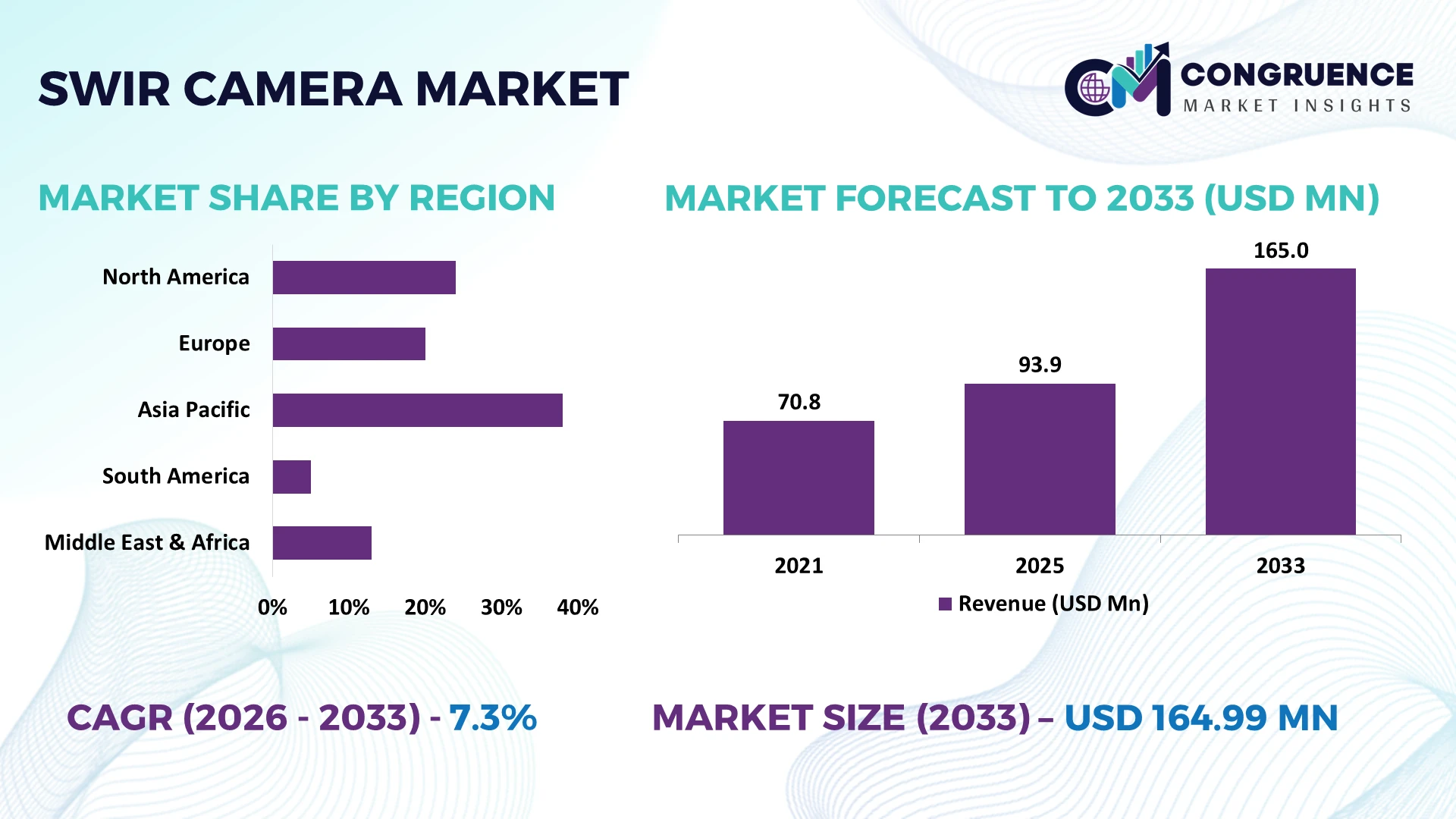
The Global SWIR Camera Market was valued at USD 93.9 Million in 2025 and is anticipated to reach a value of USD 164.99 Million by 2033 expanding at a CAGR of 7.3% between 2026 and 2033. Growth is supported by rising deployment of SWIR imaging in semiconductor wafer inspection, industrial automation, defense surveillance, and precision quality control requiring high-sensitivity imaging beyond the visible spectrum.
The United States leads the global SWIR camera market with approximately 34% share, supported by sustained defense modernization, semiconductor manufacturing, and photonics investments exceeding USD 8 billion under advanced manufacturing initiatives. Japan follows with nearly 18% market participation, driven by industrial robotics and electronics inspection, while South Korea records over 20% annual expansion in advanced chip fabrication capacity, accelerating SWIR imaging adoption. Ongoing semiconductor supply-chain realignment after U.S.-China technology restrictions further strengthens regional investment priorities.
Manufacturers expanding production capacity and aligning with advanced semiconductor and defense ecosystems are positioned to secure long-term competitive advantage.
Market Size & Growth: USD 93.9 Million in 2025, reaching USD 164.99 Million by 2033 at 7.3% CAGR, driven by expanding semiconductor inspection and defense imaging applications.
Top Growth Drivers: Semiconductor inspection contributes nearly 31% demand growth, defense modernization 24%, and industrial automation adoption rises by 19% globally.
Short-Term Forecast: By 2028, automated SWIR inspection systems improve defect detection efficiency by 27% while reducing inspection time by 18%.
Emerging Technologies: AI-enabled image analytics, InGaAs sensor enhancements, and edge-based machine vision improve imaging accuracy by over 25% across advanced manufacturing.
Regional Leaders: North America approaches USD 59 Million, Asia Pacific exceeds USD 54 Million, and Europe reaches nearly USD 36 Million by 2033, supported by regional semiconductor expansion and industrial digitalization.
Consumer/End-User Trends: More than 46% of new semiconductor inspection systems integrate SWIR imaging for higher precision and faster defect identification.
Pilot/Case Example: In 2026, advanced electronics manufacturing facilities achieved approximately 22% higher inspection throughput after deploying AI-assisted SWIR camera platforms.
Competitive Landscape: The top five manufacturers collectively control around 48% market share, led by Teledyne FLIR, Hamamatsu Photonics, Allied Vision, Xenics, and Raptor Photonics.
Regulatory & ESG Impact: Energy-efficient imaging platforms reduce inspection system power consumption by nearly 15%, supporting industrial sustainability targets and manufacturing compliance.
Investment & Funding: More than USD 1.2 billion has been directed toward photonics, semiconductor imaging, and production expansion through strategic partnerships amid global supply-chain diversification.
Innovation & Future Outlook: Next-generation compact SWIR sensors, AI-integrated vision systems, and multispectral imaging accelerate high-growth adoption across aerospace, defense, healthcare, and automated manufacturing.
Growing demand for SWIR cameras is centered on semiconductor inspection, defense intelligence, machine vision, and precision agricultural monitoring where image clarity beyond visible wavelengths improves operational accuracy. AI-enhanced imaging and compact InGaAs sensor innovation have increased automated inspection performance by nearly 25%. Continued semiconductor supply-chain diversification and advanced manufacturing investments are strengthening commercialization, setting the foundation for the strategic market assessment that follows.
The SWIR Camera Market has become strategically important as governments and manufacturers prioritize resilient semiconductor production, defense surveillance, and automated quality inspection. Ongoing semiconductor supply-chain restructuring and advanced manufacturing initiatives are accelerating investments in high-performance imaging systems that improve process reliability. Industrial users increasingly favor SWIR imaging for applications where visible-light cameras cannot detect hidden defects, contaminants, or material variations, creating a measurable competitive advantage across electronics, aerospace, and life sciences.
Compared with conventional visible-spectrum cameras, advanced SWIR systems improve hidden-defect detection accuracy by nearly 30% while reducing false inspection results by approximately 20% in automated production environments. The United States maintains leadership through defense and semiconductor investments, whereas Japan strengthens deployment through precision manufacturing and robotics integration. During the next two to three years, AI-enabled machine vision is expected to exceed 45% deployment across newly installed high-end industrial inspection systems, improving production consistency and reducing manual verification.
A practical example is semiconductor wafer inspection, where SWIR imaging identifies micro-cracks before packaging, reducing production losses and strengthening yield management. Companies are expanding InGaAs sensor manufacturing, establishing technology partnerships, and investing in AI-enabled imaging software to strengthen product differentiation. Organizations that combine advanced sensing, localized production, and intelligent analytics will secure stronger competitive positioning and long-term operational resilience.
The rapid expansion of semiconductor fabrication and industrial automation is strengthening demand for high-performance SWIR imaging solutions. Nearly 32% of advanced wafer inspection lines now incorporate SWIR-based vision systems, while automated quality inspection improves defect identification rates by around 28%. The United States continues expanding domestic semiconductor manufacturing under strategic industrial policies, increasing demand for precision optical inspection equipment. This structural shift improves production efficiency while reducing material waste and costly downstream failures. In response, leading manufacturers are increasing InGaAs sensor production, forming partnerships with AI software providers, and expanding application-specific imaging portfolios. Companies integrating machine vision with intelligent analytics are securing stronger long-term contracts and improving manufacturing productivity across electronics and aerospace sectors.
Premium InGaAs sensors remain a major structural limitation because they account for nearly 40% of total SWIR camera production costs, while specialized optical components add another 15–20% to manufacturing expenses. Dependence on a limited number of advanced sensor suppliers, particularly in Japan and the United States, creates procurement uncertainty during periods of semiconductor supply imbalance. These constraints reduce pricing flexibility, delay product deliveries, and limit adoption among cost-sensitive industrial users. To reduce exposure, manufacturers are diversifying supplier networks, expanding localized assembly operations, and securing multi-year procurement agreements. Several companies are also developing alternative sensor architectures to improve cost competitiveness without compromising industrial imaging performance.
The integration of AI-driven image analytics with SWIR cameras is unlocking new commercial opportunities across battery inspection, recycling, pharmaceutical production, and precision agriculture. Automated image interpretation improves inspection efficiency by approximately 25%, while predictive quality control reduces manufacturing downtime by nearly 18%. South Korea is accelerating smart factory deployment through advanced semiconductor and electronics investments, creating new demand for intelligent optical inspection platforms. Companies are increasing R&D spending, collaborating with robotics developers, and expanding software ecosystems that combine edge computing with multispectral imaging. A non-obvious opportunity lies in circular manufacturing, where SWIR technology improves automated material sorting and resource recovery, strengthening both operational efficiency and industrial sustainability.
The principal long-term challenge is integrating SWIR imaging into highly automated production environments while maintaining consistent system performance across multiple facilities. More than 35% of industrial deployments require extensive calibration and software customization before full-scale implementation, and integration timelines frequently extend by 20% when legacy automation platforms are involved. Germany's advanced manufacturing sector illustrates the complexity of combining intelligent vision systems with existing industrial infrastructure and cybersecurity requirements. These implementation barriers affect deployment consistency, workforce productivity, and long-term competitiveness. Companies must invest in standardized software architectures, workforce training, cybersecurity frameworks, and strategic technology partnerships to achieve scalable, interoperable, and future-ready industrial imaging ecosystems.
AI-Driven Vision Integration Advanced AI image processing is now integrated into nearly 44% of newly deployed SWIR inspection platforms, reducing defect classification time by approximately 30% and manual verification by 22%. Electronics manufacturers in South Korea and the United States are embedding edge-based analytics directly into imaging workflows as labor shortages and stricter quality requirements reshape production. Vendors are expanding AI software partnerships and offering integrated hardware-software platforms to shorten deployment cycles and improve operational consistency.
Localized Sensor Manufacturing Expansion Supply-chain diversification has accelerated localized assembly and sensor packaging, with more than 35% of manufacturers increasing regional production capabilities since 2025. Export control measures and semiconductor procurement pressures are encouraging companies to reduce dependency on single-source components. This restructuring lowers procurement risk, improves delivery reliability by nearly 18%, and drives strategic investments in domestic manufacturing partnerships and component qualification programs.
Compact High-Performance Camera Designs Miniaturized SWIR camera architectures have reduced system footprint by nearly 28% while improving thermal efficiency by approximately 15%. Industrial robotics, UAV inspection, and portable diagnostic equipment increasingly require compact imaging modules without compromising sensitivity. Manufacturers are redesigning optical assemblies, adopting lightweight materials, and scaling modular product platforms that accelerate customization while lowering installation complexity across multiple industrial environments.
Multispectral Inspection Deployment More than 40% of advanced semiconductor and precision manufacturing facilities are evaluating multispectral imaging that combines SWIR with visible-spectrum sensing for higher inspection accuracy. The approach improves material differentiation by nearly 25% while reducing secondary inspection steps. Companies are restructuring product portfolios, expanding optical integration capabilities, and collaborating with automation providers to deliver unified machine vision systems that improve throughput and reduce production bottlenecks.
Cooled SWIR cameras account for approximately 47% of market demand because of their superior sensitivity, low-noise performance, and reliability in defense, semiconductor inspection, and scientific imaging. Their ability to detect minute thermal and material variations supports mission-critical operations where imaging precision directly affects production quality or operational success. Area Scan systems remain widely deployed across industrial automation because they provide flexible integration into existing machine vision platforms, while Uncooled cameras continue expanding in cost-sensitive commercial applications requiring simplified deployment.
Uncooled SWIR cameras represent the fastest-growing type as manufacturing improvements reduce component costs and improve imaging performance. Adoption has increased by nearly 24% across industrial inspection projects seeking lower ownership costs without sacrificing operational capability. Line Scan cameras maintain strategic relevance in continuous production environments such as electronics and material inspection, improving inspection throughput by approximately 20%. Manufacturers are expanding compact product portfolios, strengthening sensor partnerships, and investing in modular optical platforms to address both premium and volume-oriented applications.
Area Scan applications hold approximately 45% of total deployment due to broad use across electronics inspection, industrial automation, defense surveillance, and laboratory imaging. Their compatibility with robotic inspection systems and AI-enabled vision software supports flexible deployment across diverse production environments. Line Scan applications remain indispensable in high-speed manufacturing, particularly for continuous web inspection and semiconductor production where uninterrupted image acquisition improves quality assurance and process consistency.
Line Scan represents the fastest-expanding application segment as advanced semiconductor fabrication and battery manufacturing require continuous high-resolution inspection. Adoption has increased by nearly 23% among automated production facilities implementing inline quality control. Demand for Area Scan continues to strengthen through AI integration and higher automation intensity, while specialized cooled and uncooled imaging applications evolve to support portable inspection and scientific research. Companies are scaling production, integrating machine vision software, and collaborating with automation providers to strengthen deployment across industrial ecosystems.
The Semiconductor sector represents approximately 38% of total SWIR camera demand, supported by advanced wafer inspection, defect analysis, and process monitoring requirements. High imaging sensitivity and precision directly improve production yield, making SWIR systems a strategic investment for chip manufacturers. Industrial users maintain substantial deployment through automated inspection and quality assurance, while Aerospace & Defense continues investing in surveillance, navigation, and intelligence applications requiring reliable imaging under challenging operating conditions.
Semiconductor remains the fastest-growing end-user segment as fabrication facilities expand advanced process nodes and automate inspection workflows. Deployment of intelligent imaging systems has increased by nearly 27% in newly commissioned production lines. Healthcare and Research Institutes continue adopting SWIR technology for biomedical imaging and spectroscopy, expanding specialized applications. Manufacturers are responding through customized product development, strategic technology alliances, and application-focused solution portfolios that strengthen long-term customer relationships and improve competitive differentiation across multiple end-user industries.
North America accounted for the largest market share at 37% in 2025 however, Asia-Pacific is expected to register the fastest growth, expanding at a 8.6% CAGR between 2026 and 2033.

Advanced Semiconductor and Defense Imaging Leadership
North America maintains the leading position through its strong semiconductor manufacturing base, defense modernization programs, and advanced industrial automation ecosystem. The region contributes approximately 37% of global deployment, supported by extensive adoption across wafer inspection, aerospace surveillance, and machine vision applications. More than 45% of newly commissioned high-end semiconductor inspection systems incorporate SWIR imaging, improving manufacturing precision and reducing defect-related losses. Continued investments in domestic chip production and photonics innovation strengthen demand for advanced imaging platforms. Technology vendors are expanding localized sensor manufacturing, increasing AI integration, and forming strategic partnerships with automation companies to improve deployment efficiency and product differentiation. The combination of research capabilities, industrial infrastructure, and defense procurement continues to reinforce North America's leadership in high-performance SWIR imaging.
United States Market Outlook: The United States remains the region's largest market due to its leadership in semiconductor fabrication, aerospace programs, and defense technology. Advanced manufacturing initiatives continue expanding domestic production capacity, while defense agencies prioritize next-generation electro-optical surveillance systems. Approximately 48% of high-end semiconductor inspection investments are concentrated within the country, encouraging manufacturers to establish engineering centers, expand photonics production, and strengthen AI-based imaging partnerships for industrial and government applications.
Industrial Modernization Through Precision Manufacturing
Europe continues strengthening its SWIR camera market through industrial automation, precision engineering, and advanced optical inspection across automotive, aerospace, and research applications. The region represents approximately 26% of global deployment, supported by expanding smart manufacturing initiatives and increasing investments in digital factory modernization. More than 32% of industrial vision upgrades involve advanced imaging technologies that improve inspection consistency and reduce production waste. Companies increasingly integrate SWIR imaging into automated production lines to support stricter quality standards and energy-efficient manufacturing. Strategic collaboration between photonics developers, automation providers, and industrial equipment manufacturers is accelerating commercialization of next-generation machine vision systems while enhancing regional supply resilience.
Germany Market Outlook: Germany leads the European market through its advanced manufacturing infrastructure, globally recognized automation sector, and strong industrial robotics deployment. Nearly 35% of the country's large-scale electronics manufacturers have expanded intelligent optical inspection capabilities within automated production environments. Companies continue investing in precision imaging, AI-enabled inspection software, and engineering partnerships that strengthen manufacturing competitiveness and support high-value industrial exports.
Manufacturing Scale Accelerates Technology Deployment
Asia-Pacific represents the fastest-expanding SWIR camera market, driven by large-scale semiconductor production, electronics manufacturing, and industrial automation investments. The region accounts for nearly 33% of global deployment, supported by expanding fabrication facilities and strong export-oriented manufacturing capacity. Semiconductor production investments have increased by more than 25% across several manufacturing hubs, strengthening demand for advanced inspection technologies. Electronics manufacturers continue integrating AI-enabled SWIR systems into automated production lines to improve quality assurance and operational efficiency. Camera manufacturers are expanding assembly operations, strengthening sensor supply partnerships, and increasing localized production to improve delivery reliability and reduce procurement risks.
China Market Outlook: China remains the region's largest operational market due to extensive electronics manufacturing, semiconductor investments, and industrial automation deployment. More than 40% of newly installed intelligent production facilities incorporate advanced machine vision systems supporting defect inspection and quality control. Domestic manufacturers continue expanding optical component production while strengthening research collaborations to improve technology independence and accelerate commercial deployment across industrial sectors.
Industrial Digitization Supports Emerging Demand
South America is steadily expanding SWIR camera adoption through mining automation, industrial quality inspection, agricultural monitoring, and infrastructure modernization. The region contributes approximately 5% of global demand, with deployment concentrated in large industrial operations seeking improved operational visibility and production efficiency. Automation investments have increased by nearly 16% across major manufacturing facilities, encouraging greater adoption of advanced imaging technologies. Infrastructure limitations and dependence on imported optical components continue affecting deployment speed, yet companies are strengthening distributor networks and forming technical partnerships to improve implementation capabilities. Industrial users increasingly prioritize imaging systems capable of supporting predictive maintenance and process optimization.
Brazil Market Outlook: Brazil leads regional adoption through its diversified manufacturing base, mining operations, and expanding industrial automation investments. Approximately 60% of South America's advanced manufacturing projects are concentrated within the country, creating sustained demand for intelligent inspection technologies. Companies continue expanding local integration services and application engineering capabilities to improve deployment efficiency across mining, food processing, and industrial production environments.
Infrastructure Modernization Drives Specialized Deployment
The Middle East & Africa market is developing through investments in defense modernization, energy infrastructure, industrial inspection, and smart city initiatives. The region accounts for roughly 4% of global deployment, with demand supported by critical infrastructure monitoring and security applications. More than 18% of newly implemented industrial surveillance projects now incorporate advanced optical imaging technologies capable of operating under challenging environmental conditions. Governments and enterprises continue investing in digital infrastructure while technology providers establish regional partnerships to strengthen deployment support and technical services. Infrastructure modernization programs are creating specialized opportunities for advanced imaging solutions across multiple strategic sectors.
Saudi Arabia Market Outlook: Saudi Arabia leads regional market development through large-scale industrial diversification, defense modernization, and infrastructure expansion initiatives. Industrial investment programs continue accelerating deployment of intelligent inspection and surveillance technologies across energy, manufacturing, and transportation sectors. Approximately 22% of new industrial digitalization projects integrate advanced optical monitoring solutions, encouraging global technology suppliers to expand regional partnerships, technical support capabilities, and localized solution development.
The market is led by Teledyne FLIR, Hamamatsu Photonics, Xenics, Allied Vision, and Raptor Photonics, competing directly with emerging sensor specialists and machine vision innovators for high-value industrial, semiconductor, and defense contracts. The top five companies collectively control approximately 48% of global market share through proprietary sensor technology, application-specific imaging platforms, and established customer networks. Competition centers on imaging sensitivity, AI-enabled processing, product customization, and supply-chain reliability rather than pricing alone. Advanced imaging platforms improve inspection accuracy by nearly 25%, while localized manufacturing reduces delivery lead times by approximately 18%, creating measurable operational advantages. Companies are expanding production capacity, strengthening semiconductor partnerships, pursuing vertical integration, and accelerating software-driven product differentiation. Technology transition toward compact AI-integrated SWIR systems is reshaping competitive positioning and increasing pressure on suppliers lacking advanced sensor capabilities. Success increasingly depends on integrated hardware, intelligent software, resilient component sourcing, and rapid customer-specific engineering execution.
Teledyne FLIR
Hamamatsu Photonics
Xenics
Allied Vision Technologies
Raptor Photonics
New Imaging Technologies (NIT)
Princeton Infrared Technologies
Leonardo DRS
Sofradir
Sensors Unlimited
SWIR Vision Systems
Photon etc.
InfraTec GmbH
TriEye Ltd.
Advanced InGaAs sensor technology remains the foundation of the SWIR camera market, supporting semiconductor inspection, defense surveillance, and industrial machine vision. More than 58% of newly deployed high-performance SWIR systems now integrate AI-assisted image processing, improving defect detection accuracy by approximately 24% while reducing inspection time by 18%. Edge computing integration is accelerating real-time decision-making, allowing manufacturers to minimize production interruptions and improve throughput across automated facilities.
Emerging technologies are shifting toward hyperspectral SWIR imaging, compact uncooled sensors, and AI-enabled multispectral fusion. Compared with conventional visible-spectrum cameras, modern SWIR platforms improve hidden-defect identification by nearly 30% while lowering false inspection rates by about 20%. Around 42% of advanced semiconductor inspection lines are deploying integrated SWIR machine vision solutions that combine robotics, cloud analytics, and predictive maintenance. These technologies strengthen production consistency while reducing manual intervention and operational costs.
Disruptive innovation between 2026 and 2028 will focus on silicon-compatible SWIR sensors, photonic integration, and software-defined imaging platforms that simplify deployment while improving scalability. Companies investing in vertically integrated sensor production and AI-enabled analytics gain faster product qualification, stronger supply resilience, and higher customer retention than hardware-only competitors. Early adopters across semiconductor fabrication, aerospace, and precision manufacturing will secure operational advantages through faster inspection workflows, improved material discrimination, and lower lifecycle integration costs.
January 2026 Teledyne Judson Technologies introduced the SCION VIS–SWIR camera family featuring 10 µm pixel pitch with 640×512 and 1280×1024 formats, expanding high-volume imaging for semiconductor, hyperspectral, and defense applications. Business impact: broader deployment flexibility and lower integration complexity.
May 2026 Teledyne DALSA launched the Kaleido SWIR hyperspectral camera delivering line rates above 2.3 kHz and 1,280-pixel spatial resolution for industrial sorting, recycling, food inspection, and pharmaceuticals. Business impact: significantly higher inspection throughput and improved material discrimination. Source: teledynevisionsolutions.com
May 2026 Hamamatsu Photonics released upgraded compact SWIR MEMS-FPI spectroscopy modules with improved signal-to-noise performance and enhanced stray-light suppression for portable material analysis. Business impact: improved measurement stability while reducing integration complexity for embedded industrial systems.
February 2026 Hamamatsu Photonics introduced new high-dynamic-range 2D InGaAs area image sensors for near-infrared hyperspectral imaging, strengthening precision imaging across industrial and scientific applications. Business impact: enhanced imaging performance for advanced inspection and spectroscopy workflows. Source: hamamatsu.com
This report delivers a comprehensive assessment of the global SWIR Camera Market across technology evolution, competitive positioning, operational deployment, and industry-specific demand patterns. It evaluates four major product categories—Cooled, Uncooled, Line Scan, and Area Scan—covering deployment trends across semiconductor inspection, industrial automation, aerospace, healthcare, and research institutions. More than 60% of current demand is concentrated in precision manufacturing and advanced imaging applications, while AI-enabled inspection and multispectral imaging continue expanding commercial adoption.
The analysis covers North America, Europe, Asia-Pacific, South America, and the Middle East & Africa, highlighting country-level manufacturing strength, deployment intensity, technology investments, and enterprise expansion strategies. It examines product innovation, sensor integration, machine vision, hyperspectral imaging, and AI-assisted analytics alongside competitive benchmarking of major market participants. The report supports investment planning, market entry, partnership evaluation, product positioning, and long-term strategic decision-making by identifying operational trends, emerging application areas, and competitive priorities expected to shape market development between 2026 and 2033.
| Report Attribute/Metric | Report Details |
|---|---|
Market Revenue in 2025 | USD 93.9 Million |
Market Revenue in 2033 | USD 164.99 Million |
CAGR (2026 - 2033) | 7.3% |
Base Year | 2025 |
Forecast Period | 2026 - 2033 |
Historic Period | 2021 - 2025 |
Segments Covered | By Type
By Application
By End-User
|
Key Report Deliverable | Revenue Forecast, Growth Trends, Market Dynamics, Segmental Overview, Regional and Country-wise Analysis, Competition Landscape |
Region Covered | North America, Europe, Asia-Pacific, South America, Middle East, Africa |
Key Players Analyzed | Teledyne FLIR, Hamamatsu Photonics, Xenics, Allied Vision Technologies, Raptor Photonics, New Imaging Technologies (NIT), Princeton Infrared Technologies, Leonardo DRS, Sofradir, Sensors Unlimited, SWIR Vision Systems, Photon etc., InfraTec GmbH, TriEye Ltd. |
Customization & Pricing | Available on Request (10% Customization is Free) |




