
Reports
The Global Sustainable Marine Fuels Market was valued at USD 21600 Million in 2025 and is anticipated to reach a value of USD 62485.97 Million by 2033 expanding at a CAGR of 14.2% between 2026 and 2033. FuelEU Maritime compliance, EU ETS exposure, expanding dual-fuel fleets, and commercial-scale biofuel, biomethane, methanol, and ammonia bunkering infrastructure are accelerating the transition from conventional marine fuels.
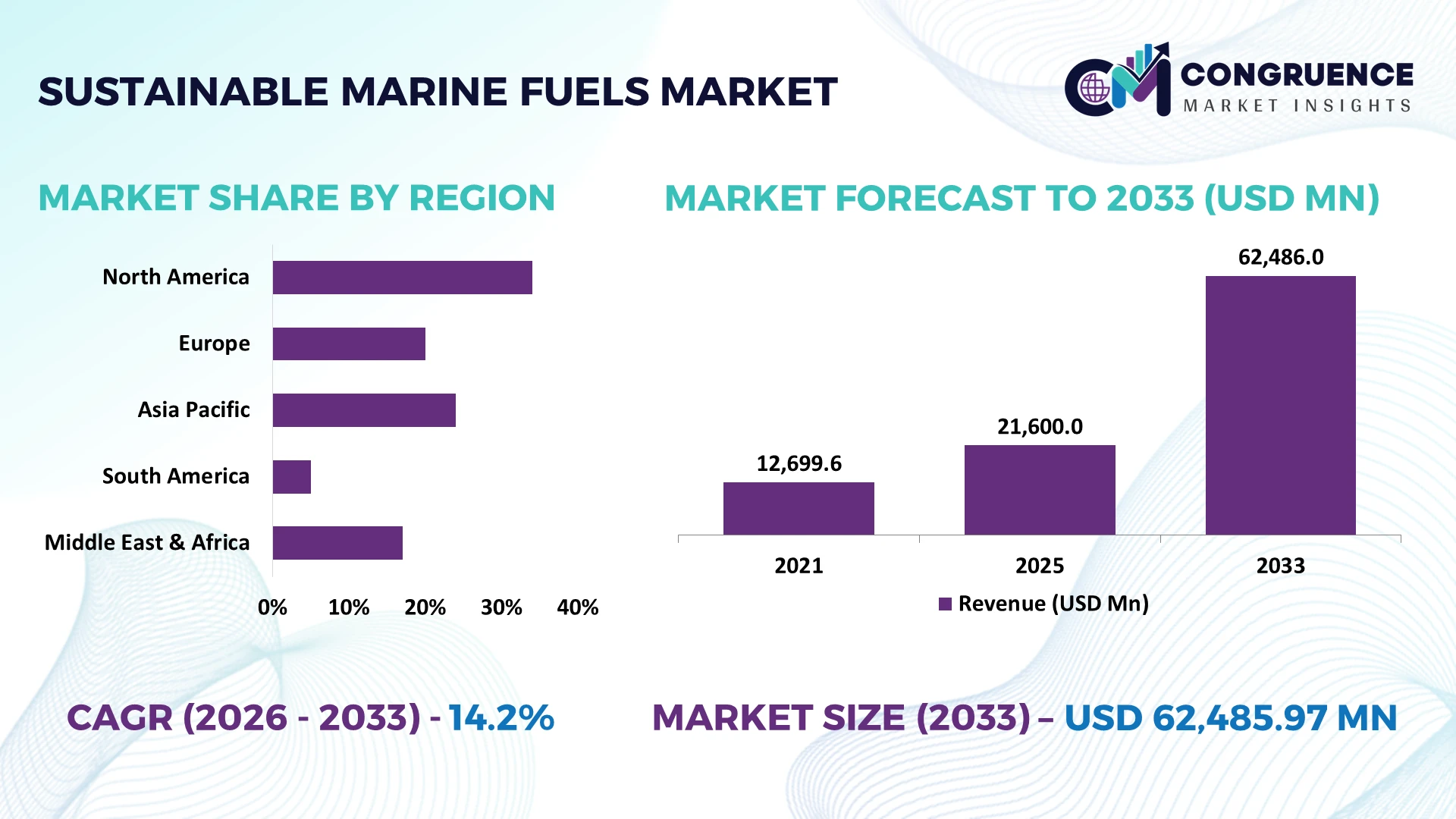
Singapore maintains global bunkering leadership, supplying more than one-sixth of marine fuel used by global shipping. Total bunker sales reached 56.77 million tonnes in 2025, while alternative marine fuels increased to 1.95 million tonnes from 1.35 million tonnes in 2024, a rise of approximately 44%. Biofuel blends and LNG are gaining commercial traction alongside emerging methanol infrastructure. Rotterdam provides a strong European comparison: biomethanol bunkering increased from 3,946 tonnes in 2024 to 11,819 tonnes in 2025, while bio-LNG reached 17,644 m³. Meanwhile, Red Sea disruptions extended Asia-Europe voyages around the Cape of Good Hope, reinforcing fuel-security considerations alongside decarbonization. FuelEU Maritime requires a 2% GHG-intensity reduction from 2025, rising to 6% by 2030.
Strategically, fuel producers, shipowners, and bunker operators securing certified low-carbon supply, dual-fuel capability, and positions at major Asia-Europe bunkering hubs will capture the strongest advantage as sustainable marine fuels transition toward scaled commercial procurement.
Market Size & Growth: USD 21.6 billion in 2025 is projected to reach USD 62.49 billion by 2033 at 14.2% CAGR, supported by fleet decarbonization and alternative-fuel bunkering expansion.
Top Growth Drivers: Alternative-fuel uptake increased approximately 44% in Singapore during 2025, biofuel-blend sales exceeded 54% growth, and LNG marine-fuel sales increased approximately 24%.
Short-Term Forecast: By 2030, FuelEU Maritime requires a 6% reduction in onboard energy GHG intensity versus the regulatory reference, materially strengthening low-carbon fuel procurement requirements.
Emerging Technologies: Green methanol, biomethane, renewable diesel, advanced biofuels, and green ammonia are reshaping propulsion strategies, while digital carbon accounting improves lifecycle-emission verification across increasingly complex fuel supply chains.
Regional Leaders: Asia-Pacific leads through Singapore's 56.77-million-tonne bunkering ecosystem; Europe advances through Rotterdam's 9.8-million-tonne bunker market, while North America is expanding renewable-fuel production and port decarbonization infrastructure.
End-User Trends: Singapore alternative marine-fuel consumption reached 1.95 million tonnes in 2025, demonstrating that container carriers, tanker operators, and major cargo owners are moving sustainable fuels into regular procurement.
Pilot/Case Example: In 2025, Rotterdam completed its first ship-to-ship ammonia transfer, while Singapore permitted licensed conventional bunker tankers to supply biofuel blends up to B30 without separate approval.
Competitive Landscape: Singapore supplies more than one-sixth of fuel consumed by global shipping, giving integrated energy suppliers and bunker operators with biofuel, LNG, methanol, and future ammonia capabilities a structural advantage.
Regulatory & ESG Impact: FuelEU Maritime requires GHG-intensity reductions of 2% from 2025, 6% from 2030, 14.5% from 2035, and 80% by 2050, creating increasingly stringent fuel-selection economics.
Investment & Funding: Singapore's 2025 LNG supply initiative attracted 14 proposals involving 18 companies, with 8 proposals incorporating biomethane or e-methane solutions, demonstrating expanding industry commitment to scalable low-carbon bunkering.
Innovation & Future Outlook: Dual-fuel engines, green methanol, ammonia-ready vessels, advanced biofuels, and digital emissions tracking will shift competition toward suppliers capable of delivering certified fuels across multiple global bunkering corridors.
The Sustainable Marine Fuels Market is increasingly centered on biofuels, green methanol, biomethane, e-fuels, and ammonia-compatible propulsion systems. Alternative marine-fuel volumes in Singapore increased approximately 44% during 2025, confirming stronger operational adoption. FuelEU Maritime requirements and Asia-Europe supply-chain adjustments are simultaneously reshaping procurement strategies, positioning fuel availability, certification, infrastructure, and lifecycle emissions as critical strategic considerations.
Sustainable marine fuels are becoming strategically important as shipping companies compete on carbon intensity, fuel security, and access to compliant trade corridors. FuelEU Maritime introduced a 2% greenhouse-gas intensity reduction requirement in 2025, while EU ETS exposure is reshaping voyage economics. This regulatory shift is pushing shipowners from isolated trials toward multi-year biofuel, biomethane, methanol, and ammonia supply arrangements.
Technology economics increasingly favor flexible propulsion. Modern dual-fuel engines can use conventional fuel alongside methanol or LNG, avoiding the operational lock-in associated with single-fuel legacy systems; selected engine configurations achieve roughly 3–5% efficiency improvement through optimized combustion and electronic control. Singapore supplied 1.95 million tonnes of alternative marine fuels in 2025, while Rotterdam's biomethanol bunkering nearly tripled year over year, highlighting Asia's scale advantage and Europe's regulation-led deployment.
Through 2026–2028, commercial activity will concentrate around certified biofuels, renewable methanol, biomethane, and ammonia-ready infrastructure. Singapore's licensing of methanol bunker suppliers illustrates how port ecosystems are moving toward routine deployment. Shipowners are simultaneously signing offtake agreements, ordering dual-fuel vessels, and partnering with energy producers. Competitive advantage will increasingly depend on securing flexible fleets, traceable fuel supplies, and dependable bunkering access before compliance requirements tighten further.
Maritime decarbonization mandates are converting emissions performance into a direct procurement criterion. FuelEU Maritime requires vessel-energy GHG intensity to decline 2% from 2025, 6% from 2030, and 14.5% from 2035. Simultaneously, EU ETS coverage expanded to 70% of applicable shipping emissions in 2025 before reaching 100% in 2026, materially increasing exposure to conventional-fuel emissions. This regulatory shift is encouraging operators serving Rotterdam, Hamburg, Antwerp, and other European gateways to secure biofuel, biomethane, and renewable-methanol supplies rather than depend exclusively on fossil bunkers. Carriers are responding with dual-fuel vessel orders, long-term fuel offtake agreements, and supplier partnerships. The strategic insight is significant: carbon intensity is becoming part of route economics, making fuel flexibility an operating advantage rather than simply an ESG attribute.
Sustainable marine fuels remain constrained by production economics and uneven physical availability. Green methanol can cost roughly 50–100% more than conventional marine fuels depending on feedstock, electricity prices, and certification, while e-fuels can carry substantially larger premiums. Despite rapid adoption, alternative fuels represented only about 3.4% of Singapore's 56.77 million tonnes of bunker sales in 2025, demonstrating the scale gap between emerging and conventional supply. Limited renewable hydrogen, sustainable biomass, and biogenic CO₂ availability further restrict production economics in countries including Japan and South Korea. Shipowners consequently face uncertain voyage-level fuel premiums and inconsistent port availability. Companies are mitigating exposure through multi-fuel fleets, indexed supply contracts, feedstock diversification, and portfolio approaches combining biofuels, LNG pathways, methanol, and future ammonia rather than committing prematurely to one fuel architecture.
The strongest opportunity lies in developing interoperable green shipping corridors connecting fuel-production centers with high-volume ports. Singapore's alternative bunker sales increased approximately 44% in 2025, while Rotterdam's biomethanol volume rose about 200%, demonstrating how infrastructure availability rapidly converts latent demand into commercial consumption. FuelEU Maritime also introduces incentives for renewable fuels of non-biological origin, strengthening the investment case for e-methanol and renewable hydrogen derivatives. Singapore, China, and the Netherlands are building complementary production, storage, certification, and bunkering capabilities that support corridor-based procurement. Energy producers, terminal operators, carriers, and technology suppliers are responding through joint ventures, offtake partnerships, and ammonia- and methanol-ready infrastructure. A less obvious opportunity is digital fuel traceability: verified lifecycle-emissions data can become commercially valuable as compliance increasingly depends on fuel provenance rather than simply onboard consumption.
The central long-term challenge is scaling safe bunkering infrastructure while fuel pathways remain fragmented. Methanol requires approximately 2.4 times the storage volume of conventional fuel for equivalent energy, while ammonia requires roughly 2.7–3 times and introduces toxicity-management requirements that materially reshape vessel and terminal design. Meanwhile, FuelEU Maritime's required GHG-intensity reduction progresses from 6% in 2030 to 31% by 2040, increasing pressure on assets commissioned today to remain compliant across decades. Singapore's development of methanol and ammonia bunkering protocols demonstrates the operational complexity surrounding transfer systems, crew training, emergency response, and fuel certification. Companies must therefore avoid infrastructure lock-in by investing in modular terminals, adaptable storage, standardized interfaces, and dual-fuel propulsion. Long-term competitiveness will depend less on selecting one winning molecule than on maintaining operational flexibility across evolving fuel standards.
Biofuel Bunkering Moves Into Scale: Singapore's alternative-fuel bunker sales reached 1.95 million tonnes in 2025, increasing about 44% year over year, while biofuel blends represented approximately 1.29 million tonnes. Suppliers are expanding blending, storage, and certification workflows as shipowners increasingly use drop-in fuels without major engine modifications, reducing near-term fleet-conversion complexity.
Methanol Bunkering Becomes Operational: Singapore's methanol bunker sales exceeded 124,000 tonnes in 2025, while Rotterdam's biomethanol bunkering increased from 3,946 tonnes in 2024 to 11,819 tonnes in 2025. Bunker suppliers, terminals, and carriers are standardizing ship-to-ship procedures and expanding dedicated infrastructure, turning methanol from demonstration fuel into an increasingly repeatable commercial operation.
Dual-Fuel Fleet Orders Reshape Procurement: Alternative-fuel-capable vessels accounted for a substantial share of new vessel capacity ordered during 2025, with LNG and methanol dominating dual-fuel contracting. Shipowners are restructuring fleet-renewal programs around fuel optionality, enabling operators to switch between conventional and lower-carbon fuels as availability and pricing change across major bunkering hubs.
Fuel Traceability Becomes Commercial Infrastructure: Lifecycle emissions verification is moving directly into bunker procurement as sustainable fuels require auditable feedstock, production, and chain-of-custody records. FuelEU Maritime's 2% GHG-intensity requirement began in 2025, while EU ETS shipping coverage rises to 100% in 2026. Suppliers are integrating digital certification and emissions-accounting systems to reduce compliance friction.
Biofuels represent the leading Sustainable Marine Fuels Market type, with an estimated 55–60% share of current commercial sustainable-fuel consumption, supported by compatibility with existing marine engines, bunkering assets, and fuel-management systems. Singapore supplied approximately 1.29 million tonnes of biofuel blends in 2025, demonstrating their scalability as a near-term decarbonization pathway. Sustainable Bio-LNG is strengthening where LNG-fueled fleets already provide infrastructure compatibility, allowing operators to lower lifecycle emissions without replacing propulsion systems.
Green Methanol is the fastest-growing type as methanol-capable vessel deliveries and bunkering networks expand. Singapore supplied more than 124,000 tonnes of methanol marine fuel during 2025, while Rotterdam recorded 11,819 tonnes of biomethanol bunkering. Green Ammonia is moving through demonstration and infrastructure-development stages, targeting long-distance zero-carbon propulsion. Renewable Hydrogen remains strategically important primarily as a production input for e-methanol and ammonia rather than direct marine propulsion. Suppliers are consequently allocating investment across scalable biofuels and next-generation hydrogen-derived fuels.
Deep-Sea Shipping represents the leading application, accounting for an estimated 60–65% of sustainable marine-fuel consumption because container vessels, tankers, and bulk carriers operate long routes with high daily fuel requirements. Alternative fuels increasingly enter Asia-Europe and trans-Pacific services through Singapore, Rotterdam, Shanghai, and other major bunkering hubs. Deep-sea operators favor biofuels and dual-fuel LNG or methanol propulsion because these pathways combine emissions reductions with increasingly established refueling infrastructure.
Short-Sea Shipping is the fastest-growing application, supported by predictable routes, frequent port calls, and easier coordination between vessel operators and fuel suppliers. Its fixed schedules make methanol, Bio-LNG, and future hydrogen-derived fuels operationally easier to deploy than across globally dispersed fleets. Inland Waterways remain suitable for smaller-scale renewable-fuel adoption, particularly across European transport corridors. Port Operations increasingly use renewable fuels for harbor craft, tugboats, service vessels, and auxiliary equipment. Companies are developing localized bunkering ecosystems and fuel contracts to connect vessel deployment with dependable port-level availability.
Container Shipping represents the dominant end-user group, with an estimated 45–50% share of current sustainable marine-fuel deployment, reflecting large vessel sizes, concentrated liner networks, cargo-owner decarbonization commitments, and aggressive dual-fuel fleet renewal. Major carriers have deployed methanol-capable ships and expanded biofuel procurement across Singapore and Rotterdam. Regular schedules also allow container operators to establish contracted bunkering arrangements more efficiently than fragmented vessel segments.
Ferry Operators represent one of the fastest-moving end-user groups because fixed routes and frequent terminal returns support controlled fuel infrastructure and predictable consumption. Bulk Shipping remains important because high voyage fuel consumption creates significant emissions-reduction potential, although variable routes complicate alternative-fuel availability. Cruise Lines are adopting biofuels and Bio-LNG where compatible infrastructure exists, while Offshore Marine Operators increasingly evaluate renewable fuels for support vessels operating around defined industrial bases. Fuel suppliers and engine manufacturers are therefore developing segment-specific contracts, dual-fuel systems, and port partnerships rather than applying standardized fuel strategies across vessel categories.
Asia-Pacific accounted for the largest market share at approximately 43% in 2025 however, Europe is expected to register the fastest growth, expanding at a CAGR of approximately 15.6% between 2026 and 2033.
Green Corridors Reshape Port-Fuel Infrastructure
North America represents approximately 18% of the Sustainable Marine Fuels Market, supported by renewable feedstock availability, established refining infrastructure, and increasingly coordinated port decarbonization programs. The United States is advancing biofuels, renewable diesel, low-carbon methanol, ammonia, and hydrogen pathways alongside vessel-efficiency improvements. Maritime fuels account for roughly 4% of U.S. transportation GHG emissions, strengthening pressure for commercially deployable alternatives. Seattle-area modeling indicates that locally supplied biofuels could satisfy 27.8% of port fuel demand at reasonable delivered cost when transportation constraints are incorporated. California, Washington, Texas, and Gulf Coast industrial clusters are consequently attracting fuel-production and bunkering initiatives. Suppliers are connecting existing refinery assets with renewable feedstocks, while shipowners increasingly structure green-corridor partnerships around predictable port calls and contracted fuel availability.
United States Market Outlook: The United States combines substantial biomass resources, renewable-fuel processing capabilities, major container gateways, and Gulf Coast chemical infrastructure. Houston gained dedicated low-carbon methanol marine-fuel pricing in 2025 for 500-tonne delivered parcels, signaling improving commercial transparency. Seattle is simultaneously evaluating green-methanol pathways for cruise operations, creating distinct Gulf Coast production and West Coast deployment ecosystems.
Multi-Fuel Bunkering Moves Into Commercial Scale
Europe holds approximately 29% of the market and has the most regulation-intensive sustainable marine-fuel ecosystem. Rotterdam, Antwerp-Bruges, Hamburg, and Scandinavian ports are integrating biofuels, bio-LNG, methanol, shore power, and emerging ammonia infrastructure. Rotterdam bunkered more than 1 million m³ of LNG in 2025, including 17,644 m³ of bio-LNG, more than six times its 2024 level. Biomethanol volumes increased from 3,946 tonnes to 11,819 tonnes during the same period. The port also completed its first ship-to-ship ammonia transfer in 2025 and first ethanol bunkering in 2026. Operators are therefore moving beyond single-fuel infrastructure toward multi-molecule terminals. This diversification gives European bunker suppliers an operational advantage as vessel fleets fragment across LNG, methanol, biofuel, and future ammonia propulsion architectures.
Netherlands Market Outlook: The Netherlands anchors Europe's alternative-bunkering transition through Rotterdam, where approximately 9.8 million tonnes of total marine fuel were bunkered during 2025. The country's strategic advantage extends beyond throughput: established methanol storage, chemical handling expertise, inland bunker barges, LNG infrastructure, and controlled ammonia trials allow suppliers to commercialize new fuels without constructing entirely separate maritime logistics networks.
Bunkering Scale Accelerates Fuel Commercialization
Asia-Pacific commands approximately 43% of the market, driven by Singapore's bunkering leadership, China's shipbuilding and alternative-fuel production capabilities, and expanding Japanese and South Korean decarbonization programs. Singapore sold 56.77 million tonnes of marine fuel in 2025, including 1.95 million tonnes of alternative fuels, establishing unmatched infrastructure scale for converting sustainable fuels from pilot volumes into routine procurement. China adds manufacturing leverage through methanol-capable vessel construction and expanding renewable methanol capacity, while Japanese shipping groups are investing across ammonia, methanol, and LNG transition pathways. The region's non-obvious advantage is ecosystem density: shipyards, ports, fuel traders, engine suppliers, and cargo owners operate within interconnected maritime corridors. Companies are therefore concentrating supply contracts, vessel deployments, and bunkering investments around Singapore-China-Japan trade flows rather than developing isolated alternative-fuel projects.
Singapore Market Outlook: Singapore remains the critical commercial gateway for sustainable marine-fuel deployment. Alternative bunker sales reached 1.95 million tonnes in 2025, approximately 44% above the previous year, alongside 42,603 bunker calls. Its licensing framework, mandatory mass-flow metering, established blending capabilities, and expanding methanol supply arrangements provide fuel producers with a regulated platform for scaling new marine-fuel products into international shipping networks.
Biofuel Resources Support Maritime Transition
South America represents approximately 6% of the Sustainable Marine Fuels Market, with Brazil providing the strongest pathway through established ethanol, biodiesel, biomass, and renewable-electricity supply chains. Port modernization around Santos and associated liquid-bulk terminals is increasingly connecting conventional fuel logistics with lower-carbon alternatives. Brazil's maritime decarbonization planning identifies ethanol, biodiesel, green methanol, bio-LNG, ammonia, and hydrogen as viable transition pathways. National energy modeling indicates alternative-fuel scenarios can reduce maritime GHG emissions by 61% to more than 100% depending on lifecycle assumptions and feedstocks. However, dedicated bunkering assets and standardized marine-fuel certification remain less developed than in Singapore or Rotterdam. Producers, port operators, and government agencies are consequently coordinating fuel standards, green corridors, terminal modernization, and domestic feedstock integration before committing to larger commercial deployment.
Brazil Market Outlook: Brazil has a distinctive competitive advantage in renewable molecules because its mature sugarcane ethanol, biodiesel, agricultural-residue, and renewable-power industries can support multiple marine-fuel pathways. The country's 2025 sustainable-vessel framework considered seven low-carbon options, including B24 biodiesel, HVO, ethanol, green methanol, bio-LNG, ammonia, and green hydrogen, encouraging broader technology optionality.
Export Hubs Target Green Molecules
Middle East & Africa accounts for approximately 4% of the market but is developing strategically important production and export capabilities around renewable hydrogen, green ammonia, and e-methanol. The UAE, Oman, Saudi Arabia, Egypt, Morocco, and Namibia combine port infrastructure with strong solar or wind resources, creating opportunities to supply low-carbon molecules to international shipping corridors. Rather than competing immediately with Singapore's bunker volumes, these markets are positioning as future production and transshipment hubs. Existing hydrocarbon terminals, ammonia-handling expertise, and large industrial zones reduce some infrastructure barriers to renewable-fuel conversion. Oman and the UAE are particularly active in integrating hydrogen projects with ports and export logistics. Developers are forming cross-border partnerships with shipping companies, technology providers, electrolyzer suppliers, and prospective European and Asian buyers to secure demand before commissioning large-scale facilities.
United Arab Emirates Market Outlook: The UAE combines Jebel Ali and Fujairah's maritime infrastructure with established fuel trading, storage, and ship-service capabilities. Fujairah already ranks among the world's major conventional bunkering locations, giving sustainable-fuel developers access to existing marine customers and logistics expertise. Investment is increasingly extending toward hydrogen derivatives, renewable fuels, and lower-carbon bunker products, strengthening its future role connecting Asian and European shipping lanes.
The Sustainable Marine Fuels Market pits integrated energy leaders Shell, TotalEnergies, BP, Neste, and Eni against bunker specialists, biofuel producers, and emerging green-molecule developers. The top five suppliers account for an estimated 30–35% of commercially addressable sustainable marine-fuel supply, leaving substantial room for regional specialists. Competition increasingly centers on lifecycle-carbon performance, port availability, certification, and delivered fuel economics rather than production volume alone. Advanced biofuels can reduce lifecycle emissions by 50–90%, while renewable methanol pathways target reductions exceeding 70% when produced with renewable inputs. Leaders are securing feedstocks, integrating production with bunkering networks, signing carrier offtake agreements, and expanding multi-fuel portfolios. Competitive pressure is shifting toward supply control as vessel operators demand dependable volumes across multiple ports. Feedstock scarcity, certification complexity, infrastructure investment, and long-term offtake requirements remain formidable entry barriers. Winning requires scalable certified fuel, competitive delivered cost, multi-port availability, and direct integration with shipping customers.
Current sustainable marine-fuel technology is led by drop-in biofuels, bio-LNG, and methanol-capable dual-fuel engines because they integrate with existing bunkering and propulsion assets. Certified marine biofuels can cut lifecycle greenhouse-gas emissions by 50–90% versus conventional fuel, while optimized dual-fuel engines can improve combustion efficiency by roughly 2–4%. Adoption is scaling fastest in Singapore and Rotterdam, where commercial biofuel and methanol bunkering now supports routine vessel operations rather than isolated trials.
Emerging systems center on green methanol, renewable ammonia, hydrogen-derived e-fuels, digital fuel traceability, and onboard carbon-intensity optimization. More than 450 methanol-capable vessels are operating or on order, and modern methanol engines have accumulated over 600,000 operating hours. Compared with legacy single-fuel propulsion, dual-fuel architectures improve fuel optionality by effectively 100%, allowing operators to switch between conventional and lower-carbon fuels as supply and pricing change.
Disruptive progress through 2026–2028 will come from ammonia-ready engines, renewable hydrogen supply chains, AI-assisted voyage optimization, and integrated lifecycle-emissions accounting. Digital optimization can reduce fuel consumption by about 3–8% on suitable routes. Shipowners, bunker suppliers, and ports that combine flexible propulsion, certified fuel access, and digital carbon verification will gain stronger compliance economics, operating resilience, and customer preference before stricter global emissions rules reshape procurement decisions.
February 2025 Maersk named Albert Maersk, its 11th methanol-capable vessel, part of an 18-ship dual-fuel series carrying 16,592 TEU. The deployment expands scalable low-emission container capacity and strengthens methanol demand across major trade lanes and bunker networks globally. Source: maersk.com
March 2025 Vopak Horizon Fujairah completed its first UAE bio-bunker supply, delivering B24 fuel containing 24% FAME at Fujairah. The operation extends certified biofuel availability into a major Middle Eastern bunkering hub and strengthens regional decarbonization logistics significantly. Source: reuters.com
April 2025 IMO approved its Net-Zero Framework covering ships above 5,000 gross tonnage, representing 85% of international shipping CO2 emissions. Mandatory fuel standards and emissions pricing materially strengthen commercial incentives for lower-GHG marine fuels across global shipping fleets. Source: imo.org
December 2025 DNV reported more than 450 methanol-capable vessels operating or on order and over 600,000 engine operating hours. The maturity milestone reduces technology risk, supporting broader fleet investment, retrofit planning, and commercial methanol-bunkering expansion worldwide at scale. Source: dnv.com
The Sustainable Marine Fuels Market Report evaluates Green Methanol, Green Ammonia, Biofuels, Sustainable Bio-LNG, and Renewable Hydrogen across Deep-Sea Shipping, Short-Sea Shipping, Inland Waterways, and Port Operations. End-user coverage includes Container Shipping, Bulk Shipping, Cruise Lines, Ferry Operators, and Offshore Marine Operators. Regional analysis spans North America, Europe, Asia-Pacific, South America, and Middle East & Africa, covering major bunkering hubs, production clusters, green corridors, and emerging fuel ecosystems.
The report examines dual-fuel propulsion, advanced biofuel processing, renewable hydrogen derivatives, ammonia-ready engines, digital carbon accounting, and fuel-traceability technologies. It tracks deployment concentration, infrastructure readiness, regulatory alignment, supplier participation, and evolving procurement models through 2026–2033. Strategic analysis supports investment planning, port expansion, fuel-supply partnerships, fleet conversion, competitive benchmarking, and market-entry decisions, while identifying opportunities in e-fuels, modular bunkering, certified feedstocks, and integrated low-carbon shipping corridors.
| Report Attribute/Metric | Report Details |
|---|---|
Market Revenue in 2025 | USD 21600 Million |
Market Revenue in 2033 | USD 62485.97 Million |
CAGR (2026 - 2033) | 14.2% |
Base Year | 2025 |
Forecast Period | 2026 - 2033 |
Historic Period | 2021 - 2025 |
Segments Covered | By Type
By Application
By End-User
|
Key Report Deliverable | Revenue Forecast, Growth Trends, Market Dynamics, Segmental Overview, Regional and Country-wise Analysis, Competition Landscape |
Region Covered | North America, Europe, Asia-Pacific, South America, Middle East, Africa |
Key Players Analyzed | Shell, TotalEnergies, BP, Neste, Eni, Chevron, ExxonMobil, Cargill, Repsol, Moeve, Bunker Holding, FincoEnergies, Gevo, World Energy |
Customization & Pricing | Available on Request (10% Customization is Free) |




