Global Sustainable AI Data Center Infrastructure Market Report Overview
The Global Sustainable AI Data Center Infrastructure Market was valued at USD 52458 Million in 2025 and is anticipated to reach a value of USD 310678.52 Million by 2033 expanding at a CAGR of 24.9% between 2026 and 2033. Growth is driven by rising GPU power densities, accelerated liquid cooling adoption, renewable electricity procurement, and increasing demand for energy efficient AI computing infrastructure.
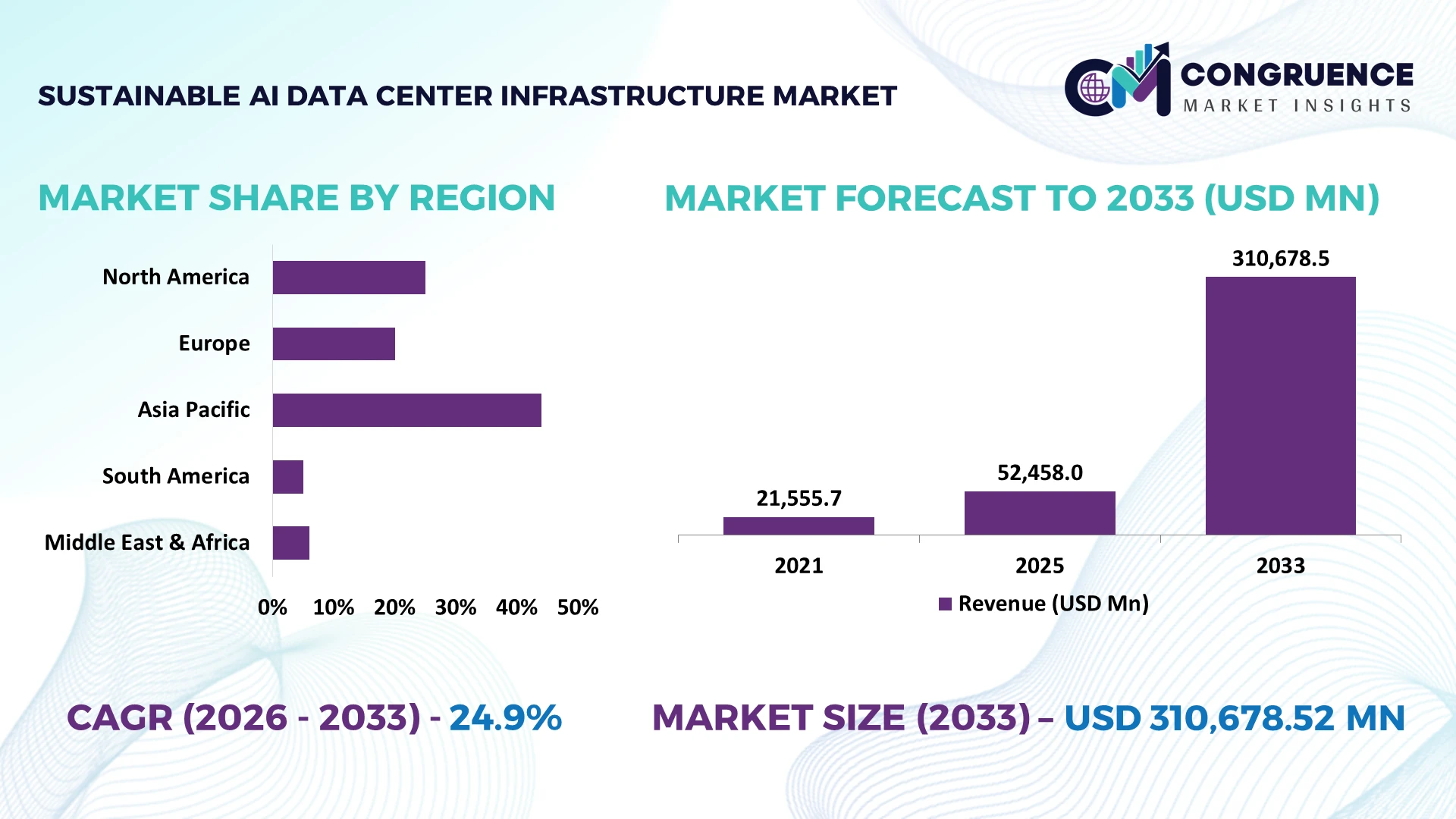
The United States dominates the global market with an estimated 38% share in 2025, supported by hyperscale infrastructure investments across cloud computing, financial services, healthcare, and generative AI. Microsoft announced approximately USD 80 billion in AI enabled data center investment for fiscal 2025, with more than 50% allocated to the United States. US data centers accounted for approximately 45% of global data center electricity consumption in 2024, compared with China's 25%. Intensifying US and China AI infrastructure competition reinforces sustainable computing investment.
Strategic investment in liquid cooling, renewable power integration, and energy efficient electrical infrastructure will determine long term capacity expansion and operating cost competitiveness.
Key Highlights of the Global Sustainable AI Data Center Infrastructure Market
-
Market Size & Growth: USD 52458 million in 2025, reaching USD 310678.52 million by 2033 at 24.9% CAGR, driven by GPU infrastructure expansion.
-
Top Growth Drivers: Estimated contributions include AI computing expansion (45%), energy efficiency requirements (35%), and renewable power integration (20%).
-
Short Term Forecast: By 2028, advanced cooling deployments target 30% lower cooling electricity consumption.
-
Emerging Technologies: Three priority innovations include immersion cooling, AI optimized energy management, and solid oxide fuel cells.
-
Regional Leaders: Estimated 2033 values include North America (USD 124271.41 million, liquid cooling), Asia Pacific (USD 99417.13 million, hyperscale expansion), and Europe (USD 65242.49 million, renewable integration).
-
Consumer/End User Trends: Hyperscale operators accounted for approximately 41% of worldwide data center capacity at the end of 2024.
-
Pilot/Case Example: Google's 2024 data center fleet achieved approximately 40% lower noncomputing energy overhead than the industry average.
-
Competitive Landscape: Schneider Electric holds an indicative 14% share estimate, alongside Vertiv, Eaton, ABB, and Siemens.
-
Regulatory & ESG Impact: EU energy reporting requirements cover data centers with installed IT power demand of at least 500 kW.
-
Investment & Funding: The 2025 Stargate initiative announced USD 500 billion in planned AI infrastructure investment.
-
Innovation & Future Outlook: Advanced liquid cooling architectures support rack densities exceeding 100 kW, reshaping infrastructure design priorities.
The Sustainable AI Data Center Infrastructure Market is experiencing concentrated demand across hyperscale computing facilities, AI training clusters, colocation campuses, and enterprise inference environments. Recent innovations include direct liquid cooling, intelligent power distribution, modular electrical infrastructure, and automated thermal management. Google's 2024 fleet achieved an average power usage effectiveness of 1.09, representing only 9% additional energy overhead relative to IT equipment consumption. Grid connection constraints are accelerating interest in colocated renewable generation, battery storage, and flexible computing workloads, positioning integrated energy and thermal infrastructure as central priorities for strategic capacity planning.
What Is the Strategic Relevance and Future Pathways of the Sustainable AI Data Center Infrastructure Market?
The Sustainable AI Data Center Infrastructure Market is becoming strategically important as electricity availability, thermal efficiency, and environmental performance increasingly determine AI computing expansion. Infrastructure investment is shifting from conventional air cooled facilities toward integrated liquid cooling and intelligent power architectures. Improving facility power usage effectiveness from 1.50 to 1.20 reduces total electricity consumption by 20% at equivalent IT loads, creating measurable operating advantages and releasing electrical capacity for additional computing equipment.
The United States prioritizes hyperscale AI campus expansion, while Denmark and Sweden leverage renewable electricity availability and district heating infrastructure. Google's Hamina data center in Finland demonstrates practical heat recovery integration through a district heating partnership designed to supply approximately 80% of local heating demand. Between 2026 and 2028, advanced thermal management deployments will increasingly target cooling electricity reductions of 25% to 35%.
Schneider Electric, Vertiv, and Eaton are expanding liquid cooling portfolios, modular power systems, and infrastructure engineering partnerships. Investment priorities increasingly emphasize integrated electrical and thermal architectures rather than independently procured equipment. Competitive leadership will depend on maximizing usable computing capacity within constrained electricity allocations, accelerating infrastructure commissioning, and maintaining measurable environmental performance throughout increasingly demanding AI infrastructure lifecycles.
Sustainable AI Data Center Infrastructure Market Dynamics
DRIVER:
Rising AI Computing Density and Energy Demand
Accelerated GPU deployment is fundamentally changing data center electrical and thermal infrastructure requirements. Global data center electricity consumption increased approximately 12% annually between 2017 and 2024, while accelerated server electricity consumption is projected to grow around 30% annually through 2030. High density AI racks increasingly exceed conventional air cooling capabilities, requiring direct liquid cooling, advanced coolant distribution units, and efficient power delivery systems. NVIDIA's GB200 NVL72 architecture exemplifies this transition through integrated liquid cooled computing infrastructure. Vertiv and Schneider Electric are expanding engineering partnerships and specialized cooling portfolios. Efficient thermal infrastructure enables operators to accommodate greater computing capacity within existing electrical allocations, strengthening infrastructure utilization and reducing dependence on additional facility construction.
RESTRAINT:
Grid Capacity Constraints and Equipment Bottlenecks
Limited grid connection availability and extended electrical equipment procurement schedules restrict sustainable AI data center expansion. Approximately 20% of planned global data center projects face potential delays from electricity infrastructure constraints, while transformer prices increased approximately 75% between 2019 and 2024. Northern Virginia and other established US data center hubs face substantial pressure on transmission infrastructure and available electrical capacity. These constraints increase construction expenditure, delay commissioning, and reduce returns on committed infrastructure investment. Eaton, ABB, and Siemens are expanding electrical equipment manufacturing capabilities, while operators pursue alternative locations and long term equipment procurement agreements. Securing dependable power access before construction increasingly determines project viability, outweighing conventional location advantages such as network connectivity and land availability.
OPPORTUNITY:
Waste Heat Commercialization and Distributed Energy Integration
AI data center waste heat recovery creates opportunities to transform cooling expenditure into commercially valuable thermal energy. Liquid cooling systems capture heat at higher temperatures, improving compatibility with district heating networks and industrial processes. Heat recovery configurations target estimated reductions of 20% to 30% in combined facility and external heating energy requirements. Microsoft's Finnish data center partnership with Fortum is designed to supply approximately 40% of district heating demand across Espoo, Kauniainen, and Kirkkonummi. Infrastructure suppliers are developing integrated heat exchangers, industrial heat pumps, and thermal storage systems. Operators establishing partnerships with municipal utilities gain opportunities to monetize recovered energy, improve local infrastructure acceptance, and differentiate sustainable AI campuses through measurable community energy benefits.
CHALLENGE:
Lifecycle Sustainability and Infrastructure Reliability
Maintaining environmental performance throughout increasingly complex AI infrastructure lifecycles presents a significant execution challenge. Microsoft's 2025 sustainability reporting indicated that total greenhouse gas emissions increased 23.4% compared with its 2020 baseline, while indirect Scope 3 emissions increased 26%. Accelerated facility construction, semiconductor manufacturing, and electrical equipment procurement contribute to embodied carbon exposure despite improvements in operational efficiency. Liquid cooling introduces additional requirements for coolant quality, material compatibility, leak detection, and preventive maintenance. Infrastructure providers must strengthen component traceability, recyclable material selection, and predictive maintenance capabilities through engineering investment and supplier partnerships. Long term competitiveness depends on demonstrating that operational electricity savings translate into genuine lifecycle environmental improvements without compromising computing availability or equipment reliability.
Sustainable AI Data Center Infrastructure Market Latest Trends
-
Modular Infrastructure Accelerates Campus Commissioning: Operators are adopting prefabricated electrical rooms, integrated power modules, and standardized infrastructure assemblies. Modular configurations target estimated construction schedule reductions of 30% and onsite installation savings of 25%. Schneider Electric and Vertiv are expanding prefabricated infrastructure portfolios, enabling faster commissioning and phased capacity expansion while reducing onsite labor dependency.
-
Intelligent Workload Scheduling Optimizes Consumption: Data center operators are integrating AI workload scheduling with electricity pricing and carbon intensity signals. Flexible scheduling targets estimated electricity cost savings of 15% and operational carbon reductions of 20%. Google is advancing carbon aware computing practices, shifting eligible workloads toward periods of cleaner electricity availability without requiring additional physical infrastructure.
-
Waterless Cooling Redefines Resource Management: Microsoft introduced a closed loop cooling design in 2024 capable of avoiding approximately 125 million liters of annual cooling water consumption per facility. Eliminating evaporative cooling water requirements supports infrastructure expansion in water stressed locations. Equipment suppliers are developing closed circuit thermal architectures to improve resource efficiency and strengthen permitting prospects.
-
Advanced Electrical Architectures Reduce Conversion Losses: Infrastructure providers are transitioning toward higher voltage direct current distribution, targeting estimated conversion loss reductions of 30% and electrical equipment footprint savings of 20%. NVIDIA's proposed 800 volt DC architecture supports future AI rack requirements, prompting Eaton, ABB, and Vertiv to advance compatible power delivery technologies.
Segmentation Analysis
By Type
Energy Efficient Servers Lead Infrastructure Investment
Energy-Efficient Servers dominate the type segmentation with an estimated 34% market share in 2025, reflecting their central role in reducing electricity consumption per computing operation. Advanced processor architectures, optimized accelerator utilization, and intelligent server power management support deployment across hyperscale AI facilities. Renewable Power Systems represent an estimated 22% share, driven by corporate electricity procurement commitments and dedicated clean energy infrastructure. Smart Power Management Systems complement these established categories through dynamic load balancing, electrical performance monitoring, and automated capacity allocation across increasingly complex computing environments.
Liquid Cooling Systems represent the projected fastest growing type as increasing accelerator densities exceed conventional thermal management capabilities. Optimized liquid cooling configurations target estimated cooling electricity savings of 35%, strengthening infrastructure utilization and operational efficiency. Energy Storage Systems support electricity reliability, peak demand management, and renewable integration, while Waste Heat Recovery Systems enable thermal energy commercialization. Dell Technologies, HPE, Vertiv, and Schneider Electric are expanding integrated server and cooling architectures, shifting procurement toward coordinated infrastructure packages that optimize computing performance and resource consumption.
- The International Energy Agency's 2025 Energy and AI report projects that accelerated server electricity consumption will increase approximately 30% annually through 2030, reinforcing investment requirements for efficient computing hardware and advanced thermal infrastructure.
By Application
AI Model Training Dominates Infrastructure Requirements
AI Model Training leads the application segmentation with an estimated 36% market share in 2025, supported by intensive computational workloads, interconnected accelerator clusters, and extended processing cycles. Large training environments require specialized power distribution, advanced cooling, and dependable electricity availability to maintain consistent computational performance. Cloud Computing accounts for an estimated 24% share, reflecting established infrastructure requirements across scalable enterprise applications and distributed computing environments. High-Performance Computing complements these applications through scientific simulation, engineering analysis, and computational research requiring efficient thermal management and high availability infrastructure.
AI Inference represents the projected fastest growing application as generative AI transitions toward widespread commercial deployment and continuous production workloads. Optimized inference infrastructure targets estimated electricity savings of 30% per equivalent computational workload. Data Analytics increasingly incorporates energy aware processing architectures, while Edge Computing emphasizes compact, efficient infrastructure supporting localized processing. NVIDIA, AMD, and infrastructure partners are expanding workload optimized computing platforms and integrated deployment architectures. Investment priorities increasingly distinguish intensive training environments from geographically distributed inference infrastructure with different energy and availability requirements.
- Stanford University's 2025 AI Index reported that inference costs for systems achieving GPT 3.5 level performance declined more than 280 fold between November 2022 and October 2024, supporting broader commercial inference deployment.
By End-User
Cloud Service Providers Concentrate Sustainable Infrastructure Procurement
Cloud Service Providers dominate the end user segmentation with an estimated 43% market share in 2025, reflecting extensive hyperscale campus development, accelerated computing deployment, and substantial clean electricity procurement commitments. Microsoft, Google, and Amazon prioritize integrated electrical infrastructure, advanced cooling, and renewable power systems to support expanding AI workloads. Colocation Providers account for an estimated 26% share, driven by enterprise demand for externally managed computing capacity. IT and Telecommunications organizations emphasize efficient network infrastructure and scalable processing environments, while Banking and Finance prioritizes dependable computing capacity for automated financial applications.
Colocation Providers represent the projected fastest growing end user group as enterprises outsource infrastructure requirements associated with increasingly demanding AI workloads. Standardized sustainable infrastructure packages target estimated commissioning time reductions of 25%, improving capacity availability. Healthcare organizations prioritize reliable processing environments, Government institutions emphasize secure infrastructure modernization, and Research Institutions require efficient computational resources. Vertiv, Eaton, and Schneider Electric are expanding configurable infrastructure portfolios and colocation partnerships, strengthening competitive positioning through deployment flexibility, standardized equipment integration, and measurable operational efficiency.
- Synergy Research Group reported in 2025 that hyperscale operators accounted for approximately 41% of worldwide data center capacity at the end of 2024, demonstrating concentrated infrastructure purchasing power and substantial sustainable modernization opportunities.
Region-Wise Market Insights
North America accounted for the largest market share at an estimated 41% in 2025; however, Asia-Pacific is expected to register the fastest growth, expanding at an estimated CAGR of 28.6% between 2026 and 2033.
North America Sustainable AI Data Center Infrastructure Market
Hyperscale Expansion Accelerates Integrated Infrastructure Modernization
North America dominates sustainable AI data center infrastructure deployment through extensive hyperscale computing campuses, advanced electrical equipment manufacturing, and corporate renewable electricity procurement. The United States represents an estimated 92.7% of regional demand, while Canada benefits from abundant hydroelectric resources and favorable cooling conditions. Amazon announced plans in 2025 to invest at least USD 20 billion in Pennsylvania data center infrastructure, reinforcing demand for efficient power distribution and thermal management systems. Infrastructure procurement increasingly prioritizes modular electrical architectures, direct liquid cooling, and intelligent energy management. Operators are also diversifying facility locations toward areas offering dependable electricity availability and renewable generation capacity. Vertiv, Eaton, and Schneider Electric are expanding integrated infrastructure capabilities. Competitive differentiation increasingly depends on maximizing computational output within available power allocations while maintaining reliable operation and measurable environmental performance.
United States Market Outlook: The United States benefits from concentrated AI accelerator deployment, established infrastructure suppliers, and extensive corporate clean energy procurement. In 2024, Microsoft signed a renewable energy framework agreement with Brookfield covering more than 10.5 GW of planned capacity. Such commitments strengthen opportunities for advanced electrical distribution, battery storage, and intelligent power management infrastructure supporting sustainable AI campus development.
Europe Sustainable AI Data Center Infrastructure Market
Energy Accountability Reshapes Data Center Engineering Priorities
Europe accounted for an estimated 23% of global market demand in 2025, supported by stringent environmental regulations, renewable electricity integration, and industrial computing modernization. Germany, France, the Netherlands, and Nordic countries represent significant infrastructure investment centers. The European Union's energy efficiency framework requires sustainability reporting from data centers with installed IT power demand of at least 500 kW. This requirement strengthens demand for automated energy monitoring, resource management, and measurable infrastructure performance. Nordic countries leverage favorable climatic conditions and district heating networks, while established commercial hubs prioritize modernization of existing facilities. Schneider Electric, ABB, and Siemens are expanding efficient electrical infrastructure and integrated energy management portfolios. Procurement increasingly emphasizes lifecycle environmental performance, creating competitive advantages for suppliers combining reliable computing infrastructure with documented electricity efficiency and resource conservation.
Germany Market Outlook: Germany's Energy Efficiency Act establishes a power usage effectiveness requirement of 1.2 for data centers commencing operations from July 2026, subject to the applicable statutory conditions. Its established electrical engineering ecosystem and industrial automation capabilities support advanced infrastructure implementation. Demand increasingly concentrates on efficient cooling, automated power optimization, and equipment capable of supporting stringent environmental performance requirements.
Asia-Pacific Sustainable AI Data Center Infrastructure Market
Accelerated Computing Expansion Drives Infrastructure Transformation
Asia Pacific represented an estimated 28% of global market demand in 2025, supported by domestic AI development, semiconductor manufacturing, hyperscale cloud expansion, and digital enterprise modernization. China, Japan, India, South Korea, and Singapore are strengthening infrastructure capabilities through coordinated computing and electricity investments. Singapore's Green Data Centre Roadmap targets at least 300 MW of additional data center capacity, linking expansion with improved resource efficiency and cleaner energy availability. Japan prioritizes efficient computing infrastructure for industrial automation, while India benefits from expanding cloud services and renewable electricity development. Infrastructure manufacturers are increasing regional production capabilities for power distribution equipment, thermal management systems, and energy storage solutions. Competitive opportunities increasingly favor suppliers offering climate adapted cooling architectures, localized engineering support, and scalable infrastructure packages compatible with diverse electricity networks and regulatory requirements.
China Market Outlook: China benefits from extensive domestic electrical equipment manufacturing, advanced computing infrastructure, and large renewable energy installations. The country added approximately 277 GW of solar generating capacity in 2024, expanding its clean electricity infrastructure. National computing hub development increasingly connects AI infrastructure investment with regional energy availability, creating opportunities for efficient servers, advanced cooling systems, and intelligent electricity distribution.
South America Sustainable AI Data Center Infrastructure Market
Renewable Electricity Supports Emerging AI Infrastructure Hubs
South America accounted for an estimated 4.2% of global market demand in 2025, with infrastructure procurement concentrated across Brazil, Chile, and Colombia. Renewable electricity availability provides a structural advantage for sustainable computing expansion, particularly in markets supported by hydroelectric, solar, and wind generation. Google's announced USD 850 million data center investment in Uruguay in 2024 demonstrates growing international interest in the region's computing infrastructure potential. Financial services, telecommunications, and digital commerce represent important demand centers for efficient cloud infrastructure. However, transmission limitations, imported equipment dependency, and uneven technical workforce availability constrain deployment schedules. Infrastructure providers are responding through localized engineering partnerships, modular equipment configurations, and flexible implementation arrangements. Suppliers offering dependable maintenance capabilities and standardized infrastructure packages gain advantages by reducing commissioning complexity and supporting incremental AI capacity expansion.
Brazil Market Outlook: Brazil leads regional infrastructure opportunities through its extensive electricity network, established enterprise technology ecosystem, and favorable renewable generation profile. Renewable sources accounted for approximately 88% of Brazilian electricity generation in 2024. This electricity mix strengthens the country's attractiveness for sustainable AI computing facilities, particularly those requiring dependable power availability, advanced thermal management, and lower operational carbon intensity.
Middle East & Africa Sustainable AI Data Center Infrastructure Market
Sovereign Computing Investment Accelerates Sustainable Campus Development
The Middle East and Africa represented an estimated 3.8% of global market demand in 2025, supported by sovereign AI investment, cloud infrastructure expansion, and government digitization initiatives. Saudi Arabia and the United Arab Emirates are developing large computing campuses, while South Africa strengthens its position through established enterprise connectivity and colocation infrastructure. The UAE's Stargate project announced in May 2025 targets 1 GW of AI computing infrastructure within a larger planned campus. High ambient temperatures and limited freshwater availability increase requirements for efficient closed circuit cooling, intelligent thermal management, and resource optimization. Infrastructure providers are expanding localized engineering capabilities and partnerships with regional energy developers. Uneven electricity reliability across African markets also strengthens demand for integrated battery storage, efficient backup power systems, and modular infrastructure supporting dependable computing operations.
Saudi Arabia Market Outlook: Saudi Arabia is strengthening its sustainable computing infrastructure through coordinated investment in domestic AI capabilities and renewable electricity development. The country's energy diversification strategy targets approximately 50% renewable electricity generation by 2030. Expanding AI campuses create specialized opportunities for water efficient cooling, advanced electrical distribution, and energy storage infrastructure adapted to demanding desert operating conditions.
Market Competition Landscape
Schneider Electric, Vertiv, Eaton, ABB, and Siemens compete across sustainable power distribution, thermal management, and integrated AI infrastructure systems. The top five players collectively account for an estimated 48% market share, reflecting moderate concentration. Schneider Electric and Vertiv emphasize integrated electrical and cooling architectures, while Eaton, ABB, and Siemens differentiate through power management, electrification, and industrial automation capabilities. Advanced cooling configurations target estimated electricity savings of 35%, while modular infrastructure targets 25% shorter commissioning schedules. Intelligent power management offers potential electrical loss reductions of 15%. Companies are expanding manufacturing capacity, strengthening accelerator ecosystem partnerships, and developing standardized infrastructure packages. Competition is shifting from standalone equipment procurement toward integrated infrastructure engineering and lifecycle performance optimization. Entry barriers include specialized thermal engineering, equipment certification, manufacturing capacity, and dependable maintenance networks. Winning requires scalable architectures, reliable equipment availability, measurable energy efficiency, and integrated engineering capabilities that maximize computing capacity within constrained electricity allocations.
Companies Profiled in the Sustainable AI Data Center Infrastructure Market Report
-
Schneider Electric SE
-
Vertiv Holdings Co.
-
Eaton Corporation plc
-
ABB Ltd.
-
Siemens AG
-
Delta Electronics, Inc.
-
NVIDIA Corporation
-
Dell Technologies Inc.
-
Hewlett Packard Enterprise Company
-
Super Micro Computer, Inc.
-
Lenovo Group Limited
-
STULZ GmbH
-
Munters Group AB
-
Johnson Controls International plc
Technology Insights for the Sustainable AI Data Center Infrastructure Market
Current technologies include direct liquid cooling, efficient server architectures, and intelligent power distribution. Direct liquid cooling targets estimated cooling electricity savings of 35% compared with conventional air cooling. Optimized server architectures target 25% lower electricity consumption per equivalent workload, while intelligent power distribution targets 15% lower electrical losses. Commercial deployment across advanced GPU clusters demonstrates growing integration of thermal and electrical infrastructure.
Emerging technologies encompass immersion cooling, predictive energy management, and advanced battery storage. Immersion cooling targets estimated cooling energy reductions of 40%, while predictive energy management targets 20% lower auxiliary electricity consumption. Battery storage configurations target 15% reductions in peak electricity procurement costs. Hyperscale operators and colocation providers benefit from improved computing capacity utilization, particularly where grid connection availability restricts infrastructure expansion.
Disruptive technologies include 800 volt direct current distribution, solid oxide fuel cells, and integrated thermal energy storage. Advanced direct current architectures target estimated conversion loss reductions of 30%, while fuel cells target 20% lower carbon emissions when replacing conventional diesel generation under suitable fuel conditions. Thermal storage targets 25% lower peak cooling demand. Between 2026 and 2028, integrated deployments will strengthen infrastructure resilience, accelerate capacity commissioning, and improve resource efficiency across increasingly power constrained AI computing environments.
Recent Developments in the Global Sustainable AI Data Center Infrastructure Market
-
April 2026: Eaton announced a manufacturing expansion in Nebraska through a facility spanning 370,000 square feet. The investment strengthens domestic switchgear production for AI data centers, addressing electrical equipment supply constraints and supporting scalable modular power infrastructure. Source: eaton.com
-
October 2025: Vertiv advanced its engineering collaboration with NVIDIA to develop 800 volt direct current power architectures for AI factories. The initiative supports efficient electricity distribution across increasingly demanding computing environments and establishes infrastructure readiness for future accelerators. Source: datacentremagazine.com
-
December 2024: Microsoft announced upcoming data center designs eliminating evaporative cooling water consumption, with projected annual savings exceeding 125 million liters per facility. The initiative reduces freshwater dependency and supports sustainable computing infrastructure development in water constrained locations. Source: datacenterdynamics.com
-
October 2024: Schneider Electric announced an agreement to acquire a 75% controlling stake in Motivair, strengthening its specialized liquid cooling portfolio. The acquisition expands thermal management capabilities for intensive AI computing workloads and reinforces integrated infrastructure offerings. Source: reuters.com
Scope of the Sustainable AI Data Center Infrastructure Market Report
The report evaluates six infrastructure types, including energy efficient servers, liquid cooling systems, renewable power systems, energy storage systems, waste heat recovery systems, and smart power management systems. Application coverage encompasses AI model training, AI inference, high performance computing, cloud computing, data analytics, and edge computing. End user analysis covers cloud service providers, colocation providers, IT and telecommunications, banking and finance, healthcare, government, and research institutions.
Regional assessment includes North America, Europe, Asia Pacific, South America, and the Middle East and Africa. The report profiles 14 major companies and examines infrastructure efficiency, deployment concentration, and competitive differentiation. Emerging technology coverage includes immersion cooling, advanced direct current distribution, and integrated thermal storage. Strategic insights support infrastructure investment planning, manufacturing expansion, technology partnerships, and competitive positioning between 2026 and 2033.
Sustainable AI Data Center Infrastructure Market Report Summary
| Report Attribute/Metric | Report Details |
|---|
Market Revenue in 2025 | USD 52458 Million |
Market Revenue in 2033 | USD 310678.52 Million |
CAGR (2026 - 2033) | 24.9% |
Base Year | 2025 |
Forecast Period | 2026 - 2033 |
Historic Period | 2021 - 2025 |
Segments Covered | By TypeWaste Heat Recovery Systems Smart Power Management Systems
By ApplicationHigh-Performance Computing
By End-UserIT and Telecommunications
|
Key Report Deliverable | Revenue Forecast, Growth Trends, Market Dynamics, Segmental Overview, Regional and Country-wise Analysis, Competition Landscape |
Region Covered | North America, Europe, Asia-Pacific, South America, Middle East, Africa |
Key Players Analyzed | Schneider Electric SE, Vertiv Holdings Co., Eaton Corporation plc, ABB Ltd., Siemens AG, Delta Electronics, Inc., NVIDIA Corporation, Dell Technologies Inc., Hewlett Packard Enterprise Company, Super Micro Computer, Inc., Lenovo Group Limited, STULZ GmbH, Munters Group AB, Johnson Controls International plc |
Customization & Pricing | Available on Request (10% Customization is Free) |





