
Reports
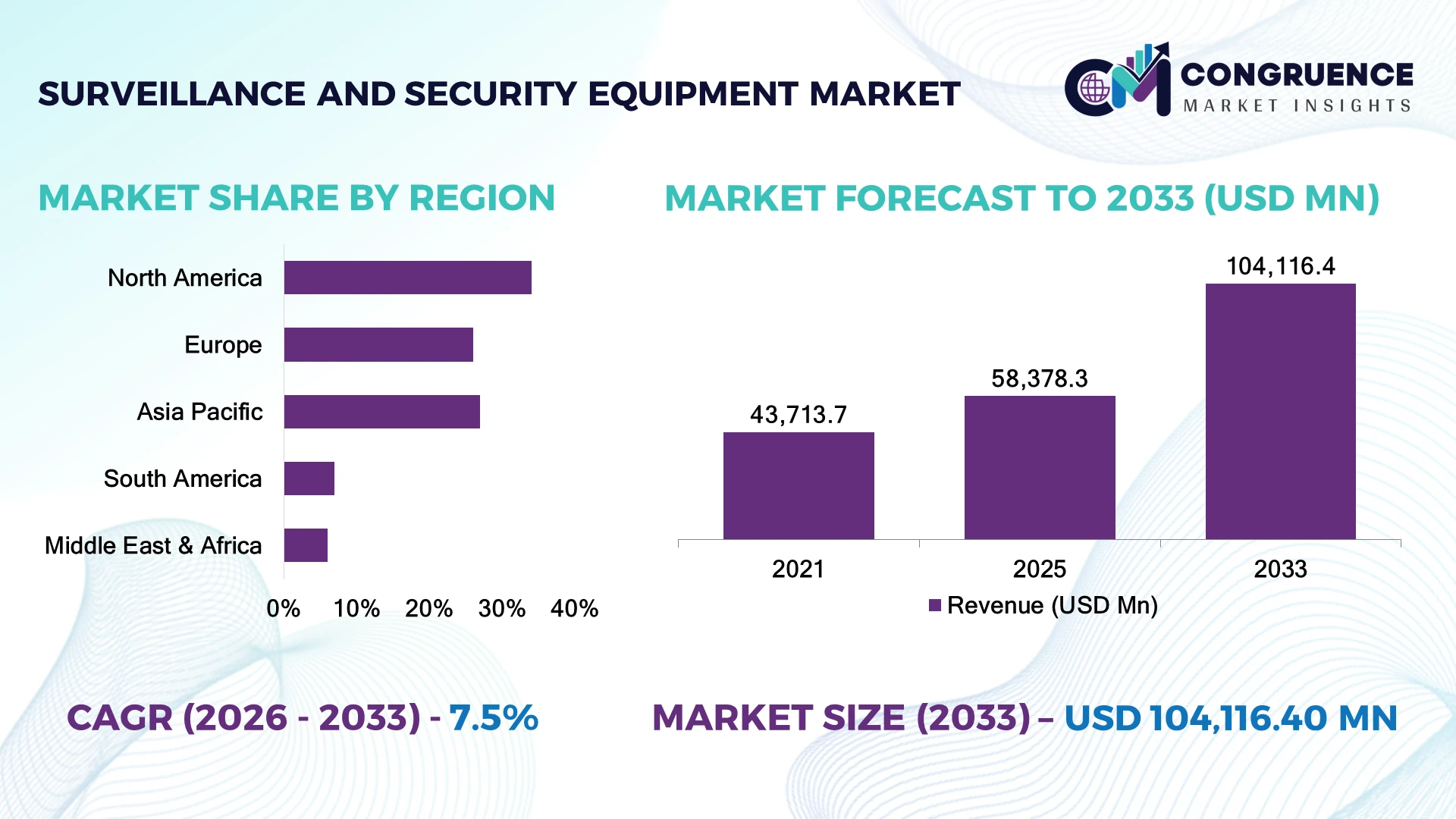
The Global Surveillance and Security Equipment Market was valued at USD 58,378.3 Million in 2025 and is anticipated to reach a value of USD 104,116.4 Million by 2033 expanding at a CAGR of 7.5% between 2026 and 2033. Growth is being driven by AI-enabled video analytics, edge computing, smart-city modernization, critical-infrastructure protection, and migration from passive recording toward real-time threat detection.
China remains the dominant country market, supported by extensive public-security infrastructure, domestic camera manufacturing, and large-scale AI modernization. China’s video-surveillance market was approximately USD 23.2 billion in 2025, while India is accelerating deployment through smart-city and Safe City programs, including a 2026 plan for 10,000 AI-enabled cameras in Delhi. AI-enabled cameras now represent a substantial share of new network-camera deployments, reinforcing the shift from recording capacity toward automated intelligence.
China’s surveillance-network modernization is increasingly shaped by semiconductor supply-chain localization and tighter technology controls, making domestic AI processing strategically important.
For investors and equipment suppliers, competitive positioning increasingly depends on AI analytics, cybersecurity, edge processing, and integration capability rather than camera volume alone.
Market Size & Growth: USD 58,378.3 million in 2025 to USD 104,116.4 million by 2033 at 7.5% CAGR, driven by AI-enabled surveillance and critical-infrastructure modernization.
Top Growth Drivers: AI video analytics 18%, smart-city deployment 15%, critical-infrastructure security 12%.
Short-Term Forecast: By 2028, AI-assisted monitoring is positioned to reduce false alarms by 30–50% and accelerate incident triage by 20–30%.
Emerging Technologies: Edge AI, computer vision, generative video analytics, thermal imaging, and autonomous threat detection are reshaping surveillance workflows.
Regional Leaders: Asia-Pacific is projected near USD 43 billion, North America near USD 28 billion, and Europe near USD 20 billion by 2033, led by AI-enabled modernization.
Consumer/End-User Trends: More than 60% of surveyed security organizations now use integrated or unified video and access-control systems, accelerating platform-based procurement.
Pilot/Case Example: A 2025 AI surveillance deployment across 3,000+ cameras during a major Indian public event reported 70% faster emergency response and 95% threat-detection accuracy.
Competitive Landscape: Hikvision retains a leading global position, competing with Dahua, Axis Communications, Hanwha Vision, Bosch, and Motorola Solutions across hardware, analytics, and integrated security platforms.
Regulatory & ESG Impact: Privacy, cybersecurity, and data-localization requirements are increasing investment in edge processing, with local inference reducing unnecessary video-data transmission.
Investment & Funding: More than USD 5 billion is being directed globally toward AI security, smart-city infrastructure, surveillance modernization, and integrated command-center deployments.
Innovation & Future Outlook: 2026–2028 adoption will shift toward multimodal AI, edge-to-cloud orchestration, autonomous event detection, and unified physical-security platforms.
The Surveillance and Security Equipment Market is shifting from conventional CCTV recording toward intelligent, networked security infrastructure spanning video surveillance, access control, intrusion detection, screening systems, thermal cameras, and command-center platforms. AI-based analytics are becoming operationally important for anomaly detection, crowd monitoring, license-plate recognition, and predictive threat assessment, while edge processing reduces dependence on centralized video transmission. In 2026, cybersecurity audits of large installed camera networks and AI-enabled Safe City deployments are reinforcing demand for secure, upgradeable systems rather than standalone hardware.
Surveillance and security equipment is becoming a strategic infrastructure layer as governments, transportation operators, industrial enterprises, retailers, and critical facilities move from reactive monitoring to real-time risk intelligence. The shift is particularly visible in China, where aging surveillance infrastructure is being upgraded with AI-enabled cameras, local processing, advanced computer vision, and searchable video. India is following a similar trajectory through smart-city, transportation, and public-safety programs.
Technology economics are also changing. AI-enabled edge cameras can filter events locally and reduce unnecessary video transmission by approximately 30–50% compared with fully centralized architectures, while intelligent analytics can reduce false alarms by more than 50% in optimized deployments. North America emphasizes enterprise integration and cybersecurity, Europe prioritizes privacy-compliant modernization, while Asia-Pacific combines large deployment volumes with rapid AI adoption.
Over the next 2–3 years, integrated and hybrid architectures will gain priority as organizations seek unified video, access control, intrusion detection, and analytics. A 2025 real-world deployment managing 16 cameras sustained 16.5 frames per second with approximately 27-second end-to-end alert latency, demonstrating the operational feasibility of edge-enabled intelligent monitoring. Companies are therefore increasing investment in AI processors, cybersecurity, cloud-edge integration, and interoperable platforms. Competitive advantage will increasingly come from converting installed surveillance infrastructure into actionable intelligence while maintaining privacy, resilience, and operational control.
AI-enabled video analytics is becoming the primary technology shift in surveillance, with intelligent cameras reducing manual monitoring requirements by approximately 30–50% and accelerating incident triage by 20–30%. China continues to deploy large-scale computer-vision infrastructure, while India is expanding AI-enabled Safe City and transportation monitoring. The operational shift from passive recording to real-time detection is increasing demand for edge processors, thermal imaging, facial and object analytics, and integrated command platforms. Cybersecurity requirements are simultaneously pushing enterprises toward locally processed video. Manufacturers are responding through AI-camera portfolios, edge computing partnerships, and software upgrades for installed systems. The non-obvious growth driver is retrofit economics: upgrading existing camera networks with analytics can deliver intelligence gains without replacing the entire physical infrastructure.
Surveillance deployment faces structural pressure from semiconductor availability, privacy regulation, and fragmented infrastructure. Camera and networking components can represent 40–60% of system procurement costs, while imported electronics remain exposed to currency and supply-chain volatility in countries such as India and Brazil. Privacy-compliance requirements can increase deployment and data-governance workloads by 10–20%, particularly where biometric analytics are involved. European operators face stricter requirements for lawful processing, retention, and access controls, limiting unrestricted centralized video storage. These pressures affect project timelines, system economics, and cross-border scalability. Companies are reducing exposure through regional sourcing, edge processing, modular architectures, longer component contracts, and privacy-preserving analytics. The strategic priority is shifting from maximum camera density toward compliant, upgradeable infrastructure with controlled data flows.
The largest opportunity is the convergence of edge AI, access control, intrusion detection, and video analytics into unified physical-security platforms. Edge processing can reduce video-data transmission requirements by approximately 30–50%, while automated event classification can lower false-alarm workloads by 40% or more in optimized deployments. India, Saudi Arabia, and Southeast Asian industrial hubs are expanding smart-city, logistics, airport, and critical-infrastructure programs, creating demand for scalable systems. Emerging multimodal AI can combine video, audio, thermal, and sensor inputs to identify complex events beyond conventional motion detection. Companies are investing in AI accelerators, open APIs, cybersecurity layers, and ecosystem partnerships. A non-obvious opportunity is monetizing analytics as a recurring software service, allowing operators to modernize installed cameras without major hardware replacement.
Long-term market expansion depends on securing increasingly connected surveillance ecosystems. Large deployments can contain thousands of network endpoints, with poorly maintained devices creating substantial attack surfaces; organizations can face 15–25% higher lifecycle costs when legacy cameras require repeated cybersecurity remediation. Integration across cameras, access-control systems, alarms, VMS platforms, and cloud services also creates interoperability bottlenecks. In 2026, AI-generated synthetic media and increasingly sophisticated spoofing techniques are raising authentication requirements for biometric and video systems. Companies must strengthen device identity, encrypted communications, zero-trust architectures, firmware management, and AI-model validation. The critical execution challenge is maintaining detection accuracy while securing continuously connected systems. Vendors that combine cybersecurity engineering with open integration frameworks will be better positioned to sustain large enterprise deployments.
Edge AI Replaces Centralized Processing: Edge-enabled cameras are increasingly handling object detection, behavioral analysis, and event classification locally, reducing upstream video transmission by 30–50% and improving alert latency by 20–30%. Enterprises are responding to privacy and bandwidth pressures by shifting analytics closer to cameras, while manufacturers expand embedded AI processors and local-storage capabilities.
Thermal Imaging Expands Applications: Thermal cameras are moving beyond perimeter defense into industrial safety, utilities, logistics, and fire-risk monitoring, with detection performance improving 15–25% in low-visibility environments. Energy and infrastructure operators are integrating thermal feeds with conventional video, while suppliers increasingly bundle multispectral analytics to reduce blind spots without adding separate monitoring teams.
Unified Security Platforms Gain Priority: Enterprises are consolidating video management, access control, intrusion detection, and analytics, with integrated deployments reducing operator workflow steps by approximately 20–30%. This shift is particularly visible in airports, logistics hubs, and large industrial sites. Vendors are responding through open APIs, platform acquisitions, and enterprise contracts rather than isolated hardware sales.
AI Supply Chains Become Strategic: Semiconductor restrictions and regional technology policies are accelerating localization of AI processors, camera modules, and video-analytics software. Domestic sourcing initiatives in China and India are increasing procurement diversification, while enterprises seek 10–15% lower supply-chain exposure through regional vendors and multi-source contracts. Manufacturers are consequently redesigning platforms around replaceable compute modules and broader supplier ecosystems.
AI-Enabled Video Surveillance Leads the Shift
AI-enabled video surveillance is estimated to account for approximately 42% of the global surveillance and security equipment market, supported by broad deployment across commercial facilities, transportation networks, industrial sites, and public infrastructure. Its dominance reflects scalable network architecture, declining edge-compute costs, and integration with video management systems. Conventional surveillance remains strategically relevant, particularly for cost-sensitive installations, while access-control hardware represents roughly 24% of demand through biometric readers, smart locks, and credential systems. Intrusion detection and perimeter-security equipment retain specialized importance where physical barriers and rapid alarm verification are critical.
The fastest-growing technology cluster is AI-integrated surveillance, with adoption increasing as organizations move from recording toward automated event detection. Approximately 30–35% of new enterprise deployments increasingly incorporate analytics capabilities, strengthening demand for edge processors, thermal imaging, and multimodal detection. Vendors are prioritizing AI-enabled product lines, open APIs, and hybrid architectures rather than standalone hardware, shifting investment toward software-enhanced equipment with recurring functionality and higher lifecycle value.
Genetec’s 2026 physical-security research found that 63.25% of teams use AI for automated real-time event flagging, demonstrating that AI has moved into operational security workflows rather than remaining a pilot-stage capability.
Commercial Security Moves Toward Unified Intelligence
Commercial and enterprise security is estimated to represent approximately 36% of market demand, supported by multi-site deployments across offices, retail facilities, financial institutions, logistics centers, and hospitality properties. Demand is concentrated around integrated video surveillance, access control, and identity management because enterprises increasingly require centralized monitoring across distributed assets. Industrial and critical-infrastructure applications account for roughly 25%, with higher-value deployments emphasizing perimeter protection, thermal monitoring, and intrusion detection. Residential security remains comparatively hardware-focused, while transportation and public-sector applications increasingly prioritize centralized command environments and analytics.
The fastest-growing application is critical infrastructure and transportation security, where automated detection and real-time response are becoming operational requirements. Adoption of intelligent analytics in these environments is expanding by an estimated 12–15% annually as airports, ports, utilities, and rail networks modernize legacy systems. Companies are responding with modular platforms, integrated command centers, and partnerships combining cameras, access credentials, sensors, and analytics. The strategic shift favors suppliers capable of delivering interoperable systems rather than isolated equipment categories.
Genetec’s 2025 industry survey reported that 81% of U.S. and Canadian respondents had access-control technology deployed and 82% had video surveillance, confirming strong infrastructure penetration across enterprise security environments.
Enterprise Buyers Drive Higher-Value Deployments
Commercial enterprises are estimated to represent approximately 39% of equipment demand, reflecting extensive multi-site infrastructure, centralized security operations, and recurring technology upgrades. Government and public-sector organizations follow at roughly 27%, supported by transportation, municipal surveillance, border infrastructure, and critical-facility programs. Enterprises typically prioritize interoperability, cybersecurity, analytics, and lifecycle management, while government buyers place greater emphasis on compliance, procurement specifications, and large-area coverage. Industrial users remain strategically important because energy, manufacturing, mining, and logistics facilities require perimeter monitoring and specialized detection systems.
The fastest-growing end-user group is large industrial and infrastructure operators, where connected security systems increasingly support both protection and operational intelligence. Approximately 20–25% of new enterprise-oriented deployments increasingly integrate video analytics with access control or other physical-security workflows. Vendors are responding with vertical-specific solutions, managed services, hybrid-cloud architectures, and ecosystem partnerships. The buying model is shifting from equipment procurement toward integrated security platforms, favoring suppliers that can combine hardware reliability, analytics, cybersecurity, and long-term system support.
Genetec’s 2026 research surveyed 7,368 physical-security professionals and found that interest in AI adoption among end users had more than doubled year over year, reinforcing the shift toward intelligent, software-integrated security environments.
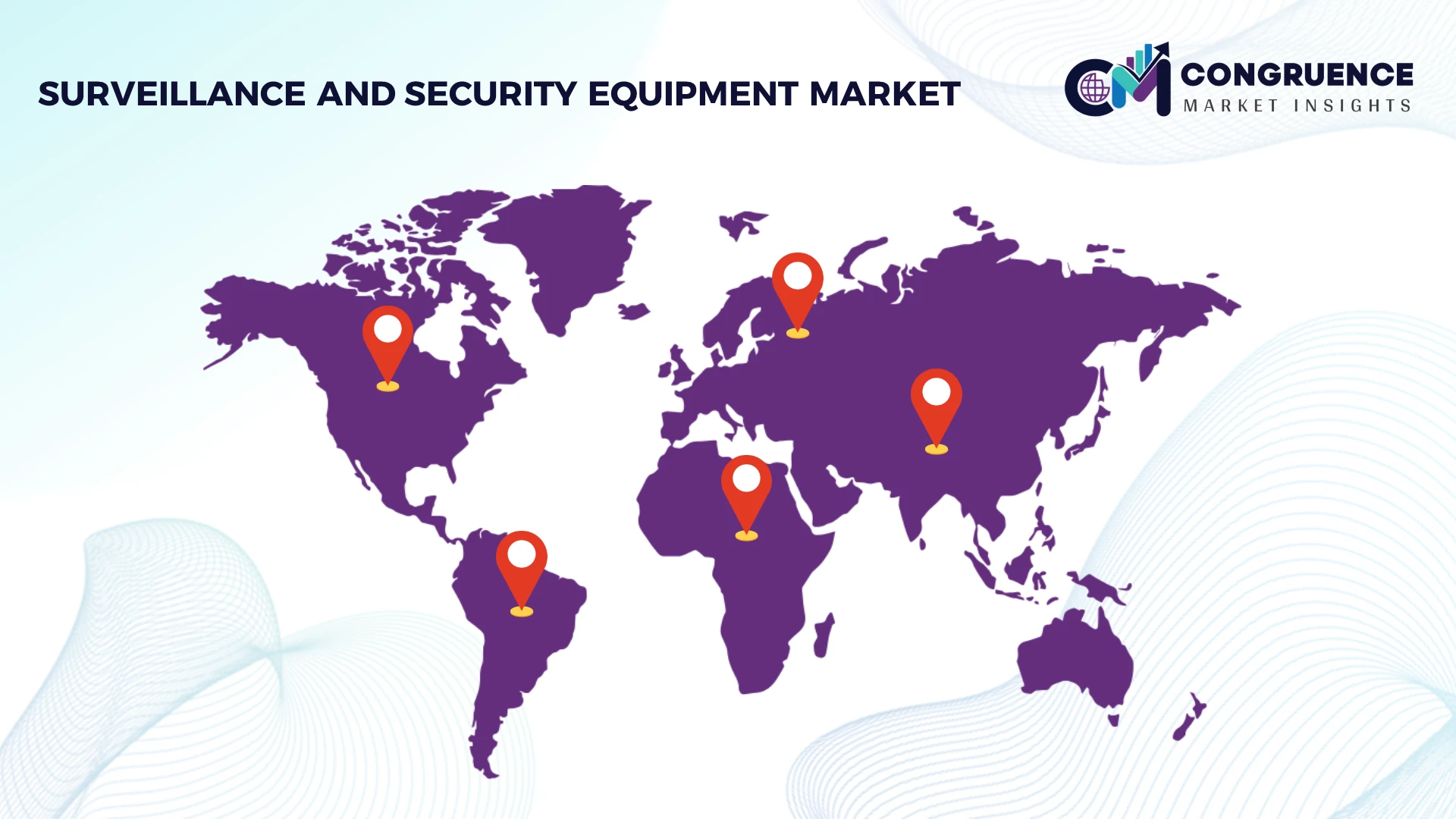
North America accounted for the largest market share at 34% in 2025 however, Asia-Pacific is expected to register the fastest growth, expanding at a CAGR of 9.2% between 2026 and 2033.
AI-led modernization is replacing fragmented security infrastructure
North America represents the largest regional demand center, supported by extensive deployments across commercial facilities, transportation, financial institutions, critical infrastructure, and government sites. The United States contributes the majority of regional spending, while Canada is accelerating modernization of access control, video surveillance, and integrated command platforms. In the U.S. and Canada, 82% and 81% of surveyed organizations respectively reported video surveillance and access-control deployment, highlighting unusually high infrastructure penetration. Approximately 36% of end users have already unified video and access-control systems, shifting purchasing toward interoperable platforms rather than standalone devices. Security modernization is increasingly tied to cybersecurity, with 79% of regional respondents reporting compliance-related impacts on physical-security programs. Vendors are therefore prioritizing AI analytics, edge processing, cloud-connected architectures, and cybersecurity integration while expanding partnerships with infrastructure operators.
United States Market Outlook: The United States remains the region's principal technology and deployment hub, supported by large enterprise campuses, airports, logistics networks, utilities, and public-sector security programs. Commercial users represent about 39% of North American video-surveillance demand, while infrastructure applications are gaining strategic importance. Investment is shifting toward AI-enabled analytics, integrated access control, and cybersecurity-ready systems that reduce dependence on fragmented legacy infrastructure.
Regulatory compliance is accelerating secure technology replacement
Europe maintains a strong position through modernization of public infrastructure, transportation systems, industrial facilities, and commercial properties, with demand increasingly shaped by data governance and cybersecurity requirements. Germany, the United Kingdom, and France remain important deployment centers, while smart-city programs are expanding intelligent video and access-control installations. Approximately 30–35% of new enterprise security projects increasingly emphasize unified platforms and analytics rather than isolated hardware. European buyers also place greater weight on privacy-by-design, secure data processing, and lifecycle management, increasing demand for compliant edge and hybrid-cloud architectures. Manufacturers are responding with localized data controls, encrypted communications, and AI systems designed for controlled deployment environments.
Germany Market Outlook: Germany combines a large industrial base with stringent operational and data-protection requirements, creating strong demand for secure surveillance across manufacturing, logistics, transportation, and commercial facilities. More than 20% of industrial security modernization programs increasingly incorporate analytics or automated event detection, encouraging suppliers to emphasize privacy-preserving AI, edge processing, and interoperable access-control systems. Germany's industrial concentration also supports higher-value equipment specifications rather than purely price-led procurement.
Scale-driven deployment is shifting toward intelligent infrastructure
Asia-Pacific combines the world's largest installed surveillance base with rapidly expanding smart-city, transportation, industrial, and digital-infrastructure projects. China remains the principal manufacturing and deployment center, while India, Japan, South Korea, and Southeast Asian economies are increasing investments in connected security systems. The region is estimated to represent roughly 27% of global market demand, while AI-enabled surveillance adoption is expanding at approximately 15% across major enterprise and public-infrastructure deployments. India's regulatory tightening of connected-camera testing in 2025 demonstrated the growing importance of cybersecurity, supply-chain control, and technology localization. Equipment suppliers are responding through localized manufacturing, secure firmware, AI-enabled cameras, and partnerships with system integrators.
China Market Outlook: China retains a decisive position through domestic manufacturing scale, extensive urban surveillance infrastructure, and strong integration of cameras with AI analytics and smart-city platforms. Chinese manufacturers account for a substantial share of global camera production, giving local suppliers cost and supply-chain advantages. However, international restrictions and cybersecurity concerns are pushing companies toward localized component ecosystems, stronger software controls, and differentiated export strategies.
Public-security investment is accelerating integrated deployments
South America is developing from fragmented camera installations toward integrated surveillance, access control, body-worn systems, and command-center architectures. Brazil dominates regional demand because of its large urban population, public-security requirements, financial institutions, airports, ports, and commercial infrastructure. The country accounted for approximately 63% of security companies and 65.5% of security personnel within its southern and southeastern concentration, supporting substantial equipment demand. Electronic security investment is increasingly directed toward AI, 5G-connected monitoring, and integrated police databases. Suppliers are expanding through local distributors, public-sector contracts, and technology partnerships, although uneven infrastructure and procurement cycles continue to constrain deployment consistency outside major urban centers.
Brazil Market Outlook: Brazil is the region's principal commercial and public-security market, with electronic security equipment demand concentrated among financial institutions, commercial facilities, airports, ports, and public transportation. Government programs include funding for 35,000 body cameras across participating states, strengthening demand for connected evidence-management and command systems. Vendors with local service networks, regulatory expertise, and scalable IP-based architectures are better positioned than suppliers competing solely on equipment price.
Mega-project security is driving high-value integrated systems
Middle East and Africa demand is increasingly concentrated around airports, ports, energy facilities, smart cities, tourism developments, and large-scale infrastructure programs. Saudi Arabia and the United Arab Emirates lead technology-intensive deployments, with projects emphasizing AI surveillance, perimeter protection, command centers, and advanced detection. Saudi Arabia's security ecosystem received approximately USD 450 million in strategic agreements in 2025, including initiatives targeting advanced detection and AI-based camera surveillance. This investment pattern favors integrated suppliers capable of combining hardware, analytics, localization, and long-term service support. African markets remain more fragmented, but critical infrastructure and urban-security programs are creating selective opportunities for ruggedized, remotely managed systems.
Saudi Arabia Market Outlook: Saudi Arabia has the strongest strategic positioning through Vision 2030 infrastructure development, smart-city programs, airports, ports, energy assets, and large tourism projects. A 2025 security partnership program valued at approximately USD 450 million targeted advanced detection and AI-enabled surveillance capabilities, reinforcing localization and technology-transfer priorities. Suppliers that combine AI analytics, integrated command platforms, detection equipment, and local workforce development are positioned to capture high-value projects.
The market pits Hikvision and Dahua against Axis Communications, Hanwha Vision, Bosch, and enterprise specialists such as Genetec, with Chinese OEMs competing on scale and price while Western suppliers emphasize cybersecurity, open architecture, analytics, and lifecycle support. The top five hardware players are estimated to control about 48% of video-surveillance unit shipments, leaving software and integration layers more fragmented. Price remains decisive in volume projects, where low-cost vendors can hold 15–20% advantages, while AI-enabled products command roughly 10–15% higher specification value through analytics. Enterprise buyers increasingly prioritize interoperability, with more than 70% favoring unified security systems. Players are responding through edge-AI launches, cloud platforms, regional expansion, system-integrator partnerships, and vertical integration of cameras, software, access control, and analytics. The competitive shift is moving from hardware replacement toward intelligent ecosystems. High certification, cybersecurity, channel, and installed-base barriers pressure entrants. Winning requires platforms, secure supply, AI performance, open integration, and lifecycle support.
Hikvision
Dahua Technology
Axis Communications
Hanwha Vision
Bosch Building Technologies
Honeywell
Johnson Controls
Motorola Solutions
Genetec
Teledyne FLIR
Panasonic Connect
Uniview Technologies
AI-enabled edge analytics is becoming the core technology layer, with object detection, anomaly recognition, and automated event classification moving processing directly into cameras. Intelligent cameras can reduce centralized processing requirements by roughly 20–30%, while improving alert response efficiency by 15–25%. Genetec’s 2026 findings show 63.25% of teams use AI to flag events automatically, confirming adoption beyond experimentation. In 2026–2028, hybrid architectures combining edge inference with cloud analytics will become preferred for enterprises.
Multisensor imaging, thermal cameras, radar, and AI audio are expanding coverage beyond conventional video. Integrated thermal-AI systems can improve low-visibility detection by approximately 20%, while multisensor designs can reduce camera-count requirements by 15–25% for wide-area deployments. The competitive advantage shifts toward suppliers combining sensing modalities with unified analytics, in critical infrastructure, logistics, airports, and industrial sites. Open APIs and cybersecurity controls increasingly determine integration with VMS and access-control platforms.
The next disruptive layer is multimodal AI and natural-language security operations, allowing operators to search events, generate alerts, and coordinate responses through commands. Enterprise AI workflows are above 60% for automated event flagging. Companies investing now gain faster investigations, lower operator workload, and stronger platform differentiation as security systems evolve from recording devices into intelligent operational infrastructure through 2028.
May 2025 Hikvision faced India’s mandatory testing rules for connected CCTV equipment, with only 35 models reportedly cleared among hundreds pending. The bottleneck disrupted inventory and accelerated pressure for localized certification, secure supply chains, and compliant product portfolios. Source: reuters.com
March 2025 Axis Communications launched AI-powered M42 dome cameras with 2MP, 4MP, and 8MP options, embedding deep-learning processing and object analytics at the edge. The launch strengthened decentralized analytics and reduced centralized processing needs for enterprise deployments systems. Source: axis.com
March 2025 Motorola Solutions expanded Avigilon security with Alta SOS and natural-language video detection, while announcing InVisit. The platform connects cameras, access data, emergency plans, and first responders, strengthening response workflows and expanding cloud security capabilities for enterprises. Source: motorolasolutions.com
September 2025 Hanwha Vision introduced a QVGA AI thermal surveillance camera with NETD below 20mK and detection distances reaching 5.4km. The launch targets critical infrastructure and perimeter monitoring, improving low-visibility detection while reducing reliance on surveillance systems. Source: hanwhavision.com (Hanwha Vision)
The Global Surveillance and Security Equipment Market Report evaluates equipment demand across video surveillance, access control, intrusion detection, perimeter security, thermal imaging, alarm systems, and integrated security platforms. Coverage spans commercial enterprises, government facilities, industrial sites, transportation, critical infrastructure, healthcare, retail, residential security, and emerging smart-city deployments. The analysis compares hardware-centric systems with AI-enabled, cloud-connected, and edge-processing architectures, identifying adoption shifts that affect procurement and technology selection.
Regional assessment covers North America, Europe, Asia-Pacific, South America, and Middle East & Africa, with country-level analysis of deployment intensity, manufacturing capacity, regulatory requirements, infrastructure modernization, and technology adoption. The report evaluates competitive positioning across global OEMs, regional manufacturers, software providers, and systems integrators, supported by indicators such as AI adoption, integrated-system penetration, and deployment concentration. Findings support investment planning, market-entry decisions, portfolio expansion, partnership strategy, supply-chain localization, and competitive positioning through 2026–2033.
| Report Attribute/Metric | Report Details |
|---|---|
|
Market Revenue in 2025 |
USD 58,378.3 Million |
|
Market Revenue in 2033 |
USD 104,116.4 Million |
|
CAGR (2026 - 2033) |
7.5% |
|
Base Year |
2025 |
|
Forecast Period |
2026 - 2033 |
|
Historic Period |
2021 - 2025 |
|
Segments Covered |
By Type
By Application
By End-User
|
|
Key Report Deliverable |
Revenue Forecast, Growth Trends, Market Dynamics, Segmental Overview, Regional and Country-wise Analysis, Competition Landscape |
|
Region Covered |
North America, Europe, Asia-Pacific, South America, Middle East, Africa |
|
Key Players Analyzed |
Hikvision, Dahua Technology, Axis Communications, Hanwha Vision, Bosch Building Technologies, Honeywell, Johnson Controls, Motorola Solutions, Genetec, Teledyne FLIR, Panasonic Connect, Uniview Technologies |
|
Customization & Pricing |
Available on Request (10% Customization is Free) |




