
Reports
The Global Surgical Stapler Market was valued at USD 5988.83 Million in 2025 and is anticipated to reach a value of USD 9763.56 Million by 2033 expanding at a CAGR of 6.3% between 2026 and 2033. Growth is driven by the rising volume of minimally invasive surgeries, increasing adoption of powered stapling systems, and continuous investment in precision surgical technologies across hospitals and ambulatory surgical centers.
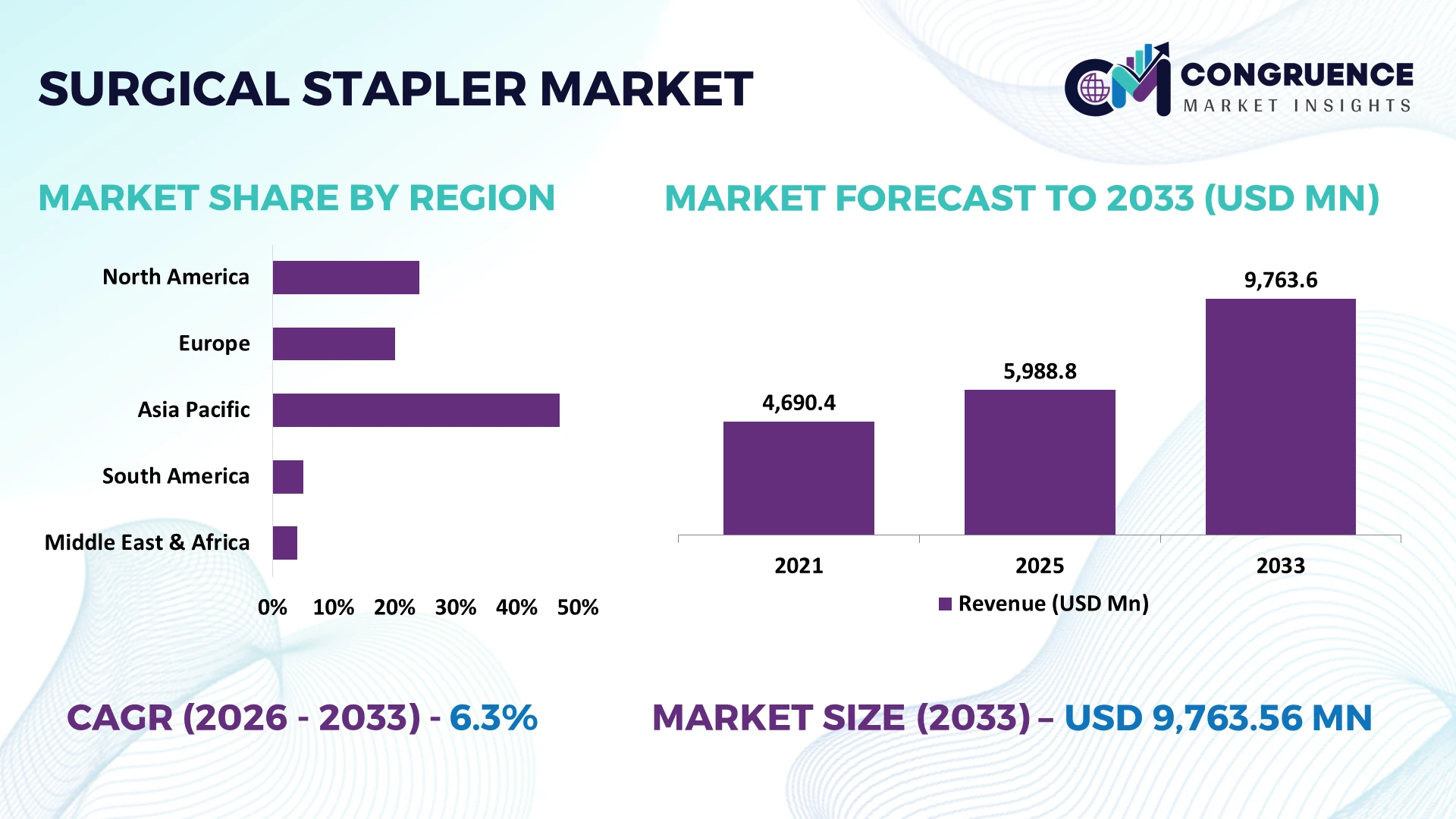
The United States remains the dominant market, accounting for approximately 39% of global procedural adoption, supported by advanced healthcare infrastructure, sustained medical device investments, and rapid integration of powered stapling platforms across high-volume surgical centers. Compared with Germany, where advanced stapler utilization exceeds 68% in tertiary hospitals, the U.S. benefits from larger procedure volumes and broader technology deployment. Following ongoing supply-chain diversification after Red Sea shipping disruptions, manufacturers accelerated regional production and inventory resilience, strengthening product availability across major healthcare networks.
Strategically, companies expanding localized manufacturing, advanced product portfolios, and hospital partnerships are positioned to capture long-term procurement opportunities in high-value surgical markets.
Market Size & Growth: USD 5988.83 Million in 2025 is projected to reach USD 9763.56 Million by 2033 at a CAGR of 6.3%, supported by wider adoption of advanced minimally invasive surgery platforms.
Top Growth Drivers: Minimally invasive procedures contribute nearly 45% of demand growth, powered staplers improve surgical consistency by approximately 22%, and outpatient surgery expansion exceeds 18% across major healthcare systems.
Short-Term Forecast: By 2028, powered stapling solutions reduce operating time by approximately 15% while improving procedural efficiency by nearly 12% in high-volume hospitals.
Emerging Technologies: AI-assisted surgical planning, smart powered staplers, and advanced bio-compatible materials accelerate precision, digital workflow integration, and tissue management.
Regional Leaders: North America approaches USD 3.8 Billion, Europe exceeds USD 2.4 Billion, and Asia-Pacific advances beyond USD 2.7 Billion through expanding hospital modernization and regional manufacturing capacity.
Consumer/End-User Trends: More than 70% of tertiary hospitals increasingly prioritize powered stapling systems for complex gastrointestinal, thoracic, and bariatric procedures.
Pilot/Case Example: In 2026, digital operating room integration improved surgical workflow efficiency by approximately 17% while reducing instrument preparation delays by 14%.
Competitive Landscape: The leading manufacturer holds approximately 24% market share alongside major competitors including Medtronic, Johnson & Johnson, B. Braun, Intuitive Surgical, and Purple Surgical, strengthening global product portfolios through regional expansion.
Regulatory & ESG Impact: Sustainable manufacturing initiatives reduce production waste by nearly 16%, while strengthened quality compliance improves product consistency across global supply chains.
Investment & Funding: More than USD 1.2 Billion in manufacturing expansion, partnerships, and production modernization strengthens supply resilience and regional capacity.
Innovation & Future Outlook: Next-generation powered staplers, digital surgical connectivity, and ergonomic device design accelerate high-growth adoption while supporting precision-focused surgical ecosystems.
Increasing demand for gastrointestinal, bariatric, thoracic, and colorectal procedures continues to reshape the Surgical Stapler Market, with powered and smart stapling platforms improving procedural consistency and workflow efficiency. Advanced tissue-sensing technologies now enhance staple formation accuracy by approximately 20%, while regional manufacturing expansion strengthens supply resilience amid evolving regulatory requirements and global logistics adjustments, setting the stage for broader strategic market developments.
The Surgical Stapler Market has become strategically important as healthcare providers prioritize procedure standardization, operating room efficiency, and value-based clinical outcomes. Competition increasingly centers on powered stapling systems, digital surgical integration, and localized manufacturing capabilities rather than product availability alone. Supply-chain restructuring following recent global logistics disruptions has encouraged manufacturers to establish regional production hubs and dual-sourcing strategies, improving procurement stability while reducing lead-time variability for hospitals.
Powered surgical staplers deliver approximately 18% faster tissue transection and reduce manual firing force by nearly 30% compared with conventional manual devices, enabling greater procedural consistency in complex laparoscopic interventions. The United States leads large-scale deployment through advanced robotic surgery infrastructure, while Japan demonstrates higher adoption of precision surgical technologies within specialized gastrointestinal centers. Over the next two to three years, digital operating room connectivity is expected to exceed 40% deployment among major tertiary hospitals, supporting workflow optimization, real-time instrument tracking, and improved surgical inventory management.
A practical example is the integration of powered stapling platforms into robotic-assisted colorectal surgery programs, where hospitals streamline procedural workflows while improving instrument utilization. Manufacturers are expanding production capacity, strengthening hospital partnerships, and investing in surgeon training alongside software-enabled surgical ecosystems. Organizations that combine technology innovation with resilient manufacturing networks and clinical collaboration will secure stronger competitive positioning and sustained operational advantage as procedural complexity continues to increase.
The accelerating transition toward minimally invasive and robotic-assisted procedures remains the strongest structural driver for the Surgical Stapler Market. More than 65% of complex gastrointestinal procedures in leading hospitals now utilize advanced stapling technologies, while powered systems improve staple line consistency by approximately 20% and shorten operating time by nearly 15%. The United States continues expanding robotic surgery infrastructure, encouraging hospitals to modernize surgical instrument portfolios. This operational shift increases procurement of premium stapling devices and disposable cartridges. Manufacturers are responding through production expansion, technology partnerships, and ergonomic product innovation, while integrating digital compatibility with robotic platforms. Companies securing clinical validation and surgeon adoption gain stronger purchasing leverage within high-volume healthcare networks.
Premium powered stapling systems and disposable reload cartridges continue to create procurement challenges, particularly for mid-sized healthcare providers. Device acquisition costs remain approximately 25% higher than conventional alternatives, while regulatory validation and post-market compliance activities can increase product launch timelines by nearly 18%. Germany and other highly regulated healthcare markets require extensive quality documentation before procurement approval, slowing commercialization. Hospitals also face budget constraints when balancing capital equipment investments with disposable surgical supplies. To reduce operational risk, manufacturers are diversifying component sourcing, localizing selected production activities, and negotiating long-term supply agreements. These strategies improve supply continuity while helping stabilize pricing and strengthen procurement confidence across institutional buyers.
Integration of smart powered staplers with digital operating room platforms creates significant operational opportunities beyond traditional device sales. AI-assisted procedural analytics and sensor-enabled tissue compression technologies improve firing accuracy by approximately 16%, while digital workflow integration reduces instrument preparation time by nearly 14%. India continues investing in tertiary healthcare expansion and advanced surgical infrastructure, increasing demand for precision surgical devices across public and private hospitals. Manufacturers are strengthening R&D partnerships, expanding regional assembly capabilities, and collaborating with robotic surgery developers to accelerate innovation. A notable strategic opportunity lies in combining connected surgical devices with procedural data analytics, enabling differentiated clinical support services alongside conventional product portfolios.
Long-term market expansion depends on successful integration of advanced stapling technologies into increasingly digital surgical environments. Approximately 35% of hospitals continue facing shortages of highly trained minimally invasive surgery specialists, while implementation of new surgical platforms extends procedural training requirements by nearly 20%. As robotic operating rooms become more interconnected, compatibility across multiple device ecosystems presents additional operational complexity. Japan and the United States are investing heavily in surgeon education and simulation-based training to improve deployment consistency. Manufacturers must strengthen clinical education programs, expand interoperability standards, and invest in digital service capabilities to ensure sustainable adoption. Companies that solve workforce readiness and technology integration challenges will establish stronger competitive resilience in advanced surgical care.
Powered Staplers Gain Clinical Preference Powered surgical staplers are replacing manual devices across high-volume surgical centers, with adoption increasing by approximately 21% over the past two years. Hospitals report nearly 16% lower instrument handling time and around 13% greater procedural consistency during complex laparoscopic procedures. Growing robotic surgery programs in the United States are accelerating this transition, prompting manufacturers to expand powered product portfolios, increase production capacity, and strengthen surgeon training partnerships to support standardized clinical workflows.
Digital Operating Room Integration Connected operating rooms are becoming a procurement priority, with digital surgical workflow deployment exceeding 38% among leading tertiary hospitals. Smart instrument tracking reduces inventory discrepancies by approximately 18%, while integrated surgical data platforms improve operating room utilization by nearly 12%. Healthcare digitization initiatives and stricter hospital efficiency targets are encouraging device manufacturers to integrate software compatibility, cloud-enabled reporting, and workflow automation into next-generation surgical stapling ecosystems.
Localized Manufacturing Reshapes Supply Networks Manufacturers are restructuring production strategies following persistent logistics disruptions and component availability challenges. Regional manufacturing investments have reduced average delivery lead times by approximately 20%, while localized sourcing has lowered procurement uncertainty by nearly 15%. Companies operating in Germany, Japan, and the United States are increasing dual-sourcing arrangements and expanding regional assembly facilities to improve operational resilience, strengthen customer responsiveness, and stabilize institutional supply commitments.
Advanced Tissue Technologies Expand Value Tissue-responsive firing mechanisms and advanced staple formation technologies are improving clinical precision across specialized procedures. Modern compression systems enhance staple formation accuracy by approximately 19% while reducing tissue trauma indicators by nearly 14%. Increasing regulatory emphasis on surgical quality outcomes is accelerating product innovation. Manufacturers are investing in biomaterial research, intelligent compression algorithms, and collaborative development programs with healthcare institutions to differentiate premium product lines and strengthen long-term competitive positioning.
Manual, Powered, Linear, and Circular surgical staplers continue serving distinct procedural requirements, although powered staplers lead the market with an estimated 41% share due to superior firing consistency, reduced surgeon fatigue, and compatibility with minimally invasive procedures. Hospitals increasingly prioritize powered systems because they improve procedural precision by approximately 18% while reducing manual force requirements by nearly 30%. Linear staplers remain widely deployed across gastrointestinal and thoracic procedures because of their versatility, whereas circular staplers retain strategic importance for anastomosis applications requiring precise tissue approximation.
Powered staplers also represent the fastest-growing segment as robotic-assisted surgery expands within advanced healthcare systems. Adoption of powered platforms has increased by approximately 20% across major tertiary hospitals, encouraging manufacturers to accelerate product innovation, expand disposable reload portfolios, and strengthen robotic surgery partnerships. Meanwhile, manual staplers continue maintaining relevance in cost-sensitive healthcare environments where affordability and procedural familiarity remain decisive procurement factors. Companies are balancing premium technology investment with broader product diversification to address varying clinical and institutional purchasing priorities.
General Surgery, Gynecological Surgery, Gastrointestinal Surgery, Thoracic Surgery, and Orthopedic Surgery collectively support sustained demand, with Gastrointestinal Surgery accounting for approximately 34% of total procedural utilization. High procedural volumes, increasing colorectal interventions, and broader adoption of laparoscopic techniques continue strengthening this segment. Stapling device utilization in gastrointestinal procedures has improved procedural efficiency by nearly 17%, while enhanced tissue management technologies contribute to greater clinical consistency. General Surgery remains the largest mature application base because of its broad procedural diversity across hospitals.
Thoracic Surgery represents the fastest-growing application as minimally invasive lung procedures and robotic-assisted interventions become more widely implemented. Adoption has expanded by approximately 19% within specialized surgical centers, while Gynecological Surgery continues integrating powered stapling systems for selected complex procedures. Orthopedic Surgery maintains a specialized but stable position where stapling devices support selected soft-tissue closure applications. Manufacturers are expanding specialty-focused product development, surgeon education programs, and application-specific device configurations to strengthen clinical adoption across multiple procedural disciplines.
Hospitals remain the dominant end-user, representing approximately 68% of overall demand because they perform the highest volume of complex surgical procedures and maintain advanced operating room infrastructure. Large healthcare institutions increasingly deploy powered staplers and integrated surgical technologies, improving operating room efficiency by nearly 15% while supporting multidisciplinary surgical programs. Trauma Centers maintain strong demand for rapid emergency interventions, whereas Specialty Clinics continue expanding their focus on selected elective procedures requiring precision surgical instruments.
Ambulatory Surgical Centers represent the fastest-growing end-user segment as outpatient procedures increase and healthcare providers emphasize shorter patient stays. Adoption within these facilities has expanded by approximately 22%, supported by streamlined workflows and greater investment in minimally invasive surgery capabilities. Manufacturers are responding through customized product bundles, flexible pricing strategies, clinical education partnerships, and distribution expansion tailored to outpatient healthcare providers. This shift is gradually diversifying procurement patterns beyond traditional hospital-centric purchasing models while strengthening long-term market competitiveness.
North America accounted for the largest market share at 39.0% in 2025 however, Asia-Pacific is expected to register the fastest growth, expanding at a 7.6% CAGR between 2026 and 2033.

Advanced Surgical Technology Drives Clinical Leadership
North America maintains the highest concentration of advanced surgical stapler deployment, supported by established robotic surgery infrastructure, high procedural volumes, and rapid adoption of powered surgical instruments. The region contributes approximately 39% of global market demand, with more than 72% of tertiary hospitals utilizing advanced stapling technologies for minimally invasive procedures. Investments in digital operating rooms and integrated surgical platforms continue strengthening procurement of premium stapling systems. Hospital networks increasingly standardize surgical devices across multi-site facilities to improve operational consistency and inventory efficiency. Strategic collaborations between medical device manufacturers and healthcare providers are accelerating product validation, surgeon education, and workflow optimization while strengthening regional supply resilience through localized production and distribution expansion.
United States Market Outlook: The United States remains the operational center of the regional market because of its extensive hospital infrastructure, advanced robotic surgery ecosystem, and continuous investment in precision surgical technologies. More than 75% of large academic medical centers have expanded minimally invasive surgery programs incorporating powered stapling systems. Manufacturers continue increasing domestic production capacity, clinical training partnerships, and digital surgery integration to strengthen procurement opportunities across high-volume healthcare networks.
Regulatory Modernization Supports Premium Device Adoption
Europe continues strengthening its position through advanced healthcare infrastructure, strict medical device quality standards, and increasing deployment of minimally invasive surgical technologies. The region accounts for approximately 28% of global market activity, with powered stapler utilization exceeding 66% across leading tertiary hospitals. Continued implementation of modern medical device regulations encourages higher product quality while accelerating investment in innovation and manufacturing modernization. Healthcare providers increasingly prioritize standardized surgical technologies that improve procedural consistency and operating room efficiency. Manufacturers are expanding regional production capabilities, strengthening distribution partnerships, and introducing advanced tissue management technologies aligned with evolving clinical requirements and procurement standards.
Germany Market Outlook: Germany leads the European market through its highly developed medical technology industry, advanced hospital infrastructure, and strong surgical innovation ecosystem. More than 68% of tertiary healthcare facilities routinely utilize advanced stapling systems during minimally invasive procedures. Domestic manufacturers continue investing in automation, precision manufacturing, and clinical collaboration programs, strengthening Germany's position as a strategic production and innovation hub for premium surgical devices.
Healthcare Expansion Accelerates Technology Deployment
Asia-Pacific is rapidly expanding through hospital infrastructure modernization, increasing surgical procedure volumes, and strong manufacturing capabilities. The region represents approximately 24% of global demand while recording the fastest operational expansion. Government-supported healthcare investments and broader access to minimally invasive procedures continue driving advanced stapler adoption. Regional manufacturers are expanding production facilities and improving localized supply chains, reducing delivery timelines by nearly 18%. International companies are strengthening partnerships with healthcare providers while expanding regional assembly operations to improve responsiveness and support growing institutional procurement requirements.
China Market Outlook: China leads regional deployment through large-scale healthcare expansion, domestic medical device manufacturing, and continuous investment in advanced surgical technologies. More than 60% of provincial tertiary hospitals have upgraded minimally invasive surgery capabilities, creating sustained demand for powered stapling devices. Manufacturers are expanding localized production, strengthening hospital partnerships, and increasing R&D investment to improve product competitiveness while supporting national healthcare modernization initiatives.
Hospital Modernization Expands Surgical Capacity
South America continues strengthening demand through gradual healthcare modernization, increasing access to minimally invasive procedures, and expanding private hospital investment. The region accounts for approximately 5% of global market activity, with major urban healthcare systems leading technology deployment. Private hospital groups have increased investment in advanced surgical equipment by nearly 16%, supporting wider utilization of powered staplers. Infrastructure disparities and import dependency remain operational constraints; however, procurement partnerships and regional distribution expansion are improving product accessibility. Companies are enhancing after-sales support, clinical education, and localized logistics to improve market penetration and strengthen long-term institutional relationships.
Brazil Market Outlook: Brazil represents the largest national market due to its extensive hospital network, expanding private healthcare sector, and increasing adoption of minimally invasive surgical procedures. Advanced surgical device procurement has grown steadily across major metropolitan healthcare systems, while domestic distributors continue strengthening logistics and technical support capabilities. Strategic partnerships between manufacturers and hospital networks are improving technology access and clinical training throughout the country.
Healthcare Investment Strengthens Surgical Infrastructure
The Middle East & Africa market continues advancing through hospital modernization, healthcare infrastructure investment, and expansion of specialized surgical services. The region contributes approximately 4% of global demand, with advanced healthcare projects supporting higher deployment of premium surgical technologies. Investment in new tertiary hospitals and specialized surgical centers has increased by nearly 20% across key healthcare markets, encouraging procurement of powered stapling systems. International manufacturers continue expanding regional distribution partnerships and technical support networks while strengthening product availability through localized inventory strategies. Public healthcare transformation initiatives are further improving access to advanced surgical equipment.
Saudi Arabia Market Outlook: Saudi Arabia leads regional development through sustained healthcare infrastructure expansion and significant investment in advanced medical technologies under national healthcare transformation programs. New specialist hospitals increasingly prioritize minimally invasive surgery capabilities, supporting greater deployment of powered stapling systems. Medical device suppliers continue expanding regional service centers, clinical education programs, and strategic partnerships with healthcare providers to strengthen operational capabilities and improve long-term technology adoption.
The Surgical Stapler Market is led by Medtronic, Johnson & Johnson, B. Braun, Intuitive Surgical, and Frankenman International, with global technology leaders competing against regional manufacturers focused on cost efficiency and localized distribution. The top five players collectively control approximately 68% of the market through extensive product portfolios, clinical relationships, and manufacturing scale. Competition is driven by powered stapling technology, procedural precision, supply-chain resilience, and hospital integration, with powered platforms improving workflow efficiency by nearly 18% and localized production reducing delivery times by approximately 20%. Leading companies continue expanding manufacturing capacity, forming hospital partnerships, investing in robotic surgery compatibility, and strengthening vertical integration to secure component availability. Regional manufacturers compete aggressively through pricing flexibility, customized product offerings, and faster procurement support. Rising regulatory requirements, surgeon training demands, and clinical validation create significant entry barriers. Winning requires continuous innovation, resilient manufacturing, strong clinical evidence, integrated digital capabilities, and trusted long-term healthcare partnerships.
Medtronic
Johnson & Johnson
B. Braun SE
Intuitive Surgical
Frankenman International
Purple Surgical
Meril Life Sciences
Grena Ltd.
Reach Surgical
Victor Medical Instruments
Golden Stapler Surgical
Panther Healthcare
Teleflex Incorporated
Conmed Corporation
Powered surgical staplers remain the core technology transforming modern operating rooms, with deployment exceeding 62% across advanced tertiary hospitals. Compared with conventional manual staplers, powered systems improve firing consistency by approximately 20% and reduce surgeon hand force by nearly 30%, supporting greater precision during minimally invasive procedures. Integration with robotic-assisted surgery platforms and digital operating room workflows is accelerating, enabling standardized instrument performance, streamlined inventory management, and enhanced procedural efficiency. These technologies provide hospitals with measurable workflow improvements while strengthening manufacturers' competitive differentiation through premium product portfolios.
Emerging technologies between 2026 and 2028 include intelligent tissue-sensing systems, adaptive compression algorithms, and smart reload platforms capable of optimizing staple formation across varying tissue thicknesses. Early deployments demonstrate approximately 16% higher staple-line accuracy and nearly 14% lower tissue trauma than previous-generation devices. Adoption of connected surgical platforms has surpassed 40% among leading academic medical centers, supporting real-time procedural analytics and predictive maintenance. Companies expanding software-enabled surgical ecosystems gain stronger procurement advantages as hospitals prioritize integrated technology over standalone devices.
Disruptive innovation is shifting toward AI-enabled procedural guidance, reusable powered stapling platforms, and robotic interoperability. Next-generation systems reduce operating room preparation time by approximately 12% while lowering selected disposable usage by nearly 15% through optimized device utilization. Technology leaders investing in digital surgery partnerships, localized manufacturing, and intelligent stapling platforms will strengthen market leadership, while slower adopters risk losing competitiveness as hospitals increasingly standardize connected surgical ecosystems through 2026–2028.
June 2025 Johnson & Johnson launched the ETHICON™ 4000 Stapler in the United States, introducing proprietary 3D Stapling Technology with redesigned reload options supporting improved staple-line integrity across multiple specialties. Business impact: strengthened advanced stapling portfolio and robotic surgery readiness. Source: jnj.com
May 2025 Ethicon Endo-Surgery received U.S. FDA 510(k) clearance for the ETHICON 4000 Stapler platform and multiple 3D Reload configurations, expanding regulatory authorization across several device variants. Business impact: accelerated commercial deployment and broader hospital procurement opportunities. Source: fda.gov
April 2026 Reach Surgical obtained European CE Mark approval for the iREACH IRIS powered reusable stapler featuring up to 90° articulation and Real-Time Firing Curve technology. Business impact: strengthened competitive positioning in advanced powered stapling and minimally invasive surgery.
April 2026 Johnson & Johnson secured European CE Mark approval for the ETHICON™ 4000 Stapler, enabling deployment across European Union markets and future integration with the OTTAVA robotic platform. Business impact: expanded international commercialization and reinforced robotic surgery strategy. Source: jnj.com
This report provides comprehensive analysis across manual, powered, linear, and circular surgical staplers while evaluating demand across general, gynecological, gastrointestinal, thoracic, and orthopedic surgery applications. End-user assessment covers hospitals, ambulatory surgical centers, specialty clinics, and trauma centers, with regional evaluation spanning North America, Europe, Asia-Pacific, South America, and the Middle East & Africa. More than 60% of current technology deployment is concentrated in advanced powered stapling platforms, reflecting the industry's transition toward precision surgical workflows and digital operating environments.
The study examines competitive positioning, technology adoption, manufacturing trends, procurement strategies, regulatory developments, and supply-chain transformation shaping the market between 2026 and 2033. It evaluates deployment patterns, innovation pipelines, enterprise partnerships, and regional expansion strategies while highlighting emerging opportunities in robotic-assisted surgery, intelligent stapling systems, and connected operating rooms. The report supports investment prioritization, product development, geographic expansion, competitive benchmarking, and long-term strategic planning through detailed operational and segment-level market intelligence.
| Report Attribute/Metric | Report Details |
|---|---|
Market Revenue in 2025 | USD 5988.83 Million |
Market Revenue in 2033 | USD 9763.56 Million |
CAGR (2026 - 2033) | 6.3% |
Base Year | 2025 |
Forecast Period | 2026 - 2033 |
Historic Period | 2021 - 2025 |
Segments Covered | By Type
By Application
By End-User
|
Key Report Deliverable | Revenue Forecast, Growth Trends, Market Dynamics, Segmental Overview, Regional and Country-wise Analysis, Competition Landscape |
Region Covered | North America, Europe, Asia-Pacific, South America, Middle East, Africa |
Key Players Analyzed | Medtronic, Johnson & Johnson, B. Braun SE, Intuitive Surgical, Frankenman International, Purple Surgical, Meril Life Sciences, Grena Ltd., Reach Surgical, Victor Medical Instruments, Golden Stapler Surgical, Panther Healthcare, Teleflex Incorporated, Conmed Corporation |
Customization & Pricing | Available on Request (10% Customization is Free) |




