
Reports
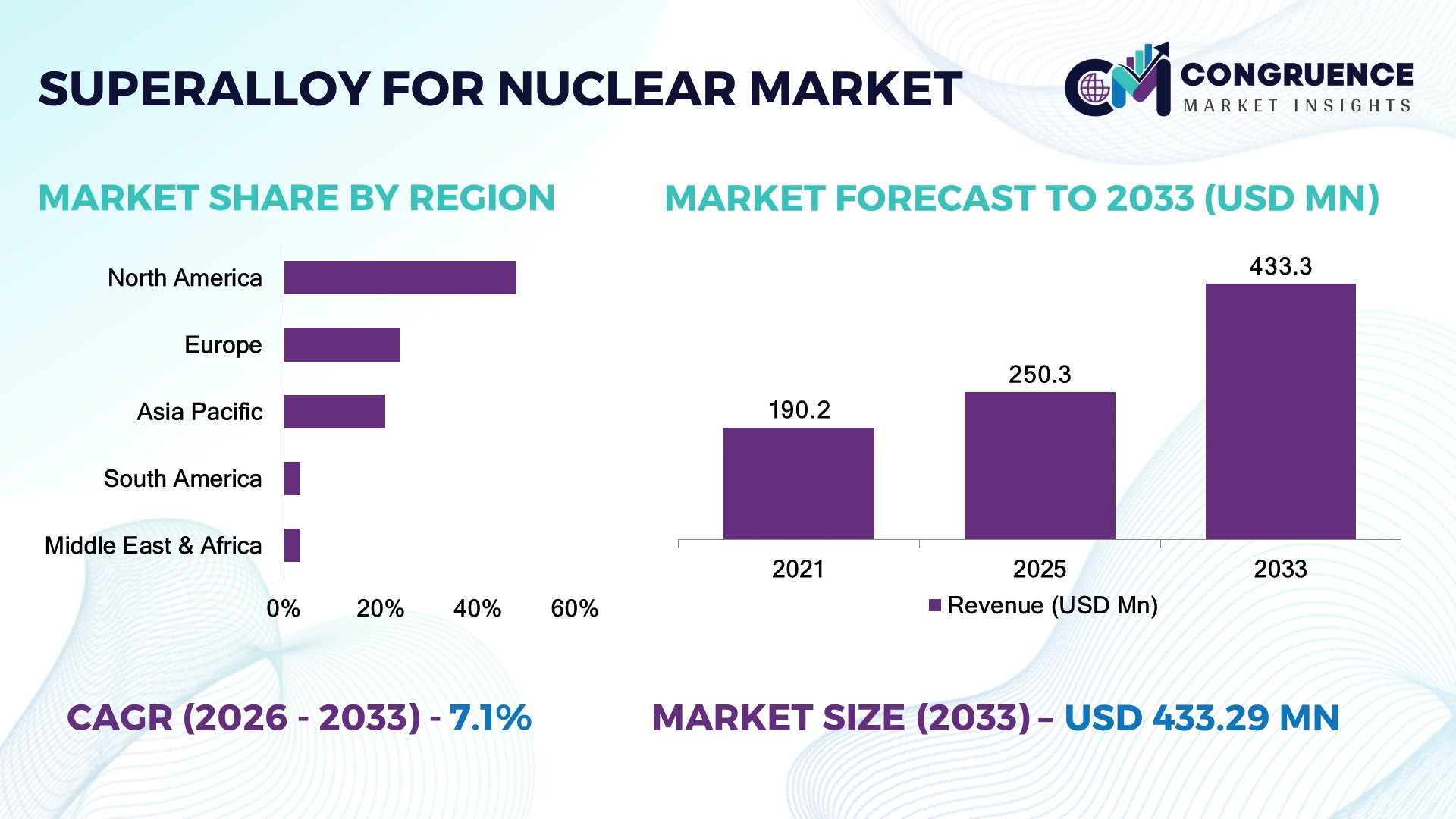
The Global Superalloy for Nuclear Market was valued at USD 250.3 Million in 2025 and is anticipated to reach a value of USD 433.3 Million by 2033 expanding at a CAGR of 7.1% between 2026 and 2033. Growth is driven by advanced reactor construction, life-extension programs, high-temperature component replacement, and domestic nuclear supply-chain localization.
The United States dominates strategic demand, supported by approximately 94% of recently initiated reactor construction relying on Chinese or Russian designs globally, intensifying domestic material-security priorities. U.S. programs target 10 new large reactors, while India has 13.1 GW under implementation, creating a contrasting scale opportunity. Cobalt supply concentration above 75% also accelerates low-cobalt alloy development.
Strategic implication: suppliers with nuclear qualification, secure alloy inputs, and advanced manufacturing capabilities hold the strongest positioning as reactor supply chains are restructured.
Market Size & Growth: USD 250.3 million in 2025 to USD 433.3 million by 2033 at 7.1% CAGR, driven by advanced-reactor construction and component replacement.
Top Growth Drivers: 35% advanced-reactor investment; 28% life-extension programs; 22% supply-chain localization.
Short-Term Forecast: By 2028, qualified additive-manufacturing capacity is targeted to improve material utilization by 20–40% versus conventional machining.
Emerging Technologies: AI-enabled process monitoring, additive manufacturing, powder metallurgy, and cobalt-lean superalloys are reshaping nuclear-component production.
Regional Leaders: North America is projected at approximately USD 165 million; Asia-Pacific USD 134 million; Europe USD 104 million, reflecting U.S. supply-chain rebuilding, Chinese reactor construction, and European modernization.
Consumer/End-User Trends: Nuclear utilities and reactor OEMs increasingly prioritize traceable materials, with qualification and lifecycle documentation becoming procurement requirements.
Pilot/Case Example: 2025 manganese-based alloy research replaced cobalt, targeting advanced-reactor applications and reducing exposure to cobalt supply concentrated above 75% in China-controlled sources.
Competitive Landscape: Leading suppliers including Special Metals, ATI, Carpenter Technology, Haynes International, and VDM Metals collectively represent approximately 48% of nuclear-grade superalloy supply, competing through qualification, alloy performance, and delivery reliability.
Regulatory & ESG Impact: Domestic sourcing initiatives increasingly prioritize resilient nuclear supply chains, while cobalt-reduced formulations lower exposure to critical-material constraints.
Investment & Funding: U.S. nuclear supply-chain financing reached USD 17.5 billion in 2026, accelerating long-lead procurement and strengthening qualified-material demand.
Innovation & Future Outlook: 2026–2028 investment is shifting toward additive nuclear components, low-cobalt formulations, automated inspection, and vertically controlled alloy-processing ecosystems.
The Superalloy for Nuclear Market is strengthening across reactor pressure systems, heat exchangers, turbine components, fasteners, and high-temperature internals. Demand is shifting toward nickel-based and cobalt-lean formulations, with advanced manufacturing reducing material waste by 20–40%. U.S. supply-chain localization and reactor construction are accelerating qualified domestic sourcing, creating a natural transition toward strategic investment priorities.
Superalloy for Nuclear is becoming a strategic materials category because reactor expansion increasingly depends on components capable of sustaining radiation, corrosion, creep, and extreme temperatures. Global nuclear capacity reached 420 GW at the end of 2025, with 78 GW under construction, increasing the importance of secure, qualified alloy supply. The U.S. is rebuilding domestic nuclear supply chains, while China concentrates approximately half of global construction capacity.
Technology is also changing procurement economics. Additive manufacturing can reduce material waste by roughly 20–40% compared with conventional machining for complex geometries, while enabling optimized channels and component designs. Conventional wrought Inconel 718 and 625 remain established, but cobalt-lean alloys are gaining strategic relevance as more than 75% of raw cobalt originates from China-controlled mines.
During 2026–2028, utilities and reactor OEMs will prioritize qualified suppliers capable of combining metallurgy, digital inspection, powder traceability, and scalable production. A practical deployment path is additive manufacture of complex heat-exchanger or reactor-support components followed by nuclear qualification. Companies are therefore investing in domestic capacity, partnering with reactor developers, and securing critical inputs. Competitive advantage will belong to suppliers that combine performance, qualification, supply security, and manufacturing flexibility.
Advanced reactor programs are increasing demand for nickel-based superalloys capable of maintaining creep strength and corrosion resistance under extreme operating conditions. The United States has more than 20 advanced reactor designs under development, while China accounts for roughly 50% of reactors currently under construction globally. Nuclear-grade component qualification increasingly prioritizes alloys supporting temperatures above 700°C. This shift is encouraging producers to expand vacuum melting, powder metallurgy, and precision-forging capacity. Companies are also forming technology partnerships with reactor developers to qualify materials earlier in design cycles. The strategic opportunity is moving upstream: suppliers participating during reactor engineering gain stronger specification influence and longer procurement visibility.
Superalloy production remains exposed to concentrated supplies of nickel, cobalt, chromium, and specialty alloying elements. China controls more than 75% of global cobalt refining capacity, while nickel prices have experienced substantial volatility since 2022. Cobalt-intensive formulations therefore face greater procurement sensitivity than low-cobalt alternatives, while nuclear qualification requirements restrict rapid material substitution. These constraints increase working-capital requirements and complicate fixed-price contracts for long-cycle reactor projects. U.S. manufacturers are responding through domestic sourcing agreements, recycled feedstock, multi-year procurement contracts, and alloy redesign. The non-obvious pressure is qualification economics: even when an alternative alloy is technically viable, requalification can delay commercialization and offset raw-material savings.
Low-cobalt superalloys represent a high-value opportunity as reactor developers seek materials with lower critical-mineral exposure without sacrificing irradiation resistance or high-temperature strength. Advanced formulations can reduce cobalt intensity by approximately 30–50% in targeted compositions, while additive manufacturing can lower material waste by 20–40% for complex components. India and the United States are strengthening domestic nuclear manufacturing ecosystems, creating demand for qualified alternative materials. Companies are increasing metallurgical R&D, computational alloy design, and additive-production trials. The strongest opportunity lies in supplying reactor-specific alloys co-developed with OEMs, because early qualification converts material innovation into embedded specifications and reduces dependence on commodity-driven alloy formulations.
Nuclear superalloy suppliers face demanding qualification, traceability, inspection, and documentation requirements that complicate production scaling across facilities. Nuclear components can require multiple destructive and nondestructive testing stages, while manufacturing deviations below 1% can trigger extensive review when they affect qualified processes. Additive manufacturing adds further complexity through powder consistency, thermal-history control, and defect detection. U.S. and European producers are therefore investing in automated inspection, digital material passports, process monitoring, and statistical quality controls. Workforce capability is another pressure point, particularly for vacuum metallurgy and nuclear-grade machining. Competitive sustainability increasingly depends on reproducing identical material properties across production lots, not simply increasing nominal manufacturing capacity.
Low-Cobalt Formulations Gain Priority: Nuclear material developers are reducing cobalt intensity by approximately 30–50% in targeted superalloy compositions as China-controlled refining exceeds 75% of global capacity. The shift is changing qualification pipelines, encouraging U.S. and European producers to invest in alternative chemistries, recycled inputs, and long-term critical-material contracts.
Additive Manufacturing Enters Qualification: Nuclear component producers are moving additive manufacturing from prototyping toward qualified production, with complex geometries achieving approximately 20–40% lower material waste than conventional machining. Automated powder handling and in-process monitoring are improving repeatability, while reactor developers increasingly engage suppliers earlier to establish component-specific qualification pathways.
Digital Inspection Becomes Standard: Automated ultrasonic, computed-tomography, and metallurgical inspection are gaining importance as nuclear manufacturers tighten defect-control requirements. Digital monitoring can reduce inspection-cycle duration by approximately 15–25% in optimized workflows. Producers are integrating traceability systems with manufacturing records, creating stronger batch accountability and reducing documentation friction during regulatory reviews.
Domestic Supply Chains Accelerate: U.S. and Indian nuclear programs are increasing emphasis on locally qualified materials, with advanced reactor initiatives creating new procurement pathways beyond traditional suppliers. Domestic sourcing can reduce exposure to concentrated specialty-metal inputs by approximately 20%, encouraging producers to establish regional melting, forging, testing, and finishing partnerships rather than relying on distant supply chains.
Nickel-based superalloys lead the Superalloy for Nuclear Market with approximately 66.3% share in 2025, reflecting their established combination of high-temperature strength, creep resistance, oxidation stability, and irradiation tolerance. Iron-based superalloys follow at about 23.5%, offering a more economical option where extreme thermal performance is not the primary design constraint. Cobalt-based grades account for roughly 10.2% and remain specialized because of higher critical-material exposure. Nickel-based formulations therefore remain the preferred specification for demanding reactor and balance-of-plant components, while iron-based materials gain relevance where cost and manufacturability carry greater weight.
The fastest-moving shift is toward lower-cobalt and advanced nickel-iron formulations as nuclear developers address material-security requirements. A 2025 U.S. nuclear-materials program demonstrated a manganese-based alternative to cobalt, while research into Fe-Ni alloys for Gen-IV reactors is advancing process optimization. Companies are responding with alloy redesign, computational materials development, and qualification programs, shifting investment from conventional composition optimization toward critical-mineral resilience and reactor-specific performance.
Industry insight: U.S. nuclear researchers reported in 2025 that more than 75% of the world’s raw cobalt is sourced from Chinese-controlled mines, strengthening the commercial case for cobalt-reduced nuclear superalloys and diversified alloy chemistry.
Steam generators and heat exchangers represent the leading application, capturing approximately 45.7% of 2025 demand. Their concentration reflects continuous exposure to high temperature, pressure, corrosion, and thermal cycling, making material integrity central to reactor availability. Reactor internals follow at approximately 32.6%, requiring alloys capable of maintaining mechanical and dimensional stability under irradiation. Fuel assembly components account for about 14.5%, while other nuclear components represent 7.2%, serving specialized maintenance and balance-of-plant requirements.
Reactor internals are positioned as the fastest-developing application as advanced reactor concepts introduce more demanding thermal and irradiation environments. Conventional steam-cycle components remain procurement-heavy, whereas next-generation designs are increasing R&D spending on material qualification and microstructural control. Companies are therefore expanding application-specific alloy development, forging and powder-metallurgy capabilities, and partnerships with reactor developers. The business implication is a shift from selling standard grades toward engineered materials qualified for individual reactor architectures, increasing specification influence and strengthening long-term supplier relationships.
Industry insight: The UK Fission Materials Roadmap published in 2026 involved more than 100 specialists from 34 institutions, underscoring the scale of coordinated materials-development activity required for next-generation reactor applications.
Nuclear power utilities and reactor operators represent the dominant end-user group, accounting for an estimated 48% of market demand because they control plant maintenance, component replacement, lifecycle upgrades, and long-term material specifications. Reactor OEMs and nuclear-component manufacturers follow at approximately 32%, where material selection is embedded directly into engineering and qualification programs. Research institutions and advanced-reactor developers account for roughly 20%, but their strategic importance is increasing as next-generation designs enter demonstration phases.
Advanced-reactor developers represent the fastest-growing end-user group because new designs require materials validated against higher temperatures, irradiation conditions, and unconventional operating environments. Established utilities remain focused on qualified replacement materials and plant-life extension, creating a more specification-driven purchasing model. Companies are consequently segmenting commercial strategies: utilities receive lifecycle supply contracts, OEMs receive co-development and qualification support, while research organizations receive specialized alloy and manufacturing partnerships. This approach increases customer retention and moves suppliers earlier into reactor-design decisions.
In 2026, India’s 500 MWe Prototype Fast Breeder Reactor at Kalpakkam achieved first criticality after regulatory clearance, reinforcing demand for domestically qualified materials and demonstrating the importance of advanced-reactor end-user programs.
North America accounted for the largest market share at 48.0% in 2025 however, Asia-Pacific is expected to register the fastest growth, expanding at a CAGR of 8.0% between 2026 and 2033.
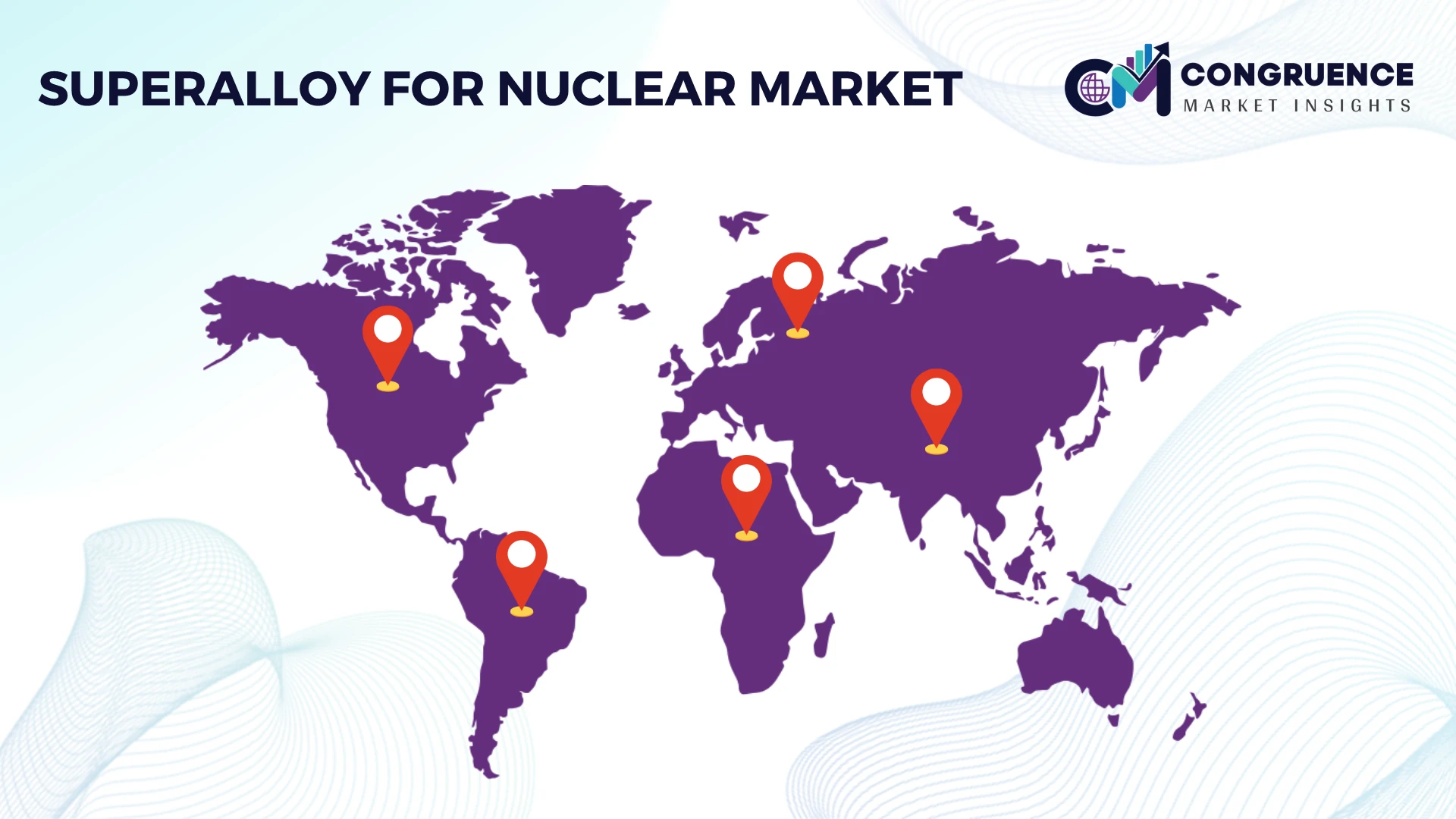
North America represents approximately 48.0% of Superalloy for Nuclear demand, supported by established reactor fleets, advanced manufacturing infrastructure, and concentrated aerospace-nuclear metallurgy capabilities. The United States remains the principal market, with utilities prioritizing life-extension components alongside new reactor technologies. Canada adds incremental demand through CANDU refurbishment and SMR development. In 2026, the region's strategic positioning strengthened as domestic nuclear manufacturing gained priority amid supply-chain security concerns. The United States is also advancing multiple microreactor and SMR programs, increasing future requirements for qualified nickel-based alloys, precision forgings, and high-integrity components. Suppliers are responding through domestic capacity expansion, long-term material contracts, and closer qualification partnerships with reactor developers. Global nuclear construction currently includes about 80 reactors, reinforcing the importance of reliable component supply.
United States Market Outlook: The United States offers the strongest combination of operating nuclear infrastructure, reactor engineering expertise, specialty-metal manufacturing, and advanced-materials research. The country is pursuing new large reactors alongside SMRs and microreactors, creating differentiated demand for high-temperature alloys. U.S. suppliers are increasingly emphasizing domestic melting, forging, powder processing, and nondestructive inspection. This integrated capability reduces qualification friction and improves control over strategically important nuclear-material supply chains.
Europe accounts for approximately 24.0% of demand, with France, Germany, the United Kingdom, and Sweden providing the principal industrial base. France remains particularly important because of its large operating reactor fleet and continuing investment in plant modernization. The region's materials strategy emphasizes lifecycle extension, traceability, corrosion resistance, and advanced manufacturing. The European supply chain is also adapting to geopolitical fragmentation by strengthening qualified domestic sourcing. Companies are investing in precision forging, metallurgical testing, and digital quality documentation to support long-duration nuclear contracts. France's Flamanville 3 entered the operating fleet in 2024, adding a new EPR reference to Europe's nuclear manufacturing ecosystem.
France Market Outlook: France represents Europe's strongest nuclear-materials market because nuclear generation remains central to its electricity system and its industrial base includes reactor engineering, heavy manufacturing, metallurgy, and fuel-cycle capabilities. The country's reactor fleet creates recurring demand for qualified replacement components, while new-build activity strengthens requirements for advanced nickel-based alloys. Suppliers benefit from close integration with nuclear OEMs and engineering contractors, particularly where material traceability and qualification history influence procurement decisions.
Asia-Pacific represents approximately 21.0% of current Superalloy for Nuclear demand but has the strongest new-build pipeline. China alone has 37 reactors under construction with approximately 38.6 GW of capacity, while India, South Korea, and Japan continue reactor construction, refurbishment, or technology-development programs. China's Hualong One and CAP-series deployment is particularly significant for standardized component sourcing. In 2026, multiple Chinese reactors reached grid connection, while construction also began on additional units in China, India, and South Korea. These projects are strengthening demand for domestically qualified alloys, forgings, welding consumables, and precision-machined components.
China Market Outlook: China is the region's most significant market because its nuclear program combines large-scale construction, domestic reactor technology, extensive heavy-industry capacity, and integrated manufacturing. With 64 operable reactors and 37 under construction, China provides an unusually large qualification and production ecosystem for nuclear materials. Domestic suppliers are increasingly positioned to serve standardized Hualong One and CAP-series requirements, strengthening localization and reducing reliance on imported specialty alloys.
South America remains a specialized market, with Brazil generating the majority of nuclear-related superalloy demand through its established nuclear-power infrastructure and industrial base. Demand is concentrated around reactor maintenance, component replacement, fuel-cycle activities, and engineering services rather than large-scale new construction. Argentina provides an additional technology pathway through its PHWR and small-reactor capabilities. Approximately 3.5% of global demand is attributable to South American applications, keeping procurement concentrated among qualified suppliers. Companies are responding through distributor relationships, regional service capabilities, and longer-term component supply arrangements. The strategic constraint is limited reactor construction compared with China or the United States, but lifecycle maintenance provides recurring high-specification demand.
Brazil Market Outlook: Brazil offers the strongest commercial position because Angra's nuclear infrastructure creates recurring requirements for qualified maintenance materials, specialized components, and metallurgical services. The country's broader steel and engineering capabilities support localized processing, although nuclear-grade qualification remains concentrated among specialized suppliers. Companies entering Brazil are therefore prioritizing technical partnerships and qualification support rather than commodity-scale alloy production, positioning themselves around lifecycle services and component reliability.
Middle East & Africa accounts for approximately 4.0% of current demand, with the United Arab Emirates and Egypt providing the clearest nuclear-project pipeline. The UAE's Barakah fleet has established an operating nuclear ecosystem, while Egypt's El Dabaa project is expanding regional demand for qualified components and specialized engineering services. Saudi Arabia is also developing nuclear ambitions, creating a longer-term materials opportunity. The region remains heavily dependent on imported nuclear-grade metallurgy, increasing the strategic value of qualified distributors and technical partnerships. Companies are building regional service capabilities, strengthening inventory buffers, and partnering with engineering contractors to shorten component lead times and improve lifecycle support.
United Arab Emirates Market Outlook: The UAE is the region's strongest operational market because the four-unit Barakah project provides an established nuclear-generation platform and a growing maintenance ecosystem. Its advanced industrial infrastructure and concentration of energy-sector investment support specialist component servicing and materials management. Suppliers with established nuclear certifications can leverage the operating fleet to build recurring maintenance relationships, while regional logistics capabilities enable the UAE to serve as a commercial hub for neighboring nuclear-development markets.
ATI, Carpenter Technology, Haynes International, VDM Metals, and Special Metals compete as global specialty-alloy suppliers, while Aubert & Duval and regional producers challenge them through customized metallurgy and localized supply. The top five players collectively account for approximately 45% of market value, indicating a moderately concentrated structure. Competition centers on qualification, alloy performance, delivery reliability, customization, and price, with advanced processing improving material utilization by 20–40% and digital inspection reducing quality-cycle time by roughly 15–25%. ATI emphasizes integrated melting, forging, and precision processing; Carpenter expands advanced manufacturing capabilities; Sandvik strengthens powder-based production partnerships; and regional producers pursue localization. The competitive shift is moving from commodity alloy supply toward reactor-specific qualification and vertically integrated materials engineering. Nuclear certification, traceability, specialized equipment, and long qualification cycles create substantial entry barriers. Winning requires nuclear-grade qualification, secure raw-material access, repeatable metallurgy, responsive customization, and early collaboration with reactor OEMs.
ATI Inc.
Carpenter Technology Corporation
Haynes International, Inc.
VDM Metals GmbH
Special Metals Corporation
Precision Castparts Corp.
Aubert & Duval
Aperam S.A.
Sandvik AB
Mitsubishi Materials Corporation
Nippon Yakin Kogyo Co., Ltd.
JFE Steel Corporation
Mishra Dhatu Nigam Limited
Doncasters Group
Vacuum melting, vacuum arc remelting, electroslag remelting, precision forging, and advanced heat treatment remain the core technologies for nuclear-grade superalloys. Vacuum processing improves cleanliness and compositional control, while automated process monitoring can reduce production variability by approximately 15%. Nuclear manufacturers increasingly combine metallurgical sensors with digital quality records, strengthening traceability across melting, forging, machining, and inspection stages.
Additive manufacturing is the principal disruptive technology, particularly laser powder-bed fusion using nickel-based powders such as IN718. Compared with subtractive machining, additive production can reduce material waste by approximately 20–40% for complex geometries while shortening prototype iteration cycles. Sandvik and Additive Industries introduced direct powder loading for MetalFab systems in 2025, demonstrating greater integration between powder supply and automated production. The competitive advantage favors suppliers controlling powder quality, process parameters, and qualification data simultaneously.
From 2026–2028, computational alloy design, AI-assisted process control, automated nondestructive testing, and digital material passports will move deeper into qualification workflows. Research on Y2O3-enhanced IN718 is improving grain and carbide control in powder-bed-fusion processing. Suppliers with closed-loop manufacturing can target 15–25% faster inspection and qualification workflows, while reactor OEM partnerships will determine which emerging materials progress from laboratory validation to commercial nuclear components. Acting now secures qualification experience and production learning before advanced-reactor procurement scales.
June 2025 Sandvik partnered with Additive Industries to supply Osprey 718 nickel superalloy powder directly into MetalFab systems. The program supports controlled powder handling for automated laser-bed fusion, strengthening repeatable production of complex nuclear-relevant components and reducing material-transfer steps. Source: sandvik.com
February 2026 ATI reported nickel-based and specialty alloys represented 46% of fiscal 2025 sales, reinforcing its high-performance materials focus. The portfolio includes alloys serving nuclear applications, supporting continued investment in qualified melting, forging, and advanced component capabilities. Source: atimaterials.com
November 2025 researchers demonstrated Y2O3-enhanced IN718 produced through laser powder-bed fusion, achieving defect-free processing while refining grains and carbide distribution. The development improves strength-ductility balance and supports qualification pathways for complex, high-temperature superalloy components for nuclear service. Source: sciencedirect.com
September 2026 India advanced plans to expand nuclear capacity toward 100 GW by 2047, creating incentives for domestic nuclear manufacturing and qualified materials. The policy direction increases strategic relevance of localized alloy production, testing, and component supply capabilities. Source: reuters.com
The report covers the Superalloy for Nuclear Market across nickel-based, iron-based, and cobalt-based alloys, with applications spanning steam generators, heat exchangers, reactor internals, fuel assembly components, and other nuclear components. Analysis also evaluates end-user requirements across utilities, reactor OEMs, component manufacturers, research organizations, and advanced-reactor developers.
Regional coverage includes North America, Europe, Asia-Pacific, South America, and Middle East & Africa, with country-level assessment of nuclear infrastructure, manufacturing capability, qualification activity, supply-chain localization, and investment priorities. The study evaluates vacuum metallurgy, precision forging, powder metallurgy, additive manufacturing, automated inspection, and digital traceability. With nickel-based alloys representing approximately 66% of demand, the report identifies critical-material exposure, emerging low-cobalt formulations, and reactor-specific qualification as strategic decision areas supporting investment planning, expansion strategy, supplier selection, and competitive positioning through 2033.
| Report Attribute/Metric | Report Details |
|---|---|
|
Market Revenue in 2025 |
USD 250.3 Million |
|
Market Revenue in 2033 |
USD 433.3 Million |
|
CAGR (2026 - 2033) |
7.1% |
|
Base Year |
2025 |
|
Forecast Period |
2026 - 2033 |
|
Historic Period |
2021 - 2025 |
|
Segments Covered |
By Type
By Application
By End-User
|
|
Key Report Deliverable |
Revenue Forecast, Growth Trends, Market Dynamics, Segmental Overview, Regional and Country-wise Analysis, Competition Landscape |
|
Region Covered |
North America, Europe, Asia-Pacific, South America, Middle East, Africa |
|
Key Players Analyzed |
ATI Inc., Carpenter Technology Corporation, Haynes International, Inc., VDM Metals GmbH, Special Metals Corporation, Precision Castparts Corp., Aubert & Duval, Aperam S.A., Sandvik AB, Mitsubishi Materials Corporation, Nippon Yakin Kogyo Co., Ltd., JFE Steel Corporation, Mishra Dhatu Nigam Limited, Doncasters Group |
|
Customization & Pricing |
Available on Request (10% Customization is Free) |




