
Reports
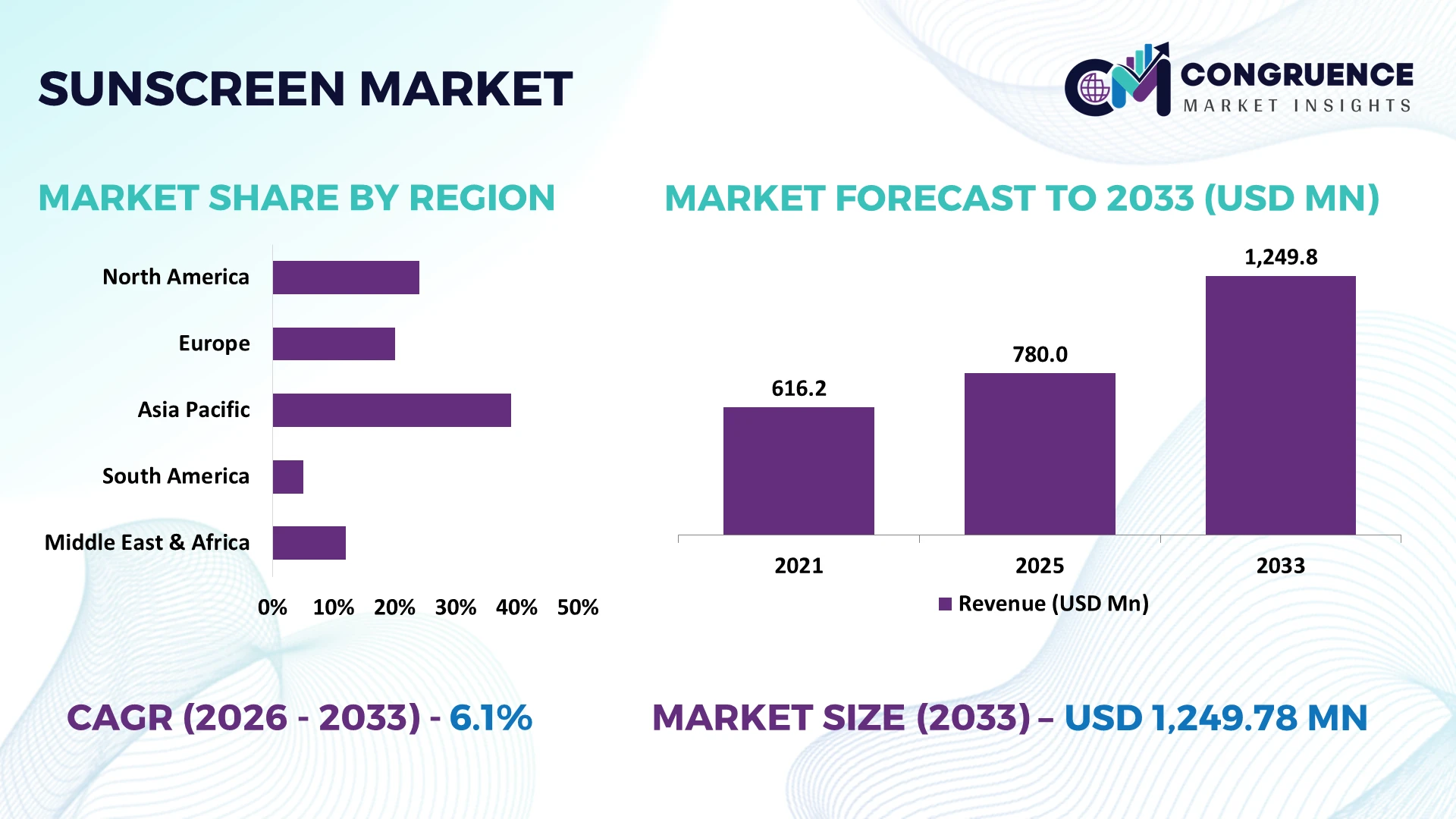
The Global Sunscreen Market was valued at USD 780 Million in 2025 and is anticipated to reach a value of USD 1249.78 Million by 2033 expanding at a CAGR of 6.07% between 2026 and 2033. Growth is being driven by daily facial-SPF adoption, mineral UV-filter innovation, stronger UVA protection standards, dermatology-led prevention, and premium multifunctional skincare incorporating SPF 30–50 protection.
The United States represents an estimated 28–30% of global sunscreen demand, supported by high dermatology penetration, outdoor recreation, and widespread SPF 30+ product adoption. Advanced zinc-oxide formulations now deliver substantially improved transparency versus traditional mineral creams, while SPF 30 blocks approximately 97% of UVB radiation. U.S.–EU differences in approved UV filters continue influencing formulation investment, sourcing, and product-launch strategies. Japan and South Korea outperform many Western markets in daily facial sunscreen integration, while Europe benefits from established UVA requirements linking protection performance to labelled SPF levels; this shifts competition toward lightweight, high-UVA, cosmetically elegant formulations.
Strategically, manufacturers should prioritize advanced mineral filters, daily-use facial formats, regional regulatory compatibility, and Asian beauty innovation to capture premium global sunscreen market demand.
Market Size & Growth: USD 780 million in 2025 advances toward USD 1,249.78 million by 2033 at 6.07%, supported by daily facial-SPF integration and mineral-filter innovation.
Top Growth Drivers: Daily sun protection adoption contributes approximately 35%, premium skincare integration 30%, and mineral or sensitive-skin formulations 20% of major demand momentum.
Short-Term Forecast: By 2027, advanced formulation and filling automation is positioned to reduce production-cycle time by approximately 10–15% for scaled sunscreen manufacturers.
Emerging Technologies: Micronized zinc oxide, encapsulated UV filters, AI-assisted formulation screening, and dispersion technology are improving transparency, photostability, sensory performance, and SPF consistency.
Regional Leaders: By 2033, North America approaches USD 425 million, Asia-Pacific USD 390 million, and Europe USD 310 million, with facial SPF, premiumization, and mineral products driving adoption.
Consumer/End-User Trends: SPF 30 blocks roughly 97% of UVB radiation, encouraging consumers to shift from occasional beach sunscreen toward higher-frequency daily facial protection.
Pilot/Case Example: In 2025, next-generation mineral sunscreen development increasingly targeted reduced whitening, with optimized zinc-oxide dispersion improving visual transparency by approximately 20–30% versus conventional formulations.
Competitive Landscape: Beiersdorf, L'Oréal, Shiseido, Unilever and Johnson & Johnson remain influential global competitors; leading brands collectively command an estimated 35–40% of organized branded demand.
Regulatory & ESG Impact: European UVA guidance requires UVA protection equivalent to at least one-third of labelled SPF, forcing measurable improvements in broad-spectrum formulation performance.
Investment & Funding: More than USD 100 million in combined industry-scale formulation, manufacturing and brand-expansion activity represents a realistic investment pool as companies expand premium SPF portfolios and regional production partnerships.
Innovation & Future Outlook: SPF 50+, invisible mineral systems, antioxidant combinations and multifunctional skincare will define advanced sunscreen innovation, while U.S.–EU filter differences reshape global formulation and supply-chain strategies.
Sunscreen demand is increasingly concentrated in daily facial protection, dermatology-oriented products, outdoor sports, children's formulations, and premium skincare. Mineral zinc-oxide systems, invisible finishes and multifunctional SPF moisturizers are accelerating product innovation, while SPF 30 provides approximately 97% UVB filtration. Regulatory differences between the U.S., Europe and Asia are simultaneously encouraging region-specific formulations, creating a stronger strategic focus on technology, compliance and portfolio positioning.
Sunscreen is becoming strategically important as brands compete across dermatology, premium skincare, cosmetics, sports protection, and daily facial care rather than seasonal beach-use categories. The market is shifting toward broad-spectrum SPF 30–50+, mineral systems, and multifunctional moisturizers as regulatory scrutiny of UV filters intensifies. In the United States, zinc oxide and titanium dioxide remain central mineral actives, while Europe and Asian markets offer broader formulation flexibility, creating distinct product-development and supply-chain strategies.
Technology now directly influences margin and product differentiation. Optimized micronized zinc-oxide dispersions can reduce visible whitening by roughly 20–30% versus traditional mineral systems, while automated high-shear mixing can shorten batch-processing time by around 10–15%. SPF 30 filters approximately 97% of UVB radiation compared with about 98% for SPF 50, shifting competition toward wearability, UVA balance, water resistance, and sensory performance rather than SPF escalation alone.
Over the next 2–3 years, daily-use facial sunscreen, tinted mineral formats, stick applications, and hybrid skincare-SPF products will take greater portfolio priority. Companies are increasing formulation R&D, contract-manufacturing partnerships, and local regulatory capabilities. Competitive advantage will increasingly depend on combining filter performance, cosmetic elegance, compliance, and scalable manufacturing rather than relying on brand recognition alone.
Daily sun protection is moving from occasional outdoor use into routine skincare, materially expanding consumption frequency. SPF 30 blocks roughly 97% of UVB radiation, while SPF 50 reaches about 98%, reinforcing consumer preference for higher-protection facial products. In the United States, dermatology-led awareness and cosmetic integration are pushing SPF into moisturizers, primers, and complexion products, while South Korea and Japan already exhibit strong daily-use culture. Regulatory emphasis on broad-spectrum protection further accelerates this shift. Companies are responding with lightweight SPF 30–50 formulations, invisible finishes, and skin-benefit combinations. The strategic advantage lies in converting sunscreen from a seasonal purchase into a repeat-use personal-care product with higher replenishment frequency and stronger cross-category potential.
Regulatory fragmentation remains a structural constraint because approved UV-filter lists differ materially across the United States, Europe, Japan, and Australia. European sunscreen guidance requires UVA protection equivalent to at least one-third of the labelled SPF, while U.S. manufacturers operate with a narrower set of widely used modern filter options. Water-resistance claims also require standardized 40- or 80-minute performance substantiation, increasing testing costs and development time. These differences complicate global formulation standardization and raise reformulation, registration, and inventory-management expenses. Companies are reducing exposure through region-specific formulations, dual sourcing of active ingredients, and closer partnerships with testing laboratories and contract manufacturers. Operationally, regulatory compatibility is becoming as important as formulation performance when scaling sunscreen products internationally.
The strongest emerging opportunity lies in improving mineral sunscreen aesthetics and integrating SPF into high-frequency skincare formats. Advanced zinc-oxide dispersion can lower visible whitening by approximately 20–30% compared with older mineral creams, while optimized processing can reduce mixing time by around 10–15%. Tinted mineral formulations, SPF sticks, serum sunscreens, and antioxidant-infused products are expanding addressable demand among consumers previously discouraged by texture or residue. India, Indonesia, and Brazil offer additional whitespace as urban skincare adoption increases alongside high year-round UV exposure. Manufacturers are allocating R&D toward micronized minerals, film-forming polymers, and complexion-compatible shades. The non-obvious opportunity is not simply higher SPF; it is improving cosmetic elegance enough to increase application frequency, product loyalty, and premium positioning.
Long-term execution risk centers on maintaining labelled protection under uneven consumer application, sweat, water exposure, and repeated daily wear. Laboratory SPF testing assumes controlled application, while real-world users often apply substantially less than recommended coverage, reducing effective protection. SPF 30 provides about 97% UVB filtration under standardized conditions, yet inadequate application can materially weaken actual performance. Water-resistant products must also sustain performance through 40- or 80-minute test periods, creating formulation and validation complexity. Companies must invest in film-forming systems, more durable emulsions, easy-reapplication formats, and clearer usage communication. The strategic challenge is therefore consistency: brands that combine laboratory performance with reliable real-world wear, repeat application, and stable sensory quality will protect consumer trust and outperform products optimized only for headline SPF values.
Facial SPF Becomes Year-Round: Sunscreen purchasing is moving away from purely seasonal replenishment toward continuous skincare use. In 2026, 46% of U.S. consumers purchased sunscreen when existing supplies ran out, while 55% prioritized UVA/UVB protection and 34% considered format. Brands are expanding facial fluids, primers, and moisturizer-SPF hybrids, using smaller pack sizes and omnichannel replenishment to increase purchase frequency and reduce dependence on summer demand cycles.
Broad-Spectrum Performance Gains Priority: Product selection is becoming more performance-led as consumers distinguish between headline SPF and complete UV protection. In 2026, 61% of British consumers ranked UVA/UVB protection as their primary sunscreen criterion, while 33% replenished immediately after finishing a product and 32% purchased before holidays. Manufacturers are strengthening UVA systems, photostability testing, and formulation validation while restructuring portfolios around broad-spectrum claims instead of simply increasing labelled SPF.
Formats Shift Toward Portability: Sticks, sprays, lightweight emulsions, and portable facial formats are changing application workflows. SPF products typically require reapplication every two hours, yet 65% of surveyed consumers report frequently forgetting to reapply. Companies are responding with touch-free sprays, compact sticks, and handbag-sized formats that shorten application time and improve repeat-use convenience. The non-obvious commercial advantage is higher usage intensity, which accelerates replenishment without requiring materially higher protection factors.
Sustainability Enters Product Engineering: Packaging and formulation development are increasingly incorporating environmental performance alongside UV efficacy. Global suncare launches carrying sustainability claims have increased more than 25% since 2018, while recyclable mono-material packs, refillable formats, and reduced-plastic components gain deployment. Regulatory scrutiny and retailer ESG requirements are pushing manufacturers to redesign packaging specifications, qualify alternative suppliers, and consolidate materials, improving compliance readiness while reducing long-term packaging complexity.
Chemical sunscreens remain the largest type, accounting for approximately 48–52% of global demand, supported by lightweight texture, formulation flexibility, high-SPF scalability, and easier integration into facial lotions and cosmetic products. Their mature manufacturing ecosystem supports large-volume production, while modern oil- and water-phase systems provide transparent application advantages. Mineral sunscreens represent roughly 22–25% and continue gaining relevance among sensitive-skin, children's, and ingredient-conscious consumers as zinc-oxide dispersion technology improves aesthetics.
Hybrid sunscreens are the fastest-growing type, combining mineral and chemical filters to optimize protection, texture, and formulation stability. Improved dispersion can reduce mineral whitening by approximately 20–30% versus legacy mineral creams, increasing premium facial adoption. Sunscreen sprays remain strategically important for body, sports, and family applications because of rapid coverage, while sunscreen sticks are gaining share in facial reapplication and travel use. Manufacturers are shifting R&D toward hybrid systems, transparent minerals, fine-mist sprays, and portable sticks, reallocating investment from basic SPF differentiation toward sensory performance and application convenience.
Daily Sun Protection leads application demand with an estimated 32–35% share as sunscreen moves into habitual skincare rather than remaining concentrated around vacations and outdoor recreation. Facial Care is the fastest-growing application because moisturizers, primers, serums, and complexion products increasingly incorporate SPF 30–50 protection. In the United States, 56% of consumers surveyed by the American Academy of Dermatology reported regular sunscreen use, yet only 20% applied it consistently on cloudy days, highlighting considerable headroom for everyday adoption.
Beach & Leisure remains a mature high-volume application concentrated around seasonal purchasing, while Sports & Outdoor increasingly favors water-resistant sprays, sticks, and sweat-stable films. Body Care maintains scale through family packs and broad-coverage lotions but faces greater price sensitivity than premium facial formats. Manufacturers are expanding daily-wear facial portfolios, automating smaller-format filling lines, and developing sport-specific water-resistant systems. Strategically, demand is shifting from occasional high-volume application toward frequent, lower-volume facial use, improving replenishment consistency and reducing seasonal inventory exposure.
Individual Consumers dominate the end-user landscape with approximately 78–82% of sunscreen purchases because sun protection remains primarily a self-directed retail and personal-care category. Purchase concentration is highest across pharmacies, beauty stores, supermarkets, and digital channels, where consumers select products by protection level, texture, skin compatibility, and format. Pharmaceutical Retailers represent the strongest institutional distribution interface, particularly for dermatology-positioned and sensitive-skin products, while Beauty Salons increasingly incorporate facial SPF into post-treatment skincare recommendations.
Dermatology Clinics are the fastest-growing end-user group from an influence perspective, even though their direct purchasing share remains comparatively small. Clinical recommendation materially shapes high-SPF, mineral, and sensitive-skin adoption. Hospitality Facilities maintain niche demand through resorts, spas, pools, and destination amenities. Companies are responding with dermatologist partnerships, pharmacy-specific portfolios, professional sampling, and hospitality-sized packaging. In the United States, 55% of consumers prioritized UVA/UVB protection when purchasing sunscreen in 2026, demonstrating that technical efficacy increasingly outweighs simple format selection and strengthening the role of expert-led product positioning.
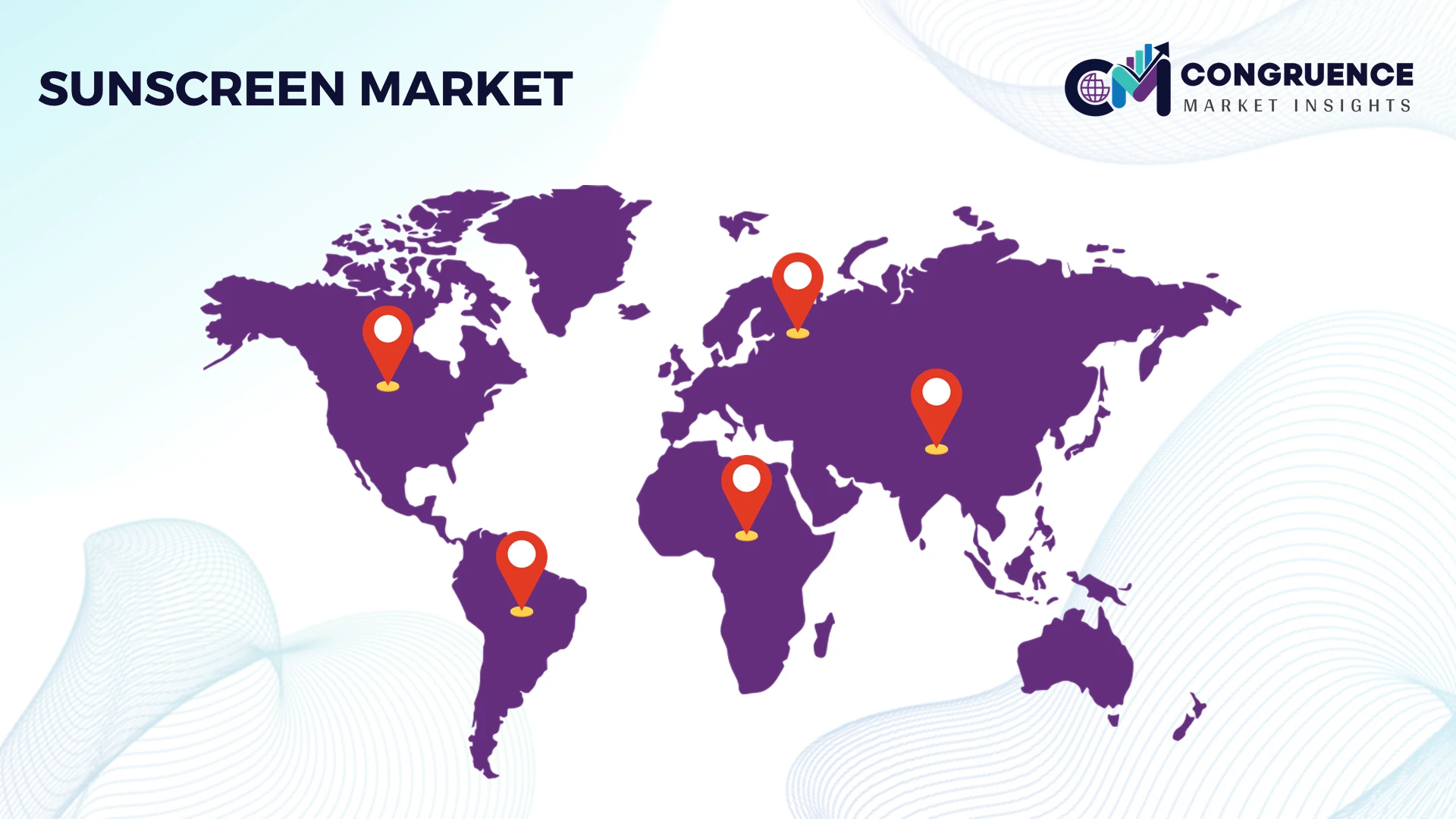
North America accounted for the largest market share at approximately 34% in 2025 however, Asia-Pacific is expected to register the fastest growth, expanding at a CAGR of approximately 7.4% between 2026 and 2033.
Daily SPF Integration Reshapes Portfolios
North America accounts for approximately 34% of global sunscreen demand, with the United States representing the overwhelming concentration of regional consumption. The market is shifting from seasonal beach protection toward daily facial SPF, dermatologist-positioned products, mineral formulations, and multifunctional skincare. SPF 30–50 products dominate shelf positioning, while sprays and sticks support sports and reapplication occasions. U.S. regulatory requirements create a distinct development environment because sunscreen is regulated as an OTC drug, increasing formulation, testing, and commercialization complexity. Canada provides additional premium skincare demand through pharmacy and beauty channels. Manufacturers are responding by expanding zinc-oxide portfolios, improving mineral dispersion and strengthening dermatology partnerships. High digital beauty penetration also enables rapid testing of tinted, sensitive-skin, and complexion-compatible SPF formats before wider retail deployment.
United States Market Outlook: The United States holds an estimated 85–90% of North American sunscreen demand, supported by extensive pharmacy, mass retail, dermatology, beauty and e-commerce infrastructure. FDA oversight favors companies with established regulatory capabilities and validated manufacturing systems. Daily facial SPF, mineral sunscreen and high-protection formats are increasingly important competitive categories, pushing suppliers toward advanced sensory formulations and stronger clinical positioning.
UVA Standards Drive Formulation Sophistication
Europe represents approximately 27% of global sunscreen demand, combining mature sun-care consumption with demanding UVA performance and cosmetic formulation standards. European recommendations establish UVA protection of at least one-third of labelled SPF, making broad-spectrum balance a central formulation requirement. France, Germany, Italy, Spain and the United Kingdom provide substantial demand across pharmacy, beauty, travel and mass-market channels. Mediterranean exposure sustains seasonal body-protection volumes, while northern markets increasingly emphasize daily facial protection. European formulators benefit from access to a wider portfolio of modern UV filters than U.S. counterparts, enabling lightweight textures and high-UVA performance. Manufacturers are also reducing packaging material, introducing recycled components and optimizing formulation footprints as sustainability requirements tighten. This regulatory-formulation ecosystem gives European suppliers a meaningful innovation advantage in premium sunscreen development.
France Market Outlook: France remains strategically important through its concentration of dermocosmetic expertise, pharmacy distribution and multinational beauty R&D. French manufacturers increasingly combine SPF 50+ protection with anti-aging, pigmentation and sensitive-skin positioning. Strong laboratory infrastructure and access to advanced UV filters enable rapid formulation differentiation, making France an important development base for products subsequently deployed across multiple international markets.
Beauty Innovation Accelerates Daily Adoption
Asia-Pacific accounts for approximately 25% of sunscreen demand but exhibits the strongest structural shift toward high-frequency facial application. Japan and South Korea lead formulation innovation through lightweight essences, gels, sticks and cosmetically elegant SPF 50+ products, while China and India provide significantly larger consumer expansion potential. Daily UV protection is closely integrated with whitening, pigmentation management, makeup preparation and anti-aging routines, reducing dependence on seasonal demand. Manufacturing clusters across Japan, South Korea and China support rapid packaging, formulation and contract-manufacturing cycles. Companies increasingly deploy hybrid filters, advanced film formers and water-resistant technologies while using digital beauty channels for accelerated launches. India is becoming strategically relevant as urban skincare penetration rises alongside year-round UV exposure, creating opportunities for affordable facial formats and localized formulations designed for humid conditions and diverse skin tones.
Japan Market Outlook: Japan combines mature daily sunscreen behavior with advanced formulation capability and demanding sensory expectations. SPF 50+ and PA++++ positioning is deeply established across facial products, gels and portable formats. Japanese expertise in UV-filter dispersion, water resistance and lightweight emulsions provides an export advantage, encouraging manufacturers to use domestic R&D platforms for broader Asian and international product launches.
High UV Exposure Supports Functional Demand
South America represents approximately 8% of global sunscreen demand, with Brazil forming the region's principal commercial and formulation hub. High UV exposure, extensive coastal recreation and strong beauty-product consumption support facial, body, sports and beach sunscreen categories. Brazil also combines domestic cosmetics manufacturing with multinational production and distribution infrastructure, enabling localized textures and price points. Pharmacy and direct beauty channels remain important for consumer access, while premium facial SPF is gaining relevance in major urban centers. Currency volatility and imported active-ingredient dependency create cost pressure, encouraging local sourcing, flexible pack sizes and portfolio segmentation. Manufacturers are increasingly developing oil-control, sweat-resistant and tinted products suited to warmer climates and varied skin tones. This localization strategy is critical for balancing technical performance with affordability and repeat purchasing.
Brazil Market Outlook: Brazil accounts for an estimated 55–60% of South American sunscreen demand and combines high UV exposure with one of the world's most developed beauty-consumption ecosystems. Domestic manufacturing capability supports localized lotions, facial products and high-protection formats. Companies increasingly prioritize pigmentation-focused, oil-control and complexion-compatible products while using pharmacies and beauty retailers to broaden year-round sunscreen purchasing.
Climate Exposure Expands Everyday Protection
Middle East & Africa represents approximately 6% of global sunscreen demand, with adoption concentrated in the Gulf states, South Africa and major urban consumer centers. Persistent high UV exposure creates a strong functional requirement, but sunscreen penetration varies significantly with income, retail infrastructure and skincare awareness. The UAE and Saudi Arabia benefit from premium beauty retail, tourism, hospitality and rapidly expanding e-commerce, supporting high-SPF facial products and internationally positioned brands. South Africa provides an established pharmacy-led market with strong outdoor-use relevance. Gulf consumers increasingly demand lightweight, sweat-resistant and pigmentation-focused formulations suitable for extreme heat. Manufacturers are responding through distributor partnerships, localized digital marketing and climate-adapted product portfolios. Premium hospitality also provides a targeted channel for travel-size and amenity-based sun-protection formats.
United Arab Emirates Market Outlook: The UAE is a strategic premium sunscreen hub because tourism, luxury retail and high year-round UV exposure intersect with strong international beauty-brand availability. Dubai's retail and e-commerce infrastructure supports rapid introduction of SPF 50+, facial fluids, sticks and premium dermocosmetics. Suppliers increasingly use the UAE as a launch and distribution platform for adjacent Gulf markets.
The sunscreen market pits global beauty leaders L'Oréal, Beiersdorf, Shiseido, Unilever and Kao against dermatology-focused brands and agile Asian skincare specialists. The top five players collectively control approximately 38–42% of organized global sales, leaving meaningful space for differentiated premium and regional brands. Competition increasingly centers on broad-spectrum efficacy, cosmetic elegance, distribution reach and formulation speed. Advanced mineral dispersions can improve visible transparency by 20–30%, while optimized manufacturing workflows reduce formulation-cycle time by roughly 10–15%. L'Oréal and Shiseido emphasize UV-filter science and premium facial formats; Beiersdorf and Kao leverage dermatological positioning and established distribution, while Unilever competes through mass-market scale. Partnerships with contract manufacturers, dermatologists and specialty retailers are accelerating launches. Competition is shifting from headline SPF toward invisible finishes, multifunctional skincare and localized formulations. Regulatory testing, formulation expertise and trusted distribution remain substantial entry barriers. Winning requires defensible UV technology, rapid product iteration, regulatory competence and repeat-use consumer positioning.
L'Oréal
Beiersdorf AG
Shiseido Company, Limited
Unilever
Kao Corporation
Edgewell Personal Care Company
The Estée Lauder Companies
Procter & Gamble
Pierre Fabre
Galderma
Rohto Pharmaceutical Co., Ltd.
Amorepacific Corporation
Coty Inc.
Natura &Co
Current sunscreen innovation centers on advanced UV-filter systems, micronized mineral dispersions, film-forming polymers, and high-shear processing. Optimized zinc-oxide dispersion can improve transparency by roughly 20–30% versus legacy mineral creams, while automated mixing shortens batch-processing time by about 10–15%. Adoption is strongest in premium facial SPF, where lightweight SPF 30–50+ fluids increasingly replace heavier seasonal lotions, improving repeat-use frequency and brand differentiation.
Emerging technologies include humidity-responsive films, self-repairing protective layers, antioxidant delivery systems, and encapsulated UV filters. Shiseido’s next-generation mineral platform has demonstrated up to 2.2-times higher UV protection than comparable formulations without the technology, while Kao’s humidity-responsive sunscreen adjusts film behavior under changing moisture conditions. These technologies improve wear consistency, reduce reapplication friction, and give R&D-led brands a performance advantage over price-focused mass-market competitors.
Disruptive development is shifting toward adaptive sunscreens integrating sensors, AI-assisted formulation screening, and multifunctional skincare. Between 2026 and 2028, wider deployment of self-repairing films, invisible mineral systems, and automated formulation optimization should reduce development cycles by 10% or more. Companies acting now can secure stronger regulatory readiness, faster launches, and defensible premium positioning. This integration also supports localized formulas for humid climates, sensitive skin, and pigmentation-focused applications.
January 2024 Shiseido developed Automatic Veil Technology, enabling sunscreen films to self-repair micro-level scratches and unevenness caused by facial movement or rubbing. The innovation strengthens protection persistence and supports differentiated premium sun-care formulations across high-performance facial sunscreen portfolios. Source: shiseido.com
February 2025 Eucerin launched Advanced Hydration Face SPF 50, combining proprietary 5AOX Shield antioxidants with multi-weight hyaluronic acid and clinically proven all-day hydration. The launch expands Beiersdorf’s daily facial-SPF positioning beyond basic UV protection for skincare routines.
February 2025 Kao announced Bioré UV Aqua Rich Airy Hold Cream using humidity-responsive technology, with overseas rollout planned across Thailand, Hong Kong, and Taiwan. Bioré UV was already sold in 27 countries and regions, strengthening international sunscreen distribution. Source: personalcareinsights.com
June 2026 U.S. FDA added bemotrizinol to permitted OTC sunscreen active ingredients, the first new sunscreen active added since the late 1990s. The decision expands formulation flexibility and unlocks new product-development pathways for sunscreen manufacturers across American portfolios. Source: fda.gov
The report examines the Sunscreen Market across Chemical Sunscreens, Mineral Sunscreens, Hybrid Sunscreens, Sunscreen Sprays, and Sunscreen Sticks, alongside Daily Sun Protection, Sports & Outdoor, Beach & Leisure, Facial Care, and Body Care applications. End-user coverage includes Individual Consumers, Dermatology Clinics, Beauty Salons, Pharmaceutical Retailers, and Hospitality Facilities. Regional analysis spans North America, Europe, Asia-Pacific, South America, and Middle East & Africa.
Technology coverage evaluates advanced UV filters, micronized mineral dispersions, self-repairing films, humidity-responsive systems, encapsulation, and automated formulation workflows. The report also tracks daily facial-SPF adoption, premium mineral positioning, regulatory differentiation, and portable reapplication formats. These insights support investment planning, geographic expansion, partnership strategy, portfolio optimization, and competitive benchmarking through 2026–2033, helping companies identify scalable product niches and operational priorities across both mature and high-growth sunscreen consumption markets.
| Report Attribute/Metric | Report Details |
|---|---|
Market Revenue in 2025 | USD 780 Million |
Market Revenue in 2033 | USD 1249.78 Million |
CAGR (2026 - 2033) | 6.07% |
Base Year | 2025 |
Forecast Period | 2026 - 2033 |
Historic Period | 2021 - 2025 |
Segments Covered | By Type
By Application
By End-User
|
Key Report Deliverable | Revenue Forecast, Growth Trends, Market Dynamics, Segmental Overview, Regional and Country-wise Analysis, Competition Landscape |
Region Covered | North America, Europe, Asia-Pacific, South America, Middle East, Africa |
Key Players Analyzed | L'Oréal, Beiersdorf AG, Shiseido Company, Limited, Unilever, Kao Corporation, Edgewell Personal Care Company, The Estée Lauder Companies, Procter & Gamble, Pierre Fabre, Galderma, Rohto Pharmaceutical Co., Ltd., Amorepacific Corporation, Coty Inc., Natura &Co |
Customization & Pricing | Available on Request (10% Customization is Free) |




