
Reports
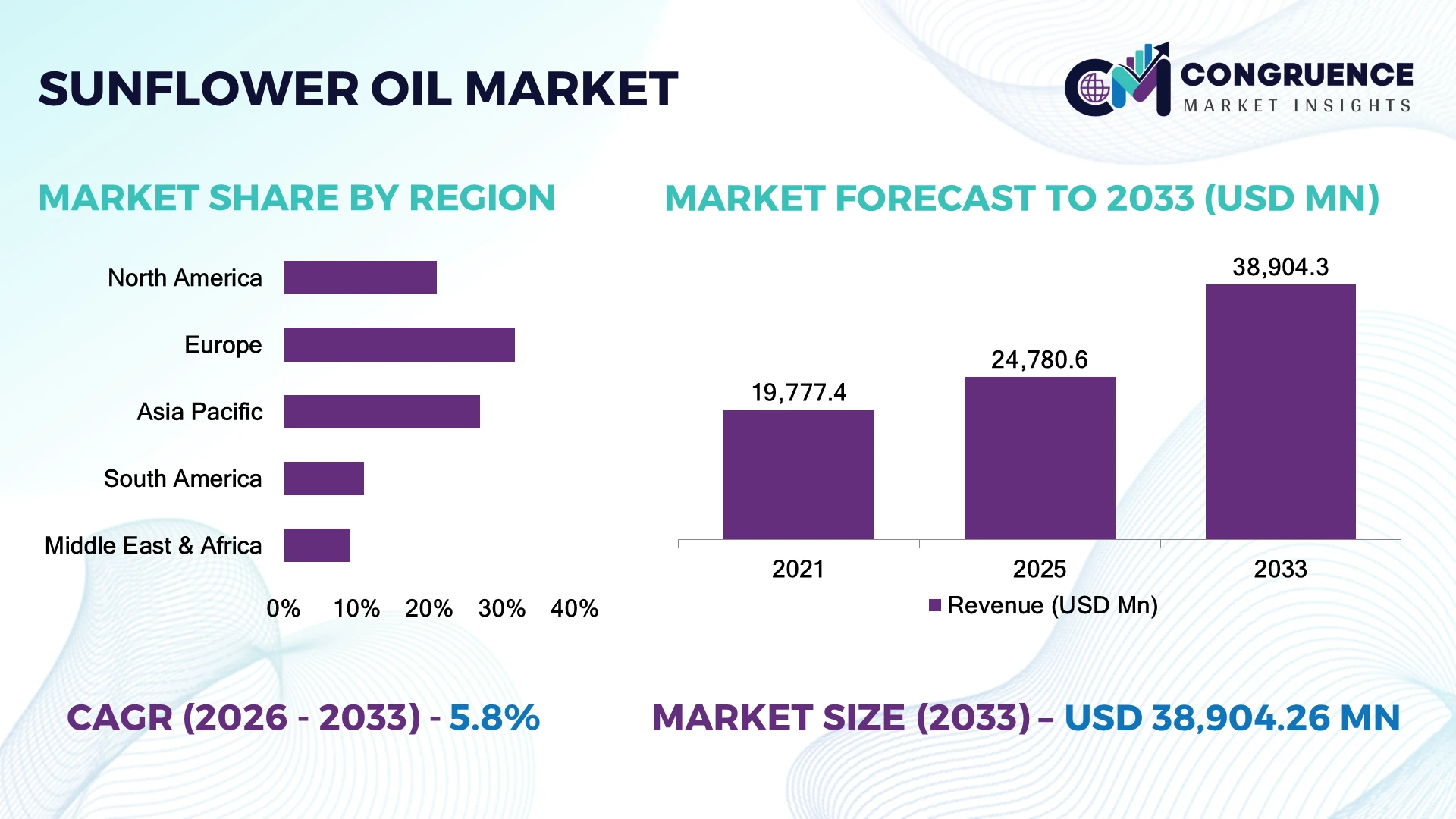
The Global Sunflower Oil Market was valued at USD 24,780.6 Million in 2025 and is anticipated to reach a value of USD 38,904.3 Million by 2033 expanding at a CAGR of 5.8% between 2026 and 2033. Growth is being driven by rising consumption of high-oleic sunflower oil, expanding food-processing applications, and refinery investments that improve yield, shelf stability, and product differentiation.
Ukraine remains the dominant supply hub, accounting for approximately 35% of global sunflower oil exports, supported by crushing capacity exceeding 20 million tonnes of sunflower seed annually and strong food-processing infrastructure. Russia follows with roughly 20% of export influence, while Turkey is strengthening refining and re-export activity. Black Sea logistics restructuring since the Russia-Ukraine war has increased emphasis on diversified ports and alternative sourcing.
Strategically, buyers should prioritize diversified procurement, flexible refining capacity, and high-oleic product portfolios to reduce exposure to Black Sea supply volatility.
Market Size & Growth: USD 24.8 billion in 2025 to USD 38.9 billion by 2033 at 5.8% CAGR, supported by premium high-oleic and foodservice applications.
Top Growth Drivers: Food processing +7%; packaged-food consumption +6%; high-oleic adoption +5%.
Short-Term Forecast: By 2028, automated refining can reduce processing losses by 3–5% while improving batch consistency by 4%.
Emerging Technologies: AI-assisted quality control, continuous deodorization, and enzymatic processing are targeting 2–4% higher refining efficiency.
Regional Leaders: Europe, Asia-Pacific, and North America remain key demand centers, with premium, cold-pressed, and high-oleic formats gaining adoption.
Consumer/End-User Trends: Approximately 28% of premium-oil buyers increasingly prioritize healthier fatty-acid profiles and minimally processed positioning.
Pilot/Case Example: 2025 high-oleic processing upgrades in Eastern Europe demonstrated approximately 4% higher usable oil recovery in optimized crushing workflows.
Competitive Landscape: Major suppliers including Kernel, Bunge, Cargill, ADM, and EFKO compete through approximately 5–8% procurement-cost advantages, scale, refining quality, and logistics control.
Regulatory & ESG Impact: Energy-efficient refining and traceability programs can lower plant energy intensity by 5–10%, strengthening compliance and sustainability positioning.
Investment & Funding: More than USD 1 billion in recent crushing, storage, refining, and logistics commitments is redirecting investment toward supply-chain resilience and higher-value oil grades.
Innovation & Future Outlook: By 2028, high-oleic formulations, digital traceability, automated crushing, and flexible-origin sourcing will shift competition from commodity volume toward specification, reliability, and margin control.
Sunflower oil demand is concentrating in packaged foods, frying applications, foodservice, cosmetics, and functional formulations, with high-oleic variants gaining particular traction as manufacturers seek improved oxidation stability. Approximately 30% of new product-development activity increasingly emphasizes differentiated fatty-acid profiles. In 2026, Black Sea logistics remain strategically important, encouraging processors to strengthen inventories, alternate-origin contracts, and regional crushing networks before capacity decisions.
Sunflower oil is becoming strategically important because edible-oil processors are balancing food inflation, crop variability, geopolitical exposure, and changing nutritional preferences simultaneously. The Russia-Ukraine conflict reshaped Black Sea trading routes, pushing importers toward diversified origins, larger safety stocks, and closer coordination with crushers and refiners. This shift makes supply reliability a competitive capability rather than a procurement function alone.
Technology is strengthening that advantage. Automated refining and inline quality monitoring can improve process efficiency by roughly 3–5% compared with less-integrated legacy workflows, while high-oleic sunflower oil provides superior oxidative stability for repeated frying applications. Ukraine and Russia retain major crushing scale, whereas Turkey and India are more focused on refining, distribution, and differentiated consumption markets. These differences are redirecting investment toward both upstream security and downstream product specialization.
Over the next 2–3 years, processors are positioned to increase automated quality monitoring, high-oleic production, and multi-origin sourcing. A practical deployment model is the integration of crushing, storage, refining, and packaging at one industrial site, reducing transfer losses and improving scheduling control. Companies that combine resilient sourcing with premium product development will secure stronger margins and more defensible customer relationships.
Food manufacturers are increasing high-oleic sunflower oil adoption because its improved oxidative stability supports longer frying cycles and cleaner-label formulations. High-oleic variants can extend frying-oil usability by approximately 15–25%, while premium formulations typically command 5–10% higher pricing than conventional grades. In Ukraine, processors are also prioritizing flexible crushing and storage configurations following Black Sea logistics disruptions. This combination is shifting investment toward differentiated refining rather than commodity-only output. Producers are expanding high-oleic processing, upgrading filtration and deodorization systems, and securing contracted seed supplies. The strategic advantage is clear: processors capturing premium specifications reduce exposure to commodity-margin compression while strengthening relationships with food manufacturers requiring consistent performance.
Sunflower oil producers face persistent exposure to seed-price volatility, crop variability, freight costs, and Black Sea logistics. Raw sunflower seed can represent roughly 70–80% of total crushing input costs, making even a 10% procurement-price movement materially affect processor margins. Ukraine and Russia remain structurally important to global supply, while disruptions can redirect cargoes toward longer and costlier routes. Refiners are responding through multi-origin procurement, forward contracts, higher storage coverage, and localized crushing. The non-obvious constraint is that additional inventory protects continuity but increases working-capital requirements. Companies with integrated crushing, storage, refining, and logistics capabilities therefore retain stronger margin control than standalone refiners dependent on spot-market feedstock.
Digital process control creates a high-value opportunity to improve yield, quality consistency, and traceability across sunflower oil processing. Automated monitoring can reduce process variability by approximately 3–6%, while predictive maintenance programs can lower unplanned equipment downtime by 5–10%. European buyers are simultaneously increasing scrutiny of origin documentation and sustainability attributes, creating demand for digitally traceable supply chains. Processors are investing in sensor-based refining, batch-level tracking, and integrated enterprise planning systems. A particularly attractive opportunity lies in mid-sized plants that can retrofit existing crushing and refining assets rather than build new facilities. This approach lowers capital intensity while enabling premium-grade production and stronger compliance positioning.
Scaling advanced sunflower oil production requires integration across seed handling, crushing, extraction, refining, packaging, utilities, and quality-control systems. Plants operating with fragmented automation can experience 5–8% lower throughput efficiency than highly integrated configurations, while skilled-maintenance requirements increase as instrumentation expands. In Turkey and India, processors are balancing modernization with the need to maintain continuous production during equipment upgrades. Companies must therefore phase automation investments, standardize control architectures, and strengthen technical partnerships. The deeper challenge is not individual equipment performance but synchronization across the production chain. Firms that fail to integrate operational data with maintenance and quality systems face inconsistent batches, higher downtime, and weaker responsiveness to changing customer specifications.
High-Oleic Capacity Expands: High-oleic sunflower oil is moving deeper into foodservice and processed-food formulations, with adoption in premium applications rising roughly 5–8% annually. Its 15–25% longer frying stability supports lower oil-change frequency and better operating economics. Processors are increasing dedicated refining capacity and contracting higher-oleic seed varieties to capture premium margins.
Black Sea Routes Diversify: Continued geopolitical pressure around the Black Sea is pushing buyers toward multi-origin procurement, with some importers increasing alternative-origin coverage by 10–20%. Longer shipping routes are encouraging larger safety inventories and regional storage. Traders and refiners are responding through forward contracts, diversified port access, and closer coordination with inland crushing facilities.
Automation Tightens Quality Control: Refiners are deploying inline sensors, automated filtration controls, and digital batch monitoring, improving process consistency by approximately 3–6% and reducing manual quality interventions by 10–15%. The shift is particularly relevant for high-volume facilities where small specification deviations create substantial rework. Producers are integrating plant-control data with maintenance and enterprise planning platforms.
Flexible Packaging Gains Ground: Packaged sunflower oil is increasingly shifting toward lightweight PET, larger foodservice formats, and recyclable packaging structures, with material optimization reducing packaging weight by approximately 5–10% in selected configurations. Higher packaging costs are accelerating redesign rather than simple downsizing. Producers are investing in automated filling lines, regional packaging hubs, and SKU rationalization to protect margins.
Refined sunflower oil represents the leading type, accounting for approximately 72% of global consumption, supported by broad use in household cooking, food processing, frying, and institutional foodservice. Its established refining infrastructure, neutral flavor, consistent specifications, and competitive pricing make it substantially more scalable than cold-pressed and specialty variants. High-oleic sunflower oil is the fastest-growing type, with adoption increasing by roughly 6–8% as food manufacturers prioritize oxidative stability and longer frying performance. Conventional refined grades remain the volume anchor, while cold-pressed oil strengthens its premium positioning among health-focused consumers.
The strategic shift is toward portfolio diversification rather than replacement of conventional oil. High-oleic products can command approximately 5–10% premium pricing, encouraging processors to invest in dedicated crushing, refining, and seed procurement. Cold-pressed variants remain strategically relevant for premium retail and specialty food applications, while organic sunflower oil benefits from traceability and certification requirements. Companies are therefore allocating more investment toward differentiated grades, flexible processing lines, and contracted high-oleic seed supply.
The U.S. Department of Agriculture’s 2025/26 outlook places global sunflowerseed production at approximately 55 million metric tons, reinforcing the scale of the feedstock base supporting refined sunflower oil processing.
Food processing is the leading application, representing approximately 58% of global sunflower oil consumption. Its dominance reflects extensive use in snacks, bakery products, sauces, prepared foods, and industrial frying, where neutral flavor and predictable thermal performance support standardized formulations. Foodservice is the fastest-growing application, with adoption advancing roughly 6–7% as commercial kitchens increasingly favor high-oleic formulations that tolerate repeated frying cycles. Household cooking remains a mature, high-volume application, while cosmetics and personal-care formulations occupy smaller but higher-value niches.
The operational divide is becoming more pronounced: food manufacturers prioritize specification consistency and bulk contracts, whereas foodservice operators increasingly evaluate frying stability and oil-change frequency. Approximately 25–30% of premium foodservice demand is shifting toward higher-stability formulations, strengthening the case for high-oleic product development. Cosmetics and personal care remain strategically relevant because sunflower oil supplies emollient and formulation functionality. Producers are responding with application-specific grades, bulk packaging, automated filling, and direct partnerships with large food manufacturers and distributors.
The Food and Agriculture Organization’s 2025 commodity outlook identifies sunflowerseed and sunflower oil as strategically important vegetable-oil commodities, with Black Sea production and trade flows remaining central to international edible-oil supply.
Food manufacturers constitute the dominant end-user group, accounting for approximately 54% of sunflower oil consumption because large processors require continuous, specification-controlled volumes for frying, bakery, snacks, sauces, and ready-to-eat products. Their procurement scale favors suppliers capable of consistent fatty-acid profiles, bulk logistics, and contract-based pricing. Foodservice is the fastest-growing end-user category, expanding adoption by approximately 6–8% as restaurant chains and institutional kitchens standardize frying oils for longer operating cycles.
Retail households remain a substantial established segment, emphasizing affordability, bottle formats, nutritional positioning, and brand recognition. Industrial users, including cosmetics and specialty formulators, represent smaller volumes but increasingly value traceability and functional characteristics. Approximately 20–25% of premium commercial buyers are placing greater emphasis on high-oleic specifications and documented origin, shifting supplier selection beyond price alone. Companies are responding through customized formulations, long-term supply agreements, regional distribution partnerships, and packaging diversification. The strongest competitive position will come from serving high-volume food manufacturers while building specialized channels for foodservice and premium industrial applications.
The International Food Information Council’s 2025 consumer research indicates that more than 60% of surveyed consumers consider healthfulness an important factor in food choices, reinforcing the commercial relevance of nutritional positioning for edible-oil brands.
Europe accounted for the largest market share at 31.8% in 2025 however, Asia-Pacific is expected to register the fastest growth, expanding at a CAGR of 6.4% between 2026 and 2033.

High-Oleic Adoption Reshapes Premium Oil Demand
North America maintains a significant position in the global sunflower oil market through established food-processing capacity, retail distribution, and rising use of high-oleic formulations. The United States remains the region’s principal production and consumption base, with high-oleic sunflower varieties increasingly integrated into commercial frying, snack manufacturing, and packaged-food applications. High-oleic products command approximately 5–10% price premiums over conventional grades where performance specifications are critical. Automated refining, optical quality inspection, and contracted seed supply are improving production consistency while reducing dependence on spot procurement. Food manufacturers are also expanding sunflower oil usage where neutral flavor and oxidative stability provide formulation advantages. Regional processors are responding through varietal partnerships, dedicated crushing contracts, and premium private-label offerings, shifting investment from commodity volume toward specification-led products.
United States Market Outlook: The United States benefits from a mature agricultural-processing ecosystem, extensive food-manufacturing infrastructure, and established high-oleic sunflower cultivation. Approximately 60% of domestic sunflowerseed production is concentrated in North Dakota and South Dakota, supporting efficient aggregation and crushing economics. Food processors increasingly use high-oleic oil for frying and reformulation, strengthening demand for reliable domestic supply. Producers are investing in improved seed genetics, precision agriculture, and differentiated oil contracts to protect margins.
Supply Diversification Becomes a Strategic Procurement Priority
Europe remains a major sunflower oil consumption and refining center, but its procurement structure has become increasingly dependent on external sunflowerseed and crude-oil supplies. EU crude sunflower oil import volume reached approximately 2.0 million tonnes in 2025, representing a 149% increase from 2015 levels. Ukraine has become the dominant supplier, accounting for most of the increase in European import value over the decade. This concentration creates logistics and geopolitical exposure while encouraging processors to diversify origins and strengthen storage. European refiners are simultaneously increasing traceability, sustainable sourcing documentation, and premium product differentiation. Companies with flexible refining assets and multi-origin procurement contracts hold an operational advantage because they can redirect volumes between Ukraine, Argentina, and other suppliers as freight and crop conditions change.
Germany Market Outlook: Germany is strategically important because of its large food-processing base, sophisticated retail network, and strong demand for refined edible oils. The country’s advanced processing infrastructure supports high-specification sunflower oil for packaged foods, foodservice, and industrial formulations. Retailers increasingly emphasize traceability and sustainability documentation, pushing suppliers toward digitally managed batch records and verified agricultural sourcing. Approximately 20% of European premium edible-oil purchasing is increasingly influenced by provenance, formulation, or sustainability attributes.
Import-Led Consumption Drives Supply-Chain Reconfiguration
Asia-Pacific is becoming the most strategically dynamic demand center as India combines high edible-oil consumption with substantial sunflower oil imports. India imported approximately 2.89 million tonnes of sunflower oil in 2025, although volumes declined from 3.74 million tonnes in 2024 as procurement conditions changed. Russia remained India’s largest supplier, while Argentina expanded shipments to approximately 628,900 tonnes, up 68% year over year. This supplier shift is encouraging importers to diversify contracts, storage positions, and port logistics. Foodservice, packaged foods, and household edible-oil consumption remain the primary demand channels. Refiners are increasingly using flexible blending and quality-control systems to manage differences in crude oil characteristics across origins.
India Market Outlook: India is the region’s most strategically significant sunflower oil market because of its large edible-oil import requirement and extensive refining and distribution infrastructure. Sunflower oil accounted for a substantial portion of the country’s 2025 vegetable-oil import program, with total sunflower oil imports reaching 2.89 million tonnes. Refiners are strengthening supplier diversification, port-based storage, and flexible procurement agreements. The growing role of Argentina alongside Russia demonstrates a clear shift toward multi-origin sourcing to improve supply resilience and manage landed-cost volatility.
Argentina Emerges as a Counter-Seasonal Supply Hub
South America is strengthening its position as an alternative sunflower oil supply base, led overwhelmingly by Argentina. The country’s 2025/26 sunflowerseed production is forecast at approximately 7.0 million tonnes, representing about 13% of global output and a substantial increase from the previous season. Crushing is projected at 5.5 million tonnes, supporting approximately 1.8 million tonnes of sunflower oil exports. Expanded processing capacity at Santa Fe-based industrial hubs is allowing processors to handle sunflower alongside soybean and other oilseeds. This flexible infrastructure improves asset utilization across crop cycles and supports export diversification. Companies are increasingly combining producer contracts, crushing investments, and logistics partnerships to capture counter-seasonal demand. The strategic advantage is the ability to complement, rather than directly replace, Black Sea supply.
Argentina Market Outlook: Argentina has become the region’s decisive sunflower oil growth platform because of expanding acreage, modern crushing infrastructure, and established agricultural export logistics. Its 2025/26 sunflowerseed output is forecast at 7.0 million tonnes, while sunflower oil exports are projected at approximately 1.8 million tonnes, the highest level in more than two decades. Investments by major processors are increasing multi-oilseed flexibility, allowing plants to switch feedstocks according to seasonal economics and export demand.
Import Dependence Accelerates Regional Processing Investment
Middle East and Africa demand is shaped by population growth, food-processing expansion, and dependence on imported edible oils. Egypt, Türkiye, and South Africa represent important commercial hubs, while Black Sea supply remains strategically significant because of geographic proximity and established maritime routes. South Africa is forecast to crush approximately 680,000 tonnes of sunflowerseed in 2025/26, producing around 258,000 tonnes of sunflower oil. Import requirements remain material because domestic output does not fully satisfy consumption. Processors are therefore prioritizing storage capacity, seed contracting, and refining efficiency rather than relying exclusively on additional acreage. In the Middle East, foodservice and packaged-food manufacturing are increasing demand for consistent refined oil specifications. Companies with diversified sourcing and local refining capabilities are best positioned to manage freight volatility and currency-sensitive procurement.
South Africa Market Outlook: South Africa provides the strongest industrial base for sunflower oil production in sub-Saharan Africa, supported by established crushing infrastructure and concentrated sunflower cultivation in the Free State and North West. The country is forecast to crush approximately 680,000 tonnes of sunflowerseed in 2025/26 and produce about 258,000 tonnes of sunflower oil. Processors are strengthening domestic procurement, inventory management, and refining utilization to compete with imported palm and other vegetable oils while protecting margins against agricultural cost volatility.
The market pits integrated agribusiness leaders such as Cargill, ADM, Bunge, Wilmar, and Louis Dreyfus against regional crushers, refiners, and private-label suppliers. The top five players collectively control approximately 30–35% of organized global supply. Competition centers on procurement cost, logistics, refining efficiency, and customization, with integrated operators achieving 5–8% lower sourcing costs and premium high-oleic products generating 5–10% pricing advantages. Players are expanding crushing capacity, securing farmer contracts, integrating refining and packaging, and forming sustainability partnerships. The competitive shift is moving from commodity trading toward supply-chain control, differentiated formulations, and traceable sourcing. Entry barriers remain high because reliable seed procurement, crushing assets, storage, export logistics, and food-grade certification require substantial capital and established relationships. Regional processors compete aggressively on localized pricing, while global groups leverage diversified origins and scale. Winning requires vertically integrated sourcing, flexible processing, resilient logistics, and differentiated oil specifications that protect margins beyond commodity pricing.
Cargill
Archer Daniels Midland Company (ADM)
Bunge Global SA
Wilmar International Limited
Louis Dreyfus Company
COFCO International
Kernel Holding S.A.
AAK AB
Richardson International
EFKO Group
Avril Group
Adams Group
Sunar Misir
Borges International Group
Modern sunflower oil processing is shifting toward automated refining, inline spectroscopy, digital quality monitoring, and high-oleic seed optimization. Automated process controls can improve throughput by approximately 6–8% while reducing processing losses by 3–5%. Adoption is strongest among integrated processors handling variable seed origins, where real-time quality data reduces reprocessing and blending requirements.
High-oleic breeding and precision agriculture are becoming commercially important technologies. Compared with conventional sunflower varieties, high-oleic formulations provide materially stronger oxidative stability and can extend frying performance by approximately 10–15% in selected foodservice applications. Precision agronomy, satellite monitoring, and digital farmer platforms are also improving input targeting by roughly 5–8%. Integrated processors and foodservice suppliers benefit most because they can monetize both agronomic consistency and differentiated oil performance.
Between 2026 and 2028, AI-enabled crop forecasting, automated extraction optimization, digital traceability, and energy-efficient refining will move from isolated deployments toward connected production systems. Biomass boilers and renewable-energy integration can reduce site emissions by 10–20% while improving energy resilience. Competitive advantage will increasingly favor companies combining agricultural data, crushing, refining, packaging, and logistics into one digitally coordinated supply chain.
April 2026 Cargill committed USD 150 million to upgrade Saint-Nazaire, adding high-protein sunflower meal capability and biomass energy. The project targets 20,000 metric tons of annual CO2 reduction, strengthening French sourcing resilience, lowering import dependence, and improving operations. Source: cargill.com (Cargill)
February 2025 Bunge agreed to acquire Aceitera Martínez in Argentina, adding a modern plant with three packaging lines and approximately 20,000 tons monthly installed capacity. The transaction strengthens value-added edible-oil production and expands Bunge’s domestic sunflower supply platform. Source: bunge.com (Bunge)
September 2025 ADM and Bayer expanded regenerative agriculture collaboration into Hungary, enrolling 30,000 acres, primarily sunflower, for the 2025 harvest. Financial and agronomic support strengthens high-oleic seed supply, improves procurement resilience, and reinforces differentiated sustainable sourcing for processors. Source: adm.com (Adm)
April 2025 Wilmar commissioned a new refinery and fractionation plant in South Africa, expanding edible-oil processing infrastructure. The facility strengthens local refining capability and product flexibility, supporting supply diversification as import-dependent markets seek greater control over edible-oil processing. Source: Wilmar International (wilmar-international.com)
The Global Sunflower Oil Market Report covers the industry across conventional, high-oleic, organic, refined, crude, and specialty sunflower oil categories, with analysis spanning food processing, foodservice, retail, animal-feed-linked processing, and industrial applications. End-user coverage includes households, commercial food manufacturers, restaurants, institutional buyers, and ingredient processors, with attention to premium and specification-driven niche demand.
Regional assessment covers North America, Europe, Asia-Pacific, South America, and the Middle East & Africa, with country-level analysis of production, imports, refining, crushing, and distribution. The report evaluates automation, high-oleic breeding, precision agriculture, digital traceability, energy-efficient refining, and supply-chain integration. Competitive analysis covers major processors and traders alongside regional refiners, supporting investment planning, sourcing diversification, capacity expansion, partnership strategy, and competitive positioning through 2033.
| Report Attribute/Metric | Report Details |
|---|---|
|
Market Revenue in 2025 |
USD 24,780.6 Million |
|
Market Revenue in 2033 |
USD 38,904.3 Million |
|
CAGR (2026 - 2033) |
5.8% |
|
Base Year |
2025 |
|
Forecast Period |
2026 - 2033 |
|
Historic Period |
2021 - 2025 |
|
Segments Covered |
By Type
By Application
By End-User
|
|
Key Report Deliverable |
Revenue Forecast, Growth Trends, Market Dynamics, Segmental Overview, Regional and Country-wise Analysis, Competition Landscape |
|
Region Covered |
North America, Europe, Asia-Pacific, South America, Middle East, Africa |
|
Key Players Analyzed |
Cargill, Archer Daniels Midland Company (ADM), Bunge Global SA, Wilmar International Limited, Louis Dreyfus Company, COFCO International, Kernel Holding S.A., AAK AB, Richardson International, EFKO Group, Avril Group, Adams Group, Sunar Misir, Borges International Group |
|
Customization & Pricing |
Available on Request (10% Customization is Free) |




