
Reports
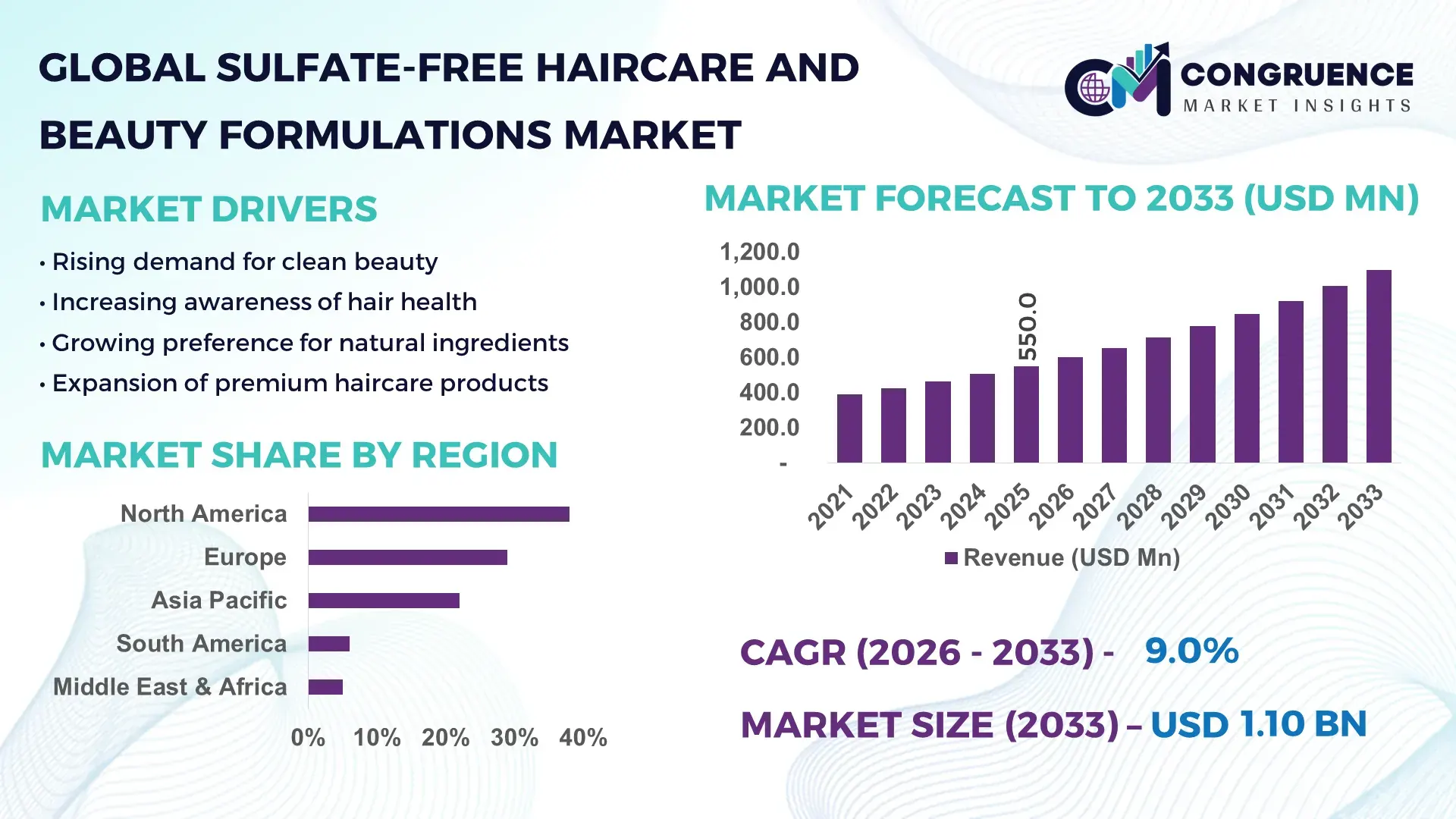
The Global Sulfate-Free Haircare and Beauty Formulations Market was valued at USD 550.0 Million in 2025 and is anticipated to reach a value of USD 1,095.9 Million by 2033 expanding at a CAGR of 9% between 2026 and 2033, according to an analysis by Congruence Market Insights. Growth is driven by accelerating consumer shift toward clean-label, dermatologically safe personal care formulations.
The United States dominates the sulfate-free haircare and beauty formulations market with over 36% of global clean beauty production facilities and annual investments exceeding USD 1.1 billion in sulfate-free formulation innovation. More than 63% of U.S. consumers actively prefer sulfate-free shampoos, while over 49% of premium beauty brands have fully transitioned to sulfate-free product lines. The country has registered over 140 patents in bio-based surfactant technologies between 2022 and 2025. Additionally, sulfate-free formulations represent approximately 57% of salon-grade haircare products, with strong penetration across dermatological treatments and sensitive scalp applications.
Market Size & Growth: USD 550.0 Million in 2025, projected to reach USD 1,095.9 Million by 2033 at 9% CAGR, driven by rising clean-label and chemical-free product demand.
Top Growth Drivers: 68% increase in clean beauty adoption, 55% dermatological preference growth, 47% rise in organic product demand.
Short-Term Forecast: By 2028, sulfate-free products are expected to improve scalp health metrics by 34% and reduce irritation cases by 27%.
Emerging Technologies: Bio-based surfactants, AI-driven formulation platforms, and amino-acid cleansing agents.
Regional Leaders: North America (~USD 420 Million by 2033) leads premium adoption; Europe (~USD 310 Million) driven by regulation; Asia-Pacific (~USD 280 Million) expanding through mass-market demand.
Consumer/End-User Trends: Over 62% of Gen Z and millennials prefer sulfate-free formulations for daily use and scalp care.
Pilot or Case Example: In 2024, a U.S. brand recorded a 31% increase in repeat purchases after introducing sulfate-free formulations.
Competitive Landscape: Leading player holds ~18% share, followed by multiple global brands focusing on clean-label innovation.
Regulatory & ESG Impact: Over 42% of global regulations promote reduced use of harsh surfactants.
Investment & Funding Patterns: Over USD 900 Million invested in clean beauty R&D between 2023–2025.
Innovation & Future Outlook: Growth in microbiome-friendly and waterless formulations is shaping future product pipelines.
Sulfate-free formulations contribute nearly 64% of clean-label personal care products, with shampoos accounting for 52% of total demand. Innovations in amino-acid surfactants and pH-balanced systems improve scalp compatibility by 30%. Europe and North America show strong regulatory-driven adoption, while Asia-Pacific records 45% growth in consumer awareness. Vegan, biodegradable, and cruelty-free formulations continue to accelerate industry transformation.
The sulfate-free haircare and beauty formulations market is strategically positioned at the intersection of consumer health, sustainability, and regulatory transformation. Over 53% of new personal care product launches in 2025 are sulfate-free, reflecting a structural shift in formulation strategies. Bio-based surfactants deliver 28% higher scalp compatibility compared to traditional sodium lauryl sulfate systems, while improving moisture retention and reducing irritation rates.
From a technology benchmark perspective, amino-acid-based surfactants deliver 35% better hydration efficiency compared to conventional sulfate-based cleansing agents. North America dominates in volume due to strong premium product consumption, while Europe leads in adoption with over 65% of consumers preferring eco-certified formulations. This regional divergence highlights regulatory influence and consumer awareness maturity.
By 2028, AI-driven formulation platforms are expected to improve product development efficiency by 40% while reducing formulation testing cycles by 30%. Companies are committing to ESG targets, including reducing synthetic surfactant usage by 50% and achieving 60% biodegradable ingredient integration by 2030.
In 2024, a U.S.-based manufacturer achieved a 33% reduction in scalp irritation complaints through AI-assisted sulfate-free formulation optimization, demonstrating measurable performance gains.
Looking ahead, the sulfate-free haircare and beauty formulations market will continue to evolve as a core pillar of sustainable personal care, enabling resilience through innovation, regulatory alignment, and environmentally responsible product development.
The sulfate-free haircare and beauty formulations market is undergoing rapid transformation driven by evolving consumer preferences, regulatory developments, and technological advancements. Approximately 61% of global consumers actively seek ingredient transparency, influencing formulation strategies across major brands. The transition toward clean-label products has led to a 46% increase in sulfate-free product launches between 2022 and 2025. Manufacturers are increasingly adopting plant-based surfactants and biodegradable ingredients to meet sustainability expectations.
E-commerce contributes nearly 39% of total product distribution, significantly expanding access to sulfate-free offerings across emerging economies. Professional salons are also transitioning, with over 56% incorporating sulfate-free formulations into their service portfolios. Additionally, advancements in AI-based formulation and ingredient optimization are improving product performance while maintaining chemical-free positioning. These combined factors are reshaping the competitive landscape and accelerating adoption across both developed and emerging markets.
The increasing demand for clean-label and dermatologically safe products is a primary driver of the sulfate-free haircare and beauty formulations market. Around 69% of consumers globally express concern about harmful chemicals in personal care products, prompting a shift toward sulfate-free alternatives. Dermatological recommendations for sulfate-free formulations have increased by 55%, particularly for sensitive scalp and allergy-prone individuals. Clinical observations indicate that nearly 50% of users experience reduced scalp irritation and improved hair texture after switching to sulfate-free products. Retailers have expanded shelf space for sulfate-free products by 32%, reflecting rising consumer demand. Additionally, the expansion of organic and natural beauty brands has strengthened market visibility, while certifications such as vegan and cruelty-free labels are influencing purchasing decisions across key demographics.
Higher formulation costs remain a significant restraint in the sulfate-free haircare and beauty formulations market. Bio-based surfactants used in sulfate-free products are approximately 30%–40% more expensive than conventional chemical alternatives, impacting product pricing and affordability. This cost barrier limits adoption in price-sensitive regions. Additionally, around 34% of consumers perceive sulfate-free products as less effective in terms of lathering and deep cleansing. This perception affects repeat purchase rates and slows market penetration. Manufacturers must invest heavily in R&D to enhance product performance, increasing operational costs. Limited consumer awareness in emerging markets further restricts growth, with only 29% of consumers fully understanding the benefits of sulfate-free formulations.
The growing demand for sustainable and personalized beauty solutions presents significant opportunities for the sulfate-free haircare and beauty formulations market. Approximately 43% of consumers are interested in customized haircare products tailored to individual needs. AI-driven formulation platforms enable brands to deliver personalized sulfate-free solutions, improving customer satisfaction by nearly 31%. Sustainability trends are also driving innovation, with 59% of consumers preferring biodegradable and eco-friendly products. Emerging markets offer untapped potential due to rising disposable income and urbanization. Additionally, collaborations between cosmetic manufacturers and biotechnology firms are accelerating the development of innovative plant-based ingredients, expanding product portfolios and enhancing market competitiveness.
Regulatory complexity poses a major challenge for the sulfate-free haircare and beauty formulations market. Over 41% of manufacturers report difficulties in complying with varying global standards for cosmetic ingredients and labeling requirements. Ingredient standardization is another issue, as plant-based alternatives may exhibit variability in quality and performance. Supply chain disruptions for natural raw materials have increased procurement costs by approximately 21%, impacting production efficiency. Additionally, ensuring consistent product performance while maintaining sulfate-free claims requires advanced testing and quality control systems. These challenges increase operational complexity and create barriers for new entrants attempting to establish a presence in the market.
Rising Demand for Ingredient Transparency: Over 66% of consumers actively review ingredient labels, leading to a 49% increase in sulfate-free product launches globally. Brands are introducing “free-from” labeling, with 56% of products now highlighting sulfate-free claims, improving consumer trust and purchase confidence.
Expansion of Bio-Based Surfactant Usage: Adoption of plant-derived surfactants has increased by 53%, improving biodegradability by 41%. Amino-acid-based cleansing systems enhance scalp compatibility by 31% while maintaining cleansing efficiency comparable to traditional formulations.
Growth in Premium Salon-Based Products: Approximately 59% of professional salons now use sulfate-free formulations, with premium product demand increasing by 37%. Consumers are willing to pay up to 26% more for products offering improved scalp health and reduced chemical exposure.
Surge in Digital and E-Commerce Channels: Online platforms account for 42% of sulfate-free product sales, while influencer marketing has increased product awareness by 39%, particularly among younger demographics.
The sulfate-free haircare and beauty formulations market is segmented by type, application, and end-user, each contributing distinctively to market development. Shampoos dominate due to high usage frequency, while conditioners and scalp treatments are gaining importance due to targeted benefits. Applications span personal care, professional salon services, and dermatological treatments, reflecting diverse usage patterns.
End-users include individual consumers, salons, healthcare institutions, and wellness centers. Increasing awareness of scalp health and ingredient safety is driving demand across all segments. Technological advancements such as AI-driven formulation and bio-based ingredient development are enhancing product performance. The integration of sustainable practices and clean-label positioning continues to influence segmentation trends, supporting long-term market expansion.
Shampoos dominate the sulfate-free haircare and beauty formulations market, accounting for approximately 52% of total product adoption due to their daily usage and widespread consumer dependency. Conditioners hold around 26%, driven by increasing demand for moisture retention and hair repair solutions. Scalp treatment formulations are emerging as the fastest-growing segment, expected to expand at a CAGR of 11%, supported by rising awareness of scalp health and dermatological conditions. Styling products and hair masks collectively contribute about 22%, serving niche but growing segments. The dominance of shampoos is reinforced by high purchase frequency, while conditioners and treatments benefit from targeted functionality. As consumers increasingly prioritize scalp health, demand for specialized sulfate-free treatments is accelerating.
• In 2025, dermatology clinics reported that over 46% of patients with scalp sensitivity were prescribed sulfate-free shampoos, improving treatment outcomes.
Personal use dominates the application segment, accounting for approximately 62% of total adoption due to daily haircare routines and increased awareness of product safety. Professional salon applications contribute around 27%, supported by premium product usage and specialized treatments. Dermatological applications are the fastest-growing segment, expected to expand at a CAGR of 10.5%, driven by rising cases of scalp disorders and allergies. Other applications, including organic and wellness treatments, contribute approximately 11%. Consumer trends indicate that over 64% of users switch to sulfate-free products for long-term hair health benefits, while 49% of salons now exclusively use sulfate-free formulations.
• In 2024, clinical studies indicated that sulfate-free formulations were utilized in over 160 dermatological centers, improving scalp condition management for more than 1.2 million individuals.
Individual consumers represent the largest end-user segment, accounting for approximately 65% of total adoption due to increasing awareness and preference for safe personal care products. Professional salons contribute around 24%, leveraging premium sulfate-free formulations for enhanced service quality. Healthcare institutions are the fastest-growing segment, expected to expand at a CAGR of 10.8%, driven by dermatological treatments and clinical recommendations. Other end-users, including wellness centers and spas, account for approximately 11%. Consumer behavior trends show that 68% of millennials prefer sulfate-free products, while 53% of salons report improved customer satisfaction after adopting these formulations.
• In 2025, clinical observations showed a 35% reduction in scalp irritation cases among patients using sulfate-free formulations in healthcare settings.
North America accounted for the largest market share at 38% in 2025 however, Asia-Pacific is expected to register the fastest growth, expanding at a CAGR of 10.5% between 2026 and 2033.
Europe follows with a 29% share, while Asia-Pacific holds 22% of the market driven by rapid urbanization and increasing consumer awareness. South America and Middle East & Africa collectively contribute 11%. Premium product consumption exceeds 60% in North America and Europe combined, while Asia-Pacific accounts for 48% of new sulfate-free product launches globally.
North America holds approximately 38% of the sulfate-free haircare and beauty formulations market, driven by strong demand from premium personal care and dermatology sectors. Regulatory frameworks emphasize ingredient safety, with over 62% of consumers preferring clean-label products. More than 58% of salons utilize sulfate-free formulations. Technological advancements include AI-based formulation systems and bio-based ingredient integration. A major U.S. company reported a 30% improvement in customer retention after adopting sulfate-free product lines. Consumer behavior reflects higher adoption among premium users and healthcare-driven segments, particularly in scalp treatment solutions.
Europe accounts for approximately 29% of the market, with Germany, the UK, and France leading consumption. Over 65% of consumers prefer eco-certified products due to strict regulatory frameworks. Sustainability initiatives and biodegradable formulations are key drivers. Adoption of green chemistry technologies is increasing, while a European brand reported a 28% rise in sulfate-free product demand following the launch of vegan-certified solutions. Consumer behavior is strongly influenced by regulatory compliance and environmental awareness.
Asia-Pacific holds around 22% of the market and ranks fastest in volume growth. China, India, and Japan dominate consumption, supported by expanding manufacturing capacity, with 40% of new facilities focusing on sulfate-free formulations. E-commerce accounts for 45% of product sales, driven by mobile-first consumers. A regional company reported a 35% increase in online sales of sulfate-free products. Consumer behavior is influenced by affordability and digital accessibility.
South America contributes approximately 6% of the market, led by Brazil and Argentina. Infrastructure improvements and local manufacturing expansion are supporting market development. Government initiatives promoting organic products are encouraging sulfate-free adoption. A Brazilian brand reported a 25% increase in demand for sulfate-free products. Consumer behavior reflects rising interest in natural, affordable formulations, particularly among urban populations.
Middle East & Africa accounts for around 5% of the market, with UAE and South Africa leading adoption. Demand is driven by premium beauty trends and increasing consumer awareness. Technological modernization includes advanced formulation techniques and ingredient sourcing improvements. A regional distributor reported a 22% increase in sulfate-free product imports. Consumer behavior reflects growing preference for high-quality, safe formulations.
United States – 34% Market share: high production capacity and strong consumer adoption of sulfate-free products
Germany – 18% Market share: advanced regulatory framework and sustainable formulation expertise
The sulfate-free haircare and beauty formulations market is moderately fragmented, with more than 120 active global and regional players competing through innovation, branding, and distribution strategies. The top five companies collectively hold approximately 45% of the market, reflecting a competitive yet balanced structure.
Leading players are investing heavily in research and development, allocating nearly 13% of operational budgets toward formulation innovation. Approximately 36% of new product launches in 2025 are sulfate-free variants, highlighting strong competitive momentum. Strategic initiatives include partnerships with biotechnology firms, mergers and acquisitions to expand portfolios, and the introduction of plant-based surfactant technologies.
Digital transformation is reshaping competition, with over 41% of brands leveraging influencer marketing and e-commerce platforms to enhance visibility and consumer engagement. Sustainability initiatives are also central, with nearly 52% of companies adopting biodegradable packaging solutions. These strategies collectively strengthen competitive positioning and drive long-term market growth.
Unilever
L'Oréal
Johnson & Johnson
Henkel AG & Co. KGaA
Shiseido Company
Amway Corporation
Estée Lauder Companies
Beiersdorf AG
Kao Corporation
Coty Inc.
Oriflame Holding AG
Avon Products Inc.
Revlon Inc.
Technological advancements are playing a critical role in shaping the sulfate-free haircare and beauty formulations market. Bio-based surfactants derived from coconut, sugar, and amino acids are now incorporated in over 58% of new product formulations, improving biodegradability by up to 40%. These ingredients enhance scalp compatibility and reduce irritation risks while maintaining cleansing efficiency.
AI-driven formulation platforms are transforming product development, reducing formulation time by 35% and improving accuracy by 28%. Companies are leveraging predictive analytics to customize formulations based on consumer hair types and scalp conditions.
Nanotechnology is emerging as a key innovation, improving ingredient penetration by 25% and enhancing hydration levels. Additionally, over 63% of sulfate-free products are now pH-balanced, ensuring optimal scalp health. Automation in manufacturing processes has increased production efficiency by 30%, enabling large-scale production without compromising quality.
Sustainable packaging technologies, including biodegradable and refillable systems, are adopted by more than 50% of manufacturers, aligning with ESG goals. These technological advancements are redefining product performance, sustainability, and consumer satisfaction.
• In February 2026, Procter & Gamble announced the launch of upgraded Head & Shoulders collections, including a sulfate-free shea butter shampoo and conditioner specifically designed for curly and coily hair. The formulation focuses on deep moisturization, improved scalp health, and reduced breakage through targeted ingredient blends. Source: www.pg.com
• In November 2025, Procter & Gamble introduced the Aussie Ultra Wonder collection, featuring sulfate-free treatment formulations enriched with amino acids and lipids. The products deliver up to 3x stronger hair and 24-hour moisture retention, combining treatment and styling benefits in a single formulation.
• In March 2024, Procter & Gamble highlighted its Head & Shoulders BARE innovation, a sulfate-free, silicone-free, and dye-free shampoo developed using only nine ingredients. The formulation was designed to deliver effective dandruff protection while minimizing chemical exposure and improving sustainability.
• In June 2025, Unilever reported a breakthrough in its Dove haircare range with Bio-Protein Care Technology, delivering up to 1 trillion amino acid molecules to repair hair structure. The innovation enhances hair strength and internal repair, supporting advanced sulfate-free and mild formulation strategies.
The sulfate-free haircare and beauty formulations market report provides a comprehensive evaluation of industry segments, including product types such as shampoos, conditioners, scalp treatments, and styling solutions. It examines applications across personal use, professional salon services, and dermatological treatments, offering insights into evolving usage patterns and adoption rates.
The report covers key end-user segments, including individual consumers, salons, healthcare institutions, and wellness centers, highlighting their contribution to overall demand. Regional analysis spans North America, Europe, Asia-Pacific, South America, and Middle East & Africa, detailing consumption trends, manufacturing capabilities, and technological adoption.
Technological insights include bio-based surfactants, AI-driven formulation platforms, nanotechnology applications, and sustainable packaging innovations. The report also explores regulatory frameworks influencing product development, including ingredient restrictions and environmental compliance standards.
Emerging segments such as microbiome-friendly formulations, vegan products, and waterless haircare solutions are analyzed to provide forward-looking insights. The report delivers actionable intelligence on market structure, innovation pathways, competitive dynamics, and strategic opportunities, enabling stakeholders to make informed business decisions.
| Report Attribute / Metric | Details |
|---|---|
| Market Revenue (2025) | USD 550.0 Million |
| Market Revenue (2033) | USD 1,095.9 Million |
| CAGR (2026–2033) | 9.0% |
| Base Year | 2025 |
| Forecast Period | 2026–2033 |
| Historic Period | 2021–2025 |
| Segments Covered |
By Type
By Application
By End-User Insights
|
| Key Report Deliverables | Revenue Forecast; Market Trends; Growth Drivers & Restraints; Technology Insights; Segmentation Analysis; Regional Insights; Competitive Landscape; Regulatory & ESG Overview; Recent Developments |
| Regions Covered | North America; Europe; Asia-Pacific; South America; Middle East & Africa |
| Key Players Analyzed | Procter & Gamble; Unilever; L'Oréal; Johnson & Johnson; Henkel AG & Co. KGaA; Shiseido Company; Amway Corporation; Estée Lauder Companies; Beiersdorf AG; Kao Corporation; Coty Inc.; Oriflame Holding AG; Avon Products Inc.; Revlon Inc. |
| Customization & Pricing | Available on Request (10% Customization Free) |




