
Reports
The Global Sugar-free Confectionery Market was valued at USD 2756.24 Million in 2025 and is anticipated to reach a value of USD 4134.68 Million by 2033 expanding at a CAGR of 5.2% between 2026 and 2033. Growth is being driven by reformulation from conventional sucrose toward polyols, stevia and high-intensity sweetener blends, while manufacturers increasingly target sugar reduction without compromising chocolate texture, sweetness and shelf stability.
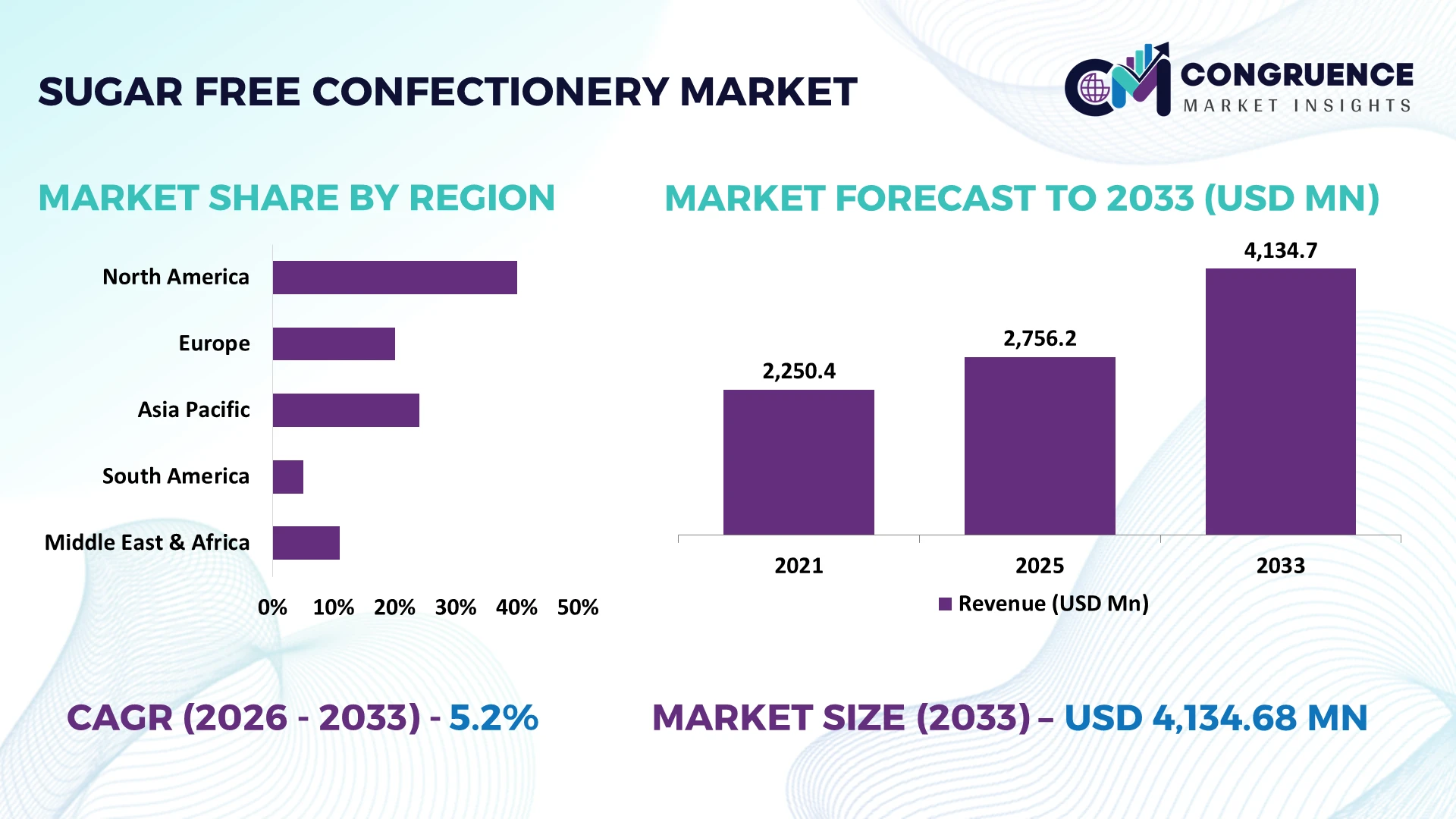
The United States is the dominant country market, supported by North America’s 38.1% share in 2024 and a mature ecosystem spanning sugar-free chocolate, gum, hard candy and functional confectionery. The U.S. benefits from broad retail penetration and product innovation from major manufacturers, while China and India are expanding their sugar-free portfolios at a faster pace. Mondelez’s 2026 U.S. launch of Oreo Zero Sugar, following earlier availability in Europe and China, demonstrates how multinational manufacturers are transferring successful reformulations across markets.
Strategically, manufacturers should prioritize U.S.-led product innovation while using China and India as expansion markets for localized sugar-free formats, sweetener systems and premium confectionery.
Market Size & Growth: USD 2756.24 million in 2025 is projected to reach USD 4134.68 million by 2033 at a 5.2% CAGR, with polyol- and stevia-based reformulation strengthening product innovation.
Top Growth Drivers: Sugar-reduction reformulation 38%, health-oriented purchasing 31%, and premium functional confectionery 24% represent the leading growth influences across developed and emerging markets.
Short-Term Forecast: By 2028, automated depositing, precision dosing and formulation analytics are positioned to improve production consistency by 5–8% while reducing formulation-related waste by 3–6%.
Emerging Technologies: AI-assisted formulation, automated sweetener dosing and advanced polyol-fiber systems are improving sweetness balance, texture and manufacturing repeatability in sugar-free confectionery.
Regional Leaders: North America held 38.1% share in 2024, Europe remains a major premium sugar-free market, while Asia Pacific is advancing through expanding adoption in China, India and Japan.
Consumer/End-User Trends: Chocolate confectionery represented 46.35% of the market in 2025, demonstrating that consumers increasingly expect sugar-free alternatives in mainstream indulgence categories rather than only specialist products.
Pilot/Case Example: In 2026, Mondelez launched Oreo Zero Sugar and Oreo Double Stuf Zero Sugar in the U.S. after more than 4 years of development, using maltitol, polydextrose, sucralose and acesulfame potassium to replicate the original product profile.
Competitive Landscape: The Hershey Company leads with an estimated 14–18% share, followed by Mars, Incorporated at 12–16%, Nestlé S.A. at 10–14%, Perfetti Van Melle at 8–12%, and SmartSweets at 6–9%, reflecting a market where global confectionery leaders compete alongside specialized sugar-free brands.
Regulatory & ESG Impact: Polyol-based formulations require tighter labeling controls; products containing more than 10% added polyols in the EU require a specific laxative-effect warning, increasing packaging-compliance requirements.
Investment & Funding: Manufacturers are directing investment toward zero-sugar portfolio expansion, with The Hershey Company, Mars, Mondelez International and Nestlé strengthening product development and commercialization capabilities.
Innovation & Future Outlook: The next competitive phase centers on stevia, erythritol, maltitol, xylitol, fiber and blended sweetener systems that improve taste and texture while shifting sugar-free confectionery toward mainstream premium offerings.
The Sugar-free Confectionery Market is increasingly concentrated around sugar-free chocolate, gummies, hard candy, mints and chewing gum, with manufacturers competing on taste equivalence, ingredient positioning and formulation performance. Chocolate accounted for 46.35% of the market in 2025, confirming its central role in category expansion. The 2026 Oreo Zero Sugar launch also demonstrates the strategic shift toward replicating established mainstream products rather than creating separate niche offerings, while cocoa-cost volatility and evolving sweetener requirements are increasing the importance of formulation efficiency and supply-chain flexibility.
The Sugar-free Confectionery Market is becoming strategically important as manufacturers move from niche diabetic-oriented products toward mainstream indulgence, functional nutrition and premium reformulation. Chocolate represented 46.35% of category demand in 2025, making taste equivalence and texture preservation critical competitive differentiators. Companies are therefore directing R&D toward polyols, stevia, fibers and blended sweetener systems rather than relying on single-ingredient substitution.
Technology is accelerating this shift. Precision dosing and automated depositing can deliver tighter ingredient consistency than conventional manual batching, with targeted material and rework reductions of approximately 5–8%. The U.S. remains a commercialization hub, where large brands are scaling zero-sugar versions of established products, while India and China emphasize localized formulations and expanding modern-retail penetration. Regulatory requirements are also reshaping production and labeling, particularly the EU threshold requiring a laxative-effect warning for products containing more than 10% added polyols.
Over the next 2–3 years, manufacturers are expected to increase automated formulation, digital quality monitoring and regional sweetener sourcing, with pilot-to-commercial conversion becoming a key investment metric. Mondelez’s 2026 U.S. Oreo Zero Sugar rollout illustrates the strategy: established brands are using large-scale distribution to validate reformulated products rapidly. Competitive advantage will increasingly depend on proprietary formulations, resilient ingredient procurement and faster commercialization cycles.
Sugar reduction is shifting from a niche dietary proposition into mainstream product development, with chocolate accounting for 46.35% of market demand and sugar-free formats expanding across chocolate, gummies, mints and hard candy. The U.S. remains a major innovation center, while India is developing localized low-sugar offerings for urban consumers. Regulatory pressure and consumer scrutiny are accelerating replacement of conventional sucrose with stevia, maltitol, erythritol and fiber systems. Companies are responding through formulation partnerships, automated dosing equipment and portfolio extensions. The non-obvious advantage is formulation know-how: manufacturers that achieve comparable sweetness and mouthfeel using lower-cost blended systems can protect margins while reducing dependence on any single sweetener input.
Sugar-free formulations carry structural cost pressures because specialized sweeteners, texturizers and processing aids often require more controlled formulation than conventional sucrose systems. Polyol usage also creates regulatory complexity, with products containing more than 10% added polyols in the EU requiring a laxative-effect warning. Product reformulation can therefore increase packaging complexity and compliance workloads by measurable double-digit percentages across affected SKUs. The U.S. has broader commercialization flexibility, while European manufacturers face tighter labeling discipline. Companies are reducing exposure through multi-supplier contracts, regional ingredient sourcing and blended sweetener architectures. The key operational constraint is not sweetener availability alone; it is maintaining identical taste, texture and shelf life when suppliers or formulation ratios change.
The strongest opportunity is the convergence of sugar-free confectionery with functional nutrition. Products combining reduced sugar with prebiotic fiber, protein, electrolytes, botanical ingredients or micronutrients can move beyond calorie reduction into higher-value consumption occasions. Chocolate already represents 46.35% of demand, creating a large platform for functional extensions, while the 10% EU polyol-labeling threshold encourages developers to optimize blends rather than maximize polyol loading. India and China offer particularly attractive white-space opportunities for localized formats and affordable premium products. Companies are increasing R&D collaboration with ingredient specialists and contract manufacturers. The strategic opportunity lies in developing modular formulations that can be rapidly adapted across countries without rebuilding the entire manufacturing process.
Commercial scale-up remains difficult because sugar performs multiple functions beyond sweetness, including bulk, moisture retention, crystallization control and texture formation. Replacing it can therefore affect multiple product attributes simultaneously, while polyol systems introduce additional formulation constraints above the 10% regulatory threshold in European products. Manufacturers expanding across countries also face differences in ingredient specifications, climate conditions and consumer taste preferences. Companies must strengthen pilot plants, sensory testing and automated process monitoring before accelerating production. The critical challenge is achieving consistent sensory performance across high-volume batches rather than simply developing a technically sugar-free recipe. Manufacturers that integrate formulation databases, real-time quality controls and supplier qualification programs will be better positioned to sustain product consistency during international expansion.
Zero-Sugar Portfolio Expansion: Major manufacturers are shifting zero-sugar products from niche shelves into mainstream portfolios, with reformulated launches targeting established brands and pack formats. Mondelez’s 2026 Oreo Zero Sugar rollout follows more than 4 years of formulation work, showing how companies are prioritizing taste parity and rapid commercialization.
Polyol Formulation Optimization: Stevia held about 29% of sweetener share in 2025, while erythritol, xylitol and maltitol systems are being blended to improve sweetness and mouthfeel. Companies are increasingly optimizing sweetener ratios rather than maximizing one ingredient, reducing sensory variability and formulation dependence.
Digital Retail Reconfiguration: Online retail is becoming a faster-moving channel as consumers compare ingredient lists, nutritional claims and dietary positioning digitally. E-commerce adoption is accelerating product discovery, while brands are using direct-to-consumer launches and subscription models to reduce dependence on traditional shelf expansion.
Cocoa Supply Strategies Shift: Chocolate manufacturers are reassessing sourcing and recipe economics as cocoa-market volatility changes input costs. Hershey and other producers are adjusting formulations, pack sizes and procurement strategies, while sugar-free chocolate retains strong category relevance at 46.35% share, making supply-chain resilience increasingly important.
Sugar-Free Chocolate remains the leading type, accounting for approximately 46.35% of the market in 2025. Its dominance reflects established chocolate-processing infrastructure, premium pricing capacity and the ability to transfer conventional products into reduced-sugar formats. Sugar-Free Gummies represent a faster-moving innovation area as manufacturers improve gelatin, pectin and polyol systems to preserve chewiness; adoption is increasingly tied to younger consumers seeking portable indulgence. Sugar-Free Hard Candies retain operational importance because their low-moisture structure simplifies shelf stability, while Sugar-Free Chewing Gum benefits from frequent consumption and established xylitol positioning.
The investment gap is shifting toward gummies and advanced chocolate reformulation. Companies are prioritizing multi-sweetener systems, automated depositing and sensory testing, with formulation optimization targeting 5–8% reductions in rework and process variability. U.S. manufacturers are scaling established chocolate brands, while Indian companies are expanding premium sugar-free chocolate and gummy assortments.
Snacking is the leading application, estimated at approximately 42% of sugar-free confectionery usage, because products fit frequent, portion-controlled consumption across chocolate, gummies, hard candies and gum. Sugar-Reduced Diets represent a mature but structurally important application, particularly in the U.S. and India, while Gifting retains premium relevance through boxed chocolates and seasonal assortments. Functional Confectionery is the fastest-evolving application as brands integrate ingredients positioned around oral care, energy and wellness.
Companies are increasingly redesigning products around convenience rather than medical-only positioning. Approximately 30% of new product-development activity is moving toward multifunctional formulations and portion-controlled formats, while online merchandising is strengthening visibility among wellness-oriented consumers. Mondelez’s 2026 U.S. Oreo Zero Sugar launch demonstrates how established brands are converting mainstream snack occasions into sugar-free formats. The strategic implication is that manufacturers are investing in taste-equivalent everyday products instead of restricting sugar-free portfolios to specialist dietary consumers.
Supermarkets & Hypermarkets remain the dominant end-user group, representing approximately 49.5% of market sales in 2025. Their scale enables broad SKU deployment, promotional visibility and category management across chocolate, gummies and hard candies. Convenience Stores remain important for impulse-oriented gum, mints and single-serve products, while Specialty Stores serve health-focused shoppers with narrower premium assortments. Online Retailers are the fastest-growing end-user channel as digital discovery removes shelf-space constraints and enables smaller brands to reach targeted consumers.
Companies are adapting channel investment accordingly, using supermarkets for mass-market scale while allocating more digital spending to Online Retailers. E-commerce is particularly effective for products requiring ingredient comparison, with approximately 20–25% higher assortment flexibility than physical shelf formats. In India, the strategy favors localized packs and premium positioning; U.S. brands emphasize established-brand extensions and rapid national distribution.
North America accounted for the largest market share at 39.1% in 2025 however, Asia-Pacific is expected to register the fastest growth, expanding at a CAGR of 5.5% between 2026 and 2033.
Mainstream Zero-Sugar Scaling Reshapes Category Economics
North America holds the strongest market position, supported by mature retail infrastructure, established sugar-free product portfolios and high penetration of reduced-sugar chocolate, gum and candy. The U.S. represents the principal demand and manufacturing hub, with major manufacturers using established brands to accelerate zero-sugar commercialization. In 2026, Mondelez expanded its Oreo Zero Sugar platform in the U.S. after more than four years of formulation development, demonstrating the shift from specialist products toward mainstream reformulation. Automated depositing, precision dosing and digital quality controls are strengthening production consistency, while cocoa-cost volatility is pushing manufacturers toward tighter procurement and pack-size optimization. Companies are prioritizing product-line extensions and retailer partnerships rather than building entirely new distribution networks, reducing commercialization friction.
United States Market Outlook: The U.S. combines large-scale confectionery manufacturing, extensive supermarket penetration and strong brand-development capabilities. It also accounts for about one-quarter of global chocolate sales, giving domestic manufacturers a substantial platform for sugar-free chocolate innovation and national-scale product testing.
Regulatory Precision Drives Reformulation Investment
Europe remains a major sugar-free confectionery market, supported by established chocolate consumption, sophisticated private-label infrastructure and stringent nutritional labeling requirements. Manufacturers are increasingly redesigning formulations around polyols, stevia, fibers and blended sweetener systems to balance sweetness with texture and regulatory compliance. Products containing more than 10% added polyols require a laxative-effect warning under European rules, making formulation optimization directly relevant to packaging and commercialization decisions. Western European sugar consumption declined 6.7% over the two years through 2025, reinforcing the structural shift toward lower-sugar consumption. Companies are responding through reformulation, portion control and premium product differentiation while strengthening ingredient traceability and supplier diversification.
Germany Market Outlook: Germany combines strong confectionery manufacturing capabilities with advanced food-processing infrastructure and demanding labeling standards. Manufacturers are using precision formulation and automated production controls to manage polyol-based recipes, while premium sugar-free chocolate and functional confectionery provide opportunities for higher-value product positioning.
High-Volume Manufacturing Meets Rapid Product Localization
Asia-Pacific is the fastest-expanding market, with China, India and Japan driving product localization, modern retail penetration and investment in reduced-sugar formulations. China provides extensive confectionery manufacturing capacity, while India is developing premium sugar-free chocolate, gummies and traditional confectionery alternatives. The region accounted for approximately 22.9% of the global market in 2025, creating substantial scale for manufacturers that can localize sweetness profiles and price points. Companies are increasing contract manufacturing partnerships, digital retail distribution and ingredient sourcing networks to shorten launch cycles. The non-obvious advantage is manufacturing flexibility: producers able to switch between conventional and sugar-free formulations on shared equipment can improve asset utilization and reduce expansion costs.
China Market Outlook: China offers the strongest combination of manufacturing scale, digital commerce infrastructure and expanding premium food consumption. Large confectionery producers are using localized formulations and online channels to test new sugar-free products before broader retail deployment, allowing faster demand validation and lower initial distribution risk.
Brazil Anchors Regional Manufacturing Expansion
South America is developing through Brazil's established confectionery manufacturing base, extensive supermarket networks and growing availability of reduced-sugar products. Brazil remains the region's principal production and commercialization hub, while Argentina and Chile support cross-border product distribution. Private-label and value-oriented sugar-free formats are becoming increasingly relevant as manufacturers seek broader consumer access without sacrificing formulation quality. Arcor expanded sugar-free candy distribution across Brazil and Chile in 2024, illustrating how regional manufacturers are using established supply networks to widen market coverage. Companies are prioritizing distributor partnerships, localized packaging and cost-efficient sweetener systems rather than heavy standalone infrastructure investment. Supply-chain efficiency remains critical because imported specialty ingredients can increase formulation costs and production lead times.
Brazil Market Outlook: Brazil provides the strongest industrial platform through established confectionery production, deep retail coverage and regional export connectivity. Manufacturers can leverage existing facilities to introduce sugar-free variants, reducing incremental capital requirements while using national-scale distribution to test price-sensitive products across mainstream retail channels.
Modern Retail and Health-Oriented Reformulation Accelerate
The Middle East & Africa market is being shaped by modern retail expansion, premium food investment and increasing emphasis on reduced-sugar formulations. Saudi Arabia and the United Arab Emirates are important commercialization hubs because of their advanced retail infrastructure, imported premium confectionery portfolios and growing food-manufacturing investment. Sugar taxes and nutrition-focused policies are also encouraging manufacturers to reconsider formulation strategies. South Africa's sugar-reduction environment is strengthening demand for reformulated confectionery, while GCC markets are supporting premium imported and locally produced products. Companies are responding through distributor partnerships, regional packaging operations and selective localization rather than broad manufacturing expansion. The key opportunity lies in using modern retail and e-commerce infrastructure to overcome fragmented traditional distribution.
Saudi Arabia Market Outlook: Saudi Arabia offers strong potential through food-sector modernization, expanding domestic manufacturing and large modern-retail networks. National investment in food-processing capacity is encouraging companies to localize selected confectionery operations, while premium sugar-free products align with growing demand for differentiated and health-oriented packaged foods.
The Sugar-free Confectionery Market is led by global confectionery groups including Mars, Mondelez International, Nestlé, The Hershey Company and Ferrero, competing with specialized producers such as Perfetti Van Melle, HARIBO and Russell Stover. The top five players collectively command an estimated 35–40% share, creating a moderately concentrated structure where scale advantages coexist with specialist innovation. Competition centers on formulation performance, brand recognition, retail access, ingredient security and pricing. Leading companies are investing 5–8% of product-development budgets into reformulation, automation and sensory optimization, while strategic partnerships with sweetener and ingredient suppliers are shortening development cycles by roughly 10–15%. Vertical integration and multi-source procurement are gaining importance as cocoa and specialty sweetener volatility affects margins. Specialized brands compete through clean-label positioning, functional ingredients and faster niche launches, increasing pressure on established portfolios. The entry barrier remains high because achieving sucrose-like texture requires formulation expertise, testing infrastructure and scaled distribution. Winning requires proprietary recipes, resilient sourcing, rapid commercialization and strong retail execution.
Mars, Incorporated
Mondelez International, Inc.
Nestlé S.A.
The Hershey Company
Ferrero International S.A.
Perfetti Van Melle
HARIBO GmbH & Co. KG
Russell Stover Chocolates
Lotte Corporation
Albanese Confectionery Group, Inc.
Chupa Chups
SmartSweets
Sugarless Confectionery
Simply Lite
Current production increasingly uses precision dosing, automated depositing and digital batch controls to stabilize sweetness, texture and weight. Automated dosing can improve ingredient accuracy by 1–2% versus manual handling, while digital monitoring can reduce rework by 2%. Adoption is strongest in large confectionery plants, where repeatable recipes and tighter portion control support margin protection and retail consistency.
Emerging technologies combine AI-assisted formulation, inline spectroscopy and machine-vision inspection. AI formulation tools can shorten recipe iteration by 10–15%, while vision systems improve defect detection by 1–2%. Integration with ERP and manufacturing execution systems gives manufacturers faster traceability, tighter quality control and better sweetener inventory planning. Compared with laboratory-only testing, connected inspection moves quality decisions closer to real time, reducing interruptions and accelerating new SKU commercialization.
Disruptive development centers on precision fermentation, novel fibers and advanced sweetener blends designed to reproduce sucrose functionality with fewer sensory compromises. By 2028, automated formulation and closed-loop quality systems should expand deployment across high-volume facilities. Digital recipes enable faster localization. Large multinational brands benefit through scale, while regional specialists gain speed through modular equipment and contract manufacturing. Companies acting now can secure formulation know-how, validate suppliers and establish production data before these technologies become standard competitive requirements.
February 2024 Mars Wrigley launched sugar-free EXTRA Refreshers in Germany, adding 35-piece packs across grocery and convenience channels. The rollout expanded sugar-free gum occasions beyond functional use, strengthening flavor-led positioning and giving retailers another impulse-focused format and seasonal merchandising immediately. Source: mars.com
May 2025 Perfetti Van Melle expanded Trident Vibes Cotton Candy into U.S. national retail after a 6-month exclusive launch. The 40-piece bottle filled a sugar-free flavor gap, converting early retail traction into broader distribution and repeat-purchase potential and shelf visibility. Source: perfettivanmelleus.com
August 2024 Mondelez and Coca-Cola launched Coca-Cola OREO Zero Sugar alongside OREO Coca-Cola cookies as a limited partnership. The two-product collaboration combined established brands, extending zero-sugar innovation into cross-category launches and creating incremental consumer engagement through shared distribution across touchpoints. Source: mondelezinternational.com
February 2026 Nestlé expanded POLO’s sugar-free range with Extra Strong Mint and Berry Mint, both produced at its York factory. The two variants broadened zero-sugar choice while retaining domestic manufacturing, supporting faster distribution and reinforcing plant utilization for UK retailers. Source: nestle.co.uk
The Sugar-free Confectionery Market report covers Sugar-Free Chocolate, Sugar-Free Gummies, Sugar-Free Hard Candies and Sugar-Free Chewing Gum across Snacking, Functional Confectionery, Gifting and Sugar-Reduced Diets. End-user analysis includes Supermarkets & Hypermarkets, Convenience Stores, Online Retailers and Specialty Stores, enabling assessment of demand concentration, channel deployment and purchasing behavior.
The study evaluates North America, Europe, Asia-Pacific, South America, and Middle East & Africa, with country-level analysis emphasizing the United States, Germany, China, Brazil and Saudi Arabia. Technology coverage includes precision dosing, automated depositing, AI-assisted formulation, machine vision, advanced sweetener blends and digital quality systems. The report supports investment planning through technology-readiness assessment, expansion prioritization, supplier diversification and competitive benchmarking. It also identifies niche opportunities in functional formats, premium sugar-free chocolate, digital retail and localized formulations, helping companies position portfolios and operational capabilities for changing market conditions between 2026 and 2033.
| Report Attribute/Metric | Report Details |
|---|---|
Market Revenue in 2025 | USD 2756.24 Million |
Market Revenue in 2033 | USD 4134.68 Million |
CAGR (2026 - 2033) | 5.2% |
Base Year | 2025 |
Forecast Period | 2026 - 2033 |
Historic Period | 2021 - 2025 |
Segments Covered | By Type
By Application
By End-User
|
Key Report Deliverable | Revenue Forecast, Growth Trends, Market Dynamics, Segmental Overview, Regional and Country-wise Analysis, Competition Landscape |
Region Covered | North America, Europe, Asia-Pacific, South America, Middle East, Africa |
Key Players Analyzed | Mars, Incorporated, Mondelez International, Inc., Nestlé S.A., The Hershey Company, Ferrero International S.A., Perfetti Van Melle, HARIBO GmbH & Co. KG, Russell Stover Chocolates, Lotte Corporation, Albanese Confectionery Group, Inc., Chupa Chups, SmartSweets, Sugarless Confectionery, Simply Lite |
Customization & Pricing | Available on Request (10% Customization is Free) |




