
Reports
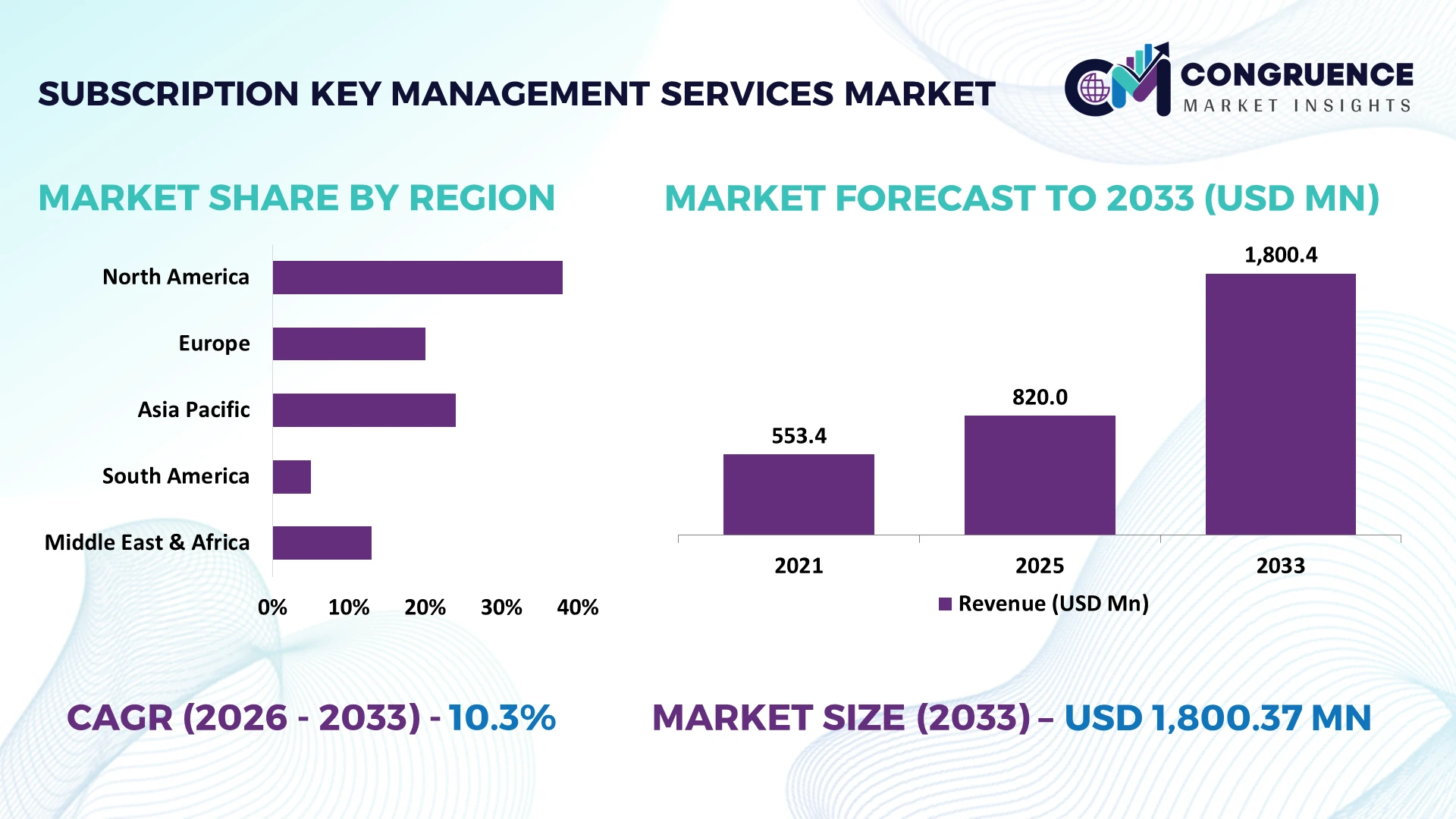
The Global Subscription Key Management Services Market was valued at USD 820 Million in 2025 and is anticipated to reach a value of USD 1800.37 Million by 2033 expanding at a CAGR of 10.33% between 2026 and 2033. Growth is driven by enterprise encryption key lifecycle automation, multicloud security integration, customer managed encryption keys, and regulatory requirements for cryptographic asset governance.
The United States leads the subscription key management services ecosystem through hyperscale cloud infrastructure, cybersecurity investment, and enterprise encryption adoption. AWS operates 39 geographic cloud regions globally, while Microsoft Azure maintains more than 70 announced regions, supporting distributed key management infrastructure. The United States hosts major providers including AWS, Microsoft, Google, and IBM, serving banking, healthcare, government, and technology enterprises. Compared with Germany, American providers demonstrate greater global infrastructure reach, while European deployments emphasize encryption sovereignty under GDPR and NIS2 requirements.
Strategically, providers combining automated key rotation, sovereign deployment options, and integration across more than 2 cloud environments gain stronger enterprise procurement positioning.
Market Size & Growth: USD 820 million in 2025, reaching USD 1,800.37 million by 2033 at 10.33% CAGR, supported by automated encryption governance.
Top Growth Drivers: 88% multicloud adoption, 84% hybrid cloud adoption, and 63% cloud security concerns reinforce encryption management priorities.
Short Term Forecast: By 2028, automated key rotation targets 30% lower administrative effort, representing an operational improvement scenario.
Emerging Technologies: Post quantum cryptography, automated key orchestration, and confidential computing represent 3 important technology directions.
Regional Leaders: North America, Europe, and Asia Pacific lead adoption; separate regional USD forecasts require validated market allocation data.
Consumer & End User Trends: 88% multicloud adoption strengthens demand for centralized encryption policy management across enterprise environments.
Pilot/Case Example: In 2025, NIST standardized 3 post quantum algorithms, accelerating enterprise cryptographic migration planning.
Competitive Landscape: AWS, Microsoft, Google, IBM, and Thales compete across cloud key management; individual market shares remain undisclosed.
Regulatory & ESG Impact: NIS2 covers 18 critical sectors, strengthening security governance and cryptographic risk management requirements.
Investment & Funding: AWS announced approximately USD 11 billion in Georgia data center investment in 2025, supporting broader cloud infrastructure expansion.
Innovation & Future Outlook: NIST's 2035 transition target accelerates preparation for quantum resistant cryptography and automated key inventory management.
The Subscription Key Management Services Market supports enterprises requiring centralized control of encryption keys across cloud applications, databases, payment systems, and regulated digital infrastructure. Subscription platforms increasingly integrate hardware security modules, bring your own key functionality, automated rotation, and cryptographic policy enforcement. Flexera's 2025 cloud research identified 70% of organizations using hybrid cloud environments, reinforcing demand for interoperable key management. The transition toward quantum resistant encryption is also influencing procurement, particularly in banking and government environments where sensitive information requires long term protection. These developments establish the foundation for evaluating strategic investment priorities and competitive differentiation.
Subscription key management services are becoming strategically essential as enterprises consolidate encryption governance across distributed cloud environments, regulated applications, and sensitive digital infrastructure. The shift from locally administered cryptographic keys toward subscription based key lifecycle management is changing cybersecurity procurement priorities. Flexera's 2025 cloud research identified 70% hybrid cloud adoption, reinforcing demand for interoperable encryption controls. Regulatory developments, including Europe's NIS2 Directive and evolving cryptographic standards, are accelerating investment in centralized key inventories, automated rotation, and hardware backed protection.
Modern key management platforms replace manual provisioning with policy driven automation, reducing administrative intervention and strengthening audit readiness. An illustrative enterprise deployment targeting 30% lower key administration effort demonstrates potential efficiency advantages over manual workflows, subject to operational validation. American hyperscalers emphasize global infrastructure coverage, while German enterprises prioritize encryption sovereignty and controlled key residency. These differences influence deployment architecture, vendor selection, and integration requirements across regulated industries.
Between 2026 and 2028, providers are prioritizing quantum resistant cryptography, confidential computing integration, and automated cryptographic discovery. A multinational bank can centralize encryption policies across cloud databases while retaining customer controlled master keys. AWS, Microsoft, Google, and Thales are expanding integration capabilities and security partnerships. Competitive leadership increasingly depends on interoperable key governance, measurable operational efficiency, and independent control over sensitive cryptographic assets.
Enterprise multicloud adoption is strengthening demand for subscription based encryption key management, centralized policy enforcement, and automated cryptographic lifecycle controls. Flexera's 2025 cloud research identified 70% hybrid cloud adoption, while 84% of organizations reported cloud spending management challenges and 60% identified cloud cost optimization as a priority. United States financial institutions increasingly operate encrypted workloads across multiple cloud environments, creating fragmented key inventories and inconsistent access policies. Subscription key management platforms address these constraints through centralized visibility, automated rotation, and integration with hardware security modules. AWS, Microsoft, and IBM are strengthening cloud security integrations and enterprise encryption capabilities. Providers delivering interoperable key governance gain procurement advantages by reducing administrative fragmentation and simplifying compliance documentation across distributed infrastructure.
Subscription key management deployment faces structural limitations from proprietary cloud interfaces, hardware security module expenses, and data residency restrictions. Flexera's 2025 research identified 84% of organizations struggling with cloud spending management, while 70% operated hybrid environments, increasing integration complexity. Additionally, 63% of organizations in broader cloud security surveys identified security and compliance concerns as significant adoption barriers. German financial institutions must evaluate European data protection requirements and operational resilience obligations when selecting external cryptographic service providers. Proprietary key formats and provider specific application interfaces increase migration expenses and complicate supplier replacement. Vendors are responding through standardized KMIP interfaces, customer controlled encryption keys, regional hosting options, and contractual portability provisions to reduce infrastructure dependency and procurement resistance.
Post quantum cryptography creates a significant opportunity for subscription key management providers offering automated discovery, algorithm migration, and cryptographic asset monitoring. NIST finalized 3 foundational post quantum cryptographic standards in 2024, establishing a transition framework for enterprises protecting sensitive information. Flexera's 2025 research recorded 70% hybrid cloud adoption, while 84% of organizations identified cloud spending management challenges, supporting demand for consolidated cryptographic administration. United States government modernization requirements are influencing private sector procurement of quantum resistant security infrastructure. Providers are investing in cryptographic bill of materials capabilities, automated certificate management, and algorithm agility. Subscription platforms combining migration assessment with continuous key governance can develop recurring service relationships while reducing enterprise dependence on fragmented security tools.
Maintaining encryption continuity during large scale cryptographic migration presents a major execution challenge for subscription key management providers. NIST's 2024 standardization introduced 3 foundational post quantum algorithms, while its transition guidance targets removal of quantum vulnerable algorithms from federal systems by 2035. Flexera's 2025 research identified 70% hybrid cloud adoption, illustrating the complexity of coordinating cryptographic changes across distributed environments. United States financial institutions must manage key rotation, application compatibility, disaster recovery, and hardware security module performance without interrupting critical transactions. Poorly coordinated migration can invalidate encrypted records or disrupt authentication services. Providers must invest in automated dependency mapping, staged algorithm replacement, resilient key recovery, and continuous security testing to maintain enterprise trust and operational stability.
Customer Controlled Encryption Gains Enterprise Priority: Enterprises are separating encryption key ownership from cloud infrastructure administration through bring your own key and hold your own key architectures. Flexera's 2025 research identified 70% hybrid cloud adoption, while 84% of organizations reported cloud spending management challenges. Financial institutions are adopting customer controlled key custody to improve security governance. Providers are expanding external key management integrations and hardware security module partnerships.
Cryptographic Observability Enters Security Operations: Security teams are incorporating encryption key inventories into centralized monitoring workflows to identify expired credentials, unauthorized access, and unmanaged cryptographic assets. NIST SP 800 57 defines 4 principal key lifecycle phases, while ISO 27001:2022 Annex A includes 93 security controls. Enterprise security vendors are connecting key management telemetry with security information platforms, improving incident investigation and reducing manual audit preparation across distributed applications.
Confidential Computing Changes Key Access Models: Cloud providers are integrating hardware protected execution environments with encryption services to limit exposure during sensitive workload processing. AMD SEV SNP and Intel TDX provide distinct confidential computing architectures, while Azure supports confidential virtual machine configurations. The 2025 Confidential Computing Consortium ecosystem includes multiple hardware and cloud participants. Providers are expanding attestation based key release, allowing cryptographic operations only after workload integrity verification and strengthening protection for regulated computing environments.
Regulated Cloud Procurement Favors Regional Custody: European enterprises are restructuring encryption contracts around operational resilience and jurisdictional control. The Digital Operational Resilience Act became applicable in January 2025, while NIS2 covers 18 critical sectors across the European Union. Cloud security providers are expanding regional key storage, dedicated hardware security modules, and customer controlled administrative access. These changes increase compliance documentation requirements while strengthening demand for geographically controlled subscription encryption services.
Cloud Based Services represent the leading segment, with an indicative market share of approximately 50% to 55%, supported by scalable encryption infrastructure, automated provisioning, and integration with managed cloud applications. Subscription platforms reduce the need for enterprises to maintain dedicated cryptographic hardware while providing centralized key rotation, access policies, and audit records. AWS Key Management Service, Azure Key Vault, and Google Cloud Key Management offer integration with their respective cloud ecosystems. On Premises Services remain important for organizations requiring direct control over hardware security modules, restricted network environments, and sensitive cryptographic assets. Financial institutions and government agencies prioritize these configurations when regulatory requirements limit external key custody.
Hybrid Services represent the fastest advancing segment as enterprises combine cloud scalability with locally controlled encryption infrastructure. Flexera's 2025 research identified 70% hybrid cloud adoption, supporting demand for interoperable cryptographic governance. Providers are strengthening external key management interfaces, dedicated hardware security modules, and centralized administration capabilities. Investment priorities increasingly favor platforms supporting independent key ownership across multiple infrastructure environments without duplicating security policies.
Encryption Key Management represents the leading application, with an indicative market share of approximately 35% to 40%, reflecting widespread requirements for protecting databases, enterprise applications, cloud storage, and sensitive digital transactions. Organizations prioritize centralized key generation, storage, access authorization, and rotation to reduce fragmented cryptographic administration. Data Protection remains closely connected to encryption governance, particularly where enterprises must secure customer records and confidential workloads. Compliance Management supports audit documentation, access accountability, and enforcement of encryption policies across regulated operating environments. Providers are developing integrated dashboards, automated reporting, and policy enforcement capabilities to reduce administrative complexity.
Cryptographic Key Lifecycle Management represents the fastest advancing application as organizations prepare for algorithm transitions and increasingly complex encryption environments. NIST finalized 3 foundational post quantum cryptographic standards in 2024, strengthening requirements for cryptographic inventory and migration planning. API Security also gains importance as distributed applications exchange sensitive information through encrypted interfaces. Technology providers are expanding automated key discovery, certificate administration, and integration with application development pipelines. Competitive differentiation increasingly depends on continuous cryptographic visibility and secure lifecycle orchestration.
BFSI represents the leading end user segment, with an indicative market share of approximately 30% to 35%, supported by extensive encryption requirements across payment infrastructure, digital banking, transaction processing, and regulated customer information systems. Financial institutions require controlled cryptographic key custody, hardware security module integration, and detailed access auditing. IT and Telecommunications companies represent another significant buyer category because of distributed infrastructure, encrypted network services, and large application environments. Government organizations prioritize sovereign key custody, classified information protection, and compliance with national cybersecurity requirements. Subscription providers are responding through dedicated encryption environments, customer managed keys, and specialized security service agreements.
Healthcare represents the fastest advancing end user category as hospitals, insurers, and digital health platforms modernize protection for patient records and connected clinical systems. The United States HIPAA Security Rule establishes requirements for protecting electronic health information, while proposed regulatory updates emphasize stronger cybersecurity controls. Retail organizations deploy encryption key services for payment security and customer information protection. Providers are developing sector specific compliance templates, scalable subscription packages, and integration partnerships to address differentiated security requirements.
North America accounted for the largest estimated market share at 38% in 2025 however, Asia Pacific is expected to register the fastest growth, expanding at a CAGR of 13.2% between 2026 and 2033.
Hyperscale Cloud Infrastructure Strengthens Encryption Governance Leadership
North America represents an estimated 38% of the global Subscription Key Management Services Market, supported by hyperscale cloud infrastructure, cybersecurity investment, and enterprise encryption requirements. The United States maintains a strong competitive position through AWS, Microsoft, Google, and IBM, which provide managed cryptographic services across distributed cloud environments. AWS operates 39 geographic cloud regions globally, supporting enterprise encryption key management across geographically distributed workloads. Financial institutions, healthcare providers, and technology companies increasingly require centralized key rotation, hardware security module integration, and customer controlled encryption policies. Canada's financial services sector emphasizes secure cloud adoption and regulatory compliance, strengthening demand for managed cryptographic infrastructure. Regional providers are expanding external key management capabilities, dedicated security environments, and integration partnerships. Competition increasingly favors platforms combining automated encryption governance with flexible deployment architectures and established enterprise security ecosystems.
United States Market Outlook: The United States leads technological development through advanced cloud infrastructure, cybersecurity research, and federal cryptographic modernization initiatives. NIST finalized 3 foundational post quantum cryptographic standards in 2024, influencing enterprise encryption migration strategies. American financial institutions and government contractors are prioritizing cryptographic inventory management, secure key custody, and automated lifecycle controls. AWS, Microsoft, and Google are strengthening managed encryption services through integration with enterprise security platforms and hardware backed cryptographic infrastructure.
Digital Sovereignty Regulations Reshape Cryptographic Infrastructure Procurement
Europe accounts for an estimated 27% of global Subscription Key Management Services Market activity, supported by financial services regulation, enterprise cloud modernization, and data sovereignty requirements. Germany, France, and the United Kingdom represent important deployment environments because of their financial infrastructure, cybersecurity capabilities, and established enterprise technology sectors. The Digital Operational Resilience Act became applicable in January 2025, strengthening operational risk management requirements for financial entities and critical technology service providers. The NIS2 Directive covers 18 critical sectors, reinforcing cybersecurity governance across European Union member states. Enterprises increasingly prioritize customer controlled encryption keys, regional hardware security modules, and cryptographic access auditing. Providers are expanding sovereign cloud partnerships, external key management interfaces, and dedicated regional infrastructure. Procurement decisions increasingly emphasize jurisdictional control, operational resilience, and compatibility with existing enterprise security architecture.
Germany Market Outlook: Germany represents a strategically important market through its industrial manufacturing base, financial institutions, and enterprise cybersecurity requirements. German organizations prioritize encryption key residency, controlled administrative access, and compliance with European data protection obligations. The Federal Office for Information Security promotes national cybersecurity standards, influencing cryptographic procurement and infrastructure modernization. Providers offering locally controlled encryption infrastructure, interoperable key management interfaces, and documented recovery procedures maintain advantages in regulated enterprise contracts.
Cloud Infrastructure Expansion Accelerates Cryptographic Service Adoption
Asia Pacific represents an estimated 24% of global Subscription Key Management Services Market demand, supported by cloud infrastructure investment, financial technology expansion, and enterprise cybersecurity modernization. China, India, Japan, Singapore, and Australia contribute through banking digitization, telecommunications infrastructure, and government cloud initiatives. India's Digital Personal Data Protection framework is strengthening enterprise attention to data security governance, while Japan's financial institutions prioritize resilient encryption infrastructure. Singapore maintains advanced cloud infrastructure and regulatory oversight of financial technology operations. Regional enterprises increasingly require centralized encryption policies across geographically distributed applications and hybrid computing environments. Cloud providers are expanding managed key services, regional hardware security module availability, and customer controlled encryption capabilities. Suppliers integrating cryptographic automation with local compliance requirements gain advantages in enterprise procurement, particularly where data residency and infrastructure interoperability influence technology selection.
India Market Outlook: India benefits from expanding digital payment infrastructure, cloud adoption, and enterprise cybersecurity investment. The Reserve Bank of India's regulatory framework influences technology risk management and information security practices across financial institutions. India's Unified Payments Interface processed more than 20 billion monthly transactions during 2025, illustrating the scale of digital transaction infrastructure requiring strong cryptographic protection. Managed key service providers are targeting banks, payment processors, and technology enterprises through automated encryption controls and localized deployment options.
Financial Digitization Strengthens Managed Encryption Requirements
South America represents an estimated 6% of global Subscription Key Management Services Market demand, with Brazil leading regional adoption through financial technology expansion, cloud infrastructure development, and enterprise cybersecurity modernization. Brazil's Pix instant payment system supports extensive digital transaction activity, increasing operational requirements for encryption key protection and secure application infrastructure. The country's General Personal Data Protection Law establishes obligations for protecting personal information, influencing enterprise security procurement. Argentina, Chile, and Colombia contribute additional demand through banking modernization and commercial cloud adoption. However, imported cybersecurity infrastructure, specialized workforce limitations, and integration expenses influence deployment economics. Providers are responding through regional cloud partnerships, managed security service agreements, and modular subscription offerings. Enterprises increasingly prioritize solutions combining automated key administration with affordable implementation and compatibility across existing cloud platforms.
Brazil Market Outlook: Brazil maintains a strong regional position through its digital banking ecosystem, financial technology industry, and established cloud infrastructure. The Central Bank of Brazil reported more than 170 million individual Pix users by 2025, demonstrating extensive participation in digital financial services. Financial institutions require secure cryptographic operations, controlled key access, and reliable transaction infrastructure. Providers are expanding partnerships with local system integrators and cloud operators to support enterprise encryption governance.
Government Digital Transformation Strengthens Sovereign Encryption Infrastructure
The Middle East and Africa represent an estimated 5% of global Subscription Key Management Services Market activity, supported by government digitization, financial infrastructure modernization, and cybersecurity investment. Saudi Arabia and the United Arab Emirates maintain significant deployment opportunities through national digital transformation programs and expanding cloud infrastructure. Saudi Arabia's Vision 2030 initiative supports digital government services and technology modernization, strengthening demand for secure cryptographic infrastructure. The United Arab Emirates emphasizes cloud security, regulated data processing, and enterprise digital infrastructure. South Africa contributes through banking, telecommunications, and commercial cloud adoption. Regional providers are developing partnerships with hyperscale cloud operators, cybersecurity integrators, and government technology contractors. Procurement increasingly favors customer controlled encryption keys, regional hosting capabilities, and integrated compliance reporting to address data sovereignty requirements and operational security priorities.
United Arab Emirates Market Outlook: The United Arab Emirates benefits from established digital government infrastructure, financial services modernization, and expanding hyperscale cloud availability. AWS operates its Middle East UAE region, providing local cloud infrastructure for enterprise applications and managed security services. Financial institutions and government organizations prioritize encryption key residency, hardware backed protection, and centralized cryptographic governance. Providers integrating managed key services with sovereign infrastructure and regulatory compliance capabilities are positioned to strengthen institutional adoption.
The Subscription Key Management Services Market features competition between hyperscale providers AWS, Microsoft, and Google, enterprise security specialists IBM and Thales, and independent cryptographic platforms such as Fortanix and HashiCorp. The five largest providers hold an indicative combined share of 55% to 60%, reflecting cloud infrastructure concentration and established enterprise relationships. Flexera's 2025 research identified 70% hybrid cloud adoption and 84% cloud spending management challenges, reinforcing competition around interoperability and administrative efficiency. Hyperscalers emphasize native cloud integration, while independent suppliers differentiate through customer controlled keys, hardware security modules, and deployment flexibility. Providers are expanding sovereign cloud partnerships, automated key rotation, and post quantum migration capabilities. Proprietary interfaces, certification expenses, and infrastructure switching costs create entry barriers. Competitive advantage depends on cryptographic portability, transparent subscription pricing, secure key custody, and reliable integration across regulated enterprise environments without sacrificing operational resilience or customer control over encryption assets.
Amazon Web Services, Inc.
Microsoft Corporation
Google LLC
IBM Corporation
Thales Group
Fortanix Inc.
HashiCorp, Inc.
Entrust Corporation
Futurex LP
Utimaco Management GmbH
Keyfactor, Inc.
Securosys SA
OpenText Corporation
Oracle Corporation
Current subscription key management platforms integrate cloud hardware security modules, centralized key inventories, automated rotation, and granular access policies. AWS, Microsoft, and Google support managed cryptographic operations across enterprise applications. Flexera's 2025 survey reported 70% hybrid cloud adoption, demonstrating demand for interoperable encryption administration. Compared with manual provisioning, automated workflows can target 30% lower administrative effort, although actual savings depend on deployment complexity and integration maturity.
Emerging technologies combine confidential computing, external key custody, and cryptographic policy orchestration. Hardware backed attestation restricts key release to verified workloads, strengthening protection against unauthorized execution. NIST finalized 3 foundational post quantum cryptographic standards in 2024, accelerating algorithm agility requirements. Enterprises evaluating migration architectures must measure verification latency, key availability, and operational overhead rather than assume universal percentage improvements. Independent providers benefit competitively when customers require cryptographic portability beyond hyperscaler ecosystems.
Between 2026 and 2028, disruptive capabilities will center on automated cryptographic discovery, quantum resistant key exchange, and intelligent lifecycle monitoring. Subscription platforms integrating these functions can reduce fragmented security administration and improve migration readiness. Financial institutions benefit from controlled encryption custody, while government agencies prioritize sovereign deployment. Vendors investing in interoperable interfaces, resilient recovery, and continuous policy verification gain stronger positioning as cryptographic modernization becomes operationally critical.
June 2025: AWS introduced on demand rotation for imported encryption keys, preserving existing key identifiers and enabling zero downtime transitions. The upgrade strengthens compliance with rotation policies while avoiding application reconfiguration and disruption across protected enterprise cloud workloads. Source: aws.amazon.com
July 2026: Google Cloud made post quantum signatures and key encapsulation generally available in Cloud KMS, supporting 3 standardized algorithm families. The release enables enterprise cryptographic migration planning while preserving data integrity and strengthening protection against emerging quantum computing threats. Source: cloud.google.com
March 2026: IBM expanded Key Protect Dedicated into Dallas, introducing single tenant key custody with customer managed hardware security modules and planned FIPS 140 3 Level 4 certification. This deployment supports stronger workload isolation and regulated encryption governance. Source: cloud.ibm.com
October 2026: Thales introduced CipherTrust Data Security Posture Management, connecting sensitive data discovery with encryption, masking, and tokenization across 3 deployment environments: cloud, premises, and hybrid. The integration helps enterprises prioritize exposure remediation and consolidate complex security workflows. Source: cpl.thalesgroup.com
The Subscription Key Management Services Market Report evaluates industry developments between 2026 and 2033 across Cloud Based Services, On Premises Services, and Hybrid Services. Application coverage includes Encryption Key Management, Cryptographic Key Lifecycle Management, API Security, Data Protection, and Compliance Management. End user analysis examines BFSI, IT and Telecommunications, Healthcare, Government, and Retail. Geographic assessment covers North America, Europe, Asia Pacific, South America, and the Middle East and Africa, emphasizing infrastructure maturity, regulatory requirements, and enterprise adoption.
The report assesses hardware security modules, automated key rotation, confidential computing, quantum resistant cryptography, and customer controlled encryption architectures. Competitive analysis examines AWS, Microsoft, Google, IBM, Thales, and independent security providers. Strategic evaluation addresses investment planning, regional expansion, technology partnerships, subscription economics, and cryptographic migration priorities, supporting competitive positioning and long term infrastructure decisions.
| Report Attribute/Metric | Report Details |
|---|---|
Market Revenue in 2025 | USD 820 Million |
Market Revenue in 2033 | USD 1800.37 Million |
CAGR (2026 - 2033) | 10.33% |
Base Year | 2025 |
Forecast Period | 2026 - 2033 |
Historic Period | 2021 - 2025 |
Segments Covered | By Type
By Application
By End-User
|
Key Report Deliverable | Revenue Forecast, Growth Trends, Market Dynamics, Segmental Overview, Regional and Country-wise Analysis, Competition Landscape |
Region Covered | North America, Europe, Asia-Pacific, South America, Middle East, Africa |
Key Players Analyzed | Amazon Web Services, Inc., Microsoft Corporation, Google LLC, IBM Corporation, Thales Group, Fortanix Inc., HashiCorp, Inc., Entrust Corporation, Futurex LP, Utimaco Management GmbH, Keyfactor, Inc., Securosys SA, OpenText Corporation, Oracle Corporation |
Customization & Pricing | Available on Request (10% Customization is Free) |




