
Reports
The Global Submarine-launched Missile Market was valued at USD 817.0 Million in 2025 and is anticipated to reach a value of USD 1,387.1 Million by 2033 expanding at a CAGR of 6.84% between 2026 and 2033. Growth is driven by nuclear deterrence modernization programs, advanced missile guidance integration, and rising investments in next-generation submarine warfare capabilities.
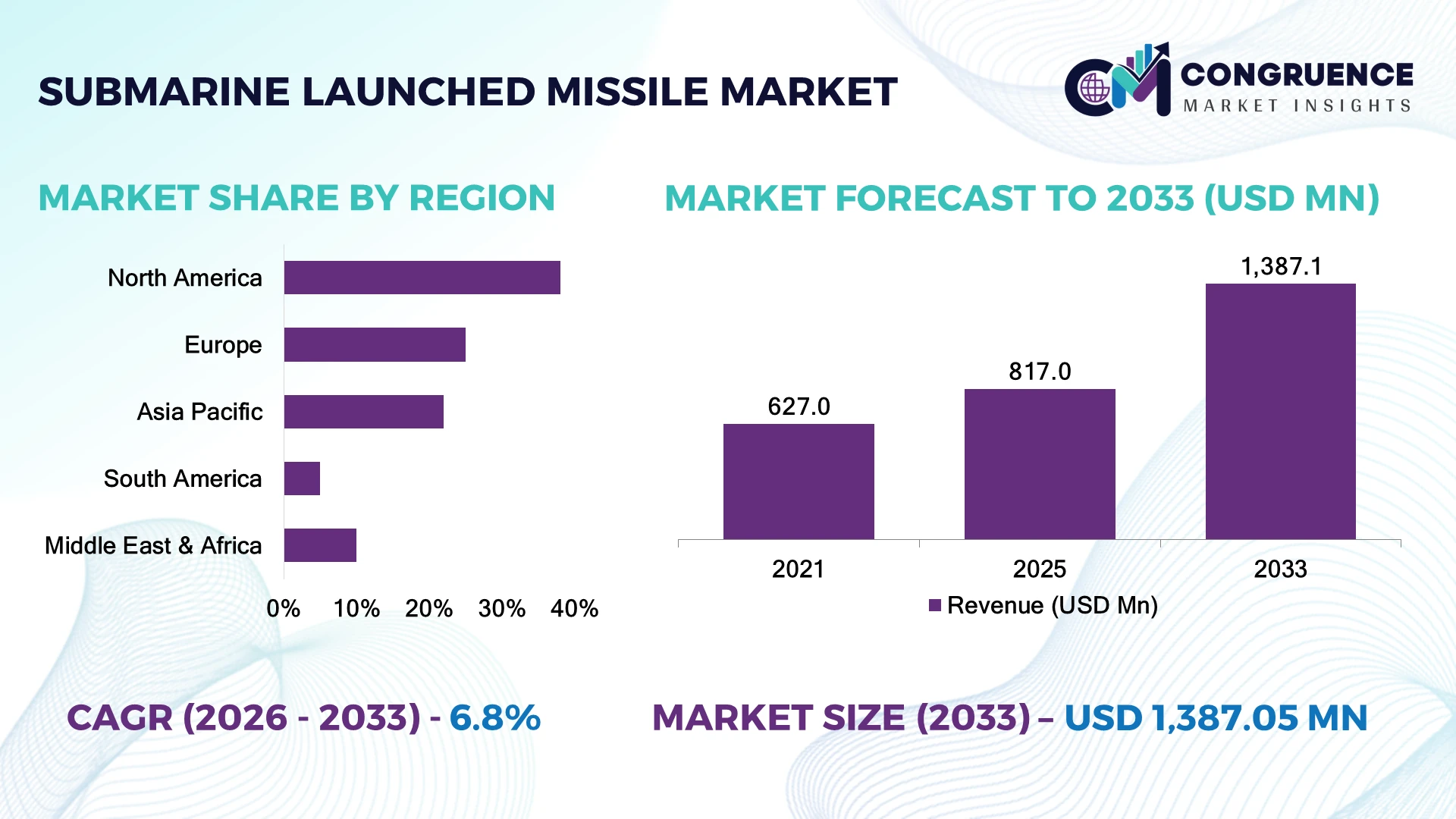
The United States dominates the market with approximately 35% share, supported by strategic programs under the U.S. Navy’s Columbia-class submarine initiative and more than USD 100 billion planned submarine fleet modernization efforts. Russia and China follow with significant naval expansion, while China has increased submarine production capacity by over 20% through domestic shipbuilding programs. The AUKUS security partnership further accelerates advanced undersea defense technology collaboration among allied nations.
Strategic implication Defense contractors prioritizing autonomous systems, precision guidance, and localized supply chains will gain stronger competitive positioning.
Market Size & Growth: USD 817.0 Million in 2025 to USD 1,387.1 Million by 2033 at 6.84% CAGR, driven by submarine fleet modernization and advanced missile technology upgrades.
Top Growth Drivers: Nuclear deterrence programs (35%), naval modernization initiatives (28%), and precision-guided missile adoption (22%) are shaping global expansion.
Short-Term Forecast: By 2028, digital targeting integration improves operational accuracy by 15% while reducing maintenance cycles by 10%.
Emerging Technologies: AI-assisted targeting, hypersonic propulsion, autonomous navigation, and advanced composite materials are transforming next-generation submarine missile systems.
Regional Leaders: North America reaches approximately USD 500 Million by 2033 through strategic submarine programs; Asia-Pacific approaches USD 420 Million through fleet expansion; Europe exceeds USD 300 Million through defense cooperation.
Consumer/End-User Trends: Naval forces are increasing adoption of advanced submarine-launched weapons, with modernization programs covering more than 60% of major submarine fleets.
Pilot/Case Example: The U.S. Navy’s 2024 Trident II D5 modernization program improved missile reliability by nearly 10% through upgraded electronics and testing systems.
Competitive Landscape: Lockheed Martin leads with approximately 30% share, alongside RTX, BAE Systems, General Dynamics, Northrop Grumman, and MBDA.
Regulatory & ESG Impact: Defense supply-chain compliance initiatives have increased component traceability requirements by over 25%, encouraging localized manufacturing.
Investment & Funding: Global naval modernization investments exceed USD 200 billion, with partnerships focused on propulsion, guidance systems, and submarine technologies.
Innovation & Future Outlook: Next-generation submarine missiles emphasize hypersonic capability, network-centric warfare, and AI-enabled battlefield integration for strategic advantage.
The Submarine-launched Missile Market is witnessing increasing demand from strategic naval forces requiring enhanced underwater strike capability, precision targeting, and survivable deterrence systems. Recent innovations include improved propulsion systems, satellite-linked navigation, and modular missile architectures, with advanced guidance adoption rising by nearly 25% across new defense programs. Operational lessons from geopolitical tensions, including Indo-Pacific maritime security developments, are accelerating procurement priorities and technology partnerships.
The Submarine-launched Missile Market is becoming strategically important as nations strengthen underwater deterrence capabilities, maritime security readiness, and long-range precision strike capacity. Rising geopolitical competition in the Indo-Pacific, NATO defense modernization efforts, and submarine fleet renewal programs are reshaping procurement strategies. Defense supply chains are also undergoing restructuring as countries prioritize domestic production and secure component availability.
Advanced missile systems are replacing legacy platforms through improved digital architectures, with modern guidance technologies delivering approximately 20% higher targeting accuracy and reducing operational maintenance requirements by nearly 15% compared with older systems. The United States maintains technological leadership through advanced submarine programs, while China focuses on rapid fleet expansion and indigenous missile development.
Over the next 2–3 years, increased deployment of autonomous systems, AI-supported targeting, and hypersonic technologies will influence investment priorities. Programs such as the U.S. Trident II modernization initiative demonstrate how companies are expanding partnerships across propulsion, electronics, and defense manufacturing ecosystems. Strategic competitiveness will depend on achieving reliable production capacity, technological superiority, and resilient defense supply networks.
Rising investments in submarine-based strategic deterrence are the primary growth driver, supported by fleet replacement programs and advanced missile development. Countries including the United States, China, India, and the United Kingdom are expanding underwater warfare capabilities, with submarine modernization budgets increasing by more than 20% in several defense programs. The shift toward precision-guided and digitally integrated missiles is improving operational effectiveness. Companies are responding through expanded R&D investments, international defense partnerships, and production upgrades. Lockheed Martin and other defense contractors are increasing collaboration with naval agencies to enhance guidance systems, propulsion technologies, and missile reliability. This modernization cycle strengthens long-term demand for advanced submarine-launched missile solutions.
High manufacturing complexity and reliance on specialized defense components limit market scalability. Advanced submarine missile programs require expensive testing infrastructure, classified technologies, and specialized materials, increasing development costs by approximately 15–25% compared with conventional missile systems. Supply-chain constraints for propulsion components, electronic systems, and advanced alloys remain significant challenges, particularly due to export controls affecting international defense cooperation. Companies are reducing exposure through supplier diversification, domestic manufacturing investments, and long-term defense contracts. The United States and European manufacturers are increasingly localizing critical components to improve resilience and reduce dependency on restricted supply networks.
Emerging technologies create significant opportunities through hypersonic missiles, AI-enabled targeting, and autonomous underwater systems. Hypersonic weapon programs are receiving increased defense funding, with adoption initiatives expanding by more than 30% across major military research programs. Digital engineering platforms are reducing development timelines by nearly 20%, enabling faster missile system upgrades. Companies are investing in advanced propulsion, machine-learning algorithms, and modular missile designs to capture future defense opportunities. India’s expanding naval capabilities and Australia’s AUKUS-driven technology collaboration highlight new opportunities for technology providers. Strategic partnerships between defense firms and government agencies are becoming essential for next-generation submarine warfare innovation.
Integration complexity remains a major challenge as modern submarine-launched missiles require coordination between submarines, command networks, sensors, and satellite systems. Cybersecurity threats targeting defense communication networks have increased significantly, with military cyber incidents rising by more than 20% in recent years. Maintaining interoperability across allied defense systems creates additional technical pressure. Companies must invest in secure communication architectures, advanced encryption, and workforce specialization to maintain operational reliability. Defense manufacturers are strengthening cybersecurity partnerships and upgrading digital infrastructure to address evolving threats. Long-term competitiveness will depend on balancing technological advancement with secure deployment, regulatory compliance, and consistent operational performance.
Hypersonic Capability ExpansionNaval forces are accelerating hypersonic missile integration, with defense programs reporting more than 30% growth in hypersonic research allocations since 2023 and testing cycles becoming 15% faster through digital simulation. The United States, China, and Russia are prioritizing maneuverable strike systems to overcome advanced missile defenses. Companies are scaling propulsion partnerships, investing in thermal-resistant materials, and restructuring engineering workflows to shorten development timelines.
AI-Based Targeting Integration Artificial intelligence is transforming submarine missile operations through automated threat analysis, predictive targeting, and decision-support systems. Adoption of AI-enabled defense software has increased by nearly 25% across advanced military programs, improving response coordination by approximately 20%. Defense contractors are expanding collaborations with software firms and integrating machine-learning platforms into command networks, while cybersecurity investments are rising to protect sensitive operational data.
Secure Supply Chain Localization Defense manufacturers are restructuring supply chains as export restrictions and geopolitical tensions increase pressure on critical component availability. Countries including the United States and India are expanding domestic sourcing programs, with localization initiatives improving component security by nearly 30%. Companies are increasing regional manufacturing capacity, establishing strategic supplier networks, and developing alternative materials to reduce dependency risks.
Digital Testing Modernization Virtual engineering, simulation platforms, and digital twin technologies are changing submarine missile development processes. Digital validation methods reduce prototype testing requirements by around 20% and improve design efficiency by 15%. Naval contractors are adopting automated testing environments and advanced analytics to reduce development bottlenecks, with non-traditional technology partnerships becoming increasingly important in defense innovation ecosystems.
Ballistic missiles represent the leading type segment in the Submarine-launched Missile Market, accounting for approximately 65% share due to their strategic deterrence role, long-range capability, and integration with nuclear-powered submarines. Systems such as submarine-launched ballistic missiles (SLBMs) benefit from established infrastructure, advanced guidance technologies, and decades of operational deployment. Cruise missiles and emerging hypersonic missile systems collectively account for around 35% of demand, with cruise missile adoption expanding due to precision strike requirements.
The fastest-growing segment is hypersonic submarine-launched missile technology, supported by increasing investments in advanced propulsion and maneuverability. Adoption is rising by nearly 30% across next-generation defense programs as countries seek faster response capabilities. Companies are shifting investment toward modular designs, advanced composites, and digital engineering platforms. While ballistic missiles remain dominant, emerging missile types are influencing future procurement strategies by improving flexibility and operational precision.
Strategic deterrence applications dominate the Submarine-launched Missile Market with approximately 70% share, driven by nuclear deterrence policies, national security programs, and submarine fleet modernization initiatives. These applications require high reliability, long-range capability, and secure command systems. Tactical strike applications represent a smaller but rapidly expanding segment, supported by increasing demand for precision engagement and flexible naval operations. Tactical applications are growing at nearly 25% adoption momentum as naval forces seek multi-role submarine capabilities beyond traditional deterrence missions. Anti-surface warfare and regional defense applications are also gaining importance, particularly among countries expanding maritime security capabilities. Companies are responding by developing adaptable missile architectures, improving integration with submarine combat systems, and creating scalable solutions for different mission requirements. The shift toward multi-purpose submarine weapon systems is creating new deployment opportunities across advanced naval forces.
Naval forces represent the dominant end-user segment, contributing approximately 85% share due to direct operational requirements for strategic deterrence, maritime defense, and underwater warfare capabilities. Government defense agencies and submarine fleet operators maintain the largest procurement budgets, while allied defense organizations increasingly collaborate on shared technology development programs. The fastest-growing end-user group is emerging naval powers, with countries such as India and Australia expanding submarine warfare investments and increasing demand for advanced missile integration. Adoption among these users is rising by nearly 20% as maritime security priorities increase. Established military users continue focusing on fleet modernization, while newer operators prioritize capability development and technology partnerships. Companies are adapting through localized production agreements, joint ventures, and customized missile integration programs to address different operational requirements. Defense suppliers are increasingly developing ecosystem-based solutions combining missiles, sensors, communication systems, and maintenance support.
North America accounted for the largest market share at 38% in 2025 however, Asia-Pacific is expected to register the fastest growth, expanding at a CAGR of 8.1% between 2026 and 2033.
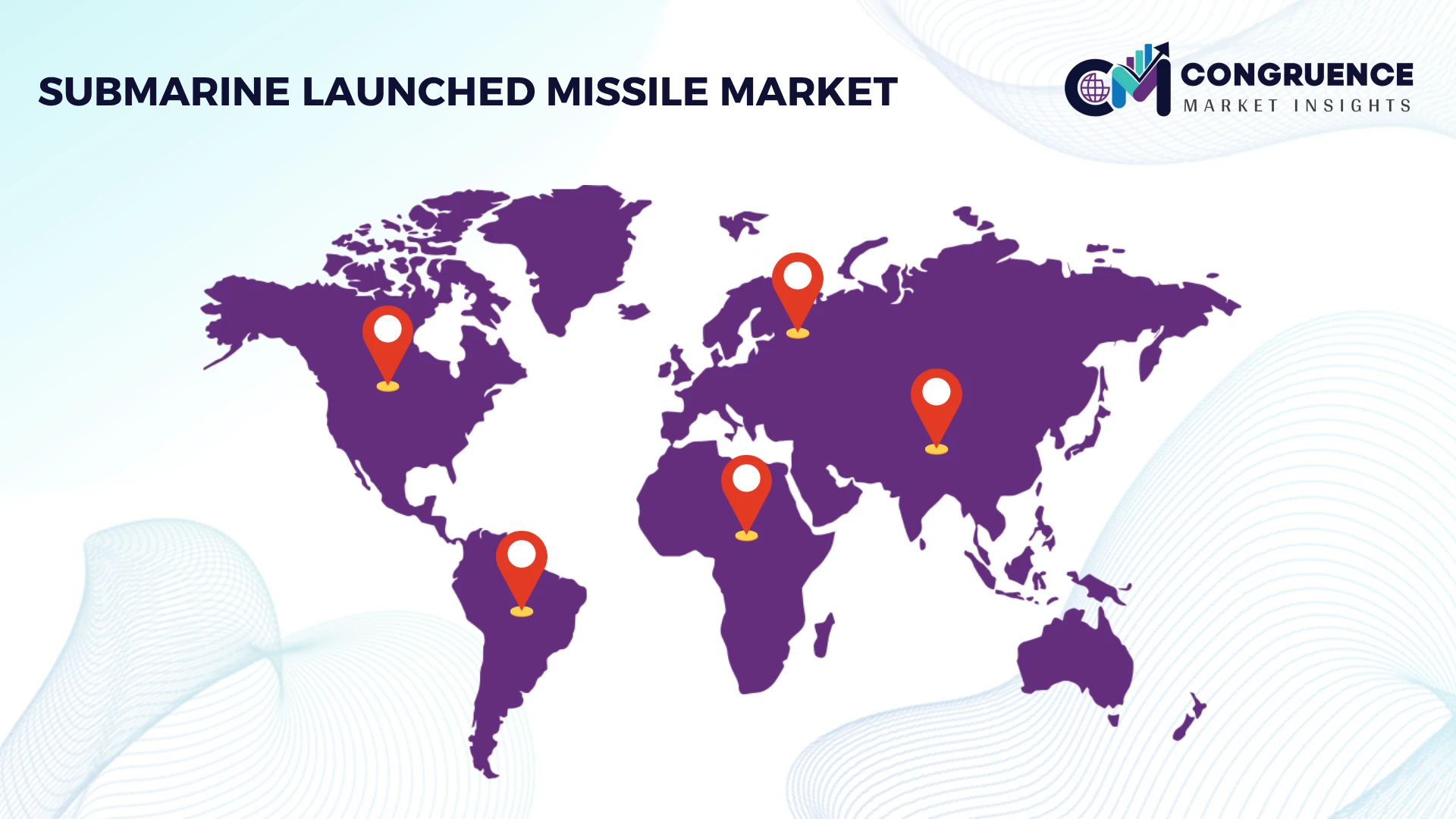
North America leads the Submarine-launched Missile Market due to extensive submarine fleets, advanced defense infrastructure, and continuous modernization programs. The region contributes approximately 38% of global demand, supported by the United States Navy’s strategic submarine programs and domestic missile production capabilities. More than 60% of regional procurement activity is concentrated in the United States, where advanced missile testing, nuclear submarine upgrades, and defense manufacturing ecosystems remain highly developed. The Columbia-class submarine program and Trident missile modernization initiatives are accelerating technology integration. Defense companies are expanding production capacity, strengthening supplier networks, and investing in digital engineering platforms to improve reliability and reduce development cycles.
United States Market Outlook: The United States represents the largest country-level market due to its extensive naval infrastructure, defense spending capacity, and strategic submarine fleet operations. The U.S. Navy operates more than 60 submarines capable of supporting advanced underwater weapon systems. Continuous investments in missile modernization, secure communication systems, and domestic defense manufacturing are strengthening the country’s technological advantage.
Europe is experiencing steady market development through submarine modernization programs, NATO cooperation, and increased focus on maritime security capabilities. The region accounts for approximately 25% of global demand, with major contributions from France, the United Kingdom, and Germany. European naval forces are upgrading submarine platforms with advanced missile systems, improved communication networks, and integrated defense technologies. Joint defense initiatives have increased collaboration between manufacturers and governments, with multinational programs improving technology sharing by nearly 20%. Companies are strengthening partnerships, expanding specialized manufacturing capabilities, and improving supply-chain resilience to address evolving defense requirements.
France Market Outlook: France remains a strategically important European market due to its independent submarine technology capabilities and advanced naval defense industry. The country operates nuclear-powered submarines equipped with strategic missile systems and maintains strong domestic production capabilities. French defense companies are investing in propulsion, guidance, and underwater combat technologies to support long-term operational readiness.
Asia-Pacific is the fastest-expanding market due to submarine fleet expansion, maritime security priorities, and increasing domestic defense manufacturing. The region represents approximately 22% of global demand, with China, India, Japan, and Australia driving procurement activity. China has expanded naval shipbuilding capacity by more than 20% through domestic production programs, while India is increasing submarine modernization efforts through indigenous defense initiatives. The AUKUS partnership is also accelerating advanced naval technology collaboration and supply-chain development. Companies are increasing regional partnerships, establishing local production facilities, and investing in advanced missile integration systems to meet rising operational requirements.
China Market Outlook: China holds a leading position in Asia-Pacific due to large-scale naval modernization, domestic missile development capabilities, and expanding submarine production infrastructure. The country has increased investment in indigenous defense technologies and strengthened naval manufacturing capacity. Chinese defense enterprises are focusing on advanced guidance systems, propulsion improvements, and integrated submarine warfare capabilities.
South America represents a developing market supported by maritime security requirements, submarine fleet maintenance, and selective naval modernization programs. The region contributes approximately 5% of global demand, with Brazil and Chile representing the primary defense markets. Brazil’s submarine development initiatives and naval industrial expansion are supporting regional capability improvements. Limited defense budgets and infrastructure constraints influence procurement cycles, with modernization programs focused mainly on fleet upgrades rather than large-scale expansion. Companies are responding through maintenance partnerships, technology transfer agreements, and customized solutions designed for regional operational needs.
Brazil Market Outlook: Brazil is the largest submarine defense market in South America due to its naval modernization programs and domestic shipbuilding capabilities. The country’s submarine industrial base supports approximately 40% of regional underwater defense activity. Investments in naval infrastructure, local manufacturing partnerships, and advanced submarine technologies are strengthening Brazil’s strategic maritime position.
The Middle East & Africa market is developing through maritime security investments, naval modernization programs, and defense infrastructure expansion. The region contributes approximately 10% of global demand, with Israel, Saudi Arabia, and selected African naval forces driving capability improvements. Growing focus on secure maritime borders and advanced defense systems is increasing demand for submarine technologies and associated weapon platforms. Defense partnerships and international procurement agreements are supporting technology adoption, while infrastructure development remains a key requirement. Companies are expanding service networks, forming regional partnerships, and providing integrated defense solutions to address operational needs.
Israel Market Outlook: Israel is a strategically significant market due to its advanced naval technology capabilities, defense innovation ecosystem, and focus on precision-guided systems. The country invests heavily in maritime surveillance, submarine operations, and secure defense technologies. Israeli defense companies continue developing advanced electronics, communication systems, and operational solutions that strengthen regional naval capabilities.
The Submarine-launched Missile Market features competition between global defense OEMs, strategic missile manufacturers, and specialized technology suppliers. Major players such as Lockheed Martin, RTX, BAE Systems, General Dynamics, Northrop Grumman, and MBDA compete through advanced missile systems, integration capabilities, and secure supply chains. The top five companies collectively account for approximately 65% of market activity, reflecting a moderately consolidated structure. Competition is based on technology superiority, production reliability, customization, and lifecycle support, with advanced guidance systems improving operational accuracy by nearly 20% and digital engineering reducing development timelines by around 15%. Leading companies are expanding through government partnerships, indigenous manufacturing programs, and vertical integration of propulsion and electronics capabilities. The competitive landscape is shifting toward hypersonic systems, autonomous technologies, and supply-chain control. High capital requirements, classified technology access, and defense certifications remain major entry barriers. Winning requires technological leadership, resilient manufacturing, and long-term defense ecosystem partnerships.
RTX Corporation
BAE Systems plc
General Dynamics Corporation
Northrop Grumman Corporation
MBDA Inc.
Naval Group
Saab AB
Mitsubishi Heavy Industries Ltd.
L3Harris Technologies Inc.
Leonardo S.p.A.
Bharat Dynamics Limited
Advanced guidance systems, artificial intelligence, and digital engineering platforms are reshaping submarine-launched missile capabilities. AI-supported targeting systems improve decision speed by approximately 20%, while automated mission planning reduces operator workload by nearly 15%. Defense organizations are increasingly integrating machine learning, secure communication networks, and real-time battlefield data exchange to improve underwater strike effectiveness.
Hypersonic propulsion and advanced composite materials represent disruptive technology shifts, providing higher speed, maneuverability, and survivability compared with traditional missile systems. New-generation hypersonic designs improve response capability by more than 30% over legacy systems, while lightweight materials reduce structural weight by around 10%. The United States, China, and Russia are leading investments in these technologies, creating competitive advantages for advanced defense manufacturers.
From 2026 to 2028, digital twins, autonomous testing, and modular missile architectures will accelerate development cycles and improve production efficiency. Companies adopting these technologies gain advantages through faster upgrades, reduced testing costs, and improved customization. The competitive focus is moving from standalone missiles toward integrated underwater warfare ecosystems combining sensors, software, communication systems, and precision strike technologies.
January 2025 Lockheed Martin received a USD 383 million U.S. Navy contract modification for the Trident II D5 Life Extension 2 program, including a new Florida production facility and approximately 300 additional jobs. The expansion strengthens sea-based deterrence capability and supports long-term missile modernization. Source: www.news.lockheedmartin.com
April 2025 BAE Systems secured a USD 70 million contract from General Dynamics Electric Boat to manufacture Virginia Payload Module missile tubes for Block VI Virginia-class submarines. The program expands submarine firepower capacity and strengthens U.S. naval industrial supply chains. Source: www.baesystems.com
March 2025 General Dynamics Electric Boat received a USD 1 billion contract modification for long-lead materials supporting Virginia-class submarine production. The investment enhances supplier capacity and accelerates submarine manufacturing readiness across the U.S. defense ecosystem. Source: www.investorrelations.gd.com
June 2025 RTX’s Raytheon received a USD 250 million contract from Mitsubishi Electric Corporation for licensed ESSM Block 2 production, expanding international missile manufacturing collaboration. The agreement strengthens allied supply networks and increases localized production capability in Japan.
The Submarine-launched Missile Market Report covers comprehensive analysis across missile types, including ballistic missiles, cruise missiles, and emerging hypersonic systems, along with applications such as strategic deterrence, tactical operations, and anti-surface warfare. The report evaluates end-users including naval forces, defense agencies, and submarine fleet operators across North America, Europe, Asia-Pacific, South America, and Middle East & Africa.
The study examines advanced technologies, deployment trends, manufacturing capabilities, competitive strategies, and supply-chain developments influencing market direction. Coverage includes established defense manufacturers, technology innovators, and emerging suppliers participating in submarine warfare ecosystems. The report supports investment planning, partnership decisions, expansion strategies, and competitive positioning by analyzing adoption patterns, modernization priorities, and future technology shifts expected to shape the market between 2026 and 2033.
| Report Attribute / Metric | Details |
|---|---|
| Market Revenue (2025) | USD 817.0 Million |
| Market Revenue (2033) | USD 1,387.1 Million |
| CAGR (2026–2033) | 6.84% |
| Base Year | 2025 |
| Forecast Period | 2026–2033 |
| Historic Period | 2021–2025 |
| Segments Covered |
By Type
By Application
By End-User
|
| Key Deliverables | Revenue Forecast; Market Trends; Growth Drivers & Restraints; Technology Insights; Segmentation Analysis; Regional Insights; Competitive Landscape; Regulatory & ESG Overview; Recent Developments |
| Regions Covered | North America; Europe; Asia-Pacific; South America; Middle East & Africa |
| Companies Profiled | Lockheed Martin Corporation; RTX Corporation; BAE Systems plc; General Dynamics Corporation; Northrop Grumman Corporation; MBDA Inc.; Naval Group; Saab AB; Mitsubishi Heavy Industries Ltd.; L3Harris Technologies Inc.; Leonardo S.p.A.; Bharat Dynamics Limited |
| Customization & Pricing | Available on Request (10% Customization Free) |




